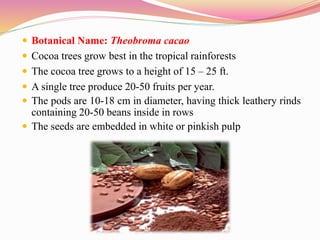
 Botanical Name: Theobroma cacao
 Cocoa trees grow best in the tropical rainforests
 The cocoa tree grows to a height of 15 – 25 ft.
 A single tree produce 20-50 fruits per year.
 The pods are 10-18 cm in diameter, having thick leathery rinds
containing 20-50 beans inside in rows
 The seeds are embedded in white or pinkish pulp
Varieties of cocoa trees
 There are three broad types of cocoa - Forastero and Criollo, as well as
Trinitario, a hybrid of the two.
 Forastero
Forastero is hardy and vigorous, producing beans with the strongest
flavour.
 Criollo
With its mild or weak chocolate flavour, Criollo trees are not hardy
and produce softer red pods, containing 20-30 white, ivory or very pale
purple beans.
 Trinitario
Plants are not found in the wild as they are cultivated hybrids of the other
two types.
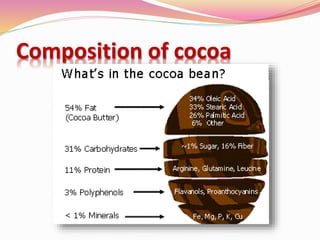
Composition of cocoa
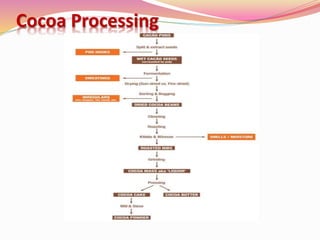
Cocoa Processing
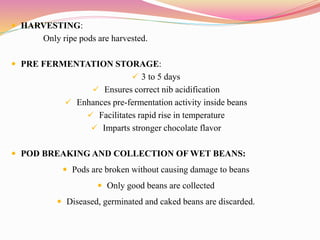
 HARVESTING:
Only ripe pods are harvested.
 PRE FERMENTATION STORAGE:
 3 to 5 days
 Ensures correct nib acidification
 Enhances pre-fermentation activity inside beans
 Facilitates rapid rise in temperature
 Imparts stronger chocolate flavor
 POD BREAKING AND COLLECTION OF WET BEANS:
 Pods are broken without causing damage to beans
 Only good beans are collected
 Diseased, germinated and caked beans are discarded.
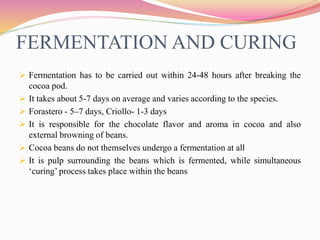
FERMENTATION AND CURING
 Fermentation has to be carried out within 24-48 hours after breaking the
cocoa pod.
 It takes about 5-7 days on average and varies according to the species.
 Forastero - 5–7 days, Criollo- 1-3 days
 It is responsible for the chocolate flavor and aroma in cocoa and also
external browning of beans.
 Cocoa beans do not themselves undergo a fermentation at all
 It is pulp surrounding the beans which is fermented, while simultaneous
‘curing’ process takes place within the beans
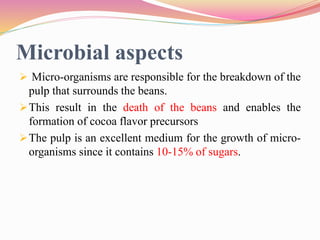
Microbial aspects
 Micro-organisms are responsible for the breakdown of the
pulp that surrounds the beans.
This result in the death of the beans and enables the
formation of cocoa flavor precursors
The pulp is an excellent medium for the growth of micro-
organisms since it contains 10-15% of sugars.
Stages of Fermentation
Stage 1
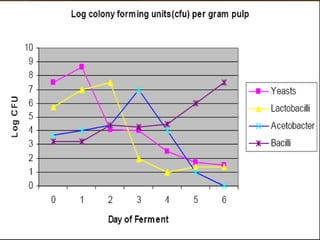
Anaerobic yeasts
 Sugar  Alcohol + CO₂
 24-48 hrs (no air circulation)
 Rise in temperature
 pH < 4 acidic
 Low oxygen
 Bean death on second day occurs due to acetic acid and
alcohol penetration inside the bean.
Stage 2:
Lactic acid bacteria
Sugar & organic acids  Lactic acid
LAB are present from start but only
become dominant in 48-96 hrs
Stage 3:
Acetic acid bacteria
Also present from start but
become significant at the end
when the aeration increases
Alcohol  acetic acid
Exothermic reaction
Increases temperature to 50˚C
Factors influencing Fermentation
 Pod maturity
 Pod storage
 Quantity of beans
 Quantity of pulp
 Type of cocoa
 Duration
 Seasonal effects
 Pod diseases
End point of fermentation
 Bean color changes to brown, becomes plump and filled
with a reddish brown exudate
 Testa becomes loose and detached from the cotyledons
 Longitudinal halves of cotyledons show bleached
appearance in the centre with a brownish ring at the
periphery
 When 50 % of beans show these signs, the lot can be
taken out for drying
Curing
High temperature and influx of acid:
 Kill the bean
 Disrupt the internal structure
Cocoa beans are composed of white cells (fats, proteins)
and purple cells (polyphenols)
Due to the disruption compounds in the beans mix and
interact within themselves.
Reactions between storage proteins, enzymes (proteolytic,
polyphenol oxidase, invertase) and polyphenols result in
formation of the crucial chocolate flavor precursors
Chocolate flavor precursors
 Proteins are degraded by enzymes to polypeptides and
amino acids
 Reducing sugars (glucose/ fructose) are released.
Reduction of astringent and bitter taste
 Part of polyphenols oxidized into large tannin molecules
 Part of polyphenols and theobromine/caffeine (20%)
diffused and exudated from the bean
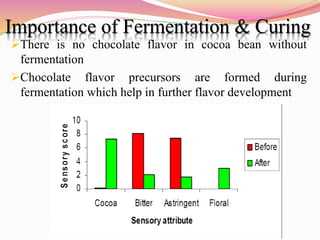
Importance of Fermentation & Curing
There is no chocolate flavor in cocoa bean without
fermentation
Chocolate flavor precursors are formed during
fermentation which help in further flavor development
DRYING:
 Extended process of fermentation
 Slow but progressive loss of moisture
 Loss of astringency & bitter taste
 Loosening of the shell from the bean
 Moisture content reduced to 6%
ROASTING:
 Dried beans are roasted at 200˚F to 250˚F for 1-2 hours in
order to develop the flavor of the beans.
 The beans become brown in color and friable (brittle).
GRINDING :
 The heat produced during grinding causes cocoa fat to
melt and the melted fat carries with it, in suspension,
finely ground particles of cocoa. This is known as
‘Cocoa mass’, ‘Chocolate liquor’ or ‘Bitter chocolate’
 This mass solidifies at about 30˚C
PRESSING OF NIBS
 Filter-pressing to separate out a major part of fat (cocoa
butter)
 The amount of fat left in the pressed cake can be varied
by the conditions of pressing
 The pressed cake is used for producing cocoa powder
COCOA PRODUCTS
 Cocoa butter also called theobroma oil, is a pale-yellow,
pure, edible vegetable fat.
 Cocoa powder
 End product of cocoa solids which are low-fat components and
are rich in flavonoids
 Chocolate
 A food preparation in the form of a paste or solid block made
from roasted and ground cacao seeds, typically sweetened.
Researches....
 Improvement of Cocoa Beans Fermentation by LAB Starter
Addition - M. T. A. Penia Kresnowati, Lenny Suryani, and
Mirra Affifah
Addition of microbial starter was thus suggested to improve the cocoa
bean fermentation process. The addition of LAB starter was observed to
accelerate the growth of both lactic acid bacteria and acetic acid bacteria,
leading to the increase in the ethanol, lactic acid, and acetic acid
concentration. Overall it increases the fermentation index and potentially
shortens the fermentation time.
 Dynamics of Cocoa Bean Pulp Degradation during Cocoa
Bean Fermentation: Effects of Yeast Starter Culture
Addition - Laras Cempaka1, Lienda Aliwarga1, Susanto
Purwo & Made Tri Ari Penia Kresnowati
This article discusses the effects of the addition of
Saccharomyces cerevisae var. Chevalieri starter culture on cocoa bean
fermentation. The dynamics in the yeast concentration, sugary pulp
compounds and metabolic products were measured during fermentation. A
higher fermentation index was measured for the cocoa bean fermentation
with yeast starter culture, 1.13 compared to 0.84. In conclusion, this
method can potentially be applied to shorten the cocoa bean fermentation
time
Reference...
 The Functional Role of Microorganisms in Cocoa Bean
Fermentation V. Thi Thuy Ho, J. Zhao, G. Srzednicki and
G. Fleet
 www.c-spot.com - chocolate flavor profiles
 Harvesting and Processing Cocoa Beans
 'Theobroma Cacao' – The Cocoa Tree
 Cocoa – production and processing -Kokou Edoh Adabe
& E. Lionelle Ngo-Samnick

Processing of cocoa

  • 2.
     Botanical Name:Theobroma cacao  Cocoa trees grow best in the tropical rainforests  The cocoa tree grows to a height of 15 – 25 ft.  A single tree produce 20-50 fruits per year.  The pods are 10-18 cm in diameter, having thick leathery rinds containing 20-50 beans inside in rows  The seeds are embedded in white or pinkish pulp
  • 3.
    Varieties of cocoatrees  There are three broad types of cocoa - Forastero and Criollo, as well as Trinitario, a hybrid of the two.  Forastero Forastero is hardy and vigorous, producing beans with the strongest flavour.  Criollo With its mild or weak chocolate flavour, Criollo trees are not hardy and produce softer red pods, containing 20-30 white, ivory or very pale purple beans.  Trinitario Plants are not found in the wild as they are cultivated hybrids of the other two types.
  • 4.
  • 5.
  • 6.
     HARVESTING: Only ripepods are harvested.  PRE FERMENTATION STORAGE:  3 to 5 days  Ensures correct nib acidification  Enhances pre-fermentation activity inside beans  Facilitates rapid rise in temperature  Imparts stronger chocolate flavor  POD BREAKING AND COLLECTION OF WET BEANS:  Pods are broken without causing damage to beans  Only good beans are collected  Diseased, germinated and caked beans are discarded.
  • 7.
    FERMENTATION AND CURING Fermentation has to be carried out within 24-48 hours after breaking the cocoa pod.  It takes about 5-7 days on average and varies according to the species.  Forastero - 5–7 days, Criollo- 1-3 days  It is responsible for the chocolate flavor and aroma in cocoa and also external browning of beans.  Cocoa beans do not themselves undergo a fermentation at all  It is pulp surrounding the beans which is fermented, while simultaneous ‘curing’ process takes place within the beans
  • 8.
    Microbial aspects  Micro-organismsare responsible for the breakdown of the pulp that surrounds the beans. This result in the death of the beans and enables the formation of cocoa flavor precursors The pulp is an excellent medium for the growth of micro- organisms since it contains 10-15% of sugars.
  • 9.
    Stages of Fermentation Stage1 Anaerobic yeasts  Sugar  Alcohol + CO₂  24-48 hrs (no air circulation)  Rise in temperature  pH < 4 acidic  Low oxygen  Bean death on second day occurs due to acetic acid and alcohol penetration inside the bean.
  • 10.
    Stage 2: Lactic acidbacteria Sugar & organic acids  Lactic acid LAB are present from start but only become dominant in 48-96 hrs Stage 3: Acetic acid bacteria Also present from start but become significant at the end when the aeration increases Alcohol  acetic acid Exothermic reaction Increases temperature to 50˚C
  • 12.
    Factors influencing Fermentation Pod maturity  Pod storage  Quantity of beans  Quantity of pulp  Type of cocoa  Duration  Seasonal effects  Pod diseases
  • 13.
    End point offermentation  Bean color changes to brown, becomes plump and filled with a reddish brown exudate  Testa becomes loose and detached from the cotyledons  Longitudinal halves of cotyledons show bleached appearance in the centre with a brownish ring at the periphery  When 50 % of beans show these signs, the lot can be taken out for drying
  • 14.
    Curing High temperature andinflux of acid:  Kill the bean  Disrupt the internal structure Cocoa beans are composed of white cells (fats, proteins) and purple cells (polyphenols) Due to the disruption compounds in the beans mix and interact within themselves. Reactions between storage proteins, enzymes (proteolytic, polyphenol oxidase, invertase) and polyphenols result in formation of the crucial chocolate flavor precursors
  • 15.
    Chocolate flavor precursors Proteins are degraded by enzymes to polypeptides and amino acids  Reducing sugars (glucose/ fructose) are released. Reduction of astringent and bitter taste  Part of polyphenols oxidized into large tannin molecules  Part of polyphenols and theobromine/caffeine (20%) diffused and exudated from the bean
  • 16.
    Importance of Fermentation& Curing There is no chocolate flavor in cocoa bean without fermentation Chocolate flavor precursors are formed during fermentation which help in further flavor development
  • 17.
    DRYING:  Extended processof fermentation  Slow but progressive loss of moisture  Loss of astringency & bitter taste  Loosening of the shell from the bean  Moisture content reduced to 6% ROASTING:  Dried beans are roasted at 200˚F to 250˚F for 1-2 hours in order to develop the flavor of the beans.  The beans become brown in color and friable (brittle).
  • 18.
    GRINDING :  Theheat produced during grinding causes cocoa fat to melt and the melted fat carries with it, in suspension, finely ground particles of cocoa. This is known as ‘Cocoa mass’, ‘Chocolate liquor’ or ‘Bitter chocolate’  This mass solidifies at about 30˚C PRESSING OF NIBS  Filter-pressing to separate out a major part of fat (cocoa butter)  The amount of fat left in the pressed cake can be varied by the conditions of pressing  The pressed cake is used for producing cocoa powder
  • 19.
    COCOA PRODUCTS  Cocoabutter also called theobroma oil, is a pale-yellow, pure, edible vegetable fat.  Cocoa powder  End product of cocoa solids which are low-fat components and are rich in flavonoids  Chocolate  A food preparation in the form of a paste or solid block made from roasted and ground cacao seeds, typically sweetened.
  • 20.
    Researches....  Improvement ofCocoa Beans Fermentation by LAB Starter Addition - M. T. A. Penia Kresnowati, Lenny Suryani, and Mirra Affifah Addition of microbial starter was thus suggested to improve the cocoa bean fermentation process. The addition of LAB starter was observed to accelerate the growth of both lactic acid bacteria and acetic acid bacteria, leading to the increase in the ethanol, lactic acid, and acetic acid concentration. Overall it increases the fermentation index and potentially shortens the fermentation time.
  • 21.
     Dynamics ofCocoa Bean Pulp Degradation during Cocoa Bean Fermentation: Effects of Yeast Starter Culture Addition - Laras Cempaka1, Lienda Aliwarga1, Susanto Purwo & Made Tri Ari Penia Kresnowati This article discusses the effects of the addition of Saccharomyces cerevisae var. Chevalieri starter culture on cocoa bean fermentation. The dynamics in the yeast concentration, sugary pulp compounds and metabolic products were measured during fermentation. A higher fermentation index was measured for the cocoa bean fermentation with yeast starter culture, 1.13 compared to 0.84. In conclusion, this method can potentially be applied to shorten the cocoa bean fermentation time
  • 22.
    Reference...  The FunctionalRole of Microorganisms in Cocoa Bean Fermentation V. Thi Thuy Ho, J. Zhao, G. Srzednicki and G. Fleet  www.c-spot.com - chocolate flavor profiles  Harvesting and Processing Cocoa Beans  'Theobroma Cacao' – The Cocoa Tree  Cocoa – production and processing -Kokou Edoh Adabe & E. Lionelle Ngo-Samnick