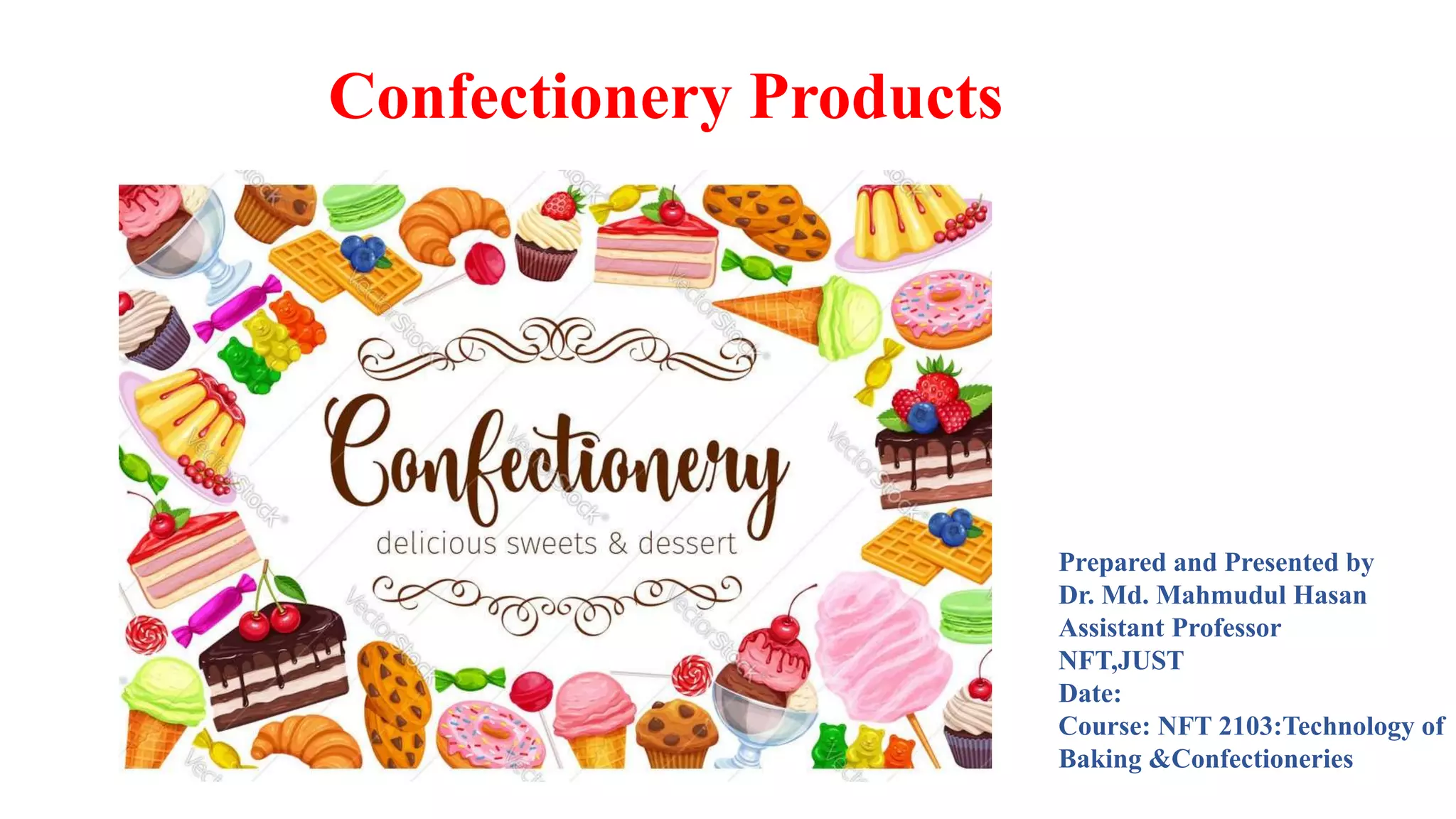
Confectionery Products
Prepared and Presented by
Dr. Md. Mahmudul Hasan
Assistant Professor
NFT,JUST
Date:
Course: NFT 2103:Technology of
Baking &Confectioneries
What is Confectionary
• Confectionery, also called sweets or candy
is sweet food.
• confectionery is divided into two broad
categories, bakers' confections and sugar
confections.
• Bakers' confectionery, also called flour
confections, includes principally sweet
pastries, cakes, and similar baked goods.
Continue..
• Sugar confectionery comprises many
different products, such as
• sweets (hard and soft toffees),
• compressed confections (sweets in tablet
form) and lozenges,
• coated sweets,
• liquor ice goods,
• candied fruits, jelly products and fruit
pastes, nut crunch, chewing gum, sherbets
and drink powders, French nougat, truffles,
and sugar-free confectionery.
Classification of Confectionery
• Sugar confectionery
• Chocolate confectionery
• Flour confectionery
• Milk-based confectionery
Sugar Confectionery
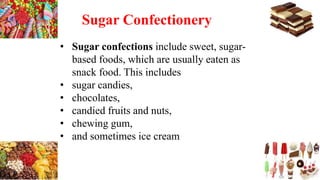
• Sugar confections include sweet, sugar-
based foods, which are usually eaten as
snack food. This includes
• sugar candies,
• chocolates,
• candied fruits and nuts,
• chewing gum,
• and sometimes ice cream
Ingredients of Sugar based Confectionery
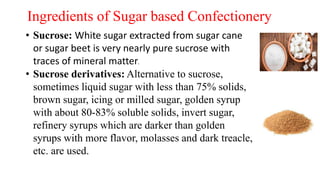
• Sucrose: White sugar extracted from sugar cane
or sugar beet is very nearly pure sucrose with
traces of mineral matter.
• Sucrose derivatives: Alternative to sucrose,
sometimes liquid sugar with less than 75% solids,
brown sugar, icing or milled sugar, golden syrup
with about 80-83% soluble solids, invert sugar,
refinery syrups which are darker than golden
syrups with more flavor, molasses and dark treacle,
etc. are used.
Continue..
• Glucose syrups: Glucose syrup is occasionally
called as confectioners' glucose. It contain a
number of different sugars all built up from
dextrose units, with dextrose and maltose
predominating.
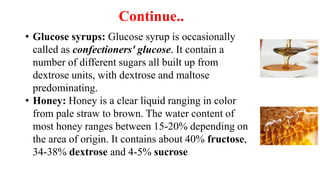
• Honey: Honey is a clear liquid ranging in color
from pale straw to brown. The water content of
most honey ranges between 15-20% depending on
the area of origin. It contains about 40% fructose,
34-38% dextrose and 4-5% sucrose
Continue..
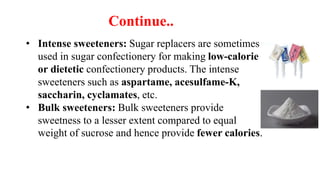
• Intense sweeteners: Sugar replacers are sometimes
used in sugar confectionery for making low-calorie
or dietetic confectionery products. The intense
sweeteners such as aspartame, acesulfame-K,
saccharin, cyclamates, etc.
• Bulk sweeteners: Bulk sweeteners provide
sweetness to a lesser extent compared to equal
weight of sucrose and hence provide fewer calories.
Continue..
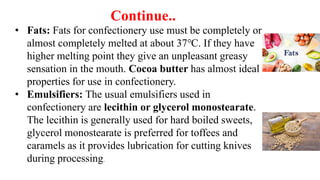
• Fats: Fats for confectionery use must be completely or
almost completely melted at about 37℃. If they have
higher melting point they give an unpleasant greasy
sensation in the mouth. Cocoa butter has almost ideal
properties for use in confectionery.
• Emulsifiers: The usual emulsifiers used in
confectionery are lecithin or glycerol monostearate.
The lecithin is generally used for hard boiled sweets,
glycerol monostearate is preferred for toffees and
caramels as it provides lubrication for cutting knives
during processing.
Continue..
• Milk products: Milk products such as spray dried milk
powder, sweetened condensed milk, sweetened
condensed skimmed milk, whey powder, sweetened
condensed whey, etc. are used for their nutritive value,
flavor and sometimes color generated due
to Maillard browning and caramelization.
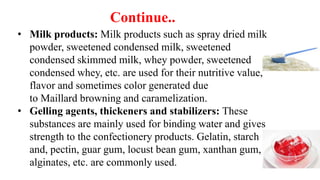
• Gelling agents, thickeners and stabilizers: These
substances are mainly used for binding water and gives
strength to the confectionery products. Gelatin, starch
and, pectin, guar gum, locust bean gum, xanthan gum,
alginates, etc. are commonly used.
• Colours: Many foods in the natural state are colored and in
many cases the color influences the consumer’s perception of
flavor. Most confectionery products are not naturally colored so
colors are added to assist in flavor perception and to provide a
means of differentiation between sweets in an assortment of
flavors. Natural colors such as caramel and permitted artificial
colors are commonly used in confectionery.
• Flavors: Natural flavors, essential oils, and artificial flavors are
used in confectionery applications. All flavors are to a greater or
lesser extent volatile and in confectionery applications they are
often added at high temperatures.
Continue..

Confectionery Products.pptx

  • 1.
    Confectionery Products Prepared andPresented by Dr. Md. Mahmudul Hasan Assistant Professor NFT,JUST Date: Course: NFT 2103:Technology of Baking &Confectioneries
  • 2.
    What is Confectionary •Confectionery, also called sweets or candy is sweet food. • confectionery is divided into two broad categories, bakers' confections and sugar confections. • Bakers' confectionery, also called flour confections, includes principally sweet pastries, cakes, and similar baked goods.
  • 3.
    Continue.. • Sugar confectionerycomprises many different products, such as • sweets (hard and soft toffees), • compressed confections (sweets in tablet form) and lozenges, • coated sweets, • liquor ice goods, • candied fruits, jelly products and fruit pastes, nut crunch, chewing gum, sherbets and drink powders, French nougat, truffles, and sugar-free confectionery.
  • 4.
    Classification of Confectionery •Sugar confectionery • Chocolate confectionery • Flour confectionery • Milk-based confectionery
  • 5.
    Sugar Confectionery • Sugarconfections include sweet, sugar- based foods, which are usually eaten as snack food. This includes • sugar candies, • chocolates, • candied fruits and nuts, • chewing gum, • and sometimes ice cream
  • 6.
    Ingredients of Sugarbased Confectionery • Sucrose: White sugar extracted from sugar cane or sugar beet is very nearly pure sucrose with traces of mineral matter. • Sucrose derivatives: Alternative to sucrose, sometimes liquid sugar with less than 75% solids, brown sugar, icing or milled sugar, golden syrup with about 80-83% soluble solids, invert sugar, refinery syrups which are darker than golden syrups with more flavor, molasses and dark treacle, etc. are used.
  • 7.
    Continue.. • Glucose syrups:Glucose syrup is occasionally called as confectioners' glucose. It contain a number of different sugars all built up from dextrose units, with dextrose and maltose predominating. • Honey: Honey is a clear liquid ranging in color from pale straw to brown. The water content of most honey ranges between 15-20% depending on the area of origin. It contains about 40% fructose, 34-38% dextrose and 4-5% sucrose
  • 8.
    Continue.. • Intense sweeteners:Sugar replacers are sometimes used in sugar confectionery for making low-calorie or dietetic confectionery products. The intense sweeteners such as aspartame, acesulfame-K, saccharin, cyclamates, etc. • Bulk sweeteners: Bulk sweeteners provide sweetness to a lesser extent compared to equal weight of sucrose and hence provide fewer calories.
  • 9.
    Continue.. • Fats: Fatsfor confectionery use must be completely or almost completely melted at about 37℃. If they have higher melting point they give an unpleasant greasy sensation in the mouth. Cocoa butter has almost ideal properties for use in confectionery. • Emulsifiers: The usual emulsifiers used in confectionery are lecithin or glycerol monostearate. The lecithin is generally used for hard boiled sweets, glycerol monostearate is preferred for toffees and caramels as it provides lubrication for cutting knives during processing.
  • 10.
    Continue.. • Milk products:Milk products such as spray dried milk powder, sweetened condensed milk, sweetened condensed skimmed milk, whey powder, sweetened condensed whey, etc. are used for their nutritive value, flavor and sometimes color generated due to Maillard browning and caramelization. • Gelling agents, thickeners and stabilizers: These substances are mainly used for binding water and gives strength to the confectionery products. Gelatin, starch and, pectin, guar gum, locust bean gum, xanthan gum, alginates, etc. are commonly used.
  • 11.
    • Colours: Manyfoods in the natural state are colored and in many cases the color influences the consumer’s perception of flavor. Most confectionery products are not naturally colored so colors are added to assist in flavor perception and to provide a means of differentiation between sweets in an assortment of flavors. Natural colors such as caramel and permitted artificial colors are commonly used in confectionery. • Flavors: Natural flavors, essential oils, and artificial flavors are used in confectionery applications. All flavors are to a greater or lesser extent volatile and in confectionery applications they are often added at high temperatures. Continue..