Classification of Cancer
Mohammed Fathy Bayomy, MSc, MD
Lecturer
Clinical Oncology & Nuclear Medicine
Faculty of Medicine
Zagazig University
 Classes of cancer
1- Carcinomas
2- Neuroectodermal (NET) tumors
3- Sarcomas
4- Hemolymphoid tumors
5- Germ cell tumors
6- Blastemal tumors
7- Embryonal Vestigal remnants tumors
8- Uncertain histogenesis tumors
9- Undifferentiated (unclassified) tumors
Carcinomas
 Definition: malignant tumors of epithelial origin
 Incidence: most common class of tumors (contributing about 80% of cases)
 Age: most common in middle and old age
 Growth rate: slow, hence, carcinomas are smaller in size than sarcomas
 Gross margin: irregular
 Histologically: composed of cohesive groups infiltrating distinct stroma, such
cohesive pattern was proved by EM to be due to presence of surface
attachment structures (desmosomes) & interdigitating cell membranes
 Spread
* Lymphatic spread: main & early route of spread
* Blood spread: late, commonly affecting liver, lungs, brain, bone
 Include
1) Squamous cell carcinoma
* Arises from skin, upper areodigestive tract, anal margin, vagina, uterus
* May arise in areas of squamous metaplasia such as lungs, urinary tract, gall
bladder
* L/M: cytoplasmic keratinization, nests in well-differentiated tumors
2) Transitional cell carcinoma
* Occur in urinary passages, nasal cavity, paranasal sinuses
* Tumor cells have undifferentiated cytoplasm
3) Adenocarcinomas
* Arises from columnar epithelium: surface epithelium (e.g. respiratory,
gastrointestinal) or from glands (e.g. liver, prostate)
* May arise on top of columnar epithelial metaplasia (urinary bladder,
esophagus)
* L/M: acinar or ductal formation, eccentric nuclei, clear cytoplasm, mucin
secretion; intracellular (signet-ring cells ) or extracellular
4) Choriocarcinoma
* Refers to fetal or gestational type which affects uterus
* L/M: biphasic structure with presence of both cyto & syncytial
trophoblastic epithelium
Sarcomas
 Definition: malignant tumors of mesenchymal origin
 Incidence: contributing about 8% of all malignant tumors
 Age: affect all ages, including children
 Rate of growth: rapid hence they present as bulky mass
 Gross: circumscribed tumors, with pseudocapsule of compressed normal tissue
 Histologically: sarcoma cells are scattered in distribution & indistinct from stroma due
to absence of desmosomes & cell membrane attachments
 Behavior
* Diversity of tumor subtypes (multiple cell differentiation, interconversion)
* Site specificity of bone tumors
 Spread: Sarcomas spread mainly by blood, lung being most common site of metastases
 Include: soft tissue & bone sarcomas
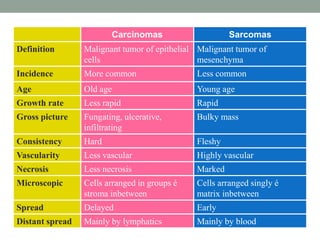
Carcinomas Sarcomas
Definition Malignant tumor of epithelial
cells
Malignant tumor of
mesenchyma
Incidence More common Less common
Age Old age Young age
Growth rate Less rapid Rapid
Gross picture Fungating, ulcerative,
infiltrating
Bulky mass
Consistency Hard Fleshy
Vascularity Less vascular Highly vascular
Necrosis Less necrosis Marked
Microscopic Cells arranged in groups é
stroma inbetween
Cells arranged singly é
matrix inbetween
Spread Delayed Early
Distant spread Mainly by lymphatics Mainly by blood
Neuroectodermal tumors
 Classified according to cell differentiation into three main groups:
1) Differentiated neuroectodermal tumors (DNET): malignant melanoma,
neurofibrosarcoma, gliomas, meningiomas
2) Neuroendocrine tumors (NET)
* Epithelial NET: carcinoid tumor, small cell undifferentiated carcinoma,
medullary carcinoma of thyroid, Merkel's cell carcinoma of skin
* Neural NET: neuroblastoma, pheochromocytoma, paragangliomas
3) Primitive neuroectodermal tumors (PNET)
* Central PNET: medulloblastoma, pineoblastoma, cerebral neuroblastoma,
olfactory neuroblastoma
* Peripheral PNET: affect bone or soft tissue (Ewing's/PNET)
Hemolymphoid Malignancies
 Include
1) Lymphoma
* Hodgkin’s lymphoma (HL)
* Non Hodgkin’s lymphoma (NHL)
2) Hematological malignancies
* Leukemias (ALL, CLL, AML, CML)
Germ Cell Tumors
 Arise in: abnormal or dysgenetic gonads
 Arise from: diploid germ cell prior to its reduction division
 Tumor types: according to different maturation pathways
1) reproduction of germ cells without differentiation
2) differentiation to primitive embryonic epithelium
3) differentiation to reproduce embryonic structures representative of 3 germ cell layers
4) differentiation to extraembryonic structures
 Include
1) Seminoma
2) Dysgermonoma
3) Embryonal carcinoma
4) Malignant teratoma
5) Yolk sac tumor
6) Choriocarcinoma
Tumors of Blastemal
 Consist of: cellular elements present in the particular location
 Age: some of these tumors are present at birth, most develop within 1st 5 years of life
 Histogenetically
* Clone of cells fail to mature during development & retains its undifferentiated
embryonic nature (blastemal cell rests)
* Tumors may be composed of one cell type (monophasic), or may be composed of
multiple cell types (biphasic, triphasic)
 Include
1) Nephroblastoma
2) Retinoblastoma
3) Neuroblastoma
4) Hepatoblastoma
5) Pancreaticoblastoma
Tumors of Vestigeal Remnants
 Origin: during embryonic development, certain structures are temporarily produced
which normally undergo atrophy. However, if parts of them remain, tumors may
develop from these remnants
 Include
1) Chordoma
2) Ameloblastoma
3) Branchiogenic carcinoma
4) Urachal carcinoma
5) Mesonephroma
6) Mullerian carcinosarcoma
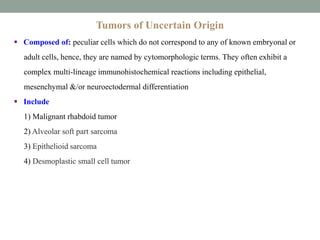
Tumors of Uncertain Origin
 Composed of: peculiar cells which do not correspond to any of known embryonal or
adult cells, hence, they are named by cytomorphologic terms. They often exhibit a
complex multi-lineage immunohistochemical reactions including epithelial,
mesenchymal &/or neuroectodermal differentiation
 Include
1) Malignant rhabdoid tumor
2) Alveolar soft part sarcoma
3) Epithelioid sarcoma
4) Desmoplastic small cell tumor
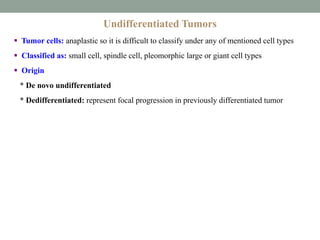
Undifferentiated Tumors
 Tumor cells: anaplastic so it is difficult to classify under any of mentioned cell types
 Classified as: small cell, spindle cell, pleomorphic large or giant cell types
 Origin
* De novo undifferentiated
* Dedifferentiated: represent focal progression in previously differentiated tumor

Classification of tumors

  • 1.
    Classification of Cancer MohammedFathy Bayomy, MSc, MD Lecturer Clinical Oncology & Nuclear Medicine Faculty of Medicine Zagazig University
  • 2.
     Classes ofcancer 1- Carcinomas 2- Neuroectodermal (NET) tumors 3- Sarcomas 4- Hemolymphoid tumors 5- Germ cell tumors 6- Blastemal tumors 7- Embryonal Vestigal remnants tumors 8- Uncertain histogenesis tumors 9- Undifferentiated (unclassified) tumors
  • 3.
    Carcinomas  Definition: malignanttumors of epithelial origin  Incidence: most common class of tumors (contributing about 80% of cases)  Age: most common in middle and old age  Growth rate: slow, hence, carcinomas are smaller in size than sarcomas  Gross margin: irregular  Histologically: composed of cohesive groups infiltrating distinct stroma, such cohesive pattern was proved by EM to be due to presence of surface attachment structures (desmosomes) & interdigitating cell membranes  Spread * Lymphatic spread: main & early route of spread * Blood spread: late, commonly affecting liver, lungs, brain, bone
  • 4.
     Include 1) Squamouscell carcinoma * Arises from skin, upper areodigestive tract, anal margin, vagina, uterus * May arise in areas of squamous metaplasia such as lungs, urinary tract, gall bladder * L/M: cytoplasmic keratinization, nests in well-differentiated tumors 2) Transitional cell carcinoma * Occur in urinary passages, nasal cavity, paranasal sinuses * Tumor cells have undifferentiated cytoplasm 3) Adenocarcinomas * Arises from columnar epithelium: surface epithelium (e.g. respiratory, gastrointestinal) or from glands (e.g. liver, prostate)
  • 5.
    * May ariseon top of columnar epithelial metaplasia (urinary bladder, esophagus) * L/M: acinar or ductal formation, eccentric nuclei, clear cytoplasm, mucin secretion; intracellular (signet-ring cells ) or extracellular 4) Choriocarcinoma * Refers to fetal or gestational type which affects uterus * L/M: biphasic structure with presence of both cyto & syncytial trophoblastic epithelium
  • 6.
    Sarcomas  Definition: malignanttumors of mesenchymal origin  Incidence: contributing about 8% of all malignant tumors  Age: affect all ages, including children  Rate of growth: rapid hence they present as bulky mass  Gross: circumscribed tumors, with pseudocapsule of compressed normal tissue  Histologically: sarcoma cells are scattered in distribution & indistinct from stroma due to absence of desmosomes & cell membrane attachments  Behavior * Diversity of tumor subtypes (multiple cell differentiation, interconversion) * Site specificity of bone tumors  Spread: Sarcomas spread mainly by blood, lung being most common site of metastases  Include: soft tissue & bone sarcomas
  • 7.
    Carcinomas Sarcomas Definition Malignanttumor of epithelial cells Malignant tumor of mesenchyma Incidence More common Less common Age Old age Young age Growth rate Less rapid Rapid Gross picture Fungating, ulcerative, infiltrating Bulky mass Consistency Hard Fleshy Vascularity Less vascular Highly vascular Necrosis Less necrosis Marked Microscopic Cells arranged in groups é stroma inbetween Cells arranged singly é matrix inbetween Spread Delayed Early Distant spread Mainly by lymphatics Mainly by blood
  • 8.
    Neuroectodermal tumors  Classifiedaccording to cell differentiation into three main groups: 1) Differentiated neuroectodermal tumors (DNET): malignant melanoma, neurofibrosarcoma, gliomas, meningiomas 2) Neuroendocrine tumors (NET) * Epithelial NET: carcinoid tumor, small cell undifferentiated carcinoma, medullary carcinoma of thyroid, Merkel's cell carcinoma of skin * Neural NET: neuroblastoma, pheochromocytoma, paragangliomas 3) Primitive neuroectodermal tumors (PNET) * Central PNET: medulloblastoma, pineoblastoma, cerebral neuroblastoma, olfactory neuroblastoma * Peripheral PNET: affect bone or soft tissue (Ewing's/PNET)
  • 9.
    Hemolymphoid Malignancies  Include 1)Lymphoma * Hodgkin’s lymphoma (HL) * Non Hodgkin’s lymphoma (NHL) 2) Hematological malignancies * Leukemias (ALL, CLL, AML, CML)
  • 10.
    Germ Cell Tumors Arise in: abnormal or dysgenetic gonads  Arise from: diploid germ cell prior to its reduction division  Tumor types: according to different maturation pathways 1) reproduction of germ cells without differentiation 2) differentiation to primitive embryonic epithelium 3) differentiation to reproduce embryonic structures representative of 3 germ cell layers 4) differentiation to extraembryonic structures  Include 1) Seminoma 2) Dysgermonoma 3) Embryonal carcinoma 4) Malignant teratoma 5) Yolk sac tumor 6) Choriocarcinoma
  • 11.
    Tumors of Blastemal Consist of: cellular elements present in the particular location  Age: some of these tumors are present at birth, most develop within 1st 5 years of life  Histogenetically * Clone of cells fail to mature during development & retains its undifferentiated embryonic nature (blastemal cell rests) * Tumors may be composed of one cell type (monophasic), or may be composed of multiple cell types (biphasic, triphasic)  Include 1) Nephroblastoma 2) Retinoblastoma 3) Neuroblastoma 4) Hepatoblastoma 5) Pancreaticoblastoma
  • 12.
    Tumors of VestigealRemnants  Origin: during embryonic development, certain structures are temporarily produced which normally undergo atrophy. However, if parts of them remain, tumors may develop from these remnants  Include 1) Chordoma 2) Ameloblastoma 3) Branchiogenic carcinoma 4) Urachal carcinoma 5) Mesonephroma 6) Mullerian carcinosarcoma
  • 13.
    Tumors of UncertainOrigin  Composed of: peculiar cells which do not correspond to any of known embryonal or adult cells, hence, they are named by cytomorphologic terms. They often exhibit a complex multi-lineage immunohistochemical reactions including epithelial, mesenchymal &/or neuroectodermal differentiation  Include 1) Malignant rhabdoid tumor 2) Alveolar soft part sarcoma 3) Epithelioid sarcoma 4) Desmoplastic small cell tumor
  • 14.
    Undifferentiated Tumors  Tumorcells: anaplastic so it is difficult to classify under any of mentioned cell types  Classified as: small cell, spindle cell, pleomorphic large or giant cell types  Origin * De novo undifferentiated * Dedifferentiated: represent focal progression in previously differentiated tumor