Cancer Chemotherapy
Presented By- Money Kalash
PharmD
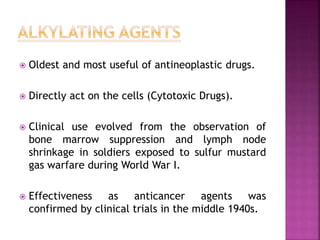
 Oldest and most useful of antineoplastic drugs.
 Directly act on the cells (Cytotoxic Drugs).
 Clinical use evolved from the observation of
bone marrow suppression and lymph node
shrinkage in soldiers exposed to sulfur mustard
gas warfare during World War I.
 Effectiveness as anticancer agents was
confirmed by clinical trials in the middle 1940s.
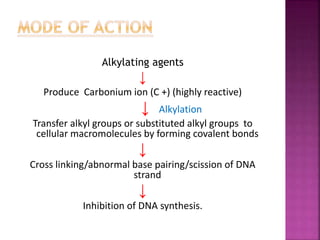
Alkylating agents
↓
Produce Carbonium ion (C +) (highly reactive)
↓ Alkylation
Transfer alkyl groups or substituted alkyl groups to
cellular macromolecules by forming covalent bonds
↓
Cross linking/abnormal base pairing/scission of DNA
strand
↓
Inhibition of DNA synthesis.
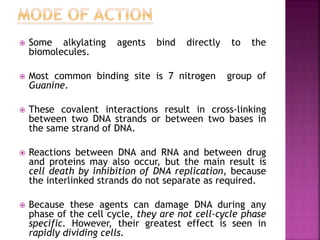
 Some alkylating agents bind directly to the
biomolecules.
 Most common binding site is 7 nitrogen group of
Guanine.
 These covalent interactions result in cross-linking
between two DNA strands or between two bases in
the same strand of DNA.
 Reactions between DNA and RNA and between drug
and proteins may also occur, but the main result is
cell death by inhibition of DNA replication, because
the interlinked strands do not separate as required.
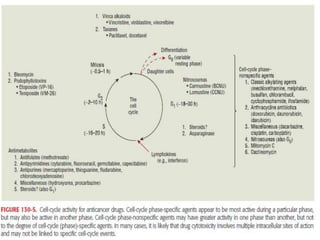
 Because these agents can damage DNA during any
phase of the cell cycle, they are not cell-cycle phase
specific. However, their greatest effect is seen in
rapidly dividing cells.
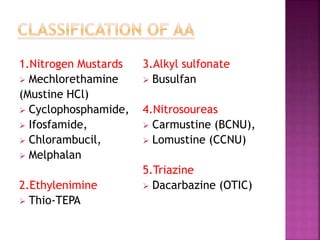
1.Nitrogen Mustards
 Mechlorethamine
(Mustine HCl)
 Cyclophosphamide,
 Ifosfamide,
 Chlorambucil,
 Melphalan
2.Ethylenimine
 Thio-TEPA
3.Alkyl sulfonate
 Busulfan
4.Nitrosoureas
 Carmustine (BCNU),
 Lomustine (CCNU)
5.Triazine
 Dacarbazine (OTIC)
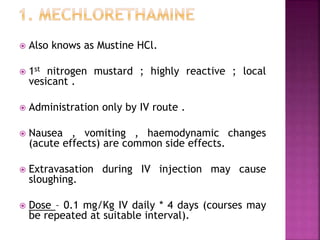
 Also knows as Mustine HCl.
 1st nitrogen mustard ; highly reactive ; local
vesicant .
 Administration only by IV route .
 Nausea , vomiting , haemodynamic changes
(acute effects) are common side effects.
 Extravasation during IV injection may cause
sloughing.
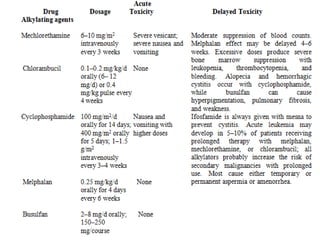
 Dose – 0.1 mg/Kg IV daily * 4 days (courses may
be repeated at suitable interval).
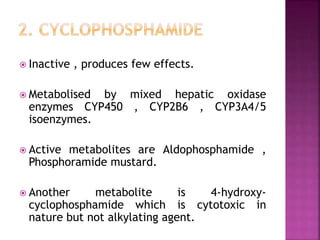
 Inactive , produces few effects.
 Metabolised by mixed hepatic oxidase
enzymes CYP450 , CYP2B6 , CYP3A4/5
isoenzymes.
 Active metabolites are Aldophosphamide ,
Phosphoramide mustard.
 Another metabolite is 4-hydroxy-
cyclophosphamide which is cytotoxic in
nature but not alkylating agent.
 Prominent Immunosuppressant property.
 Side effects –
 Thrombocytopenia (less prominent)
 Alopecia and Cystitis (due to another metabolite
Acrolein) are prominent.
 Vomiting
Note -Chloremphenicol decreases the metabolism
of cyclophosphamide.
Dose – 2-3 mg/Kg/day Oral ; 10-15 mg/Kg IV every
7-10 days.
 Inactive like Cyclophosphamide.
 Longer and dose dependent t 1/2 .
 Metabolism similar to Cyclophosphamide.
 Active metabolite is Ifosfamide mustard(in liver).
 Dose limiting toxicity – Haemorrhagic Cystitis.
 To prevent the same MESNA is routinely given with
it.
 Side effects – alopecia and vomiting.
 Very slow acting alkylating agent .
 Especially active on lymphoid tissue.
 Myeloid tissue largely spared.
 DOC for long term therapy for Chronic Lymphatic
Leukemia , Hodgkin’s Disease.
 Less Immunosuppressant property.
 Dose – 4-10 mg (0.1-0.2 mg/Kg) daily for 3-6
weeks , then 2 mg daily for maintenance.
 Very effective in Multiple Myeloma and
Advanced Ovarian Cancer .
 Mainly causes bone marrow toxicity .
 Complications – infection , diarrhoea ,
pancreatitis.
 Dose – 10 mg daily for 7 days or 6 mg/day for
2-3 weeks -----4 weeks gap-----2-4 mg daily
for maintenance orally.
 An Ethylenimine .
 Active form of the drug .
 Produces High toxicity.
 Dose – 0.3-0.4 mg/Kg IV at 1-4 week interval.
 Highly sensitive for the myeloid elements.
 Granulocyte precursors are the most sensitive
followed by platelet precursors and then by
those of RBCs.
 Little effect on lymphoid tissue and GIT.
 Side effects – Hyperuricemia (common) and
Pulmonary Fibrosis (specific adverse effect) ;
Sterility .
 DOC for Chronic Myeloid Leukemia.
 Dose – 2-6 mg/day (0.06 mg/Kg/day)
 Characterized by high lipophilicity so therefore can cross
BBB.
 Nitrosoureas decompose to reactive alkylating metabolites
and to isocyanate compounds that have several effects on
reproducing cells.
 Effective in Meningeal Leukemia and Brain Tumours.
 Side effects – nausea, vomiting , bone marrow suppression.
Visceral fibrosis and Renal damage can also occur.
 Carmustine(BCNU) AND Lomustine (CCNU) are examples.
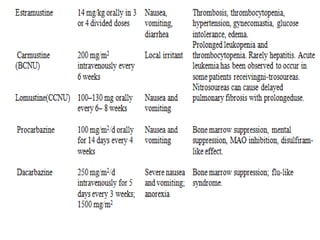
 Dose – Lomustine : 100-130 mg/mt sq. BSA single oral dose
every 6 weeks.
 Several other cytotoxic agents appear to act
as alkylators , although their structures do
not include the classic alkylating groups.
 They are capable of binding covalently to
cellular components and include
Procarbazine, Dacarbazine, Temozolomide
etc.
 Have primary inhibitory action on RNA and Protein
synthesis.(KDT)
 Undergo demethylation to active intermediate
(monomethyl triazeno-imidazole-carboxamide
[MTIC]) that interrupts DNA replication by causing
methylation of guanine.(DIPIRO)
 Metabolised in liver .
 Used in Malignant Melanoma and Hodgkin’s Disease.
 Side effects – nausea and vomiting.
 Dose – 3.5 mg/Kg/day IV for 10 days ; repeat after 4
weeks.
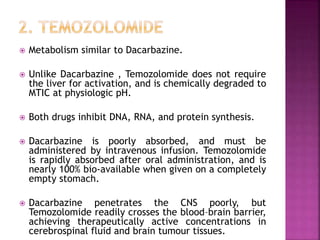
 Metabolism similar to Dacarbazine.
 Unlike Dacarbazine , Temozolomide does not require
the liver for activation, and is chemically degraded to
MTIC at physiologic pH.
 Both drugs inhibit DNA, RNA, and protein synthesis.
 Dacarbazine is poorly absorbed, and must be
administered by intravenous infusion. Temozolomide
is rapidly absorbed after oral administration, and is
nearly 100% bio-available when given on a completely
empty stomach.
 Dacarbazine penetrates the CNS poorly, but
Temozolomide readily crosses the blood–brain barrier,
achieving therapeutically active concentrations in
cerebrospinal fluid and brain tumour tissues.
Alkylating agents
Alkylating agents
Alkylating agents
Alkylating agents

Alkylating agents

  • 1.
  • 2.
     Oldest andmost useful of antineoplastic drugs.  Directly act on the cells (Cytotoxic Drugs).  Clinical use evolved from the observation of bone marrow suppression and lymph node shrinkage in soldiers exposed to sulfur mustard gas warfare during World War I.  Effectiveness as anticancer agents was confirmed by clinical trials in the middle 1940s.
  • 3.
    Alkylating agents ↓ Produce Carboniumion (C +) (highly reactive) ↓ Alkylation Transfer alkyl groups or substituted alkyl groups to cellular macromolecules by forming covalent bonds ↓ Cross linking/abnormal base pairing/scission of DNA strand ↓ Inhibition of DNA synthesis.
  • 4.
     Some alkylatingagents bind directly to the biomolecules.  Most common binding site is 7 nitrogen group of Guanine.  These covalent interactions result in cross-linking between two DNA strands or between two bases in the same strand of DNA.  Reactions between DNA and RNA and between drug and proteins may also occur, but the main result is cell death by inhibition of DNA replication, because the interlinked strands do not separate as required.  Because these agents can damage DNA during any phase of the cell cycle, they are not cell-cycle phase specific. However, their greatest effect is seen in rapidly dividing cells.
  • 6.
    1.Nitrogen Mustards  Mechlorethamine (MustineHCl)  Cyclophosphamide,  Ifosfamide,  Chlorambucil,  Melphalan 2.Ethylenimine  Thio-TEPA 3.Alkyl sulfonate  Busulfan 4.Nitrosoureas  Carmustine (BCNU),  Lomustine (CCNU) 5.Triazine  Dacarbazine (OTIC)
  • 7.
     Also knowsas Mustine HCl.  1st nitrogen mustard ; highly reactive ; local vesicant .  Administration only by IV route .  Nausea , vomiting , haemodynamic changes (acute effects) are common side effects.  Extravasation during IV injection may cause sloughing.  Dose – 0.1 mg/Kg IV daily * 4 days (courses may be repeated at suitable interval).
  • 8.
     Inactive ,produces few effects.  Metabolised by mixed hepatic oxidase enzymes CYP450 , CYP2B6 , CYP3A4/5 isoenzymes.  Active metabolites are Aldophosphamide , Phosphoramide mustard.  Another metabolite is 4-hydroxy- cyclophosphamide which is cytotoxic in nature but not alkylating agent.
  • 9.
     Prominent Immunosuppressantproperty.  Side effects –  Thrombocytopenia (less prominent)  Alopecia and Cystitis (due to another metabolite Acrolein) are prominent.  Vomiting Note -Chloremphenicol decreases the metabolism of cyclophosphamide. Dose – 2-3 mg/Kg/day Oral ; 10-15 mg/Kg IV every 7-10 days.
  • 10.
     Inactive likeCyclophosphamide.  Longer and dose dependent t 1/2 .  Metabolism similar to Cyclophosphamide.  Active metabolite is Ifosfamide mustard(in liver).  Dose limiting toxicity – Haemorrhagic Cystitis.  To prevent the same MESNA is routinely given with it.  Side effects – alopecia and vomiting.
  • 11.
     Very slowacting alkylating agent .  Especially active on lymphoid tissue.  Myeloid tissue largely spared.  DOC for long term therapy for Chronic Lymphatic Leukemia , Hodgkin’s Disease.  Less Immunosuppressant property.  Dose – 4-10 mg (0.1-0.2 mg/Kg) daily for 3-6 weeks , then 2 mg daily for maintenance.
  • 12.
     Very effectivein Multiple Myeloma and Advanced Ovarian Cancer .  Mainly causes bone marrow toxicity .  Complications – infection , diarrhoea , pancreatitis.  Dose – 10 mg daily for 7 days or 6 mg/day for 2-3 weeks -----4 weeks gap-----2-4 mg daily for maintenance orally.
  • 13.
     An Ethylenimine.  Active form of the drug .  Produces High toxicity.  Dose – 0.3-0.4 mg/Kg IV at 1-4 week interval.
  • 14.
     Highly sensitivefor the myeloid elements.  Granulocyte precursors are the most sensitive followed by platelet precursors and then by those of RBCs.  Little effect on lymphoid tissue and GIT.  Side effects – Hyperuricemia (common) and Pulmonary Fibrosis (specific adverse effect) ; Sterility .  DOC for Chronic Myeloid Leukemia.  Dose – 2-6 mg/day (0.06 mg/Kg/day)
  • 15.
     Characterized byhigh lipophilicity so therefore can cross BBB.  Nitrosoureas decompose to reactive alkylating metabolites and to isocyanate compounds that have several effects on reproducing cells.  Effective in Meningeal Leukemia and Brain Tumours.  Side effects – nausea, vomiting , bone marrow suppression. Visceral fibrosis and Renal damage can also occur.  Carmustine(BCNU) AND Lomustine (CCNU) are examples.  Dose – Lomustine : 100-130 mg/mt sq. BSA single oral dose every 6 weeks.
  • 16.
     Several othercytotoxic agents appear to act as alkylators , although their structures do not include the classic alkylating groups.  They are capable of binding covalently to cellular components and include Procarbazine, Dacarbazine, Temozolomide etc.
  • 17.
     Have primaryinhibitory action on RNA and Protein synthesis.(KDT)  Undergo demethylation to active intermediate (monomethyl triazeno-imidazole-carboxamide [MTIC]) that interrupts DNA replication by causing methylation of guanine.(DIPIRO)  Metabolised in liver .  Used in Malignant Melanoma and Hodgkin’s Disease.  Side effects – nausea and vomiting.  Dose – 3.5 mg/Kg/day IV for 10 days ; repeat after 4 weeks.
  • 18.
     Metabolism similarto Dacarbazine.  Unlike Dacarbazine , Temozolomide does not require the liver for activation, and is chemically degraded to MTIC at physiologic pH.  Both drugs inhibit DNA, RNA, and protein synthesis.  Dacarbazine is poorly absorbed, and must be administered by intravenous infusion. Temozolomide is rapidly absorbed after oral administration, and is nearly 100% bio-available when given on a completely empty stomach.  Dacarbazine penetrates the CNS poorly, but Temozolomide readily crosses the blood–brain barrier, achieving therapeutically active concentrations in cerebrospinal fluid and brain tumour tissues.

Editor's Notes

  • #6 Courtesy:DIPIRO
  • #20 COURTESY : GOODMANN AND GILLMANN 45TH EDITION