XBT702-Recombinant DNA Technology
Calcium phosphate method
Presented by
M.Aarthy(121011101408)
R.Jayaranjani(121011101418)
Ms.P.Mala
Assistant professor
Department of biotechnology
Principle of the Calcium Phosphate Method
The calcium phosphate method involves the precipitation of DNA with calcium
ions, followed by the uptake of the resulting DNA-calcium phosphate precipitate
by target cells. The basic principle is the ability of calcium ions to form a
complex with DNA, which can then be taken up by cells, allowing for the
integration of the foreign DNA into the cell’s genome or expression of the
recombinant DNA.
Steps Involved in the Calcium Phosphate
Method for rDNA Transfection
Preparation of DNA Solution
• The plasmid DNA or recombinant DNA of interest is typically purified and
prepared in an aqueous solution .
• The DNA is typically mixed with an appropriate amount of calcium chloride
(CaCl ) to form a solution that will facilitate the precipitation proces
₂
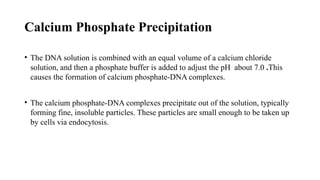
Calcium Phosphate Precipitation
• The DNA solution is combined with an equal volume of a calcium chloride
solution, and then a phosphate buffer is added to adjust the pH about 7.0 .This
causes the formation of calcium phosphate-DNA complexes.
• The calcium phosphate-DNA complexes precipitate out of the solution, typically
forming fine, insoluble particles. These particles are small enough to be taken up
by cells via endocytosis.
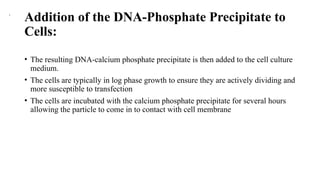
Addition of the DNA-Phosphate Precipitate to
Cells:
• The resulting DNA-calcium phosphate precipitate is then added to the cell culture
medium.
• The cells are typically in log phase growth to ensure they are actively dividing and
more susceptible to transfection
• The cells are incubated with the calcium phosphate precipitate for several hours
allowing the particle to come in to contact with cell membrane
.
Washing and Recovery
• After the incubation period, cells are typically washed to remove excess
precipitate and unbound calcium phosphate.
• The cells are cultured in a fresh medium to recover from the medium after few
days the cells are harvested for analysis of gene expression
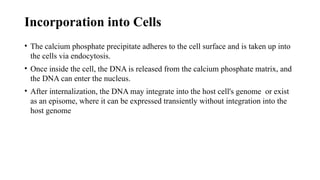
Incorporation into Cells
• The calcium phosphate precipitate adheres to the cell surface and is taken up into
the cells via endocytosis.
• Once inside the cell, the DNA is released from the calcium phosphate matrix, and
the DNA can enter the nucleus.
• After internalization, the DNA may integrate into the host cell's genome or exist
as an episome, where it can be expressed transiently without integration into the
host genome
Application
• Gene Cloning and Expression
• Gene Knockdown/Overexpression
• Viral Vector Production
• Stable Cell Line Creation
Advantages
• Simplicity
• No Need for Chemical Reagents
• Well-Established Protocol
• Effectiveness for Certain Cell Types
Limitations
• Effectiveness for Certain Cell Types
• Toxicity
• Limited Use for Primary Cells
• Transfection Stability
1.Graham F, van der Eb A. 1973. A new technique for the assay of infectivity of human adenovirus
5 DNA. Virology. 52(2):456-467. https://doi.org/10.1016/0042-6822(73)90341-3
2.Wigler M, Pellicer A, Silverstein S, Axel R. 1978. Biochemical transfer of single-copy eucaryotic
genes using total cellular DNA as donor. Cell. 14(3):725-731. https://doi.org/10.1016/0092-
8674(78)90254-4
3.Axel, R. ∙ Cedar, H. ∙ Felsenfeld, G.in: Proc. Nat. Acad. Sci. USA. 70. 1973; 2029-2032Google
Scholar
4.Bacchetti, S. ∙ Graham, F.L.in: Proc. Nat. Acad. Sci. USA. 74. 1977; 1590-1594Google Scholar
5.Chasin, L.A. ∙ Urlaub, G.Somatic Cell Genet. 1976; 2:453-467CrossrefScopus
(52)PubMedGoogle Scholar
6.Graham, F.L. ∙ Abrahams, P.J. ∙ Mulder, C. ...in: Cold Spring Harbor Symp. Quant. Biol. 39.
1974; 637-650Google Scholar
7.Ketner, G. ∙ Kelly, T.J.in: Proc. Nat. Acad. Sci. USA. 73. 1976; 1102-1106Google Scholar
THANK YOU
• Addition of the DNA-Phosphate Precipitate to Cells:
cipitate is then added to the cell culture medium. The cells are typically in log phase growth to ensure they are actively di
um phosphate precipitate for several hours (typically 4-6 hours), allowing the particles to come into contact with the cell m

Calcium phosphate method. briefs explanation

  • 1.
    XBT702-Recombinant DNA Technology Calciumphosphate method Presented by M.Aarthy(121011101408) R.Jayaranjani(121011101418) Ms.P.Mala Assistant professor Department of biotechnology
  • 2.
    Principle of theCalcium Phosphate Method The calcium phosphate method involves the precipitation of DNA with calcium ions, followed by the uptake of the resulting DNA-calcium phosphate precipitate by target cells. The basic principle is the ability of calcium ions to form a complex with DNA, which can then be taken up by cells, allowing for the integration of the foreign DNA into the cell’s genome or expression of the recombinant DNA.
  • 3.
    Steps Involved inthe Calcium Phosphate Method for rDNA Transfection Preparation of DNA Solution • The plasmid DNA or recombinant DNA of interest is typically purified and prepared in an aqueous solution . • The DNA is typically mixed with an appropriate amount of calcium chloride (CaCl ) to form a solution that will facilitate the precipitation proces ₂
  • 4.
    Calcium Phosphate Precipitation •The DNA solution is combined with an equal volume of a calcium chloride solution, and then a phosphate buffer is added to adjust the pH about 7.0 .This causes the formation of calcium phosphate-DNA complexes. • The calcium phosphate-DNA complexes precipitate out of the solution, typically forming fine, insoluble particles. These particles are small enough to be taken up by cells via endocytosis.
  • 5.
    Addition of theDNA-Phosphate Precipitate to Cells: • The resulting DNA-calcium phosphate precipitate is then added to the cell culture medium. • The cells are typically in log phase growth to ensure they are actively dividing and more susceptible to transfection • The cells are incubated with the calcium phosphate precipitate for several hours allowing the particle to come in to contact with cell membrane .
  • 6.
    Washing and Recovery •After the incubation period, cells are typically washed to remove excess precipitate and unbound calcium phosphate. • The cells are cultured in a fresh medium to recover from the medium after few days the cells are harvested for analysis of gene expression
  • 7.
    Incorporation into Cells •The calcium phosphate precipitate adheres to the cell surface and is taken up into the cells via endocytosis. • Once inside the cell, the DNA is released from the calcium phosphate matrix, and the DNA can enter the nucleus. • After internalization, the DNA may integrate into the host cell's genome or exist as an episome, where it can be expressed transiently without integration into the host genome
  • 8.
    Application • Gene Cloningand Expression • Gene Knockdown/Overexpression • Viral Vector Production • Stable Cell Line Creation Advantages • Simplicity • No Need for Chemical Reagents • Well-Established Protocol • Effectiveness for Certain Cell Types
  • 9.
    Limitations • Effectiveness forCertain Cell Types • Toxicity • Limited Use for Primary Cells • Transfection Stability
  • 10.
    1.Graham F, vander Eb A. 1973. A new technique for the assay of infectivity of human adenovirus 5 DNA. Virology. 52(2):456-467. https://doi.org/10.1016/0042-6822(73)90341-3 2.Wigler M, Pellicer A, Silverstein S, Axel R. 1978. Biochemical transfer of single-copy eucaryotic genes using total cellular DNA as donor. Cell. 14(3):725-731. https://doi.org/10.1016/0092- 8674(78)90254-4 3.Axel, R. ∙ Cedar, H. ∙ Felsenfeld, G.in: Proc. Nat. Acad. Sci. USA. 70. 1973; 2029-2032Google Scholar 4.Bacchetti, S. ∙ Graham, F.L.in: Proc. Nat. Acad. Sci. USA. 74. 1977; 1590-1594Google Scholar 5.Chasin, L.A. ∙ Urlaub, G.Somatic Cell Genet. 1976; 2:453-467CrossrefScopus (52)PubMedGoogle Scholar 6.Graham, F.L. ∙ Abrahams, P.J. ∙ Mulder, C. ...in: Cold Spring Harbor Symp. Quant. Biol. 39. 1974; 637-650Google Scholar 7.Ketner, G. ∙ Kelly, T.J.in: Proc. Nat. Acad. Sci. USA. 73. 1976; 1102-1106Google Scholar
  • 11.
  • 12.
    • Addition ofthe DNA-Phosphate Precipitate to Cells: cipitate is then added to the cell culture medium. The cells are typically in log phase growth to ensure they are actively di um phosphate precipitate for several hours (typically 4-6 hours), allowing the particles to come into contact with the cell m