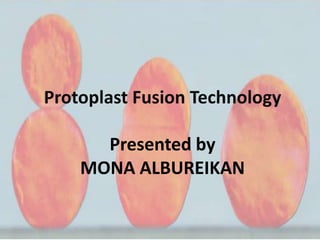

Protoplast Fusion Technology

      Presented by
    MONA ALBUREIKAN
What is protoplast fusion?
• cell walls are removed.
• They only have a cell membrane.
• can be obtained by specific lytic enzymes.
• It is a physical phenomenon.
• it is possible to transfer some useful genes.
• The hybrid protoplast = cytoplasm + two
  fused parent nuclei.
• important tools in strain improvement.
• Used for prokaryotic and eukaryotic cells.
Why use protoplast fusion?
• create strains with desired properties.

• industrial properties.

• one of the most frequently used research
  tools.

• a great potential for genetic analysis.

• for strain improvement.
Enzymes used for breaking of cell walls:

• Various enzymes used for this process.
• Cellulase and pectinase or macerozyme for plant cell
  wall.
• Bacterial cell wall are degraded by lysozyme.
• Fungal wall degraded by Novozyme -234 ( glucanase
  and chitinase).
• Streptomyces cell wall degraded by lysozyme and
  achromopeptidase
Methods of protoplast fusion:
Protoplast fusion classified into two categories:
• Spontaneous fusion:
  - often fuse spontaneously.
  - fuse through their plasmodesmata.
• Induced fusion:
  - Fusion with the help of fusion inducing chemicals
  agent.
  - Normally , do not fuse with each other.
How the isolated protoplast can be induced
                  to fuse
by three ways;
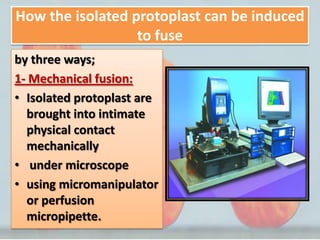
1- Mechanical fusion:
• Isolated protoplast are
  brought into intimate
  physical contact
  mechanically
• under microscope
• using micromanipulator
  or perfusion
  micropipette.
How the isolated protoplast can be
              induced to fuse
2- Chemofusion:
• Several chemicals has been used to induce protoplast
   fusion.
• such as sodium nitrate ,polyethylene glycol, Calcium
   ions(Ca++ ).
• cause the isolated protoplast to adhere each other.
• It is a non specific.
• It is inexpensive.
• It can cause massive fusion product.
• It can be cytotoxic and non selecetive and having less
   fusion frequency.
How the isolated protoplast can be
             induced to fuse
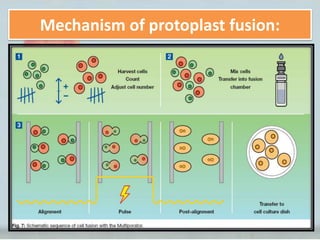
3- Electrofusion;
• Used electric stimulation.
• Used An electric field of low strength (10Kvm-1).
• Electrofusion is easy to control.
• It is having fusion frequency up to 100%.
• It is gives reproducibility.
• It is less cytotoxic.
• The equipment is sophisticated and expensive.
Mechanism of protoplast fusion:
Protoplast fusion in bacteria:
• In bacteria protoplast can be obtained.
• Fusion can be carried out with low frequency in
  some gram positive organisms.
• For gram negative bacteria it is possible to
  obtain protoplast but regeneration is difficult.
• The procedure is highly efficient and yields upto
  80% transformants.
References;
• http://www.biocompare.com/images/bc/006/ArticleI
  mages/hybridomaguide_0304_8.jpg
• http://www.aidic.it/IBIC2008/webpapers/96Verma.p
  df
• http://en.wikipedia.org/wiki/Somatic_fusion
• http://www.ihar.edu.pl/ZIKiT/hybrids.php4
THANK YOU

Protoplast fusion technology

  • 1.
    Protoplast Fusion Technology Presented by MONA ALBUREIKAN
  • 2.
    What is protoplastfusion? • cell walls are removed. • They only have a cell membrane. • can be obtained by specific lytic enzymes. • It is a physical phenomenon. • it is possible to transfer some useful genes. • The hybrid protoplast = cytoplasm + two fused parent nuclei. • important tools in strain improvement. • Used for prokaryotic and eukaryotic cells.
  • 3.
    Why use protoplastfusion? • create strains with desired properties. • industrial properties. • one of the most frequently used research tools. • a great potential for genetic analysis. • for strain improvement.
  • 4.
    Enzymes used forbreaking of cell walls: • Various enzymes used for this process. • Cellulase and pectinase or macerozyme for plant cell wall. • Bacterial cell wall are degraded by lysozyme. • Fungal wall degraded by Novozyme -234 ( glucanase and chitinase). • Streptomyces cell wall degraded by lysozyme and achromopeptidase
  • 5.
    Methods of protoplastfusion: Protoplast fusion classified into two categories: • Spontaneous fusion: - often fuse spontaneously. - fuse through their plasmodesmata. • Induced fusion: - Fusion with the help of fusion inducing chemicals agent. - Normally , do not fuse with each other.
  • 6.
    How the isolatedprotoplast can be induced to fuse by three ways; 1- Mechanical fusion: • Isolated protoplast are brought into intimate physical contact mechanically • under microscope • using micromanipulator or perfusion micropipette.
  • 7.
    How the isolatedprotoplast can be induced to fuse 2- Chemofusion: • Several chemicals has been used to induce protoplast fusion. • such as sodium nitrate ,polyethylene glycol, Calcium ions(Ca++ ). • cause the isolated protoplast to adhere each other. • It is a non specific. • It is inexpensive. • It can cause massive fusion product. • It can be cytotoxic and non selecetive and having less fusion frequency.
  • 8.
    How the isolatedprotoplast can be induced to fuse 3- Electrofusion; • Used electric stimulation. • Used An electric field of low strength (10Kvm-1). • Electrofusion is easy to control. • It is having fusion frequency up to 100%. • It is gives reproducibility. • It is less cytotoxic. • The equipment is sophisticated and expensive.
  • 9.
  • 10.
    Protoplast fusion inbacteria: • In bacteria protoplast can be obtained. • Fusion can be carried out with low frequency in some gram positive organisms. • For gram negative bacteria it is possible to obtain protoplast but regeneration is difficult. • The procedure is highly efficient and yields upto 80% transformants.
  • 11.
    References; • http://www.biocompare.com/images/bc/006/ArticleI mages/hybridomaguide_0304_8.jpg • http://www.aidic.it/IBIC2008/webpapers/96Verma.p df • http://en.wikipedia.org/wiki/Somatic_fusion • http://www.ihar.edu.pl/ZIKiT/hybrids.php4
  • 12.