ANTI-ANGINAL DRUGS
UTTARA L.JOSHI
ATHEROSCLEROSIS
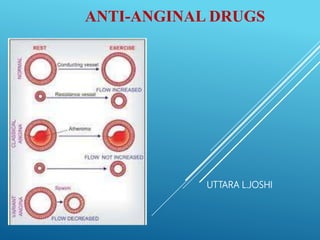
 Atherosclerotic lesions in coronary arteries can obstruct blood
flow.
 leading to an imbalance in myocardial oxygen supply and
demand that presents as stable angina or an acute coronary
syndrome (myocardial infarction [MI] or unstable angina).
 Spasms of vascular smooth muscle may also inhibit cardiac blood
flow, reducing perfusion and causing ischemia and anginal pain.
ANGINA PECTORIS
 Typical angina pectoris is a characteristic:
 Sudden, severe, crushing chest pain that may radiate to the neck,
jaw, back, and arms.
 Patients may also present with dyspnea or
 Atypical symptoms such as indigestion, nausea, vomiting, or
diaphoresis.
 Angina different types caused by varying combinations of increased
myocardial demand and decreased myocardial perfusion.
TREATMENT STRATEGIES
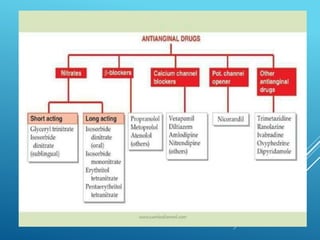
 Four types of drugs, used either alone or in combination, are
commonly used to manage patients with stable angina:
 β-blockers.
 Calcium Channel Blockers.
 Organic Nitrates.
 The sodium channel–blocking drug, ranolazine.
 These agents help to balance the cardiac oxygen supply and
demand equation by affecting blood pressure, venous return, heart
rate, and contractility.
ORGANIC NITRATES
 These compounds cause a reduction in myocardial oxygen demand,
followed by relief of symptoms.
 Main Mechanism of action:
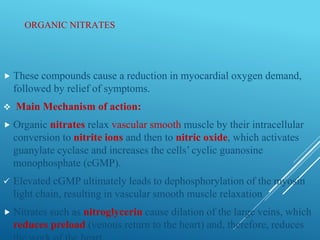
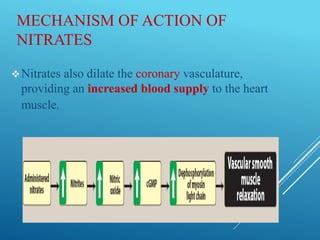
 Organic nitrates relax vascular smooth muscle by their intracellular
conversion to nitrite ions and then to nitric oxide, which activates
guanylate cyclase and increases the cells’ cyclic guanosine
monophosphate (cGMP).
 Elevated cGMP ultimately leads to dephosphorylation of the myosin
light chain, resulting in vascular smooth muscle relaxation
 Nitrates such as nitroglycerin cause dilation of the large veins, which
reduces preload (venous return to the heart) and, therefore, reduces
MECHANISM OF ACTION OF
NITRATES
Nitrates also dilate the coronary vasculature,
providing an increased blood supply to the heart
muscle.
PHARMACOKINETICS
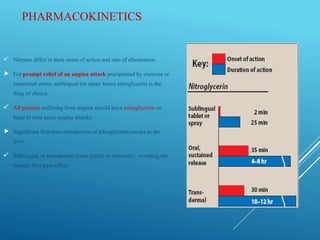
 Nitratesdiffer in their onset of action and rate of elimination.
 For prompt relief of an angina attack precipitatedby exercise or
emotional stress,sublingual (or spray form) nitroglycerinis the
drug of choice.
 All patientssufferingfrom angina should have nitroglycerinon
hand to treat acute angina attacks.
 Significantfirst-passmetabolismof nitroglycerinoccurs in the
liver.
 Sublingual or transdermalroute (patch or ointment), avoiding the
hepatic first-passeffect.
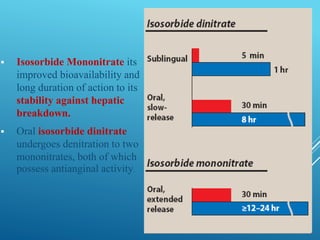
 Isosorbide Mononitrate its
improved bioavailability and
long duration of action to its
stability against hepatic
breakdown.
 Oral isosorbide dinitrate
undergoes denitration to two
mononitrates, both of which
possess antianginal activity.
ADVERSE EFFECTS
 Headache is the most common adverse effect of nitrates.
 High doses …..postural hypotension, facial flushing, and tachycardia.
 Phosphodiesterase type 5 inhibitors as sildenafil potentiate the action of the
nitrates Dangerous hypotension ………. combination is contraindicated.
 Tolerance to the actions of nitrates develops rapidly as the blood vessels become
desensitized to vasodilation.
 Tolerance can be overcome by providing a daily “nitrate-free interval” to restore
sensitivity to the drug. This interval of 10 to 12 hours is usually taken at night
because demand on the heart is decreased at that time.
 Nitroglycerin patches are worn for 12 hours and then removed for 12 hours.
 Nitrate-free interval in these patients should occur in the late afternoon.
Β-ADRENERGIC BLOCKERS
 The β-adrenergic blockers decrease the oxygen demands of the
myocardium by blocking β1 receptors, resulting in decreased heart
rate, contractility, cardiac output, and blood pressure.
 These agents reduce myocardial oxygen demand during exertion
and at rest.
 Can reduce both the frequency and severity of angina attacks.
 β-Blockers can be used to increase exercise duration and
tolerance in patients with effort-induced angina.
 β-Blockers are recommended as initial antianginal therapy in all
patients unless contraindicated.
 β-Blockers reduce the risk of death and MI in patients who have
had a prior MI and also improve mortality in patients with
hypertension and heart failure with reduced ejection fraction.
Propranolol is the prototype for this class of compounds,
but it is not cardioselective
 Metoprolol and Atenolol, are preferred.
 All β-blockers are nonselective at high doses and can
inhibit β2 receptors.
o β-Blockers should be avoided in patients with severe
bradycardia.
o Nonselective β-blockers should be avoided in patients
with asthma.
o It is important not to discontinue β-blocker therapy
abruptly.
o The dose should be gradually tapered off over 2 to 3
weeks to avoid rebound angina, MI, and hypertension.
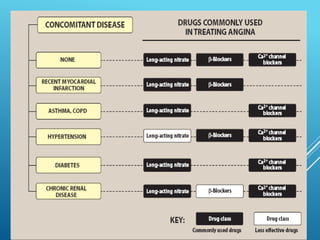
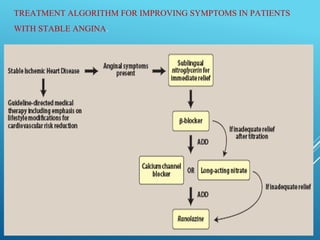
TREATMENT ALGORITHM FOR IMPROVING SYMPTOMS IN PATIENTS
WITH STABLE ANGINA.
CALICUM CHANNEL BLOCKERS
Calcium is essential for muscular contraction.
Calcium influx is increased in ischemia because of the
membrane depolarization that hypoxia produces.
This promotes the activity of several ATP-consuming
enzymes, thereby depleting energy stores and worsening
the ischemia.
The calcium channel blockers protect the tissue by
inhibiting the entrance of calcium into cardiac and smooth
muscle cells of the coronary and systemic arterial beds.
CALCIUM CHANNEL BLOCKERS
 These agents primarily affect the resistance of peripheral and coronary
arteriolar smooth muscle.
 In the treatment of effort-induced angina, calcium channel blockers reduce
myocardial oxygen consumption by decreasing vascular resistance, thereby
decreasing afterload.
 All calcium channel blockers lower blood pressure.
DIHYDROPYRIDINE CALCIUM
CHANNEL BLOCKERS
Amlodipine an oral dihydropyridine, functions mainly
as an arteriolar vasodilator.
 This drug has minimal effect on cardiac conduction.
The vasodilatory effect of amlodipine is useful in the
treatment of variant angina caused by spontaneous
coronary spasm.
 Nifedipine is another agent in this class; it is usually
administered as an extended-release oral formulation.
NONDIHYDROPYRIDINE CALCIUM
CHANNEL BLOCKERS
 Verapamil slows atrioventricular (AV) conduction directly and decreases heart
rate, contractility, blood pressure, and oxygen demand.
 Verapamil has greater negative inotropic effects than amlodipine, but it is a
weaker vasodilator.
 Verapamil is contraindicated in patients with preexisting depressed cardiac
function or AV conduction abnormalities.
 Diltiazem also slows AV conduction, decreases the rate of firing of the sinus
node pacemaker, and is also a coronary artery vasodilator.
 Nondihydropyridine calcium channel blockers can worsen heart failure due to
their negative inotropic effect, and their use should be avoided in this
population.
SODIUM CHANNEL BLOCKERS
 Ranolazine inhibits the late phase of the sodium current (late INa).
 Improving the oxygen supply and demand equation.
 Inhibition of late INa reduces intracellular sodium and calcium
overload, thereby improving diastolic function.
 Ranolazine has antianginal as well as antiarrhythmic properties.
 It is indicated for the treatment of chronic angina and may be used
alone or in combination with other traditional therapies.
 It is most often used in patients who have failed other antianginal
therapies.
 Ranolazine is extensively metabolized in the liver.
 Ranolazine is subject to numerous drug interactions.