TRACE
ELEMENTS
Dr Bushra Jabeen
18/01/2020
Nutrition – it is that branch of science, which deals with
the study of dynamic process, in which the consumed food is
utilized for nourishing the body
( A PROCESS OF ASSIMILATION OF FOOD)
Macronutrients:
-Proteins (7-15 %)
-Fats (10-30 %)
-Carbohydrates (65-80 %)
Micronutrients:
-Vitamins
-Minerals
Organic and inorganic complexes contained in food
are called nutrients
Classification of nutrients
3
MINERALS
Major minerals :-
Calcium
Phosphorus
Sodium
Potassium
magnesium
Trace elements :-
Iron
Iodine
Fluorine
Zinc
Copper
Trace contaminants :-
Lead
Mercury
Barium
Boron
Aluminium
4
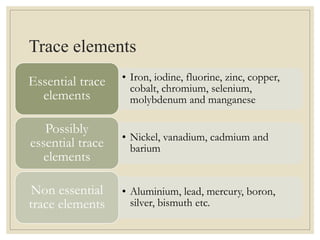
Trace elements
• Iron, iodine, fluorine, zinc, copper,
cobalt, chromium, selenium,
molybdenum and manganese
Essential trace
elements
• Nickel, vanadium, cadmium and
barium
Possibly
essential trace
elements
• Aluminium, lead, mercury, boron,
silver, bismuth etc.
Non essential
trace elements
IRON
One way substance
IRON
• 3-4 grams in body
• 60-70 % in blood
• 1g Hb = 3.34 mg iron
Functions :
 Hemoglobin formation
 Brain development
 Temperature regulation
 Muscle activity
 Catecholamine metabolism
7
Dietary requirements
◦ Adult man – 10 mg/day
◦ Menstruating woman – 18 mg/ day
◦ Pregnant and lactating woman – 40 mg/day
Rich
source
• Organ meats
Good
source
• Leafy vegetables
• Pulses
• Cereals
• Fish
Poor
source
• Milk
• Wheat
• Polished rice
Sources
Absorption, transportation and storage
Iron losses :
1 mg daily (12.5 mg/ 28 days)
Iron deficiency :
o Decreased storage
o Latent iron deficiency
o Overt iron deficiency
• Nutritional anemia
• Impaired immunity
• Diminished work performance
11
Hemosiderosis: excessive iron in the body
Hemochromatosis: iron is directly deposited in the tissues.
• Weakness, easy fatigability, lethargy
• Immuno-compromised
• Diminished physical and mental capacity
• Reduced work capacity, reduced endurance
General
• Weakness, diminished physical and mental capacity,
• Increased morbidity
• Increased risk of low birth baby, abortion, premature delivery, intra-
uterine growth retardation,
• Congenial fetal malformations, PPH, maternal mortality
Pregnant and Lactating Women
• Low birth weight, Perinatal mortality,
• Impaired cognitive performance and motor development,
• Psychological and behavioral effects
• Inattention, fatigue and insecurity
Children
Consequences of Anaemia . . .
12
 Breastfeeding and appropriate weaning
 Dietary modification
 Deworming
 Nutrition education
 Iron supplementation & Iron fortification
Prevention & control
13
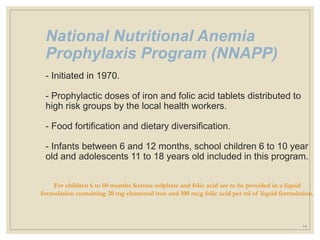
National Nutritional Anemia
Prophylaxis Program (NNAPP)
- Initiated in 1970.
- Prophylactic doses of iron and folic acid tablets distributed to
high risk groups by the local health workers.
- Food fortification and dietary diversification.
- Infants between 6 and 12 months, school children 6 to 10 year
old and adolescents 11 to 18 years old included in this program.
14
For children 6 to 60 months ferrous sulphate and folic acid are to be provided in a liquid
formulation containing 20 mg elemental iron and 100 mcg folic acid per ml of liquid formulation.
IODINE
Iodine deficiency disorder
16
IODINE
• 20 mg in body
• 80 % in thyroid gland
Functions :
 Synthesis of thyroxine and triiodothyronine
17
Sources & Dietary requirements
Adult man – 100 - 150 μg/day
Pregnant woman – 200 μg/day
Absorption
• 30% small
intestine
• Skin and lungs
Storage
• 80% as iodo-
thyroglobulin in
thyroid gland
Excretion
• Kidney
• Saliva, bile,
skin and milk
(in lactating
women)
Pregnancy
Spontaneous Abortion,
Still births
Fetus
Abortions
Still births
Congenital anomalies
Increased perinatal
mortality
Increased infant mortality
Infant
Neurological Cretinism
Mental deficiency
Deaf mutism
Spastic diplegia
Squint
Myxedematous
Cretinism
Dwarfism
Psychomotor defects
Neonate
Neonatal goitre
Neonatal hypothyroidism
SPECTRUM OF IODINE DEFICIENCY DISORDERS
Child and
adolescent
Goiter,
Juvenile hypothyroidism
Impaired mental function
Subnormal intelligence (loss
of 10 to 15 IQ points)
Retarded physical development
Delayed motor milestones
Hearing and speech defects
Stunting and muscle disorder
Adult
Goitre and its complications
Hypothyroidism
Lack of energy
Impaired mental function
Lowered productivity
Animal
Reproductive failure
Decreased yield of milk, egg,
etc.
20
Under the National IDD Control Programme
four main components are :
1.Use of Iodized salt or oil
2. Iodine monitoring
3. Manpower training
4. Mass communication
Prevention & control
21
FLUORINE
Double edged sword
FLUORINE
• Found in bones and teeth
Functions :
 Prevents development of dental caries
 Development of bones
 Inhibits activities of certain enzymes
23
Dietary requirements & Sources
Intake of less than 2 ppm.
Intake absorption and excretion
Fluoride consumption
Water Food Toothpaste Air pollution etc.
Higher concentration in ground waters than surface waters
The optimum concentration for drinking purpose is 0.5 to 0.8 mg/L (ppm)
but the permissible upper limit is 1.5 mg/L (1.5 ppm).
‘A double edged sword’.
fluorine
26
fluoride
Excess Deficiency
Fluorosis Caries
(< 0.5 ppm )
- Dental fluorosis
(> 1.5 ppm, 0-7 yrs of life)
- Skeletal fluorosis
(> 10 ppm)
Health problem in rural districts of Andhra Pradesh (esp. Nellore, Nalgonda and Prakasham districts), Haryana, Karnataka,
Kerala, Punjab, Rajasthan and Tamil Nadu.
27
Prevention & control
 Change in water source
 Defluoridation—The Nalgonda Technique
(lime and alum precipitation)
 Prohibit fluoride fortified water (0.5–0.8 ppm)/
toothpaste in endemic areas
28
ZINC
ZINC
• Total content in body is 2g
• Intracellular element
• Found in prostate gland, pancrease and brain
30
Functions :
• Component of more than 300 enzymes
• Antioxidant
• Storage and secretion of insulin
• Promotes synthesis of retinol binding protein
• Wound healing
• Main content of Gusten protein
• Essential for growth of foaetus
Dietary requirements & Sources
◦ 10 – 15 mg/ day
◦ Increases by 50% in pregnancy and lactation.
Intake absorption and excretion
COPPER
COPPER
• 100 – 150 mg in adult body
36
Functions :
 Essential component of enzyme
 Synthesis of hemoglobin
 Lysyl oxidase is necessary for cross linking structural
proteins
 Ceruloplasmin
 Synthesis of melanin and phospholipid
 Development of bones and nervous system
Dietary requirements & Sources
◦ Adults –
◦ 2 to 3 mg/day
◦ Infants and children –
◦ 0.5 to 2 mg/day
Intake absorption and excretion
Cobalt
Important as constituent of vitamin B12.
Functions are same as that of vit B12.
Stimulates production of hormone erythropoietin.
Prolonged administration results in polycythemia.
Molybdenum
Constituent of enzymes
Absorbed in small intestine
Excess absorption of molybdenum has been shown to
produce bony deformities.
Deficiency of molybdenum is associated with mouth and
oesophageal cancer.
46
Summary box - Microminerals
References
1. K. Park; textbook of preventive and social medicine; 24th edition.
2. Textbook of public health & community medicine 1st edition;
AFMC Pune (2009); Ashok K. Jindal, Puja Dudeja.
3. Satyanarayana, U. (2008). Biochemistry. 3rd ed. Kolkata: Books and
allied (P) Ltd.
4. Minerals [Internet]. Linus Pauling Institute. 2020 [cited 17 January
2020]. Available from: https://lpi.oregonstate.edu/mic/minerals

Trace elements minerals

  • 1.
  • 2.
    Nutrition – itis that branch of science, which deals with the study of dynamic process, in which the consumed food is utilized for nourishing the body ( A PROCESS OF ASSIMILATION OF FOOD)
  • 3.
    Macronutrients: -Proteins (7-15 %) -Fats(10-30 %) -Carbohydrates (65-80 %) Micronutrients: -Vitamins -Minerals Organic and inorganic complexes contained in food are called nutrients Classification of nutrients 3
  • 4.
    MINERALS Major minerals :- Calcium Phosphorus Sodium Potassium magnesium Traceelements :- Iron Iodine Fluorine Zinc Copper Trace contaminants :- Lead Mercury Barium Boron Aluminium 4
  • 5.
    Trace elements • Iron,iodine, fluorine, zinc, copper, cobalt, chromium, selenium, molybdenum and manganese Essential trace elements • Nickel, vanadium, cadmium and barium Possibly essential trace elements • Aluminium, lead, mercury, boron, silver, bismuth etc. Non essential trace elements
  • 6.
  • 7.
    IRON • 3-4 gramsin body • 60-70 % in blood • 1g Hb = 3.34 mg iron Functions :  Hemoglobin formation  Brain development  Temperature regulation  Muscle activity  Catecholamine metabolism 7
  • 8.
    Dietary requirements ◦ Adultman – 10 mg/day ◦ Menstruating woman – 18 mg/ day ◦ Pregnant and lactating woman – 40 mg/day
  • 9.
    Rich source • Organ meats Good source •Leafy vegetables • Pulses • Cereals • Fish Poor source • Milk • Wheat • Polished rice Sources
  • 10.
  • 11.
    Iron losses : 1mg daily (12.5 mg/ 28 days) Iron deficiency : o Decreased storage o Latent iron deficiency o Overt iron deficiency • Nutritional anemia • Impaired immunity • Diminished work performance 11 Hemosiderosis: excessive iron in the body Hemochromatosis: iron is directly deposited in the tissues.
  • 12.
    • Weakness, easyfatigability, lethargy • Immuno-compromised • Diminished physical and mental capacity • Reduced work capacity, reduced endurance General • Weakness, diminished physical and mental capacity, • Increased morbidity • Increased risk of low birth baby, abortion, premature delivery, intra- uterine growth retardation, • Congenial fetal malformations, PPH, maternal mortality Pregnant and Lactating Women • Low birth weight, Perinatal mortality, • Impaired cognitive performance and motor development, • Psychological and behavioral effects • Inattention, fatigue and insecurity Children Consequences of Anaemia . . . 12
  • 13.
     Breastfeeding andappropriate weaning  Dietary modification  Deworming  Nutrition education  Iron supplementation & Iron fortification Prevention & control 13
  • 14.
    National Nutritional Anemia ProphylaxisProgram (NNAPP) - Initiated in 1970. - Prophylactic doses of iron and folic acid tablets distributed to high risk groups by the local health workers. - Food fortification and dietary diversification. - Infants between 6 and 12 months, school children 6 to 10 year old and adolescents 11 to 18 years old included in this program. 14 For children 6 to 60 months ferrous sulphate and folic acid are to be provided in a liquid formulation containing 20 mg elemental iron and 100 mcg folic acid per ml of liquid formulation.
  • 15.
  • 16.
  • 17.
    IODINE • 20 mgin body • 80 % in thyroid gland Functions :  Synthesis of thyroxine and triiodothyronine 17
  • 18.
    Sources & Dietaryrequirements Adult man – 100 - 150 μg/day Pregnant woman – 200 μg/day
  • 19.
    Absorption • 30% small intestine •Skin and lungs Storage • 80% as iodo- thyroglobulin in thyroid gland Excretion • Kidney • Saliva, bile, skin and milk (in lactating women)
  • 20.
    Pregnancy Spontaneous Abortion, Still births Fetus Abortions Stillbirths Congenital anomalies Increased perinatal mortality Increased infant mortality Infant Neurological Cretinism Mental deficiency Deaf mutism Spastic diplegia Squint Myxedematous Cretinism Dwarfism Psychomotor defects Neonate Neonatal goitre Neonatal hypothyroidism SPECTRUM OF IODINE DEFICIENCY DISORDERS Child and adolescent Goiter, Juvenile hypothyroidism Impaired mental function Subnormal intelligence (loss of 10 to 15 IQ points) Retarded physical development Delayed motor milestones Hearing and speech defects Stunting and muscle disorder Adult Goitre and its complications Hypothyroidism Lack of energy Impaired mental function Lowered productivity Animal Reproductive failure Decreased yield of milk, egg, etc. 20
  • 21.
    Under the NationalIDD Control Programme four main components are : 1.Use of Iodized salt or oil 2. Iodine monitoring 3. Manpower training 4. Mass communication Prevention & control 21
  • 22.
  • 23.
    FLUORINE • Found inbones and teeth Functions :  Prevents development of dental caries  Development of bones  Inhibits activities of certain enzymes 23
  • 24.
    Dietary requirements &Sources Intake of less than 2 ppm.
  • 25.
  • 26.
    Fluoride consumption Water FoodToothpaste Air pollution etc. Higher concentration in ground waters than surface waters The optimum concentration for drinking purpose is 0.5 to 0.8 mg/L (ppm) but the permissible upper limit is 1.5 mg/L (1.5 ppm). ‘A double edged sword’. fluorine 26
  • 27.
    fluoride Excess Deficiency Fluorosis Caries (<0.5 ppm ) - Dental fluorosis (> 1.5 ppm, 0-7 yrs of life) - Skeletal fluorosis (> 10 ppm) Health problem in rural districts of Andhra Pradesh (esp. Nellore, Nalgonda and Prakasham districts), Haryana, Karnataka, Kerala, Punjab, Rajasthan and Tamil Nadu. 27
  • 28.
    Prevention & control Change in water source  Defluoridation—The Nalgonda Technique (lime and alum precipitation)  Prohibit fluoride fortified water (0.5–0.8 ppm)/ toothpaste in endemic areas 28
  • 29.
  • 30.
    ZINC • Total contentin body is 2g • Intracellular element • Found in prostate gland, pancrease and brain 30
  • 31.
    Functions : • Componentof more than 300 enzymes • Antioxidant • Storage and secretion of insulin • Promotes synthesis of retinol binding protein • Wound healing • Main content of Gusten protein • Essential for growth of foaetus
  • 32.
    Dietary requirements &Sources ◦ 10 – 15 mg/ day ◦ Increases by 50% in pregnancy and lactation.
  • 33.
  • 35.
  • 36.
    COPPER • 100 –150 mg in adult body 36
  • 37.
    Functions :  Essentialcomponent of enzyme  Synthesis of hemoglobin  Lysyl oxidase is necessary for cross linking structural proteins  Ceruloplasmin  Synthesis of melanin and phospholipid  Development of bones and nervous system
  • 38.
    Dietary requirements &Sources ◦ Adults – ◦ 2 to 3 mg/day ◦ Infants and children – ◦ 0.5 to 2 mg/day
  • 39.
  • 41.
    Cobalt Important as constituentof vitamin B12. Functions are same as that of vit B12. Stimulates production of hormone erythropoietin. Prolonged administration results in polycythemia.
  • 44.
    Molybdenum Constituent of enzymes Absorbedin small intestine Excess absorption of molybdenum has been shown to produce bony deformities. Deficiency of molybdenum is associated with mouth and oesophageal cancer.
  • 46.
    46 Summary box -Microminerals
  • 47.
    References 1. K. Park;textbook of preventive and social medicine; 24th edition. 2. Textbook of public health & community medicine 1st edition; AFMC Pune (2009); Ashok K. Jindal, Puja Dudeja. 3. Satyanarayana, U. (2008). Biochemistry. 3rd ed. Kolkata: Books and allied (P) Ltd. 4. Minerals [Internet]. Linus Pauling Institute. 2020 [cited 17 January 2020]. Available from: https://lpi.oregonstate.edu/mic/minerals