VITAMIN D,
CALCIUM,
PHOSPHATE
METABOLISM
CONTENTS
1. INTRODUCTION
2. VITAMIN D
INTRODUCTION
SYNTHESIS AND REGULATION
BIOCHEMICAL FUNCTIONS
3. CALCIUM AND PHOSPHATE
INTRODUCTION
ROLE
SOURCE IN DIET
ABSORPTION & EXCRETION
REGULATION
4. APPLIED ASPECT
5. CONCLUSION
6. REFERENCES
INTRODUCTION
• "vitamin" comes from the Greek word “vita”, means
"life".
• Reqd in small quantities.
• FUNCTIONS:
(a) Resistance of the body against diseases.
(b) Stimulate and give strength to digestive and
nervous system.
(c) Convert food into energy, and repair cellular
damage.
(d) Help strengthen bones, heal wounds, and
immune system.
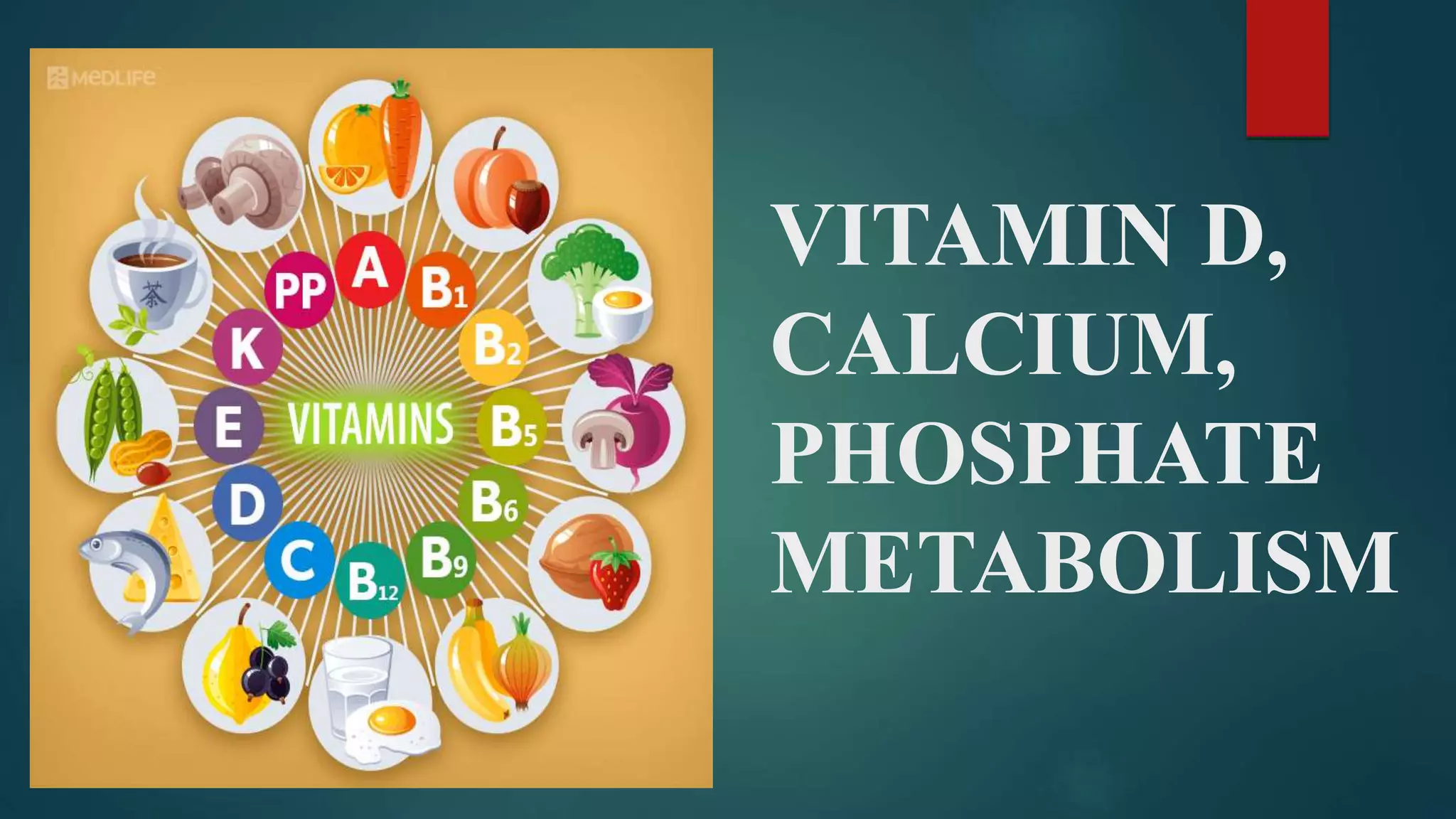
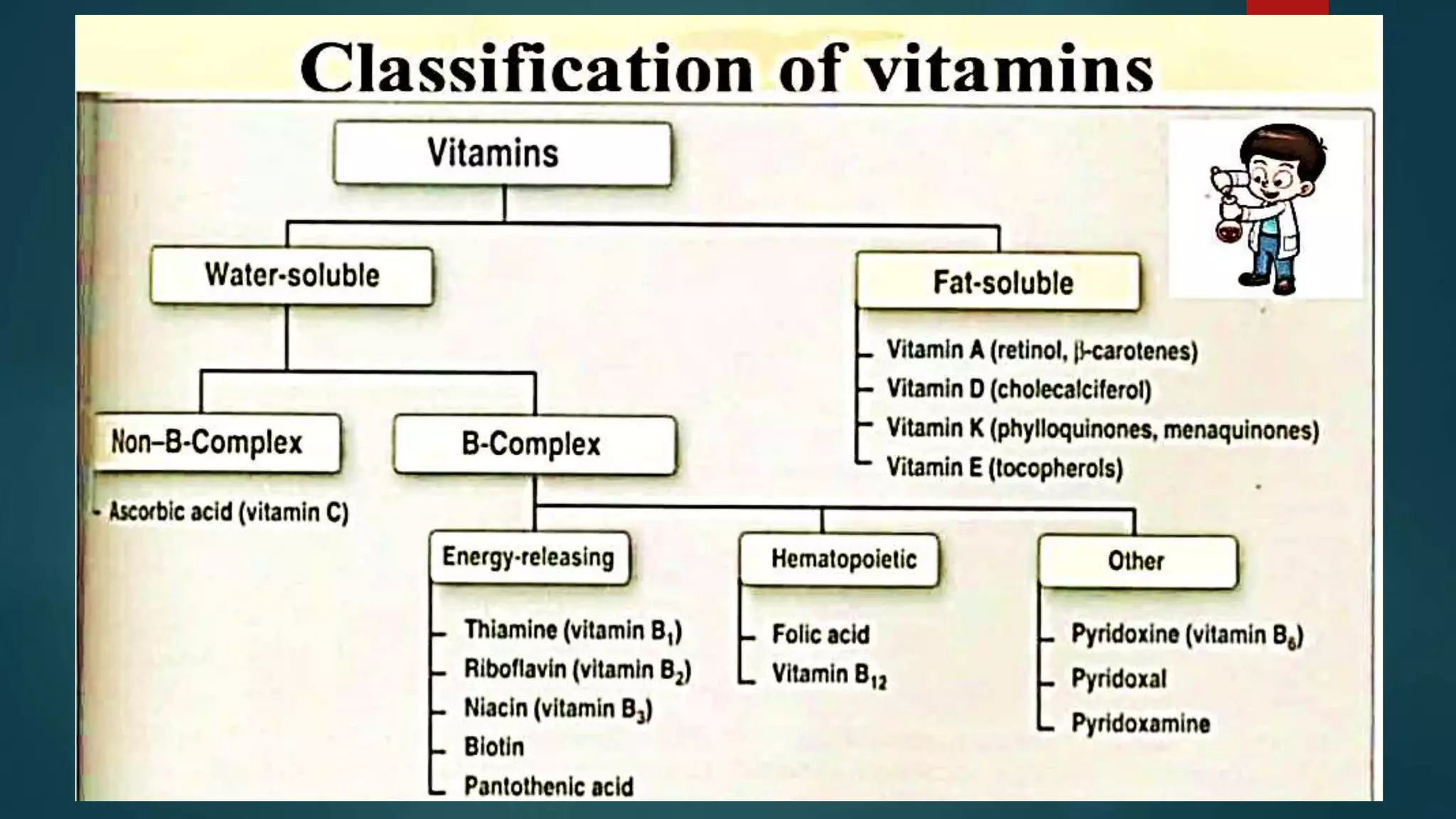
VITAMINS:
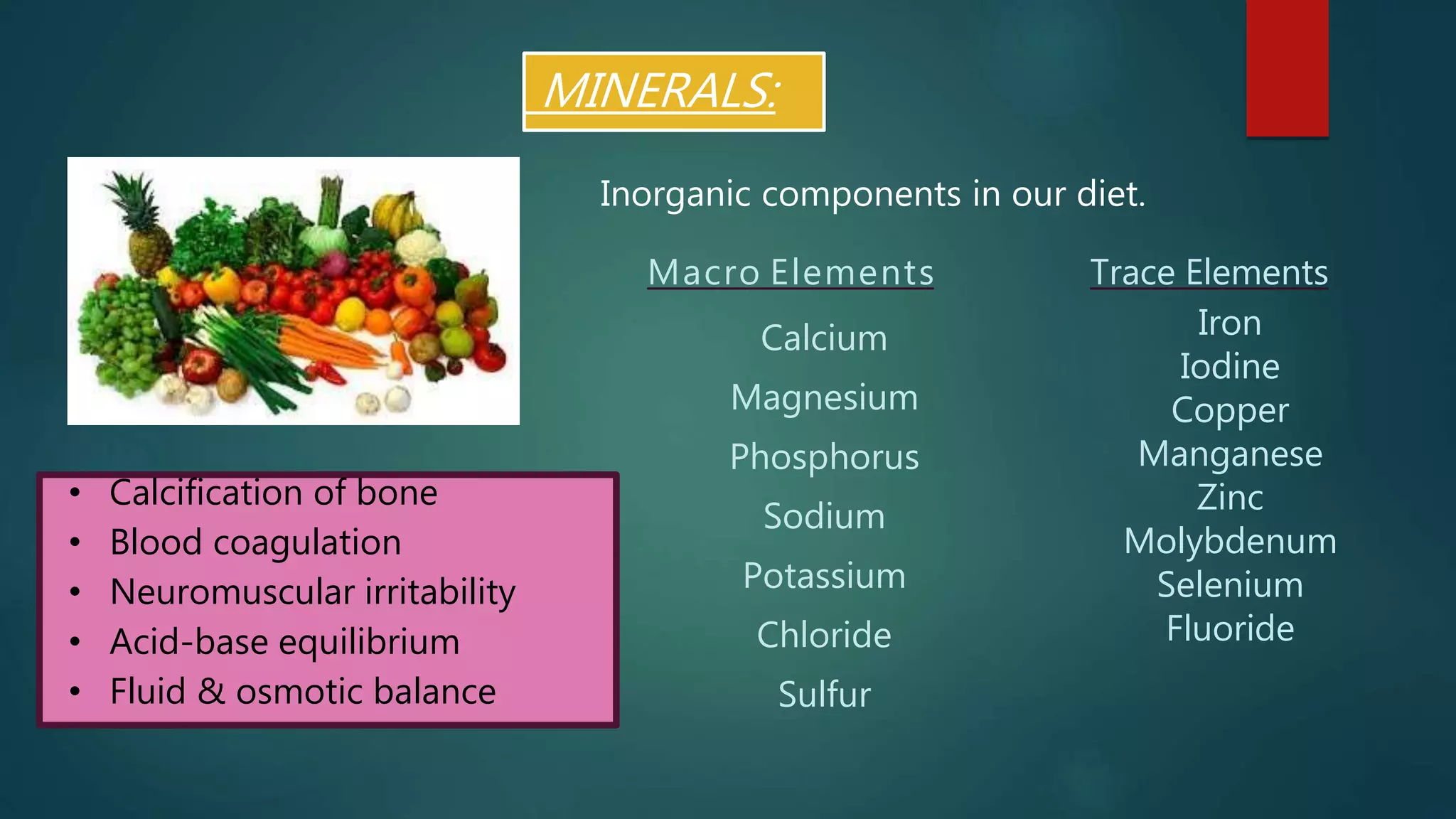
MINERALS:
Macro Elements
Calcium
Magnesium
Phosphorus
Sodium
Potassium
Chloride
Sulfur
Trace Elements
Iron
Iodine
Copper
Manganese
Zinc
Molybdenum
Selenium
Fluoride
• Calcification of bone
• Blood coagulation
• Neuromuscular irritability
• Acid-base equilibrium
• Fluid & osmotic balance
Inorganic components in our diet.
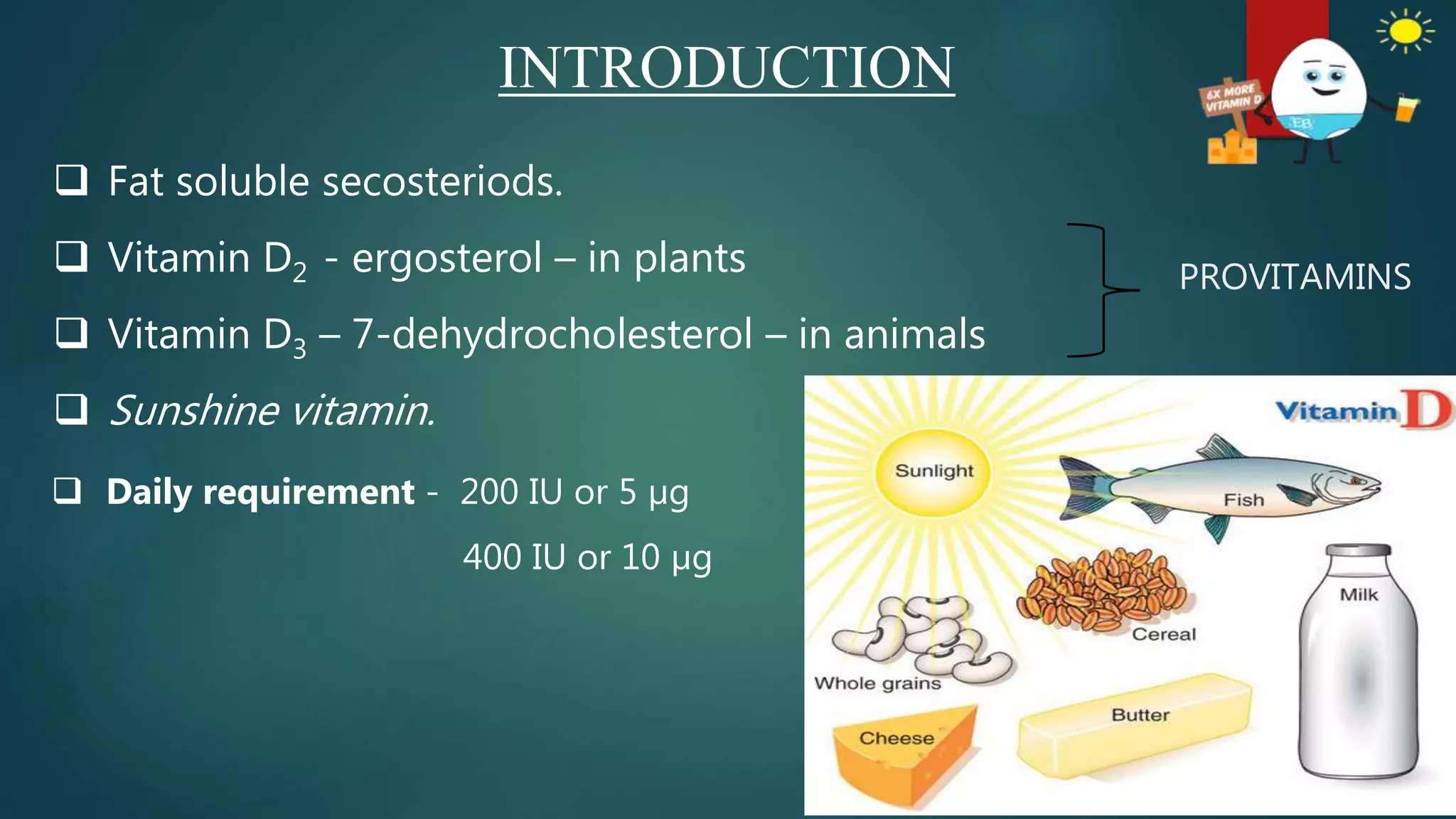
 Fat soluble secosteriods.
 Vitamin D2 - ergosterol – in plants
 Vitamin D3 – 7-dehydrocholesterol – in animals
 Sunshine vitamin.
INTRODUCTION
PROVITAMINS
 Daily requirement - 200 IU or 5 µg
400 IU or 10 µg
SYNTHESIS
• Cholecalciferol is hydroxylated at 25th
position to 25-hydroxycholecalciferol by
specific 25-hydroxylase present in liver.
• Kidney possesses a specific enzyme, 25-
hydroxycholecalciferol 1-hydroxylase at
position 1 to produce 1,25-DHCC.
REGULATION
i. Plasma phosphorus
level
ii. Plasma calcium level
BIOCHEMICAL FUNCTIONS
1. Action of calcitriol on the intestine :
• Calcitriol cytosolic receptor calcitriol
receptor complex.
• Increased formation of Calbindin, a calcium binding protein.
• This protein increases the calcium uptake by the intestine.
2. Action of calcitriol on the bone :
• Promotes mineralization of epiphyseal cartilage & osteoid matrix.
• Stimulates synthesis of osteocalcin and activity of alkaline phosphatase.
• Along with PTH, increases mobilization.
3. Action of calcitriol on the kidney :
• Stimulates reabsorption of Calcium &
Phosphorus at Distal renal tubular level.
• Calcitriol is also minimizes the excretion of
calcium and phosphate.
Vitamin D deficiency: • hypoplasia of enamel
• atrophy of salivary glands
• facilitates development of dental
caries
• compromise osseous healing
• increased gingival inflammation
• tooth loss
• Will not produce cathecidin
DENTAL IMPLICATIONS
CALCIUM
Adult human contains 1.0 – 1.5kg.
99% - bones & teeth
Normal plasma level: 9.0 – 11.0mg/100ml.
Ionized (50%)
Plasma calcium exists: Protein Bound (40%)
Complexed (5 – 10%)
PHOSPHATE
 In human body Phosphorus is present as phosphates
 Adult body contains: 0.7 – 1.0kg.
 80-85% in bones and teeth.
 Normal plasma level – 4.5 – 6.0mg/100ml infants.
3.0 – 4.0mg/100ml adults.
free inorganic (40%)
 Plasma phosphate exist: phosphate complexed (50%)
protein bound (10%)
ROLE OF CALCIUM IN BODY
 Blood coagulation.
 Action on heart.
 Secretory activity of glands.
 Release of certain hormones
like insulin, vasopressin, PTH.
 Key constituent of bone and teeth.
 Regulates blood pH.
 Forms phospholipids, phosphoproteins &
nucleic acid.
 Formation and utilization of high energy
phosphate compounds.
 Phosphorylation.
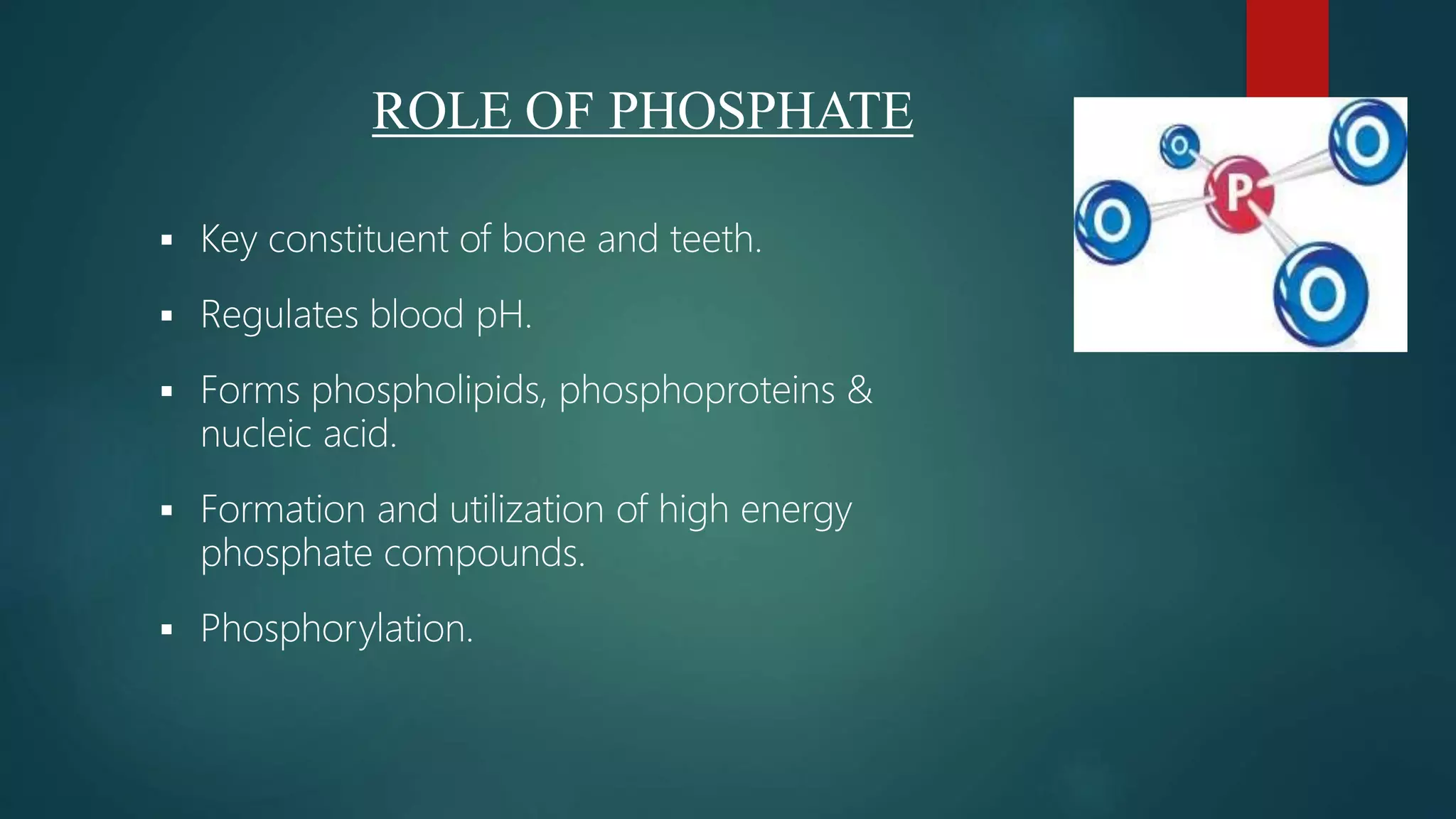
ROLE OF PHOSPHATE
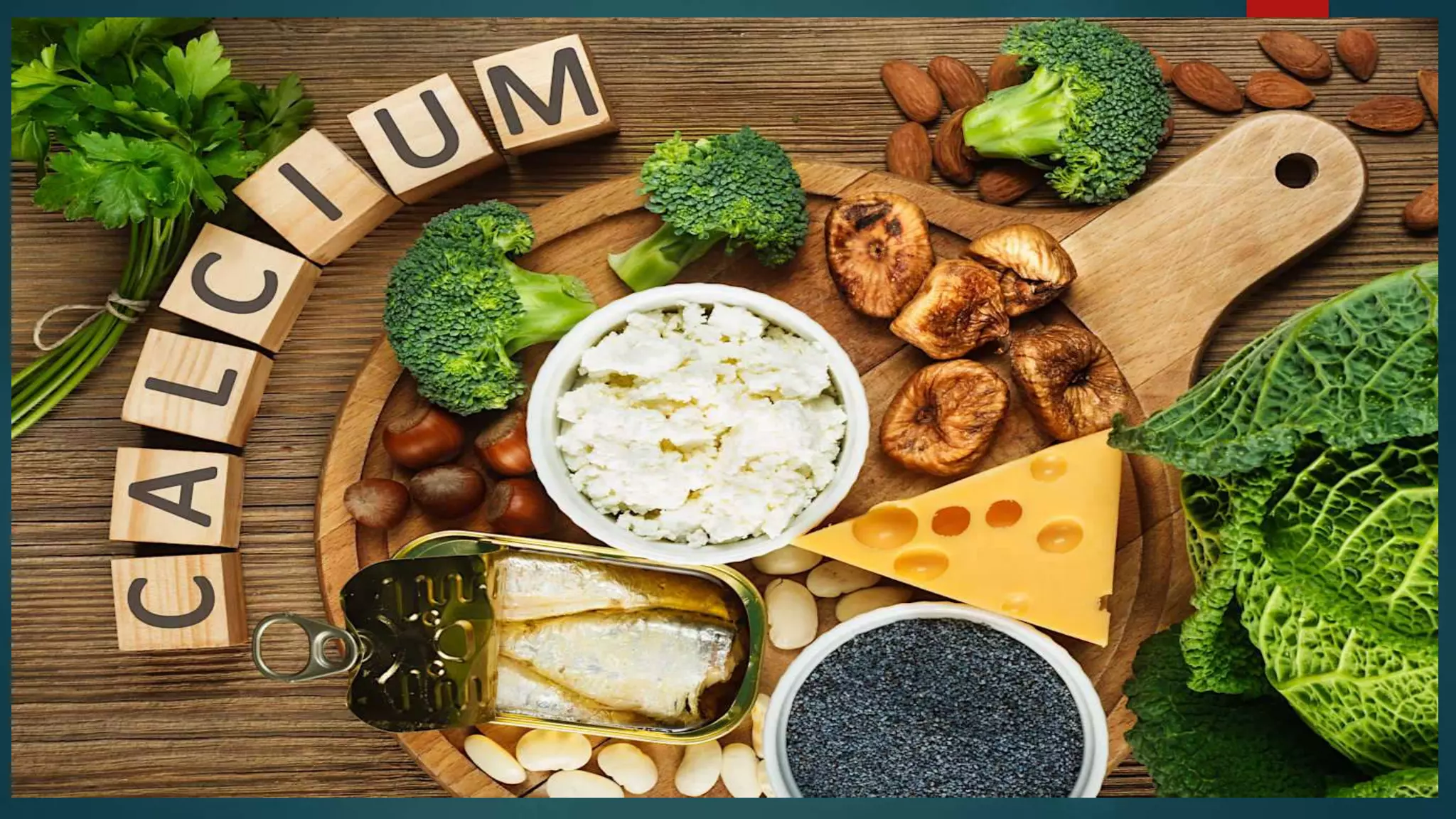
Best source:
Hard cheese
Milk
Dark green leafy
vegetables
Good source:
Broccoli
Baked beans
Dried legumes
Dried figs
Fair source:
String beans
Eggs
Bread
RDA OF CALCIUM:
Averageadult-800mg/day
Infants:<1yr - 360-540mg
1-10yr - 800mg
11-18yr -1200mg
Duringpregnancy&lactation-1200mg/ day
SOURCES OF CALCIUM
Rich source
Milk
Fish
Poultry
Eggs
Moderate sources
Cereals
Pulses
Nuts
Legumes
Meat
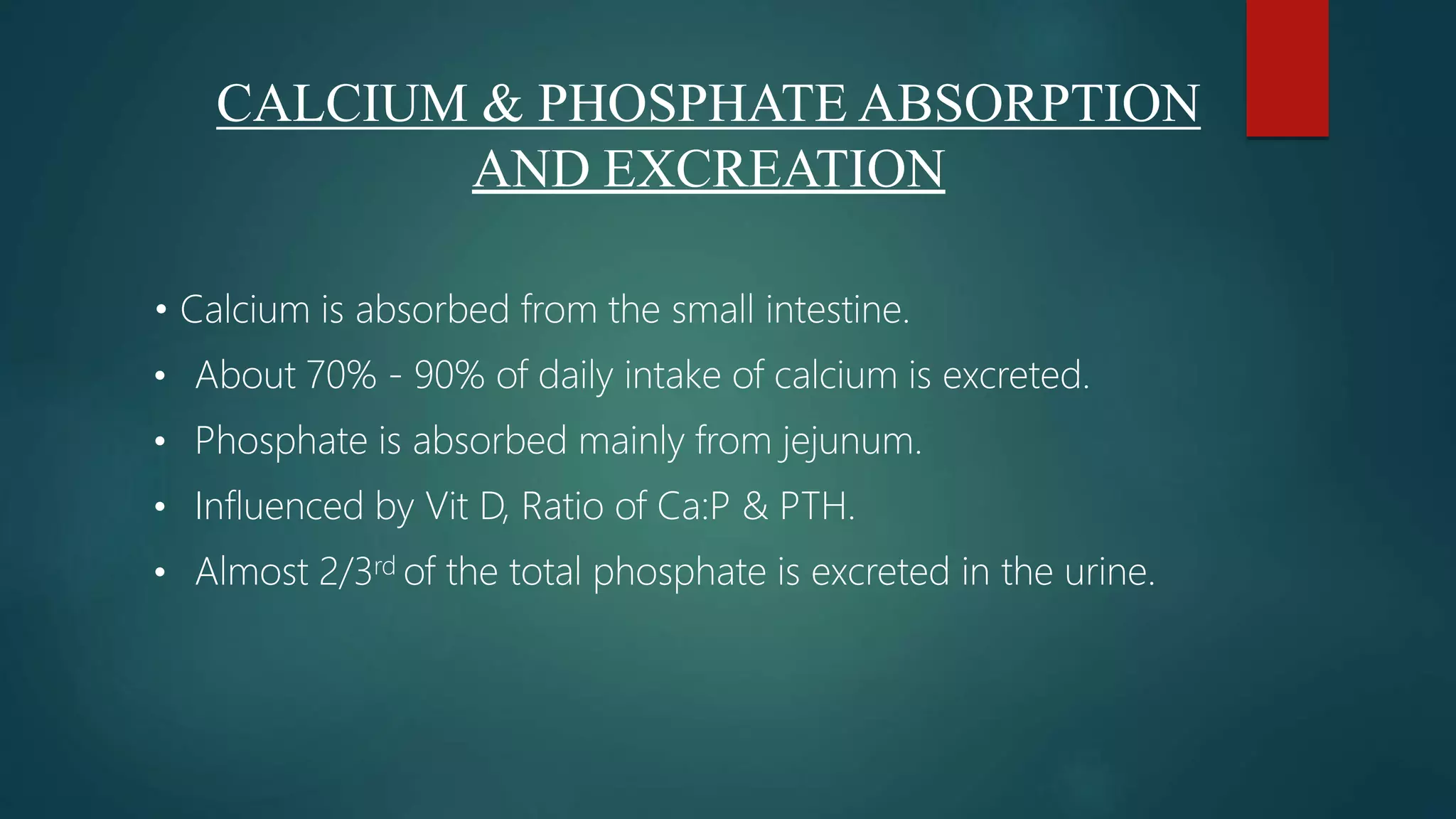
RDA OF PHOSPHATES
Adults-800-1200mg/day
Infants-240mg/day
During pregnancy & lactation-1200mg/ day
SOURCES OF PHOSPHATE
• Calcium is absorbed from the small intestine.
• About 70% - 90% of daily intake of calcium is excreted.
• Phosphate is absorbed mainly from jejunum.
• Influenced by Vit D, Ratio of Ca:P & PTH.
• Almost 2/3rd of the total phosphate is excreted in the urine.
CALCIUM & PHOSPHATE ABSORPTION
AND EXCREATION
FACTORS AFFECTING CALCIUM ABSORPTION
FACTORS INCREASING
ABSORPTION
FACTORS DECREASING ABSORPTION
• Calcitriol (D3)
• PTH
• Acidity (Low PH)
• Protein rich diet
• Growth Hormone
• Pregnancy, Lactation
• Milk sugar (Lactose)
• Oxalates & phytates – form Ca salts
• High dietary fibers
• Excess Phosphates & Magnesium
• Diet rich in fats – Ca soaps
• Chronic renal failure
• Glucocorticoids
REGULATION OF
PLASMA CALCIUM
LEVELS
1. In case of hypocalcemia:
• Activates 25-hydroxy-
cholecaliferol 1-hydroxylase.
• Mobilization of Ca and P
.
• Renal tubular reabsorption.
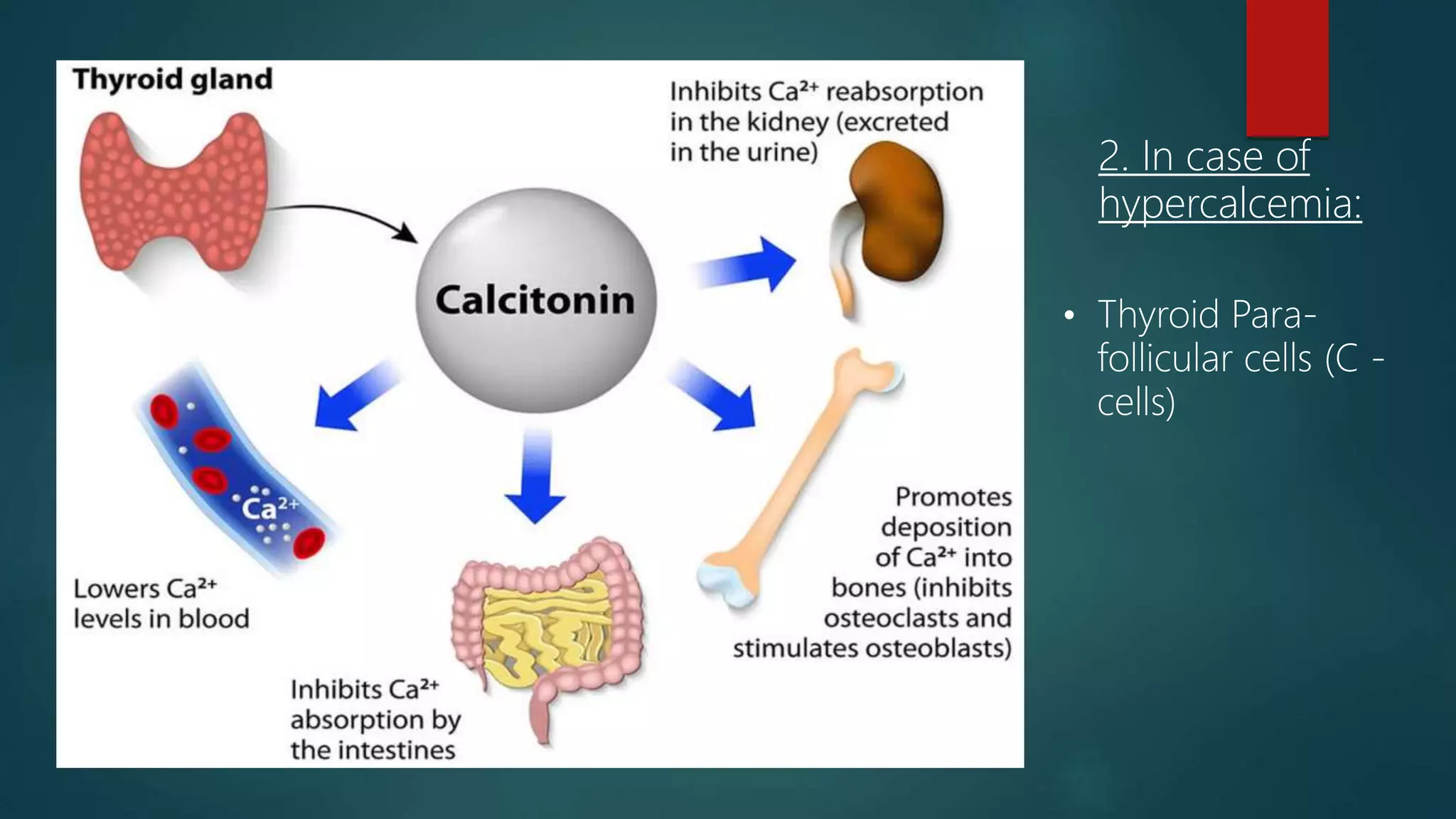
2. In case of
hypercalcemia:
• Thyroid Para-
follicular cells (C -
cells)
REGULATION OF PLASMA PHOSPHATE LEVEL
APPLIED ASPECT
OSTEOPOROSIS
• WHO defines osteoporosis as a bone density
that falls 2.5 standard deviations (SD) below
the mean for young healthy adults of the
same sex— also referred to as a T-score of –
2.5.
• Male to female ratio 1:4.
• More common in post menopausal women.
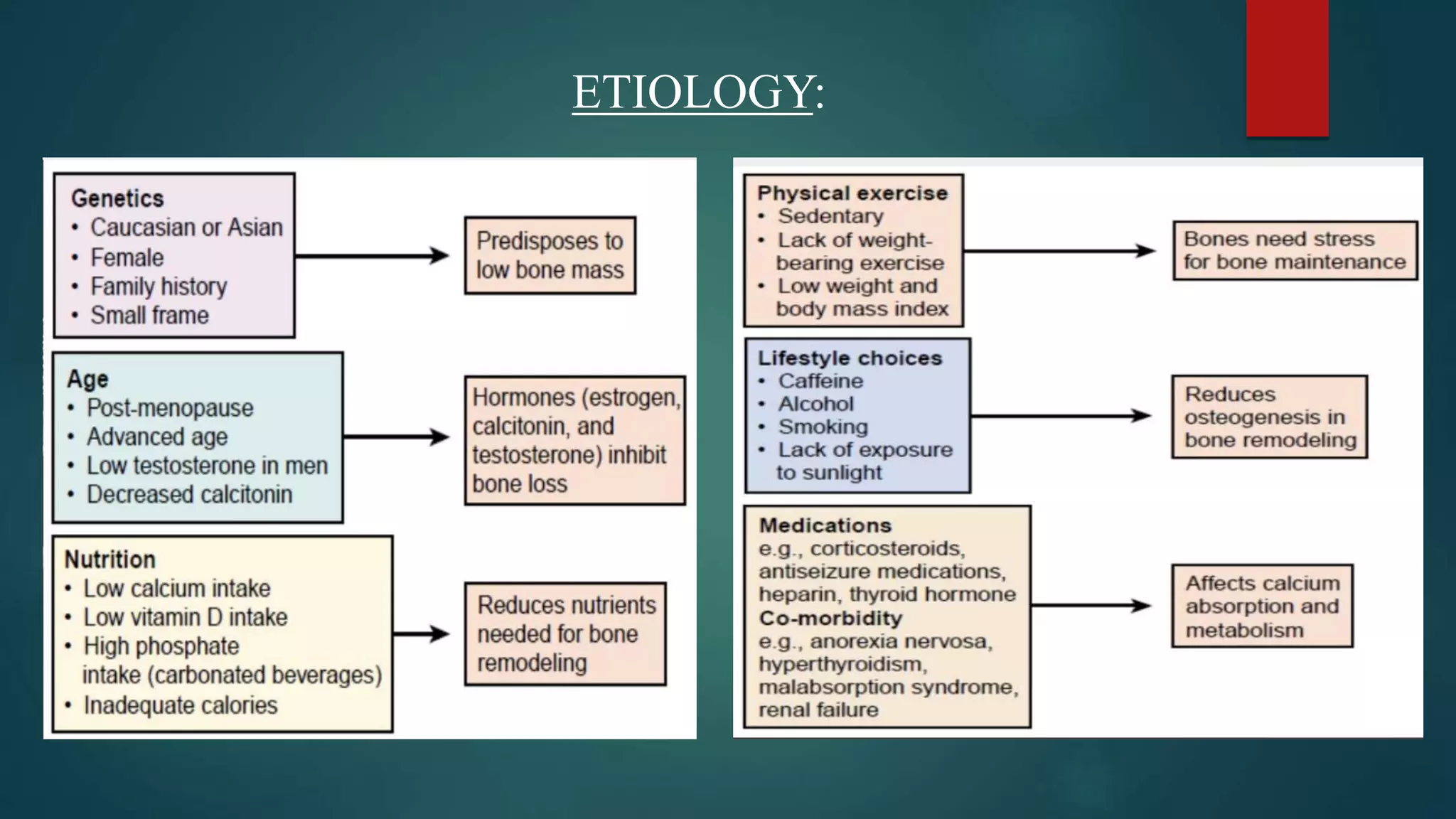
ETIOLOGY:
1. Fracture after minor trauma may
be first indication.
2. Stiffness, Weakness.
3. Back pain: Episodic, acute , low
thoracic/high lumbar pain.
4. Decrease in height
5. Kyphosis
6. Dowager’s hump
7. Early satiety
CLINICAL
MANIFESTATIONS:
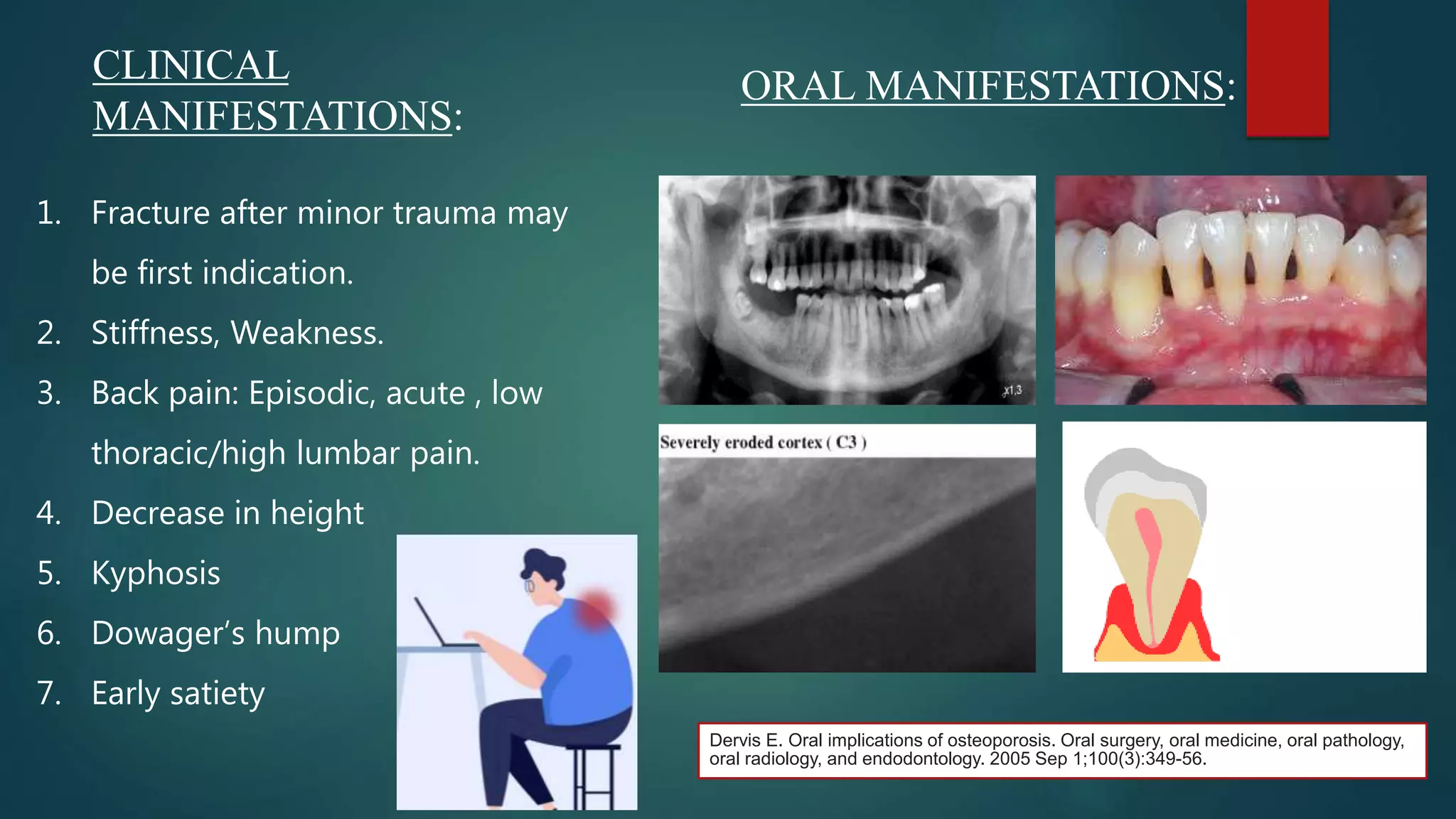
Dervis E. Oral implications of osteoporosis. Oral surgery, oral medicine, oral pathology,
oral radiology, and endodontology. 2005 Sep 1;100(3):349-56.
ORAL MANIFESTATIONS:
TREATMENT:
1. Physical therapy program of gentle exercise and activity.
2. Lifestyle modification.
3. Drug therapy to slow disease progress
4. Supportive devices
5. Surgery
RICKETS
• Characterized by bone deformities due to
incomplete or under-mineralization of bones.
• In rickets, the plasma level of calcitriol is
decreased and alkaline phosphatase activity is
elevated.
 Rickets during the time of tooth formation is
the most common cause of enamel hypoplasia.
 Shelling & Anderson - in rachitic children: 43%
of teeth showed hypoplasia.
ORAL MANIFESTATIONS:
• Enamel hypoplasia of primary
teeth.
• Tooth loss at a young age.
• Recurrent abscesses.
• Delayed eruption and
development.
OSTEOMALACIA
 Demineralization of
preformed bones.
 Women with multiple
pregnancies, lactating
mothers.
 Minimal exposure to sunlight.
 Increased alkaline
phosphatase & PTH.
Clinical features:
• Bone pain and tenderness
• Peculiar waddling or
“penguin”gait
• Tetany
• Greenstick bone fractures
• Myopathy
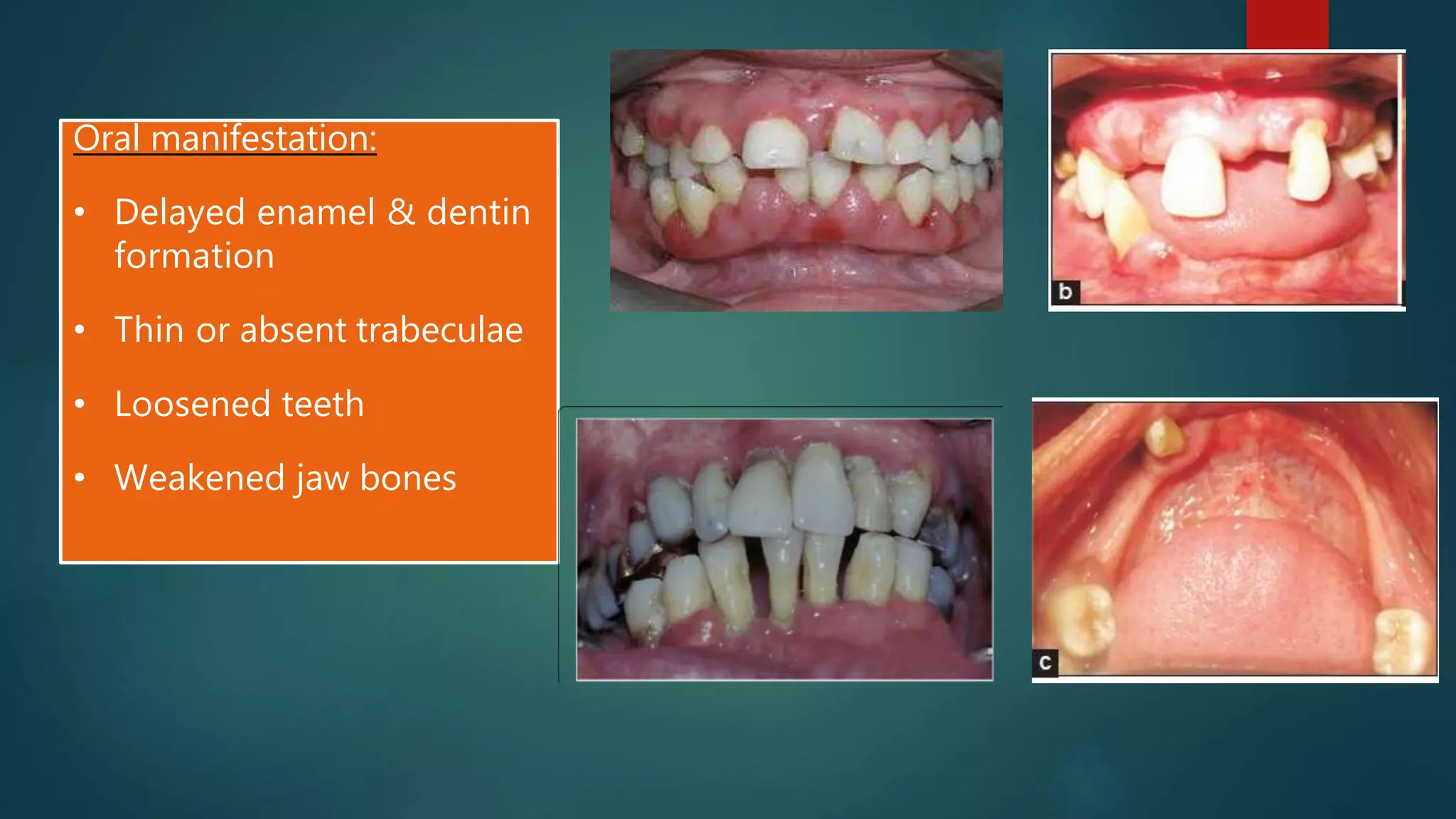
Oral manifestation:
• Delayed enamel & dentin
formation
• Thin or absent trabeculae
• Loosened teeth
• Weakened jaw bones
RENAL RICKETS
 Chronic renal failure
 Calcidiol not converted to calcitriol in kidney.
 Leads to hypocalcemia stimulates PTH bone resorption
 Hypocalcemia & hyperphosphatemia.
 Administration of oral or IV 1, 25-DHCC.
HYPERVITAMINOSIS D
 Early symptoms include nausea, vomiting, anorexia, thirst,
diarrhoea, stupor.
 Marked increase in plasma calcium level.
 Causes calcification of soft tissues & organs.
 Renal stones of calcium oxalate & renal failure.
 Generalised osteoporosis.
HYPOCALCEMIA TETANY
• Plasma Ca2+ <7.5 mg/100ml.
• For each gram decrease of albumin from
normal (i.e., 4.0 mg/100ml), [Ca2+] decreases
by 0.8 mg/100ml.
CAUSES OF HYPOCALCEMIA
• Hypoparathyroidism
• Vitamin D deficiency
• Chronic liver disease and renal
failure
• Medullary carcinoma of thyroid
• Rickets, osteomalacia,
osteoporosis
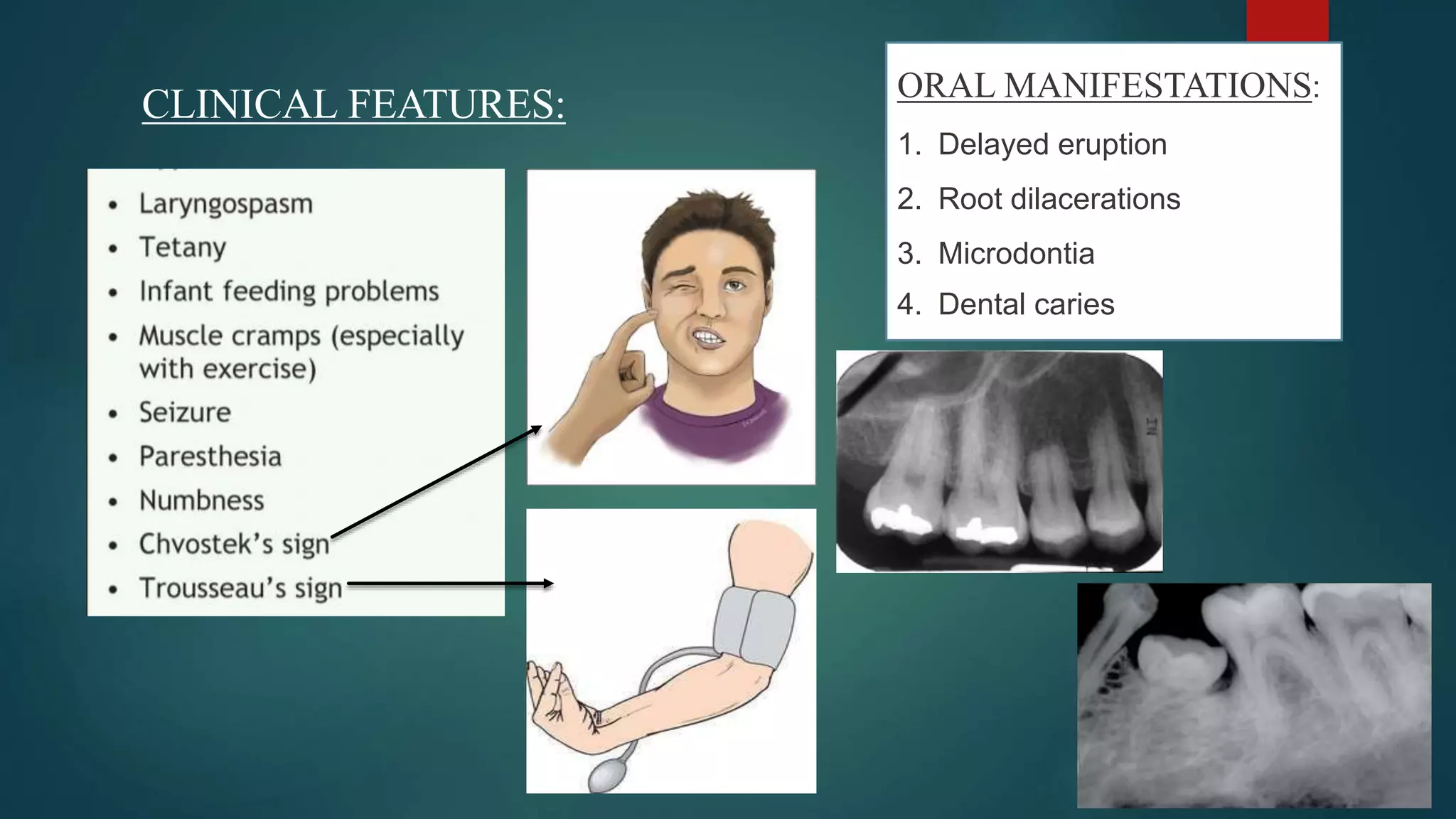
CLINICAL FEATURES: ORAL MANIFESTATIONS:
1. Delayed eruption
2. Root dilacerations
3. Microdontia
4. Dental caries
Calcium gluconate contains 90 mg of elemental calcium per
10 mL ampule, and usually 1 to 2 ampules (180 mg of
elemental calcium) diluted in 50 to 100 mL of 5% dextrose
is infused over 10 minutes.
Oral calcium and vitamin D or an activated vitamin D
metabolite such as calcitriol
TREATMENT:
 <2mg/100ml in rickets.
 Def. of enzyme alkaline phosphatase.
 C/F:
Infantile form Severe
rickets Bone
abnormalities Failure
to thrive
Childhood
Loss of primary teeth
Increased infection Growth
retardation Rachitic like
deformation, lung., renal, GI
disorders
Adult
Spontaneous fracture
HYPOPHOSPHATASIA:
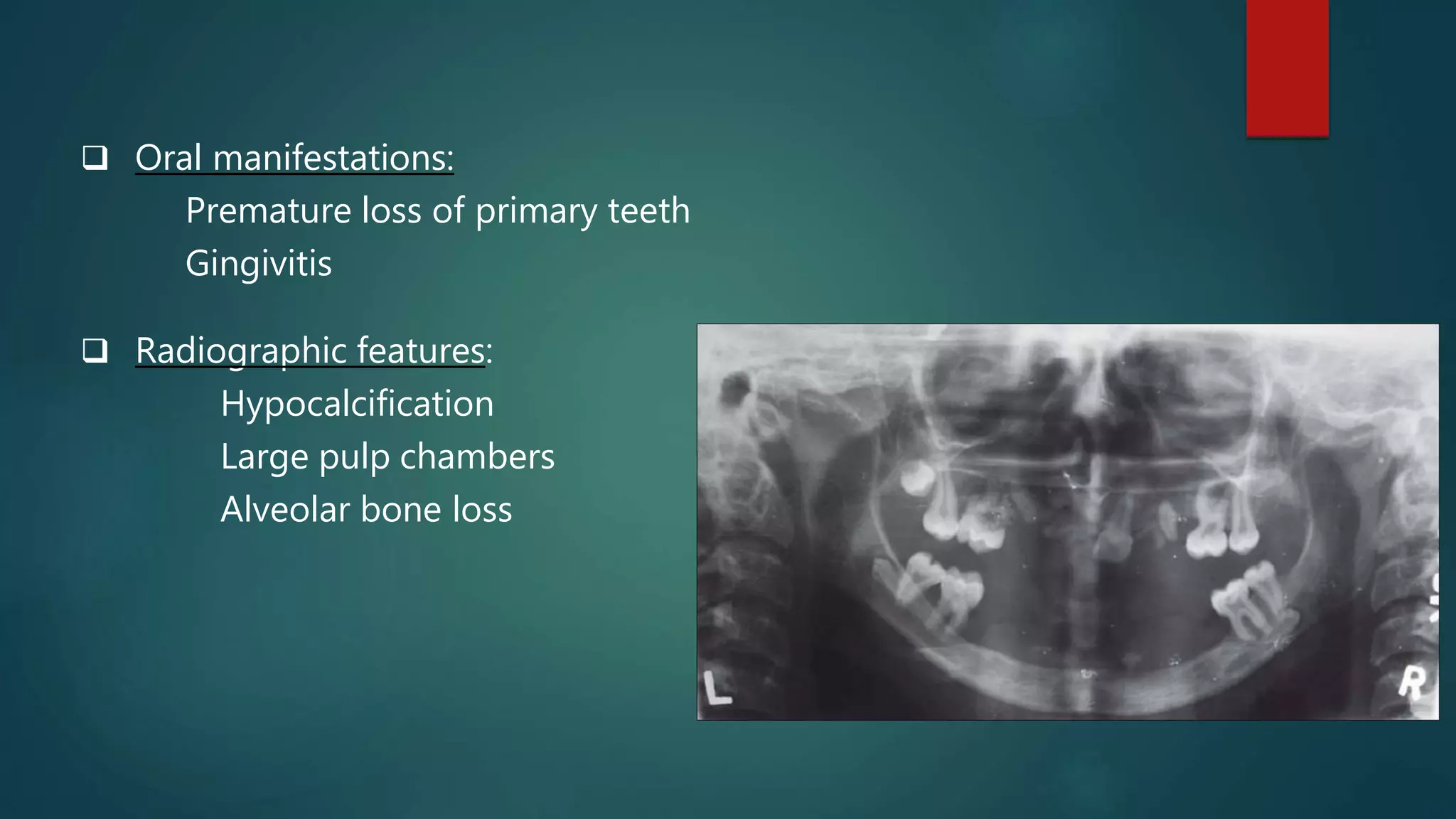
 Oral manifestations:
Premature loss of primary teeth
Gingivitis
 Radiographic features:
Hypocalcification
Large pulp chambers
Alveolar bone loss
HYPERCALCEMIA
• serum Ca2+ >12 mg/100ml in an individual with
normal serum albumin concentration.
CAUSES : Increased absorption
Vitamin D excess
Elevated PTH
Increased bone resorption
Decreased urinary excretion
Paget’s disease and multiple myeloma
CLINICAL FEATURES:
MANAGEMENT OF HYPERCALCEMIA
HYPERPHOSPHATEMIA
• serum phosphorous is >4.5mg/100ml.
• Increased serum P & decreased PTH
CAUSES:
Hypoparathyroidism
Renal failure
Diabetes mellitus
Acromegaly
EFFECTS OF HYPERPHOSPHATAEMIA
1. Rhabdomyolysis
2. Cardiamyopathy
3. Respiratory insufficiency
4. Erythrocyte dysfunction
5. Nervous dysfunction
6. Skeletal dysfunction
7. Metabolic acidosis.
PERIODONTAL DISEASE DUE TO DIETARY CALCIUM
DEFICIENCY AND/ OR DIETARY PHOSPHOROUS
 Henrickson suggested:
High incidence of periodontal disease in natives of India-attributed in part
to their low dietary calcium & phosphate intake.
 Labile for Resorption- Alveolar bone
Vertebrae
Ribs
Long bones
Nutrition and Immunology: Principles and Practice edited by M. Eric Gershwin, J. Bruce German, Carl L. Keen
• Vitamines are organic components while minerals are inorganic
components that are required in our diet for growth and maintenance of
good health.
• Vitamin D regulates the plasma calcium and plasma phosphate levels.
• These elements are interconnected with each other, hence, deficiency of
any one would lead to imbalance in body.
• Vitamin D is considered a calciotropic hormone while cholecalciferol is a
prohormone.
CONCLUSION
• Calcium & phosphate are key elements required in the metabolism
of bone and bone health.
• Deficiency would lead to osteoporosis, rickets, osteomalacia.
• People with lower vitamin D levels had more attachment loss.
• Pregnant women with PD had lower vitamin D levels and were twice
as likely to have vitamin D insufficiency
REFERENCES
1. Guyton’s Textbook of Medical Physiology; 8th edition.
2. Biochemistry by Dr. U Satyanarayana 3rd edition.
3. Textbook of biochemistry with biochemical significance by Prem Prakash
Gupta.
4. Ferguson, John H. (1936). THE BLOOD CALCIUM AND THE CALCIUM
FACTOR IN BLOOD COAGULATION. Physiological Reviews, 16(4), 640–
670.
5. Bolat M, Chiriac MI, Trandafir L, Ciubara A, Diaconescu S. Oral
manifestations of nuritional diseases in children. Romanian Journal of Oral
Rehabilitation. 2016 Apr 1;8(2):56-60.
6. Mizumoto T. Effects of the calcium ion on the wound healing process.
[Hokkaido igaku zasshi] The Hokkaido journal of medical science. 1987
Mar;62(2):332.
VITAMIN D, CALCIUM, PHOSPHATE METABOLISM

VITAMIN D, CALCIUM, PHOSPHATE METABOLISM

  • 1.
  • 2.
    CONTENTS 1. INTRODUCTION 2. VITAMIND INTRODUCTION SYNTHESIS AND REGULATION BIOCHEMICAL FUNCTIONS 3. CALCIUM AND PHOSPHATE INTRODUCTION ROLE SOURCE IN DIET ABSORPTION & EXCRETION REGULATION 4. APPLIED ASPECT 5. CONCLUSION 6. REFERENCES
  • 3.
    INTRODUCTION • "vitamin" comesfrom the Greek word “vita”, means "life". • Reqd in small quantities. • FUNCTIONS: (a) Resistance of the body against diseases. (b) Stimulate and give strength to digestive and nervous system. (c) Convert food into energy, and repair cellular damage. (d) Help strengthen bones, heal wounds, and immune system. VITAMINS:
  • 5.
    MINERALS: Macro Elements Calcium Magnesium Phosphorus Sodium Potassium Chloride Sulfur Trace Elements Iron Iodine Copper Manganese Zinc Molybdenum Selenium Fluoride •Calcification of bone • Blood coagulation • Neuromuscular irritability • Acid-base equilibrium • Fluid & osmotic balance Inorganic components in our diet.
  • 7.
     Fat solublesecosteriods.  Vitamin D2 - ergosterol – in plants  Vitamin D3 – 7-dehydrocholesterol – in animals  Sunshine vitamin. INTRODUCTION PROVITAMINS  Daily requirement - 200 IU or 5 µg 400 IU or 10 µg
  • 8.
    SYNTHESIS • Cholecalciferol ishydroxylated at 25th position to 25-hydroxycholecalciferol by specific 25-hydroxylase present in liver. • Kidney possesses a specific enzyme, 25- hydroxycholecalciferol 1-hydroxylase at position 1 to produce 1,25-DHCC.
  • 9.
  • 10.
    BIOCHEMICAL FUNCTIONS 1. Actionof calcitriol on the intestine : • Calcitriol cytosolic receptor calcitriol receptor complex. • Increased formation of Calbindin, a calcium binding protein. • This protein increases the calcium uptake by the intestine.
  • 11.
    2. Action ofcalcitriol on the bone : • Promotes mineralization of epiphyseal cartilage & osteoid matrix. • Stimulates synthesis of osteocalcin and activity of alkaline phosphatase. • Along with PTH, increases mobilization.
  • 12.
    3. Action ofcalcitriol on the kidney : • Stimulates reabsorption of Calcium & Phosphorus at Distal renal tubular level. • Calcitriol is also minimizes the excretion of calcium and phosphate.
  • 13.
    Vitamin D deficiency:• hypoplasia of enamel • atrophy of salivary glands • facilitates development of dental caries • compromise osseous healing • increased gingival inflammation • tooth loss • Will not produce cathecidin DENTAL IMPLICATIONS
  • 15.
    CALCIUM Adult human contains1.0 – 1.5kg. 99% - bones & teeth Normal plasma level: 9.0 – 11.0mg/100ml. Ionized (50%) Plasma calcium exists: Protein Bound (40%) Complexed (5 – 10%)
  • 16.
    PHOSPHATE  In humanbody Phosphorus is present as phosphates  Adult body contains: 0.7 – 1.0kg.  80-85% in bones and teeth.  Normal plasma level – 4.5 – 6.0mg/100ml infants. 3.0 – 4.0mg/100ml adults. free inorganic (40%)  Plasma phosphate exist: phosphate complexed (50%) protein bound (10%)
  • 17.
    ROLE OF CALCIUMIN BODY  Blood coagulation.  Action on heart.  Secretory activity of glands.  Release of certain hormones like insulin, vasopressin, PTH.
  • 18.
     Key constituentof bone and teeth.  Regulates blood pH.  Forms phospholipids, phosphoproteins & nucleic acid.  Formation and utilization of high energy phosphate compounds.  Phosphorylation. ROLE OF PHOSPHATE
  • 19.
    Best source: Hard cheese Milk Darkgreen leafy vegetables Good source: Broccoli Baked beans Dried legumes Dried figs Fair source: String beans Eggs Bread RDA OF CALCIUM: Averageadult-800mg/day Infants:<1yr - 360-540mg 1-10yr - 800mg 11-18yr -1200mg Duringpregnancy&lactation-1200mg/ day SOURCES OF CALCIUM
  • 20.
    Rich source Milk Fish Poultry Eggs Moderate sources Cereals Pulses Nuts Legumes Meat RDAOF PHOSPHATES Adults-800-1200mg/day Infants-240mg/day During pregnancy & lactation-1200mg/ day SOURCES OF PHOSPHATE
  • 21.
    • Calcium isabsorbed from the small intestine. • About 70% - 90% of daily intake of calcium is excreted. • Phosphate is absorbed mainly from jejunum. • Influenced by Vit D, Ratio of Ca:P & PTH. • Almost 2/3rd of the total phosphate is excreted in the urine. CALCIUM & PHOSPHATE ABSORPTION AND EXCREATION
  • 22.
    FACTORS AFFECTING CALCIUMABSORPTION FACTORS INCREASING ABSORPTION FACTORS DECREASING ABSORPTION • Calcitriol (D3) • PTH • Acidity (Low PH) • Protein rich diet • Growth Hormone • Pregnancy, Lactation • Milk sugar (Lactose) • Oxalates & phytates – form Ca salts • High dietary fibers • Excess Phosphates & Magnesium • Diet rich in fats – Ca soaps • Chronic renal failure • Glucocorticoids
  • 23.
    REGULATION OF PLASMA CALCIUM LEVELS 1.In case of hypocalcemia: • Activates 25-hydroxy- cholecaliferol 1-hydroxylase. • Mobilization of Ca and P . • Renal tubular reabsorption.
  • 24.
    2. In caseof hypercalcemia: • Thyroid Para- follicular cells (C - cells)
  • 25.
    REGULATION OF PLASMAPHOSPHATE LEVEL
  • 26.
  • 27.
    OSTEOPOROSIS • WHO definesosteoporosis as a bone density that falls 2.5 standard deviations (SD) below the mean for young healthy adults of the same sex— also referred to as a T-score of – 2.5. • Male to female ratio 1:4. • More common in post menopausal women.
  • 28.
  • 29.
    1. Fracture afterminor trauma may be first indication. 2. Stiffness, Weakness. 3. Back pain: Episodic, acute , low thoracic/high lumbar pain. 4. Decrease in height 5. Kyphosis 6. Dowager’s hump 7. Early satiety CLINICAL MANIFESTATIONS: Dervis E. Oral implications of osteoporosis. Oral surgery, oral medicine, oral pathology, oral radiology, and endodontology. 2005 Sep 1;100(3):349-56. ORAL MANIFESTATIONS:
  • 30.
    TREATMENT: 1. Physical therapyprogram of gentle exercise and activity. 2. Lifestyle modification. 3. Drug therapy to slow disease progress 4. Supportive devices 5. Surgery
  • 31.
    RICKETS • Characterized bybone deformities due to incomplete or under-mineralization of bones. • In rickets, the plasma level of calcitriol is decreased and alkaline phosphatase activity is elevated.  Rickets during the time of tooth formation is the most common cause of enamel hypoplasia.  Shelling & Anderson - in rachitic children: 43% of teeth showed hypoplasia.
  • 32.
    ORAL MANIFESTATIONS: • Enamelhypoplasia of primary teeth. • Tooth loss at a young age. • Recurrent abscesses. • Delayed eruption and development.
  • 33.
    OSTEOMALACIA  Demineralization of preformedbones.  Women with multiple pregnancies, lactating mothers.  Minimal exposure to sunlight.  Increased alkaline phosphatase & PTH. Clinical features: • Bone pain and tenderness • Peculiar waddling or “penguin”gait • Tetany • Greenstick bone fractures • Myopathy
  • 34.
    Oral manifestation: • Delayedenamel & dentin formation • Thin or absent trabeculae • Loosened teeth • Weakened jaw bones
  • 35.
    RENAL RICKETS  Chronicrenal failure  Calcidiol not converted to calcitriol in kidney.  Leads to hypocalcemia stimulates PTH bone resorption  Hypocalcemia & hyperphosphatemia.  Administration of oral or IV 1, 25-DHCC.
  • 36.
    HYPERVITAMINOSIS D  Earlysymptoms include nausea, vomiting, anorexia, thirst, diarrhoea, stupor.  Marked increase in plasma calcium level.  Causes calcification of soft tissues & organs.  Renal stones of calcium oxalate & renal failure.  Generalised osteoporosis.
  • 37.
    HYPOCALCEMIA TETANY • PlasmaCa2+ <7.5 mg/100ml. • For each gram decrease of albumin from normal (i.e., 4.0 mg/100ml), [Ca2+] decreases by 0.8 mg/100ml.
  • 38.
    CAUSES OF HYPOCALCEMIA •Hypoparathyroidism • Vitamin D deficiency • Chronic liver disease and renal failure • Medullary carcinoma of thyroid • Rickets, osteomalacia, osteoporosis
  • 39.
    CLINICAL FEATURES: ORALMANIFESTATIONS: 1. Delayed eruption 2. Root dilacerations 3. Microdontia 4. Dental caries
  • 40.
    Calcium gluconate contains90 mg of elemental calcium per 10 mL ampule, and usually 1 to 2 ampules (180 mg of elemental calcium) diluted in 50 to 100 mL of 5% dextrose is infused over 10 minutes. Oral calcium and vitamin D or an activated vitamin D metabolite such as calcitriol TREATMENT:
  • 41.
     <2mg/100ml inrickets.  Def. of enzyme alkaline phosphatase.  C/F: Infantile form Severe rickets Bone abnormalities Failure to thrive Childhood Loss of primary teeth Increased infection Growth retardation Rachitic like deformation, lung., renal, GI disorders Adult Spontaneous fracture HYPOPHOSPHATASIA:
  • 42.
     Oral manifestations: Prematureloss of primary teeth Gingivitis  Radiographic features: Hypocalcification Large pulp chambers Alveolar bone loss
  • 43.
    HYPERCALCEMIA • serum Ca2+>12 mg/100ml in an individual with normal serum albumin concentration. CAUSES : Increased absorption Vitamin D excess Elevated PTH Increased bone resorption Decreased urinary excretion Paget’s disease and multiple myeloma
  • 44.
  • 45.
  • 46.
    HYPERPHOSPHATEMIA • serum phosphorousis >4.5mg/100ml. • Increased serum P & decreased PTH CAUSES: Hypoparathyroidism Renal failure Diabetes mellitus Acromegaly EFFECTS OF HYPERPHOSPHATAEMIA 1. Rhabdomyolysis 2. Cardiamyopathy 3. Respiratory insufficiency 4. Erythrocyte dysfunction 5. Nervous dysfunction 6. Skeletal dysfunction 7. Metabolic acidosis.
  • 47.
    PERIODONTAL DISEASE DUETO DIETARY CALCIUM DEFICIENCY AND/ OR DIETARY PHOSPHOROUS  Henrickson suggested: High incidence of periodontal disease in natives of India-attributed in part to their low dietary calcium & phosphate intake.  Labile for Resorption- Alveolar bone Vertebrae Ribs Long bones Nutrition and Immunology: Principles and Practice edited by M. Eric Gershwin, J. Bruce German, Carl L. Keen
  • 48.
    • Vitamines areorganic components while minerals are inorganic components that are required in our diet for growth and maintenance of good health. • Vitamin D regulates the plasma calcium and plasma phosphate levels. • These elements are interconnected with each other, hence, deficiency of any one would lead to imbalance in body. • Vitamin D is considered a calciotropic hormone while cholecalciferol is a prohormone. CONCLUSION
  • 49.
    • Calcium &phosphate are key elements required in the metabolism of bone and bone health. • Deficiency would lead to osteoporosis, rickets, osteomalacia. • People with lower vitamin D levels had more attachment loss. • Pregnant women with PD had lower vitamin D levels and were twice as likely to have vitamin D insufficiency
  • 50.
    REFERENCES 1. Guyton’s Textbookof Medical Physiology; 8th edition. 2. Biochemistry by Dr. U Satyanarayana 3rd edition. 3. Textbook of biochemistry with biochemical significance by Prem Prakash Gupta. 4. Ferguson, John H. (1936). THE BLOOD CALCIUM AND THE CALCIUM FACTOR IN BLOOD COAGULATION. Physiological Reviews, 16(4), 640– 670. 5. Bolat M, Chiriac MI, Trandafir L, Ciubara A, Diaconescu S. Oral manifestations of nuritional diseases in children. Romanian Journal of Oral Rehabilitation. 2016 Apr 1;8(2):56-60. 6. Mizumoto T. Effects of the calcium ion on the wound healing process. [Hokkaido igaku zasshi] The Hokkaido journal of medical science. 1987 Mar;62(2):332.