REGULATION OF C3
PATHWAY
PHOTOSYNTHESIS
 “Synthesis using light.”
 Light energy is converted into chemical energy in the form
of sugar and carbohydrate.
 Occurs in chloroplasts of the cell.
 Involves two reaction which is Light-dependent reaction
and Light-independent reaction.
LIGHT REACTION
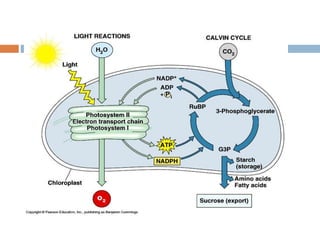
 Occurs on thylakoid which contains antenna pigment.
 The main purpose of the light reaction is to generate
organic energy molecules such as “ATP” and “NADPH”
which are needed for the subsequent dark reaction.
 It consist of four major protein complexes i.e.
Photosystem2 Cytochrome b6f complex Photosystem1
ATPsynthatase
 Chlorophyll pigments are excited and give up their
electrons and to compensate for the loss of electrons,
water is oxidized and protons are released by PS2 in
lumen.
 PS1 reduces NADP to NADPH in stroma
 Protons are also transported from cyt b6f complex for proton
gradient.
 These protons then diffuses into ATP synthase enzyme where
their e.p gradient is used to synthesize ATP.
 Plastoquinone and plastocyanin are electron carrier which
helps in transfering e- to cyt b6f and PS1.
CALVIN CYCLE
 The Calvin cycle is named after Melvin Calvin, who was an
American biochemist.
 Calvin was also awarded wit Nobel prize in Chemistry in
the year 1961.
 Calvin along with James Benson and Andrew Bassham
worked at the University of California, U.S.A.
 They fed Chlorella and Scenedesmus with radioactive 14C
in carbon dioxide and traced their co2 fixation path during
photosynthesis.
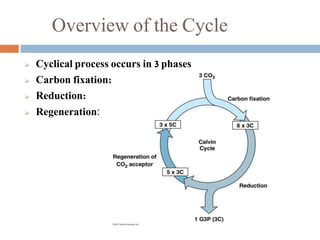
Overview of the Cycle
 Cyclical process occurs in 3 phases
 Carbon fixation:
 Reduction:
 Regeneration:
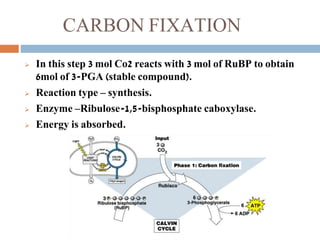
CARBON FIXATION
 In this step 3 mol Co2 reacts with 3 mol of RuBP to obtain
6mol of 3-PGA (stable compound).
 Reaction type – synthesis.
 Enzyme –Ribulose-1,5-bisphosphate caboxylase.
 Energy is absorbed.
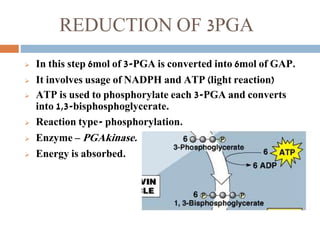
REDUCTION OF 3PGA
 In this step 6mol of 3-PGA is converted into 6mol of GAP.
 It involves usage of NADPH and ATP (light reaction)
 ATP is used to phosphorylate each 3-PGA and converts
into 1,3-bisphosphoglycerate.
 Reaction type- phosphorylation.
 Enzyme – PGAkinase.
 Energy is absorbed.
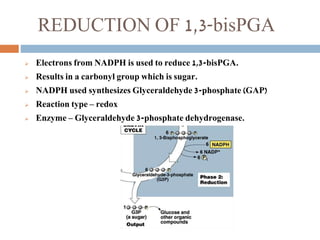
REDUCTION OF 1,3-bisPGA
 Electrons from NADPH is used to reduce 1,3-bisPGA.
 Results in a carbonyl group which is sugar.
 NADPH used synthesizes Glyceraldehyde 3-phosphate (GAP)
 Reaction type – redox
 Enzyme – Glyceraldehyde 3-phosphate dehydrogenase.
REGENERATION
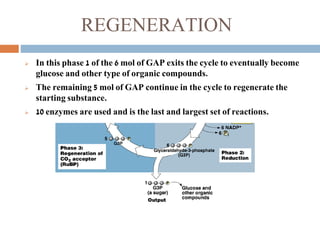
 In this phase 1 of the 6 mol of GAP exits the cycle to eventually become
glucose and other type of organic compounds.
 The remaining 5 mol of GAP continue in the cycle to regenerate the
starting substance.
 10 enzymes are used and is the last and largest set of reactions.
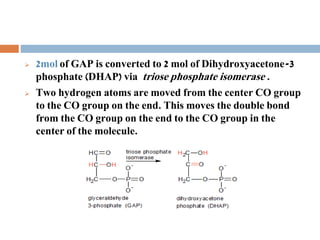
 2mol of GAP is converted to 2 mol of Dihydroxyacetone-3
phosphate (DHAP) via triose phosphate isomerase .
 Two hydrogen atoms are moved from the center CO group
to the CO group on the end. This moves the double bond
from the CO group on the end to the CO group in the
center of the molecule.
 Aldolase catalyzes the aldol condensation of 3rd mol of
GAP with 1 mol of DHAP, yielding a six carbon sugar
fructose1,6-bisphosphate (FBP).
 FBP is then hydrolyzed to fructose-6-phosphate (F6-P) via
fbpase.
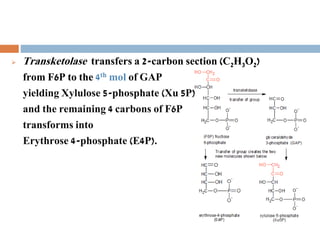
 Transketolase transfers a 2-carbon section (C2H3O2)
from F6P to the 4th mol of GAP
yielding Xylulose 5-phosphate (Xu 5P)
and the remaining 4 carbons of F6P
transforms into
Erythrose 4-phosphate (E4P).
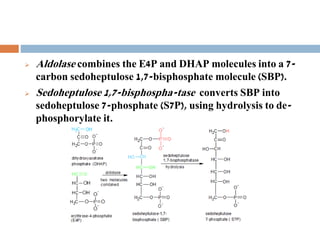
 Aldolase combines the E4P and DHAP molecules into a 7-
carbon sedoheptulose 1,7-bisphosphate molecule (SBP).
 Sedoheptulose 1,7-bisphospha-tase converts SBP into
sedoheptulose 7-phosphate (S7P), using hydrolysis to de-
phosphorylate it.
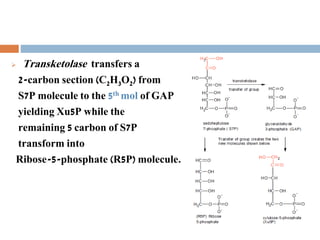
 Transketolase transfers a
2-carbon section (C2H3O2) from
S7P molecule to the 5th mol of GAP
yielding Xu5P while the
remaining 5 carbon of S7P
transform into
Ribose-5-phosphate (R5P) molecule.
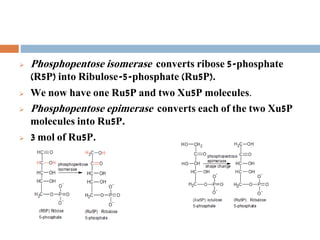
 Phosphopentose isomerase converts ribose 5-phosphate
(R5P) into Ribulose-5-phosphate (Ru5P).
 We now have one Ru5P and two Xu5P molecules.
 Phosphopentose epimerase converts each of the two Xu5P
molecules into Ru5P.
 3 mol of Ru5P.
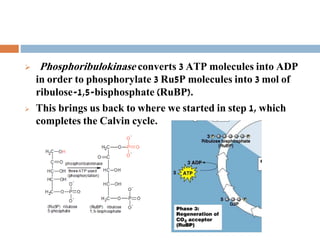
 Phosphoribulokinase converts 3 ATP molecules into ADP
in order to phosphorylate 3 Ru5P molecules into 3 mol of
ribulose-1,5-bisphosphate (RuBP).
 This brings us back to where we started in step 1, which
completes the Calvin cycle.
CONCLUSION
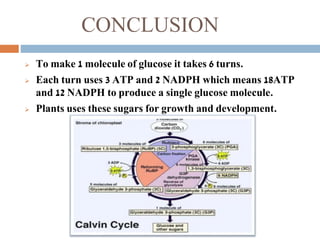
 To make 1 molecule of glucose it takes 6 turns.
 Each turn uses 3 ATP and 2 NADPH which means 18ATP
and 12 NADPH to produce a single glucose molecule.
 Plants uses these sugars for growth and development.
REFERENCE
 Plants Physiology by Taiz and Zeiger
 Introductory Plant Physiology by G. Ray Noggle
and George J. Fritz
 Plants Physiology by S.N Pandey and B.K Sinha
C3 pathway in plants.

C3 pathway in plants.

  • 1.
  • 2.
    PHOTOSYNTHESIS  “Synthesis usinglight.”  Light energy is converted into chemical energy in the form of sugar and carbohydrate.  Occurs in chloroplasts of the cell.  Involves two reaction which is Light-dependent reaction and Light-independent reaction.
  • 3.
    LIGHT REACTION  Occurson thylakoid which contains antenna pigment.  The main purpose of the light reaction is to generate organic energy molecules such as “ATP” and “NADPH” which are needed for the subsequent dark reaction.  It consist of four major protein complexes i.e. Photosystem2 Cytochrome b6f complex Photosystem1 ATPsynthatase  Chlorophyll pigments are excited and give up their electrons and to compensate for the loss of electrons, water is oxidized and protons are released by PS2 in lumen.
  • 4.
     PS1 reducesNADP to NADPH in stroma  Protons are also transported from cyt b6f complex for proton gradient.  These protons then diffuses into ATP synthase enzyme where their e.p gradient is used to synthesize ATP.  Plastoquinone and plastocyanin are electron carrier which helps in transfering e- to cyt b6f and PS1.
  • 6.
    CALVIN CYCLE  TheCalvin cycle is named after Melvin Calvin, who was an American biochemist.  Calvin was also awarded wit Nobel prize in Chemistry in the year 1961.  Calvin along with James Benson and Andrew Bassham worked at the University of California, U.S.A.  They fed Chlorella and Scenedesmus with radioactive 14C in carbon dioxide and traced their co2 fixation path during photosynthesis.
  • 7.
    Overview of theCycle  Cyclical process occurs in 3 phases  Carbon fixation:  Reduction:  Regeneration:
  • 8.
    CARBON FIXATION  Inthis step 3 mol Co2 reacts with 3 mol of RuBP to obtain 6mol of 3-PGA (stable compound).  Reaction type – synthesis.  Enzyme –Ribulose-1,5-bisphosphate caboxylase.  Energy is absorbed.
  • 9.
    REDUCTION OF 3PGA In this step 6mol of 3-PGA is converted into 6mol of GAP.  It involves usage of NADPH and ATP (light reaction)  ATP is used to phosphorylate each 3-PGA and converts into 1,3-bisphosphoglycerate.  Reaction type- phosphorylation.  Enzyme – PGAkinase.  Energy is absorbed.
  • 10.
    REDUCTION OF 1,3-bisPGA Electrons from NADPH is used to reduce 1,3-bisPGA.  Results in a carbonyl group which is sugar.  NADPH used synthesizes Glyceraldehyde 3-phosphate (GAP)  Reaction type – redox  Enzyme – Glyceraldehyde 3-phosphate dehydrogenase.
  • 11.
    REGENERATION  In thisphase 1 of the 6 mol of GAP exits the cycle to eventually become glucose and other type of organic compounds.  The remaining 5 mol of GAP continue in the cycle to regenerate the starting substance.  10 enzymes are used and is the last and largest set of reactions.
  • 12.
     2mol ofGAP is converted to 2 mol of Dihydroxyacetone-3 phosphate (DHAP) via triose phosphate isomerase .  Two hydrogen atoms are moved from the center CO group to the CO group on the end. This moves the double bond from the CO group on the end to the CO group in the center of the molecule.
  • 13.
     Aldolase catalyzesthe aldol condensation of 3rd mol of GAP with 1 mol of DHAP, yielding a six carbon sugar fructose1,6-bisphosphate (FBP).  FBP is then hydrolyzed to fructose-6-phosphate (F6-P) via fbpase.
  • 14.
     Transketolase transfersa 2-carbon section (C2H3O2) from F6P to the 4th mol of GAP yielding Xylulose 5-phosphate (Xu 5P) and the remaining 4 carbons of F6P transforms into Erythrose 4-phosphate (E4P).
  • 15.
     Aldolase combinesthe E4P and DHAP molecules into a 7- carbon sedoheptulose 1,7-bisphosphate molecule (SBP).  Sedoheptulose 1,7-bisphospha-tase converts SBP into sedoheptulose 7-phosphate (S7P), using hydrolysis to de- phosphorylate it.
  • 16.
     Transketolase transfersa 2-carbon section (C2H3O2) from S7P molecule to the 5th mol of GAP yielding Xu5P while the remaining 5 carbon of S7P transform into Ribose-5-phosphate (R5P) molecule.
  • 17.
     Phosphopentose isomeraseconverts ribose 5-phosphate (R5P) into Ribulose-5-phosphate (Ru5P).  We now have one Ru5P and two Xu5P molecules.  Phosphopentose epimerase converts each of the two Xu5P molecules into Ru5P.  3 mol of Ru5P.
  • 18.
     Phosphoribulokinase converts3 ATP molecules into ADP in order to phosphorylate 3 Ru5P molecules into 3 mol of ribulose-1,5-bisphosphate (RuBP).  This brings us back to where we started in step 1, which completes the Calvin cycle.
  • 19.
    CONCLUSION  To make1 molecule of glucose it takes 6 turns.  Each turn uses 3 ATP and 2 NADPH which means 18ATP and 12 NADPH to produce a single glucose molecule.  Plants uses these sugars for growth and development.
  • 20.
    REFERENCE  Plants Physiologyby Taiz and Zeiger  Introductory Plant Physiology by G. Ray Noggle and George J. Fritz  Plants Physiology by S.N Pandey and B.K Sinha