PLANT PHYSIOLOGY
BOT-232
C4 PATHWAY
Lecture- 3rd
By
Prof. SD Tidke
Modern CABT, Pune
C4 PATHWAY
• Up to 1965, it was believed that the fixation of co2 photosynthesis
of higher plants and algae takes place only by benson calvin cycle,
but kort schak, Hartt and Burr (1965) demonstrated with the use
of c12o2 that in sugarcane leaves the chief synthesized labelled
product are c4- dicarboxylic acid like malate, aspartate etc.
• Their observations were confirmed by M. D. Hatch and C. R
Slack (1966).
• They told that during photosynthesis in sugarcane leaves 4-
carbon substance like oxaloacetate, malate and aspartate are
synthesised within a very short time.
• Later on, these observations have been confirmed in other
monocotyladonous plants like Zea Mays, Sorghum, panicum maximum
and Cyperus and some dicotyledonous plants like Amaranthus and
Atriplex etc.
• Thus, this cycle occurs in the members of cyperaceae and some
dicotyledonus plants in addition to members of graminae.
• This cycle was named after the discovers as Hatch-Slack cycle. It is
also called as β carboxylation pathway.
• The first stable compound Hatch-Slack cycle is 4-carbon oxaloacetic
acid. Therefore, it is called c4-cycle.
• Such plants which possess c4 cycle are called c4 plants.
C4 PLANTS
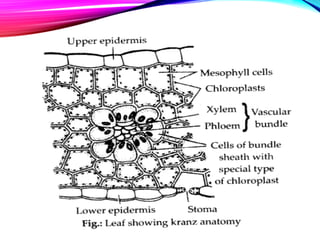
 The leaves of c4 plants possess special anatomy kranz type.
• The vascular elements in c4 leaves remain surrounded by a layer of
bundle sheath cells containing chloroplast in abundance.
• The bundle sheath is surrunded one to three layers of mesophyll cells
which possess very small intercellular space.
 The chloroplats in c4 leaves are dimorphic i.e, distinctly of two types
• the chloroplasts of mesophyll cella are of normal type,
• the chloroplasts of bundle sheath cells are comparatively quite larger
in size, without grana or PS -2 but contain starch grains and
arranged centripetally.
 PEP carboxylase enzyme occurs in mesophyll cells.
 C4 cycle is performed in mesophyll cells while c3 cycle is performed in cells of
bundle sheath.
 They possess two types of co2 acceptor –
• phosphoenol pyruvate which occurs in the mesophyll cells,
• Ribulose diphosphate (RuDP) which occurs in the bundle sheath cells.
 In them, the first stable compound formed is oxloacetic acid
 C4 plants are found in tropical and subtropical regions.
 They grow fast at high temperature and in more light intensities. Therefore,
c4 plants are called efficient plants. The optimum temperature for their
growth varies from 30 to 45˚C.
 In C4 plants, the O2 has no inhibitory effect.
 They lack photo- respiration.
HOW ARE C4 PLANTS
DIFFERENT FROM C3 PLANTS?
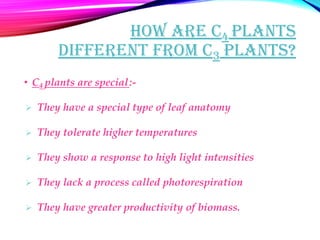
• C4 plants are special:-
 They have a special type of leaf anatomy
 They tolerate higher temperatures
 They show a response to high light intensities
 They lack a process called photorespiration
 They have greater productivity of biomass.
HATCH AND SLACK
PATHWAY
 Reaction of Hatch & Slack cycle:
Hatch & Slack cycle is completed in the chloroplasts of mesophyll cells and bundle
sheath cells following reactions occur during this cycle.
 Reaction occurring in the chloroplast of mesophyll cell.
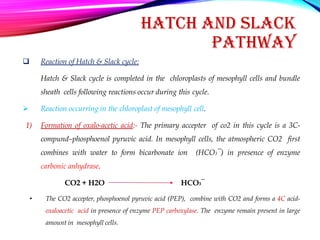
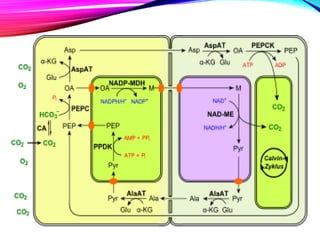
1) Formation of oxalo-acetic acid:- The primary accepter of co2 in this cycle is a 3C-
compund–phosphoenol pyruvic acid. In mesophyll cells, the atmospheric CO2 first
combines with water to form bicarbonate ion (HCO3¯) in presence of enzyme
carbonic anhydrase.
CO2 + H2O HCO3¯
• The CO2 accepter, phosphoenol pyruvic acid (PEP), combine with CO2 and forms a 4C acid-
oxaloacetic acid in presence of enzyme PEP carboxylase. The enzyme remain present in large
amount in mesophyll cells.
2) Formation of malic acid and aspartic acid :-
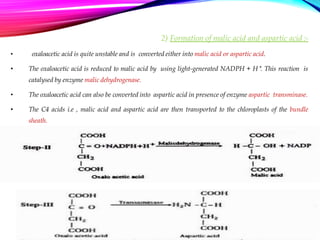
• oxaloacetic acid is quite unstable and is converted either into malic acid or aspartic acid.
• The oxaloacetic acid is reduced to malic acid by using light-generated NADPH + H⁺. This reaction is
catalysed by enzyme malic dehydrogenase.
• The oxaloacetic acid can also be converted into aspartic acid in presence of enzyme aspartic transminase.
• The C4 acids i.e , malic acid and aspartic acid are then transported to the chloroplasts of the bundle
sheath.
Reaction occurring in bundle sheath chloroplast:-
• 3) Formation of pyruvic acid-
• In bundle sheath chloroplast, the malic acid undergoes
oxidative decarboxylation to yield pyruvic acid and CO2 in
presence of malic enzyme.
4) The CO2 and NADP + H⁺, produced by oxidative decarboxylation of
malic enter into calvin cycle. The co2 combines with ribulose
diphosphates (RuDP) to yield 2 molecules of phosphoglyceric acid
(PGA)
• CO2 + RuDP 2 Mols. PGA.
5) In a few C4 plants the aspartic acid undergoes transmination to form
oxaloacetic acid which is then decarboxylated to pyruvic acid. This
reaction is catalysed by aspartate transminase.
• L-Aspartic acid oxaloacetic acid pyruvic acid
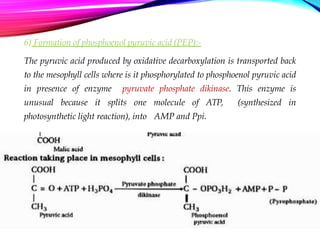
6) Formation of phosphoenol pyruvic acid (PEP):-
The pyruvic acid produced by oxidative decarboxylation is transported back
to the mesophyll cells where is it phosphorylated to phosphoenol pyruvic acid
in presence of enzyme pyruvate phosphate dikinase. This enzyme is
unusual because it splits one molecule of ATP, (synthesized in
photosynthetic light reaction), into AMP and Ppi.
SIGNIFICATION OF C4 CYCLE
• In C4 plants, it increase the photosynthetic yield two to
three times more than c3 plants.
• In C4 plants, it performs a high rate of photosynthesis even
when the stomata are nearly closed.
• It increase the adaptability of C4 plants to high temperature
and light intensities.
• They can very well grow in saline soils because of presence
of C4 organic acid.
C4 Pathway
C4 Pathway

C4 Pathway

  • 1.
    PLANT PHYSIOLOGY BOT-232 C4 PATHWAY Lecture-3rd By Prof. SD Tidke Modern CABT, Pune
  • 2.
    C4 PATHWAY • Upto 1965, it was believed that the fixation of co2 photosynthesis of higher plants and algae takes place only by benson calvin cycle, but kort schak, Hartt and Burr (1965) demonstrated with the use of c12o2 that in sugarcane leaves the chief synthesized labelled product are c4- dicarboxylic acid like malate, aspartate etc. • Their observations were confirmed by M. D. Hatch and C. R Slack (1966). • They told that during photosynthesis in sugarcane leaves 4- carbon substance like oxaloacetate, malate and aspartate are synthesised within a very short time.
  • 3.
    • Later on,these observations have been confirmed in other monocotyladonous plants like Zea Mays, Sorghum, panicum maximum and Cyperus and some dicotyledonous plants like Amaranthus and Atriplex etc. • Thus, this cycle occurs in the members of cyperaceae and some dicotyledonus plants in addition to members of graminae. • This cycle was named after the discovers as Hatch-Slack cycle. It is also called as β carboxylation pathway. • The first stable compound Hatch-Slack cycle is 4-carbon oxaloacetic acid. Therefore, it is called c4-cycle. • Such plants which possess c4 cycle are called c4 plants.
  • 4.
    C4 PLANTS  Theleaves of c4 plants possess special anatomy kranz type. • The vascular elements in c4 leaves remain surrounded by a layer of bundle sheath cells containing chloroplast in abundance. • The bundle sheath is surrunded one to three layers of mesophyll cells which possess very small intercellular space.  The chloroplats in c4 leaves are dimorphic i.e, distinctly of two types • the chloroplasts of mesophyll cella are of normal type, • the chloroplasts of bundle sheath cells are comparatively quite larger in size, without grana or PS -2 but contain starch grains and arranged centripetally.  PEP carboxylase enzyme occurs in mesophyll cells.
  • 5.
     C4 cycleis performed in mesophyll cells while c3 cycle is performed in cells of bundle sheath.  They possess two types of co2 acceptor – • phosphoenol pyruvate which occurs in the mesophyll cells, • Ribulose diphosphate (RuDP) which occurs in the bundle sheath cells.  In them, the first stable compound formed is oxloacetic acid  C4 plants are found in tropical and subtropical regions.  They grow fast at high temperature and in more light intensities. Therefore, c4 plants are called efficient plants. The optimum temperature for their growth varies from 30 to 45˚C.  In C4 plants, the O2 has no inhibitory effect.  They lack photo- respiration.
  • 8.
    HOW ARE C4PLANTS DIFFERENT FROM C3 PLANTS? • C4 plants are special:-  They have a special type of leaf anatomy  They tolerate higher temperatures  They show a response to high light intensities  They lack a process called photorespiration  They have greater productivity of biomass.
  • 9.
    HATCH AND SLACK PATHWAY Reaction of Hatch & Slack cycle: Hatch & Slack cycle is completed in the chloroplasts of mesophyll cells and bundle sheath cells following reactions occur during this cycle.  Reaction occurring in the chloroplast of mesophyll cell. 1) Formation of oxalo-acetic acid:- The primary accepter of co2 in this cycle is a 3C- compund–phosphoenol pyruvic acid. In mesophyll cells, the atmospheric CO2 first combines with water to form bicarbonate ion (HCO3¯) in presence of enzyme carbonic anhydrase. CO2 + H2O HCO3¯ • The CO2 accepter, phosphoenol pyruvic acid (PEP), combine with CO2 and forms a 4C acid- oxaloacetic acid in presence of enzyme PEP carboxylase. The enzyme remain present in large amount in mesophyll cells.
  • 11.
    2) Formation ofmalic acid and aspartic acid :- • oxaloacetic acid is quite unstable and is converted either into malic acid or aspartic acid. • The oxaloacetic acid is reduced to malic acid by using light-generated NADPH + H⁺. This reaction is catalysed by enzyme malic dehydrogenase. • The oxaloacetic acid can also be converted into aspartic acid in presence of enzyme aspartic transminase. • The C4 acids i.e , malic acid and aspartic acid are then transported to the chloroplasts of the bundle sheath.
  • 12.
    Reaction occurring inbundle sheath chloroplast:- • 3) Formation of pyruvic acid- • In bundle sheath chloroplast, the malic acid undergoes oxidative decarboxylation to yield pyruvic acid and CO2 in presence of malic enzyme.
  • 13.
    4) The CO2and NADP + H⁺, produced by oxidative decarboxylation of malic enter into calvin cycle. The co2 combines with ribulose diphosphates (RuDP) to yield 2 molecules of phosphoglyceric acid (PGA) • CO2 + RuDP 2 Mols. PGA. 5) In a few C4 plants the aspartic acid undergoes transmination to form oxaloacetic acid which is then decarboxylated to pyruvic acid. This reaction is catalysed by aspartate transminase. • L-Aspartic acid oxaloacetic acid pyruvic acid
  • 14.
    6) Formation ofphosphoenol pyruvic acid (PEP):- The pyruvic acid produced by oxidative decarboxylation is transported back to the mesophyll cells where is it phosphorylated to phosphoenol pyruvic acid in presence of enzyme pyruvate phosphate dikinase. This enzyme is unusual because it splits one molecule of ATP, (synthesized in photosynthetic light reaction), into AMP and Ppi.
  • 16.
    SIGNIFICATION OF C4CYCLE • In C4 plants, it increase the photosynthetic yield two to three times more than c3 plants. • In C4 plants, it performs a high rate of photosynthesis even when the stomata are nearly closed. • It increase the adaptability of C4 plants to high temperature and light intensities. • They can very well grow in saline soils because of presence of C4 organic acid.