Content….
 Introduction
 Characater of CAM plant
 Overview of CAM :a two- part cycle
A. During the night
B. During the day
 CAM pathway
 The benefits of CAM
Introduction
 The CAM (Crassulacean Acid Metabolism ) occurs in
hundreds of species in 20 families of angiosperms.
 Some of these families are liliaceae, crassulaceae,
euphorbiaceae.
 It has been reported that though CAM is genetically
controlled it is sometimes affected by changes in the
surrounding environment.
What is CAM ?
 It is a carbon fixation pathway present in some
plants. also known as CAM photosynthesi.
 These plants fix carbon dioxide (CO2) during the
night, storing it as the four carbon acid malate.
 The CO2 is released during the day, where it is
concentrated around the enzyme RuBisCO,
increasing the efficiency of photosynthesis.
Character of CAM plant
 CAM can be considered an adaptation to arid conditions.
 CAM plants often display other xerophytic characters,
such as thick, reduced leaves with a low surface area-to-
volume ratio; thick cuticle; and stomata sunken into pits
 Some shed their leaves during the day season; others store
water in vacuoles.
Overview of CAM :a two -part cycle
a. During the night
 The CAM plan's stomata are open,
allowing CO2 to enter and be
fixated as organic acids (malate
)that are stored in vacuoles.
 The carbon dioxide is fixed in the
mesophyll cell's cytoplasm by a
PEP (phosphoenolPuruvic acid
)reaction.
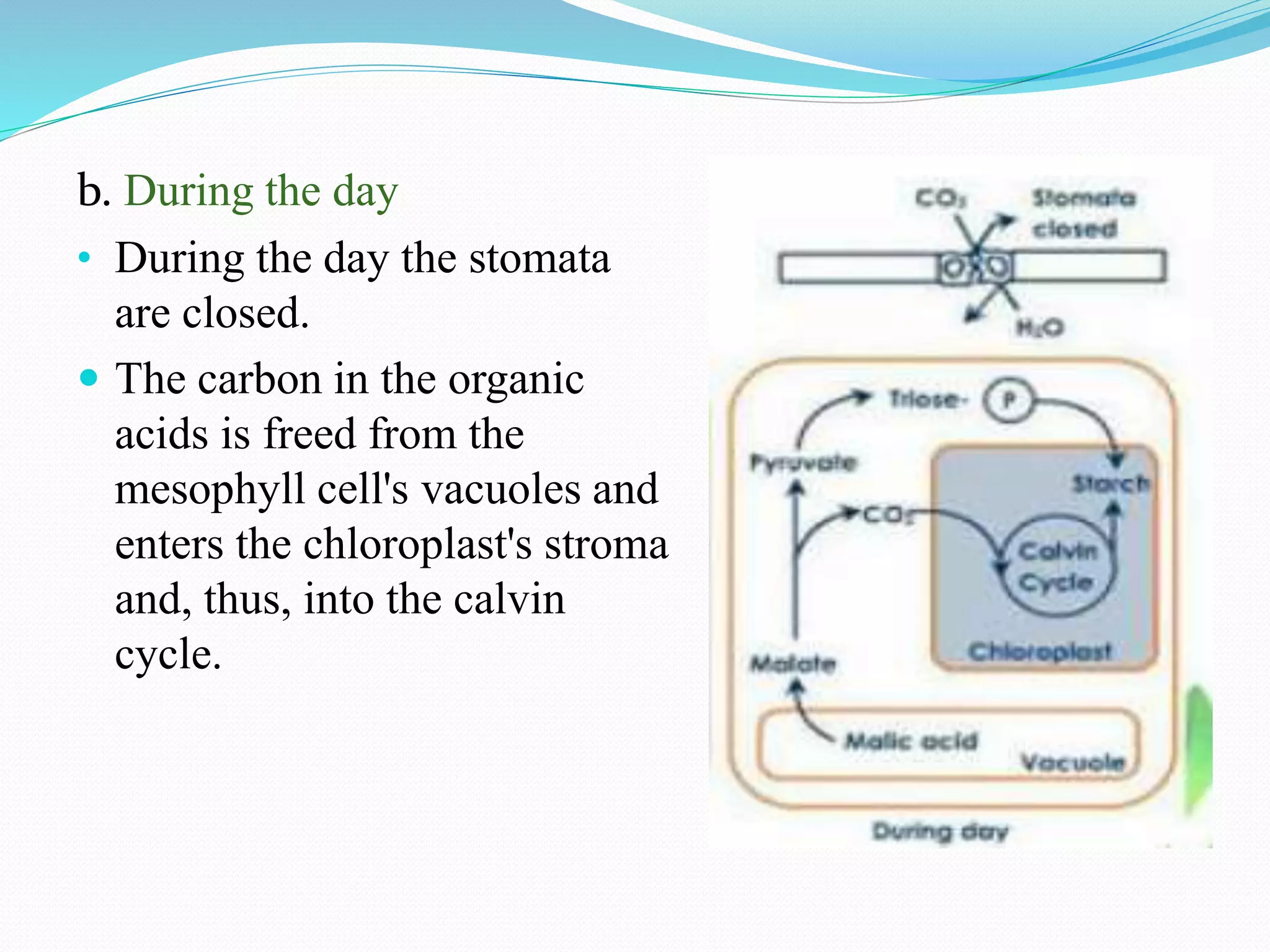
b. During the day
• During the day the stomata
are closed.
 The carbon in the organic
acids is freed from the
mesophyll cell's vacuoles and
enters the chloroplast's stroma
and, thus, into the calvin
cycle.
CAM pathway
 These plants have adopted organic acid metabolism at
night and have the normal photosynthesis during the
day.
 the stomata are kept open during night to trap
atmospheric CO2 and are closed during the day to
avoid the adverse effects of transpiration.
 During night time the phosphoenol pyruvic acid
produced in glycolysis reacts with CO2 in the presence
of the enzyme PEP carboxylase to produce oxaloacetic
acid .
 The oxaloacetic acid is then reduced to malate by the enzyme
malic acid dehydrogenase.
 The malate is converted into malic acid by gaining 2H+ ions.
 Malic acid enters the vacuole and gets stored there.
 Some of the species contain citric and isometric acid as well.
 Following reactions occur within the guard cells during the
night time.
 During the day time the malic acid is decarboxylated by
one of the three reactions shows below :
The benefits of CAM
 The most important benefit to the plant is the ability to
leave most leaf stomata closed during the day.
 Being able to keep stomata closed during the hottest and
dried part of the day reduces the loss of water through
evapotranspiration, allowing CAM plants to grow in
environments that would otherwise be far too dry.
Reference
 V. V. VERMA
PLANT PHYSIOLOGY
 WWW.WIKIPEDIA.COM
Cam pathway

Cam pathway

  • 2.
    Content….  Introduction  Characaterof CAM plant  Overview of CAM :a two- part cycle A. During the night B. During the day  CAM pathway  The benefits of CAM
  • 3.
    Introduction  The CAM(Crassulacean Acid Metabolism ) occurs in hundreds of species in 20 families of angiosperms.  Some of these families are liliaceae, crassulaceae, euphorbiaceae.  It has been reported that though CAM is genetically controlled it is sometimes affected by changes in the surrounding environment.
  • 4.
    What is CAM?  It is a carbon fixation pathway present in some plants. also known as CAM photosynthesi.  These plants fix carbon dioxide (CO2) during the night, storing it as the four carbon acid malate.  The CO2 is released during the day, where it is concentrated around the enzyme RuBisCO, increasing the efficiency of photosynthesis.
  • 5.
  • 6.
     CAM canbe considered an adaptation to arid conditions.  CAM plants often display other xerophytic characters, such as thick, reduced leaves with a low surface area-to- volume ratio; thick cuticle; and stomata sunken into pits  Some shed their leaves during the day season; others store water in vacuoles.
  • 7.
    Overview of CAM:a two -part cycle a. During the night  The CAM plan's stomata are open, allowing CO2 to enter and be fixated as organic acids (malate )that are stored in vacuoles.  The carbon dioxide is fixed in the mesophyll cell's cytoplasm by a PEP (phosphoenolPuruvic acid )reaction.
  • 8.
    b. During theday • During the day the stomata are closed.  The carbon in the organic acids is freed from the mesophyll cell's vacuoles and enters the chloroplast's stroma and, thus, into the calvin cycle.
  • 9.
    CAM pathway  Theseplants have adopted organic acid metabolism at night and have the normal photosynthesis during the day.  the stomata are kept open during night to trap atmospheric CO2 and are closed during the day to avoid the adverse effects of transpiration.  During night time the phosphoenol pyruvic acid produced in glycolysis reacts with CO2 in the presence of the enzyme PEP carboxylase to produce oxaloacetic acid .
  • 10.
     The oxaloaceticacid is then reduced to malate by the enzyme malic acid dehydrogenase.  The malate is converted into malic acid by gaining 2H+ ions.  Malic acid enters the vacuole and gets stored there.  Some of the species contain citric and isometric acid as well.  Following reactions occur within the guard cells during the night time.
  • 14.
     During theday time the malic acid is decarboxylated by one of the three reactions shows below :
  • 15.
    The benefits ofCAM  The most important benefit to the plant is the ability to leave most leaf stomata closed during the day.  Being able to keep stomata closed during the hottest and dried part of the day reduces the loss of water through evapotranspiration, allowing CAM plants to grow in environments that would otherwise be far too dry.
  • 16.
    Reference  V. V.VERMA PLANT PHYSIOLOGY  WWW.WIKIPEDIA.COM