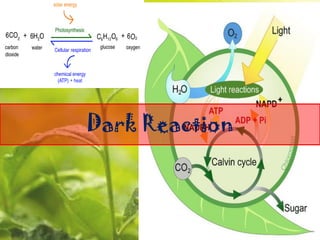
Dark Reaction
What Is Photosynthesis?
• Photosynthesis is a chemical process that converts carbon
dioxide into organic compounds, especially sugars, using
the energy from sunlight
• Photosynthesis occurs in plants, algae, and many species
of bacteria. Photosynthetic organisms are called
photoautotrophs, since they can create their own food. In
plants, algae, and cyanobacteria, photosynthesis uses
carbon dioxide and water, releasing oxygen as a product.
• Photosynthesis is also the source of the carbon in all the
organic compounds within organisms' bodies
Overall Perspective
• Light reactions:
– Harvest light energy
– Convert light energy to
chemical energy
• Dark Reactions:
– Expend chemical energy
– Fix Carbon [convert CO2
to organic form]
At the end of the Light Reactions
• The reaction of the light reaction is:
– CO2 +H2O (CH2O) + O2
• Recent estimates indicate that about 200 billion
tones of CO2 are converted to biomass each year.
– 40 % of this is from marine phytoplankton
– The bulk of the carbon is incorporated into organic
compounds by the carbon reducing reactions (dark
reactions) of photosynthesis
At the end of the light reactions
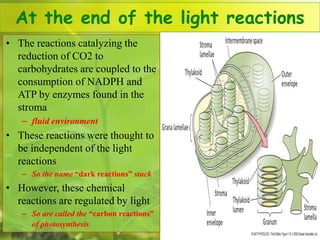
• The reactions catalyzing the
reduction of CO2 to
carbohydrates are coupled to the
consumption of NADPH and
ATP by enzymes found in the
stroma
– fluid environment
• These reactions were thought to
be independent of the light
reactions
– So the name “dark reactions” stuck
• However, these chemical
reactions are regulated by light
– So are called the “carbon reactions”
of photosynthesis
Dark Reaction
It is process of photosynthesis , happen after
light reaction.
Dark reaction reduce the CO2 to form
carbohydrates.
Called light-independent reaction , no need
direct light to perform it. But direct depend
upon light reaction.
Occurs in the stroma of the chloroplast when
the products of light reaction (ATP,NADPH) are
used to make glyceraldehyde 3-phosphate
from reductoin of carbon dioxide.
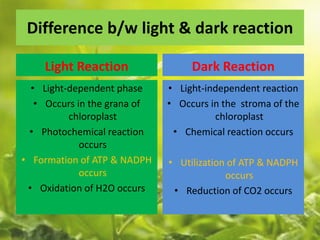
Difference b/w light & dark reaction
Light Reaction
• Light-dependent phase
• Occurs in the grana of
chloroplast
• Photochemical reaction
occurs
• Formation of ATP & NADPH
occurs
• Oxidation of H2O occurs
Dark Reaction
• Light-independent reaction
• Occurs in the stroma of the
chloroplast
• Chemical reaction occurs
• Utilization of ATP & NADPH
occurs
• Reduction of CO2 occurs
Dark reaction
• Dark reaction reduce CO2 to form
carbohydrates by three pathways-
• Calvin cycle (mainly)
• C4 cycle (alternative pathway)
• CAM pathways (alternative)
Overview of the carbon reactions
• The Calvin cycle:
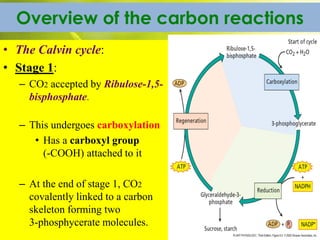
• Stage 1:
– CO2 accepted by Ribulose-1,5-
bisphosphate.
– This undergoes carboxylation
• Has a carboxyl group
(-COOH) attached to it
– At the end of stage 1, CO2
covalently linked to a carbon
skeleton forming two
3-phosphycerate molecules.
Carboxylation: The first step is the
most important
• Step 1: The enzyme RUBISCO (Ribulose bis-phosphate carboxylase
oxygenase) carries out this conversion
• Rubisco accounts for 40% of the protein content of chloroplasts
– is likely the most abundant protein on Earth
• Rubisco is, in fact, very inefficient, and that a mechanism has evolved
to deal with this handicap
Overview of the carbon reactions
• The Calvin cycle:
• Stage 2:
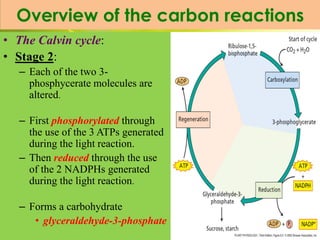
– Each of the two 3-
phosphycerate molecules are
altered.
– First phosphorylated through
the use of the 3 ATPs generated
during the light reaction.
– Then reduced through the use
of the 2 NADPHs generated
during the light reaction.
– Forms a carbohydrate
• glyceraldehyde-3-phosphate
3-phosphycerate molecules are altered
• First phosphorylated through the use of the 3 ATP molecules
generated during the light reaction
– Forms 1,3-bisphosphoglycerate
• Then reduced through the use of the 2 NADPH molecules generated
during the light reaction
– Forms glyceraldehyde-3-phosphate
• Note the formation of triose phosphate
Overview of the carbon reactions
• The Calvin cycle:
• Stage 3:
– Regeneration of Ribulose-1,5-
bisphosphate.
– This requires the coordinated
action of eight reaction steps
• And thus eight specific enzymes
– Three molecules of Ribulose-1,5-
bisphosphate are formed from
the reshuffling of carbon atoms
from triose phosphate.
Regeneration of
Ribulose-1,5-bisphosphate
• The Calvin cycle reactions regenerate the
biochemical intermediates needed for operation
• More importantly, the cycle is Autocatalytic
– Rate of operation can be enhanced by increasing the
concentration of the intermediates in the cycle
• So, Calvin cycle has the metabolically desirable
of producing more substrate than is consumed
– Works as long as the produced triose phosphate is
NOT diverted elsewhere (as in times of stress or
disease)
Overview of the carbon reactions
• The Calvin cycle:
• The cycle runs six times:
– Each time incorporating a new
carbon . Those six carbon
dioxides are reduced to glucose:
– Glucose can now serve as a
building block to make:
• polysaccharides
• other monosaccharides
• fats
• amino acids
• nucleotides
Only one-sixth of the triose phosphate is
used for polysaccharide production
• Synthesis of polysaccharides, such as starch and
sucrose, provide a sink
– Ensures an adequate flow of carbon atoms through
the cycle IF CO2 is constantly available
• During a steady rate of photosynthesis 5/6 of the
triose phosphates are used for the regeneration of
Ribulose-1,5-bisphosphate
• 1/6 is transported to the cytosol for the synthesis
of sucrose or other metabolites that are converted
to starch in the chloroplast
Regulation of the Calvin cycle
• The high energy efficiency of the Calvin cycle
indicates that some form of regulation ensures that
all intermediates in cycle:
– Are present at adequate concentrations
– The cycle is turned off when it is not needed in the dark
• Many factors regulate the Calvin cycle
Regulation of the Calvin cycle
• 1: The pH of the stroma increases as protons are
pumped out of it through the membrane assembly of
the light reactions.
– The enzymes of the Calvin Cycle function better at this
higher pH.
• 2: The reactions of the Calvin cycle have to stop
when they run out of substrate
– as photosynthesis stops, there is no more ATP or
NADPH in the stroma for the dark reactions to take
place.
Regulation of the Calvin cycle
• 3: The light reactions increase the permeability of
the stromal membrane to required cofactors
– Mg ions are required for the Calvin Cycle.
• 4: Several enzymes of the Calvin Cycle are
activated by the breaking of disulphide bridges of
enzymes involved in the working of the cycle.
– the activity of the light reactions is communicated to the
dark reactions by an enzyme intermediate
Alternative Pathways
Plants that fix carbon exclusively through the
Calvin Cycle- C3 Plants
Because of the 3-C compound PGA, that is initially
formed.
Example: Rice, wheat, oats, and soybeans
Alternative Pathways
Plants in hot, dry climates use alternative
pathways to reduced oxygenation of RuBp
Plant lose H2O to the air-through small pores
called stomata (underside of leaf)
Can be partially closed to prevent water loss
Stomata are the major passageways through
which CO2 enters and O2 leaves
(when stomata are closed CO2 levels decrease and
O2 levels increase)
C4 cycle
Alternative mode of carbon fixation to
minimize photorespiration & optimize calvin
cycle leads to concentrates CO2 at the site of
carboxylation,keeping the CO2 conc.high for
RuBisco to bind CO2 rather than O2.
In C4 cycle ,1st product is made 4 carbon acid
so named C4 cycle.
Discovered by Hatch & Slack, so called hatch-
slack pathway.
C4 cycle
Plants that have C4 cycle are called C4 plants,
include monocots & dicots , dominates in
Gramineae (corn,sugarcane), chenopodiaceae
(atriplex) etc.
In C4 plants have two distinct type of
photosynthesis cells-
1) mesophyll cell
2) bundle sheath cell
The basic C4 cycle involves 4 stages in 2 different
cells
C4 cycle
CO2 reacts to PEP and fix into 4-carbon
compound malate in mesophyll cell.
Now malate is transported into bundle sheath
by diffusion.
In bundle sheath, decarboxylation of malate
occurred and relesed CO2 and pyruvate.here
CO2 is used by calvin cycle and pyruvate go
back to mesophyll cell.
In mesophyll cell,pyruvate is converted into
PEP.ATP dependent step.C4 cycle isATP-driven
CO2 enrichment
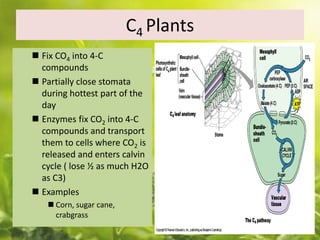
C4 Plants
 Fix CO4 into 4-C
compounds
 Partially close stomata
during hottest part of the
day
 Enzymes fix CO2 into 4-C
compounds and transport
them to cells where CO2 is
released and enters calvin
cycle ( lose ½ as much H2O
as C3)
 Examples
 Corn, sugar cane,
crabgrass
Crassulacean Acid Metabolism (CAM)
Photosynthetic adaptation in succulent plants ,
alternative pathway of CO2 fixation
Succulent plants-
- known as fat plants.
- xerophytic plants adapted to arid climates.
- store water in their leaves.
- Exam-cacti
-open stomata during light & close durin day.
CAM Pathway
 During night-stomata open-these plants take uo
CO2.
 Assimilation of CO2 occurs into malic acid at night
which is stored in the vacuole.this mode of
carbon fixation is called crassulacean acid
metabolism or CAM.
 During day time-stomata close & light reactions
can supply ATP and NADH for the calvin cycle,CO2
is released from the Acid in the mesophyll cell
 in CAM plants, the two steps occur at separate
times,but within the same cell.
CAM Pathways

Dark reaction

  • 1.
  • 2.
  • 3.
    • Photosynthesis isa chemical process that converts carbon dioxide into organic compounds, especially sugars, using the energy from sunlight • Photosynthesis occurs in plants, algae, and many species of bacteria. Photosynthetic organisms are called photoautotrophs, since they can create their own food. In plants, algae, and cyanobacteria, photosynthesis uses carbon dioxide and water, releasing oxygen as a product. • Photosynthesis is also the source of the carbon in all the organic compounds within organisms' bodies
  • 4.
    Overall Perspective • Lightreactions: – Harvest light energy – Convert light energy to chemical energy • Dark Reactions: – Expend chemical energy – Fix Carbon [convert CO2 to organic form]
  • 5.
    At the endof the Light Reactions • The reaction of the light reaction is: – CO2 +H2O (CH2O) + O2 • Recent estimates indicate that about 200 billion tones of CO2 are converted to biomass each year. – 40 % of this is from marine phytoplankton – The bulk of the carbon is incorporated into organic compounds by the carbon reducing reactions (dark reactions) of photosynthesis
  • 6.
    At the endof the light reactions • The reactions catalyzing the reduction of CO2 to carbohydrates are coupled to the consumption of NADPH and ATP by enzymes found in the stroma – fluid environment • These reactions were thought to be independent of the light reactions – So the name “dark reactions” stuck • However, these chemical reactions are regulated by light – So are called the “carbon reactions” of photosynthesis
  • 7.
    Dark Reaction It isprocess of photosynthesis , happen after light reaction. Dark reaction reduce the CO2 to form carbohydrates. Called light-independent reaction , no need direct light to perform it. But direct depend upon light reaction. Occurs in the stroma of the chloroplast when the products of light reaction (ATP,NADPH) are used to make glyceraldehyde 3-phosphate from reductoin of carbon dioxide.
  • 8.
    Difference b/w light& dark reaction Light Reaction • Light-dependent phase • Occurs in the grana of chloroplast • Photochemical reaction occurs • Formation of ATP & NADPH occurs • Oxidation of H2O occurs Dark Reaction • Light-independent reaction • Occurs in the stroma of the chloroplast • Chemical reaction occurs • Utilization of ATP & NADPH occurs • Reduction of CO2 occurs
  • 9.
    Dark reaction • Darkreaction reduce CO2 to form carbohydrates by three pathways- • Calvin cycle (mainly) • C4 cycle (alternative pathway) • CAM pathways (alternative)
  • 10.
    Overview of thecarbon reactions • The Calvin cycle: • Stage 1: – CO2 accepted by Ribulose-1,5- bisphosphate. – This undergoes carboxylation • Has a carboxyl group (-COOH) attached to it – At the end of stage 1, CO2 covalently linked to a carbon skeleton forming two 3-phosphycerate molecules.
  • 11.
    Carboxylation: The firststep is the most important • Step 1: The enzyme RUBISCO (Ribulose bis-phosphate carboxylase oxygenase) carries out this conversion • Rubisco accounts for 40% of the protein content of chloroplasts – is likely the most abundant protein on Earth • Rubisco is, in fact, very inefficient, and that a mechanism has evolved to deal with this handicap
  • 12.
    Overview of thecarbon reactions • The Calvin cycle: • Stage 2: – Each of the two 3- phosphycerate molecules are altered. – First phosphorylated through the use of the 3 ATPs generated during the light reaction. – Then reduced through the use of the 2 NADPHs generated during the light reaction. – Forms a carbohydrate • glyceraldehyde-3-phosphate
  • 13.
    3-phosphycerate molecules arealtered • First phosphorylated through the use of the 3 ATP molecules generated during the light reaction – Forms 1,3-bisphosphoglycerate • Then reduced through the use of the 2 NADPH molecules generated during the light reaction – Forms glyceraldehyde-3-phosphate • Note the formation of triose phosphate
  • 14.
    Overview of thecarbon reactions • The Calvin cycle: • Stage 3: – Regeneration of Ribulose-1,5- bisphosphate. – This requires the coordinated action of eight reaction steps • And thus eight specific enzymes – Three molecules of Ribulose-1,5- bisphosphate are formed from the reshuffling of carbon atoms from triose phosphate.
  • 15.
    Regeneration of Ribulose-1,5-bisphosphate • TheCalvin cycle reactions regenerate the biochemical intermediates needed for operation • More importantly, the cycle is Autocatalytic – Rate of operation can be enhanced by increasing the concentration of the intermediates in the cycle • So, Calvin cycle has the metabolically desirable of producing more substrate than is consumed – Works as long as the produced triose phosphate is NOT diverted elsewhere (as in times of stress or disease)
  • 16.
    Overview of thecarbon reactions • The Calvin cycle: • The cycle runs six times: – Each time incorporating a new carbon . Those six carbon dioxides are reduced to glucose: – Glucose can now serve as a building block to make: • polysaccharides • other monosaccharides • fats • amino acids • nucleotides
  • 17.
    Only one-sixth ofthe triose phosphate is used for polysaccharide production • Synthesis of polysaccharides, such as starch and sucrose, provide a sink – Ensures an adequate flow of carbon atoms through the cycle IF CO2 is constantly available • During a steady rate of photosynthesis 5/6 of the triose phosphates are used for the regeneration of Ribulose-1,5-bisphosphate • 1/6 is transported to the cytosol for the synthesis of sucrose or other metabolites that are converted to starch in the chloroplast
  • 18.
    Regulation of theCalvin cycle • The high energy efficiency of the Calvin cycle indicates that some form of regulation ensures that all intermediates in cycle: – Are present at adequate concentrations – The cycle is turned off when it is not needed in the dark • Many factors regulate the Calvin cycle
  • 19.
    Regulation of theCalvin cycle • 1: The pH of the stroma increases as protons are pumped out of it through the membrane assembly of the light reactions. – The enzymes of the Calvin Cycle function better at this higher pH. • 2: The reactions of the Calvin cycle have to stop when they run out of substrate – as photosynthesis stops, there is no more ATP or NADPH in the stroma for the dark reactions to take place.
  • 20.
    Regulation of theCalvin cycle • 3: The light reactions increase the permeability of the stromal membrane to required cofactors – Mg ions are required for the Calvin Cycle. • 4: Several enzymes of the Calvin Cycle are activated by the breaking of disulphide bridges of enzymes involved in the working of the cycle. – the activity of the light reactions is communicated to the dark reactions by an enzyme intermediate
  • 21.
    Alternative Pathways Plants thatfix carbon exclusively through the Calvin Cycle- C3 Plants Because of the 3-C compound PGA, that is initially formed. Example: Rice, wheat, oats, and soybeans
  • 22.
    Alternative Pathways Plants inhot, dry climates use alternative pathways to reduced oxygenation of RuBp Plant lose H2O to the air-through small pores called stomata (underside of leaf) Can be partially closed to prevent water loss Stomata are the major passageways through which CO2 enters and O2 leaves (when stomata are closed CO2 levels decrease and O2 levels increase)
  • 23.
    C4 cycle Alternative modeof carbon fixation to minimize photorespiration & optimize calvin cycle leads to concentrates CO2 at the site of carboxylation,keeping the CO2 conc.high for RuBisco to bind CO2 rather than O2. In C4 cycle ,1st product is made 4 carbon acid so named C4 cycle. Discovered by Hatch & Slack, so called hatch- slack pathway.
  • 24.
    C4 cycle Plants thathave C4 cycle are called C4 plants, include monocots & dicots , dominates in Gramineae (corn,sugarcane), chenopodiaceae (atriplex) etc. In C4 plants have two distinct type of photosynthesis cells- 1) mesophyll cell 2) bundle sheath cell The basic C4 cycle involves 4 stages in 2 different cells
  • 25.
    C4 cycle CO2 reactsto PEP and fix into 4-carbon compound malate in mesophyll cell. Now malate is transported into bundle sheath by diffusion. In bundle sheath, decarboxylation of malate occurred and relesed CO2 and pyruvate.here CO2 is used by calvin cycle and pyruvate go back to mesophyll cell. In mesophyll cell,pyruvate is converted into PEP.ATP dependent step.C4 cycle isATP-driven CO2 enrichment
  • 26.
    C4 Plants  FixCO4 into 4-C compounds  Partially close stomata during hottest part of the day  Enzymes fix CO2 into 4-C compounds and transport them to cells where CO2 is released and enters calvin cycle ( lose ½ as much H2O as C3)  Examples  Corn, sugar cane, crabgrass
  • 27.
    Crassulacean Acid Metabolism(CAM) Photosynthetic adaptation in succulent plants , alternative pathway of CO2 fixation Succulent plants- - known as fat plants. - xerophytic plants adapted to arid climates. - store water in their leaves. - Exam-cacti -open stomata during light & close durin day.
  • 28.
    CAM Pathway  Duringnight-stomata open-these plants take uo CO2.  Assimilation of CO2 occurs into malic acid at night which is stored in the vacuole.this mode of carbon fixation is called crassulacean acid metabolism or CAM.  During day time-stomata close & light reactions can supply ATP and NADH for the calvin cycle,CO2 is released from the Acid in the mesophyll cell  in CAM plants, the two steps occur at separate times,but within the same cell.
  • 29.