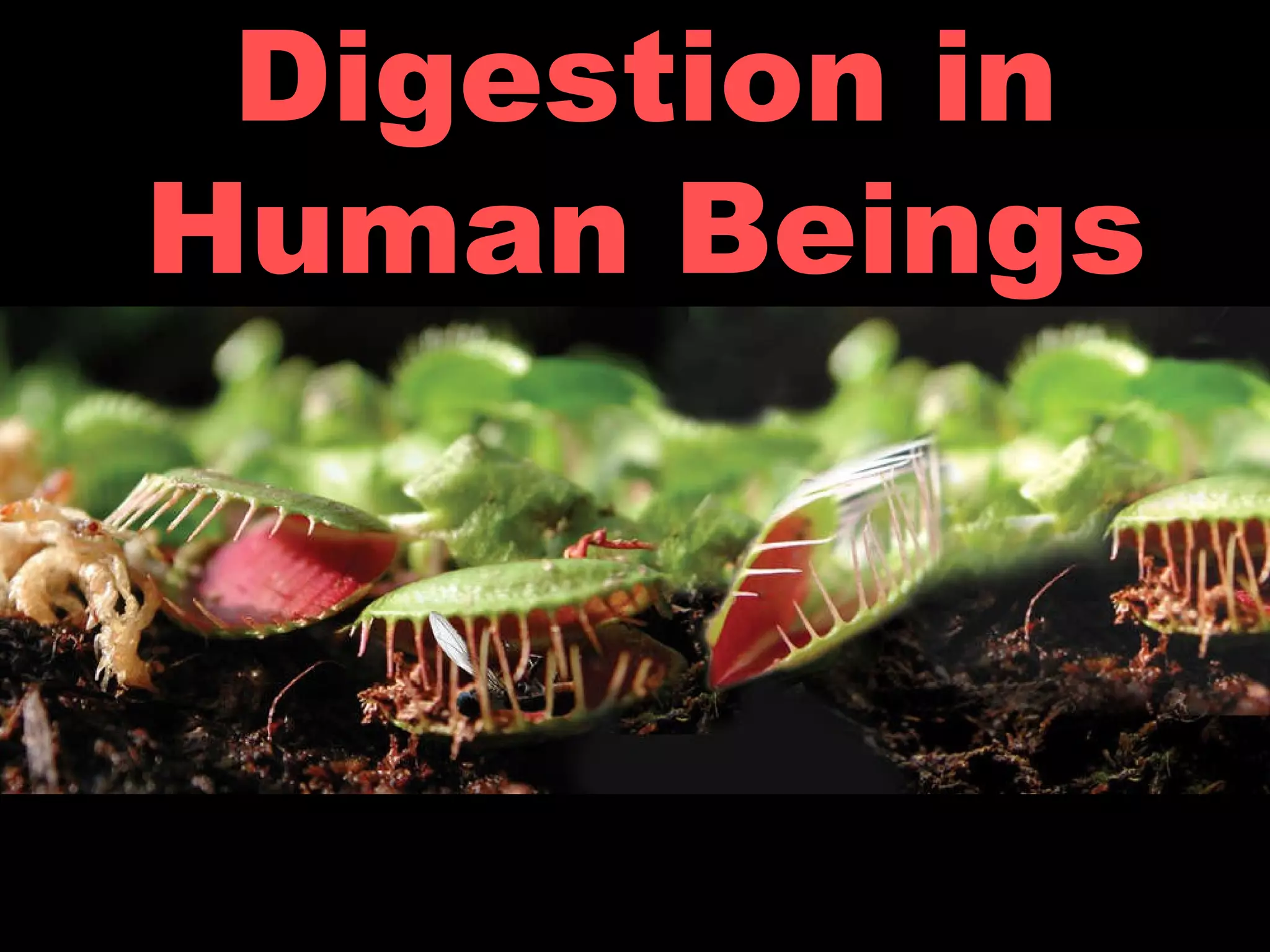
Digestion in Human Beings
26.1 Why We Need Food? We need food to: provide us with  energy  for our daily activities like walking, and to maintain our body temperature; maintain a healthy body ; grow  new cells and tissues; and  repair  worn out tissues.
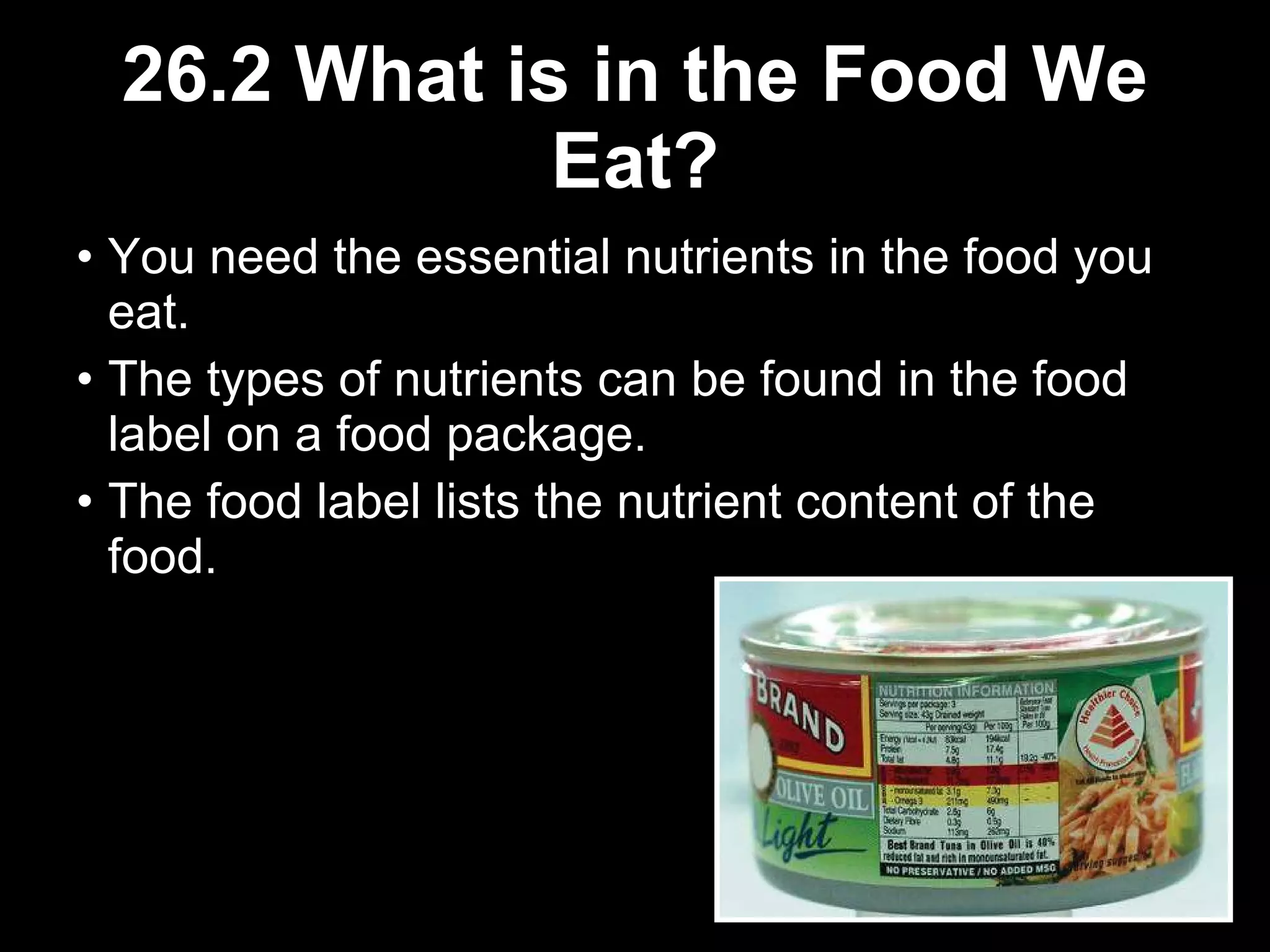
26.2 What is in the Food We Eat? You need the essential nutrients in the food you eat.  The types of nutrients can be found in the food label on a food package. The food label lists the nutrient content of the food.
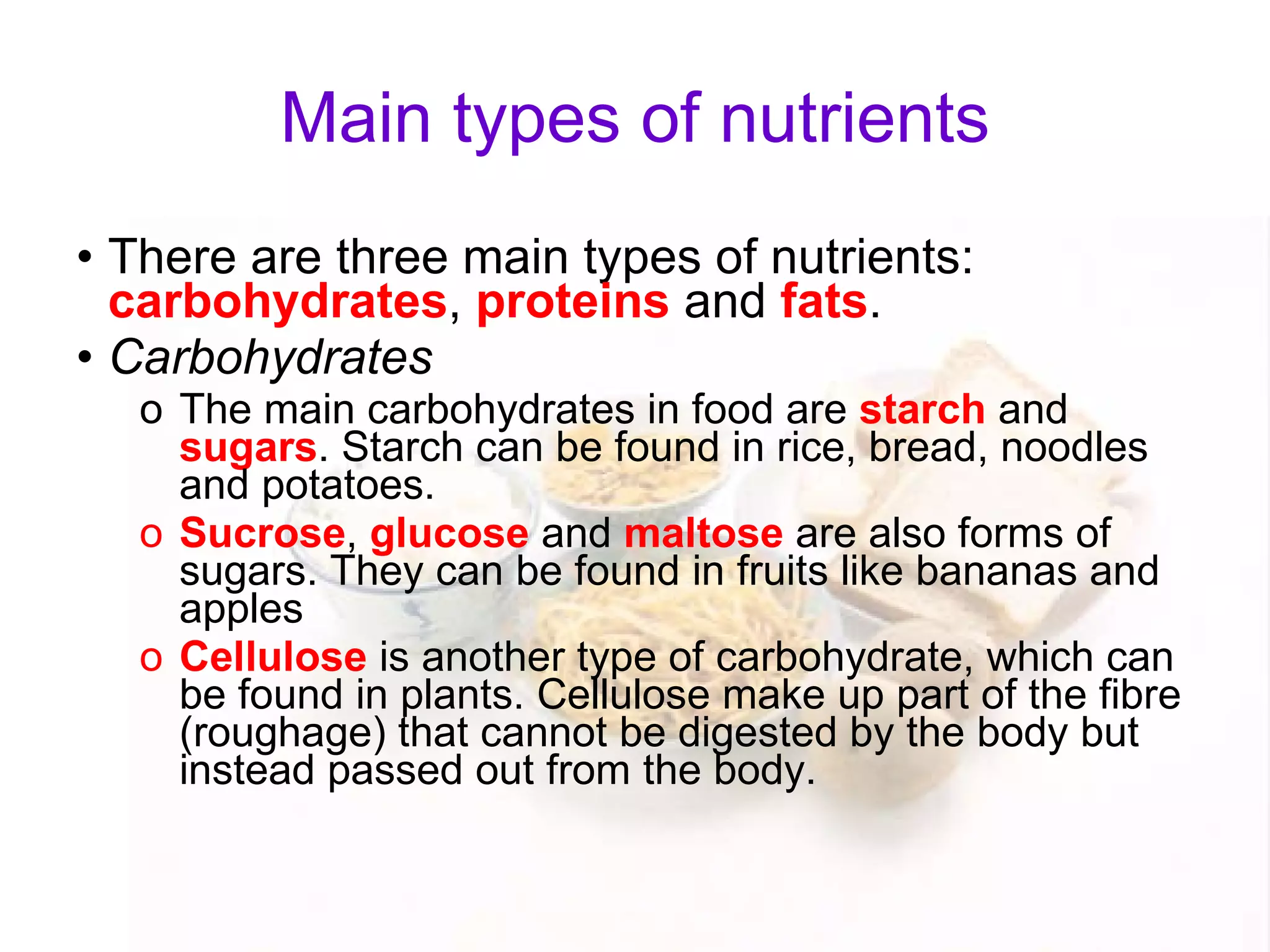
Main types of nutrients There are three main types of nutrients:  carbohydrates ,  proteins  and  fats . Carbohydrates The main carbohydrates in food are  starch  and  sugars . Starch can be found in rice, bread, noodles and potatoes. Sucrose ,  glucose  and  maltose  are also forms of sugars. They can be found in fruits like bananas and apples Cellulose  is another type of carbohydrate, which can be found in plants. Cellulose make up part of the fibre (roughage) that cannot be digested by the body but instead passed out from the body.
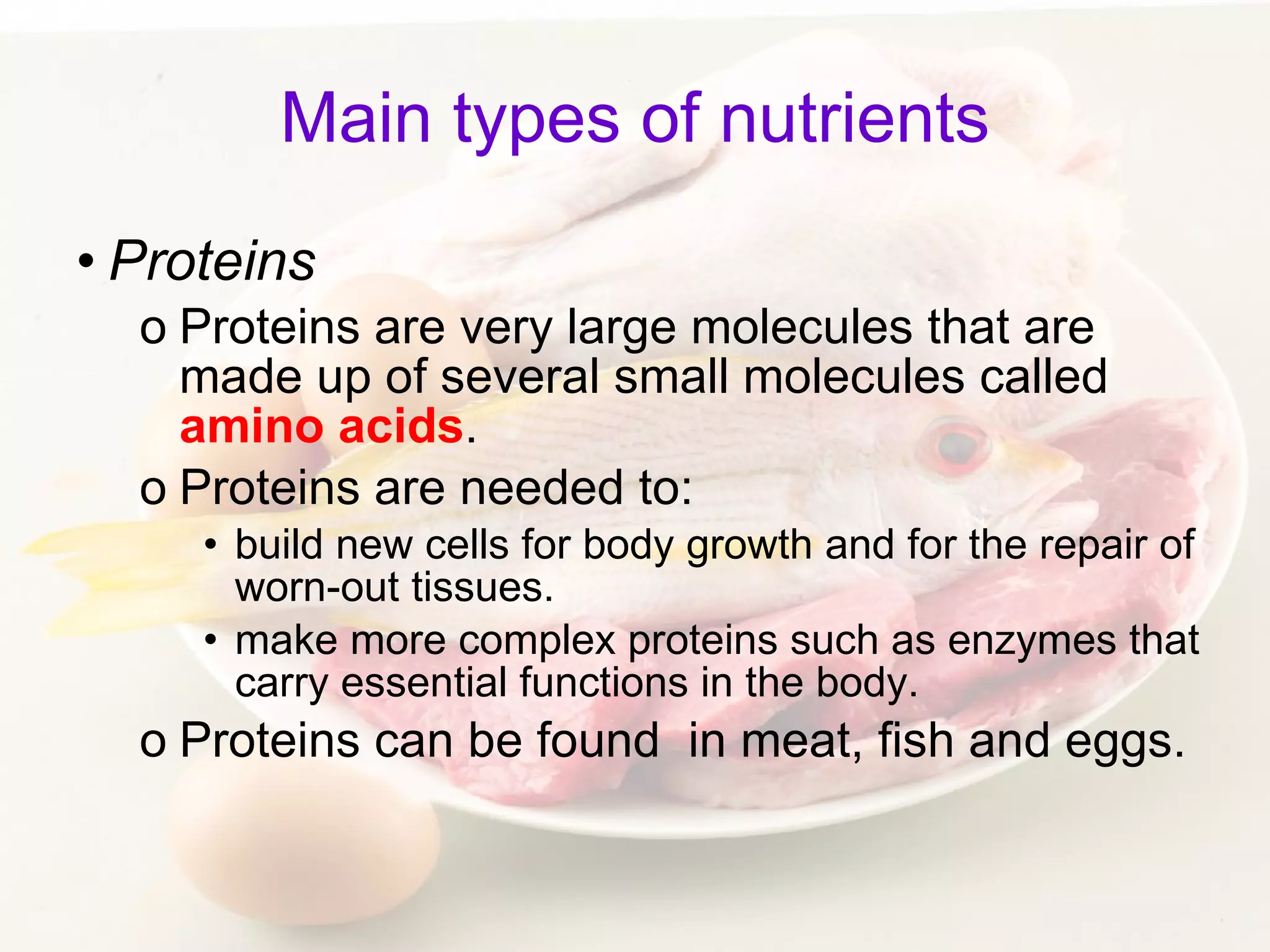
Main types of nutrients Proteins Proteins are very large molecules that are made up of several small molecules called  amino acids .  Proteins are needed to: build new cells for body growth and for the repair of worn-out tissues. make more complex proteins such as enzymes that carry essential functions in the body.  Proteins can be found  in meat, fish and eggs.
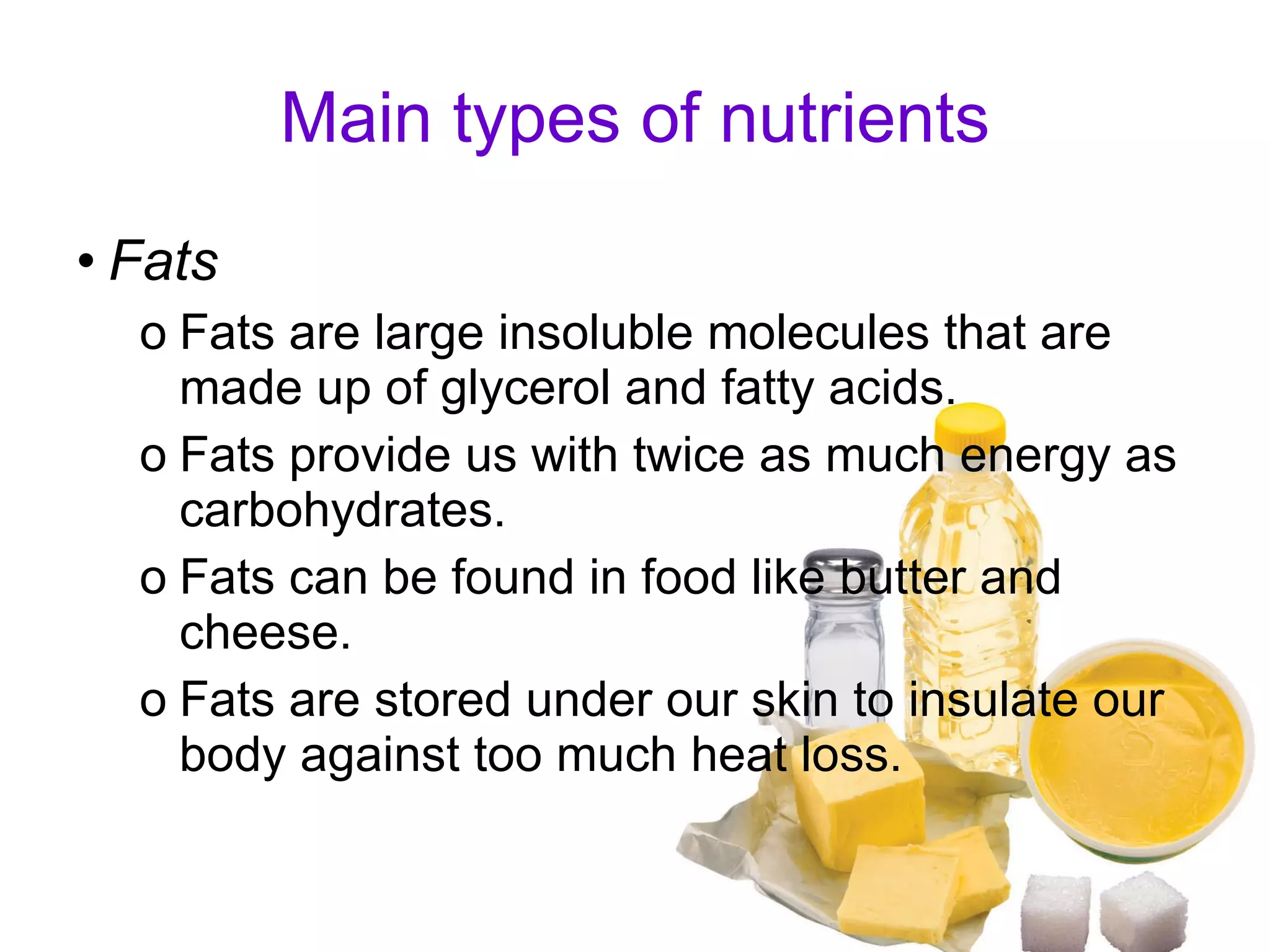
Main types of nutrients Fats Fats are large insoluble molecules that are made up of glycerol and fatty acids. Fats provide us with twice as much energy as carbohydrates. Fats can be found in food like butter and cheese. Fats are stored under our skin to insulate our body against too much heat loss.
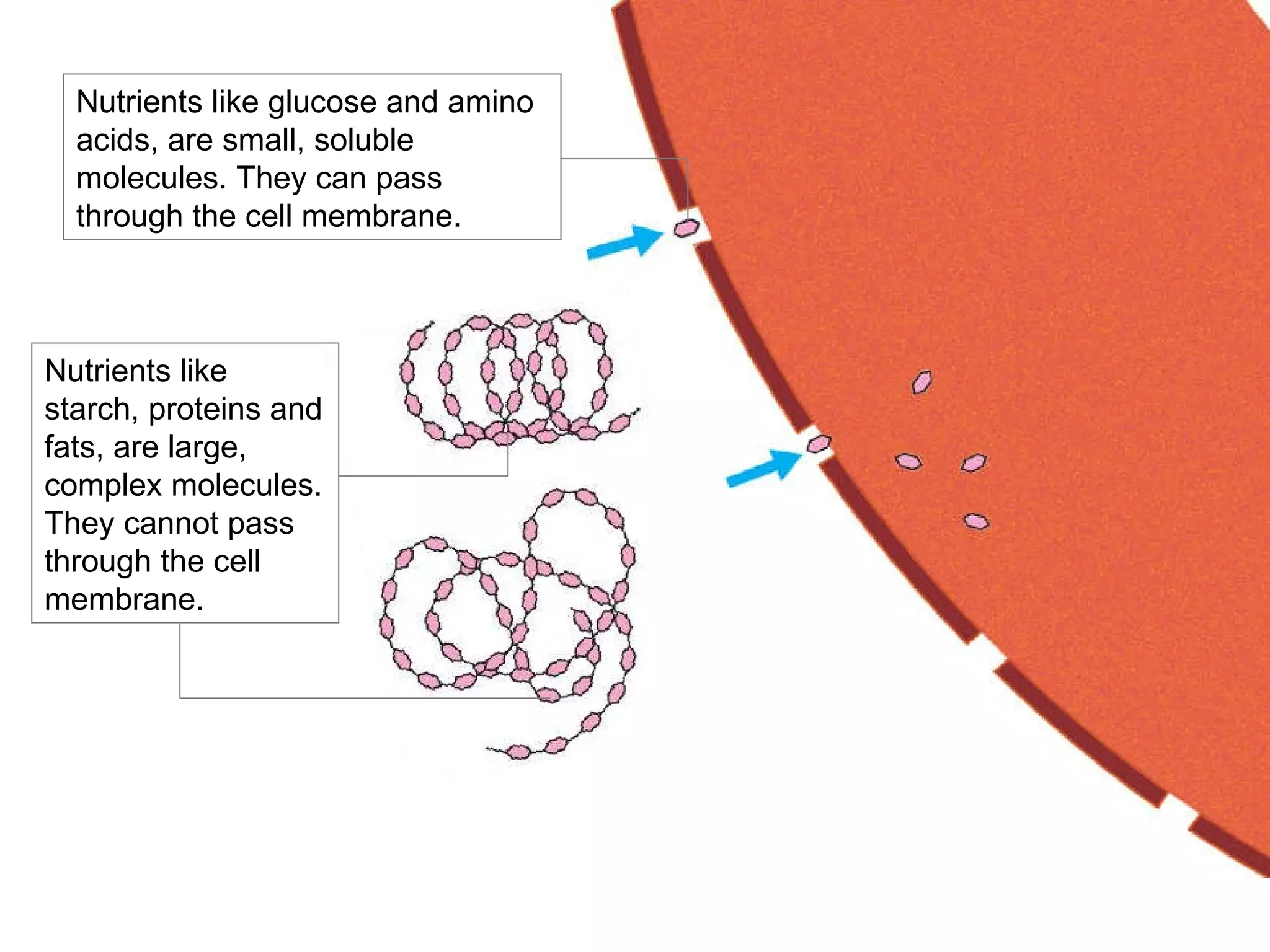
26.3 Why Must Food be Digested? We can only use the nutrients in the food we eat when they pass through the gut walls into the blood vessels. Here, the nutrients can be carried through the bloodstream to all parts of the body. The gut walls and blood vessels are made up of cells.  The cell membrane has small openings (or pores) that allow small molecules to enter, but not large molecules.  Nutrients like glucose and amino acids are small molecules. They can pass through the cell membranes easily and enter the bloodstream.
26.3 Why Must Food be Digested? But most major nutrients in food are large molecules which cannot pass through the cell membranes.  They must be broken down into molecules that are small enough to pass through the cell membranes. This process is called  digestion . Digestion  is the breaking down of large, complex food molecules into small, simpler molecules.  Our body is able to carry out digestion by producing complex proteins called  enzymes .  The enzymes involved in digestion are called  digestive enzymes .
Nutrients like starch, proteins and fats, are large, complex molecules. They cannot pass through the cell membrane. Nutrients like glucose and amino acids, are small, soluble molecules. They can pass through the cell membrane.
26.4 What are Enzymes? Enzymes  are complex proteins that speed up the rate of chemical reactions. Enzymes remain unchanged at the end of chemical reactions.  Enzymes act like chemical ‘scissors’. They break down large molecules into small molecules to speed up the process of digestion.
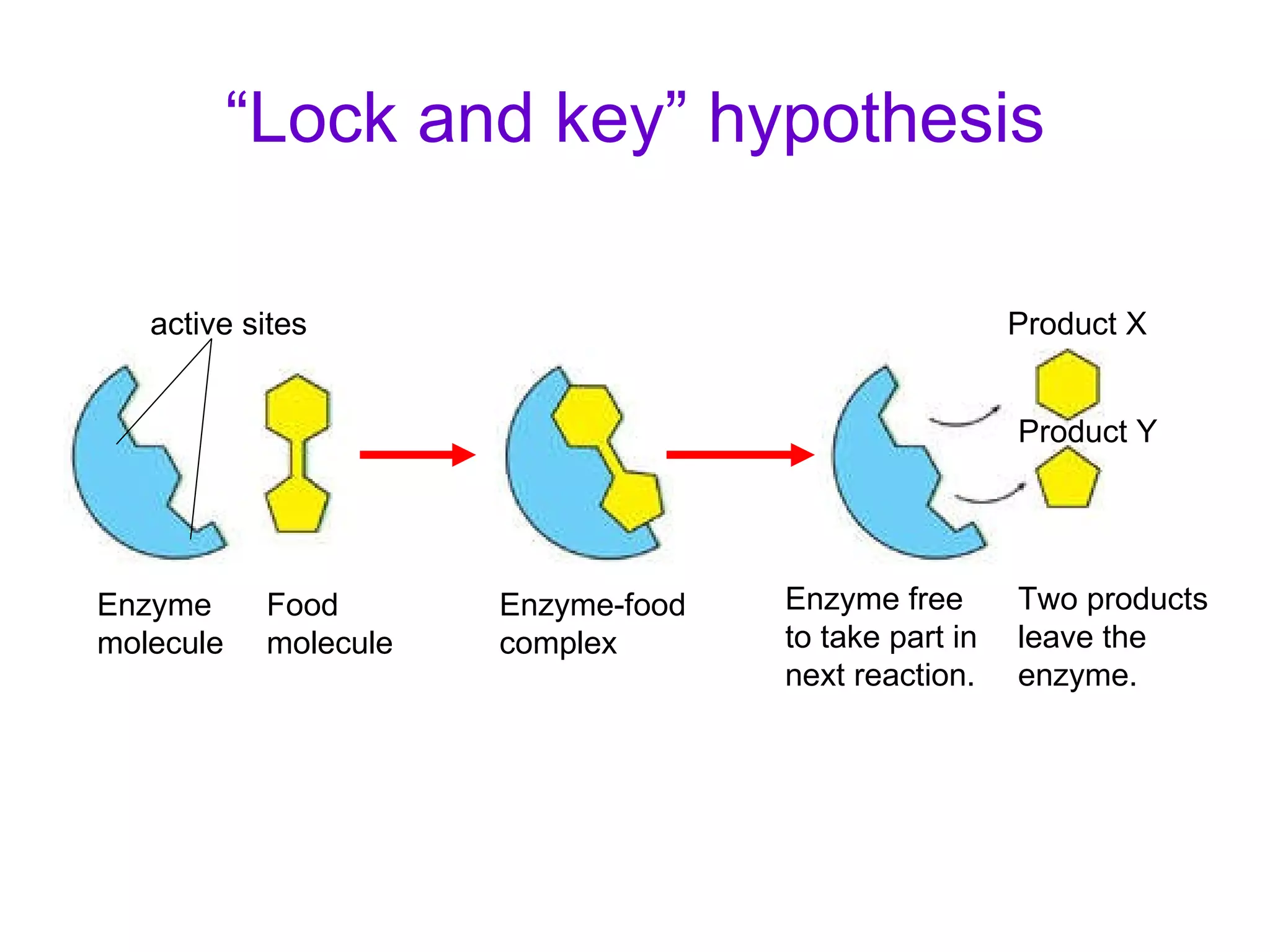
“ Lock and key” hypothesis active sites Enzyme molecule Food molecule Enzyme-food complex Enzyme free to take part in next reaction.  Two products leave the enzyme. Product X Product Y
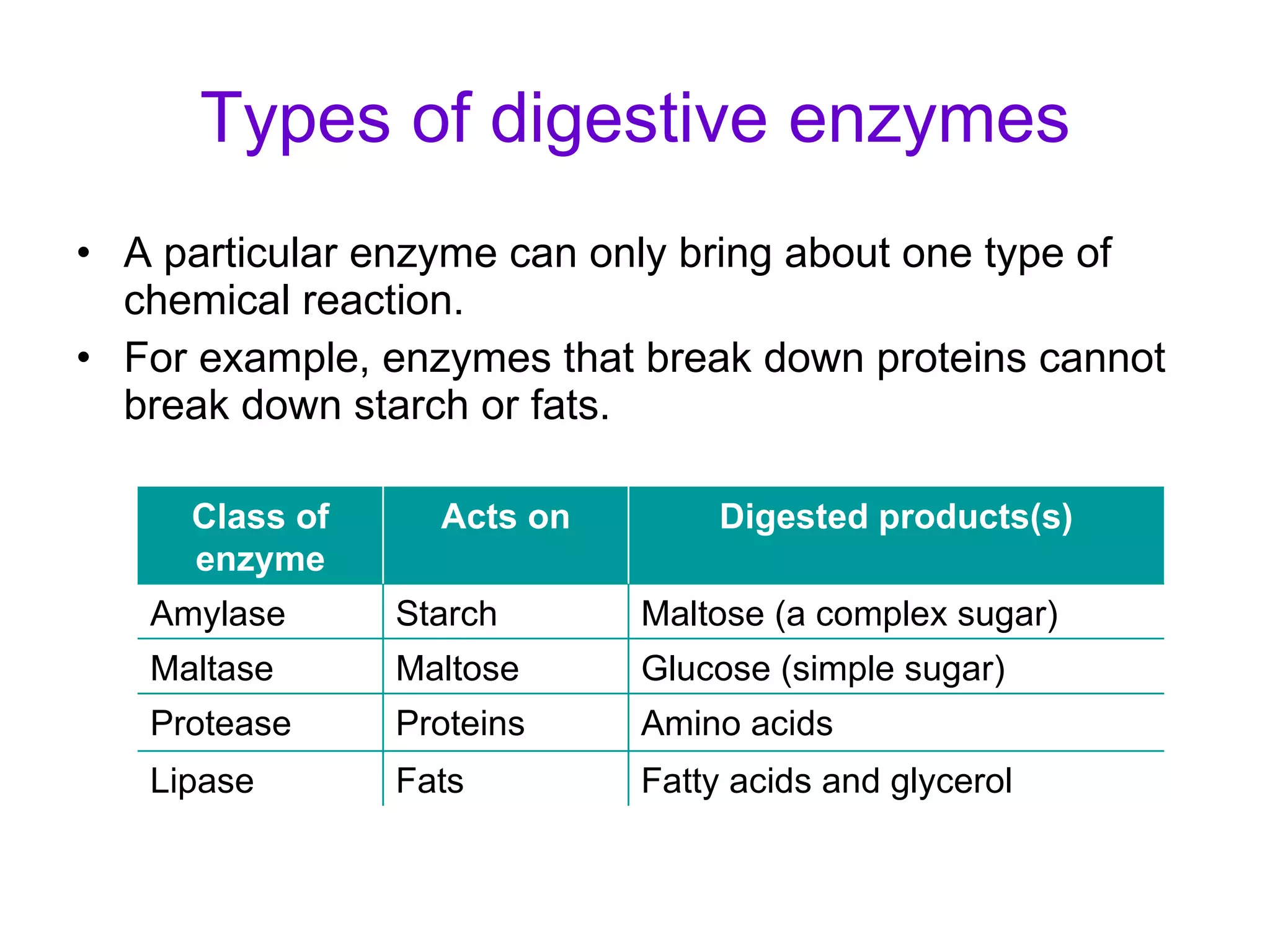
Types of digestive enzymes A particular enzyme can only bring about one type of chemical reaction. For example, enzymes that break down proteins cannot break down starch or fats. Amino acids Proteins  Protease Fatty acids and glycerol  Fats Lipase  Glucose (simple sugar) Maltose Maltase Maltose (a complex sugar) Starch Amylase Digested products(s) Acts on Class of enzyme
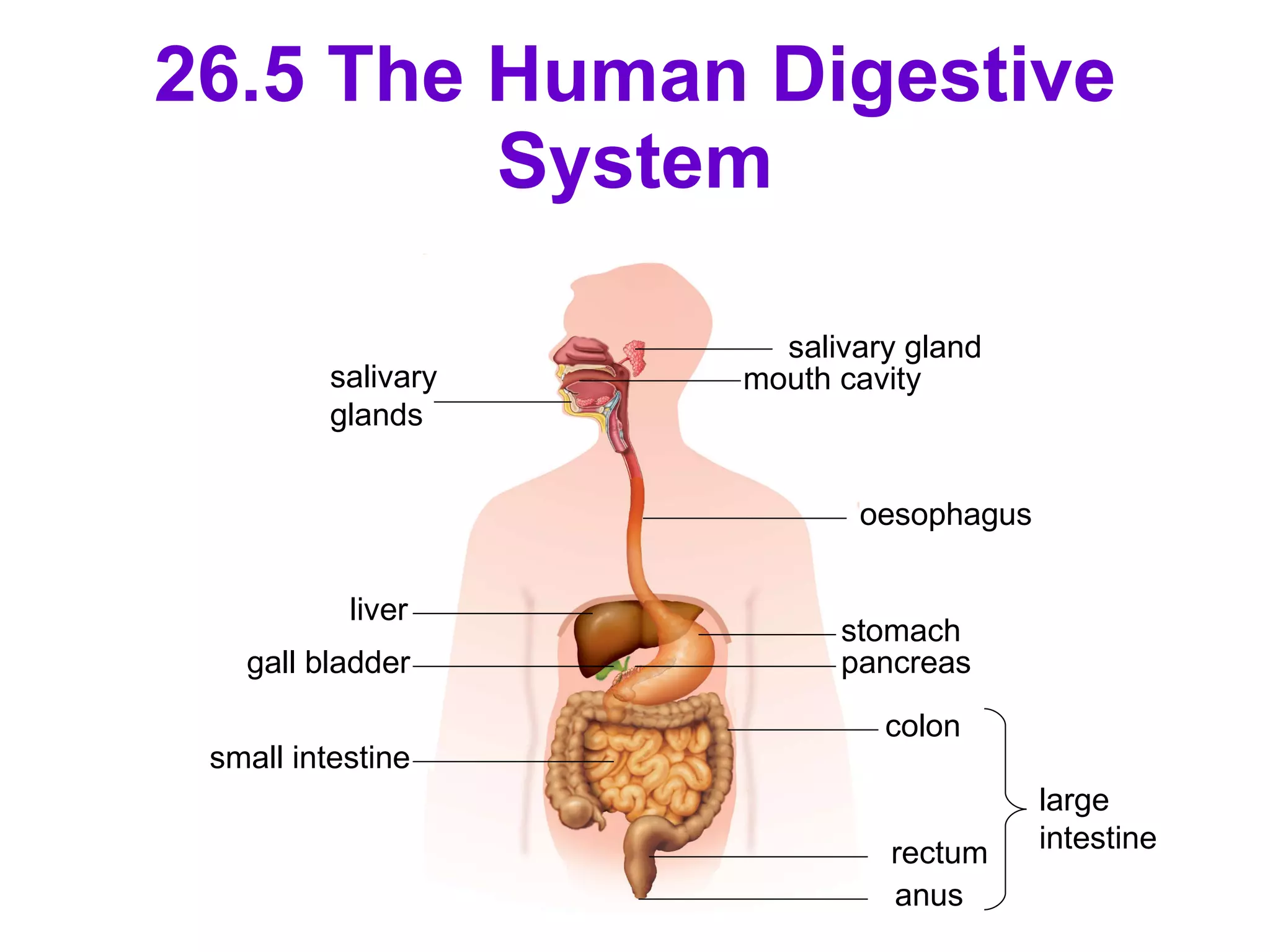
26.5 The Human Digestive System Food is digested in our body through the  digestive system . The digestive system is made up a long tube called the  gut  (or  alimentary canal ). The gut is about nine metres long. The wall of the gut is muscular, which allows food to move along its length. Food enters the body through the mouth, and undigested food leaves the body through the anus.
26.5 The Human Digestive System Glands connected to the gut are organs which produce special juices containing enzymes.  These glands are the  salivary glands ,  liver  and  pancreas .
26.5 The Human Digestive System salivary gland mouth cavity oesophagus stomach salivary glands pancreas colon rectum anus large intestine liver gall bladder small intestine
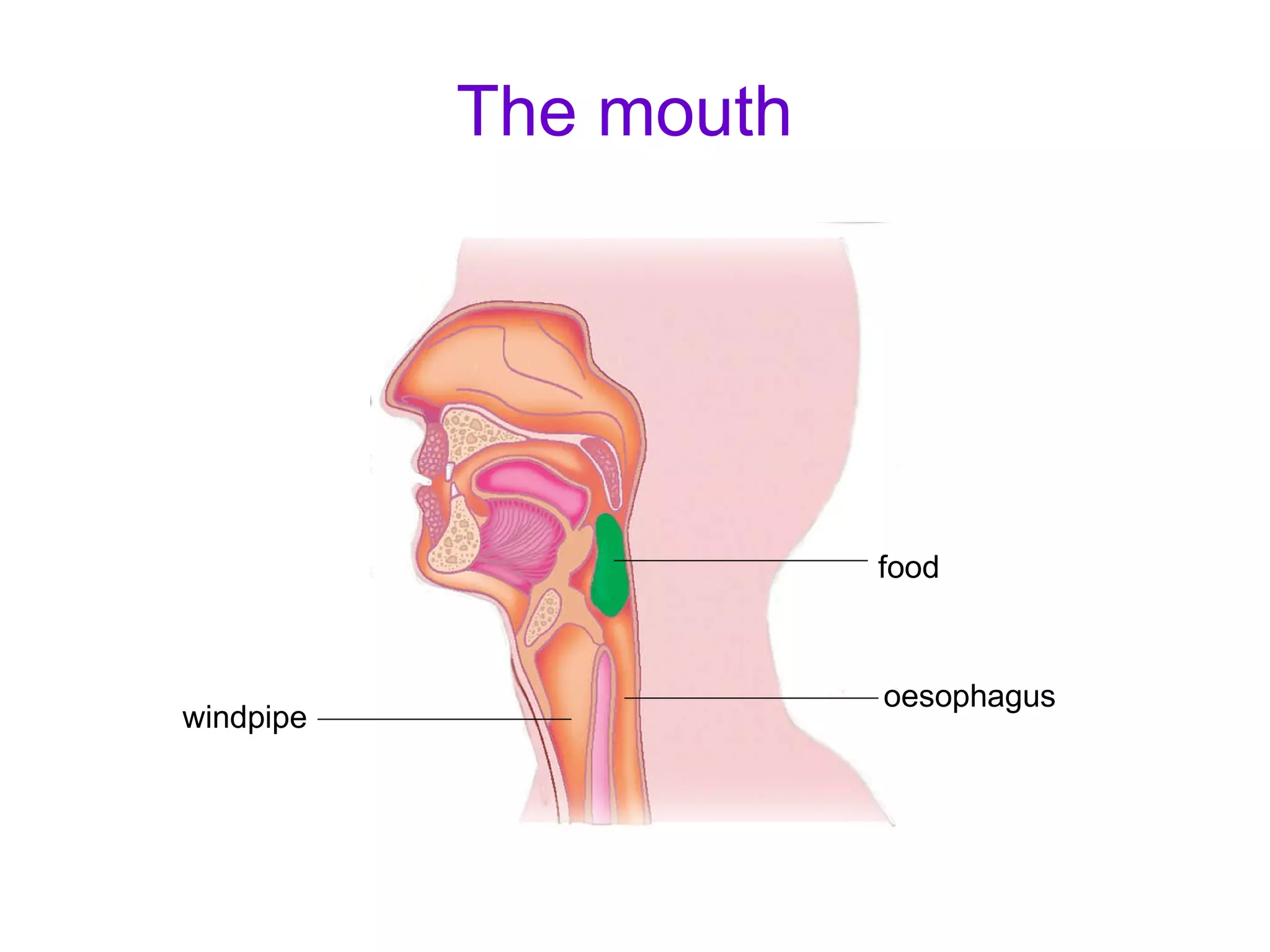
The mouth food oesophagus windpipe
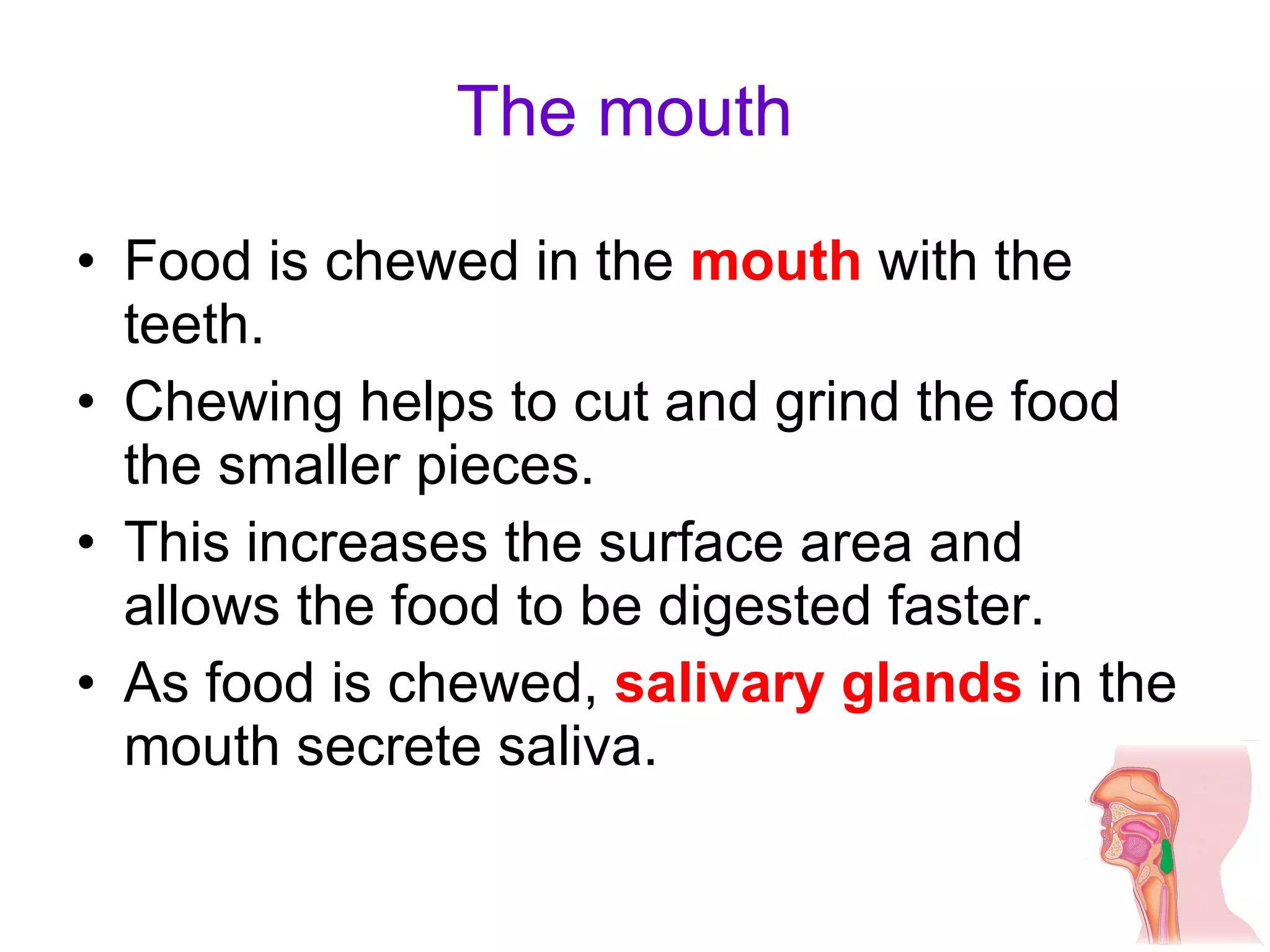
The mouth Food is chewed in the  mouth  with the teeth.  Chewing helps to cut and grind the food the smaller pieces. This increases the surface area and allows the food to be digested faster.  As food is chewed,  salivary glands  in the mouth secrete saliva.
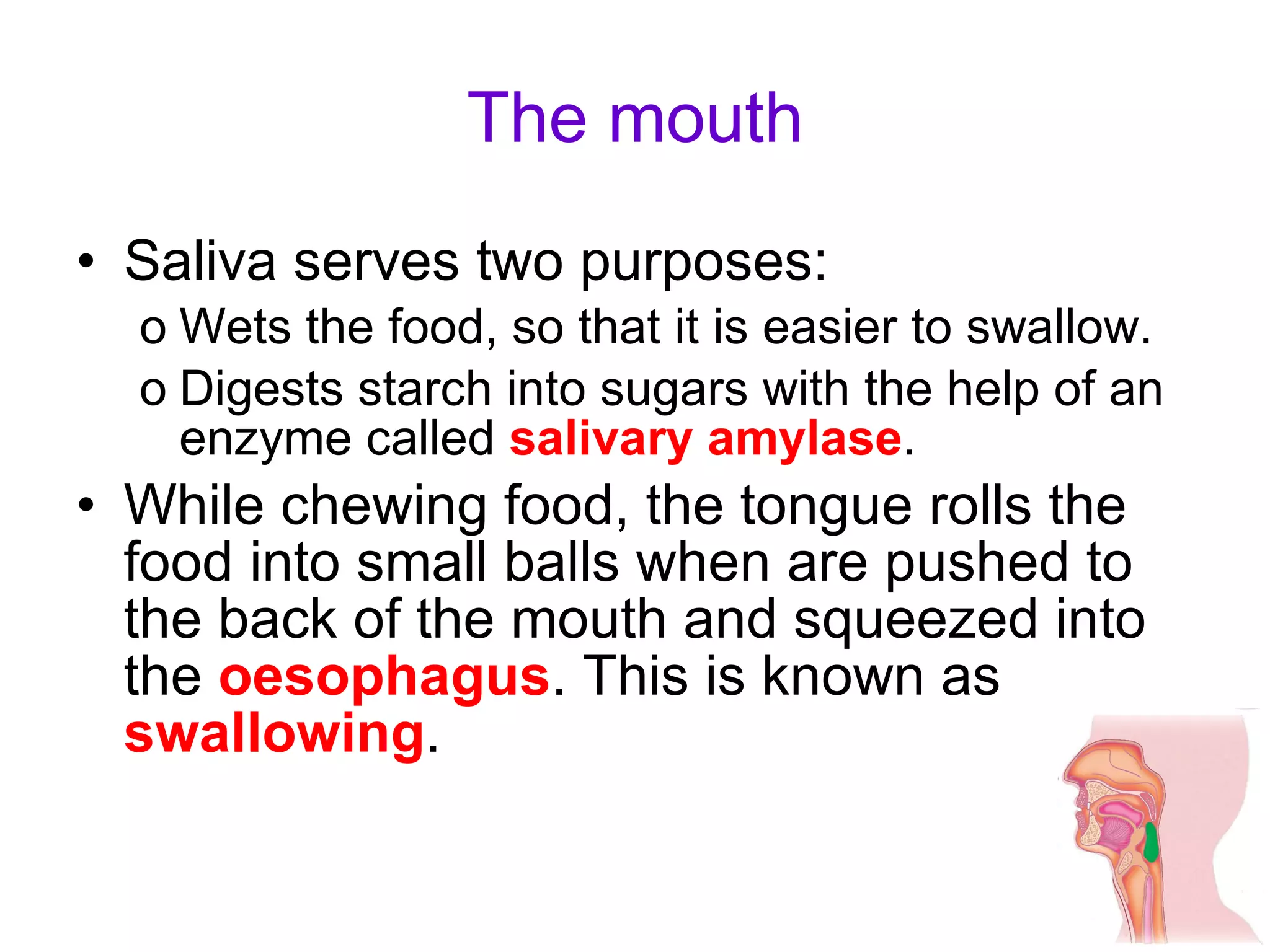
The mouth Saliva serves two purposes: Wets the food, so that it is easier to swallow. Digests starch into sugars with the help of an enzyme called  salivary amylase .  While chewing food, the tongue rolls the food into small balls when are pushed to the back of the mouth and squeezed into the  oesophagus . This is known as  swallowing .
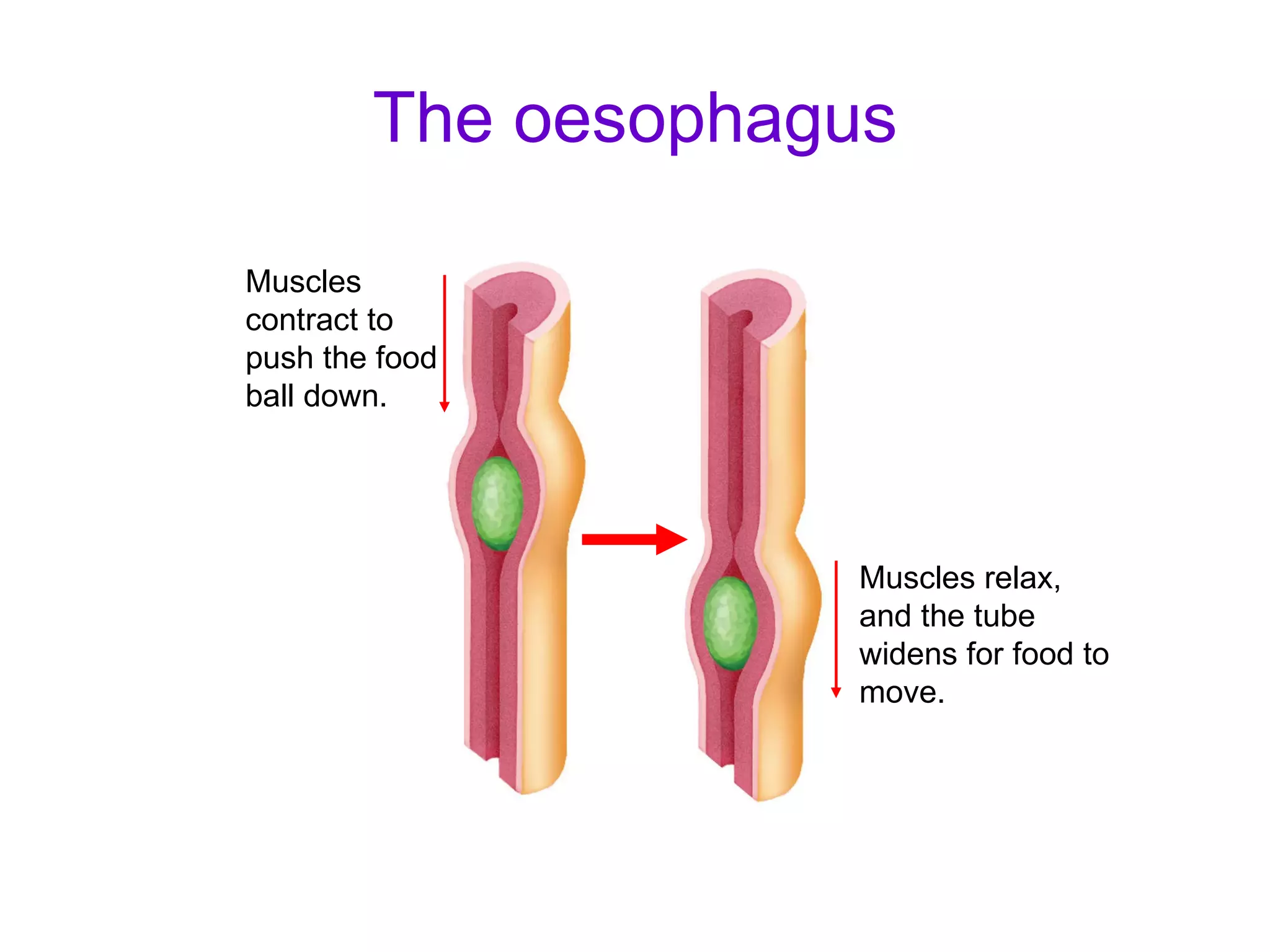
The oesophagus Muscles contract to push the food ball down. Muscles relax, and the tube widens for food to move.
The oesophagus The  oesophagus  is a long muscular tube leading to the stomach. By contracting and relaxing, the muscles help to push the food down to the stomach. This is how food moves along the rest of the gut too. No digestion occurs in the oesophagus.  However, the digestion of starch by amylase may continue as the food moves to the stomach.
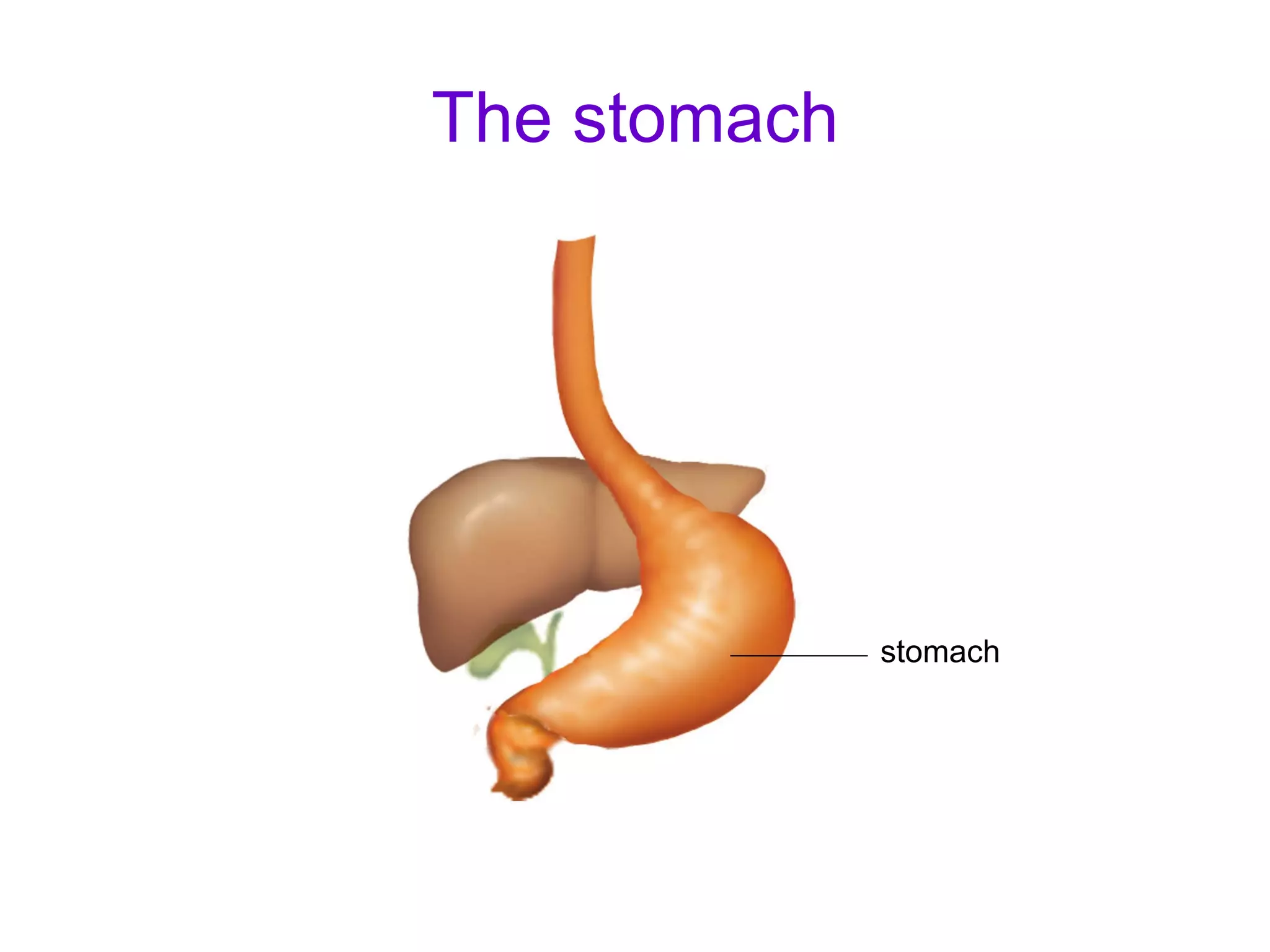
The stomach stomach
The stomach The  stomach  is a muscular bag that lies in the upper part of the abdomen. Its muscles contract and relax, causing food to break up into even smaller pieces. This movement also mixes the food well with  gastric juice  for better digestion. Gastric juice is secreted by glands in the stomach walls, into the stomach cavity. It contains: proteases  which digest proteins; and hydrochloric acid , which helps proteases to work. Hydrochloric acid kills any bacteria in the food. Food stays in the stomach for a few hours before passing into the small intestine, bit by bit.
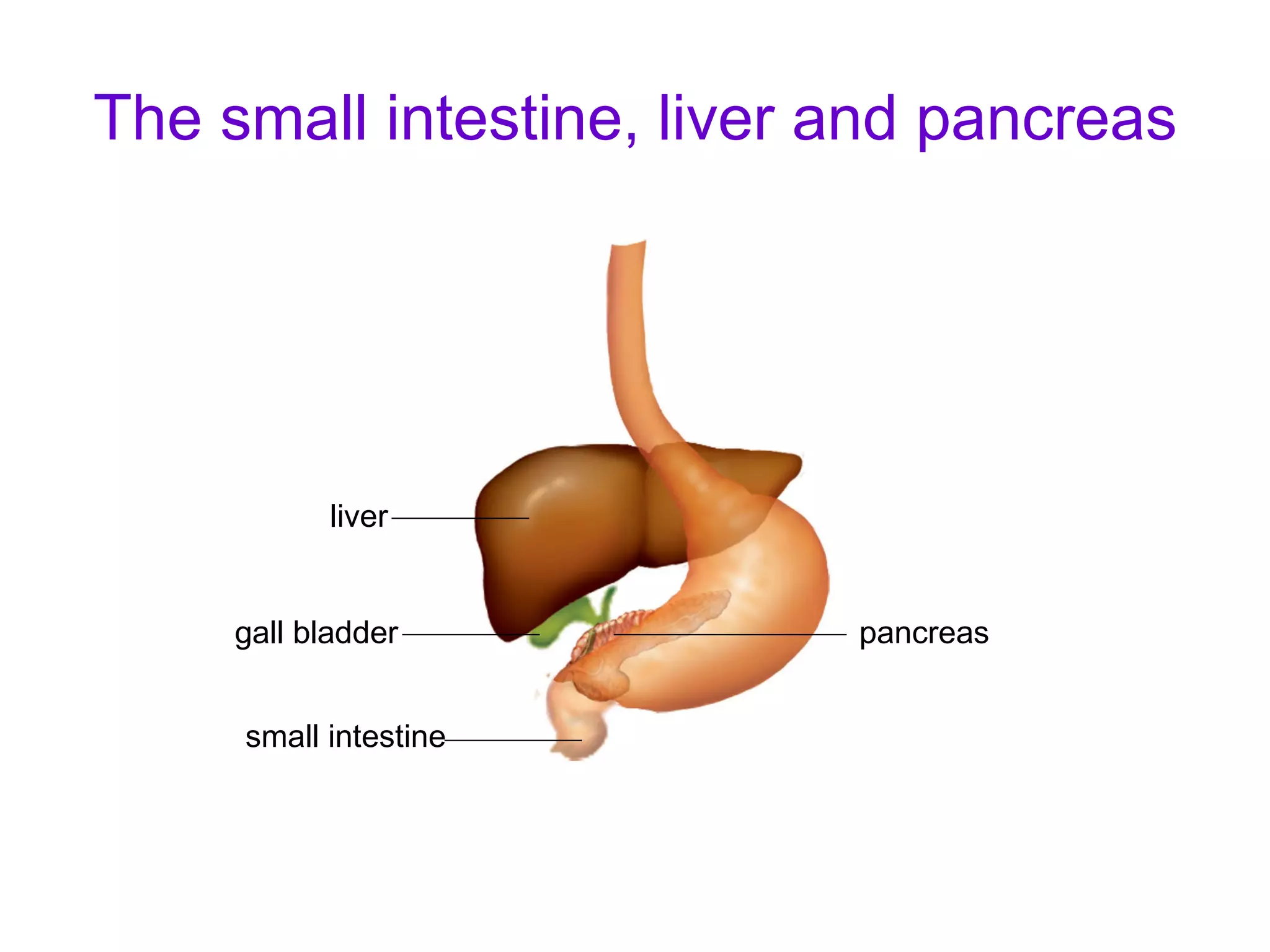
The small intestine, liver and pancreas gall bladder liver small intestine pancreas
The small intestine The  small intestine  is a long muscular tube, which is about 6 m long. The liver and the pancreas are connected to the small intestine. Food is mixed with 3 fluids in the small intestine to aid digestion: Intestinal juice  from the walls of the intestine. It contains the enzymes maltase, proteases and lipases. Pancreatic juice  from the pancreas. Bile  from the liver.
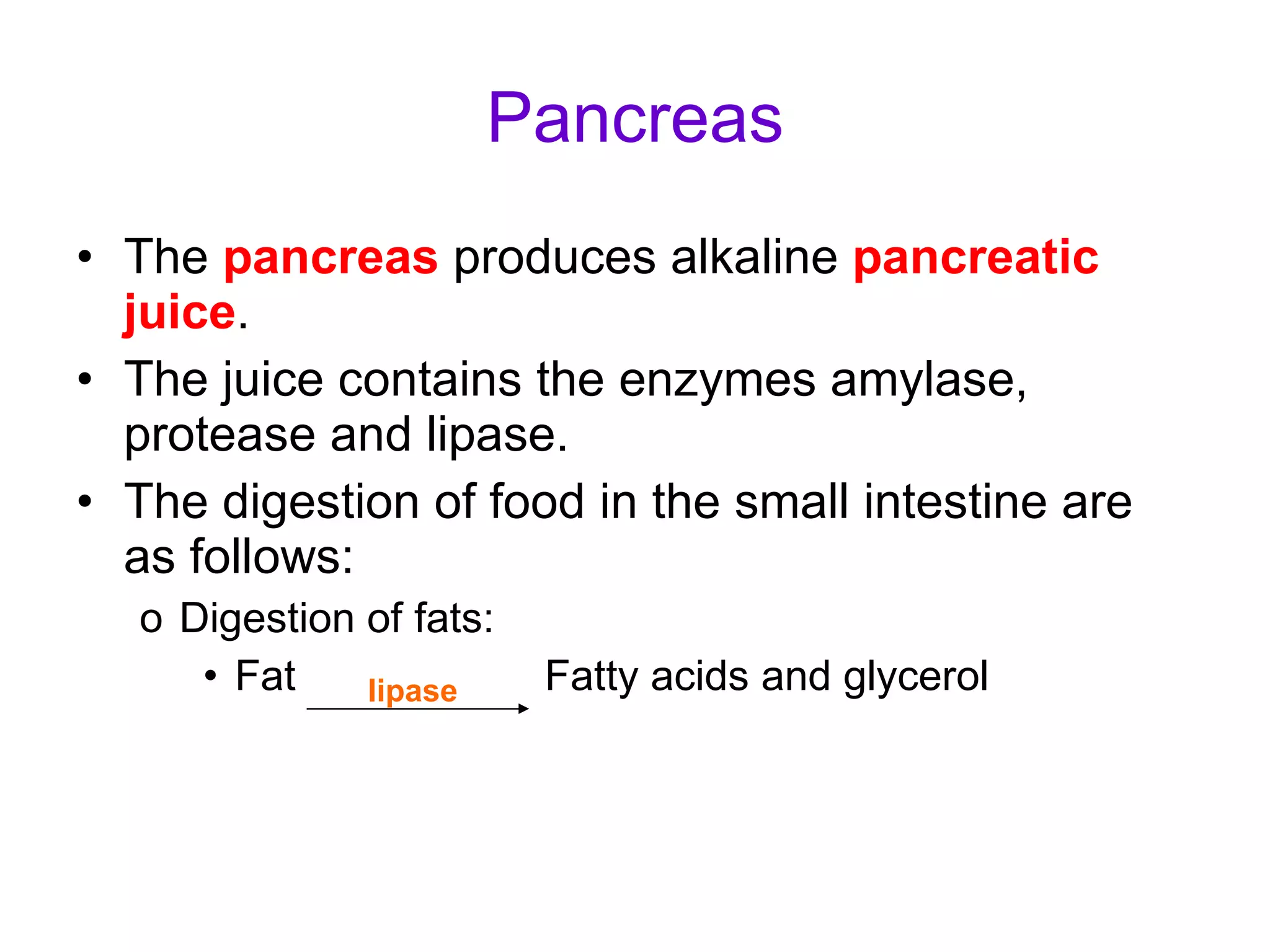
Pancreas The  pancreas  produces alkaline  pancreatic juice . The juice contains the enzymes amylase, protease and lipase. The digestion of food in the small intestine are as follows: Digestion of fats:  Fat  Fatty acids and glycerol  lipase
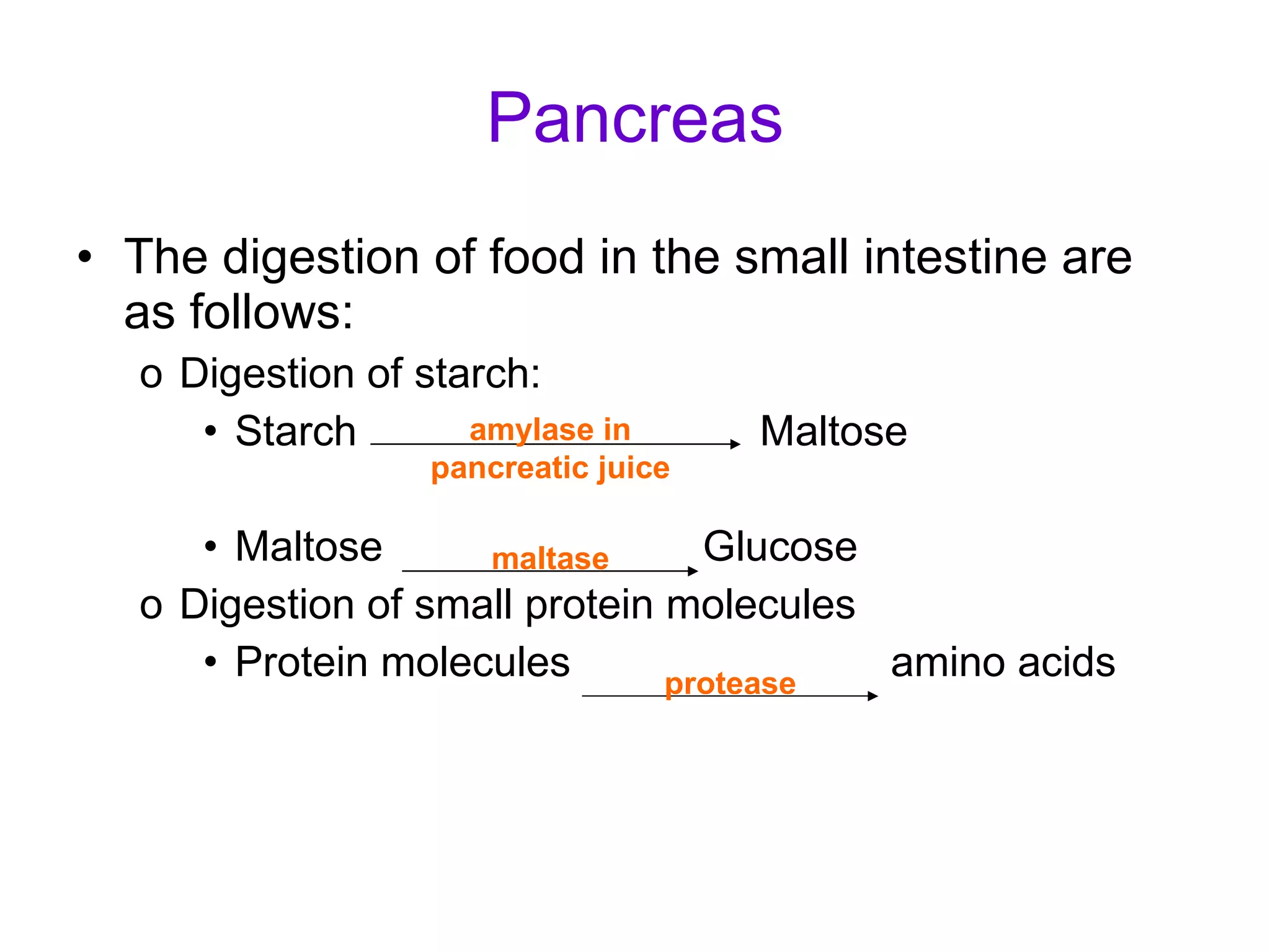
Pancreas The digestion of food in the small intestine are as follows: Digestion of starch:  Starch  Maltose Maltose  Glucose Digestion of small protein molecules Protein molecules  amino acids amylase in pancreatic juice maltase protease
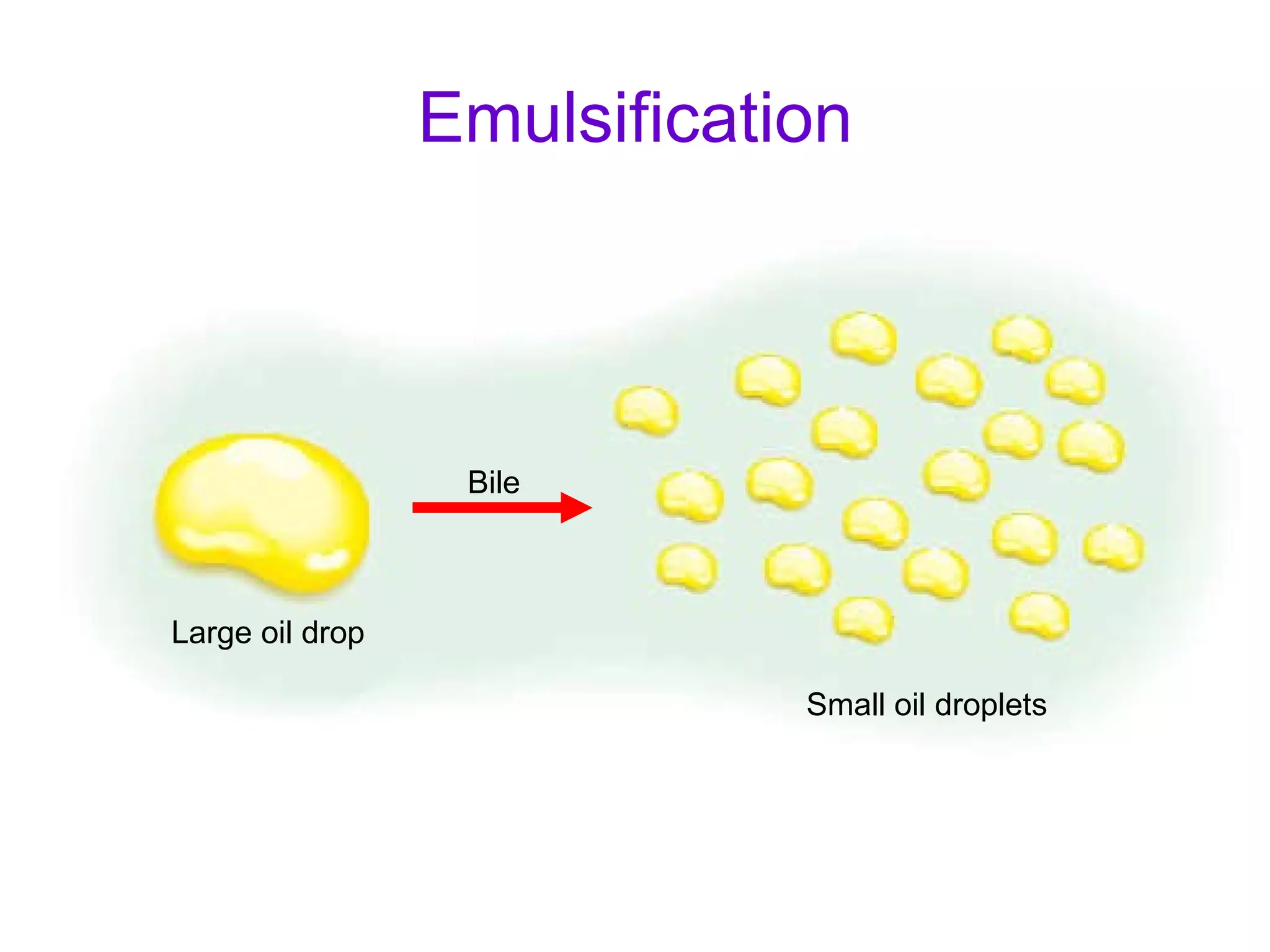
Liver The liver produces a yellowish-green fluid called bile. Bile is stored in the  gall bladder . The gall bladder has a duct (a small tube) that carries bile into the small intestine. Bile does not contain digestive enzymes, but helps to break up fast into smaller oil droplets in a process known as  emulsification . This increases the surface area of the oil and allows the fats to be digested quickly by the lipases in the pancreatic and intestinal juices.
Emulsification Bile Large oil drop Small oil droplets
Absorption in the small intestine The small intestine allows only small molecules like sugar and amino acids to pass through its wall and into the bloodstream. Large molecules like starch and proteins cannot pass through the walls of the small intestine. Digestion ends in the small intestine.  The final products of digestion are glucose, amino acids, fatty acids and glycerol.
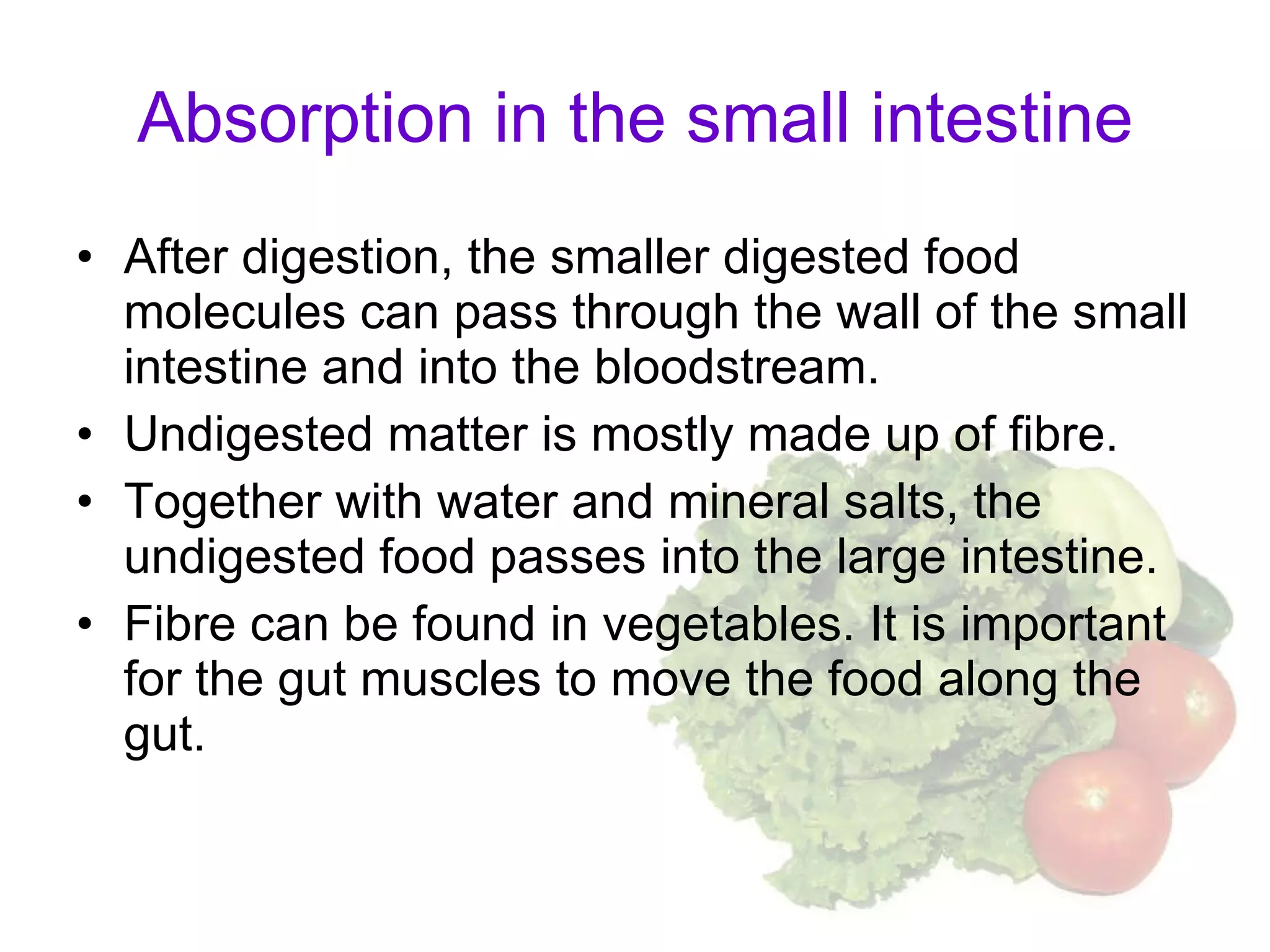
Absorption in the small intestine After digestion, the smaller digested food molecules can pass through the wall of the small intestine and into the bloodstream.  Undigested matter is mostly made up of fibre.  Together with water and mineral salts, the undigested food passes into the large intestine. Fibre can be found in vegetables. It is important for the gut muscles to move the food along the gut.
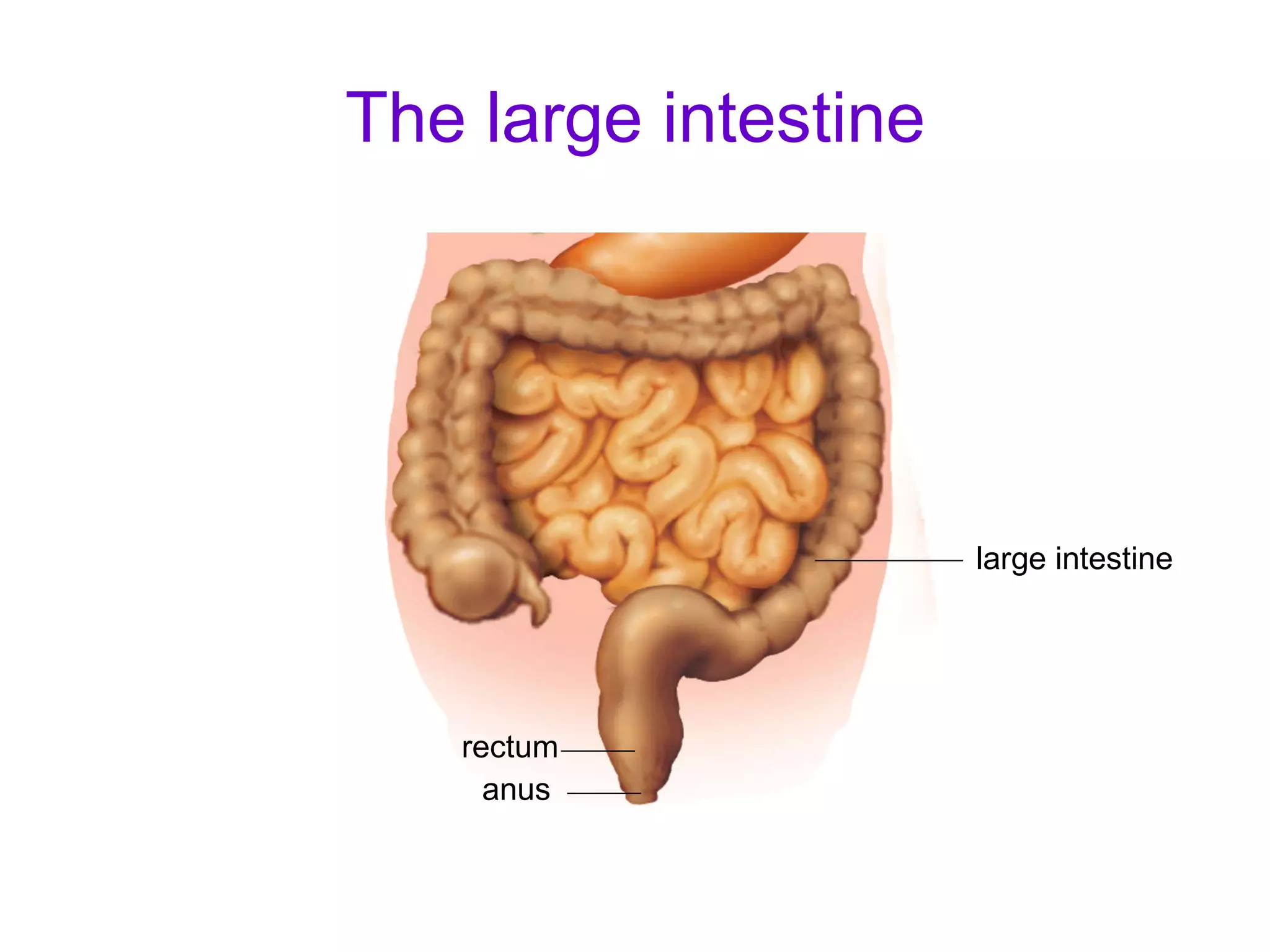
The large intestine large intestine rectum anus
The large intestine The large intestine is about 1.5 m long.  Its function is to absorb water and mineral salts. This takes place in the colon. What is left now is a nearly solid waste called  faeces .  This is temporarily stored in the rectum, before being expelled through the anus is a process called egestion.
Miscellaneous http://kidshealth.org/kid/body/digest_noSW.html http://www.ahealthyme.com/topic/digestivesystem http://hopkins-gi.org/multimedia/database/intro_250_Swallow.swf http://yucky.discovery.com/noflash/body/pg000008.html http://hes.ucf.k12.pa.us/gclaypo/digestive_system.html#What%20is%20Digestion

C26 Digestion In Human

  • 1.
  • 2.
    26.1 Why WeNeed Food? We need food to: provide us with energy for our daily activities like walking, and to maintain our body temperature; maintain a healthy body ; grow new cells and tissues; and repair worn out tissues.
  • 3.
    26.2 What isin the Food We Eat? You need the essential nutrients in the food you eat. The types of nutrients can be found in the food label on a food package. The food label lists the nutrient content of the food.
  • 4.
    Main types ofnutrients There are three main types of nutrients: carbohydrates , proteins and fats . Carbohydrates The main carbohydrates in food are starch and sugars . Starch can be found in rice, bread, noodles and potatoes. Sucrose , glucose and maltose are also forms of sugars. They can be found in fruits like bananas and apples Cellulose is another type of carbohydrate, which can be found in plants. Cellulose make up part of the fibre (roughage) that cannot be digested by the body but instead passed out from the body.
  • 5.
    Main types ofnutrients Proteins Proteins are very large molecules that are made up of several small molecules called amino acids . Proteins are needed to: build new cells for body growth and for the repair of worn-out tissues. make more complex proteins such as enzymes that carry essential functions in the body. Proteins can be found in meat, fish and eggs.
  • 6.
    Main types ofnutrients Fats Fats are large insoluble molecules that are made up of glycerol and fatty acids. Fats provide us with twice as much energy as carbohydrates. Fats can be found in food like butter and cheese. Fats are stored under our skin to insulate our body against too much heat loss.
  • 7.
    26.3 Why MustFood be Digested? We can only use the nutrients in the food we eat when they pass through the gut walls into the blood vessels. Here, the nutrients can be carried through the bloodstream to all parts of the body. The gut walls and blood vessels are made up of cells. The cell membrane has small openings (or pores) that allow small molecules to enter, but not large molecules. Nutrients like glucose and amino acids are small molecules. They can pass through the cell membranes easily and enter the bloodstream.
  • 8.
    26.3 Why MustFood be Digested? But most major nutrients in food are large molecules which cannot pass through the cell membranes. They must be broken down into molecules that are small enough to pass through the cell membranes. This process is called digestion . Digestion is the breaking down of large, complex food molecules into small, simpler molecules. Our body is able to carry out digestion by producing complex proteins called enzymes . The enzymes involved in digestion are called digestive enzymes .
  • 9.
    Nutrients like starch,proteins and fats, are large, complex molecules. They cannot pass through the cell membrane. Nutrients like glucose and amino acids, are small, soluble molecules. They can pass through the cell membrane.
  • 10.
    26.4 What areEnzymes? Enzymes are complex proteins that speed up the rate of chemical reactions. Enzymes remain unchanged at the end of chemical reactions. Enzymes act like chemical ‘scissors’. They break down large molecules into small molecules to speed up the process of digestion.
  • 11.
    “ Lock andkey” hypothesis active sites Enzyme molecule Food molecule Enzyme-food complex Enzyme free to take part in next reaction. Two products leave the enzyme. Product X Product Y
  • 12.
    Types of digestiveenzymes A particular enzyme can only bring about one type of chemical reaction. For example, enzymes that break down proteins cannot break down starch or fats. Amino acids Proteins Protease Fatty acids and glycerol Fats Lipase Glucose (simple sugar) Maltose Maltase Maltose (a complex sugar) Starch Amylase Digested products(s) Acts on Class of enzyme
  • 13.
    26.5 The HumanDigestive System Food is digested in our body through the digestive system . The digestive system is made up a long tube called the gut (or alimentary canal ). The gut is about nine metres long. The wall of the gut is muscular, which allows food to move along its length. Food enters the body through the mouth, and undigested food leaves the body through the anus.
  • 14.
    26.5 The HumanDigestive System Glands connected to the gut are organs which produce special juices containing enzymes. These glands are the salivary glands , liver and pancreas .
  • 15.
    26.5 The HumanDigestive System salivary gland mouth cavity oesophagus stomach salivary glands pancreas colon rectum anus large intestine liver gall bladder small intestine
  • 16.
    The mouth foodoesophagus windpipe
  • 17.
    The mouth Foodis chewed in the mouth with the teeth. Chewing helps to cut and grind the food the smaller pieces. This increases the surface area and allows the food to be digested faster. As food is chewed, salivary glands in the mouth secrete saliva.
  • 18.
    The mouth Salivaserves two purposes: Wets the food, so that it is easier to swallow. Digests starch into sugars with the help of an enzyme called salivary amylase . While chewing food, the tongue rolls the food into small balls when are pushed to the back of the mouth and squeezed into the oesophagus . This is known as swallowing .
  • 19.
    The oesophagus Musclescontract to push the food ball down. Muscles relax, and the tube widens for food to move.
  • 20.
    The oesophagus The oesophagus is a long muscular tube leading to the stomach. By contracting and relaxing, the muscles help to push the food down to the stomach. This is how food moves along the rest of the gut too. No digestion occurs in the oesophagus. However, the digestion of starch by amylase may continue as the food moves to the stomach.
  • 21.
  • 22.
    The stomach The stomach is a muscular bag that lies in the upper part of the abdomen. Its muscles contract and relax, causing food to break up into even smaller pieces. This movement also mixes the food well with gastric juice for better digestion. Gastric juice is secreted by glands in the stomach walls, into the stomach cavity. It contains: proteases which digest proteins; and hydrochloric acid , which helps proteases to work. Hydrochloric acid kills any bacteria in the food. Food stays in the stomach for a few hours before passing into the small intestine, bit by bit.
  • 23.
    The small intestine,liver and pancreas gall bladder liver small intestine pancreas
  • 24.
    The small intestineThe small intestine is a long muscular tube, which is about 6 m long. The liver and the pancreas are connected to the small intestine. Food is mixed with 3 fluids in the small intestine to aid digestion: Intestinal juice from the walls of the intestine. It contains the enzymes maltase, proteases and lipases. Pancreatic juice from the pancreas. Bile from the liver.
  • 25.
    Pancreas The pancreas produces alkaline pancreatic juice . The juice contains the enzymes amylase, protease and lipase. The digestion of food in the small intestine are as follows: Digestion of fats: Fat Fatty acids and glycerol lipase
  • 26.
    Pancreas The digestionof food in the small intestine are as follows: Digestion of starch: Starch Maltose Maltose Glucose Digestion of small protein molecules Protein molecules amino acids amylase in pancreatic juice maltase protease
  • 27.
    Liver The liverproduces a yellowish-green fluid called bile. Bile is stored in the gall bladder . The gall bladder has a duct (a small tube) that carries bile into the small intestine. Bile does not contain digestive enzymes, but helps to break up fast into smaller oil droplets in a process known as emulsification . This increases the surface area of the oil and allows the fats to be digested quickly by the lipases in the pancreatic and intestinal juices.
  • 28.
    Emulsification Bile Largeoil drop Small oil droplets
  • 29.
    Absorption in thesmall intestine The small intestine allows only small molecules like sugar and amino acids to pass through its wall and into the bloodstream. Large molecules like starch and proteins cannot pass through the walls of the small intestine. Digestion ends in the small intestine. The final products of digestion are glucose, amino acids, fatty acids and glycerol.
  • 30.
    Absorption in thesmall intestine After digestion, the smaller digested food molecules can pass through the wall of the small intestine and into the bloodstream. Undigested matter is mostly made up of fibre. Together with water and mineral salts, the undigested food passes into the large intestine. Fibre can be found in vegetables. It is important for the gut muscles to move the food along the gut.
  • 31.
    The large intestinelarge intestine rectum anus
  • 32.
    The large intestineThe large intestine is about 1.5 m long. Its function is to absorb water and mineral salts. This takes place in the colon. What is left now is a nearly solid waste called faeces . This is temporarily stored in the rectum, before being expelled through the anus is a process called egestion.
  • 33.
    Miscellaneous http://kidshealth.org/kid/body/digest_noSW.html http://www.ahealthyme.com/topic/digestivesystemhttp://hopkins-gi.org/multimedia/database/intro_250_Swallow.swf http://yucky.discovery.com/noflash/body/pg000008.html http://hes.ucf.k12.pa.us/gclaypo/digestive_system.html#What%20is%20Digestion