Project Management
PERT/CPM
BILAL MUSTAFA
12-BHM-507
MECHANICAL PRODUCTION
 Discuss the behavioral aspects of projects in terms
of project personnel and the project manager.
 Discuss the nature and importance of a work
breakdown structure in project management.
 Give a general description of PERT/CPM
techniques.
 Construct simple network diagrams.
 List the kinds of information that a PERT or CPM
analysis can provide.
 Analyze networks with deterministic times.
 Analyze networks with probabilistic times.
 Describe activity “crashing” and solve typical
problems.
Unique, one-time operations designed toUnique, one-time operations designed to
accomplish a specific set of objectives in aaccomplish a specific set of objectives in a
limited time frame.limited time frame.
Build A
A Done
Build B
B Done
Build C
C Done
Build D
Ship
JAN FEB MAR APR MAY JUN
On time!
What are the Key Metrics
Time
Cost
Performance objectives
What are the Key Success Factors?
Top-down commitment
Having a capable project manager
Having time to plan
Careful tracking and control
Good communications
What are the Major Administrative Issues?
Executive responsibilities
Project selection
Project manager selection
Organizational structure
Organizational alternatives
Manage within functional unit
Assign a coordinator
Use a matrix organization with a project leader
What are the tools?
Work breakdown structure
Network diagram
Gantt charts
Risk management
MAR APR MAY JUN JUL AUG SEP OCT NOV DEC
Locate new
facilities
Interview staff
Hire and train staff
Select and order
machine
Installation /
Remodel
Move in/startup
Gantt Chart
Deciding which projects to implement
Selecting a project manager
Selecting a project team
Planning and designing the project
Managing and controlling project resources
Deciding if and when a project should be
terminated
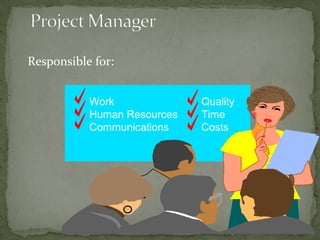
Responsible for:
Work Quality
Human Resources Time
Communications Costs
Temptation to understate costs
Withhold information
Misleading status reports
Falsifying records
Comprising workers’ safety
Approving substandard work
Concept
FeasibilityFeasibility
PlanningPlanning
ExecutionExecution
TerminationTermination
Management
Project XProject X
Level 1
Level 2
Level 3
Level 4
PERT: Program Evaluation and Review Technique
 Program (Project) Evaluation and Review Technique
PERT is a project management tool used to schedule, organize,
and coordinate tasks within a project. It is basically a method to
analyze the tasks involved in completing a given project, especially
the time needed to complete each task, and to identify the
minimum time needed to complete the total project.
Graphically displays project activities
Estimates how long the project will take
Indicates most critical activities
Show where delays will not affect project
Prediction of deliverables
Planning resource requirements
Controlling resource allocation
Internal program review
External program review
 Performance evaluation
Uniform wide acceptance
In construction activities
Transportation activities
In oil refineries
Computer system-
 For manufacturing electric generator machines
Medical and surgical sector
Library activities
Saving of time
Determination of activities
Elimination of risk in complex activities –
Flexibility
Evaluation of alternatives-
Useful in effective control-
Useful in decision making
Useful is research work
Network (precedence) diagram – diagram of
project activities that shows sequential
relationships by the use of arrows and nodes.
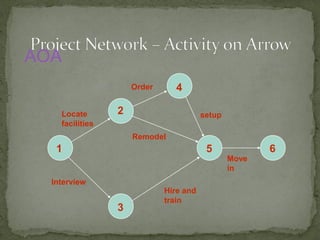
Activity-on-arrow (AOA) – a network diagram
convention in which arrows designate activities.
Activity-on-node (AON) – a network diagram
convention in which nodes designate activities.
Activities – steps in the project that consume
resources and/or time.
Events – the starting and finishing of activities,
designated by nodes in the AOA convention.
Path
Sequence of activities that leads from the starting
node to the finishing node
Critical path
The longest path; determines expected project
duration
Critical activities
Activities on the critical path
Slack
Allowable slippage for path; the difference the
length of path and the length of critical path
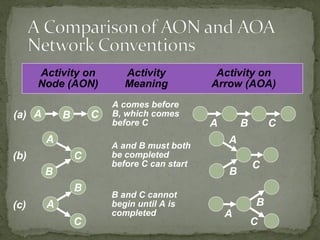
Activity on Activity Activity on
Node (AON) Meaning Arrow (AOA)
A comes before
B, which comes
before C
(a) A B C
BA C
A and B must both
be completed
before C can start
(b)
A
C
C
B
A
B
B and C cannot
begin until A is
completed
(c)
B
A
C
A
B
C
Activity on Activity Activity on
Node (AON) Meaning Arrow (AOA)
C and D cannot
begin until A
and B have
both been
completed
(d)
A
B
C
D B
A C
D
C cannot begin
until both A and B
are completed; D
cannot begin until
B is completed. A
dummy activity is
introduced in AOA
(e)
CA
B D
Dummy activity
A
B
C
D
Activity on Activity Activity on
Node (AON) Meaning Arrow (AOA)
B and C cannot
begin until A is
completed. D
cannot begin
until both B and
C are completed.
A dummy
activity is again
introduced in
AOA.
(f)
A
C
DB A B
C
D
Dummy
activity
1
2
3
4
5 6
Locate
facilities
Order
setup
Interview
Hire and
train
Remodel
Move
in
AOA
1
2
3
5
6
Locate
facilities
Order
setup
Interview
Remodel
Move
in
4
Hire and
train
7S
AON
Deterministic
Time estimates that are fairly certain
Probabilistic
Estimates of times that allow for variation
Network activities
ES: earliest start
EF: earliest finish
LS: latest start
LF: latest finish
Used to determine
Expected project duration
Slack time
Critical path
Perform a Critical Path AnalysisPerform a Critical Path Analysis
Table 3.2Table 3.2
Activity Description Time (weeks)
A Build internal components 2
B Modify roof and floor 3
C Construct collection stack 2
D Pour concrete and install frame 4
E Build high-temperature burner 4
F Install pollution control system 3
G Install air pollution device 5
H Inspect and test 2
Total Time (weeks) 25
Earliest start (ES) = earliest time at
which an activity can start, assuming
all predecessors have been completed
Earliest finish (EF) = earliest time at
which an activity can be finished
Latest start (LS) = latest time at
which an activity can start so as to not
delay the completion time of the entire
project
Latest finish (LF) = latest time by
which an activity has to be finished so
as to not delay the completion time of
the entire project
Activity Description
Immediate
Predecessors
A Build internal components —
B Modify roof and floor —
C Construct collection stack A
D Pour concrete and install frame A, B
E Build high-temperature burner C
F Install pollution control system C
G Install air pollution device D, E
H Inspect and test F, G
Milwaukee Paper Manufacturing'sMilwaukee Paper Manufacturing's
Activities and PredecessorsActivities and Predecessors
A
Start
BStart
Activity
Activity A
(Build Internal Components)
Activity B
(Modify Roof and Floor)
C
D
A
Start
B
Activity A Precedes Activity C
Activities A and B
Precede Activity D
G
E
F
H
CA
Start
DB
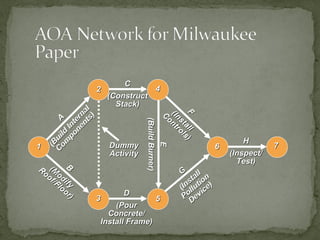
Arrows Show Precedence
Relationships
HH
(Inspect/(Inspect/
Test)Test)
77DummyDummy
ActivityActivity
66
FF(Install
(Install
Controls)
Controls)
EE
(BuildBurner)(BuildBurner)
GG
(Install
(Install
Pollution
Pollution
Device)
Device)
55
DD
(Pour(Pour
Concrete/Concrete/
Install Frame)Install Frame)
44
CC
(Construct(Construct
Stack)Stack)
11
33
22
BB(M
odify
(M
odify
Roof/Floor)
Roof/Floor)
AA
(B
uild
Internal
(B
uild
Internal
C
om
ponents)
C
om
ponents)
Optimistic time
Time required under optimal conditions
Pessimistic time
Time required under worst conditions
Most likely time
Most probable length of time that will be required
PERT makes two more assumptions:PERT makes two more assumptions:
 Total project completion times follow aTotal project completion times follow a
normal probability distributionnormal probability distribution
 Activity times are statisticallyActivity times are statistically
independentindependent
Crash – shortening activity duration
Procedure for crashing
Crash the project one period at a time
Only an activity on the critical path
Crash the least expensive activity
Multiple critical paths: find the sum of crashing the
least expensive activity on each critical path
Projects are a unique set of activities
Projects go through life cycles
PERT and CPM are two common techniques
Network diagrams
Project management software available

Project Management

  • 1.
  • 2.
     Discuss thebehavioral aspects of projects in terms of project personnel and the project manager.  Discuss the nature and importance of a work breakdown structure in project management.  Give a general description of PERT/CPM techniques.  Construct simple network diagrams.
  • 3.
     List thekinds of information that a PERT or CPM analysis can provide.  Analyze networks with deterministic times.  Analyze networks with probabilistic times.  Describe activity “crashing” and solve typical problems.
  • 4.
    Unique, one-time operationsdesigned toUnique, one-time operations designed to accomplish a specific set of objectives in aaccomplish a specific set of objectives in a limited time frame.limited time frame. Build A A Done Build B B Done Build C C Done Build D Ship JAN FEB MAR APR MAY JUN On time!
  • 5.
    What are theKey Metrics Time Cost Performance objectives What are the Key Success Factors? Top-down commitment Having a capable project manager Having time to plan Careful tracking and control Good communications
  • 6.
    What are theMajor Administrative Issues? Executive responsibilities Project selection Project manager selection Organizational structure Organizational alternatives Manage within functional unit Assign a coordinator Use a matrix organization with a project leader
  • 7.
    What are thetools? Work breakdown structure Network diagram Gantt charts Risk management
  • 8.
    MAR APR MAYJUN JUL AUG SEP OCT NOV DEC Locate new facilities Interview staff Hire and train staff Select and order machine Installation / Remodel Move in/startup Gantt Chart
  • 9.
    Deciding which projectsto implement Selecting a project manager Selecting a project team Planning and designing the project Managing and controlling project resources Deciding if and when a project should be terminated
  • 10.
    Responsible for: Work Quality HumanResources Time Communications Costs
  • 11.
    Temptation to understatecosts Withhold information Misleading status reports Falsifying records Comprising workers’ safety Approving substandard work
  • 12.
  • 13.
    Project XProject X Level1 Level 2 Level 3 Level 4
  • 14.
    PERT: Program Evaluationand Review Technique  Program (Project) Evaluation and Review Technique PERT is a project management tool used to schedule, organize, and coordinate tasks within a project. It is basically a method to analyze the tasks involved in completing a given project, especially the time needed to complete each task, and to identify the minimum time needed to complete the total project. Graphically displays project activities Estimates how long the project will take Indicates most critical activities Show where delays will not affect project
  • 15.
    Prediction of deliverables Planningresource requirements Controlling resource allocation Internal program review External program review  Performance evaluation Uniform wide acceptance
  • 16.
    In construction activities Transportationactivities In oil refineries Computer system-  For manufacturing electric generator machines Medical and surgical sector Library activities
  • 17.
    Saving of time Determinationof activities Elimination of risk in complex activities – Flexibility Evaluation of alternatives- Useful in effective control- Useful in decision making Useful is research work
  • 18.
    Network (precedence) diagram– diagram of project activities that shows sequential relationships by the use of arrows and nodes. Activity-on-arrow (AOA) – a network diagram convention in which arrows designate activities. Activity-on-node (AON) – a network diagram convention in which nodes designate activities. Activities – steps in the project that consume resources and/or time. Events – the starting and finishing of activities, designated by nodes in the AOA convention.
  • 19.
    Path Sequence of activitiesthat leads from the starting node to the finishing node Critical path The longest path; determines expected project duration Critical activities Activities on the critical path Slack Allowable slippage for path; the difference the length of path and the length of critical path
  • 20.
    Activity on ActivityActivity on Node (AON) Meaning Arrow (AOA) A comes before B, which comes before C (a) A B C BA C A and B must both be completed before C can start (b) A C C B A B B and C cannot begin until A is completed (c) B A C A B C
  • 21.
    Activity on ActivityActivity on Node (AON) Meaning Arrow (AOA) C and D cannot begin until A and B have both been completed (d) A B C D B A C D C cannot begin until both A and B are completed; D cannot begin until B is completed. A dummy activity is introduced in AOA (e) CA B D Dummy activity A B C D
  • 22.
    Activity on ActivityActivity on Node (AON) Meaning Arrow (AOA) B and C cannot begin until A is completed. D cannot begin until both B and C are completed. A dummy activity is again introduced in AOA. (f) A C DB A B C D Dummy activity
  • 23.
  • 24.
  • 25.
    Deterministic Time estimates thatare fairly certain Probabilistic Estimates of times that allow for variation
  • 26.
    Network activities ES: earlieststart EF: earliest finish LS: latest start LF: latest finish Used to determine Expected project duration Slack time Critical path
  • 27.
    Perform a CriticalPath AnalysisPerform a Critical Path Analysis Table 3.2Table 3.2 Activity Description Time (weeks) A Build internal components 2 B Modify roof and floor 3 C Construct collection stack 2 D Pour concrete and install frame 4 E Build high-temperature burner 4 F Install pollution control system 3 G Install air pollution device 5 H Inspect and test 2 Total Time (weeks) 25 Earliest start (ES) = earliest time at which an activity can start, assuming all predecessors have been completed Earliest finish (EF) = earliest time at which an activity can be finished Latest start (LS) = latest time at which an activity can start so as to not delay the completion time of the entire project Latest finish (LF) = latest time by which an activity has to be finished so as to not delay the completion time of the entire project
  • 28.
    Activity Description Immediate Predecessors A Buildinternal components — B Modify roof and floor — C Construct collection stack A D Pour concrete and install frame A, B E Build high-temperature burner C F Install pollution control system C G Install air pollution device D, E H Inspect and test F, G Milwaukee Paper Manufacturing'sMilwaukee Paper Manufacturing's Activities and PredecessorsActivities and Predecessors
  • 29.
    A Start BStart Activity Activity A (Build InternalComponents) Activity B (Modify Roof and Floor)
  • 30.
    C D A Start B Activity A PrecedesActivity C Activities A and B Precede Activity D
  • 31.
  • 32.
  • 33.
    Optimistic time Time requiredunder optimal conditions Pessimistic time Time required under worst conditions Most likely time Most probable length of time that will be required
  • 34.
    PERT makes twomore assumptions:PERT makes two more assumptions:  Total project completion times follow aTotal project completion times follow a normal probability distributionnormal probability distribution  Activity times are statisticallyActivity times are statistically independentindependent
  • 35.
    Crash – shorteningactivity duration Procedure for crashing Crash the project one period at a time Only an activity on the critical path Crash the least expensive activity Multiple critical paths: find the sum of crashing the least expensive activity on each critical path
  • 36.
    Projects are aunique set of activities Projects go through life cycles PERT and CPM are two common techniques Network diagrams Project management software available