Preparation of different meatPreparation of different meat
cutscuts
BASIC MEAT CUTSBASIC MEAT CUTS
**Meats cuts are based on 2 FactorsMeats cuts are based on 2 Factors::
 Muscle and Bone structure of the meat.Muscle and Bone structure of the meat.
 Uses and appropriate cooking methods of various parts of theUses and appropriate cooking methods of various parts of the
animal.animal.
CARCASSES:CARCASSES: whole animal, minus entrails, head, feet and hide. (pork:whole animal, minus entrails, head, feet and hide. (pork:
has only the head and entrails removed).has only the head and entrails removed).
STEPS IN BREAKING DOWN CARCASSES (PRIMAL CUTS)STEPS IN BREAKING DOWN CARCASSES (PRIMAL CUTS)
Forequarter and Hindquarter: (beef)Forequarter and Hindquarter: (beef) – is split through the back bone– is split through the back bone
into sides. Sides are divided between the 12into sides. Sides are divided between the 12thth
and 13and 13thth
ribs, intoribs, into
forequarter and hindquarter.forequarter and hindquarter.
Foresaddle and hindsaddle: (veal and lamb)Foresaddle and hindsaddle: (veal and lamb) – are not split into sides– are not split into sides
but are divided between ribs 12 and 13, into foresaddle andbut are divided between ribs 12 and 13, into foresaddle and
hindsaddle.hindsaddle.
CattleCattle
general term for domesticated bovine animals raised ongeneral term for domesticated bovine animals raised on
a farm or ranch for their meat, milk, or hides or for usea farm or ranch for their meat, milk, or hides or for use
as draft animals. Cattle are categorized by sex and age.as draft animals. Cattle are categorized by sex and age.
 CalvesCalves

young cattle of either sex.young cattle of either sex.

A male calf is known as a bull calf, and a female calf is called a heiferA male calf is known as a bull calf, and a female calf is called a heifer
calf.calf.
 BullsBulls

mature, uncastrated male cattle used for breeding.mature, uncastrated male cattle used for breeding.
 SteersSteers

male cattle that have been castrated before reaching sexual maturitymale cattle that have been castrated before reaching sexual maturity

Most beef that Americans eat comes from steers.Most beef that Americans eat comes from steers.
 StagsStags

male cattle that have undergone castration after they have matured.male cattle that have undergone castration after they have matured.
 HeifersHeifers

calves grow into heifers and eventually become cows.calves grow into heifers and eventually become cows.
 CowsCows

mature female cattle, and are usually used as a source of milk.mature female cattle, and are usually used as a source of milk.
FabricationFabrication
 Beef and other meats are available for purchase in variousBeef and other meats are available for purchase in various
forms: carcasses; partial carcasses; and primal, subprimal,forms: carcasses; partial carcasses; and primal, subprimal,
and fabricated cuts.and fabricated cuts.
 Labor, equipment, facilities, and menu uses determine theLabor, equipment, facilities, and menu uses determine the
form purchased.form purchased.
 The carcass is the whole animal after slaughter, withoutThe carcass is the whole animal after slaughter, without
head, feet, hide, and entrails.head, feet, hide, and entrails.
 It is typical to split a beef carcass into halves and then to cutIt is typical to split a beef carcass into halves and then to cut
each half into a front portion, or forequarter, and a reareach half into a front portion, or forequarter, and a rear
portion, or hindquarter.portion, or hindquarter.
 A side or a quarter of beef represents a partial carcass.A side or a quarter of beef represents a partial carcass.
 Carcasses and partial carcasses are market forms whoseCarcasses and partial carcasses are market forms whose
use is not feasible in most foodservice operations.use is not feasible in most foodservice operations.
 Only the largest operations are able to store and processOnly the largest operations are able to store and process
these forms, reducing them to the preferred primal,these forms, reducing them to the preferred primal,
subprimal, and fabricated cuts.subprimal, and fabricated cuts.
 Primal cutPrimal cut is a large, primary pieceis a large, primary piece
of meat, sometimes called aof meat, sometimes called a
wholesale cut.wholesale cut.
 Subprimal cutSubprimal cut is a basic cut madeis a basic cut made
from a primal cut.from a primal cut.
 Fabricated cutFabricated cut is the smaller portionis the smaller portion
taken from a subprimal cut, such astaken from a subprimal cut, such as
a roast, steak, and ground.a roast, steak, and ground.
FabricationFabrication
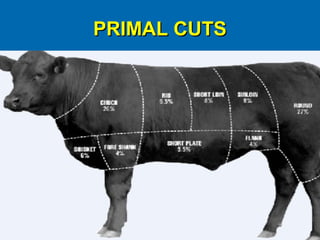
PRIMAL CUTSPRIMAL CUTS
Primal CutsPrimal Cuts
FABRICATED CUTSFABRICATED CUTS
Beef ForequarterBeef Forequarter
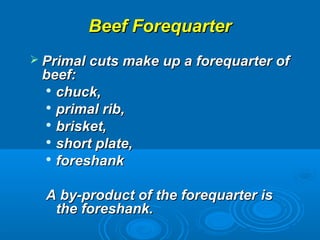
 Primal cuts make up a forequarter ofPrimal cuts make up a forequarter of
beef:beef:

chuck,chuck,

primal rib,primal rib,

brisket,brisket,

short plate,short plate,

foreshankforeshank
A by-product of the forequarter isA by-product of the forequarter is
the foreshank.the foreshank.
ChuckChuck
 chuck comes from the animal’s shoulder.chuck comes from the animal’s shoulder.
 includes part of the back bone and the first five rib bones asincludes part of the back bone and the first five rib bones as
well as portions of arm bones and blade bones.well as portions of arm bones and blade bones.
 chuck makes up nearly 30% of the weight of the beefchuck makes up nearly 30% of the weight of the beef
carcass.carcass.
 A fairly large proportion of the chuck is connective tissueA fairly large proportion of the chuck is connective tissue
 Chuck has a great deal of flavor when prepared properly.Chuck has a great deal of flavor when prepared properly.
 A moist technique or a combination method such asA moist technique or a combination method such as
stewing or braising is appropriate for this cut.stewing or braising is appropriate for this cut.
 Primal chuck yields various fabricated cuts: shoulder clod,Primal chuck yields various fabricated cuts: shoulder clod,
chuck eye roll, chuck tender, triangle, chuck short ribs,chuck eye roll, chuck tender, triangle, chuck short ribs,
cubed or tenderized steaks, stew meat, and ground chuck.cubed or tenderized steaks, stew meat, and ground chuck.
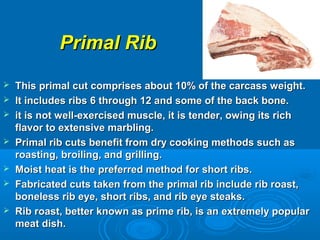
Primal RibPrimal Rib
 This primal cut comprises about 10% of the carcass weight.This primal cut comprises about 10% of the carcass weight.
 It includes ribs 6 through 12 and some of the back bone.It includes ribs 6 through 12 and some of the back bone.
 it is not well-exercised muscle, it is tender, owing its richit is not well-exercised muscle, it is tender, owing its rich
flavor to extensive marbling.flavor to extensive marbling.
 Primal rib cuts benefit from dry cooking methods such asPrimal rib cuts benefit from dry cooking methods such as
roasting, broiling, and grilling.roasting, broiling, and grilling.
 Moist heat is the preferred method for short ribs.Moist heat is the preferred method for short ribs.
 Fabricated cuts taken from the primal rib include rib roast,Fabricated cuts taken from the primal rib include rib roast,
boneless rib eye, short ribs, and rib eye steaks.boneless rib eye, short ribs, and rib eye steaks.
 Rib roast, better known as prime rib, is an extremely popularRib roast, better known as prime rib, is an extremely popular
meat dish.meat dish.
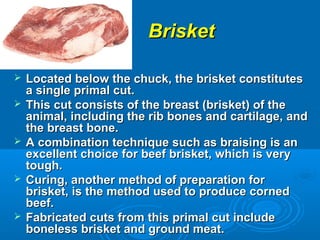
BrisketBrisket
 Located below the chuck, the brisket constitutesLocated below the chuck, the brisket constitutes
a single primal cut.a single primal cut.
 This cut consists of the breast (brisket) of theThis cut consists of the breast (brisket) of the
animal, including the rib bones and cartilage, andanimal, including the rib bones and cartilage, and
the breast bone.the breast bone.
 A combination technique such as braising is anA combination technique such as braising is an
excellent choice for beef brisket, which is veryexcellent choice for beef brisket, which is very
tough.tough.
 Curing, another method of preparation forCuring, another method of preparation for
brisket, is the method used to produce cornedbrisket, is the method used to produce corned
beef.beef.
 Fabricated cuts from this primal cut includeFabricated cuts from this primal cut include
boneless brisket and ground meat.boneless brisket and ground meat.
Short PlateShort Plate
 Short plate is the cut below primal rib on a sideShort plate is the cut below primal rib on a side
of beef.of beef.
 It contains rib bones and cartilage and the tip ofIt contains rib bones and cartilage and the tip of
the breast bone.the breast bone.
 Fabricated cuts from the short plate includeFabricated cuts from the short plate include
ground beef, skirt steak, and short ribs.ground beef, skirt steak, and short ribs.
 Moist cooking is appropriate for short ribs, whichMoist cooking is appropriate for short ribs, which
are quite meaty but also contain a large amountare quite meaty but also contain a large amount
of connective tissue.of connective tissue.
 Marination and grilling are excellent methods forMarination and grilling are excellent methods for
skirt steak, which is sliced for fajitas.skirt steak, which is sliced for fajitas.
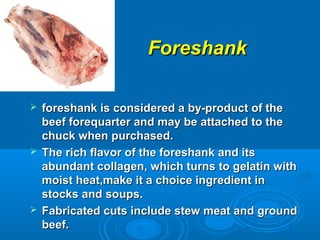
ForeshankForeshank
 foreshank is considered a by-product of theforeshank is considered a by-product of the
beef forequarter and may be attached to thebeef forequarter and may be attached to the
chuck when purchased.chuck when purchased.
 The rich flavor of the foreshank and itsThe rich flavor of the foreshank and its
abundant collagen, which turns to gelatin withabundant collagen, which turns to gelatin with
moist heat,make it a choice ingredient inmoist heat,make it a choice ingredient in
stocks and soups.stocks and soups.
 Fabricated cuts include stew meat and groundFabricated cuts include stew meat and ground
beef.beef.
Beef HindquarterBeef Hindquarter
 A beef hindquarter also yields fourA beef hindquarter also yields four
primal cuts:primal cuts:

short loin,short loin,

sirloin,sirloin,

round,round,

flank.flank.
Short LoinShort Loin
 The short loin is the first primal cut of theThe short loin is the first primal cut of the
hindquarter, forming the front portion of thehindquarter, forming the front portion of the
beef loin. It includes one rib and part of thebeef loin. It includes one rib and part of the
back bone.back bone.
 The yield of this primal cut is substantial andThe yield of this primal cut is substantial and
represents the most palatable and popular, asrepresents the most palatable and popular, as
well as the most expensive, cuts of beef.well as the most expensive, cuts of beef.
 Among these is the tenderloin, the most tenderAmong these is the tenderloin, the most tender
piece of beef.piece of beef.
 Fabricated cuts from the short loin include clubFabricated cuts from the short loin include club
steaks, T-bone steaks, porterhouse steaks, stripsteaks, T-bone steaks, porterhouse steaks, strip
loin, strip loin steaks, and short tenderloin.loin, strip loin steaks, and short tenderloin.
 These cuts are best cooked using dry methods.These cuts are best cooked using dry methods.
SirloinSirloin
 Located next to the short loin, the sirloinLocated next to the short loin, the sirloin
contains a portion of both the back bone andcontains a portion of both the back bone and
the hip bone.the hip bone.
 The subprimal and fabricated cuts taken fromThe subprimal and fabricated cuts taken from
the sirloin have good flavor and are quitethe sirloin have good flavor and are quite
tender, though not as tender as the short lointender, though not as tender as the short loin
cuts.cuts.
 Fabricated cuts from the sirloin include topFabricated cuts from the sirloin include top
sirloin roasts and steaks and top and bottomsirloin roasts and steaks and top and bottom
sirloin butt roasts and steaks.sirloin butt roasts and steaks.
 The dry techniques of broiling, roasting, andThe dry techniques of broiling, roasting, and
grilling are best for these cuts.grilling are best for these cuts.
RoundRound
 The round is the hind leg of the animal,The round is the hind leg of the animal,
including the round, aitch, shank, and tail bones.including the round, aitch, shank, and tail bones.
 It is an extremely large cut, constitutingIt is an extremely large cut, constituting
approximately 24% of the carcass weight.approximately 24% of the carcass weight.
 Very flavorful and fairly tender, the round yieldsVery flavorful and fairly tender, the round yields
various subprimal and fabricated cuts, includingvarious subprimal and fabricated cuts, including
top round, bottom round (eye of round andtop round, bottom round (eye of round and
outside round), knuckle, heel, and shank.outside round), knuckle, heel, and shank.
 Dry cooking such as roasting is appropriate forDry cooking such as roasting is appropriate for
top round, which is relatively tender.top round, which is relatively tender.
 The tougher bottom round benefits fromThe tougher bottom round benefits from
combination cooking such as stewing orcombination cooking such as stewing or
braising.braising.
FlankFlank
 Beneath the loin and behind the shortBeneath the loin and behind the short
plate is the flank.plate is the flank.
 The flank contains a good amount ofThe flank contains a good amount of
fat and connective tissue, which makesfat and connective tissue, which makes
it tough.it tough.
 The flank yields flank steak.The flank yields flank steak.
 Moist cooking techniques are best forMoist cooking techniques are best for
flank cuts except when flank steak isflank cuts except when flank steak is
prepared as London broil and cut thinlyprepared as London broil and cut thinly
across the grain.across the grain.
VARIETY OF MEATSVARIETY OF MEATS
 VARIETY MEATS-VARIETY MEATS- also called offals,also called offals,
includes various organs, glands, and otherincludes various organs, glands, and other
meats that don’t form a part of a dressedmeats that don’t form a part of a dressed
carcass of the animals.carcass of the animals.
 Glandular meatsGlandular meats – liver, kidneys,– liver, kidneys,
sweetbreads, brains.sweetbreads, brains.
 Muscle meatsMuscle meats – heart, tripe tongue,– heart, tripe tongue,
oxtails.oxtails.
GLANDULAR MEATSGLANDULAR MEATS
 LiverLiver – calf or veal liver is the most prized. Because it is tender and– calf or veal liver is the most prized. Because it is tender and
delicate in flavor.delicate in flavor.
Pale, pinkish color.Pale, pinkish color.
Served – sauteed, fried, broiled.Served – sauteed, fried, broiled.
beef liver is darker in color, tougher, and has a strong flavor than vealbeef liver is darker in color, tougher, and has a strong flavor than veal
liver.liver.
Served – pan fried, broiled, braised.Served – pan fried, broiled, braised.
 KidneyKidney – veal and lamb kidneys are most popular in elegant restaurants.– veal and lamb kidneys are most popular in elegant restaurants.
Served – sauteed, broiled.Served – sauteed, broiled.
Beef kidneys – stronger flavor tougher, and darker color. Served –Beef kidneys – stronger flavor tougher, and darker color. Served –
braisedbraised
 SweetbreadsSweetbreads – thymus glands of calves or young animals, considered– thymus glands of calves or young animals, considered
delicacy and expensive. Very mild in flavor, and delicate in texture.delicacy and expensive. Very mild in flavor, and delicate in texture.
Served – braised, breaded and fried or sauteed in butter.Served – braised, breaded and fried or sauteed in butter.
 BrainsBrains – not popular item but very delicate in flavor and texture. Very– not popular item but very delicate in flavor and texture. Very
perishable and cooked as soon as possible.perishable and cooked as soon as possible.
Served - pan fried in brown butter, breaded and fried serve with tomatoServed - pan fried in brown butter, breaded and fried serve with tomato
sauce.sauce.
Muscular MeatsMuscular Meats
HeartHeart – usually from veal or beef, very tough– usually from veal or beef, very tough
and lean. It can be braised or simmer, orand lean. It can be braised or simmer, or
ground and added to other chopped meatsground and added to other chopped meats
for casserole dishes.for casserole dishes.
Beef tongueBeef tongue – very tough, but softens in moist– very tough, but softens in moist
heat. Can be served cold, smoked, braised orheat. Can be served cold, smoked, braised or
cured.cured.
OxtailsOxtails – very flavorful and a rich gelatin– very flavorful and a rich gelatin
content. It can be served in soups or braised.content. It can be served in soups or braised.
TripeTripe – muscular stomach lining, of beef, lamb,– muscular stomach lining, of beef, lamb,
and pork. Honeycomb tripe is the mostand pork. Honeycomb tripe is the most
popular.popular.
It can be served in soups or braised.It can be served in soups or braised.
FabricationFabrication
 Meats can be purchased in numerous ways.Meats can be purchased in numerous ways.
 This decision depends on a variety of factors;This decision depends on a variety of factors;

butchering skillsbutchering skills

available storage spaceavailable storage space

use of meat, bones, and trimmings on theuse of meat, bones, and trimmings on the
menumenu

and cost per portion, including labor.and cost per portion, including labor.
 Primal cuts can be fabricated into smaller cutsPrimal cuts can be fabricated into smaller cuts
such as chops, roasts, steaks, stew beef ,andsuch as chops, roasts, steaks, stew beef ,and
ground beef.ground beef.
LAMBLAMB
LAMBLAMB
 A lamb is a young animal belonging to theA lamb is a young animal belonging to the
genusgenus OvisOvis, which includes both, which includes both
domesticated and wild sheep.domesticated and wild sheep.
 There are several terms for the meat of ovineThere are several terms for the meat of ovine
animals. Each indicates a specific level ofanimals. Each indicates a specific level of
muscle and bone development.muscle and bone development.
 LambLamb is meat from sheep under one year ofis meat from sheep under one year of
age.age.
 MuttonMutton is meat from mature sheep. Sheepis meat from mature sheep. Sheep
reach maturity at one year.reach maturity at one year.
 YearlingYearling is a sheep between 12 and 20is a sheep between 12 and 20
months old. It produces yearling mutton.months old. It produces yearling mutton.
SkeletalSkeletal
structurestructure
of lambof lamb
Types of LambTypes of Lamb
 Age at the time of slaughter and period ofAge at the time of slaughter and period of
production determine various types of lamb.production determine various types of lamb.
 Baby lambBaby lamb refers to meat from lamb sent torefers to meat from lamb sent to
market before weaning, usually between 6 andmarket before weaning, usually between 6 and
10 weeks old. Another term for baby lamb is10 weeks old. Another term for baby lamb is
hothouse lamb.hothouse lamb.
 Genuine lambGenuine lamb is meat from a sheep less thanis meat from a sheep less than
one year old.one year old.
 Spring lambSpring lamb is 3 to 5 months old and isis 3 to 5 months old and is
produced between March and October. Springproduced between March and October. Spring
lamb is milk-fed.lamb is milk-fed.
FABRICATIONFABRICATION
lamb carcass is
divided between the
ribs into the foresaddle
and the hindsaddle.
Foresaddle yields
three primal cuts,
Hindsaddle produces
two.
Each primal cut
contains both halves,
or sides, of the
arcass.

Butchery

  • 1.
    Preparation of differentmeatPreparation of different meat cutscuts
  • 2.
    BASIC MEAT CUTSBASICMEAT CUTS **Meats cuts are based on 2 FactorsMeats cuts are based on 2 Factors::  Muscle and Bone structure of the meat.Muscle and Bone structure of the meat.  Uses and appropriate cooking methods of various parts of theUses and appropriate cooking methods of various parts of the animal.animal. CARCASSES:CARCASSES: whole animal, minus entrails, head, feet and hide. (pork:whole animal, minus entrails, head, feet and hide. (pork: has only the head and entrails removed).has only the head and entrails removed). STEPS IN BREAKING DOWN CARCASSES (PRIMAL CUTS)STEPS IN BREAKING DOWN CARCASSES (PRIMAL CUTS) Forequarter and Hindquarter: (beef)Forequarter and Hindquarter: (beef) – is split through the back bone– is split through the back bone into sides. Sides are divided between the 12into sides. Sides are divided between the 12thth and 13and 13thth ribs, intoribs, into forequarter and hindquarter.forequarter and hindquarter. Foresaddle and hindsaddle: (veal and lamb)Foresaddle and hindsaddle: (veal and lamb) – are not split into sides– are not split into sides but are divided between ribs 12 and 13, into foresaddle andbut are divided between ribs 12 and 13, into foresaddle and hindsaddle.hindsaddle.
  • 3.
    CattleCattle general term fordomesticated bovine animals raised ongeneral term for domesticated bovine animals raised on a farm or ranch for their meat, milk, or hides or for usea farm or ranch for their meat, milk, or hides or for use as draft animals. Cattle are categorized by sex and age.as draft animals. Cattle are categorized by sex and age.  CalvesCalves  young cattle of either sex.young cattle of either sex.  A male calf is known as a bull calf, and a female calf is called a heiferA male calf is known as a bull calf, and a female calf is called a heifer calf.calf.  BullsBulls  mature, uncastrated male cattle used for breeding.mature, uncastrated male cattle used for breeding.  SteersSteers  male cattle that have been castrated before reaching sexual maturitymale cattle that have been castrated before reaching sexual maturity  Most beef that Americans eat comes from steers.Most beef that Americans eat comes from steers.  StagsStags  male cattle that have undergone castration after they have matured.male cattle that have undergone castration after they have matured.  HeifersHeifers  calves grow into heifers and eventually become cows.calves grow into heifers and eventually become cows.  CowsCows  mature female cattle, and are usually used as a source of milk.mature female cattle, and are usually used as a source of milk.
  • 4.
    FabricationFabrication  Beef andother meats are available for purchase in variousBeef and other meats are available for purchase in various forms: carcasses; partial carcasses; and primal, subprimal,forms: carcasses; partial carcasses; and primal, subprimal, and fabricated cuts.and fabricated cuts.  Labor, equipment, facilities, and menu uses determine theLabor, equipment, facilities, and menu uses determine the form purchased.form purchased.  The carcass is the whole animal after slaughter, withoutThe carcass is the whole animal after slaughter, without head, feet, hide, and entrails.head, feet, hide, and entrails.  It is typical to split a beef carcass into halves and then to cutIt is typical to split a beef carcass into halves and then to cut each half into a front portion, or forequarter, and a reareach half into a front portion, or forequarter, and a rear portion, or hindquarter.portion, or hindquarter.  A side or a quarter of beef represents a partial carcass.A side or a quarter of beef represents a partial carcass.  Carcasses and partial carcasses are market forms whoseCarcasses and partial carcasses are market forms whose use is not feasible in most foodservice operations.use is not feasible in most foodservice operations.  Only the largest operations are able to store and processOnly the largest operations are able to store and process these forms, reducing them to the preferred primal,these forms, reducing them to the preferred primal, subprimal, and fabricated cuts.subprimal, and fabricated cuts.
  • 5.
     Primal cutPrimalcut is a large, primary pieceis a large, primary piece of meat, sometimes called aof meat, sometimes called a wholesale cut.wholesale cut.  Subprimal cutSubprimal cut is a basic cut madeis a basic cut made from a primal cut.from a primal cut.  Fabricated cutFabricated cut is the smaller portionis the smaller portion taken from a subprimal cut, such astaken from a subprimal cut, such as a roast, steak, and ground.a roast, steak, and ground. FabricationFabrication
  • 6.
  • 7.
  • 8.
  • 9.
    Beef ForequarterBeef Forequarter Primal cuts make up a forequarter ofPrimal cuts make up a forequarter of beef:beef:  chuck,chuck,  primal rib,primal rib,  brisket,brisket,  short plate,short plate,  foreshankforeshank A by-product of the forequarter isA by-product of the forequarter is the foreshank.the foreshank.
  • 10.
    ChuckChuck  chuck comesfrom the animal’s shoulder.chuck comes from the animal’s shoulder.  includes part of the back bone and the first five rib bones asincludes part of the back bone and the first five rib bones as well as portions of arm bones and blade bones.well as portions of arm bones and blade bones.  chuck makes up nearly 30% of the weight of the beefchuck makes up nearly 30% of the weight of the beef carcass.carcass.  A fairly large proportion of the chuck is connective tissueA fairly large proportion of the chuck is connective tissue  Chuck has a great deal of flavor when prepared properly.Chuck has a great deal of flavor when prepared properly.  A moist technique or a combination method such asA moist technique or a combination method such as stewing or braising is appropriate for this cut.stewing or braising is appropriate for this cut.  Primal chuck yields various fabricated cuts: shoulder clod,Primal chuck yields various fabricated cuts: shoulder clod, chuck eye roll, chuck tender, triangle, chuck short ribs,chuck eye roll, chuck tender, triangle, chuck short ribs, cubed or tenderized steaks, stew meat, and ground chuck.cubed or tenderized steaks, stew meat, and ground chuck.
  • 11.
    Primal RibPrimal Rib This primal cut comprises about 10% of the carcass weight.This primal cut comprises about 10% of the carcass weight.  It includes ribs 6 through 12 and some of the back bone.It includes ribs 6 through 12 and some of the back bone.  it is not well-exercised muscle, it is tender, owing its richit is not well-exercised muscle, it is tender, owing its rich flavor to extensive marbling.flavor to extensive marbling.  Primal rib cuts benefit from dry cooking methods such asPrimal rib cuts benefit from dry cooking methods such as roasting, broiling, and grilling.roasting, broiling, and grilling.  Moist heat is the preferred method for short ribs.Moist heat is the preferred method for short ribs.  Fabricated cuts taken from the primal rib include rib roast,Fabricated cuts taken from the primal rib include rib roast, boneless rib eye, short ribs, and rib eye steaks.boneless rib eye, short ribs, and rib eye steaks.  Rib roast, better known as prime rib, is an extremely popularRib roast, better known as prime rib, is an extremely popular meat dish.meat dish.
  • 12.
    BrisketBrisket  Located belowthe chuck, the brisket constitutesLocated below the chuck, the brisket constitutes a single primal cut.a single primal cut.  This cut consists of the breast (brisket) of theThis cut consists of the breast (brisket) of the animal, including the rib bones and cartilage, andanimal, including the rib bones and cartilage, and the breast bone.the breast bone.  A combination technique such as braising is anA combination technique such as braising is an excellent choice for beef brisket, which is veryexcellent choice for beef brisket, which is very tough.tough.  Curing, another method of preparation forCuring, another method of preparation for brisket, is the method used to produce cornedbrisket, is the method used to produce corned beef.beef.  Fabricated cuts from this primal cut includeFabricated cuts from this primal cut include boneless brisket and ground meat.boneless brisket and ground meat.
  • 13.
    Short PlateShort Plate Short plate is the cut below primal rib on a sideShort plate is the cut below primal rib on a side of beef.of beef.  It contains rib bones and cartilage and the tip ofIt contains rib bones and cartilage and the tip of the breast bone.the breast bone.  Fabricated cuts from the short plate includeFabricated cuts from the short plate include ground beef, skirt steak, and short ribs.ground beef, skirt steak, and short ribs.  Moist cooking is appropriate for short ribs, whichMoist cooking is appropriate for short ribs, which are quite meaty but also contain a large amountare quite meaty but also contain a large amount of connective tissue.of connective tissue.  Marination and grilling are excellent methods forMarination and grilling are excellent methods for skirt steak, which is sliced for fajitas.skirt steak, which is sliced for fajitas.
  • 14.
    ForeshankForeshank  foreshank isconsidered a by-product of theforeshank is considered a by-product of the beef forequarter and may be attached to thebeef forequarter and may be attached to the chuck when purchased.chuck when purchased.  The rich flavor of the foreshank and itsThe rich flavor of the foreshank and its abundant collagen, which turns to gelatin withabundant collagen, which turns to gelatin with moist heat,make it a choice ingredient inmoist heat,make it a choice ingredient in stocks and soups.stocks and soups.  Fabricated cuts include stew meat and groundFabricated cuts include stew meat and ground beef.beef.
  • 15.
    Beef HindquarterBeef Hindquarter A beef hindquarter also yields fourA beef hindquarter also yields four primal cuts:primal cuts:  short loin,short loin,  sirloin,sirloin,  round,round,  flank.flank.
  • 16.
    Short LoinShort Loin The short loin is the first primal cut of theThe short loin is the first primal cut of the hindquarter, forming the front portion of thehindquarter, forming the front portion of the beef loin. It includes one rib and part of thebeef loin. It includes one rib and part of the back bone.back bone.  The yield of this primal cut is substantial andThe yield of this primal cut is substantial and represents the most palatable and popular, asrepresents the most palatable and popular, as well as the most expensive, cuts of beef.well as the most expensive, cuts of beef.  Among these is the tenderloin, the most tenderAmong these is the tenderloin, the most tender piece of beef.piece of beef.  Fabricated cuts from the short loin include clubFabricated cuts from the short loin include club steaks, T-bone steaks, porterhouse steaks, stripsteaks, T-bone steaks, porterhouse steaks, strip loin, strip loin steaks, and short tenderloin.loin, strip loin steaks, and short tenderloin.  These cuts are best cooked using dry methods.These cuts are best cooked using dry methods.
  • 17.
    SirloinSirloin  Located nextto the short loin, the sirloinLocated next to the short loin, the sirloin contains a portion of both the back bone andcontains a portion of both the back bone and the hip bone.the hip bone.  The subprimal and fabricated cuts taken fromThe subprimal and fabricated cuts taken from the sirloin have good flavor and are quitethe sirloin have good flavor and are quite tender, though not as tender as the short lointender, though not as tender as the short loin cuts.cuts.  Fabricated cuts from the sirloin include topFabricated cuts from the sirloin include top sirloin roasts and steaks and top and bottomsirloin roasts and steaks and top and bottom sirloin butt roasts and steaks.sirloin butt roasts and steaks.  The dry techniques of broiling, roasting, andThe dry techniques of broiling, roasting, and grilling are best for these cuts.grilling are best for these cuts.
  • 18.
    RoundRound  The roundis the hind leg of the animal,The round is the hind leg of the animal, including the round, aitch, shank, and tail bones.including the round, aitch, shank, and tail bones.  It is an extremely large cut, constitutingIt is an extremely large cut, constituting approximately 24% of the carcass weight.approximately 24% of the carcass weight.  Very flavorful and fairly tender, the round yieldsVery flavorful and fairly tender, the round yields various subprimal and fabricated cuts, includingvarious subprimal and fabricated cuts, including top round, bottom round (eye of round andtop round, bottom round (eye of round and outside round), knuckle, heel, and shank.outside round), knuckle, heel, and shank.  Dry cooking such as roasting is appropriate forDry cooking such as roasting is appropriate for top round, which is relatively tender.top round, which is relatively tender.  The tougher bottom round benefits fromThe tougher bottom round benefits from combination cooking such as stewing orcombination cooking such as stewing or braising.braising.
  • 19.
    FlankFlank  Beneath theloin and behind the shortBeneath the loin and behind the short plate is the flank.plate is the flank.  The flank contains a good amount ofThe flank contains a good amount of fat and connective tissue, which makesfat and connective tissue, which makes it tough.it tough.  The flank yields flank steak.The flank yields flank steak.  Moist cooking techniques are best forMoist cooking techniques are best for flank cuts except when flank steak isflank cuts except when flank steak is prepared as London broil and cut thinlyprepared as London broil and cut thinly across the grain.across the grain.
  • 20.
    VARIETY OF MEATSVARIETYOF MEATS  VARIETY MEATS-VARIETY MEATS- also called offals,also called offals, includes various organs, glands, and otherincludes various organs, glands, and other meats that don’t form a part of a dressedmeats that don’t form a part of a dressed carcass of the animals.carcass of the animals.  Glandular meatsGlandular meats – liver, kidneys,– liver, kidneys, sweetbreads, brains.sweetbreads, brains.  Muscle meatsMuscle meats – heart, tripe tongue,– heart, tripe tongue, oxtails.oxtails.
  • 21.
    GLANDULAR MEATSGLANDULAR MEATS LiverLiver – calf or veal liver is the most prized. Because it is tender and– calf or veal liver is the most prized. Because it is tender and delicate in flavor.delicate in flavor. Pale, pinkish color.Pale, pinkish color. Served – sauteed, fried, broiled.Served – sauteed, fried, broiled. beef liver is darker in color, tougher, and has a strong flavor than vealbeef liver is darker in color, tougher, and has a strong flavor than veal liver.liver. Served – pan fried, broiled, braised.Served – pan fried, broiled, braised.  KidneyKidney – veal and lamb kidneys are most popular in elegant restaurants.– veal and lamb kidneys are most popular in elegant restaurants. Served – sauteed, broiled.Served – sauteed, broiled. Beef kidneys – stronger flavor tougher, and darker color. Served –Beef kidneys – stronger flavor tougher, and darker color. Served – braisedbraised  SweetbreadsSweetbreads – thymus glands of calves or young animals, considered– thymus glands of calves or young animals, considered delicacy and expensive. Very mild in flavor, and delicate in texture.delicacy and expensive. Very mild in flavor, and delicate in texture. Served – braised, breaded and fried or sauteed in butter.Served – braised, breaded and fried or sauteed in butter.  BrainsBrains – not popular item but very delicate in flavor and texture. Very– not popular item but very delicate in flavor and texture. Very perishable and cooked as soon as possible.perishable and cooked as soon as possible. Served - pan fried in brown butter, breaded and fried serve with tomatoServed - pan fried in brown butter, breaded and fried serve with tomato sauce.sauce.
  • 22.
    Muscular MeatsMuscular Meats HeartHeart– usually from veal or beef, very tough– usually from veal or beef, very tough and lean. It can be braised or simmer, orand lean. It can be braised or simmer, or ground and added to other chopped meatsground and added to other chopped meats for casserole dishes.for casserole dishes. Beef tongueBeef tongue – very tough, but softens in moist– very tough, but softens in moist heat. Can be served cold, smoked, braised orheat. Can be served cold, smoked, braised or cured.cured. OxtailsOxtails – very flavorful and a rich gelatin– very flavorful and a rich gelatin content. It can be served in soups or braised.content. It can be served in soups or braised. TripeTripe – muscular stomach lining, of beef, lamb,– muscular stomach lining, of beef, lamb, and pork. Honeycomb tripe is the mostand pork. Honeycomb tripe is the most popular.popular. It can be served in soups or braised.It can be served in soups or braised.
  • 23.
    FabricationFabrication  Meats canbe purchased in numerous ways.Meats can be purchased in numerous ways.  This decision depends on a variety of factors;This decision depends on a variety of factors;  butchering skillsbutchering skills  available storage spaceavailable storage space  use of meat, bones, and trimmings on theuse of meat, bones, and trimmings on the menumenu  and cost per portion, including labor.and cost per portion, including labor.  Primal cuts can be fabricated into smaller cutsPrimal cuts can be fabricated into smaller cuts such as chops, roasts, steaks, stew beef ,andsuch as chops, roasts, steaks, stew beef ,and ground beef.ground beef.
  • 24.
  • 25.
    LAMBLAMB  A lambis a young animal belonging to theA lamb is a young animal belonging to the genusgenus OvisOvis, which includes both, which includes both domesticated and wild sheep.domesticated and wild sheep.  There are several terms for the meat of ovineThere are several terms for the meat of ovine animals. Each indicates a specific level ofanimals. Each indicates a specific level of muscle and bone development.muscle and bone development.  LambLamb is meat from sheep under one year ofis meat from sheep under one year of age.age.  MuttonMutton is meat from mature sheep. Sheepis meat from mature sheep. Sheep reach maturity at one year.reach maturity at one year.  YearlingYearling is a sheep between 12 and 20is a sheep between 12 and 20 months old. It produces yearling mutton.months old. It produces yearling mutton.
  • 26.
  • 27.
    Types of LambTypesof Lamb  Age at the time of slaughter and period ofAge at the time of slaughter and period of production determine various types of lamb.production determine various types of lamb.  Baby lambBaby lamb refers to meat from lamb sent torefers to meat from lamb sent to market before weaning, usually between 6 andmarket before weaning, usually between 6 and 10 weeks old. Another term for baby lamb is10 weeks old. Another term for baby lamb is hothouse lamb.hothouse lamb.  Genuine lambGenuine lamb is meat from a sheep less thanis meat from a sheep less than one year old.one year old.  Spring lambSpring lamb is 3 to 5 months old and isis 3 to 5 months old and is produced between March and October. Springproduced between March and October. Spring lamb is milk-fed.lamb is milk-fed.
  • 28.
    FABRICATIONFABRICATION lamb carcass is dividedbetween the ribs into the foresaddle and the hindsaddle. Foresaddle yields three primal cuts, Hindsaddle produces two. Each primal cut contains both halves, or sides, of the arcass.