objectives
• identify the kinds of meat and poultry for processing;
• describe the market forms of meat and poultry;
• enumerate the tips in buying the right kind of meat.
CLICK HERE...
Meat
Meat
• is used to describe animal parts that are eaten as
food
• made up of muscle fibers connected with tissues and
fats
• 15-20% protein, 50-70% water; good source of Vit B
and trace amount of iron
Offal
Is the internal organs
of a butchered animal
Kinds of Meat
Kinds of Meat
Pork
from pig or hog
Kinds of Meat
Veal
from calves or young cattle
Kinds of Meat
beef
From adult cow
Kinds of Meat
Venison
from deer
Kinds of Meat
Carabeef
from carabao
Kinds of Meat
chevon
from goat
Kinds of Meat
lamb
from young sheep
Kinds of Meat
mutton
from adult sheep
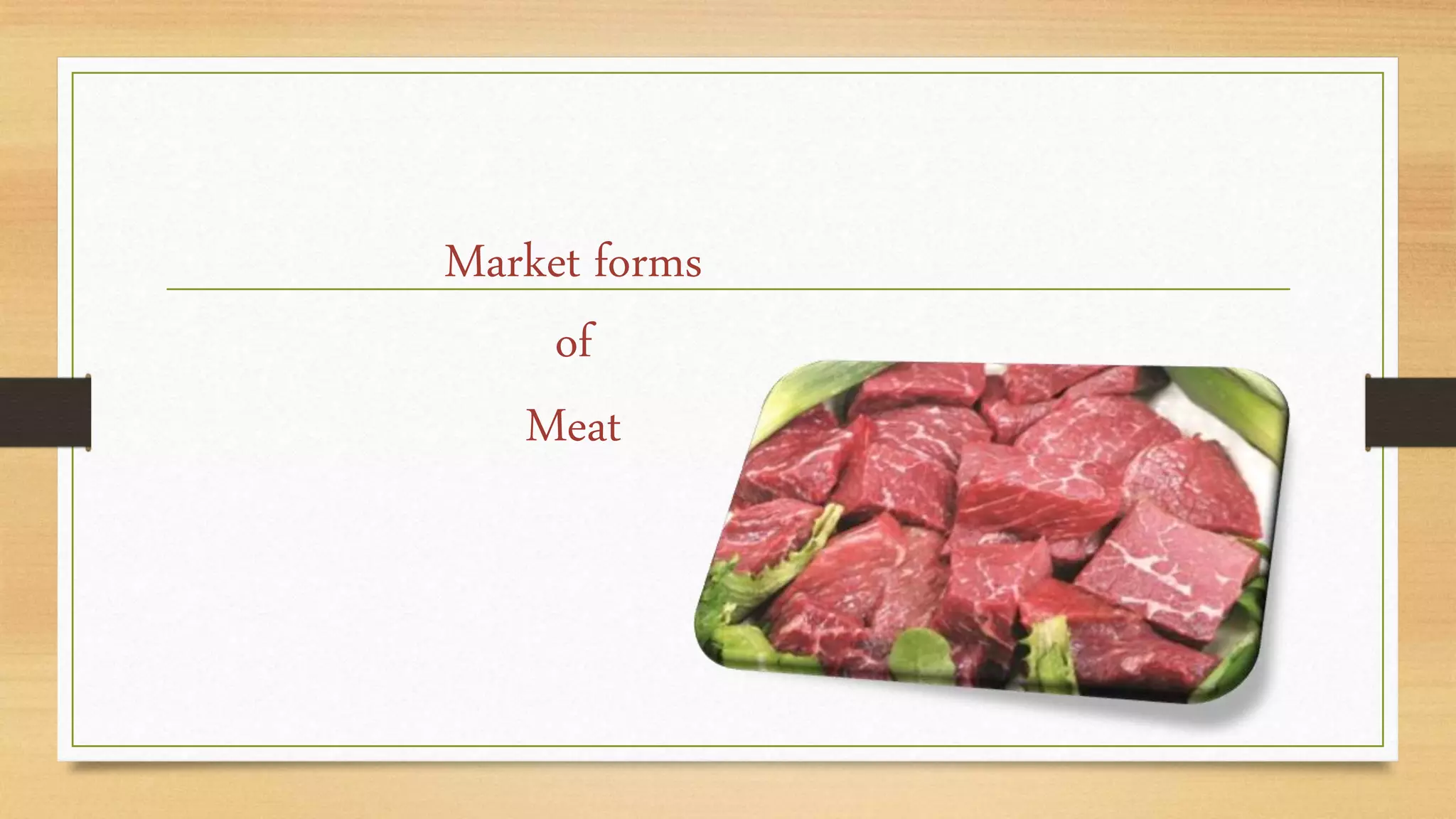
Market forms
of
Meat
Market forms of Meat
Fresh meat
is a form of meat after slaughter that has not
undergone chilling
chilled meat
has been kept cold above freezing point within 24
hours after slaughter
Market forms of Meat
frozen meat
meat stored in the freezer; sold as hard as stone
Cured or Processed meat
meat products that have been cured with
preservatives agents
characteristics of the
diffrent Meat cuts
Tender cuts
taken from animal parts that have less muscle
activity and are plump, like sirloin and tenderloin
Less tender cuts
are cuts that come from the muscle parts most used
by the animal, like hocks, chuck and flank
characteristics of the
diffrent Meat cuts
Tough cuts
cuts that necessitate longer cooking like
bulalo
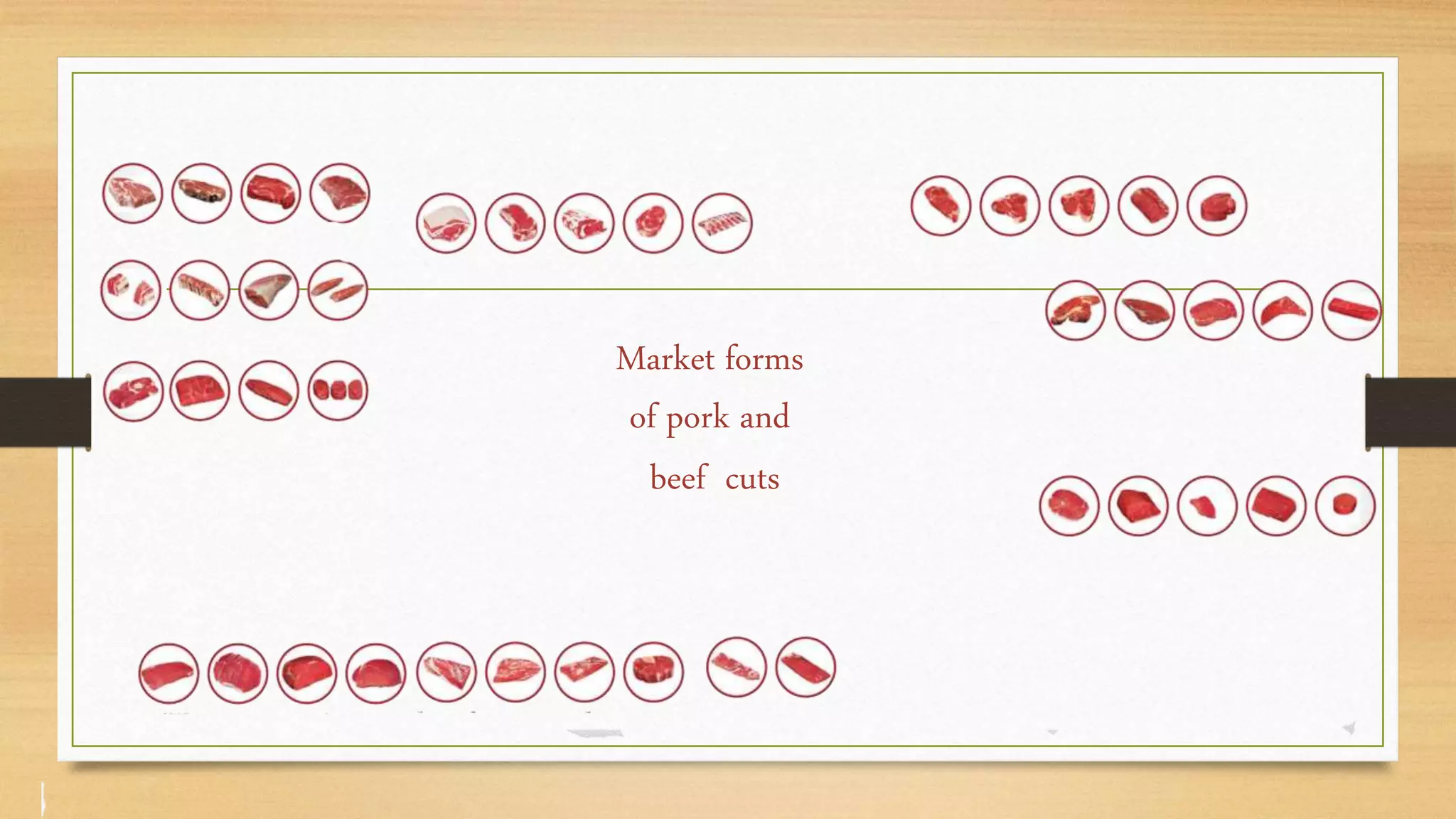
Market forms
of pork and
beef cuts
pork breakdown
beef cuts
beef cuts
Buying the
right Kind of
Meat
poultry
poultry
• refers to domestic birds such as chicken, duck
(itik), goose, turkey, pigeon, and quail.
• provides a lot of protein, vit b, iron, phosphorus
and fat
Types of chicken
and other
poultry
Types of chicken
Broiler or fryer
A chicken whose meat is tender and soft
roaster
Usually four to six months old (chosen for grilling or roasting)
stag
A male chicken less than ten months old
Types of chicken
hen
A mature female chicken bred for more than ten months.
rooster
A mature male chicken with rough skin and dark meat
Jumbo chicken
Considered as large chicken if it weighs about 4kg or more
Other poultry
Peking duck
Originated from Peking, China
Duck or itik
Available in many places in the Philippines
Market forms
of
poultry
Market forms of poultry
Live poultry
Market forms of poultry
whole poultry
refers to poultry carcass from which
feathers have been removed but the head,
feet, and innards are still intact
Market forms of poultry
dressed
Poultry
refers to poultry carcass
from which feathers and
innards have been removed
Market forms of poultry
Poultry
Parts
Several pieces of poultry parts is usually
packed in one package
(thighs, wings, breast, liver, gizzard)
Market forms of poultry
Choice cuts
of poultry
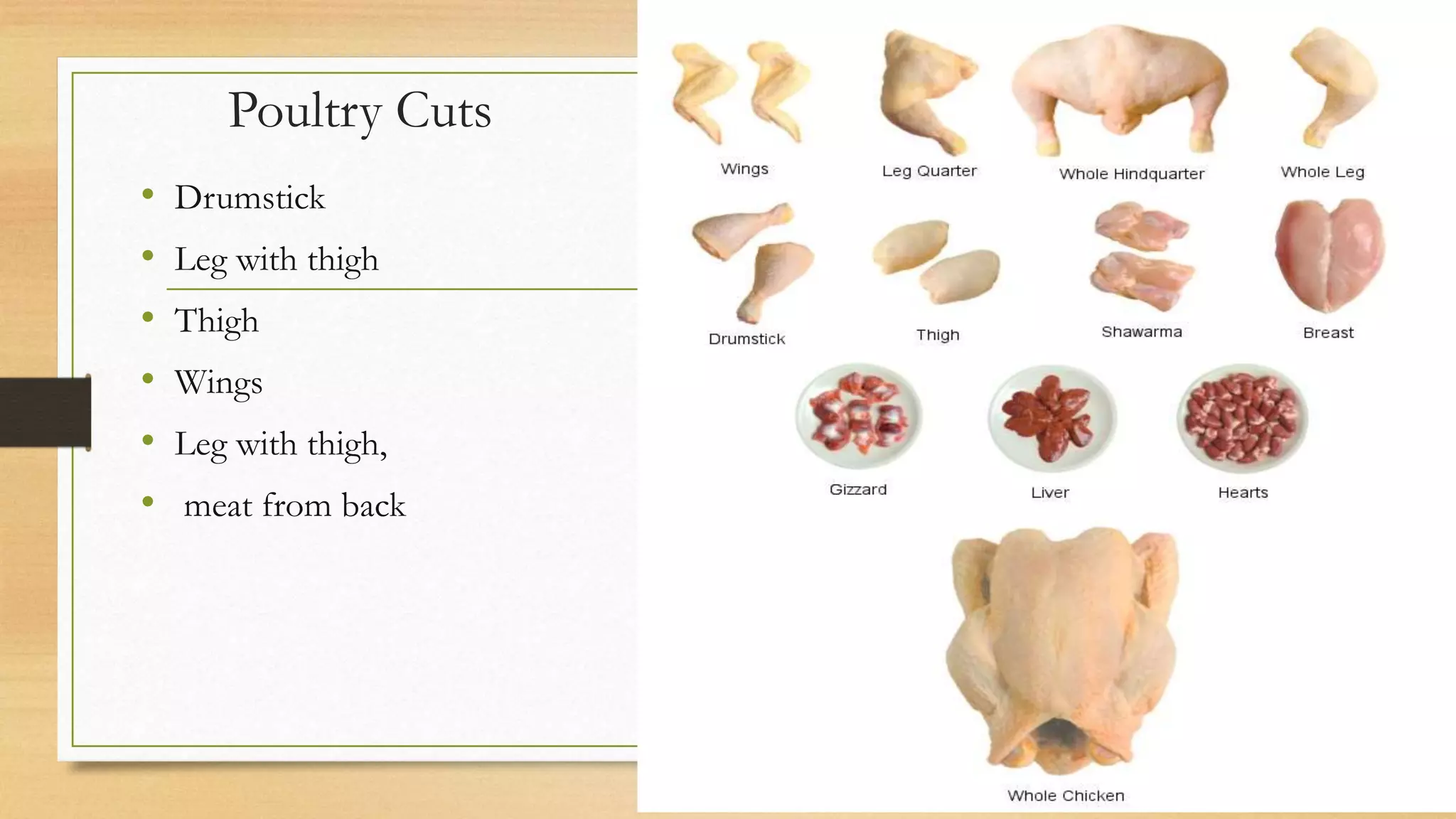
Poultry cuts
Poultry Cuts
• Drumstick
• Leg with thigh
• Thigh
• Wings
• Leg with thigh,
• meat from back
summary
• Meat and poultry are animal parts eaten as food
• Meat and poultry are sold in different market forms fpr cooking.
• Meat cuts are classified as tender, less tender and rough
• Good quality of meat and poultry can be detected through the skin color, texture, and odor
reference
Lee, Estifania Gloria L., et al., TLE Grade 8, pages 3 to 6
Thank You!
buying the right kind of meat
• Buy clean meat sold by those who observe good sanitation and hygiene
• Look for the inspected and stamped marks that ensure those are real
meat from cows, carabaos, and pigs, etc.
• Be knowledgeable of the different cuts of meat for different recipes to
be prepared
• Beef must be bright red in color with yellow fat.
• Pork must be light pink in color, firm, and with white fat
buying the right kind of meat
• Meat should have a fresh smell and free from slime
• Buy frozen or refrigerated meats from those who have reliable
refrigerator equipment
• Meat should be properly wrapped with plastic bags or clean wrapping
materials.

Kinds of meat

Editor's Notes

  • #6 the edible portion of mammals which contains muscle, fat, bone, connective tissue, and water (includes meat from cattle, swine, and sheep) refers to the edible flesh of animals is animal flesh that is eaten as food `B-Complex (Thiamin, Niacin, Riboflavin)- need for mental health and digestion Vitamin B6- strong immune system Vitamin B12- maintains a good blood supply Minerals Iron- combines with Protein to form hemoglobin Zinc- forms enzymes and insulin Phosphorus- works with Calcium to form strong bones and teeth Changes in Meat after Death 1) Muscle is pliant, soft, gel like, sticky, immediately after death 2) A few minutes to 1 hr. – muscle shortens, become rigid, hard, inflexible. Should not be cooked at this time 3) After a few days – gradual tenderization, after freezing. This is the time to cook the meat
  • #7 As animal ages; its thymus gland shrinks; therefore, sweetbreads are not available from older cattle or sheep Sweetbreads – these are the thymus glands of veal and lamb.. Liver, heart, kidney, and tongue of beef, veal, lamb and pork. Tripe – the inner lining of the stomach of ruminant (cud-chewing) animals. blanket tripe - tuwalya honeycomb tripe – libro-libro or librilyo
  • #9 a. Hogs or pigs not more than 1 year of age when slaughtered b. Grayish pink/rose color with well-marbled exterior The fresh meat of domestic swine (pigs) Ham is a pork product that has been cured (salted) or smoked Eating pork is considered taboo in both the Jewish and Islamic faiths
  • #10 Young veal has a firm texture, light pink in color and very little fat. As soon as a calf starts eating solid food, the iron in the food begins to turn the young animal’s meat red. Calves under the age of nine months. (8-16 weeks) lighter in color than beef, more delicate flavor generally more tender. Meat from calves slaughtered when they are older than five months is called calf. deeper red, with some marbling and external fat. A veal carcass weighs in a range of 60 to 245 pounds (27-110 kg.) The meat of calves (young cattle) Considered a delicacy due to its tender texture Consumption is controversial due to the belief of inhumane treatment (restricted movement
  • #11 The meat of older, domestic cattle Eating beef is considered taboo in both the Hindu and Buddhist faiths Marbling refers to the distribution of fat throughout a piece of meat.
  • #15 the smallest animal used for meat Animals not more than 14 months of age when slaughtered Pinkish/red color with fine texture
  • #16 meat from older sheep a. Slaughtered over the age of two years b. Dark red color with layer of cream-colored exterior fat
  • #30 Poultry - Domesticated bird for eating Generally, the least expensive and most versatile of all main dish foods. It can be cooked by almost any method A bird stores fat in skin, abdominal cavity and the fat pad near its tail The breast & the wing flesh of chicken & turkey lighter in color than thighs and legs due to higher concentration of protein myoglobin
  • #32 Broiler – young with soft, smooth and textured skin, relatively lean, flexible breastbones … Age:13 weeks, Weight: 1.5kg or less Roaster – young with tender meat, smooth textured skin, breastbones are less flexible Age: 3-5 mons Weight: 1.5-2kg
  • #36 When selecting live poultry choose those hat are alert, well feathered, and well formed
  • #37 Hunted birds, similar to the form of live poultry but no longer alive These are slaughtered poultry with head, feet and viscera intact. Blood and feathers are removed
  • #38 These are slaughtered poultry with head, feet and viscera intact. Blood and feathers are removed
  • #42 Factors that Affect Poultry Tenderness Birds that struggle before or during slaughter cause rigor to set in to quickly Exposure to environmental stresses before slaughter will cause a similar situation High pre-slaughter stunning temperatures High scalding temperatures Longer scalding times Machine picking Can all contribute to poultry being tougher Tenderness of boneless cuts are influenced by the time between death (postmortem) and deboning To avoid toughening meat can be aged for 6-24 hours before deboning This is costly for the processor