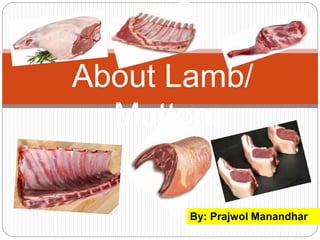
About Lamb/
Mutton
By: Prajwol Manandhar
Lamb/Mutton
Introduction:- Lamb is the meat of a young sheep and
mutton the flesh of the mature sheep or goat. Lamb
usually is the flesh of animals not more than 14
months of age.
The average weight of an imported lamb is approx. 32
Ibs (16 kg), and for mutton, it is up to 50 Ibs (25 kg).
The average weight of an Indian lamb is 10 kg to 14
kg. For mutton, it is between 20 kg to 22 kg.
Quality Points
Lamb
1. Carcass should be compact and evenly fleshed, having an
even coat of fat.
2. Lean flesh is firm and of a pleasing, dull red colour and of
a fine texture of grain.
3. Fat should be evenly distributed, hard, brittle, flaky and
clear white in colour.
4. The bones are porous in young animals; as age
progresses, they are smooth, white and brittle.
5. The leg and shoulders should be plump and well-filled,
and the back is broad and well developed.
Cont…
Storage:- If possible, whole carcass of lamb/ mutton
should be hang on the meat hooks from racks fixed to
the ceiling of the cold room. Joints and small cuts
should be stored on clean stainless steel trays at a
temperature of 2°C to 4°C. frozen lamb/ mutton
should be stored at a temperature of -18°C in a deep
frozen for 6 month.
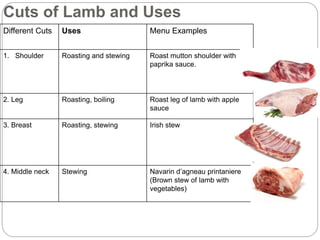
Cuts of Lamb and Uses
Different Cuts Uses Menu Examples
1. Shoulder Roasting and stewing Roast mutton shoulder with
paprika sauce.
2. Leg Roasting, boiling Roast leg of lamb with apple
sauce
3. Breast Roasting, stewing Irish stew
4. Middle neck Stewing Navarin d’agneau printaniere
(Brown stew of lamb with
vegetables)
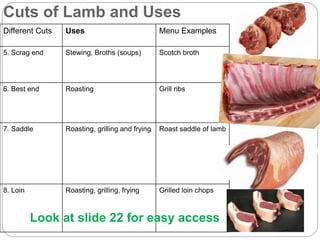
Cuts of Lamb and Uses
Different Cuts Uses Menu Examples
5. Scrag end Stewing, Broths (soups) Scotch broth
6. Best end Roasting Grill ribs
7. Saddle Roasting, grilling and frying Roast saddle of lamb
8. Loin Roasting, grilling, frying Grilled loin chops
Look at slide 22 for easy access
About lamb and mutton

About lamb and mutton

  • 1.
  • 2.
    Lamb/Mutton Introduction:- Lamb isthe meat of a young sheep and mutton the flesh of the mature sheep or goat. Lamb usually is the flesh of animals not more than 14 months of age. The average weight of an imported lamb is approx. 32 Ibs (16 kg), and for mutton, it is up to 50 Ibs (25 kg). The average weight of an Indian lamb is 10 kg to 14 kg. For mutton, it is between 20 kg to 22 kg.
  • 3.
    Quality Points Lamb 1. Carcassshould be compact and evenly fleshed, having an even coat of fat. 2. Lean flesh is firm and of a pleasing, dull red colour and of a fine texture of grain. 3. Fat should be evenly distributed, hard, brittle, flaky and clear white in colour. 4. The bones are porous in young animals; as age progresses, they are smooth, white and brittle. 5. The leg and shoulders should be plump and well-filled, and the back is broad and well developed.
  • 4.
    Cont… Storage:- If possible,whole carcass of lamb/ mutton should be hang on the meat hooks from racks fixed to the ceiling of the cold room. Joints and small cuts should be stored on clean stainless steel trays at a temperature of 2°C to 4°C. frozen lamb/ mutton should be stored at a temperature of -18°C in a deep frozen for 6 month.
  • 5.
    Cuts of Lamband Uses Different Cuts Uses Menu Examples 1. Shoulder Roasting and stewing Roast mutton shoulder with paprika sauce. 2. Leg Roasting, boiling Roast leg of lamb with apple sauce 3. Breast Roasting, stewing Irish stew 4. Middle neck Stewing Navarin d’agneau printaniere (Brown stew of lamb with vegetables)
  • 6.
    Cuts of Lamband Uses Different Cuts Uses Menu Examples 5. Scrag end Stewing, Broths (soups) Scotch broth 6. Best end Roasting Grill ribs 7. Saddle Roasting, grilling and frying Roast saddle of lamb 8. Loin Roasting, grilling, frying Grilled loin chops Look at slide 22 for easy access

Editor's Notes