HILAL GROUP
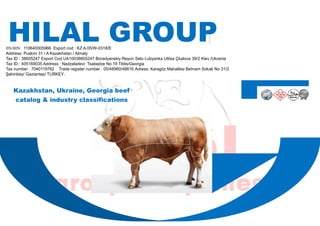
Kazakhstan, Ukraine, Georgia beef
catalog & industry classifications
IIN/BIN: 110640005966 Export cod : KZ A.05/W-0318/E
Address: Puskini 31 / A Kazakhstan / Almaty
Tax ID : 38605247 Export Cod UA10038605247 Boradyanskiy Reyon Selo Lubyanka Ulitsa Çkalova 39/2 Kiev /Ukrania
Tax ID : 405169035 Address : Nadzaladevi Tsabadze No 19 Tiblis/Georgia
Tax number : 7040119762 Trade register number : 05/48960/48616 Adress: Karagöz Mahallesi Behram Sokak No 31/2
Şahinbey/ Gaziantep/ TURKEY.
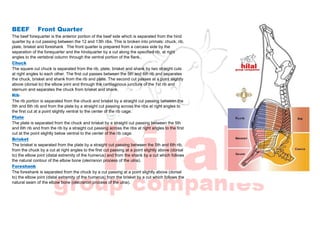
BEEF Front Quarter
The beef forequarter is the anterior portion of the beef side which is separated from the hind
quarter by a cut passing between the 12 and 13th ribs. This is broken into primals: chuck, rib,
plate, brisket and foreshank The front quarter is prepared from a carcass side by the
separation of the forequarter and the hindquarter by a cut along the specified rib, at right
angles to the vertebral column through the ventral portion of the flank..
Chuck
The square cut chuck is separated from the rib, plate, brisket and shank by two straight cuts
at right angles to each other. The first cut passes between the 5th and 6th rib and separates
the chuck, brisket and shank from the rib and plate. The second cut passes at a point slightly
above (dorsal to) the elbow joint and through the cartilaginous juncture of the 1st rib and
sternum and separates the chuck from brisket and shank.
Rib
The rib portion is separated from the chuck and brisket by a straight cut passing between the
5th and 6th rib and from the plate by a straight cut passing across the ribs at right angles to
the first cut at a point slightly ventral to the center of the rib cage.
Plate
The plate is separated from the chuck and brisket by a straight cut passing between the 5th
and 6th rib and from the rib by a straight cut passing across the ribs at right angles to the first
cut at the point slightly below ventral to the center of the rib cage.
Brisket
The brisket is separated from the plate by a straight cut passing between the 5th and 6th rib,
from the chuck by a cut at right angles to the first cut passing at a point slightly above (dorsal
to) the elbow joint (distal extremity of the humerus) and from the shank by a cut which follows
the natural contour of the elbow bone (olecranon process of the ulna).
Foreshank
The foreshank is separated from the chuck by a cut passing at a point slightly above (dorsal
to) the elbow joint (distal extremity of the humerus) from the brisket by a cut which follows the
natural seam of the elbow bone (olecranon process of the ulna).
.
Chuck
Beef Chuck, Square Cut
The portion of the front quarter which is separated from primal rib, plate and brisket
by two straight cuts at right angle to each other. It is a bone-in cut that has portions
of the blade bone, arm bone and back bone present.
d Beef Chuck, Neck Bone
This bone is close to the head of the cattle. This cut consists of
the 1st to the 5th cervical vertebra (neck bone). Some meat may stay on the bones.
e Beef Chuck, Chuck Bone
This bone was attached to the neck bone(113D). T his cut usually consist of the 6th to
7th cervical vertebra (neck bone) and the 1st to the 5th thoracic vertebra.
Purchaser may specify how much lean meat may stay on the bone.
Beef Chuck, Long Cut Shoulder Clod
This cut is inclusive of top blade (114D) muscle without being separated.
It consists of the outer muscle system of the chuck
which lies outside (lateral side) of the blade bone (scapula) and ventral
to the ridge of the blade bone extending from the shoulder joint to the tip of
the blade bone cartilage. It lies next to the humerus (arm bone) and below the spine
of the chuck bone
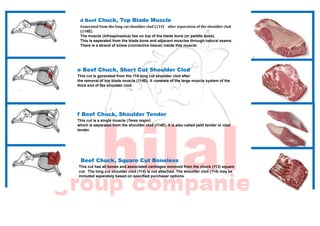
d Beef Chuck, Top Blade Muscle
Generated from the long cut shoulder clod (114) after separation of the shoulder clod
(114E).
The muscle (Infraspinastus) lies on top of the blade bone (or paddle bone).
This is separated from the blade bone and adjacent muscles through natural seams.
There is a strand of sinew (connective tissue) inside this muscle.
e Beef Chuck, Short Cut Shoulder Clod
This cut is generated from the 114 long cut shoulder clod after
the removal of top blade muscle (114D). It consists of the large muscle system of the
thick end of the shoulder clod.
f Beef Chuck, Shoulder Tender
This cut is a single muscle (Teres major)
which is separated from the shoulder clod (114E). It is also called petit tender or clod
tender.
Beef Chuck, Square Cut Boneless
This cut has all bones and associated cartilages removed from the chuck (113) square
cut. The long cut shoulder clod (114) is not attached. The shoulder clod (114) may be
included separately based on specified purchaser options.
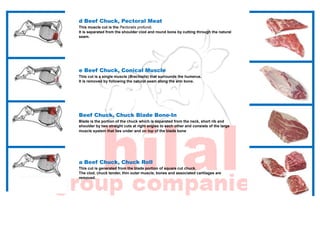
d Beef Chuck, Pectoral Meat
This muscle cut is the Pectoralis profundi.
It is separated from the shoulder clod and round bone by cutting through the natural
seam.
e Beef Chuck, Conical Muscle
This cut is a single muscle (Brachialis) that surrounds the humerus.
It is removed by following the natural seam along the arm bone.
Beef Chuck, Chuck Blade Bone-In
Blade is the portion of the chuck which is separated from the neck, short rib and
shoulder by two straight cuts at right angles to each other and consists of the large
muscle system that lies under and on top of the blade bone
a Beef Chuck, Chuck Roll
This cut is generated from the blade portion of square cut chuck.
The clod, chuck tender, thin outer muscle, bones and associated cartilages are
removed.
.
b Beef Chuck, Chuck Tender
This cut is generated from the chuck. It is a single muscle (Supraspinatus) which is
located at the lower portion of the scapula spinous processes. It is also called mock
tender or Scotch tender.
d Beef Chuck, Chuck Eye Roll
The chuck eye cut is separated from the chuck roll by cutting through the natural
seam.
e Beef Chuck, Edge Roast Meat
This cut is Serratus ventralis, Rhomboideusand Splenius muscles.
It is separated from the chuck eye roll through the natural seam.
The dorsal and ventral edges are straight cuts.
f Beef Chuck, Rope Meat
This cut is the strip-shaped Longus collimuscle that extends from the first thoracic
vertebra to the junction between the ribs and the 6th thoracic vertebra.
It can also be called neckchain
.
.
.
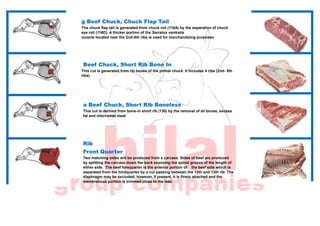
g Beef Chuck, Chuck Flap Tail
The chuck flap tail is generated from chuck roll (116A) by the separation of chuck
eye roll (116D). A thicker portion of the Serratus ventralis
muscle located near the 2nd-4th ribs is used for merchandizing purposes
Beef Chuck, Short Rib Bone In
This cut is generated from rib bones of the primal chuck. It includes 4 ribs (2nd- 5th
ribs).
a Beef Chuck, Short Rib Boneless
This cut is derived from bone-in short rib (130) by the removal of all bones, excess
fat and intercostal meat
Rib
Front Quarter
Two matching sides will be produced from a carcass. Sides of beef are produced
by splitting the carcass down the back exposing the spinal groove of the length of
either side. The beef forequarter is the anterior portion of the beef side which is
separated from the hindquarter by a cut passing between the 12th and 13th rib. The
diaphragm may be excluded; however, if present, it is firmly attached and the
membranous portion is trimmed close to the lean
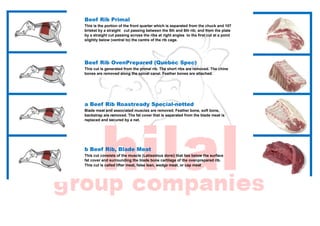
Beef Rib Primal
This is the portion of the front quarter which is separated from the chuck and 107
brisket by a straight cut passing between the 5th and 6th rib; and from the plate
by a straight cut passing across the ribs at right angles to the first cut at a point
slightly below (ventral to) the centre of the rib cage.
Beef Rib OvenPrepared (Quebéc Spec)
This cut is generated from the primal rib. The short ribs are removed. The chine
bones are removed along the spinal canal. Feather bones are attached.
a Beef Rib Roastready Special-netted
Blade meat and associated muscles are removed. Feather bone, soft bone,
backstrap are removed. The fat cover that is separated from the blade meat is
replaced and secured by a net.
b Beef Rib, Blade Meat
This cut consists of the muscle (Latissimus dorsi) that lies below the surface
fat cover and surrounding the blade bone cartilage of the ovenprepared rib.
This cut is called lifter meat, false lean, wedge meat, or cap meat
.
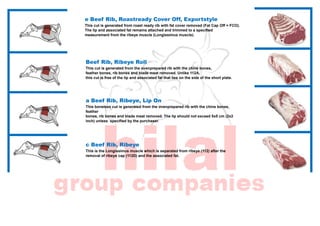
e Beef Rib, Roastready Cover Off, Exportstyle
This cut is generated from roast ready rib with fat cover removed (Fat Cap Off = FCO).
The lip and associated fat remains attached and trimmed to a specified
measurement from the ribeye muscle (Longissimus muscle).
Beef Rib, Ribeye Roll
This cut is generated from the ovenprepared rib with the chine bones,
feather bones, rib bones and blade meat removed. Unlike 112A,
this cut is free of the lip and associated fat that lies on the side of the short plate.
a Beef Rib, Ribeye, Lip On
This boneless cut is generated from the ovenprepared rib with the chine bones,
feather
bones, rib bones and blade meat removed. The lip should not exceed 5x5 cm (2x2
inch) unless specified by the purchaser.
c Beef Rib, Ribeye
This is the Longissimus muscle which is separated from ribeye (112) after the
removal of ribeye cap (112D) and the associated fat.
d Beef Rib, Ribeye Cap
This muscle is generated from the ribeye (112) by the separation of Longissimus
muscle and the associated fat. The Complexus and Spinalis muscles have been
removed through the natural seams.
Beef Short Rib (7 Bones)
Short ribs are generated from the primal rib after separation of prime rib. This is
the rib end portion of the rib and plate obtained by making a straight cut parallel
and adjacent to the cut which separates the rib from the plate.
Beef Short Rib - Pso Short Rib Piece Bones 6-9
This cut includes 6th-9th ribs and intercostals only. The blade meat and fat are
removed.
Beef Short Rib - Pso End Cut Bones 9-12
This cut looks similar to short ribs (123A) but includes 9th12th ribs. The blade
meat and fat remain.
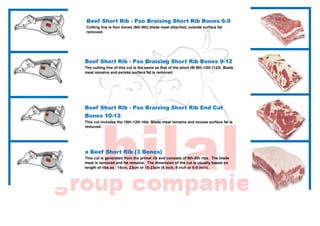
Beef Short Rib - Pso Braising Short Rib Bones 6-9
Cutting line is four bones (6th-9th) blade meat attached, outside surface fat
removed.
Beef Short Rib - Pso Braising Short Rib Bones 9-12
The cutting line of this cut is the same as that of the short rib 9th-12th (123). Blade
meat remains and excess surface fat is removed.
Beef Short Rib - Pso Braising Short Rib End Cut
Bones 10-12
This cut includes the 10th-12th ribs. Blade meat remains and excess surface fat is
removed.
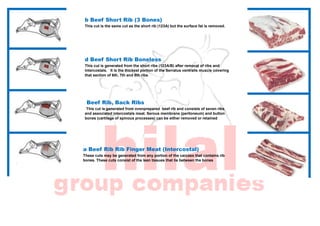
a Beef Short Rib (3 Bones)
This cut is generated from the primal rib and consists of 6th-8th ribs. The blade
meat is removed and fat remains. The dimension of the cut is usually based on
length of ribs as 15cm, 23cm or 15-23cm (6 inch, 9 inch or 6-9 inch).
b Beef Short Rib (3 Bones)
This cut is the same cut as the short rib (123A) but the surface fat is removed.
d Beef Short Rib Boneless
This cut is generated from the short ribs (123A/B) after removal of ribs and
intercostals. It is the thickest portion of the Serratus ventralis muscle covering
that section of 6th, 7th and 8th ribs.
Beef Rib, Back Ribs
This cut is generated from ovenprepared beef rib and consists of seven ribs
and associated intercostals meat. Serous membrane (peritoneum) and button
bones (cartilage of spinous processes) can be either removed or retained
.
a Beef Rib Rib Finger Meat (Intercostal)
These cuts may be generated from any portion of the carcass that contains rib
bones. These cuts consist of the lean tissues that lie between the bones
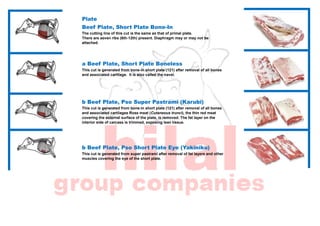
Plate
Beef Plate, Short Plate Bone-In
The cutting line of this cut is the same as that of primal plate.
There are seven ribs (6th-12th) present. Diaphragm may or may not be
attached.
a Beef Plate, Short Plate Boneless
This cut is generated from bone-in short plate (121) after removal of all bones
and associated cartilage. It is also called the navel.
b Beef Plate, Pso Super Pastrami (Karubi)
This cut is generated from bone-in short plate (121) after removal of all bones
and associated cartilages Rose meat (Cutaneous trunci), the thin red meat
covering the external surface of the plate, is removed. The fat layer on the
interior side of carcass is trimmed, exposing lean tissue.
b Beef Plate, Pso Short Plate Eye (Yakiniku)
This cut is generated from super pastrami after removal of fat layers and other
muscles covering the eye of the short plate.
c Beef Plate, Outside Skirt
This cut is the costal muscular portion of the diaphragm. It is a thin,
rectangular, slightly dark, and coarse muscle. It is situated across the ribs
which extend from the end of the brisket to the lumbar bone. A thin membrane
covers the lean
.
d Beef Plate, Inside Skirt
This cut is the lumbar portion of the diaphragm. It is thick muscle (Transversus
abdominis) and looks similar to,but wider and bigger, than the outside skirt. It is
usually offered as membrane or skin off and is practically free of fat.
e Beef Plate Outside Skirt (Skinned)
This cut is generated from 121C outside skirt after removal of the thin membrane
covering both sides of this cut.
Brisket
Beef Brisket Bone-In
This primal cut is separated from the plate by a straight cut passing between
the 5th and 6th rib; from the chuck by a cut at a right angle
to the first cut passing at a point slightly above the elbow joint; and from the
shank by a cut which follows the natural contour of the elbow bone
.
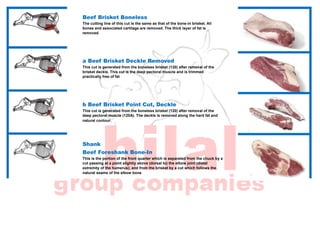
Beef Brisket Boneless
The cutting line of this cut is the same as that of the bone-in brisket. All
bones and associated cartilage are removed. The thick layer of fat is
removed.
a Beef Brisket Deckle Removed
This cut is generated from the boneless brisket (120) after removal of the
brisket deckle. This cut is the deep pectoral muscle and is trimmed
practically free of fat
b Beef Brisket Point Cut, Deckle
This cut is generated from the boneless brisket (120) after removal of the
deep pectoral muscle (120A). The deckle is removed along the hard fat and
natural contour.
Shank
Beef Foreshank Bone-In
This is the portion of the front quarter which is separated from the chuck by a
cut passing at a point slightly above (dorsal to) the elbow joint (distal
extremity of the humerus); and from the brisket by a cut which follows the
natural seams of the elbow bone
.
international confirmation code
KZ A.05/W-0318/E / EC.X-Deuc.0113 GE405169035 / UA10038605247
Viber – WhatsApp GSM +77012666846 +995591907028+380634456495 +905332001683 Phone +77272734973 +903422325046
Email : hilalcasing@mail.ru hilalcasing@gmail.com hilalmeat.kz@yandex.com Web: http://hilalmeatkz.wix.com/hilalgruopcompanies
HALAL Slaughtered certificate : www.halaldamu.kz Skype: hilalcasing1968
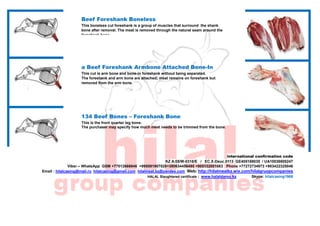
Beef Foreshank Boneless
This boneless cut foreshank is a group of muscles that surround the shank
bone after removal. The meat is removed through the natural seam around the
foreshank bone.
a Beef Foreshank Armbone Attached Bone-In
This cut is arm bone and bone-in foreshank without being separated.
The foreshank and arm bone are attached; meat remains on foreshank but
removed from the arm bone.
134 Beef Bones – Foreshank Bone
This is the front quarter leg bone.
The purchaser may specify how much meat needs to be trimmed from the bone.

Beef front quarter

  • 1.
    HILAL GROUP Kazakhstan, Ukraine,Georgia beef catalog & industry classifications IIN/BIN: 110640005966 Export cod : KZ A.05/W-0318/E Address: Puskini 31 / A Kazakhstan / Almaty Tax ID : 38605247 Export Cod UA10038605247 Boradyanskiy Reyon Selo Lubyanka Ulitsa Çkalova 39/2 Kiev /Ukrania Tax ID : 405169035 Address : Nadzaladevi Tsabadze No 19 Tiblis/Georgia Tax number : 7040119762 Trade register number : 05/48960/48616 Adress: Karagöz Mahallesi Behram Sokak No 31/2 Şahinbey/ Gaziantep/ TURKEY.
  • 2.
    BEEF Front Quarter Thebeef forequarter is the anterior portion of the beef side which is separated from the hind quarter by a cut passing between the 12 and 13th ribs. This is broken into primals: chuck, rib, plate, brisket and foreshank The front quarter is prepared from a carcass side by the separation of the forequarter and the hindquarter by a cut along the specified rib, at right angles to the vertebral column through the ventral portion of the flank.. Chuck The square cut chuck is separated from the rib, plate, brisket and shank by two straight cuts at right angles to each other. The first cut passes between the 5th and 6th rib and separates the chuck, brisket and shank from the rib and plate. The second cut passes at a point slightly above (dorsal to) the elbow joint and through the cartilaginous juncture of the 1st rib and sternum and separates the chuck from brisket and shank. Rib The rib portion is separated from the chuck and brisket by a straight cut passing between the 5th and 6th rib and from the plate by a straight cut passing across the ribs at right angles to the first cut at a point slightly ventral to the center of the rib cage. Plate The plate is separated from the chuck and brisket by a straight cut passing between the 5th and 6th rib and from the rib by a straight cut passing across the ribs at right angles to the first cut at the point slightly below ventral to the center of the rib cage. Brisket The brisket is separated from the plate by a straight cut passing between the 5th and 6th rib, from the chuck by a cut at right angles to the first cut passing at a point slightly above (dorsal to) the elbow joint (distal extremity of the humerus) and from the shank by a cut which follows the natural contour of the elbow bone (olecranon process of the ulna). Foreshank The foreshank is separated from the chuck by a cut passing at a point slightly above (dorsal to) the elbow joint (distal extremity of the humerus) from the brisket by a cut which follows the natural seam of the elbow bone (olecranon process of the ulna).
  • 3.
    . Chuck Beef Chuck, SquareCut The portion of the front quarter which is separated from primal rib, plate and brisket by two straight cuts at right angle to each other. It is a bone-in cut that has portions of the blade bone, arm bone and back bone present. d Beef Chuck, Neck Bone This bone is close to the head of the cattle. This cut consists of the 1st to the 5th cervical vertebra (neck bone). Some meat may stay on the bones. e Beef Chuck, Chuck Bone This bone was attached to the neck bone(113D). T his cut usually consist of the 6th to 7th cervical vertebra (neck bone) and the 1st to the 5th thoracic vertebra. Purchaser may specify how much lean meat may stay on the bone. Beef Chuck, Long Cut Shoulder Clod This cut is inclusive of top blade (114D) muscle without being separated. It consists of the outer muscle system of the chuck which lies outside (lateral side) of the blade bone (scapula) and ventral to the ridge of the blade bone extending from the shoulder joint to the tip of the blade bone cartilage. It lies next to the humerus (arm bone) and below the spine of the chuck bone
  • 4.
    d Beef Chuck,Top Blade Muscle Generated from the long cut shoulder clod (114) after separation of the shoulder clod (114E). The muscle (Infraspinastus) lies on top of the blade bone (or paddle bone). This is separated from the blade bone and adjacent muscles through natural seams. There is a strand of sinew (connective tissue) inside this muscle. e Beef Chuck, Short Cut Shoulder Clod This cut is generated from the 114 long cut shoulder clod after the removal of top blade muscle (114D). It consists of the large muscle system of the thick end of the shoulder clod. f Beef Chuck, Shoulder Tender This cut is a single muscle (Teres major) which is separated from the shoulder clod (114E). It is also called petit tender or clod tender. Beef Chuck, Square Cut Boneless This cut has all bones and associated cartilages removed from the chuck (113) square cut. The long cut shoulder clod (114) is not attached. The shoulder clod (114) may be included separately based on specified purchaser options.
  • 5.
    d Beef Chuck,Pectoral Meat This muscle cut is the Pectoralis profundi. It is separated from the shoulder clod and round bone by cutting through the natural seam. e Beef Chuck, Conical Muscle This cut is a single muscle (Brachialis) that surrounds the humerus. It is removed by following the natural seam along the arm bone. Beef Chuck, Chuck Blade Bone-In Blade is the portion of the chuck which is separated from the neck, short rib and shoulder by two straight cuts at right angles to each other and consists of the large muscle system that lies under and on top of the blade bone a Beef Chuck, Chuck Roll This cut is generated from the blade portion of square cut chuck. The clod, chuck tender, thin outer muscle, bones and associated cartilages are removed.
  • 6.
    . b Beef Chuck,Chuck Tender This cut is generated from the chuck. It is a single muscle (Supraspinatus) which is located at the lower portion of the scapula spinous processes. It is also called mock tender or Scotch tender. d Beef Chuck, Chuck Eye Roll The chuck eye cut is separated from the chuck roll by cutting through the natural seam. e Beef Chuck, Edge Roast Meat This cut is Serratus ventralis, Rhomboideusand Splenius muscles. It is separated from the chuck eye roll through the natural seam. The dorsal and ventral edges are straight cuts. f Beef Chuck, Rope Meat This cut is the strip-shaped Longus collimuscle that extends from the first thoracic vertebra to the junction between the ribs and the 6th thoracic vertebra. It can also be called neckchain
  • 7.
    . . . g Beef Chuck,Chuck Flap Tail The chuck flap tail is generated from chuck roll (116A) by the separation of chuck eye roll (116D). A thicker portion of the Serratus ventralis muscle located near the 2nd-4th ribs is used for merchandizing purposes Beef Chuck, Short Rib Bone In This cut is generated from rib bones of the primal chuck. It includes 4 ribs (2nd- 5th ribs). a Beef Chuck, Short Rib Boneless This cut is derived from bone-in short rib (130) by the removal of all bones, excess fat and intercostal meat Rib Front Quarter Two matching sides will be produced from a carcass. Sides of beef are produced by splitting the carcass down the back exposing the spinal groove of the length of either side. The beef forequarter is the anterior portion of the beef side which is separated from the hindquarter by a cut passing between the 12th and 13th rib. The diaphragm may be excluded; however, if present, it is firmly attached and the membranous portion is trimmed close to the lean
  • 8.
    Beef Rib Primal Thisis the portion of the front quarter which is separated from the chuck and 107 brisket by a straight cut passing between the 5th and 6th rib; and from the plate by a straight cut passing across the ribs at right angles to the first cut at a point slightly below (ventral to) the centre of the rib cage. Beef Rib OvenPrepared (Quebéc Spec) This cut is generated from the primal rib. The short ribs are removed. The chine bones are removed along the spinal canal. Feather bones are attached. a Beef Rib Roastready Special-netted Blade meat and associated muscles are removed. Feather bone, soft bone, backstrap are removed. The fat cover that is separated from the blade meat is replaced and secured by a net. b Beef Rib, Blade Meat This cut consists of the muscle (Latissimus dorsi) that lies below the surface fat cover and surrounding the blade bone cartilage of the ovenprepared rib. This cut is called lifter meat, false lean, wedge meat, or cap meat
  • 9.
    . e Beef Rib,Roastready Cover Off, Exportstyle This cut is generated from roast ready rib with fat cover removed (Fat Cap Off = FCO). The lip and associated fat remains attached and trimmed to a specified measurement from the ribeye muscle (Longissimus muscle). Beef Rib, Ribeye Roll This cut is generated from the ovenprepared rib with the chine bones, feather bones, rib bones and blade meat removed. Unlike 112A, this cut is free of the lip and associated fat that lies on the side of the short plate. a Beef Rib, Ribeye, Lip On This boneless cut is generated from the ovenprepared rib with the chine bones, feather bones, rib bones and blade meat removed. The lip should not exceed 5x5 cm (2x2 inch) unless specified by the purchaser. c Beef Rib, Ribeye This is the Longissimus muscle which is separated from ribeye (112) after the removal of ribeye cap (112D) and the associated fat.
  • 10.
    d Beef Rib,Ribeye Cap This muscle is generated from the ribeye (112) by the separation of Longissimus muscle and the associated fat. The Complexus and Spinalis muscles have been removed through the natural seams. Beef Short Rib (7 Bones) Short ribs are generated from the primal rib after separation of prime rib. This is the rib end portion of the rib and plate obtained by making a straight cut parallel and adjacent to the cut which separates the rib from the plate. Beef Short Rib - Pso Short Rib Piece Bones 6-9 This cut includes 6th-9th ribs and intercostals only. The blade meat and fat are removed. Beef Short Rib - Pso End Cut Bones 9-12 This cut looks similar to short ribs (123A) but includes 9th12th ribs. The blade meat and fat remain.
  • 11.
    Beef Short Rib- Pso Braising Short Rib Bones 6-9 Cutting line is four bones (6th-9th) blade meat attached, outside surface fat removed. Beef Short Rib - Pso Braising Short Rib Bones 9-12 The cutting line of this cut is the same as that of the short rib 9th-12th (123). Blade meat remains and excess surface fat is removed. Beef Short Rib - Pso Braising Short Rib End Cut Bones 10-12 This cut includes the 10th-12th ribs. Blade meat remains and excess surface fat is removed. a Beef Short Rib (3 Bones) This cut is generated from the primal rib and consists of 6th-8th ribs. The blade meat is removed and fat remains. The dimension of the cut is usually based on length of ribs as 15cm, 23cm or 15-23cm (6 inch, 9 inch or 6-9 inch).
  • 12.
    b Beef ShortRib (3 Bones) This cut is the same cut as the short rib (123A) but the surface fat is removed. d Beef Short Rib Boneless This cut is generated from the short ribs (123A/B) after removal of ribs and intercostals. It is the thickest portion of the Serratus ventralis muscle covering that section of 6th, 7th and 8th ribs. Beef Rib, Back Ribs This cut is generated from ovenprepared beef rib and consists of seven ribs and associated intercostals meat. Serous membrane (peritoneum) and button bones (cartilage of spinous processes) can be either removed or retained . a Beef Rib Rib Finger Meat (Intercostal) These cuts may be generated from any portion of the carcass that contains rib bones. These cuts consist of the lean tissues that lie between the bones
  • 13.
    Plate Beef Plate, ShortPlate Bone-In The cutting line of this cut is the same as that of primal plate. There are seven ribs (6th-12th) present. Diaphragm may or may not be attached. a Beef Plate, Short Plate Boneless This cut is generated from bone-in short plate (121) after removal of all bones and associated cartilage. It is also called the navel. b Beef Plate, Pso Super Pastrami (Karubi) This cut is generated from bone-in short plate (121) after removal of all bones and associated cartilages Rose meat (Cutaneous trunci), the thin red meat covering the external surface of the plate, is removed. The fat layer on the interior side of carcass is trimmed, exposing lean tissue. b Beef Plate, Pso Short Plate Eye (Yakiniku) This cut is generated from super pastrami after removal of fat layers and other muscles covering the eye of the short plate.
  • 14.
    c Beef Plate,Outside Skirt This cut is the costal muscular portion of the diaphragm. It is a thin, rectangular, slightly dark, and coarse muscle. It is situated across the ribs which extend from the end of the brisket to the lumbar bone. A thin membrane covers the lean . d Beef Plate, Inside Skirt This cut is the lumbar portion of the diaphragm. It is thick muscle (Transversus abdominis) and looks similar to,but wider and bigger, than the outside skirt. It is usually offered as membrane or skin off and is practically free of fat. e Beef Plate Outside Skirt (Skinned) This cut is generated from 121C outside skirt after removal of the thin membrane covering both sides of this cut. Brisket Beef Brisket Bone-In This primal cut is separated from the plate by a straight cut passing between the 5th and 6th rib; from the chuck by a cut at a right angle to the first cut passing at a point slightly above the elbow joint; and from the shank by a cut which follows the natural contour of the elbow bone
  • 15.
    . Beef Brisket Boneless Thecutting line of this cut is the same as that of the bone-in brisket. All bones and associated cartilage are removed. The thick layer of fat is removed. a Beef Brisket Deckle Removed This cut is generated from the boneless brisket (120) after removal of the brisket deckle. This cut is the deep pectoral muscle and is trimmed practically free of fat b Beef Brisket Point Cut, Deckle This cut is generated from the boneless brisket (120) after removal of the deep pectoral muscle (120A). The deckle is removed along the hard fat and natural contour. Shank Beef Foreshank Bone-In This is the portion of the front quarter which is separated from the chuck by a cut passing at a point slightly above (dorsal to) the elbow joint (distal extremity of the humerus); and from the brisket by a cut which follows the natural seams of the elbow bone
  • 16.
    . international confirmation code KZA.05/W-0318/E / EC.X-Deuc.0113 GE405169035 / UA10038605247 Viber – WhatsApp GSM +77012666846 +995591907028+380634456495 +905332001683 Phone +77272734973 +903422325046 Email : hilalcasing@mail.ru hilalcasing@gmail.com hilalmeat.kz@yandex.com Web: http://hilalmeatkz.wix.com/hilalgruopcompanies HALAL Slaughtered certificate : www.halaldamu.kz Skype: hilalcasing1968 Beef Foreshank Boneless This boneless cut foreshank is a group of muscles that surround the shank bone after removal. The meat is removed through the natural seam around the foreshank bone. a Beef Foreshank Armbone Attached Bone-In This cut is arm bone and bone-in foreshank without being separated. The foreshank and arm bone are attached; meat remains on foreshank but removed from the arm bone. 134 Beef Bones – Foreshank Bone This is the front quarter leg bone. The purchaser may specify how much meat needs to be trimmed from the bone.