9/5/2013 1BAC 102 Culinary Foundation Level II
 Definition
 Muscle composition
 Identifying poultry
 Nutrition
 Inspection & grading
 Purchasing
 Storing
 Precautions
9/5/2013 2BAC 102 Culinary Foundation Level II
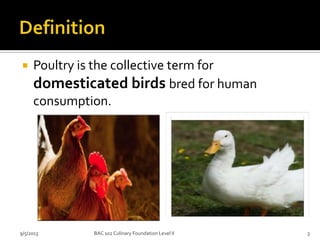
 Poultry is the collective term for
domesticated birds bred for human
consumption.
9/5/2013 3BAC 102 Culinary Foundation Level II
 Contains no intramuscular fat (Marbling)
 Fat is stored under the skin and in the
abdominal cavity
 Poultry fat has a lower melting point than
other animal fats
9/5/2013 4BAC 102 Culinary Foundation Level II
 Dark meat
 Thigh and leg of flightless
birds
 Full body of flight birds
 Contains more myoglobin
 Contains more fat and
connective tissue
 Longer cooking time
 White meat
 Breast and wing of
flightless birds
 Larger muscle mass
 Contains less fat
 Can dry out if overcooked
9/5/2013 5BAC 102 Culinary Foundation Level II
 Categories of poultry recognized by the
USDA
 Chicken
 Duck
 Goose
 Guinea
 Pigeon
 Turkey
9/5/2013 6BAC 102 Culinary Foundation Level II
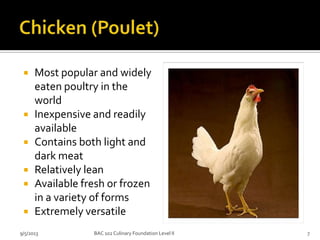
 Most popular and widely
eaten poultry in the
world
 Inexpensive and readily
available
 Contains both light and
dark meat
 Relatively lean
 Available fresh or frozen
in a variety of forms
 Extremely versatile
9/5/2013 7BAC 102 Culinary Foundation Level II
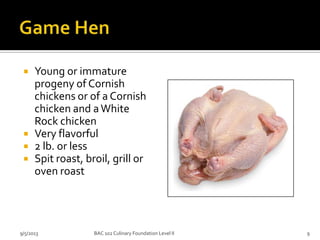
 Game Hen
 5-6 weeks old
 Broiler/fryer
 13 weeks old
 Roaster
 3-5 months old
 Capon
 Under 8 months old
 Hen/stewing
 Over 10 months old
9/5/2013 8BAC 102 Culinary Foundation Level II
 Young or immature
progeny of Cornish
chickens or of a Cornish
chicken and aWhite
Rock chicken
 Very flavorful
 2 lb. or less
 Spit roast, broil, grill or
oven roast
9/5/2013 9BAC 102 Culinary Foundation Level II
 Young with soft, smooth
textured skin
 Relatively lean
 Flexible breastbone
 3 lb. 8 oz. or less
 Can use any cooking
method
9/5/2013 10BAC 102 Culinary Foundation Level II
 Surgically castrated male
 Tender meat with soft
smooth skin
 Bred for well-flavored
meat
 Contains a high portion
of light to dark meat
 Relatively high in fat
 6-10 lb.
 Roast
9/5/2013 11BAC 102 Culinary Foundation Level II
12
9/5/2013 12BAC 102 Culinary Foundation Level II
9/5/2013 13BAC 102 Culinary Foundation Level II
9/5/2013 14BAC 102 Culinary Foundation Level II
9/5/2013 15BAC 102 Culinary Foundation Level II
9/5/2013 16BAC 102 Culinary Foundation Level II
9/5/2013 17BAC 102 Culinary Foundation Level II
9/5/2013 18BAC 102 Culinary Foundation Level II
9/5/2013 19BAC 102 Culinary Foundation Level II
 Classes
 Broiler
 Roaster
 Mature
 Contains only dark meat
 Large amount of fat
 High percentage of bone and
fat to meat
 Roast
9/5/2013 20BAC 102 Culinary Foundation Level II
 Classes
 Young
 Mature
 Contains only dark meat
 Very fatty skin
 Popular at holidays
 Served with acidic fruit-
based sauces to offset
fattiness
9/5/2013 21BAC 102 Culinary Foundation Level II
 Classes
 Young
 Mature
 Domesticated
descendant of a game
bird
 Has both light and dark
meat
 Tender enough to sauté
 Contains little fat
 Usually is barded prior to
roasting
9/5/2013 22BAC 102 Culinary Foundation Level II
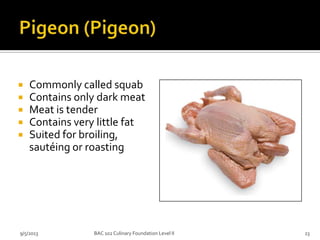
 Commonly called squab
 Contains only dark meat
 Meat is tender
 Contains very little fat
 Suited for broiling,
sautéing or roasting
9/5/2013 23BAC 102 Culinary Foundation Level II
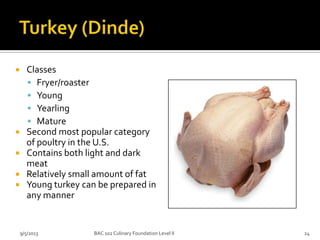
 Classes
 Fryer/roaster
 Young
 Yearling
 Mature
 Second most popular category
of poultry in the U.S.
 Contains both light and dark
meat
 Relatively small amount of fat
 Young turkey can be prepared in
any manner
9/5/2013 24BAC 102 Culinary Foundation Level II
 Ostrich
 Emu
 Rhea
9/5/2013 BAC 102 Culinary Foundation Level II 25
OSTRICH
 Economical source of high-quality protein
 Similar to other meats
 Chicken and turkey breast are lower in fat and
higher in niacin than other lean meats
 Generally dark meat contains more niacin
and riboflavin than white meat
9/5/2013 26BAC 102 Culinary Foundation Level II
9/5/2013 BAC 102 Culinary Foundation Level II 27
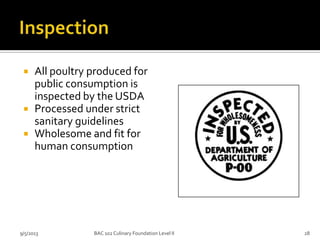
 All poultry produced for
public consumption is
inspected by the USDA
 Processed under strict
sanitary guidelines
 Wholesome and fit for
human consumption
9/5/2013 28BAC 102 Culinary Foundation Level II
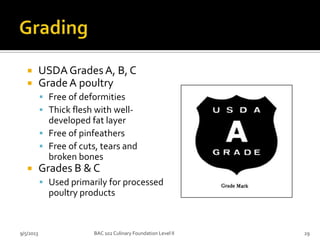
 USDA Grades A, B, C
 GradeA poultry
 Free of deformities
 Thick flesh with well-
developed fat layer
 Free of pinfeathers
 Free of cuts, tears and
broken bones
 Grades B & C
 Used primarily for processed
poultry products
9/5/2013 29BAC 102 Culinary Foundation Level II
 Fresh or frozen
 Whole or cut up
 Bone-in or boneless
 Portion control (P.C.)
 Individually quick-frozen (IQF)
 Ground
 Prepared and convenience items
9/5/2013 30BAC 102 Culinary Foundation Level II
 Poultry is a potentially hazardous food
 It is highly perishable
 Particularly susceptible to contamination by
salmonella bacteria
 Store on ice or at 32°F–34°F
 Thaw under refrigeration
9/5/2013 31BAC 102 Culinary Foundation Level II
 Be sure that all equipment used in the
preparation of poultry is sanitized before
and after coming in contact with poultry
 Be careful that juices and trimmings from
poultry do not come into contact with other
foods
 Rinse poultry in cold running water and dry
before cooking to remove collected juices
9/5/2013 32BAC 102 Culinary Foundation Level II
9/5/2013 BAC 102 Culinary Foundation Level II 33

Poultry

  • 1.
    9/5/2013 1BAC 102Culinary Foundation Level II
  • 2.
     Definition  Musclecomposition  Identifying poultry  Nutrition  Inspection & grading  Purchasing  Storing  Precautions 9/5/2013 2BAC 102 Culinary Foundation Level II
  • 3.
     Poultry isthe collective term for domesticated birds bred for human consumption. 9/5/2013 3BAC 102 Culinary Foundation Level II
  • 4.
     Contains nointramuscular fat (Marbling)  Fat is stored under the skin and in the abdominal cavity  Poultry fat has a lower melting point than other animal fats 9/5/2013 4BAC 102 Culinary Foundation Level II
  • 5.
     Dark meat Thigh and leg of flightless birds  Full body of flight birds  Contains more myoglobin  Contains more fat and connective tissue  Longer cooking time  White meat  Breast and wing of flightless birds  Larger muscle mass  Contains less fat  Can dry out if overcooked 9/5/2013 5BAC 102 Culinary Foundation Level II
  • 6.
     Categories ofpoultry recognized by the USDA  Chicken  Duck  Goose  Guinea  Pigeon  Turkey 9/5/2013 6BAC 102 Culinary Foundation Level II
  • 7.
     Most popularand widely eaten poultry in the world  Inexpensive and readily available  Contains both light and dark meat  Relatively lean  Available fresh or frozen in a variety of forms  Extremely versatile 9/5/2013 7BAC 102 Culinary Foundation Level II
  • 8.
     Game Hen 5-6 weeks old  Broiler/fryer  13 weeks old  Roaster  3-5 months old  Capon  Under 8 months old  Hen/stewing  Over 10 months old 9/5/2013 8BAC 102 Culinary Foundation Level II
  • 9.
     Young orimmature progeny of Cornish chickens or of a Cornish chicken and aWhite Rock chicken  Very flavorful  2 lb. or less  Spit roast, broil, grill or oven roast 9/5/2013 9BAC 102 Culinary Foundation Level II
  • 10.
     Young withsoft, smooth textured skin  Relatively lean  Flexible breastbone  3 lb. 8 oz. or less  Can use any cooking method 9/5/2013 10BAC 102 Culinary Foundation Level II
  • 11.
     Surgically castratedmale  Tender meat with soft smooth skin  Bred for well-flavored meat  Contains a high portion of light to dark meat  Relatively high in fat  6-10 lb.  Roast 9/5/2013 11BAC 102 Culinary Foundation Level II
  • 12.
    12 9/5/2013 12BAC 102Culinary Foundation Level II
  • 13.
    9/5/2013 13BAC 102Culinary Foundation Level II
  • 14.
    9/5/2013 14BAC 102Culinary Foundation Level II
  • 15.
    9/5/2013 15BAC 102Culinary Foundation Level II
  • 16.
    9/5/2013 16BAC 102Culinary Foundation Level II
  • 17.
    9/5/2013 17BAC 102Culinary Foundation Level II
  • 18.
    9/5/2013 18BAC 102Culinary Foundation Level II
  • 19.
    9/5/2013 19BAC 102Culinary Foundation Level II
  • 20.
     Classes  Broiler Roaster  Mature  Contains only dark meat  Large amount of fat  High percentage of bone and fat to meat  Roast 9/5/2013 20BAC 102 Culinary Foundation Level II
  • 21.
     Classes  Young Mature  Contains only dark meat  Very fatty skin  Popular at holidays  Served with acidic fruit- based sauces to offset fattiness 9/5/2013 21BAC 102 Culinary Foundation Level II
  • 22.
     Classes  Young Mature  Domesticated descendant of a game bird  Has both light and dark meat  Tender enough to sauté  Contains little fat  Usually is barded prior to roasting 9/5/2013 22BAC 102 Culinary Foundation Level II
  • 23.
     Commonly calledsquab  Contains only dark meat  Meat is tender  Contains very little fat  Suited for broiling, sautéing or roasting 9/5/2013 23BAC 102 Culinary Foundation Level II
  • 24.
     Classes  Fryer/roaster Young  Yearling  Mature  Second most popular category of poultry in the U.S.  Contains both light and dark meat  Relatively small amount of fat  Young turkey can be prepared in any manner 9/5/2013 24BAC 102 Culinary Foundation Level II
  • 25.
     Ostrich  Emu Rhea 9/5/2013 BAC 102 Culinary Foundation Level II 25 OSTRICH
  • 26.
     Economical sourceof high-quality protein  Similar to other meats  Chicken and turkey breast are lower in fat and higher in niacin than other lean meats  Generally dark meat contains more niacin and riboflavin than white meat 9/5/2013 26BAC 102 Culinary Foundation Level II
  • 27.
    9/5/2013 BAC 102Culinary Foundation Level II 27
  • 28.
     All poultryproduced for public consumption is inspected by the USDA  Processed under strict sanitary guidelines  Wholesome and fit for human consumption 9/5/2013 28BAC 102 Culinary Foundation Level II
  • 29.
     USDA GradesA, B, C  GradeA poultry  Free of deformities  Thick flesh with well- developed fat layer  Free of pinfeathers  Free of cuts, tears and broken bones  Grades B & C  Used primarily for processed poultry products 9/5/2013 29BAC 102 Culinary Foundation Level II
  • 30.
     Fresh orfrozen  Whole or cut up  Bone-in or boneless  Portion control (P.C.)  Individually quick-frozen (IQF)  Ground  Prepared and convenience items 9/5/2013 30BAC 102 Culinary Foundation Level II
  • 31.
     Poultry isa potentially hazardous food  It is highly perishable  Particularly susceptible to contamination by salmonella bacteria  Store on ice or at 32°F–34°F  Thaw under refrigeration 9/5/2013 31BAC 102 Culinary Foundation Level II
  • 32.
     Be surethat all equipment used in the preparation of poultry is sanitized before and after coming in contact with poultry  Be careful that juices and trimmings from poultry do not come into contact with other foods  Rinse poultry in cold running water and dry before cooking to remove collected juices 9/5/2013 32BAC 102 Culinary Foundation Level II
  • 33.
    9/5/2013 BAC 102Culinary Foundation Level II 33