



MEAT FABRICATION
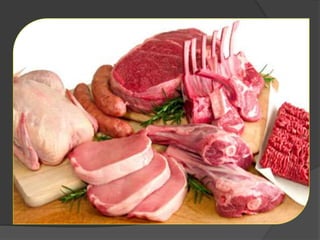
 Process of cutting carcasses into
standard wholesale (primal) and
retail cuts
GENERAL PRINCIPLE OF
MEAT FABRICATION
1. Tender meat is separated from
tough meat
2. Thick portion must be separated
from the thin portion
3. Muscles must be cut across the
meat fiber/grain
4. Cheap parts must be separated
from the expensive parts
REVIEW
PRIMAL CUTS OF BEEF AND
CARABEEF CARCASSES
Front quarter
1. Chuck –pot roast, ground beef
2. Rib/prime cut – dry-heat cooking
3. Brisket – corned beef
4. Plate/short plate – carne asada
5. Shank/foreshank – osso buco
PRIMAL CUTS OF BEEF AND
CARABEEF CARCASSES
Hind quarter
1. Shortloin –dry-heat cooking
2. Sirloin– roasting & barbecuing
3. Tenderloin – grilling & broiling
4. Flank or navel – braising
5. Round – moist-heat cooking (i.e.
crockpot)
PRIMAL CUTS OF MUTTON
AND CHEVON CARCASSES
Front quarter
1. Neck
2. Shoulder
3. Party Rack
4. Shank
PRIMAL CUTS OF MUTTON
AND CHEVON CARCASSES
Hind quarter
1. Loin
2. Eye of loin
3. Tenderloin
4. Chump
5. Leg
PRIMAL CUTS OF PORK
CARCASSES
1. Jowl – sausages, bacon
2. Boston butt – sausages, lard
3. Picnic shoulder – cured or smoked
4. Loin – dry-heat cooking (roasting)
5. Spareribs - grilling (slowly over low
temp)
6. Side - braising
7. Ham – serrano ham, prosciutto
8. Foot – pickled, Mexican menudo
ANIMAL PRODUCTS
PROCESSING
TOPIC 6
MEAT PROCESSING
 Includes all processes utilized in
altering fresh meat
 Except for simple grinding, cutting
and mixing
 Necessary from the standpoint of
preservation because through
processing
- Stability or shelf life of meat
products are prolonged
- Prevent early meat spoilage
MEAT PROCESSING
 Leads to the production of
flavorful and nutritious products
 Provides both convenience and
variety of choices
 Product marketability of meat
processed is also enhanced
TYPE OF PROCESSED MEAT
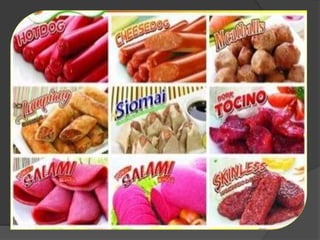
1. CURED meat
 Process by the application of salt
with or without sugar, with or
without nitrate and may or may
not be smoked
 However, smoking further
improved the palatability and
stability or shelf life or cured meat
 i.e. ham, bacon, tocino and tapa
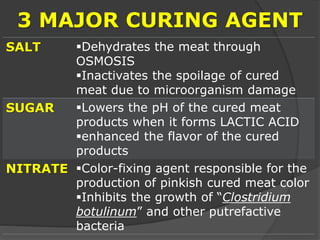
3 MAJOR CURING AGENT
SALT Dehydrates the meat through
OSMOSIS
Inactivates the spoilage of cured
meat due to microorganism damage
SUGAR Lowers the pH of the cured meat
products when it forms LACTIC ACID
enhanced the flavor of the cured
products
NITRATE Color-fixing agent responsible for the
production of pinkish cured meat color
Inhibits the growth of “Clostridium
botulinum” and other putrefactive
bacteria
TYPE OF PROCESSED MEAT
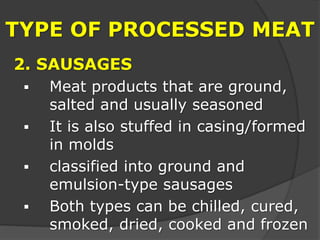
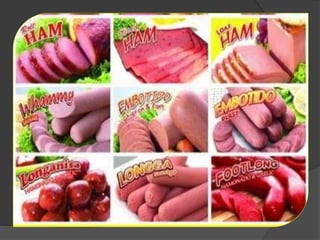
2. SAUSAGES
 Meat products that are ground,
salted and usually seasoned
 It is also stuffed in casing/formed
in molds
 classified into ground and
emulsion-type sausages
 Both types can be chilled, cured,
smoked, dried, cooked and frozen
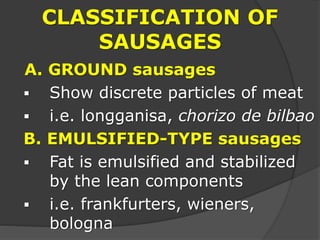
CLASSIFICATION OF
SAUSAGES
A. GROUND sausages
 Show discrete particles of meat
 i.e. longganisa, chorizo de bilbao
B. EMULSIFIED-TYPE sausages
 Fat is emulsified and stabilized
by the lean components
 i.e. frankfurters, wieners,
bologna
TYPE OF PROCESSED MEAT
3. RESTRUCTURED meat
products
 Generally made from flaked,
ground or sectioned beef or pork
which is shaped into roasts,
steaks or loaves.
 i.e. smoked sliced beef, boneless
hams
BY-PRODUCTS OF MEAT
ANIMALS
 product of considerably less value
than the major product
(meat/carcass)
 i.e. hide, skin, fat, bone and internal
organs
 In other countries (temperate)
- major products – hide, skin, milk,
draft
- by-products – meat/carcass
2 CATEGORIES OF BY-
PRODUCTS BASED ON
HUMAN CONSUMPTION
EDIBLE BY-PRODUCTS
 VARIETY meat
- products originating from organs and
body parts other than carcass
- liver, heart, tongue, etc.
 TRIPE – comes from the lining of the
stomach of ruminant animals (rumen,
reticulum and omasum)
 SWEETBREAD – thymus gland
INEDIBLE BY-PRODUCTS
 Tallow, hides, skins and inedible
organs are the most higher-valued
inedible by-products
 Cattle/buffalo hides – 80% of the
worlds leather products
 HIDE –beef hide weighing > 15 kg
 SKIN - beef hide weighing < 15 kg
 SHEEP PELTS – skins from sheep
with a wool left on it
INEDIBLE BY-PRODUCTS
 Inedible by-products are
classified according to:
a. species
b. weight
c. size
d. placement of brand
e. type of packer / producer /
manufacturer
MILK PROCESSING
 The production of highly perishable
commodity like MILK demands special
consideration to ensure that it
reaches the market in an acceptable
condition
 In the absence of cooling equipment,
milk can be distributed only over
short distances
 One basic ELEMENT of dairying is
PROCESSING which EXTENDS the
range and duration of marketability
BASIC MILK PROCESSING
TREATMENTS
1. Heat treatment Methods
a. Pasteurization
- heat treatment of an intensity
combined with a specific holding time
that destroys most of the
psychotropic and pathogenic bacteria
- but milk must be cooled to below
5ºC immediately after heat
treatments
- this is done to prevent surviving
microorganism from multiplying and
causing short shelf life of the
pasteurized milk
- pasteurization does NOT significantly
affect the nutritional composition of
milk except for the loss of light
sensitive vitamins A and riboflavin
- loss of ascorbic acid that is oxidized
during storage if the package is NOT
LIGHT tight.
3 HEAT TREATMENTS
a.1. LTLT (low-temp-long-time) method
- heats the milk at 63ºC for 30 minutes
a.2. HTST (high-temp-short-time) method
- heats the milk at 72ºC for 15 seconds
a.3. UHT processing
- heats the milk to about 142-145ºC for
2-3 seconds to bring the
microorganism level to ZERO (sterilized
the milk)
3 HEAT TREATMENTS
a.3. UHT processing
- UHT processed milk considerably loses
its ascorbic acid, Vitamins B12 and B6
- only riboflavin remains stable due to
the packaging which protects the milk
against light
NOTE: PROTEIN content in BOTH
pasteurized & UHT-processed milk
remains stable during treatment &
storage
BASIC MILK PROCESSING
TREATMENTS
2. Quick cooling methods
- Cooling the milk 10ºC or lower 2 hours
after milking or preferably immediately
after milking
- quick cooling stops the dev’t of
microorganisms at an early stage in the
lag-phase of the growth curve
- quick cooling also extends the period
that the bacteriostatic properties of the
milk remain active
BASIC MILK PROCESSING
TREATMENTS
3. Traditional processing methods
- processing using salt and sugar
treatments
- adding this compounds at a level
below saturation to raw milk will
extend its shelf-life for few hours
BASIC MILK PROCESSING
TREATMENTS
3. Traditional processing methods
- limited milk use
- salt-treated milk – can no longer
be made into “pastillas de leche”
- sugar-treated milk – can no
longer be use in making “cheese”
BASIC MILK PROCESSING
TREATMENTS
4. Clarification/Filtering Method
- removal of extraneous matter from
the milk
- simplest way to remove impurities
- however, this has the disadvantage
that ALL milk has to pass through
the dirt that accumulates on the
filter
BASIC MILK PROCESSING
TREATMENTS
5. Standardization Method
- refers to the adjustment of milk
and dairy products composition
- i.e. butterfat (milk with 3.5% BF
sold commercial)
- if the butterfat is high, a portion of
cream is removed
- if the butterfat is low, a sufficient
skim milk is added
BASIC MILK PROCESSING
TREATMENTS
6.Cream separation method/Gravity
Creaming
- the separation of the milk fat
globules (sg:0.63) and skim milk
(sg:1.035) causes the globules to rise
under gravity and slowly accumulated
at the top forming a cream layer
- Centrifugal creaming (5,000 times
faster than cream separation method)
BASIC MILK PROCESSING
TREATMENTS
7. Homogenization method
- process involving the breaking
up of the fat globules whose
diameter is around 1-18µ into
smaller size of <1µ
- thus preventing the globules
from rising during storage and
forming a cream layer
BASIC MILK PROCESSING
TREATMENTS
8. Reconstitution method
- process involving the dissolving
of milk powder in water
- inferior quality of whole milk
produced due to poor solubility of
whole milk powder and oxidation
of milk fat during storage
BASIC MILK PROCESSING
TREATMENTS
9. Recombination method
- process of standardizing
reconstituted skim milk with
butter oil
- favored process due to better
solubility of skim milk powder and
better keeping quality of butter
oil/fat when kept separately
BASIC MILK PROCESSING
TREATMENTS
10. Toning method
- toned milk is obtained by
blending locally produced milk
containing high fat content
(buffalo/sheep milk) with water
and non-fat dry milk (skim milk
powder)
- good flavor is retained
PROCESSED MILK
PRODUCTS
1. Whole Milk or Full Cream Milk
- milk from which milk fat has
NOT been extracted
- packaged for beverage (<3%
milk fat and NOT <8.25% milk
solid-non-fat (SNF)
PROCESSED MILK
PRODUCTS
2. Low-fat Milk
- milk from which some or most
milk fat has been removed
- but must be maintained fat
levels with 0.5%, 1%, or 2% and
NOT <8.25% milk SNF
PROCESSED MILK
PRODUCTS
3. Skim Milk
- milk from which sufficient milk
fat has been removed to reduce
its milk fat content to <0.5% and
contains NOT <8.5% milk SNF.
PROCESSED MILK
PRODUCTS
4. Evaporated Milk
- produced by pre-heating to
stabilize proteins and remove about
60% of the water
- it is sealed in a container and then
heat-treated to sterilize its contents
- milk fat and SNF of evaporated
milk must be at least 7.5% and
25%, respectively
PROCESSED MILK
PRODUCTS
5. Condensed Milk
- it has milk fat (7.5%) and SNF
(25.5%) requirements
- milk from which water has
removed, but NOT subjected to
further heat treatment
- addition of enough sugar that acts
as a natural preservative

Meat Fabrication

  • 1.
    MEAT FABRICATION  Processof cutting carcasses into standard wholesale (primal) and retail cuts
  • 2.
    GENERAL PRINCIPLE OF MEATFABRICATION 1. Tender meat is separated from tough meat 2. Thick portion must be separated from the thin portion 3. Muscles must be cut across the meat fiber/grain 4. Cheap parts must be separated from the expensive parts
  • 3.
  • 4.
    PRIMAL CUTS OFBEEF AND CARABEEF CARCASSES Front quarter 1. Chuck –pot roast, ground beef 2. Rib/prime cut – dry-heat cooking 3. Brisket – corned beef 4. Plate/short plate – carne asada 5. Shank/foreshank – osso buco
  • 5.
    PRIMAL CUTS OFBEEF AND CARABEEF CARCASSES Hind quarter 1. Shortloin –dry-heat cooking 2. Sirloin– roasting & barbecuing 3. Tenderloin – grilling & broiling 4. Flank or navel – braising 5. Round – moist-heat cooking (i.e. crockpot)
  • 6.
    PRIMAL CUTS OFMUTTON AND CHEVON CARCASSES Front quarter 1. Neck 2. Shoulder 3. Party Rack 4. Shank
  • 7.
    PRIMAL CUTS OFMUTTON AND CHEVON CARCASSES Hind quarter 1. Loin 2. Eye of loin 3. Tenderloin 4. Chump 5. Leg
  • 8.
    PRIMAL CUTS OFPORK CARCASSES 1. Jowl – sausages, bacon 2. Boston butt – sausages, lard 3. Picnic shoulder – cured or smoked 4. Loin – dry-heat cooking (roasting) 5. Spareribs - grilling (slowly over low temp) 6. Side - braising 7. Ham – serrano ham, prosciutto 8. Foot – pickled, Mexican menudo
  • 9.
  • 10.
    MEAT PROCESSING  Includesall processes utilized in altering fresh meat  Except for simple grinding, cutting and mixing  Necessary from the standpoint of preservation because through processing - Stability or shelf life of meat products are prolonged - Prevent early meat spoilage
  • 11.
    MEAT PROCESSING  Leadsto the production of flavorful and nutritious products  Provides both convenience and variety of choices  Product marketability of meat processed is also enhanced
  • 12.
    TYPE OF PROCESSEDMEAT 1. CURED meat  Process by the application of salt with or without sugar, with or without nitrate and may or may not be smoked  However, smoking further improved the palatability and stability or shelf life or cured meat  i.e. ham, bacon, tocino and tapa
  • 14.
    3 MAJOR CURINGAGENT SALT Dehydrates the meat through OSMOSIS Inactivates the spoilage of cured meat due to microorganism damage SUGAR Lowers the pH of the cured meat products when it forms LACTIC ACID enhanced the flavor of the cured products NITRATE Color-fixing agent responsible for the production of pinkish cured meat color Inhibits the growth of “Clostridium botulinum” and other putrefactive bacteria
  • 15.
    TYPE OF PROCESSEDMEAT 2. SAUSAGES  Meat products that are ground, salted and usually seasoned  It is also stuffed in casing/formed in molds  classified into ground and emulsion-type sausages  Both types can be chilled, cured, smoked, dried, cooked and frozen
  • 16.
    CLASSIFICATION OF SAUSAGES A. GROUNDsausages  Show discrete particles of meat  i.e. longganisa, chorizo de bilbao B. EMULSIFIED-TYPE sausages  Fat is emulsified and stabilized by the lean components  i.e. frankfurters, wieners, bologna
  • 20.
    TYPE OF PROCESSEDMEAT 3. RESTRUCTURED meat products  Generally made from flaked, ground or sectioned beef or pork which is shaped into roasts, steaks or loaves.  i.e. smoked sliced beef, boneless hams
  • 22.
    BY-PRODUCTS OF MEAT ANIMALS product of considerably less value than the major product (meat/carcass)  i.e. hide, skin, fat, bone and internal organs  In other countries (temperate) - major products – hide, skin, milk, draft - by-products – meat/carcass
  • 23.
    2 CATEGORIES OFBY- PRODUCTS BASED ON HUMAN CONSUMPTION
  • 24.
    EDIBLE BY-PRODUCTS  VARIETYmeat - products originating from organs and body parts other than carcass - liver, heart, tongue, etc.  TRIPE – comes from the lining of the stomach of ruminant animals (rumen, reticulum and omasum)  SWEETBREAD – thymus gland
  • 25.
    INEDIBLE BY-PRODUCTS  Tallow,hides, skins and inedible organs are the most higher-valued inedible by-products  Cattle/buffalo hides – 80% of the worlds leather products  HIDE –beef hide weighing > 15 kg  SKIN - beef hide weighing < 15 kg  SHEEP PELTS – skins from sheep with a wool left on it
  • 26.
    INEDIBLE BY-PRODUCTS  Inedibleby-products are classified according to: a. species b. weight c. size d. placement of brand e. type of packer / producer / manufacturer
  • 27.
    MILK PROCESSING  Theproduction of highly perishable commodity like MILK demands special consideration to ensure that it reaches the market in an acceptable condition  In the absence of cooling equipment, milk can be distributed only over short distances  One basic ELEMENT of dairying is PROCESSING which EXTENDS the range and duration of marketability
  • 28.
    BASIC MILK PROCESSING TREATMENTS 1.Heat treatment Methods a. Pasteurization - heat treatment of an intensity combined with a specific holding time that destroys most of the psychotropic and pathogenic bacteria - but milk must be cooled to below 5ºC immediately after heat treatments
  • 29.
    - this isdone to prevent surviving microorganism from multiplying and causing short shelf life of the pasteurized milk - pasteurization does NOT significantly affect the nutritional composition of milk except for the loss of light sensitive vitamins A and riboflavin - loss of ascorbic acid that is oxidized during storage if the package is NOT LIGHT tight.
  • 30.
    3 HEAT TREATMENTS a.1.LTLT (low-temp-long-time) method - heats the milk at 63ºC for 30 minutes a.2. HTST (high-temp-short-time) method - heats the milk at 72ºC for 15 seconds a.3. UHT processing - heats the milk to about 142-145ºC for 2-3 seconds to bring the microorganism level to ZERO (sterilized the milk)
  • 31.
    3 HEAT TREATMENTS a.3.UHT processing - UHT processed milk considerably loses its ascorbic acid, Vitamins B12 and B6 - only riboflavin remains stable due to the packaging which protects the milk against light NOTE: PROTEIN content in BOTH pasteurized & UHT-processed milk remains stable during treatment & storage
  • 32.
    BASIC MILK PROCESSING TREATMENTS 2.Quick cooling methods - Cooling the milk 10ºC or lower 2 hours after milking or preferably immediately after milking - quick cooling stops the dev’t of microorganisms at an early stage in the lag-phase of the growth curve - quick cooling also extends the period that the bacteriostatic properties of the milk remain active
  • 33.
    BASIC MILK PROCESSING TREATMENTS 3.Traditional processing methods - processing using salt and sugar treatments - adding this compounds at a level below saturation to raw milk will extend its shelf-life for few hours
  • 34.
    BASIC MILK PROCESSING TREATMENTS 3.Traditional processing methods - limited milk use - salt-treated milk – can no longer be made into “pastillas de leche” - sugar-treated milk – can no longer be use in making “cheese”
  • 35.
    BASIC MILK PROCESSING TREATMENTS 4.Clarification/Filtering Method - removal of extraneous matter from the milk - simplest way to remove impurities - however, this has the disadvantage that ALL milk has to pass through the dirt that accumulates on the filter
  • 36.
    BASIC MILK PROCESSING TREATMENTS 5.Standardization Method - refers to the adjustment of milk and dairy products composition - i.e. butterfat (milk with 3.5% BF sold commercial) - if the butterfat is high, a portion of cream is removed - if the butterfat is low, a sufficient skim milk is added
  • 37.
    BASIC MILK PROCESSING TREATMENTS 6.Creamseparation method/Gravity Creaming - the separation of the milk fat globules (sg:0.63) and skim milk (sg:1.035) causes the globules to rise under gravity and slowly accumulated at the top forming a cream layer - Centrifugal creaming (5,000 times faster than cream separation method)
  • 38.
    BASIC MILK PROCESSING TREATMENTS 7.Homogenization method - process involving the breaking up of the fat globules whose diameter is around 1-18µ into smaller size of <1µ - thus preventing the globules from rising during storage and forming a cream layer
  • 39.
    BASIC MILK PROCESSING TREATMENTS 8.Reconstitution method - process involving the dissolving of milk powder in water - inferior quality of whole milk produced due to poor solubility of whole milk powder and oxidation of milk fat during storage
  • 40.
    BASIC MILK PROCESSING TREATMENTS 9.Recombination method - process of standardizing reconstituted skim milk with butter oil - favored process due to better solubility of skim milk powder and better keeping quality of butter oil/fat when kept separately
  • 41.
    BASIC MILK PROCESSING TREATMENTS 10.Toning method - toned milk is obtained by blending locally produced milk containing high fat content (buffalo/sheep milk) with water and non-fat dry milk (skim milk powder) - good flavor is retained
  • 42.
    PROCESSED MILK PRODUCTS 1. WholeMilk or Full Cream Milk - milk from which milk fat has NOT been extracted - packaged for beverage (<3% milk fat and NOT <8.25% milk solid-non-fat (SNF)
  • 43.
    PROCESSED MILK PRODUCTS 2. Low-fatMilk - milk from which some or most milk fat has been removed - but must be maintained fat levels with 0.5%, 1%, or 2% and NOT <8.25% milk SNF
  • 44.
    PROCESSED MILK PRODUCTS 3. SkimMilk - milk from which sufficient milk fat has been removed to reduce its milk fat content to <0.5% and contains NOT <8.5% milk SNF.
  • 45.
    PROCESSED MILK PRODUCTS 4. EvaporatedMilk - produced by pre-heating to stabilize proteins and remove about 60% of the water - it is sealed in a container and then heat-treated to sterilize its contents - milk fat and SNF of evaporated milk must be at least 7.5% and 25%, respectively
  • 46.
    PROCESSED MILK PRODUCTS 5. CondensedMilk - it has milk fat (7.5%) and SNF (25.5%) requirements - milk from which water has removed, but NOT subjected to further heat treatment - addition of enough sugar that acts as a natural preservative