Meat   Preservation                              
Meat   Putrefication Meat is putrefied due to the action of bacteria , moulds , yeasts.  To grow and proliferate the organisms temperature is necessary. Due to this classify the organisms, 1-Pschyrophiles: have optimum temperature range of -2 to 7*c. 2-Mesophiles: have 10 to 40*c. 3-Thermophiles: have 43 to 66*c .  Organisms also need water for growth.
Why Preserve Meat??? Delays product spoilage Extends life of the product Improves product quality
Preserve Meat To preserve the meat temperature must be 1- : -2*c by chilling or freezing. 2- : 66*c by pasteurization , cooking or sterilization. To preserve the meat , remove the water by dehydration , freezing , curing.
Types of Preservation Techniques Freezing Cooking Dehydration Chemical  Fermentation Irradiation
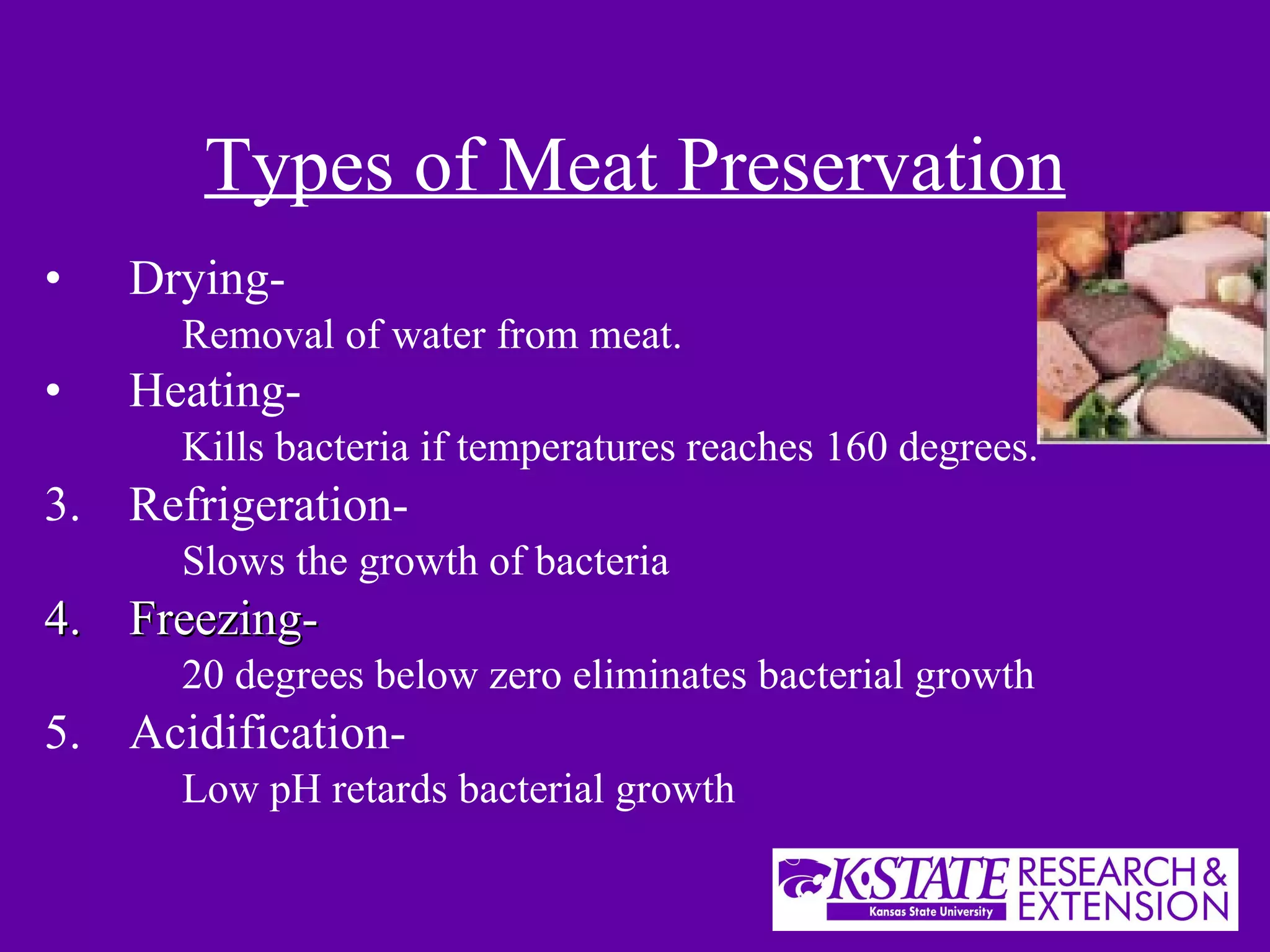
Types of Meat Preservation Drying-   Removal of water from meat. Heating-   Kills bacteria if temperatures reaches 160 degrees. Refrigeration- Slows the growth of bacteria Freezing- 20 degrees below zero eliminates bacterial growth Acidification-  Low pH retards bacterial growth
Types of Meat Preservation 6. Irradiation - Low levels kill bacteria in fresh meat products Canning-   Packaging meat into sealed containers and heating meat to kill bacteria Curing-  Compounds make meats inhospitable to microbial growth. Salting and Sugaring-  Prevents microbial growth Smoking-  Forms antibacterial chemicals to the meats surface
Typical Methods of Food Preservation : High temperature Pasteurization kills spoilage and pathogenic organisms (1864 – Pasteur) Longer temperatures and times can sterilize foods Low temperature Refrigeration or freezing inhibits microbial growth
Typical Methods of Food Preservation : Dehydration Air drying Chemical preservatives Inhibitors of organism growth such as salt, sodium nitrite, and propionates Bactofugation Removing bacteria from liquids by centrifugation
Freezing Optimum temperature (0 °F or lower) Meat freeze at -1.4*C Works by completely stopping enzyme activity & inhibiting spoilage microorganisms Bacteria Yeasts Molds
Freezing REMEMBER:  Thaw meat at refrigeration temps or in the microwave DO NOT THAW AT ROOM TEMPS
How long with frozen meat last? Beef – 12 months   Pork -  6 months Lamb – 6-9  months Poultry – 3-6 months
Disadvantages of freezing Frozen meat stored too long become dry , less palatable and rancid. After thawing it is less durable than fresh-killed or chilled meat. When frozen meat is thawed it weeps or drips which consist mainly of water, salt, protein and demaged blood corpuscles. Loss of weight due to drip in beef is up to 3% while in mutton , lamb or pork loss is less than beef.
FREEZER BURN Yellowish –brown or whitish areas seen on the surface of frozen meats. It is due to excessive drying of the surface. Phenomenon involves the formation of a  condensed layer of the muscular tissue just under the surface. this prevents moisture coming to the surface from the depth of the meat.
Chilling of meat It is useful when meat is stored for short time up to 35 days. It is kept at b/w -1.4*c and 1*c preferably in the dark as light has the effect of oxidizing fats. Atmosphere keep dry to prevent the mould formation 5-10%CO2 helps to prevent the growth of mould and bacteria. It is important that temperature does not reach -1.4*c otherwise meat is frozen..
Cold shortening Toughness develops in lamb carcasses, if they are exposed to low temperature within about 16 hours after slaughtering pH is about 6.3 and ATP levels are high ,lowering of the temperature causes the muscle to contract. It starts normally at 15*c and become greater down to 0*c. Beef carcass do not chilled quickly b/c of the thickness of the muscles. Due to rapid fall in the pH there is no problem of cold shortening in the pig carcass.
Cooking Works by heating products to high temperatures to kill microorganisms 2 types of cooking Pasteurization Sterilization
Pasteurized Cooking Products are cooked to 150-170 °F Kills most (but not all) microorganisms Product must be REFRIGERATED Example: “Hotdogs”
Sterilized Cooking Products cooked under pressure to 250 °F All microorganisms killed Products are shelf stable Example:  Canned Hams
Smoking - Meat, fish and some other foods may be both preserved and flavored through the use of smoke, typically in a  smoke house . The combination of heat to dry the food without cooking it, and the addition of the aromatic (phenolic)hydrocarbons from the smoke preserves the food.
Vacuum packing Vacuum-packing stores food in a vacuum environment, usually in an air-tight bag or bottle. The  vacuum  environment strips bacteria of oxygen needed for survival, slowing spoiling.
Canning Canning :  food is sealed in a container such as a can or glass jar and heated to kill all living organisms, or at least to ensure that there will be no growth of residual organisms. Acidic foods should be  heated  to 100 °C, whereas nonacidic foods should be heated to 121°C.  Properly canned foods may not be sterile b/c heating them for the time required might alter the foods’ taste and nutritional value. Since some of the anaerobic organisms that can grow in cans are from the genus  Clostridium ,  food from  a can that is visibly altered, ex.  bulged can, should not be eaten .
Dehydration Oldest forms of preserving meat Works by removing water from the product water is required by all microorganisms to grow  NO WATER = NO GROWTH
Dehydration Dehydrate by air drying, heating, or freezing Example: “Beef Jerky”
Chemical Chemicals inhibit microorganism growth Salting or curing draws moisture from the meat through a process of  osmosis. Examples Salt Sodium Nitrite Sodium Lactate
Chemical Preservatives Sodium Benzoate Sorbate Proprionates
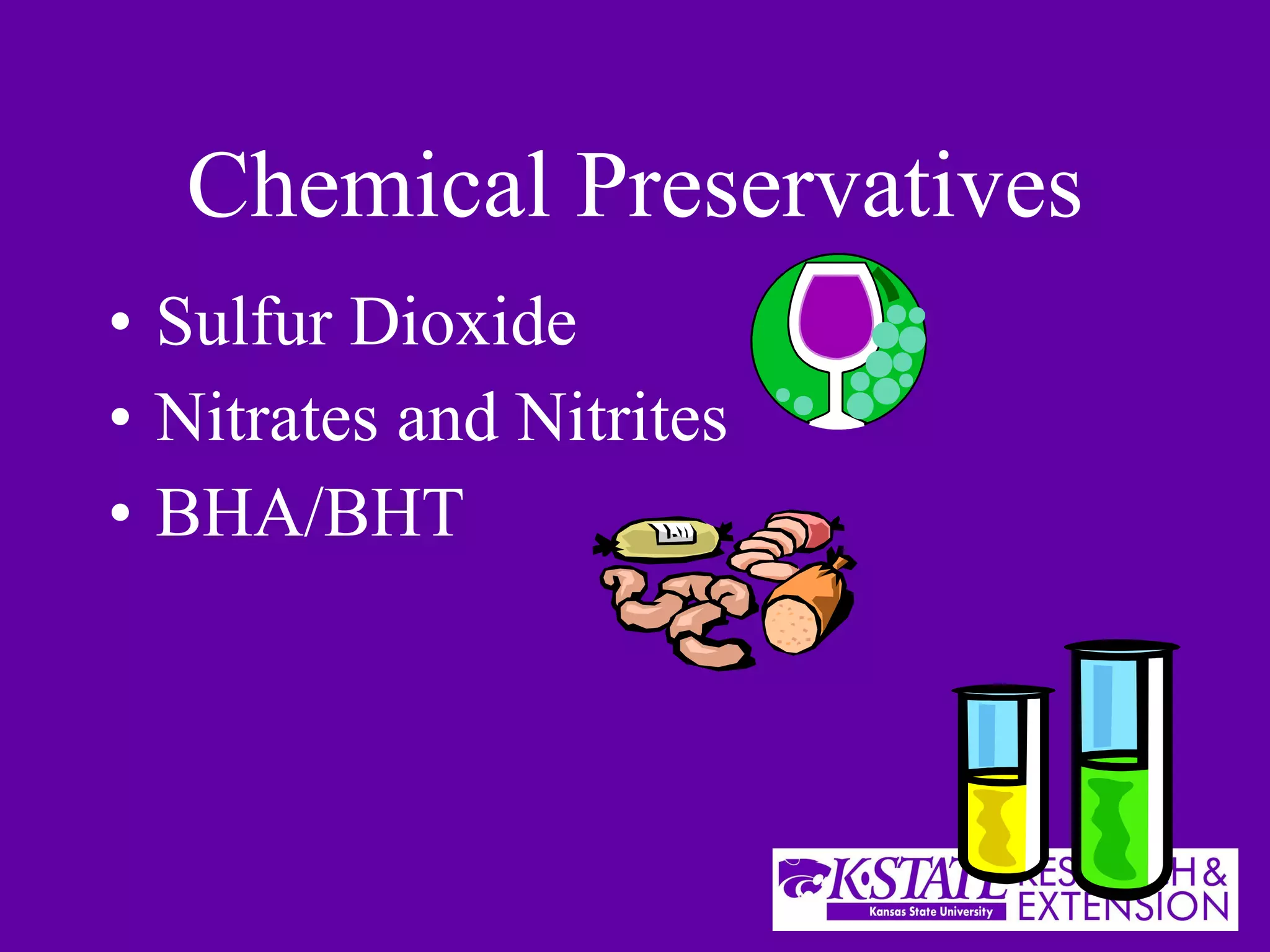
Chemical Preservatives Sulfur Dioxide Nitrates and Nitrites BHA/BHT
Chemical Other benefits: Add flavor to the product Improve product shelf life  Develop a pink cured-meat color  All Chemicals added to meat are FDA approved
Fermentation Works by changing sugar into acid Acid prevents microorganisms from growing Tangy flavor and special texture developed Example: “Pepperoni”
Modified Atmosphere Preservation MAP – Modified Atmosphere Packaging Carbon Dioxide Types Hypobaric Vacuum Packaging MAP Equilibrium Modified Atmosphere Controlled Atmosphere Packaging
MAP Equipment
Irradiation A new process to make food SAFER!!!! Works by exposing meat to radiant energy Destroys most (but not all) microorganisms “ Radura” sign on labels
Irradiation Reduces spoilage Irradiated meat is still nutritious Irradiated meat needs to be COOKED IRRADIATED MEAT IS SAFE TO EAT!!!!
Irradiation unit
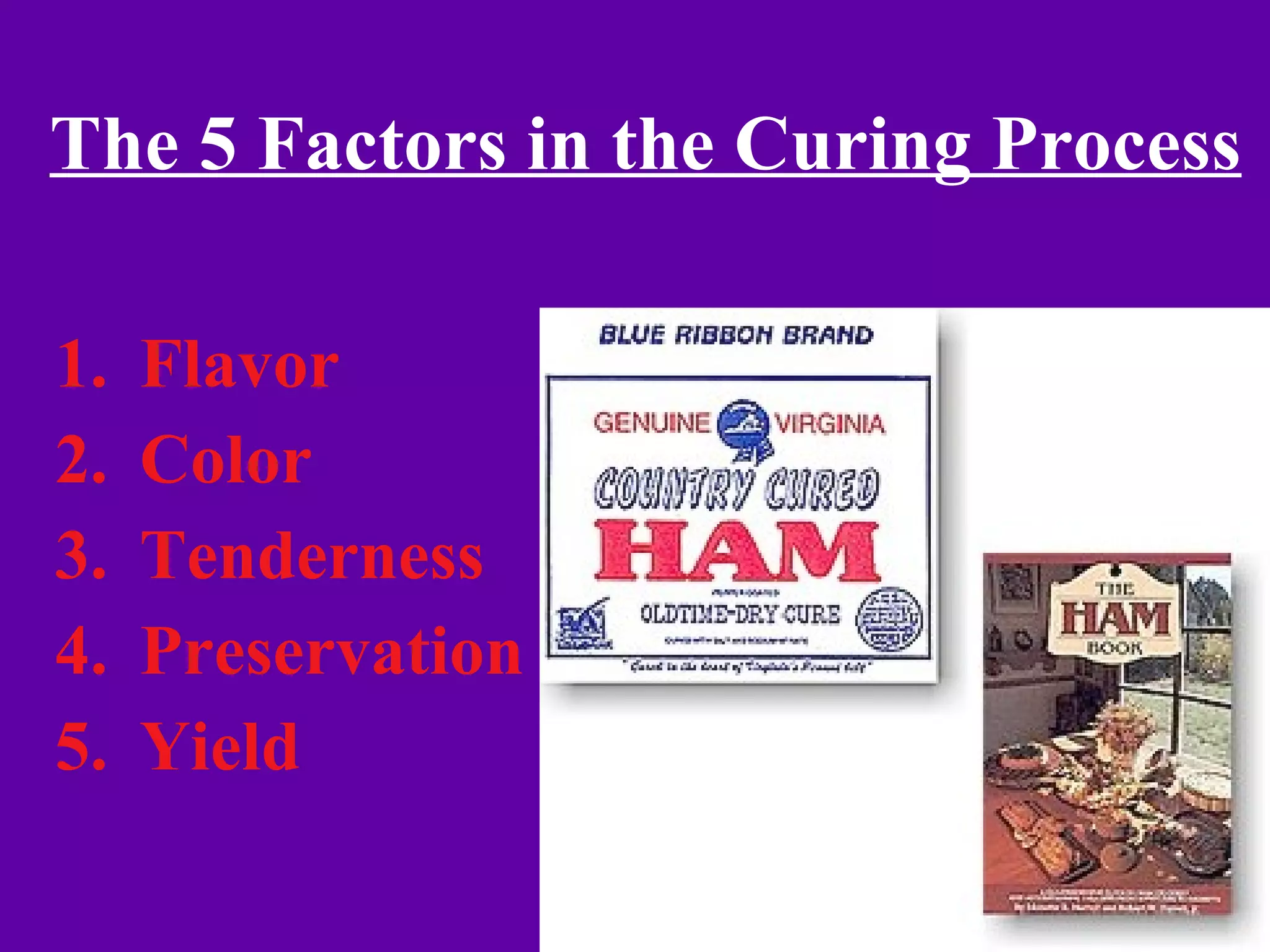
The 5 Factors in the Curing Process Flavor Color Tenderness Preservation Yield
Preservation 3 main ingredients to preservation process Salt Sugar Nitrite
Flavor Flavor is the primary reason consumers purchase meat more than once Salt-  Predominant flavor in most processed meats Sugar-  Used to reduce the harshness of the salt flavor Nitrite-  Provide a characteristic flavor you recognize    as a ham flavor Smoked-  Contains a smoke flavoring rather than  being traditionally smoked
Color and Tenderness Color-   If nitrate is used the meat will take  on a distinctive red color. Tenderness- The type of process will affect the  tenderness of the meat. Examples: Jerky the meat is dry and tough Ham usually fairly tender
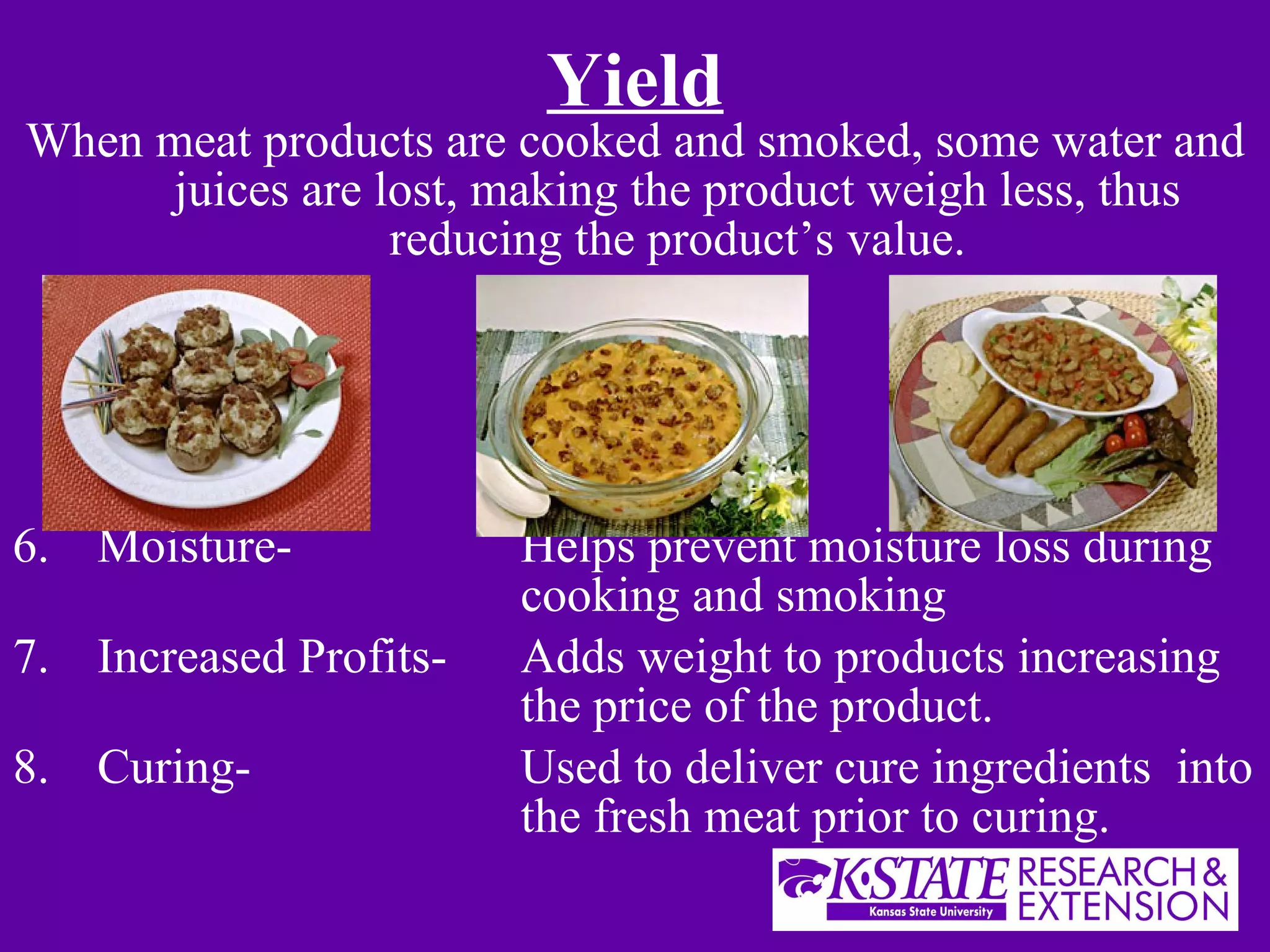
Yield When meat products are cooked and smoked, some water and juices are lost, making the product weigh less, thus reducing the product’s value. Moisture-  Helps prevent moisture loss during  cooking and smoking Increased Profits- Adds weight to products increasing  the price of the product. Curing- Used to deliver cure ingredients  into  the fresh meat prior to curing.
The Curing Process Non-Meat Ingredients Not meat!!! Ingredients Increase product yield Aid in color, texture or flavor development Increase product shelf-life Increase process efficiency
Questions Please contact Dr. Elizabeth Boyle or Ryan Timm at (785)532-1247 email:  [email_address] [email_address] Please contact Dr.M.Arshad.Javid email:  [email_address] OR Call your county extension office

Ksu meat preservation

  • 1.
    Meat Preservation                              
  • 2.
    Meat Putrefication Meat is putrefied due to the action of bacteria , moulds , yeasts. To grow and proliferate the organisms temperature is necessary. Due to this classify the organisms, 1-Pschyrophiles: have optimum temperature range of -2 to 7*c. 2-Mesophiles: have 10 to 40*c. 3-Thermophiles: have 43 to 66*c . Organisms also need water for growth.
  • 3.
    Why Preserve Meat???Delays product spoilage Extends life of the product Improves product quality
  • 4.
    Preserve Meat Topreserve the meat temperature must be 1- : -2*c by chilling or freezing. 2- : 66*c by pasteurization , cooking or sterilization. To preserve the meat , remove the water by dehydration , freezing , curing.
  • 5.
    Types of PreservationTechniques Freezing Cooking Dehydration Chemical Fermentation Irradiation
  • 6.
    Types of MeatPreservation Drying- Removal of water from meat. Heating- Kills bacteria if temperatures reaches 160 degrees. Refrigeration- Slows the growth of bacteria Freezing- 20 degrees below zero eliminates bacterial growth Acidification- Low pH retards bacterial growth
  • 7.
    Types of MeatPreservation 6. Irradiation - Low levels kill bacteria in fresh meat products Canning- Packaging meat into sealed containers and heating meat to kill bacteria Curing- Compounds make meats inhospitable to microbial growth. Salting and Sugaring- Prevents microbial growth Smoking- Forms antibacterial chemicals to the meats surface
  • 8.
    Typical Methods ofFood Preservation : High temperature Pasteurization kills spoilage and pathogenic organisms (1864 – Pasteur) Longer temperatures and times can sterilize foods Low temperature Refrigeration or freezing inhibits microbial growth
  • 9.
    Typical Methods ofFood Preservation : Dehydration Air drying Chemical preservatives Inhibitors of organism growth such as salt, sodium nitrite, and propionates Bactofugation Removing bacteria from liquids by centrifugation
  • 10.
    Freezing Optimum temperature(0 °F or lower) Meat freeze at -1.4*C Works by completely stopping enzyme activity & inhibiting spoilage microorganisms Bacteria Yeasts Molds
  • 11.
    Freezing REMEMBER: Thaw meat at refrigeration temps or in the microwave DO NOT THAW AT ROOM TEMPS
  • 12.
    How long withfrozen meat last? Beef – 12 months Pork - 6 months Lamb – 6-9 months Poultry – 3-6 months
  • 13.
    Disadvantages of freezingFrozen meat stored too long become dry , less palatable and rancid. After thawing it is less durable than fresh-killed or chilled meat. When frozen meat is thawed it weeps or drips which consist mainly of water, salt, protein and demaged blood corpuscles. Loss of weight due to drip in beef is up to 3% while in mutton , lamb or pork loss is less than beef.
  • 14.
    FREEZER BURN Yellowish–brown or whitish areas seen on the surface of frozen meats. It is due to excessive drying of the surface. Phenomenon involves the formation of a condensed layer of the muscular tissue just under the surface. this prevents moisture coming to the surface from the depth of the meat.
  • 15.
    Chilling of meatIt is useful when meat is stored for short time up to 35 days. It is kept at b/w -1.4*c and 1*c preferably in the dark as light has the effect of oxidizing fats. Atmosphere keep dry to prevent the mould formation 5-10%CO2 helps to prevent the growth of mould and bacteria. It is important that temperature does not reach -1.4*c otherwise meat is frozen..
  • 16.
    Cold shortening Toughnessdevelops in lamb carcasses, if they are exposed to low temperature within about 16 hours after slaughtering pH is about 6.3 and ATP levels are high ,lowering of the temperature causes the muscle to contract. It starts normally at 15*c and become greater down to 0*c. Beef carcass do not chilled quickly b/c of the thickness of the muscles. Due to rapid fall in the pH there is no problem of cold shortening in the pig carcass.
  • 17.
    Cooking Works byheating products to high temperatures to kill microorganisms 2 types of cooking Pasteurization Sterilization
  • 18.
    Pasteurized Cooking Productsare cooked to 150-170 °F Kills most (but not all) microorganisms Product must be REFRIGERATED Example: “Hotdogs”
  • 19.
    Sterilized Cooking Productscooked under pressure to 250 °F All microorganisms killed Products are shelf stable Example: Canned Hams
  • 20.
    Smoking - Meat,fish and some other foods may be both preserved and flavored through the use of smoke, typically in a smoke house . The combination of heat to dry the food without cooking it, and the addition of the aromatic (phenolic)hydrocarbons from the smoke preserves the food.
  • 21.
    Vacuum packing Vacuum-packingstores food in a vacuum environment, usually in an air-tight bag or bottle. The vacuum environment strips bacteria of oxygen needed for survival, slowing spoiling.
  • 22.
    Canning Canning : food is sealed in a container such as a can or glass jar and heated to kill all living organisms, or at least to ensure that there will be no growth of residual organisms. Acidic foods should be heated to 100 °C, whereas nonacidic foods should be heated to 121°C. Properly canned foods may not be sterile b/c heating them for the time required might alter the foods’ taste and nutritional value. Since some of the anaerobic organisms that can grow in cans are from the genus Clostridium , food from a can that is visibly altered, ex. bulged can, should not be eaten .
  • 23.
    Dehydration Oldest formsof preserving meat Works by removing water from the product water is required by all microorganisms to grow NO WATER = NO GROWTH
  • 24.
    Dehydration Dehydrate byair drying, heating, or freezing Example: “Beef Jerky”
  • 25.
    Chemical Chemicals inhibitmicroorganism growth Salting or curing draws moisture from the meat through a process of osmosis. Examples Salt Sodium Nitrite Sodium Lactate
  • 26.
    Chemical Preservatives SodiumBenzoate Sorbate Proprionates
  • 27.
    Chemical Preservatives SulfurDioxide Nitrates and Nitrites BHA/BHT
  • 28.
    Chemical Other benefits:Add flavor to the product Improve product shelf life Develop a pink cured-meat color All Chemicals added to meat are FDA approved
  • 29.
    Fermentation Works bychanging sugar into acid Acid prevents microorganisms from growing Tangy flavor and special texture developed Example: “Pepperoni”
  • 30.
    Modified Atmosphere PreservationMAP – Modified Atmosphere Packaging Carbon Dioxide Types Hypobaric Vacuum Packaging MAP Equilibrium Modified Atmosphere Controlled Atmosphere Packaging
  • 31.
  • 32.
    Irradiation A newprocess to make food SAFER!!!! Works by exposing meat to radiant energy Destroys most (but not all) microorganisms “ Radura” sign on labels
  • 33.
    Irradiation Reduces spoilageIrradiated meat is still nutritious Irradiated meat needs to be COOKED IRRADIATED MEAT IS SAFE TO EAT!!!!
  • 34.
  • 35.
    The 5 Factorsin the Curing Process Flavor Color Tenderness Preservation Yield
  • 36.
    Preservation 3 mainingredients to preservation process Salt Sugar Nitrite
  • 37.
    Flavor Flavor isthe primary reason consumers purchase meat more than once Salt- Predominant flavor in most processed meats Sugar- Used to reduce the harshness of the salt flavor Nitrite- Provide a characteristic flavor you recognize as a ham flavor Smoked- Contains a smoke flavoring rather than being traditionally smoked
  • 38.
    Color and TendernessColor- If nitrate is used the meat will take on a distinctive red color. Tenderness- The type of process will affect the tenderness of the meat. Examples: Jerky the meat is dry and tough Ham usually fairly tender
  • 39.
    Yield When meatproducts are cooked and smoked, some water and juices are lost, making the product weigh less, thus reducing the product’s value. Moisture- Helps prevent moisture loss during cooking and smoking Increased Profits- Adds weight to products increasing the price of the product. Curing- Used to deliver cure ingredients into the fresh meat prior to curing.
  • 40.
    The Curing ProcessNon-Meat Ingredients Not meat!!! Ingredients Increase product yield Aid in color, texture or flavor development Increase product shelf-life Increase process efficiency
  • 41.
    Questions Please contactDr. Elizabeth Boyle or Ryan Timm at (785)532-1247 email: [email_address] [email_address] Please contact Dr.M.Arshad.Javid email: [email_address] OR Call your county extension office

Editor's Notes

  • #28 Sulfur Dioxide Gas or Liquid Form Dried fruits, lemon juice, molasses, wines, fruit juices NOT permitted in meats Insects, microorganisms Nitrates and Nitrites Curing – Stabilize Red Color Contribute to Flavor Development Inhibit microorganisms - C. bot. Meat Products Nitrosamines – Nitrite reacting to secondary amines – Carcinogenic BHA/BHT butylated hydroxyanisole butylated hydroxytolune Inhibit Gram positive and negative more in foods than in lab media are needed for inhibition PRIMARY ROLE - antioxidant
  • #31 MAP- Gaseous environment on or around foods Carbon Dioxide 90% of boxed beef 90-95% of fresh pasta – UK Icreased CO2 and decrease in Oxygen Hypobaric – Store in air under low pressure, low temp and high humidity. All very controlled. Very Limited in Use Vacuum Air evacuated from gas impermeable pouches and then sealed O removed and increased co2 results from tissue and microbial respiration Meats 10-20% CO2 in 4 hours MAP The chamber of the packaging material is alternated by flushing with mixtures of CO2, Nitrogen and/or Oxygen. Concentrations can’t be adjusted during storage Equilibrium flush gas permeable pouches with gas – Used for fresh f and v Controlled Atmosphere A form of MAP MAP uses high barrier plastic films CAP uses foil laminates, metal or glass containers so the gas concentrations do not change