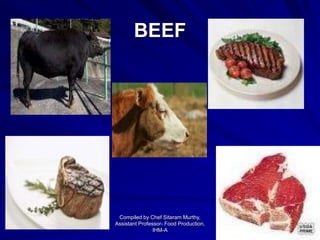
BEEF
Compiled by Chef Sitaram Murthy,
Assistant Professor- Food Production,
IHM-A
BEEF AND VEAL
• Beef and Veal are got from the Bovine animals and
they are classified by their ages:
• Veal: Flesh of calf ( less than 3 months of age)
• Calves: The animals are from 3 to 8 months
• Beef: The meat is taken when an animal is above 8
months old
• Beef is the most popular of all the edible meats in
Western Countries
• It is the flesh of Steers, Heifers, Cows, Bulls and
Stags.
Compiled by Chef Sitaram Murthy,
Assistant Professor- Food Production,
IHM-A
ORDER OF DISSECTION:
BEEF CUTS
The carcass is divided into two lengthwise:
Hindquarter
Forequarter
Compiled by Chef Sitaram Murthy,
Assistant Professor- Food Production,
IHM-A
Basic Cuts - Beef
Forequarter
– Chuck
– Brisket
– Shank
– Rib
– Short Plate
Hindquarter
– Full Loin
– Short loin
– Sirloin
– Flank
– Round
Compiled by Chef Sitaram Murthy,
Assistant Professor- Food Production,
IHM-A
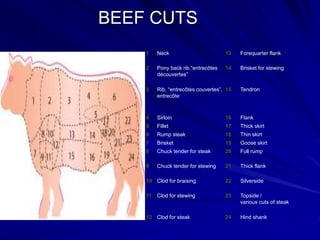
BEEF CUTS
1 Neck 13 Forequarter flank
2 Pony back rib,“entrecôtes
découvertes”
14 Brisket for stewing
3 Rib, “entrecôtes couvertes”,
entrecôte
15 Tendron
4 Sirloin 16 Flank
5 Fillet 17 Thick skirt
6 Rump steak 18 Thin skirt
7 Brisket 19 Goose skirt
8 Chuck tender for steak 20 Full rump
9 Chuck tender for stewing 21 Thick flank
10 Clod for braising 22 Silverside
11 Clod for stewing 23 Topside /
various cuts of steak
12 Clod for steak 24 Hind shank
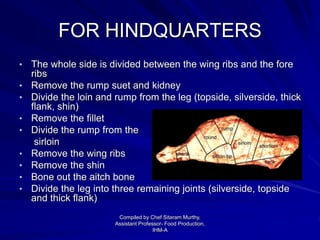
FOR HINDQUARTERS
• The whole side is divided between the wing ribs and the fore
ribs
• Remove the rump suet and kidney
• Divide the loin and rump from the leg (topside, silverside, thick
flank, shin)
• Remove the fillet
• Divide the rump from the
sirloin
• Remove the wing ribs
• Remove the shin
• Bone out the aitch bone
• Divide the leg into three remaining joints (silverside, topside
and thick flank)
Compiled by Chef Sitaram Murthy,
Assistant Professor- Food Production,
IHM-A
FOR FOREQUARTERS
Remove the shank
Divide in half down the center
Take off the fore ribs
Divide into joints
Compiled by Chef Sitaram Murthy,
Assistant Professor- Food Production,
IHM-A
Compiled by Chef Sitaram Murthy,
Assistant Professor- Food Production,
IHM-A
CUTS OF
BEEF
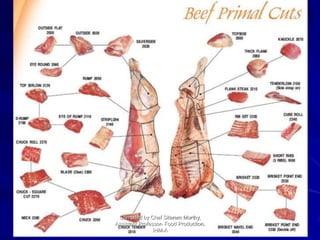
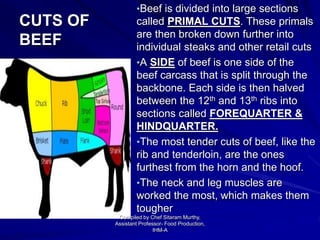
•Beef is divided into large sections
called PRIMAL CUTS. These primals
are then broken down further into
individual steaks and other retail cuts
•A SIDE of beef is one side of the
beef carcass that is split through the
backbone. Each side is then halved
between the 12th and 13th ribs into
sections called FOREQUARTER &
HINDQUARTER.
•The most tender cuts of beef, like the
rib and tenderloin, are the ones
furthest from the horn and the hoof.
•The neck and leg muscles are
worked the most, which makes them
tougher
Compiled by Chef Sitaram Murthy,
Assistant Professor- Food Production,
IHM-A
CHUCK
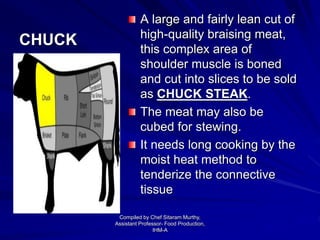
A large and fairly lean cut of
high-quality braising meat,
this complex area of
shoulder muscle is boned
and cut into slices to be sold
as CHUCK STEAK.
The meat may also be
cubed for stewing.
It needs long cooking by the
moist heat method to
tenderize the connective
tissue
Compiled by Chef Sitaram Murthy,
Assistant Professor- Food Production,
IHM-A
CHUCK
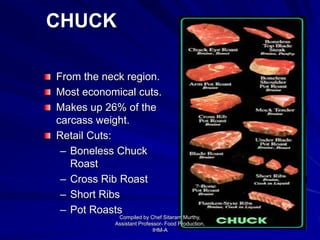
From the neck region.
Most economical cuts.
Makes up 26% of the
carcass weight.
Retail Cuts:
– Boneless Chuck
Roast
– Cross Rib Roast
– Short Ribs
– Pot Roasts
Compiled by Chef Sitaram Murthy,
Assistant Professor- Food Production,
IHM-A
Beef Chuck Cuts
Compiled by Chef Sitaram Murthy,
Assistant Professor- Food Production,
IHM-A
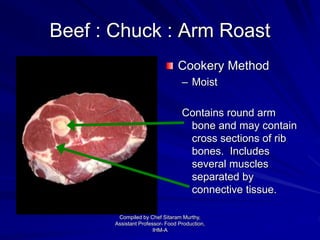
Beef : Chuck : Arm Roast
Cookery Method
– Moist
Contains round arm
bone and may contain
cross sections of rib
bones. Includes
several muscles
separated by
connective tissue.
Compiled by Chef Sitaram Murthy,
Assistant Professor- Food Production,
IHM-A
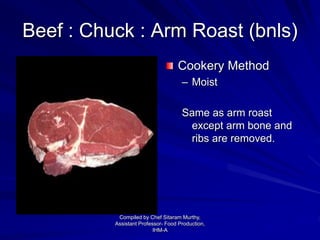
Beef : Chuck : Arm Roast (bnls)
Cookery Method
– Moist
Same as arm roast
except arm bone and
ribs are removed.
Compiled by Chef Sitaram Murthy,
Assistant Professor- Food Production,
IHM-A
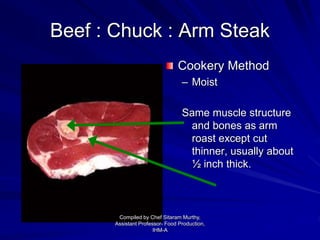
Beef : Chuck : Arm Steak
Cookery Method
– Moist
Same muscle structure
and bones as arm
roast except cut
thinner, usually about
½ inch thick.
Compiled by Chef Sitaram Murthy,
Assistant Professor- Food Production,
IHM-A
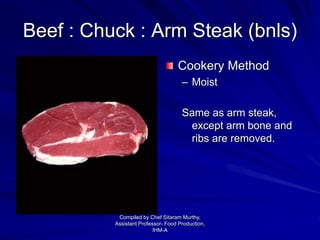
Beef : Chuck : Arm Steak (bnls)
Cookery Method
– Moist
Same as arm steak,
except arm bone and
ribs are removed.
Compiled by Chef Sitaram Murthy,
Assistant Professor- Food Production,
IHM-A
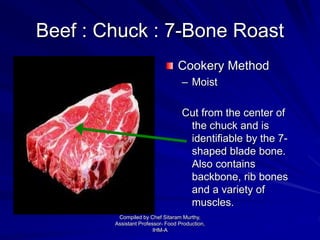
Beef : Chuck : 7-Bone Roast
Cookery Method
– Moist
Cut from the center of
the chuck and is
identifiable by the 7-
shaped blade bone.
Also contains
backbone, rib bones
and a variety of
muscles.
Compiled by Chef Sitaram Murthy,
Assistant Professor- Food Production,
IHM-A
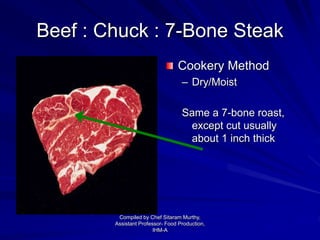
Beef : Chuck : 7-Bone Steak
Cookery Method
– Dry/Moist
Same a 7-bone roast,
except cut usually
about 1 inch thick
Compiled by Chef Sitaram Murthy,
Assistant Professor- Food Production,
IHM-A
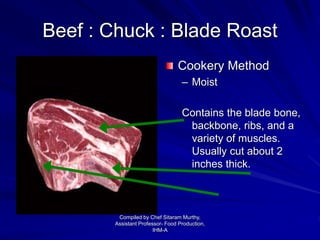
Beef : Chuck : Blade Roast
Cookery Method
– Moist
Contains the blade bone,
backbone, ribs, and a
variety of muscles.
Usually cut about 2
inches thick.
Compiled by Chef Sitaram Murthy,
Assistant Professor- Food Production,
IHM-A
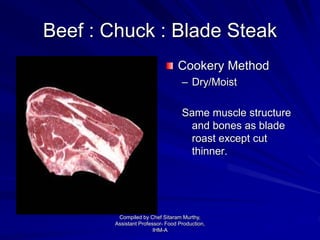
Beef : Chuck : Blade Steak
Cookery Method
– Dry/Moist
Same muscle structure
and bones as blade
roast except cut
thinner.
Compiled by Chef Sitaram Murthy,
Assistant Professor- Food Production,
IHM-A
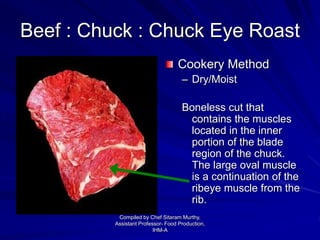
Beef : Chuck : Chuck Eye Roast
Cookery Method
– Dry/Moist
Boneless cut that
contains the muscles
located in the inner
portion of the blade
region of the chuck.
The large oval muscle
is a continuation of the
ribeye muscle from the
rib.
Compiled by Chef Sitaram Murthy,
Assistant Professor- Food Production,
IHM-A
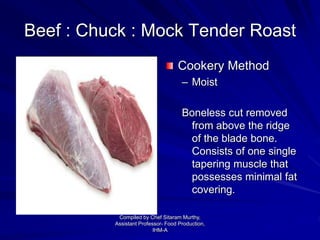
Beef : Chuck : Mock Tender Roast
Cookery Method
– Moist
Boneless cut removed
from above the ridge
of the blade bone.
Consists of one single
tapering muscle that
possesses minimal fat
covering.
Compiled by Chef Sitaram Murthy,
Assistant Professor- Food Production,
IHM-A
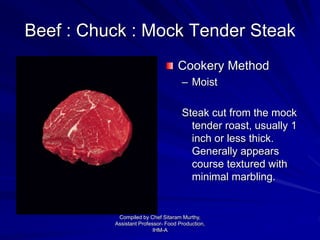
Beef : Chuck : Mock Tender Steak
Cookery Method
– Moist
Steak cut from the mock
tender roast, usually 1
inch or less thick.
Generally appears
course textured with
minimal marbling.
Compiled by Chef Sitaram Murthy,
Assistant Professor- Food Production,
IHM-A
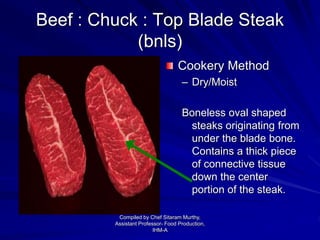
Beef : Chuck : Top Blade Steak
(bnls)
Cookery Method
– Dry/Moist
Boneless oval shaped
steaks originating from
under the blade bone.
Contains a thick piece
of connective tissue
down the center
portion of the steak.
Compiled by Chef Sitaram Murthy,
Assistant Professor- Food Production,
IHM-A
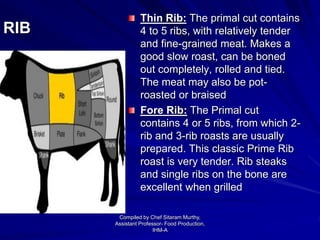
RIB
Thin Rib: The primal cut contains
4 to 5 ribs, with relatively tender
and fine-grained meat. Makes a
good slow roast, can be boned
out completely, rolled and tied.
The meat may also be pot-
roasted or braised
Fore Rib: The Primal cut
contains 4 or 5 ribs, from which 2-
rib and 3-rib roasts are usually
prepared. This classic Prime Rib
roast is very tender. Rib steaks
and single ribs on the bone are
excellent when grilled
Compiled by Chef Sitaram Murthy,
Assistant Professor- Food Production,
IHM-A
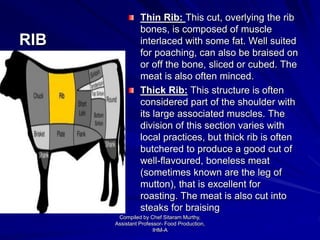
RIB
Thin Rib: This cut, overlying the rib
bones, is composed of muscle
interlaced with some fat. Well suited
for poaching, can also be braised on
or off the bone, sliced or cubed. The
meat is also often minced.
Thick Rib: This structure is often
considered part of the shoulder with
its large associated muscles. The
division of this section varies with
local practices, but thick rib is often
butchered to produce a good cut of
well-flavoured, boneless meat
(sometimes known are the leg of
mutton), that is excellent for
roasting. The meat is also cut into
steaks for braising
Compiled by Chef Sitaram Murthy,
Assistant Professor- Food Production,
IHM-A
Beef Rib Cuts
Compiled by Chef Sitaram Murthy,
Assistant Professor- Food Production,
IHM-A
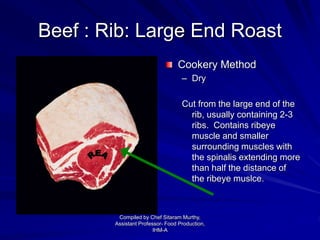
Beef : Rib: Large End Roast
Cookery Method
– Dry
Cut from the large end of the
rib, usually containing 2-3
ribs. Contains ribeye
muscle and smaller
surrounding muscles with
the spinalis extending more
than half the distance of
the ribeye muslce.
Compiled by Chef Sitaram Murthy,
Assistant Professor- Food Production,
IHM-A
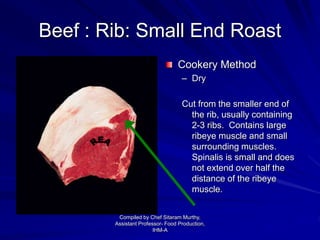
Beef : Rib: Small End Roast
Cookery Method
– Dry
Cut from the smaller end of
the rib, usually containing
2-3 ribs. Contains large
ribeye muscle and small
surrounding muscles.
Spinalis is small and does
not extend over half the
distance of the ribeye
muscle.
Compiled by Chef Sitaram Murthy,
Assistant Professor- Food Production,
IHM-A
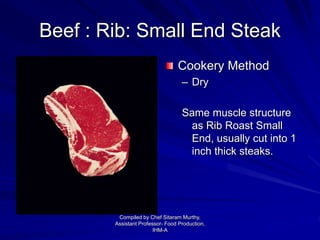
Beef : Rib: Small End Steak
Cookery Method
– Dry
Same muscle structure
as Rib Roast Small
End, usually cut into 1
inch thick steaks.
Compiled by Chef Sitaram Murthy,
Assistant Professor- Food Production,
IHM-A
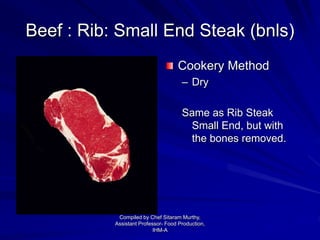
Beef : Rib: Small End Steak (bnls)
Cookery Method
– Dry
Same as Rib Steak
Small End, but with
the bones removed.
Compiled by Chef Sitaram Murthy,
Assistant Professor- Food Production,
IHM-A
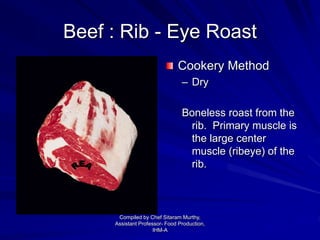
Beef : Rib - Eye Roast
Cookery Method
– Dry
Boneless roast from the
rib. Primary muscle is
the large center
muscle (ribeye) of the
rib.
Compiled by Chef Sitaram Murthy,
Assistant Professor- Food Production,
IHM-A
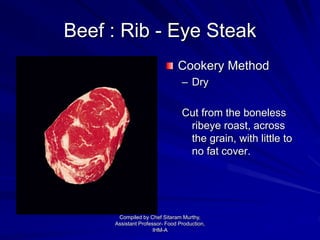
Beef : Rib - Eye Steak
Cookery Method
– Dry
Cut from the boneless
ribeye roast, across
the grain, with little to
no fat cover.
Compiled by Chef Sitaram Murthy,
Assistant Professor- Food Production,
IHM-A
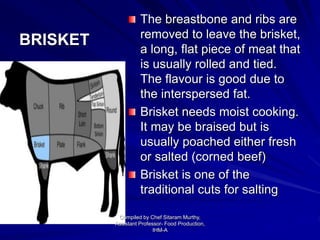
BRISKET
The breastbone and ribs are
removed to leave the brisket,
a long, flat piece of meat that
is usually rolled and tied.
The flavour is good due to
the interspersed fat.
Brisket needs moist cooking.
It may be braised but is
usually poached either fresh
or salted (corned beef)
Brisket is one of the
traditional cuts for salting
Compiled by Chef Sitaram Murthy,
Assistant Professor- Food Production,
IHM-A
Beef Brisket Cuts
Compiled by Chef Sitaram Murthy,
Assistant Professor- Food Production,
IHM-A
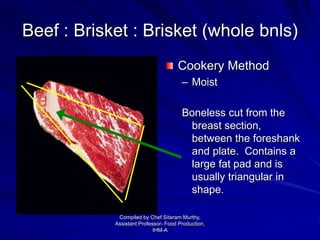
Beef : Brisket : Brisket (whole bnls)
Cookery Method
– Moist
Boneless cut from the
breast section,
between the foreshank
and plate. Contains a
large fat pad and is
usually triangular in
shape.
Compiled by Chef Sitaram Murthy,
Assistant Professor- Food Production,
IHM-A
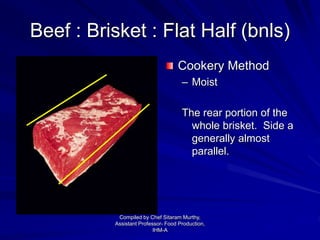
Beef : Brisket : Flat Half (bnls)
Cookery Method
– Moist
The rear portion of the
whole brisket. Side a
generally almost
parallel.
Compiled by Chef Sitaram Murthy,
Assistant Professor- Food Production,
IHM-A
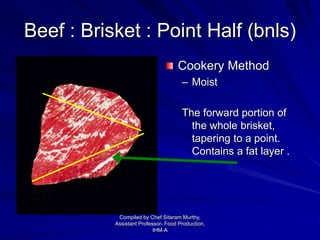
Beef : Brisket : Point Half (bnls)
Cookery Method
– Moist
The forward portion of
the whole brisket,
tapering to a point.
Contains a fat layer .
Compiled by Chef Sitaram Murthy,
Assistant Professor- Food Production,
IHM-A
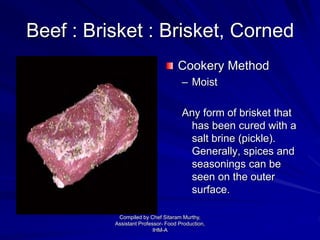
Beef : Brisket : Brisket, Corned
Cookery Method
– Moist
Any form of brisket that
has been cured with a
salt brine (pickle).
Generally, spices and
seasonings can be
seen on the outer
surface.
Compiled by Chef Sitaram Murthy,
Assistant Professor- Food Production,
IHM-A
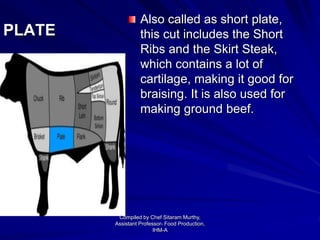
PLATE
Also called as short plate,
this cut includes the Short
Ribs and the Skirt Steak,
which contains a lot of
cartilage, making it good for
braising. It is also used for
making ground beef.
Compiled by Chef Sitaram Murthy,
Assistant Professor- Food Production,
IHM-A
Beef Plate Cuts
Compiled by Chef Sitaram Murthy,
Assistant Professor- Food Production,
IHM-A
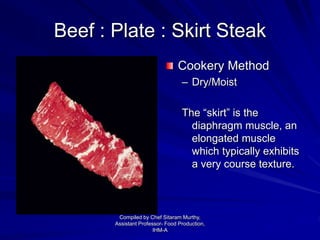
Beef : Plate : Skirt Steak
Cookery Method
– Dry/Moist
The “skirt” is the
diaphragm muscle, an
elongated muscle
which typically exhibits
a very course texture.
Compiled by Chef Sitaram Murthy,
Assistant Professor- Food Production,
IHM-A
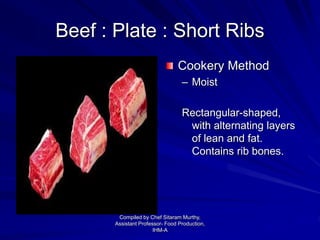
Beef : Plate : Short Ribs
Cookery Method
– Moist
Rectangular-shaped,
with alternating layers
of lean and fat.
Contains rib bones.
Compiled by Chef Sitaram Murthy,
Assistant Professor- Food Production,
IHM-A
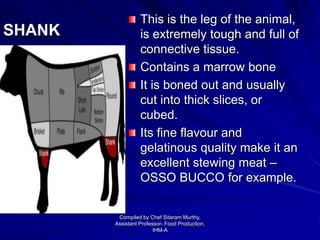
SHANK
This is the leg of the animal,
is extremely tough and full of
connective tissue.
Contains a marrow bone
It is boned out and usually
cut into thick slices, or
cubed.
Its fine flavour and
gelatinous quality make it an
excellent stewing meat –
OSSO BUCCO for example.
Compiled by Chef Sitaram Murthy,
Assistant Professor- Food Production,
IHM-A
Beef Shank Cuts
Compiled by Chef Sitaram Murthy,
Assistant Professor- Food Production,
IHM-A
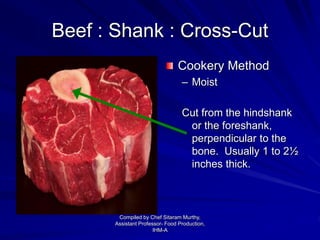
Beef : Shank : Cross-Cut
Cookery Method
– Moist
Cut from the hindshank
or the foreshank,
perpendicular to the
bone. Usually 1 to 2½
inches thick.
Compiled by Chef Sitaram Murthy,
Assistant Professor- Food Production,
IHM-A
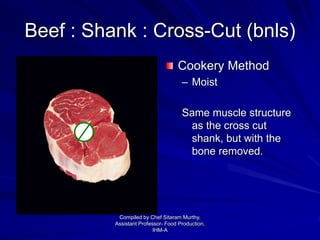
Beef : Shank : Cross-Cut (bnls)
Cookery Method
– Moist
Same muscle structure
as the cross cut
shank, but with the
bone removed.
Compiled by Chef Sitaram Murthy,
Assistant Professor- Food Production,
IHM-A
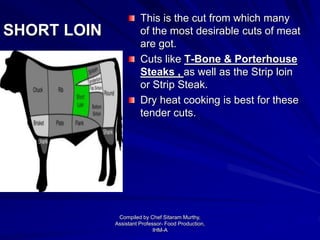
SHORT LOIN
This is the cut from which many
of the most desirable cuts of meat
are got.
Cuts like T-Bone & Porterhouse
Steaks , as well as the Strip loin
or Strip Steak.
Dry heat cooking is best for these
tender cuts.
Compiled by Chef Sitaram Murthy,
Assistant Professor- Food Production,
IHM-A
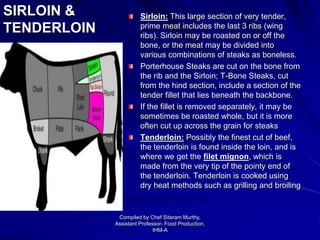
SIRLOIN &
TENDERLOIN
Sirloin: This large section of very tender,
prime meat includes the last 3 ribs (wing
ribs). Sirloin may be roasted on or off the
bone, or the meat may be divided into
various combinations of steaks as boneless.
Porterhouse Steaks are cut on the bone from
the rib and the Sirloin; T-Bone Steaks, cut
from the hind section, include a section of the
tender fillet that lies beneath the backbone.
If the fillet is removed separately, it may be
sometimes be roasted whole, but it is more
often cut up across the grain for steaks
Tenderloin: Possibly the finest cut of beef,
the tenderloin is found inside the loin, and is
where we get the filet mignon, which is
made from the very tip of the pointy end of
the tenderloin. Tenderloin is cooked using
dry heat methods such as grilling and broiling
Compiled by Chef Sitaram Murthy,
Assistant Professor- Food Production,
IHM-A
Beef Loin Cuts
Compiled by Chef Sitaram Murthy,
Assistant Professor- Food Production,
IHM-A
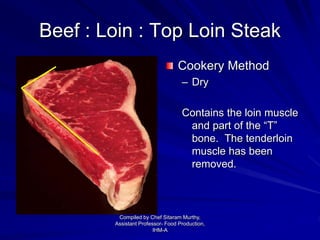
Beef : Loin : Top Loin Steak
Cookery Method
– Dry
Contains the loin muscle
and part of the “T”
bone. The tenderloin
muscle has been
removed.
Compiled by Chef Sitaram Murthy,
Assistant Professor- Food Production,
IHM-A
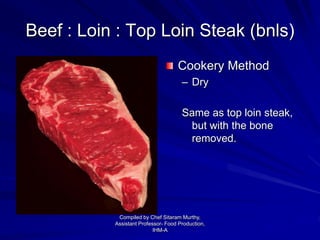
Beef : Loin : Top Loin Steak (bnls)
Cookery Method
– Dry
Same as top loin steak,
but with the bone
removed.
Compiled by Chef Sitaram Murthy,
Assistant Professor- Food Production,
IHM-A
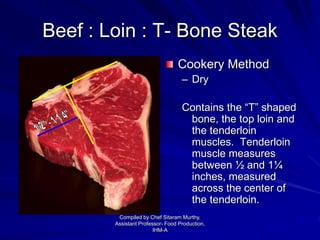
Beef : Loin : T- Bone Steak
Cookery Method
– Dry
Contains the “T” shaped
bone, the top loin and
the tenderloin
muscles. Tenderloin
muscle measures
between ½ and 1¼
inches, measured
across the center of
the tenderloin.
Compiled by Chef Sitaram Murthy,
Assistant Professor- Food Production,
IHM-A
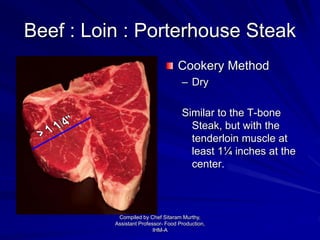
Beef : Loin : Porterhouse Steak
Cookery Method
– Dry
Similar to the T-bone
Steak, but with the
tenderloin muscle at
least 1¼ inches at the
center.
Compiled by Chef Sitaram Murthy,
Assistant Professor- Food Production,
IHM-A
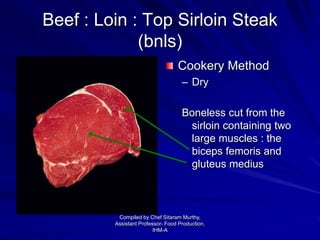
Beef : Loin : Top Sirloin Steak
(bnls)
Cookery Method
– Dry
Boneless cut from the
sirloin containing two
large muscles : the
biceps femoris and
gluteus medius
Compiled by Chef Sitaram Murthy,
Assistant Professor- Food Production,
IHM-A
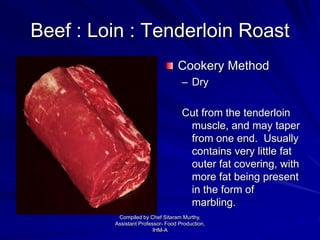
Beef : Loin : Tenderloin Roast
Cookery Method
– Dry
Cut from the tenderloin
muscle, and may taper
from one end. Usually
contains very little fat
outer fat covering, with
more fat being present
in the form of
marbling.
Compiled by Chef Sitaram Murthy,
Assistant Professor- Food Production,
IHM-A
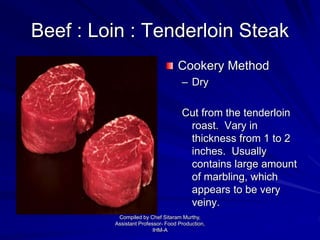
Beef : Loin : Tenderloin Steak
Cookery Method
– Dry
Cut from the tenderloin
roast. Vary in
thickness from 1 to 2
inches. Usually
contains large amount
of marbling, which
appears to be very
veiny.
Compiled by Chef Sitaram Murthy,
Assistant Professor- Food Production,
IHM-A
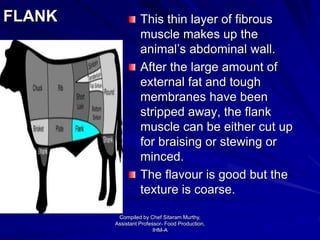
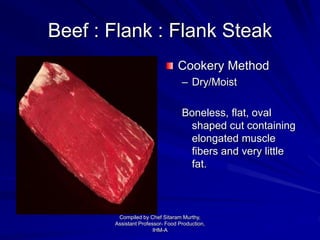
FLANK This thin layer of fibrous
muscle makes up the
animal’s abdominal wall.
After the large amount of
external fat and tough
membranes have been
stripped away, the flank
muscle can be either cut up
for braising or stewing or
minced.
The flavour is good but the
texture is coarse.
Compiled by Chef Sitaram Murthy,
Assistant Professor- Food Production,
IHM-A
Beef Flank Cuts
Compiled by Chef Sitaram Murthy,
Assistant Professor- Food Production,
IHM-A
Beef : Flank : Flank Steak
Cookery Method
– Dry/Moist
Boneless, flat, oval
shaped cut containing
elongated muscle
fibers and very little
fat.
Compiled by Chef Sitaram Murthy,
Assistant Professor- Food Production,
IHM-A
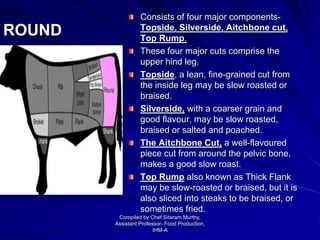
ROUND
Consists of four major components-
Topside, Silverside, Aitchbone cut,
Top Rump.
These four major cuts comprise the
upper hind leg.
Topside, a lean, fine-grained cut from
the inside leg may be slow roasted or
braised.
Silverside, with a coarser grain and
good flavour, may be slow roasted,
braised or salted and poached.
The Aitchbone Cut, a well-flavoured
piece cut from around the pelvic bone,
makes a good slow roast.
Top Rump also known as Thick Flank
may be slow-roasted or braised, but it is
also sliced into steaks to be braised, or
sometimes fried.
Compiled by Chef Sitaram Murthy,
Assistant Professor- Food Production,
IHM-A
Beef Round Cuts
Compiled by Chef Sitaram Murthy,
Assistant Professor- Food Production,
IHM-A
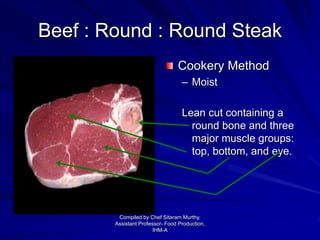
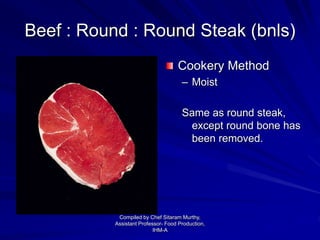
Beef : Round : Round Steak
Cookery Method
– Moist
Lean cut containing a
round bone and three
major muscle groups:
top, bottom, and eye.
Compiled by Chef Sitaram Murthy,
Assistant Professor- Food Production,
IHM-A
Beef : Round : Round Steak (bnls)
Cookery Method
– Moist
Same as round steak,
except round bone has
been removed.
Compiled by Chef Sitaram Murthy,
Assistant Professor- Food Production,
IHM-A
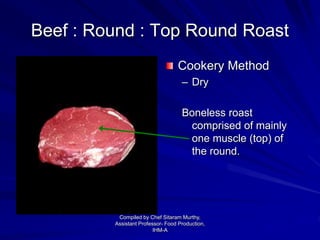
Beef : Round : Top Round Roast
Cookery Method
– Dry
Boneless roast
comprised of mainly
one muscle (top) of
the round.
Compiled by Chef Sitaram Murthy,
Assistant Professor- Food Production,
IHM-A
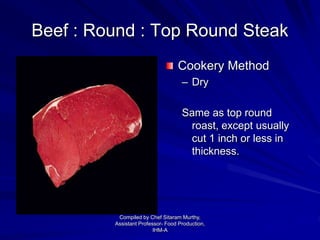
Beef : Round : Top Round Steak
Cookery Method
– Dry
Same as top round
roast, except usually
cut 1 inch or less in
thickness.
Compiled by Chef Sitaram Murthy,
Assistant Professor- Food Production,
IHM-A
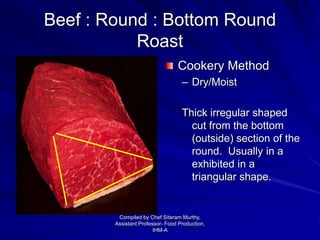
Beef : Round : Bottom Round
Roast
Cookery Method
– Dry/Moist
Thick irregular shaped
cut from the bottom
(outside) section of the
round. Usually in a
exhibited in a
triangular shape.
Compiled by Chef Sitaram Murthy,
Assistant Professor- Food Production,
IHM-A
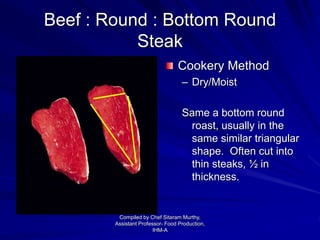
Beef : Round : Bottom Round
Steak
Cookery Method
– Dry/Moist
Same a bottom round
roast, usually in the
same similar triangular
shape. Often cut into
thin steaks, ½ in
thickness.
Compiled by Chef Sitaram Murthy,
Assistant Professor- Food Production,
IHM-A
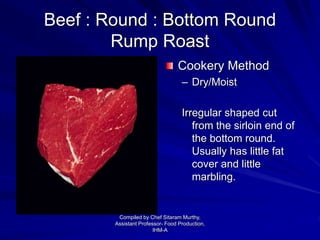
Beef : Round : Bottom Round
Rump Roast
Cookery Method
– Dry/Moist
Irregular shaped cut
from the sirloin end of
the bottom round.
Usually has little fat
cover and little
marbling.
Compiled by Chef Sitaram Murthy,
Assistant Professor- Food Production,
IHM-A
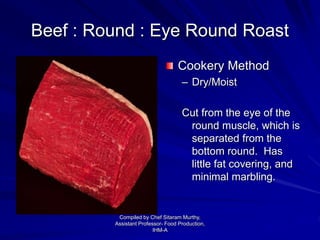
Beef : Round : Eye Round Roast
Cookery Method
– Dry/Moist
Cut from the eye of the
round muscle, which is
separated from the
bottom round. Has
little fat covering, and
minimal marbling.
Compiled by Chef Sitaram Murthy,
Assistant Professor- Food Production,
IHM-A
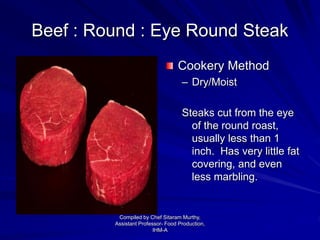
Beef : Round : Eye Round Steak
Cookery Method
– Dry/Moist
Steaks cut from the eye
of the round roast,
usually less than 1
inch. Has very little fat
covering, and even
less marbling.
Compiled by Chef Sitaram Murthy,
Assistant Professor- Food Production,
IHM-A
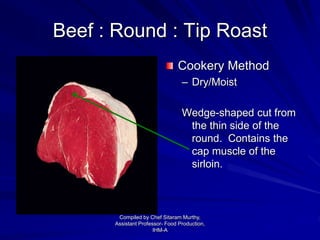
Beef : Round : Tip Roast
Cookery Method
– Dry/Moist
Wedge-shaped cut from
the thin side of the
round. Contains the
cap muscle of the
sirloin.
Compiled by Chef Sitaram Murthy,
Assistant Professor- Food Production,
IHM-A
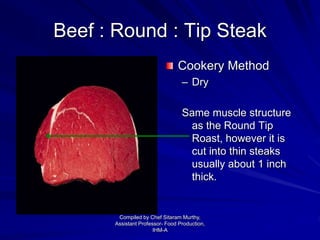
Beef : Round : Tip Steak
Cookery Method
– Dry
Same muscle structure
as the Round Tip
Roast, however it is
cut into thin steaks
usually about 1 inch
thick.
Compiled by Chef Sitaram Murthy,
Assistant Professor- Food Production,
IHM-A
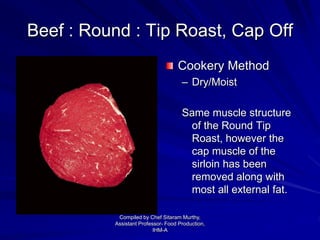
Beef : Round : Tip Roast, Cap Off
Cookery Method
– Dry/Moist
Same muscle structure
of the Round Tip
Roast, however the
cap muscle of the
sirloin has been
removed along with
most all external fat.
Compiled by Chef Sitaram Murthy,
Assistant Professor- Food Production,
IHM-A
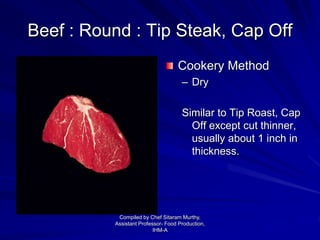
Beef : Round : Tip Steak, Cap Off
Cookery Method
– Dry
Similar to Tip Roast, Cap
Off except cut thinner,
usually about 1 inch in
thickness.
Compiled by Chef Sitaram Murthy,
Assistant Professor- Food Production,
IHM-A
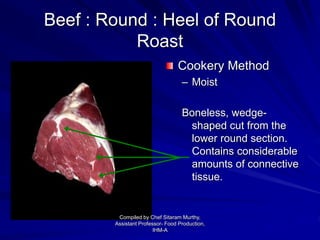
Beef : Round : Heel of Round
Roast
Cookery Method
– Moist
Boneless, wedge-
shaped cut from the
lower round section.
Contains considerable
amounts of connective
tissue.
Compiled by Chef Sitaram Murthy,
Assistant Professor- Food Production,
IHM-A
OTHER
CUTS
Blade: The shoulder blade contained in
the primal cut is removed by the butcher
and the main muscles are divided in
different ways to yield steaks or larger
pieces for braising
The flavour is good and the meat fairly
lean. Some pieces contain a thick seam
of gelatinous tissue that attaches the
muscles to the blade bone.
This is left on the meat because it melts
down and becomes tender when cooked
by moist heat.
•Neck or Sticking
Piece: The neck is a
very muscular cut with a
high proportion of
connective tissue.
•It needs very long,
moist cooking to achieve
tenderness, but it is well-
flavoured and
inexpensive.
•The meat is usually sold
cubed or minced
Compiled by Chef Sitaram Murthy,
Assistant Professor- Food Production,
IHM-A
Beef Various Cuts
Compiled by Chef Sitaram Murthy,
Assistant Professor- Food Production,
IHM-A
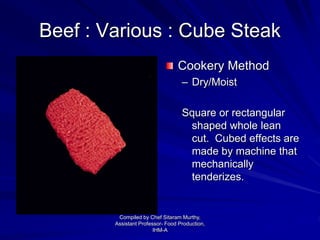
Beef : Various : Cube Steak
Cookery Method
– Dry/Moist
Square or rectangular
shaped whole lean
cut. Cubed effects are
made by machine that
mechanically
tenderizes.
Compiled by Chef Sitaram Murthy,
Assistant Professor- Food Production,
IHM-A
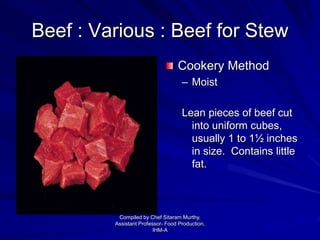
Beef : Various : Beef for Stew
Cookery Method
– Moist
Lean pieces of beef cut
into uniform cubes,
usually 1 to 1½ inches
in size. Contains little
fat.
Compiled by Chef Sitaram Murthy,
Assistant Professor- Food Production,
IHM-A
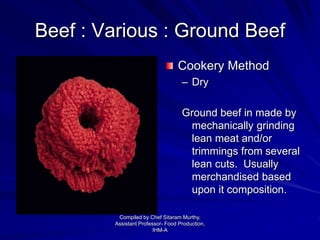
Beef : Various : Ground Beef
Cookery Method
– Dry
Ground beef in made by
mechanically grinding
lean meat and/or
trimmings from several
lean cuts. Usually
merchandised based
upon it composition.
Compiled by Chef Sitaram Murthy,
Assistant Professor- Food Production,
IHM-A
Beef Variety Cuts
Compiled by Chef Sitaram Murthy,
Assistant Professor- Food Production,
IHM-A
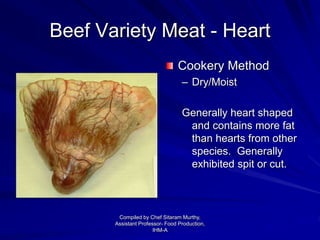
Beef Variety Meat - Heart
Cookery Method
– Dry/Moist
Generally heart shaped
and contains more fat
than hearts from other
species. Generally
exhibited spit or cut.
Compiled by Chef Sitaram Murthy,
Assistant Professor- Food Production,
IHM-A
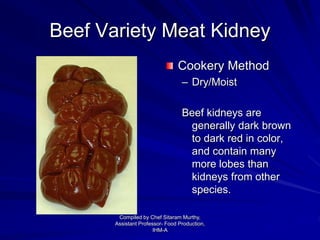
Beef Variety Meat Kidney
Cookery Method
– Dry/Moist
Beef kidneys are
generally dark brown
to dark red in color,
and contain many
more lobes than
kidneys from other
species.
Compiled by Chef Sitaram Murthy,
Assistant Professor- Food Production,
IHM-A
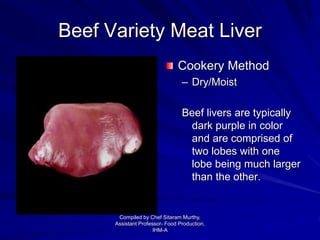
Beef Variety Meat Liver
Cookery Method
– Dry/Moist
Beef livers are typically
dark purple in color
and are comprised of
two lobes with one
lobe being much larger
than the other.
Compiled by Chef Sitaram Murthy,
Assistant Professor- Food Production,
IHM-A
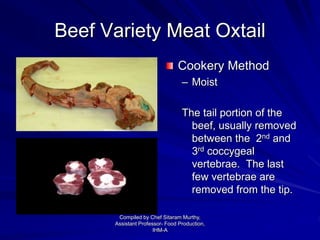
Beef Variety Meat Oxtail
Cookery Method
– Moist
The tail portion of the
beef, usually removed
between the 2nd and
3rd coccygeal
vertebrae. The last
few vertebrae are
removed from the tip.
Compiled by Chef Sitaram Murthy,
Assistant Professor- Food Production,
IHM-A
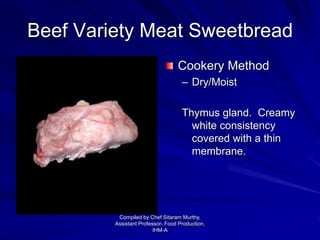
Beef Variety Meat Sweetbread
Cookery Method
– Dry/Moist
Thymus gland. Creamy
white consistency
covered with a thin
membrane.
Compiled by Chef Sitaram Murthy,
Assistant Professor- Food Production,
IHM-A
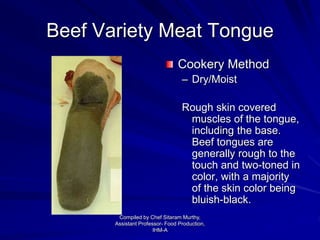
Beef Variety Meat Tongue
Cookery Method
– Dry/Moist
Rough skin covered
muscles of the tongue,
including the base.
Beef tongues are
generally rough to the
touch and two-toned in
color, with a majority
of the skin color being
bluish-black.
Compiled by Chef Sitaram Murthy,
Assistant Professor- Food Production,
IHM-A
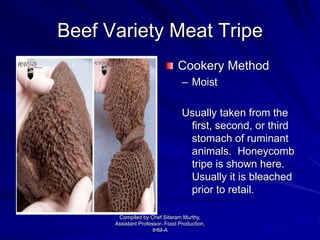
Beef Variety Meat Tripe
Cookery Method
– Moist
Usually taken from the
first, second, or third
stomach of ruminant
animals. Honeycomb
tripe is shown here.
Usually it is bleached
prior to retail.
Compiled by Chef Sitaram Murthy,
Assistant Professor- Food Production,
IHM-A

TS-3.ppt

  • 1.
    BEEF Compiled by ChefSitaram Murthy, Assistant Professor- Food Production, IHM-A
  • 2.
    BEEF AND VEAL •Beef and Veal are got from the Bovine animals and they are classified by their ages: • Veal: Flesh of calf ( less than 3 months of age) • Calves: The animals are from 3 to 8 months • Beef: The meat is taken when an animal is above 8 months old • Beef is the most popular of all the edible meats in Western Countries • It is the flesh of Steers, Heifers, Cows, Bulls and Stags. Compiled by Chef Sitaram Murthy, Assistant Professor- Food Production, IHM-A
  • 3.
    ORDER OF DISSECTION: BEEFCUTS The carcass is divided into two lengthwise: Hindquarter Forequarter Compiled by Chef Sitaram Murthy, Assistant Professor- Food Production, IHM-A
  • 4.
    Basic Cuts -Beef Forequarter – Chuck – Brisket – Shank – Rib – Short Plate Hindquarter – Full Loin – Short loin – Sirloin – Flank – Round Compiled by Chef Sitaram Murthy, Assistant Professor- Food Production, IHM-A
  • 5.
    BEEF CUTS 1 Neck13 Forequarter flank 2 Pony back rib,“entrecôtes découvertes” 14 Brisket for stewing 3 Rib, “entrecôtes couvertes”, entrecôte 15 Tendron 4 Sirloin 16 Flank 5 Fillet 17 Thick skirt 6 Rump steak 18 Thin skirt 7 Brisket 19 Goose skirt 8 Chuck tender for steak 20 Full rump 9 Chuck tender for stewing 21 Thick flank 10 Clod for braising 22 Silverside 11 Clod for stewing 23 Topside / various cuts of steak 12 Clod for steak 24 Hind shank
  • 6.
    FOR HINDQUARTERS • Thewhole side is divided between the wing ribs and the fore ribs • Remove the rump suet and kidney • Divide the loin and rump from the leg (topside, silverside, thick flank, shin) • Remove the fillet • Divide the rump from the sirloin • Remove the wing ribs • Remove the shin • Bone out the aitch bone • Divide the leg into three remaining joints (silverside, topside and thick flank) Compiled by Chef Sitaram Murthy, Assistant Professor- Food Production, IHM-A
  • 7.
    FOR FOREQUARTERS Remove theshank Divide in half down the center Take off the fore ribs Divide into joints Compiled by Chef Sitaram Murthy, Assistant Professor- Food Production, IHM-A
  • 8.
    Compiled by ChefSitaram Murthy, Assistant Professor- Food Production, IHM-A
  • 9.
    CUTS OF BEEF •Beef isdivided into large sections called PRIMAL CUTS. These primals are then broken down further into individual steaks and other retail cuts •A SIDE of beef is one side of the beef carcass that is split through the backbone. Each side is then halved between the 12th and 13th ribs into sections called FOREQUARTER & HINDQUARTER. •The most tender cuts of beef, like the rib and tenderloin, are the ones furthest from the horn and the hoof. •The neck and leg muscles are worked the most, which makes them tougher Compiled by Chef Sitaram Murthy, Assistant Professor- Food Production, IHM-A
  • 10.
    CHUCK A large andfairly lean cut of high-quality braising meat, this complex area of shoulder muscle is boned and cut into slices to be sold as CHUCK STEAK. The meat may also be cubed for stewing. It needs long cooking by the moist heat method to tenderize the connective tissue Compiled by Chef Sitaram Murthy, Assistant Professor- Food Production, IHM-A
  • 11.
    CHUCK From the neckregion. Most economical cuts. Makes up 26% of the carcass weight. Retail Cuts: – Boneless Chuck Roast – Cross Rib Roast – Short Ribs – Pot Roasts Compiled by Chef Sitaram Murthy, Assistant Professor- Food Production, IHM-A
  • 12.
    Beef Chuck Cuts Compiledby Chef Sitaram Murthy, Assistant Professor- Food Production, IHM-A
  • 13.
    Beef : Chuck: Arm Roast Cookery Method – Moist Contains round arm bone and may contain cross sections of rib bones. Includes several muscles separated by connective tissue. Compiled by Chef Sitaram Murthy, Assistant Professor- Food Production, IHM-A
  • 14.
    Beef : Chuck: Arm Roast (bnls) Cookery Method – Moist Same as arm roast except arm bone and ribs are removed. Compiled by Chef Sitaram Murthy, Assistant Professor- Food Production, IHM-A
  • 15.
    Beef : Chuck: Arm Steak Cookery Method – Moist Same muscle structure and bones as arm roast except cut thinner, usually about ½ inch thick. Compiled by Chef Sitaram Murthy, Assistant Professor- Food Production, IHM-A
  • 16.
    Beef : Chuck: Arm Steak (bnls) Cookery Method – Moist Same as arm steak, except arm bone and ribs are removed. Compiled by Chef Sitaram Murthy, Assistant Professor- Food Production, IHM-A
  • 17.
    Beef : Chuck: 7-Bone Roast Cookery Method – Moist Cut from the center of the chuck and is identifiable by the 7- shaped blade bone. Also contains backbone, rib bones and a variety of muscles. Compiled by Chef Sitaram Murthy, Assistant Professor- Food Production, IHM-A
  • 18.
    Beef : Chuck: 7-Bone Steak Cookery Method – Dry/Moist Same a 7-bone roast, except cut usually about 1 inch thick Compiled by Chef Sitaram Murthy, Assistant Professor- Food Production, IHM-A
  • 19.
    Beef : Chuck: Blade Roast Cookery Method – Moist Contains the blade bone, backbone, ribs, and a variety of muscles. Usually cut about 2 inches thick. Compiled by Chef Sitaram Murthy, Assistant Professor- Food Production, IHM-A
  • 20.
    Beef : Chuck: Blade Steak Cookery Method – Dry/Moist Same muscle structure and bones as blade roast except cut thinner. Compiled by Chef Sitaram Murthy, Assistant Professor- Food Production, IHM-A
  • 21.
    Beef : Chuck: Chuck Eye Roast Cookery Method – Dry/Moist Boneless cut that contains the muscles located in the inner portion of the blade region of the chuck. The large oval muscle is a continuation of the ribeye muscle from the rib. Compiled by Chef Sitaram Murthy, Assistant Professor- Food Production, IHM-A
  • 22.
    Beef : Chuck: Mock Tender Roast Cookery Method – Moist Boneless cut removed from above the ridge of the blade bone. Consists of one single tapering muscle that possesses minimal fat covering. Compiled by Chef Sitaram Murthy, Assistant Professor- Food Production, IHM-A
  • 23.
    Beef : Chuck: Mock Tender Steak Cookery Method – Moist Steak cut from the mock tender roast, usually 1 inch or less thick. Generally appears course textured with minimal marbling. Compiled by Chef Sitaram Murthy, Assistant Professor- Food Production, IHM-A
  • 24.
    Beef : Chuck: Top Blade Steak (bnls) Cookery Method – Dry/Moist Boneless oval shaped steaks originating from under the blade bone. Contains a thick piece of connective tissue down the center portion of the steak. Compiled by Chef Sitaram Murthy, Assistant Professor- Food Production, IHM-A
  • 25.
    RIB Thin Rib: Theprimal cut contains 4 to 5 ribs, with relatively tender and fine-grained meat. Makes a good slow roast, can be boned out completely, rolled and tied. The meat may also be pot- roasted or braised Fore Rib: The Primal cut contains 4 or 5 ribs, from which 2- rib and 3-rib roasts are usually prepared. This classic Prime Rib roast is very tender. Rib steaks and single ribs on the bone are excellent when grilled Compiled by Chef Sitaram Murthy, Assistant Professor- Food Production, IHM-A
  • 26.
    RIB Thin Rib: Thiscut, overlying the rib bones, is composed of muscle interlaced with some fat. Well suited for poaching, can also be braised on or off the bone, sliced or cubed. The meat is also often minced. Thick Rib: This structure is often considered part of the shoulder with its large associated muscles. The division of this section varies with local practices, but thick rib is often butchered to produce a good cut of well-flavoured, boneless meat (sometimes known are the leg of mutton), that is excellent for roasting. The meat is also cut into steaks for braising Compiled by Chef Sitaram Murthy, Assistant Professor- Food Production, IHM-A
  • 27.
    Beef Rib Cuts Compiledby Chef Sitaram Murthy, Assistant Professor- Food Production, IHM-A
  • 28.
    Beef : Rib:Large End Roast Cookery Method – Dry Cut from the large end of the rib, usually containing 2-3 ribs. Contains ribeye muscle and smaller surrounding muscles with the spinalis extending more than half the distance of the ribeye muslce. Compiled by Chef Sitaram Murthy, Assistant Professor- Food Production, IHM-A
  • 29.
    Beef : Rib:Small End Roast Cookery Method – Dry Cut from the smaller end of the rib, usually containing 2-3 ribs. Contains large ribeye muscle and small surrounding muscles. Spinalis is small and does not extend over half the distance of the ribeye muscle. Compiled by Chef Sitaram Murthy, Assistant Professor- Food Production, IHM-A
  • 30.
    Beef : Rib:Small End Steak Cookery Method – Dry Same muscle structure as Rib Roast Small End, usually cut into 1 inch thick steaks. Compiled by Chef Sitaram Murthy, Assistant Professor- Food Production, IHM-A
  • 31.
    Beef : Rib:Small End Steak (bnls) Cookery Method – Dry Same as Rib Steak Small End, but with the bones removed. Compiled by Chef Sitaram Murthy, Assistant Professor- Food Production, IHM-A
  • 32.
    Beef : Rib- Eye Roast Cookery Method – Dry Boneless roast from the rib. Primary muscle is the large center muscle (ribeye) of the rib. Compiled by Chef Sitaram Murthy, Assistant Professor- Food Production, IHM-A
  • 33.
    Beef : Rib- Eye Steak Cookery Method – Dry Cut from the boneless ribeye roast, across the grain, with little to no fat cover. Compiled by Chef Sitaram Murthy, Assistant Professor- Food Production, IHM-A
  • 34.
    BRISKET The breastbone andribs are removed to leave the brisket, a long, flat piece of meat that is usually rolled and tied. The flavour is good due to the interspersed fat. Brisket needs moist cooking. It may be braised but is usually poached either fresh or salted (corned beef) Brisket is one of the traditional cuts for salting Compiled by Chef Sitaram Murthy, Assistant Professor- Food Production, IHM-A
  • 35.
    Beef Brisket Cuts Compiledby Chef Sitaram Murthy, Assistant Professor- Food Production, IHM-A
  • 36.
    Beef : Brisket: Brisket (whole bnls) Cookery Method – Moist Boneless cut from the breast section, between the foreshank and plate. Contains a large fat pad and is usually triangular in shape. Compiled by Chef Sitaram Murthy, Assistant Professor- Food Production, IHM-A
  • 37.
    Beef : Brisket: Flat Half (bnls) Cookery Method – Moist The rear portion of the whole brisket. Side a generally almost parallel. Compiled by Chef Sitaram Murthy, Assistant Professor- Food Production, IHM-A
  • 38.
    Beef : Brisket: Point Half (bnls) Cookery Method – Moist The forward portion of the whole brisket, tapering to a point. Contains a fat layer . Compiled by Chef Sitaram Murthy, Assistant Professor- Food Production, IHM-A
  • 39.
    Beef : Brisket: Brisket, Corned Cookery Method – Moist Any form of brisket that has been cured with a salt brine (pickle). Generally, spices and seasonings can be seen on the outer surface. Compiled by Chef Sitaram Murthy, Assistant Professor- Food Production, IHM-A
  • 40.
    PLATE Also called asshort plate, this cut includes the Short Ribs and the Skirt Steak, which contains a lot of cartilage, making it good for braising. It is also used for making ground beef. Compiled by Chef Sitaram Murthy, Assistant Professor- Food Production, IHM-A
  • 41.
    Beef Plate Cuts Compiledby Chef Sitaram Murthy, Assistant Professor- Food Production, IHM-A
  • 42.
    Beef : Plate: Skirt Steak Cookery Method – Dry/Moist The “skirt” is the diaphragm muscle, an elongated muscle which typically exhibits a very course texture. Compiled by Chef Sitaram Murthy, Assistant Professor- Food Production, IHM-A
  • 43.
    Beef : Plate: Short Ribs Cookery Method – Moist Rectangular-shaped, with alternating layers of lean and fat. Contains rib bones. Compiled by Chef Sitaram Murthy, Assistant Professor- Food Production, IHM-A
  • 44.
    SHANK This is theleg of the animal, is extremely tough and full of connective tissue. Contains a marrow bone It is boned out and usually cut into thick slices, or cubed. Its fine flavour and gelatinous quality make it an excellent stewing meat – OSSO BUCCO for example. Compiled by Chef Sitaram Murthy, Assistant Professor- Food Production, IHM-A
  • 45.
    Beef Shank Cuts Compiledby Chef Sitaram Murthy, Assistant Professor- Food Production, IHM-A
  • 46.
    Beef : Shank: Cross-Cut Cookery Method – Moist Cut from the hindshank or the foreshank, perpendicular to the bone. Usually 1 to 2½ inches thick. Compiled by Chef Sitaram Murthy, Assistant Professor- Food Production, IHM-A
  • 47.
    Beef : Shank: Cross-Cut (bnls) Cookery Method – Moist Same muscle structure as the cross cut shank, but with the bone removed. Compiled by Chef Sitaram Murthy, Assistant Professor- Food Production, IHM-A
  • 48.
    SHORT LOIN This isthe cut from which many of the most desirable cuts of meat are got. Cuts like T-Bone & Porterhouse Steaks , as well as the Strip loin or Strip Steak. Dry heat cooking is best for these tender cuts. Compiled by Chef Sitaram Murthy, Assistant Professor- Food Production, IHM-A
  • 49.
    SIRLOIN & TENDERLOIN Sirloin: Thislarge section of very tender, prime meat includes the last 3 ribs (wing ribs). Sirloin may be roasted on or off the bone, or the meat may be divided into various combinations of steaks as boneless. Porterhouse Steaks are cut on the bone from the rib and the Sirloin; T-Bone Steaks, cut from the hind section, include a section of the tender fillet that lies beneath the backbone. If the fillet is removed separately, it may be sometimes be roasted whole, but it is more often cut up across the grain for steaks Tenderloin: Possibly the finest cut of beef, the tenderloin is found inside the loin, and is where we get the filet mignon, which is made from the very tip of the pointy end of the tenderloin. Tenderloin is cooked using dry heat methods such as grilling and broiling Compiled by Chef Sitaram Murthy, Assistant Professor- Food Production, IHM-A
  • 50.
    Beef Loin Cuts Compiledby Chef Sitaram Murthy, Assistant Professor- Food Production, IHM-A
  • 51.
    Beef : Loin: Top Loin Steak Cookery Method – Dry Contains the loin muscle and part of the “T” bone. The tenderloin muscle has been removed. Compiled by Chef Sitaram Murthy, Assistant Professor- Food Production, IHM-A
  • 52.
    Beef : Loin: Top Loin Steak (bnls) Cookery Method – Dry Same as top loin steak, but with the bone removed. Compiled by Chef Sitaram Murthy, Assistant Professor- Food Production, IHM-A
  • 53.
    Beef : Loin: T- Bone Steak Cookery Method – Dry Contains the “T” shaped bone, the top loin and the tenderloin muscles. Tenderloin muscle measures between ½ and 1¼ inches, measured across the center of the tenderloin. Compiled by Chef Sitaram Murthy, Assistant Professor- Food Production, IHM-A
  • 54.
    Beef : Loin: Porterhouse Steak Cookery Method – Dry Similar to the T-bone Steak, but with the tenderloin muscle at least 1¼ inches at the center. Compiled by Chef Sitaram Murthy, Assistant Professor- Food Production, IHM-A
  • 55.
    Beef : Loin: Top Sirloin Steak (bnls) Cookery Method – Dry Boneless cut from the sirloin containing two large muscles : the biceps femoris and gluteus medius Compiled by Chef Sitaram Murthy, Assistant Professor- Food Production, IHM-A
  • 56.
    Beef : Loin: Tenderloin Roast Cookery Method – Dry Cut from the tenderloin muscle, and may taper from one end. Usually contains very little fat outer fat covering, with more fat being present in the form of marbling. Compiled by Chef Sitaram Murthy, Assistant Professor- Food Production, IHM-A
  • 57.
    Beef : Loin: Tenderloin Steak Cookery Method – Dry Cut from the tenderloin roast. Vary in thickness from 1 to 2 inches. Usually contains large amount of marbling, which appears to be very veiny. Compiled by Chef Sitaram Murthy, Assistant Professor- Food Production, IHM-A
  • 58.
    FLANK This thinlayer of fibrous muscle makes up the animal’s abdominal wall. After the large amount of external fat and tough membranes have been stripped away, the flank muscle can be either cut up for braising or stewing or minced. The flavour is good but the texture is coarse. Compiled by Chef Sitaram Murthy, Assistant Professor- Food Production, IHM-A
  • 59.
    Beef Flank Cuts Compiledby Chef Sitaram Murthy, Assistant Professor- Food Production, IHM-A
  • 60.
    Beef : Flank: Flank Steak Cookery Method – Dry/Moist Boneless, flat, oval shaped cut containing elongated muscle fibers and very little fat. Compiled by Chef Sitaram Murthy, Assistant Professor- Food Production, IHM-A
  • 61.
    ROUND Consists of fourmajor components- Topside, Silverside, Aitchbone cut, Top Rump. These four major cuts comprise the upper hind leg. Topside, a lean, fine-grained cut from the inside leg may be slow roasted or braised. Silverside, with a coarser grain and good flavour, may be slow roasted, braised or salted and poached. The Aitchbone Cut, a well-flavoured piece cut from around the pelvic bone, makes a good slow roast. Top Rump also known as Thick Flank may be slow-roasted or braised, but it is also sliced into steaks to be braised, or sometimes fried. Compiled by Chef Sitaram Murthy, Assistant Professor- Food Production, IHM-A
  • 62.
    Beef Round Cuts Compiledby Chef Sitaram Murthy, Assistant Professor- Food Production, IHM-A
  • 63.
    Beef : Round: Round Steak Cookery Method – Moist Lean cut containing a round bone and three major muscle groups: top, bottom, and eye. Compiled by Chef Sitaram Murthy, Assistant Professor- Food Production, IHM-A
  • 64.
    Beef : Round: Round Steak (bnls) Cookery Method – Moist Same as round steak, except round bone has been removed. Compiled by Chef Sitaram Murthy, Assistant Professor- Food Production, IHM-A
  • 65.
    Beef : Round: Top Round Roast Cookery Method – Dry Boneless roast comprised of mainly one muscle (top) of the round. Compiled by Chef Sitaram Murthy, Assistant Professor- Food Production, IHM-A
  • 66.
    Beef : Round: Top Round Steak Cookery Method – Dry Same as top round roast, except usually cut 1 inch or less in thickness. Compiled by Chef Sitaram Murthy, Assistant Professor- Food Production, IHM-A
  • 67.
    Beef : Round: Bottom Round Roast Cookery Method – Dry/Moist Thick irregular shaped cut from the bottom (outside) section of the round. Usually in a exhibited in a triangular shape. Compiled by Chef Sitaram Murthy, Assistant Professor- Food Production, IHM-A
  • 68.
    Beef : Round: Bottom Round Steak Cookery Method – Dry/Moist Same a bottom round roast, usually in the same similar triangular shape. Often cut into thin steaks, ½ in thickness. Compiled by Chef Sitaram Murthy, Assistant Professor- Food Production, IHM-A
  • 69.
    Beef : Round: Bottom Round Rump Roast Cookery Method – Dry/Moist Irregular shaped cut from the sirloin end of the bottom round. Usually has little fat cover and little marbling. Compiled by Chef Sitaram Murthy, Assistant Professor- Food Production, IHM-A
  • 70.
    Beef : Round: Eye Round Roast Cookery Method – Dry/Moist Cut from the eye of the round muscle, which is separated from the bottom round. Has little fat covering, and minimal marbling. Compiled by Chef Sitaram Murthy, Assistant Professor- Food Production, IHM-A
  • 71.
    Beef : Round: Eye Round Steak Cookery Method – Dry/Moist Steaks cut from the eye of the round roast, usually less than 1 inch. Has very little fat covering, and even less marbling. Compiled by Chef Sitaram Murthy, Assistant Professor- Food Production, IHM-A
  • 72.
    Beef : Round: Tip Roast Cookery Method – Dry/Moist Wedge-shaped cut from the thin side of the round. Contains the cap muscle of the sirloin. Compiled by Chef Sitaram Murthy, Assistant Professor- Food Production, IHM-A
  • 73.
    Beef : Round: Tip Steak Cookery Method – Dry Same muscle structure as the Round Tip Roast, however it is cut into thin steaks usually about 1 inch thick. Compiled by Chef Sitaram Murthy, Assistant Professor- Food Production, IHM-A
  • 74.
    Beef : Round: Tip Roast, Cap Off Cookery Method – Dry/Moist Same muscle structure of the Round Tip Roast, however the cap muscle of the sirloin has been removed along with most all external fat. Compiled by Chef Sitaram Murthy, Assistant Professor- Food Production, IHM-A
  • 75.
    Beef : Round: Tip Steak, Cap Off Cookery Method – Dry Similar to Tip Roast, Cap Off except cut thinner, usually about 1 inch in thickness. Compiled by Chef Sitaram Murthy, Assistant Professor- Food Production, IHM-A
  • 76.
    Beef : Round: Heel of Round Roast Cookery Method – Moist Boneless, wedge- shaped cut from the lower round section. Contains considerable amounts of connective tissue. Compiled by Chef Sitaram Murthy, Assistant Professor- Food Production, IHM-A
  • 77.
    OTHER CUTS Blade: The shoulderblade contained in the primal cut is removed by the butcher and the main muscles are divided in different ways to yield steaks or larger pieces for braising The flavour is good and the meat fairly lean. Some pieces contain a thick seam of gelatinous tissue that attaches the muscles to the blade bone. This is left on the meat because it melts down and becomes tender when cooked by moist heat. •Neck or Sticking Piece: The neck is a very muscular cut with a high proportion of connective tissue. •It needs very long, moist cooking to achieve tenderness, but it is well- flavoured and inexpensive. •The meat is usually sold cubed or minced Compiled by Chef Sitaram Murthy, Assistant Professor- Food Production, IHM-A
  • 78.
    Beef Various Cuts Compiledby Chef Sitaram Murthy, Assistant Professor- Food Production, IHM-A
  • 79.
    Beef : Various: Cube Steak Cookery Method – Dry/Moist Square or rectangular shaped whole lean cut. Cubed effects are made by machine that mechanically tenderizes. Compiled by Chef Sitaram Murthy, Assistant Professor- Food Production, IHM-A
  • 80.
    Beef : Various: Beef for Stew Cookery Method – Moist Lean pieces of beef cut into uniform cubes, usually 1 to 1½ inches in size. Contains little fat. Compiled by Chef Sitaram Murthy, Assistant Professor- Food Production, IHM-A
  • 81.
    Beef : Various: Ground Beef Cookery Method – Dry Ground beef in made by mechanically grinding lean meat and/or trimmings from several lean cuts. Usually merchandised based upon it composition. Compiled by Chef Sitaram Murthy, Assistant Professor- Food Production, IHM-A
  • 82.
    Beef Variety Cuts Compiledby Chef Sitaram Murthy, Assistant Professor- Food Production, IHM-A
  • 83.
    Beef Variety Meat- Heart Cookery Method – Dry/Moist Generally heart shaped and contains more fat than hearts from other species. Generally exhibited spit or cut. Compiled by Chef Sitaram Murthy, Assistant Professor- Food Production, IHM-A
  • 84.
    Beef Variety MeatKidney Cookery Method – Dry/Moist Beef kidneys are generally dark brown to dark red in color, and contain many more lobes than kidneys from other species. Compiled by Chef Sitaram Murthy, Assistant Professor- Food Production, IHM-A
  • 85.
    Beef Variety MeatLiver Cookery Method – Dry/Moist Beef livers are typically dark purple in color and are comprised of two lobes with one lobe being much larger than the other. Compiled by Chef Sitaram Murthy, Assistant Professor- Food Production, IHM-A
  • 86.
    Beef Variety MeatOxtail Cookery Method – Moist The tail portion of the beef, usually removed between the 2nd and 3rd coccygeal vertebrae. The last few vertebrae are removed from the tip. Compiled by Chef Sitaram Murthy, Assistant Professor- Food Production, IHM-A
  • 87.
    Beef Variety MeatSweetbread Cookery Method – Dry/Moist Thymus gland. Creamy white consistency covered with a thin membrane. Compiled by Chef Sitaram Murthy, Assistant Professor- Food Production, IHM-A
  • 88.
    Beef Variety MeatTongue Cookery Method – Dry/Moist Rough skin covered muscles of the tongue, including the base. Beef tongues are generally rough to the touch and two-toned in color, with a majority of the skin color being bluish-black. Compiled by Chef Sitaram Murthy, Assistant Professor- Food Production, IHM-A
  • 89.
    Beef Variety MeatTripe Cookery Method – Moist Usually taken from the first, second, or third stomach of ruminant animals. Honeycomb tripe is shown here. Usually it is bleached prior to retail. Compiled by Chef Sitaram Murthy, Assistant Professor- Food Production, IHM-A