Slide 1.1
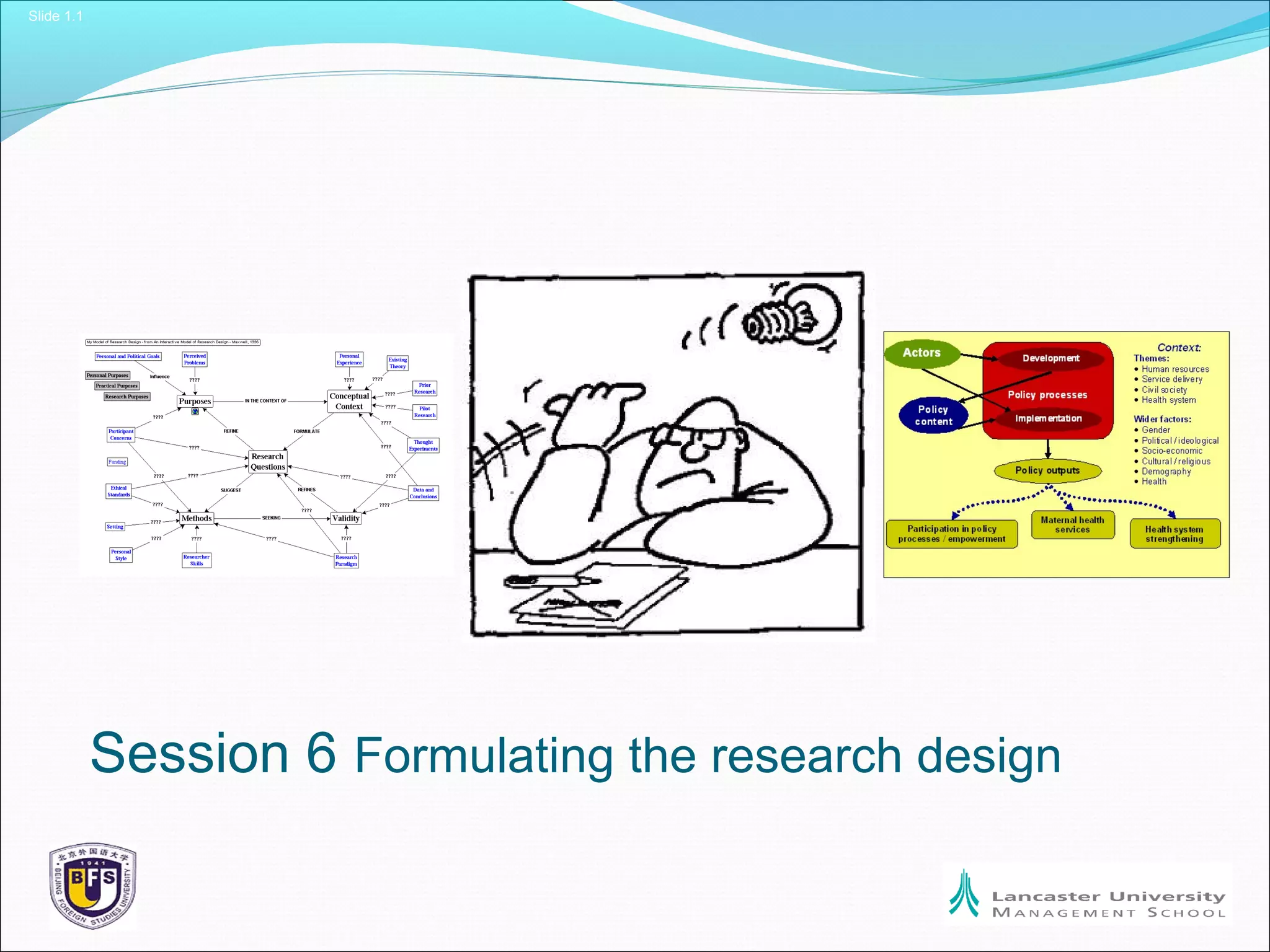
Session 6 Formulating the research design
Slide 1.2
Review your research questions:
Good Questions Are:
Relevant.
Manageable in terms of research and in terms of
your own academic abilities.
Substantial and with original dimensions.
Consistent with the requirements of the assessment.
Clear and simple.
Interesting.
http://www.socscidiss.bham.ac.uk/s7.html
Slide 1.3
What is the relationship between launch strategy
and subsequent success and failure?
• define the four approaches to toy launch strategy
• define success & failure over a relevant time period
• classify the launch strategy for each new toy in one
year
• relate the four strategies to success and failure
• identify the factors within the strategies contributing
to success and failure
Slide 1.4
“Is technical leadership the principal driver of
project success in IT program management”?
Identify the five main drivers of project success in IT
program management.
What is relative importance of each of these drivers?
What is the relative importance of technical
leadership relative to the other drivers in the context
of IT program management.
Slide 1.5
Is the Compact Disc becoming a redundant
format for music consumption?
What is the proportion of CD sales to download sales and how has this
changed in recent years?
Are the main music suppliers (i.e. the major record labels) or the
consumers driving the change from CD to download?
What factors have limited the change from CD to download?
Can the product life-cycle model be applied to the CD?
What evidence is there from the past to hint at future trends?
 http://userweb.port.ac.uk/~accproj/resources/Accounting_Dissertation_Proposal-example_6.pdf
Slide 1.6
The Process of Research Design
Research choices
Research strategies
Time horizons
Slide 1.7
Research Design and Tactics
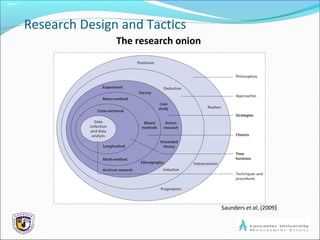
The research onion
Saunders et al, (2009)
Figure 5.1 The research ‘onion’
Slide 1.8
Research Design
The research design needs
Clear objectives derived from the research question
To specify sources of data collection
To consider constraints and ethical issues
Valid reasons for your choice of design
Slide 1.9
Classification of the research purpose
Exploratory research
Descriptive studies
Explanatory studies
Slide 1.10
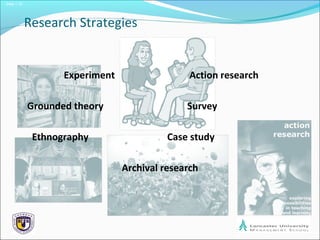
Research Strategies
Experiment Action research
Grounded theory Survey
Ethnography Case study
Archival research
Slide 1.11
Research Strategies
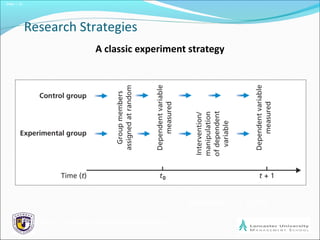
An experiment will involve
Definition of a theoretical hypothesis
Selection of samples from know populations
Random allocation of samples
Introduction of planned intervention
Measurement on a small number of dependent variables
Control of all other variables
Slide 1.12
Research Strategies
A classic experiment strategy
Saunders et al, (2009)
Figure 5.2 A classic experiment strategy
Slide 1.13
Research Strategies
Survey: key features
Popular in business research
Perceived as authoritative
Allows collection of quantative data
Data can be analysed quantitatively
Samples need to be representative
Gives the researcher independence
Structured observation and interviews can be used
Slide 1.14
Research Strategies
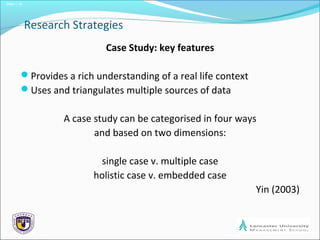
Case Study: key features
Provides a rich understanding of a real life context
Uses and triangulates multiple sources of data
A case study can be categorised in four ways
and based on two dimensions:
single case v. multiple case
holistic case v. embedded case
Yin (2003)
Slide 1.15
Research Strategies
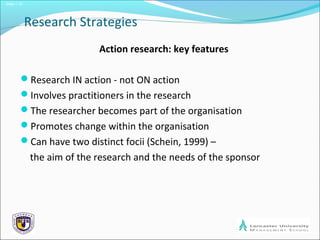
Action research: key features
Research IN action - not ON action
Involves practitioners in the research
The researcher becomes part of the organisation
Promotes change within the organisation
Can have two distinct focii (Schein, 1999) –
the aim of the research and the needs of the sponsor
Slide 1.16
Research Strategies
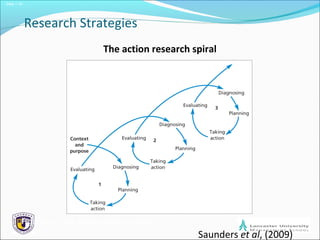
The action research spiral
Saunders et al, (2009)
Figure 5.3 The action research spiral
Slide 1.17
Research Strategies
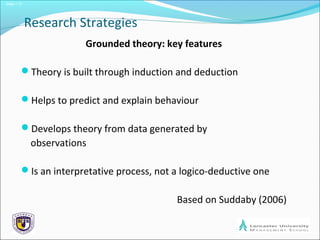
Grounded theory: key features
Theory is built through induction and deduction
Helps to predict and explain behaviour
Develops theory from data generated by
observations
Is an interpretative process, not a logico-deductive one
Based on Suddaby (2006)
Slide 1.18
Research Strategies
Ethnography: key features
Aims to describe and explain the social world inhabited by
the researcher
Takes place over an extended time period
Is naturalistic
Involves extended participant observation
Slide 1.19
Research Strategies
Archival research: key features
Uses administrative records and documents as the
principal sources of data
Allows research questions focused on the past
Is constrained by the nature of the records and
documents
Slide 1.20
Research Strategies
The role of the practitioner-researcher
Key features
Research access is more easily available
The researcher knows the organisation
Has the disadvantage of familiarity
The researcher is likely to their own assumptions
and preconceptions
The dual role requires careful negotiation
Slide 1.21
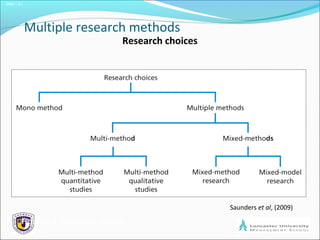
Multiple research methods
Research choices
Saunders et al, (2009)
Figure 5.4 Research choices
Slide 1.22
Multiple research methods
Reasons for using mixed method designs:
(Table 5.1 )
Triangulation
Facilitation
Complementarity
Generality
Aid interpretation
Study different aspects
Solving a puzzle
Source: developed from Bryman (2006)
Slide 1.23
Time Horizons
Select the appropriate time horizon
Cross-sectional studies
Longitudinal studies
Slide 1.24
Credibility of research findings
Important considerations
Reliability
Validity
Generalisability
Logic leaps and false assumptions
Slide 1.25
Research design ethics
Remember
‘The research design should not subject the research
population to embarrassment, harm or other material
disadvantage’
Adapted from Saunders et al, (2009)
Slide 1.26
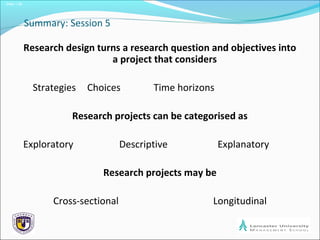
Summary: Session 5
Research design turns a research question and objectives into
a project that considers
Strategies Choices Time horizons
Research projects can be categorised as
Exploratory Descriptive Explanatory
Research projects may be
Cross-sectional Longitudinal
Slide 1.27
Summary: Session 5
Important considerations
The main research strategies may combined in the same
project
The opportunities provided by using multiple methods
The validity and reliability of results
Access and ethical considerations

Business Research Methods session 6 research design

  • 1.
    Slide 1.1 Session 6Formulating the research design
  • 2.
    Slide 1.2 Review yourresearch questions: Good Questions Are: Relevant. Manageable in terms of research and in terms of your own academic abilities. Substantial and with original dimensions. Consistent with the requirements of the assessment. Clear and simple. Interesting. http://www.socscidiss.bham.ac.uk/s7.html
  • 3.
    Slide 1.3 What isthe relationship between launch strategy and subsequent success and failure? • define the four approaches to toy launch strategy • define success & failure over a relevant time period • classify the launch strategy for each new toy in one year • relate the four strategies to success and failure • identify the factors within the strategies contributing to success and failure
  • 4.
    Slide 1.4 “Is technicalleadership the principal driver of project success in IT program management”? Identify the five main drivers of project success in IT program management. What is relative importance of each of these drivers? What is the relative importance of technical leadership relative to the other drivers in the context of IT program management.
  • 5.
    Slide 1.5 Is theCompact Disc becoming a redundant format for music consumption? What is the proportion of CD sales to download sales and how has this changed in recent years? Are the main music suppliers (i.e. the major record labels) or the consumers driving the change from CD to download? What factors have limited the change from CD to download? Can the product life-cycle model be applied to the CD? What evidence is there from the past to hint at future trends?  http://userweb.port.ac.uk/~accproj/resources/Accounting_Dissertation_Proposal-example_6.pdf
  • 6.
    Slide 1.6 The Processof Research Design Research choices Research strategies Time horizons
  • 7.
    Slide 1.7 Research Designand Tactics The research onion Saunders et al, (2009) Figure 5.1 The research ‘onion’
  • 8.
    Slide 1.8 Research Design Theresearch design needs Clear objectives derived from the research question To specify sources of data collection To consider constraints and ethical issues Valid reasons for your choice of design
  • 9.
    Slide 1.9 Classification ofthe research purpose Exploratory research Descriptive studies Explanatory studies
  • 10.
    Slide 1.10 Research Strategies ExperimentAction research Grounded theory Survey Ethnography Case study Archival research
  • 11.
    Slide 1.11 Research Strategies Anexperiment will involve Definition of a theoretical hypothesis Selection of samples from know populations Random allocation of samples Introduction of planned intervention Measurement on a small number of dependent variables Control of all other variables
  • 12.
    Slide 1.12 Research Strategies Aclassic experiment strategy Saunders et al, (2009) Figure 5.2 A classic experiment strategy
  • 13.
    Slide 1.13 Research Strategies Survey:key features Popular in business research Perceived as authoritative Allows collection of quantative data Data can be analysed quantitatively Samples need to be representative Gives the researcher independence Structured observation and interviews can be used
  • 14.
    Slide 1.14 Research Strategies CaseStudy: key features Provides a rich understanding of a real life context Uses and triangulates multiple sources of data A case study can be categorised in four ways and based on two dimensions: single case v. multiple case holistic case v. embedded case Yin (2003)
  • 15.
    Slide 1.15 Research Strategies Actionresearch: key features Research IN action - not ON action Involves practitioners in the research The researcher becomes part of the organisation Promotes change within the organisation Can have two distinct focii (Schein, 1999) – the aim of the research and the needs of the sponsor
  • 16.
    Slide 1.16 Research Strategies Theaction research spiral Saunders et al, (2009) Figure 5.3 The action research spiral
  • 17.
    Slide 1.17 Research Strategies Groundedtheory: key features Theory is built through induction and deduction Helps to predict and explain behaviour Develops theory from data generated by observations Is an interpretative process, not a logico-deductive one Based on Suddaby (2006)
  • 18.
    Slide 1.18 Research Strategies Ethnography:key features Aims to describe and explain the social world inhabited by the researcher Takes place over an extended time period Is naturalistic Involves extended participant observation
  • 19.
    Slide 1.19 Research Strategies Archivalresearch: key features Uses administrative records and documents as the principal sources of data Allows research questions focused on the past Is constrained by the nature of the records and documents
  • 20.
    Slide 1.20 Research Strategies Therole of the practitioner-researcher Key features Research access is more easily available The researcher knows the organisation Has the disadvantage of familiarity The researcher is likely to their own assumptions and preconceptions The dual role requires careful negotiation
  • 21.
    Slide 1.21 Multiple researchmethods Research choices Saunders et al, (2009) Figure 5.4 Research choices
  • 22.
    Slide 1.22 Multiple researchmethods Reasons for using mixed method designs: (Table 5.1 ) Triangulation Facilitation Complementarity Generality Aid interpretation Study different aspects Solving a puzzle Source: developed from Bryman (2006)
  • 23.
    Slide 1.23 Time Horizons Selectthe appropriate time horizon Cross-sectional studies Longitudinal studies
  • 24.
    Slide 1.24 Credibility ofresearch findings Important considerations Reliability Validity Generalisability Logic leaps and false assumptions
  • 25.
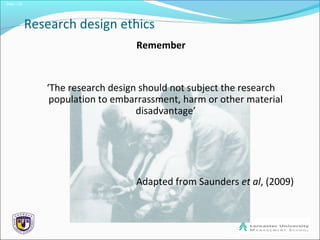
    Slide 1.25 Research designethics Remember ‘The research design should not subject the research population to embarrassment, harm or other material disadvantage’ Adapted from Saunders et al, (2009)
  • 26.
    Slide 1.26 Summary: Session5 Research design turns a research question and objectives into a project that considers Strategies Choices Time horizons Research projects can be categorised as Exploratory Descriptive Explanatory Research projects may be Cross-sectional Longitudinal
  • 27.
    Slide 1.27 Summary: Session5 Important considerations The main research strategies may combined in the same project The opportunities provided by using multiple methods The validity and reliability of results Access and ethical considerations