Slide 4.1
Saunders, Lewis and Thornhill, Research Methods for Business Students, 5th
Edition, © Mark Saunders, Philip Lewis and Adrian Thornhill 2009
Chapter 4
Understanding research philosophies
and approaches
Slide 4.2
Saunders, Lewis and Thornhill, Research Methods for Business Students, 5th
Edition, © Mark Saunders, Philip Lewis and Adrian Thornhill 2009
Understanding research
philosophies and approaches
• By end of this chapter you should be able to:
• Define the key terms ontology, epistemology and explain
their relevance to business research;
• Explain the relevance for business research of
philosophical perspectives such as positivism, realism,
pragmatism, and interpretivism;
• understand the main research paradigms which are
significant for business research;
• Distinguish between main research approaches; deductive
and inductive;
• State your own epistemological and axiological positions.
Slide 4.3
Saunders, Lewis and Thornhill, Research Methods for Business Students, 5th
Edition, © Mark Saunders, Philip Lewis and Adrian Thornhill 2009
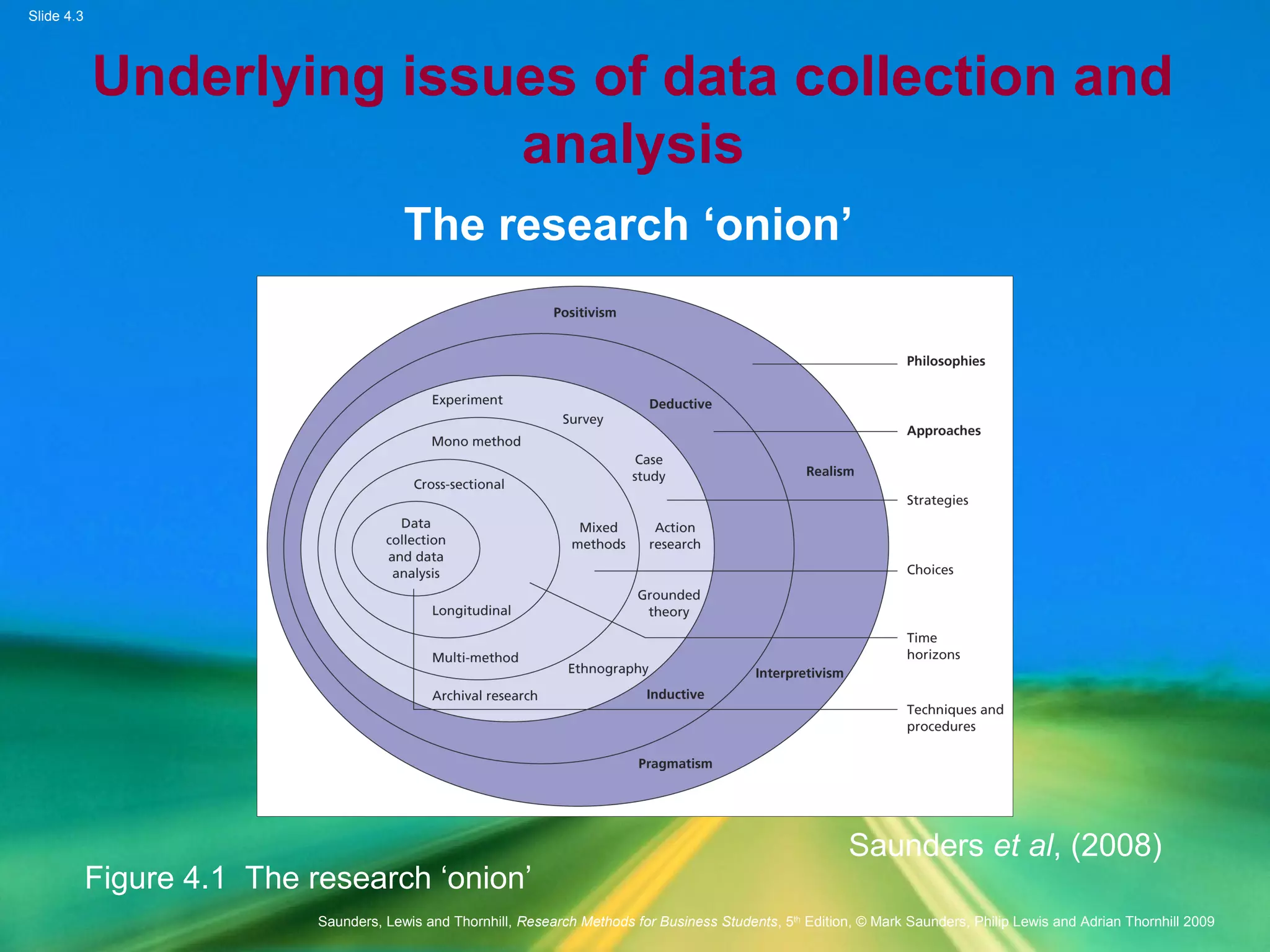
Underlying issues of data collection and
analysis
The research ‘onion’
Saunders et al, (2008)
Figure 4.1 The research ‘onion’
Slide 4.4
Saunders, Lewis and Thornhill, Research Methods for Business Students, 5th
Edition, © Mark Saunders, Philip Lewis and Adrian Thornhill 2009
Understanding your research philosophy
(1)
‘Research philosophy is an over-arching term
relating to the development of knowledge and
the nature of that knowledge’
Adapted from Saunders et al, (2009)
Slide 4.5
Saunders, Lewis and Thornhill, Research Methods for Business Students, 5th
Edition, © Mark Saunders, Philip Lewis and Adrian Thornhill 2009
Understanding your research philosophy
(2)
Thinking about research philosophy
• Ontology: is concerned with nature of reality. This
raise the questions of the assumptions researchers
have about the way the world operates and
commitment held to particular views. The two aspects
of ontology we describe here will both have their
devotees among business and management
researchers , In addition, both are likely to be
accepted as producing valid knowledge by many
researchers
Slide 4.6
Saunders, Lewis and Thornhill, Research Methods for Business Students, 5th
Edition, © Mark Saunders, Philip Lewis and Adrian Thornhill 2009
Ontology
• The first aspect of ontology we discuss is
objectivism. This portrays the position that
social entities exist in reality external to
social actors concerned with their existence.
• The second aspect, subjectivism holds that
social phenomena are created from the
perceptions and consequent actions of those
social actors concerned with their existence
Slide 4.7
Saunders, Lewis and Thornhill, Research Methods for Business Students, 5th
Edition, © Mark Saunders, Philip Lewis and Adrian Thornhill 2009
Ontology
• Blaikie (1993) describes the root definition of ontology as
‘the science or study of being’ and develops this
description for the social sciences to encompass ‘claims
about what exists, what it looks like, what units make it up
and how these units interact with each other’. In short,
ontology describes our view (whether claims or
assumptions) on the nature of reality, and specifically, is
this an objective reality that really exists, or only a
subjective reality, created in our minds.
Slide 4.8
Saunders, Lewis and Thornhill, Research Methods for Business Students, 5th
Edition, © Mark Saunders, Philip Lewis and Adrian Thornhill 2009
Ontology
• For the everyday example, they use the example of a
workplace report – asking one to question whether it
describes what is really going on, or only what the author
thinks is going on. They go on to highlight the complexity
that is introduced when considering phenomena such as
culture, power or control, and whether they really exist or
are simply an illusion, further extending the discussion as
to how individuals (and groups) determine these realities –
does the reality exist only through experience of it
(subjectivism), or does it exist independently of those
• who live it (objectivism).
Slide 4.9
Saunders, Lewis and Thornhill, Research Methods for Business Students, 5th
Edition, © Mark Saunders, Philip Lewis and Adrian Thornhill 2009
Epistemology
• It concerns what constitutes acceptable knowledge
in a field of study.
• Closely coupled with ontology and its consideration of
what constitutes reality, epistemology considers views
about the most appropriate ways of enquiring into the
• nature of the world (Easterby-Smith, Thorpe and
Jackson, 2008) and ‘what is knowledge and what are the
sources and limits of knowledge’ (Eriksson and
Kovalainen, 2008). Questions of epistemology begin to
consider the research method, and Eriksson and
Kovalainen go on to discuss how epistemology defines
how knowledge can be produced and argued for.
Slide 4.10
Saunders, Lewis and Thornhill, Research Methods for Business Students, 5th
Edition, © Mark Saunders, Philip Lewis and Adrian Thornhill 2009
Epistemology
• Blaikie (1993) describes epistemology as ‘the theory or
science of the method or grounds of knowledge’
expanding this into a set of claims or assumptions about
the ways in which it is possible to gain knowledge of
reality, how what exists may be known, what can be
known, and what criteria must be satisfied in order to be
described as
• knowledge. Chia (2002) describes epistemology as ‘how
and what it is possible to know’ and the need to reflect on
methods and standards through which reliable and
verifiable knowledge is produced.
Slide 4.11
Saunders, Lewis and Thornhill, Research Methods for Business Students, 5th
Edition, © Mark Saunders, Philip Lewis and Adrian Thornhill 2009
Epistemology
• Hatch and Cunliffe (2006) summarise
epistemology as ‘knowing how you can know’
and expand this by asking how is knowledge
generated, what criteria discriminate good
knowledge from bad knowledge, and how should
reality be represented or described. They go on to
highlight the inter-dependent relationship
• between epistemology and ontology, and how one
both informs, and depends upon, the
• other.
Slide 4.12
Saunders, Lewis and Thornhill, Research Methods for Business Students, 5th
Edition, © Mark Saunders, Philip Lewis and Adrian Thornhill 2009
Understanding your research philosophy
(4)
Aspects of philosophy
• Positivism - the stance of the natural scientist
• Realism - direct and critical realism
• Interpretivism – researchers as ‘social actors’
• Axiology – studies judgements about value
Slide 4.13
Saunders, Lewis and Thornhill, Research Methods for Business Students, 5th
Edition, © Mark Saunders, Philip Lewis and Adrian Thornhill 2009
Positivism
• Positivism can be defined as “research
approaches that employ empirical methods,
make extensive use of quantitative analysis,
or develop logical calculi to build formal
explanatory theory”
Slide 4.14
Saunders, Lewis and Thornhill, Research Methods for Business Students, 5th
Edition, © Mark Saunders, Philip Lewis and Adrian Thornhill 2009
Realism
• Is another philosophical position which
relates to scientific enquiry. The essence of
realism is that what the senses show us as
reality is the truth; that objects have an
existence independent of the human mind.
In this sense, realism is opposed to
idealism, the theory that only the mind and
its contents exist
Slide 4.15
Saunders, Lewis and Thornhill, Research Methods for Business Students, 5th
Edition, © Mark Saunders, Philip Lewis and Adrian Thornhill 2009
Direct realism and critical
realism
• It says that what you see is what you get:
what we experience through our senses
portrays the world accurately.
• critical realism: critical realists argue that
we experience are sensations, the images of
the things in the real world, not the things
directly. Critical realists point out how often
our senses deceive us.
Slide 4.16
Saunders, Lewis and Thornhill, Research Methods for Business Students, 5th
Edition, © Mark Saunders, Philip Lewis and Adrian Thornhill 2009
Interpretivism
• Interpretivisim advocates it is necessary for
the researcher to understand differences
between humans in our role as social actors.
This emphasizes the differences between
conducting research among people rather
than objects such as trucks and computers.
Slide 4.17
Saunders, Lewis and Thornhill, Research Methods for Business Students, 5th
Edition, © Mark Saunders, Philip Lewis and Adrian Thornhill 2009
Interpretivisim
• Interpretive research is concerned with the meanings that
people attach to norms, rules, and values that regulate their
interactions. Care is taken not to impose a previous
understanding of norms, rules, and values on others but
rather to understand their beliefs and actions from their
point of view. The focus is not only on what they tell us
directly about the reasons for their beliefs and actions but
also on the social practices that underlie them. Social
practice gives meaning to social action
Slide 4.18
Saunders, Lewis and Thornhill, Research Methods for Business Students, 5th
Edition, © Mark Saunders, Philip Lewis and Adrian Thornhill 2009
pragmatism
• Pragmatism holds that the most important
determinant of the epistemology, ontology,
axiology adopted is the research question.
Slide 4.19
Saunders, Lewis and Thornhill, Research Methods for Business Students, 5th
Edition, © Mark Saunders, Philip Lewis and Adrian Thornhill 2009
Research paradigms
Definition
‘A way of examining social phenomenon from
which particular understandings of these
phenomena can be gained and explanations
attempted’
Saunders et al. (2009)
Slide 4.20
Saunders, Lewis and Thornhill, Research Methods for Business Students, 5th
Edition, © Mark Saunders, Philip Lewis and Adrian Thornhill 2009
Research Approaches (1)
Deduction
5 sequential stages of testing theory
• Deducing a hypothesis
• Expressing the hypothesis operationally
• Testing the operational hypothesis
• Examining the specific outcome of the enquiry
• Modifying the theory (if necessary)
Adapted from Robson (2002)
Slide 4.21
Saunders, Lewis and Thornhill, Research Methods for Business Students, 5th
Edition, © Mark Saunders, Philip Lewis and Adrian Thornhill 2009
Research Approaches (2)
Characteristics of Deduction
• Explaining causal relationships between variables
• Establishing controls for testing hypotheses
• Independence of the researcher
• Concepts operationalised for quantative measurement
• Generalisation
Slide 4.22
Saunders, Lewis and Thornhill, Research Methods for Business Students, 5th
Edition, © Mark Saunders, Philip Lewis and Adrian Thornhill 2009
Research Approaches (3)
Induction
Building theory by –
• Understanding the way human build their world
• Permitting alternative explanations of what’s
going on
• Being concerned with the context of events
• Using more qualitative data
• Using a variety of data collection methods
Slide 4.23
Saunders, Lewis and Thornhill, Research Methods for Business Students, 5th
Edition, © Mark Saunders, Philip Lewis and Adrian Thornhill 2009
Choosing your research approach
The right choice of approach helps you to
• Make a more informed decision about the
research design
• Think about which strategies will work for your
research topic
• Adapt your design to cater for any constraints
Adapted from Easterby-Smith et al. (2008)
Slide 4.24
Saunders, Lewis and Thornhill, Research Methods for Business Students, 5th
Edition, © Mark Saunders, Philip Lewis and Adrian Thornhill 2009
Combining research approaches
Things worth considering
• The nature of the research topic
• The time available
• The extent of risk
• The research audience – managers and markers
Slide 4.25
Saunders, Lewis and Thornhill, Research Methods for Business Students, 5th
Edition, © Mark Saunders, Philip Lewis and Adrian Thornhill 2009
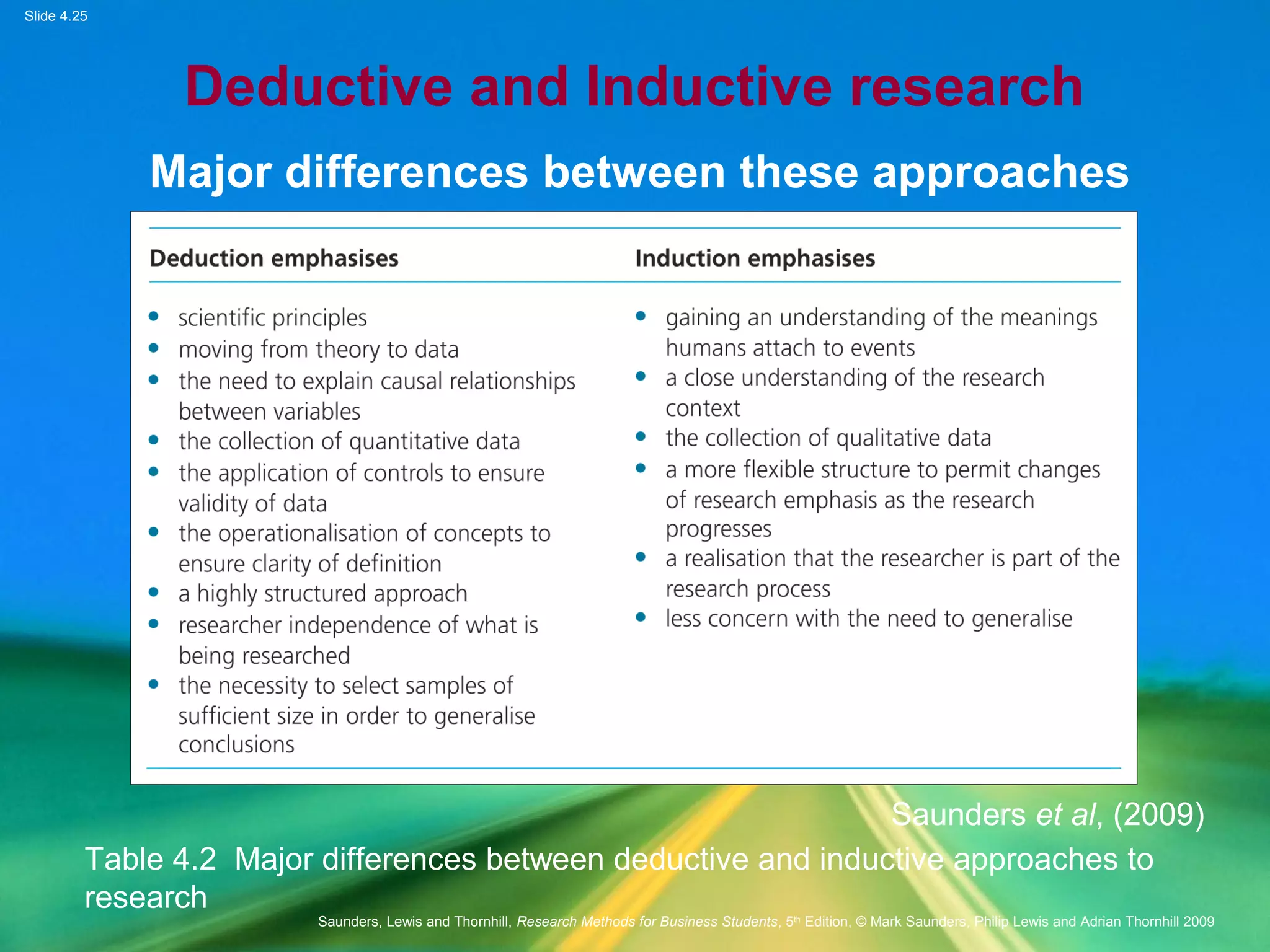
Deductive and Inductive research
Major differences between these approaches
Saunders et al, (2009)
Table 4.2 Major differences between deductive and inductive approaches to
research
Slide 4.26
Saunders, Lewis and Thornhill, Research Methods for Business Students, 5th
Edition, © Mark Saunders, Philip Lewis and Adrian Thornhill 2009
Summary: Chapter 4
Research philosophy
• relates to the development of knowledge and
the nature of that knowledge
• contains important assumptions about the
way in which you view the world
Slide 4.27
Saunders, Lewis and Thornhill, Research Methods for Business Students, 5th
Edition, © Mark Saunders, Philip Lewis and Adrian Thornhill 2009
Summary: Chapter 4
Three major ways of thinking about research
philosophy
• Epistemology
• Ontology – objectivism and subjectivism
• Axiology
Slide 4.28
Saunders, Lewis and Thornhill, Research Methods for Business Students, 5th
Edition, © Mark Saunders, Philip Lewis and Adrian Thornhill 2009
Summary: Chapter 4
Social science paradigms can generate fresh
insights into real-life issues and problems
Four of the paradigms are:
Functionalist Radical humanist
Interpretive Radical structuralist
Slide 4.29
Saunders, Lewis and Thornhill, Research Methods for Business Students, 5th
Edition, © Mark Saunders, Philip Lewis and Adrian Thornhill 2009
Summary: Chapter 4
The two main research approaches are
Deduction - theory and hypothesis are
developed and tested
Induction – data are collected and a theory
developed from the data analysis

Chapter four2

  • 1.
    Slide 4.1 Saunders, Lewisand Thornhill, Research Methods for Business Students, 5th Edition, © Mark Saunders, Philip Lewis and Adrian Thornhill 2009 Chapter 4 Understanding research philosophies and approaches
  • 2.
    Slide 4.2 Saunders, Lewisand Thornhill, Research Methods for Business Students, 5th Edition, © Mark Saunders, Philip Lewis and Adrian Thornhill 2009 Understanding research philosophies and approaches • By end of this chapter you should be able to: • Define the key terms ontology, epistemology and explain their relevance to business research; • Explain the relevance for business research of philosophical perspectives such as positivism, realism, pragmatism, and interpretivism; • understand the main research paradigms which are significant for business research; • Distinguish between main research approaches; deductive and inductive; • State your own epistemological and axiological positions.
  • 3.
    Slide 4.3 Saunders, Lewisand Thornhill, Research Methods for Business Students, 5th Edition, © Mark Saunders, Philip Lewis and Adrian Thornhill 2009 Underlying issues of data collection and analysis The research ‘onion’ Saunders et al, (2008) Figure 4.1 The research ‘onion’
  • 4.
    Slide 4.4 Saunders, Lewisand Thornhill, Research Methods for Business Students, 5th Edition, © Mark Saunders, Philip Lewis and Adrian Thornhill 2009 Understanding your research philosophy (1) ‘Research philosophy is an over-arching term relating to the development of knowledge and the nature of that knowledge’ Adapted from Saunders et al, (2009)
  • 5.
    Slide 4.5 Saunders, Lewisand Thornhill, Research Methods for Business Students, 5th Edition, © Mark Saunders, Philip Lewis and Adrian Thornhill 2009 Understanding your research philosophy (2) Thinking about research philosophy • Ontology: is concerned with nature of reality. This raise the questions of the assumptions researchers have about the way the world operates and commitment held to particular views. The two aspects of ontology we describe here will both have their devotees among business and management researchers , In addition, both are likely to be accepted as producing valid knowledge by many researchers
  • 6.
    Slide 4.6 Saunders, Lewisand Thornhill, Research Methods for Business Students, 5th Edition, © Mark Saunders, Philip Lewis and Adrian Thornhill 2009 Ontology • The first aspect of ontology we discuss is objectivism. This portrays the position that social entities exist in reality external to social actors concerned with their existence. • The second aspect, subjectivism holds that social phenomena are created from the perceptions and consequent actions of those social actors concerned with their existence
  • 7.
    Slide 4.7 Saunders, Lewisand Thornhill, Research Methods for Business Students, 5th Edition, © Mark Saunders, Philip Lewis and Adrian Thornhill 2009 Ontology • Blaikie (1993) describes the root definition of ontology as ‘the science or study of being’ and develops this description for the social sciences to encompass ‘claims about what exists, what it looks like, what units make it up and how these units interact with each other’. In short, ontology describes our view (whether claims or assumptions) on the nature of reality, and specifically, is this an objective reality that really exists, or only a subjective reality, created in our minds.
  • 8.
    Slide 4.8 Saunders, Lewisand Thornhill, Research Methods for Business Students, 5th Edition, © Mark Saunders, Philip Lewis and Adrian Thornhill 2009 Ontology • For the everyday example, they use the example of a workplace report – asking one to question whether it describes what is really going on, or only what the author thinks is going on. They go on to highlight the complexity that is introduced when considering phenomena such as culture, power or control, and whether they really exist or are simply an illusion, further extending the discussion as to how individuals (and groups) determine these realities – does the reality exist only through experience of it (subjectivism), or does it exist independently of those • who live it (objectivism).
  • 9.
    Slide 4.9 Saunders, Lewisand Thornhill, Research Methods for Business Students, 5th Edition, © Mark Saunders, Philip Lewis and Adrian Thornhill 2009 Epistemology • It concerns what constitutes acceptable knowledge in a field of study. • Closely coupled with ontology and its consideration of what constitutes reality, epistemology considers views about the most appropriate ways of enquiring into the • nature of the world (Easterby-Smith, Thorpe and Jackson, 2008) and ‘what is knowledge and what are the sources and limits of knowledge’ (Eriksson and Kovalainen, 2008). Questions of epistemology begin to consider the research method, and Eriksson and Kovalainen go on to discuss how epistemology defines how knowledge can be produced and argued for.
  • 10.
    Slide 4.10 Saunders, Lewisand Thornhill, Research Methods for Business Students, 5th Edition, © Mark Saunders, Philip Lewis and Adrian Thornhill 2009 Epistemology • Blaikie (1993) describes epistemology as ‘the theory or science of the method or grounds of knowledge’ expanding this into a set of claims or assumptions about the ways in which it is possible to gain knowledge of reality, how what exists may be known, what can be known, and what criteria must be satisfied in order to be described as • knowledge. Chia (2002) describes epistemology as ‘how and what it is possible to know’ and the need to reflect on methods and standards through which reliable and verifiable knowledge is produced.
  • 11.
    Slide 4.11 Saunders, Lewisand Thornhill, Research Methods for Business Students, 5th Edition, © Mark Saunders, Philip Lewis and Adrian Thornhill 2009 Epistemology • Hatch and Cunliffe (2006) summarise epistemology as ‘knowing how you can know’ and expand this by asking how is knowledge generated, what criteria discriminate good knowledge from bad knowledge, and how should reality be represented or described. They go on to highlight the inter-dependent relationship • between epistemology and ontology, and how one both informs, and depends upon, the • other.
  • 12.
    Slide 4.12 Saunders, Lewisand Thornhill, Research Methods for Business Students, 5th Edition, © Mark Saunders, Philip Lewis and Adrian Thornhill 2009 Understanding your research philosophy (4) Aspects of philosophy • Positivism - the stance of the natural scientist • Realism - direct and critical realism • Interpretivism – researchers as ‘social actors’ • Axiology – studies judgements about value
  • 13.
    Slide 4.13 Saunders, Lewisand Thornhill, Research Methods for Business Students, 5th Edition, © Mark Saunders, Philip Lewis and Adrian Thornhill 2009 Positivism • Positivism can be defined as “research approaches that employ empirical methods, make extensive use of quantitative analysis, or develop logical calculi to build formal explanatory theory”
  • 14.
    Slide 4.14 Saunders, Lewisand Thornhill, Research Methods for Business Students, 5th Edition, © Mark Saunders, Philip Lewis and Adrian Thornhill 2009 Realism • Is another philosophical position which relates to scientific enquiry. The essence of realism is that what the senses show us as reality is the truth; that objects have an existence independent of the human mind. In this sense, realism is opposed to idealism, the theory that only the mind and its contents exist
  • 15.
    Slide 4.15 Saunders, Lewisand Thornhill, Research Methods for Business Students, 5th Edition, © Mark Saunders, Philip Lewis and Adrian Thornhill 2009 Direct realism and critical realism • It says that what you see is what you get: what we experience through our senses portrays the world accurately. • critical realism: critical realists argue that we experience are sensations, the images of the things in the real world, not the things directly. Critical realists point out how often our senses deceive us.
  • 16.
    Slide 4.16 Saunders, Lewisand Thornhill, Research Methods for Business Students, 5th Edition, © Mark Saunders, Philip Lewis and Adrian Thornhill 2009 Interpretivism • Interpretivisim advocates it is necessary for the researcher to understand differences between humans in our role as social actors. This emphasizes the differences between conducting research among people rather than objects such as trucks and computers.
  • 17.
    Slide 4.17 Saunders, Lewisand Thornhill, Research Methods for Business Students, 5th Edition, © Mark Saunders, Philip Lewis and Adrian Thornhill 2009 Interpretivisim • Interpretive research is concerned with the meanings that people attach to norms, rules, and values that regulate their interactions. Care is taken not to impose a previous understanding of norms, rules, and values on others but rather to understand their beliefs and actions from their point of view. The focus is not only on what they tell us directly about the reasons for their beliefs and actions but also on the social practices that underlie them. Social practice gives meaning to social action
  • 18.
    Slide 4.18 Saunders, Lewisand Thornhill, Research Methods for Business Students, 5th Edition, © Mark Saunders, Philip Lewis and Adrian Thornhill 2009 pragmatism • Pragmatism holds that the most important determinant of the epistemology, ontology, axiology adopted is the research question.
  • 19.
    Slide 4.19 Saunders, Lewisand Thornhill, Research Methods for Business Students, 5th Edition, © Mark Saunders, Philip Lewis and Adrian Thornhill 2009 Research paradigms Definition ‘A way of examining social phenomenon from which particular understandings of these phenomena can be gained and explanations attempted’ Saunders et al. (2009)
  • 20.
    Slide 4.20 Saunders, Lewisand Thornhill, Research Methods for Business Students, 5th Edition, © Mark Saunders, Philip Lewis and Adrian Thornhill 2009 Research Approaches (1) Deduction 5 sequential stages of testing theory • Deducing a hypothesis • Expressing the hypothesis operationally • Testing the operational hypothesis • Examining the specific outcome of the enquiry • Modifying the theory (if necessary) Adapted from Robson (2002)
  • 21.
    Slide 4.21 Saunders, Lewisand Thornhill, Research Methods for Business Students, 5th Edition, © Mark Saunders, Philip Lewis and Adrian Thornhill 2009 Research Approaches (2) Characteristics of Deduction • Explaining causal relationships between variables • Establishing controls for testing hypotheses • Independence of the researcher • Concepts operationalised for quantative measurement • Generalisation
  • 22.
    Slide 4.22 Saunders, Lewisand Thornhill, Research Methods for Business Students, 5th Edition, © Mark Saunders, Philip Lewis and Adrian Thornhill 2009 Research Approaches (3) Induction Building theory by – • Understanding the way human build their world • Permitting alternative explanations of what’s going on • Being concerned with the context of events • Using more qualitative data • Using a variety of data collection methods
  • 23.
    Slide 4.23 Saunders, Lewisand Thornhill, Research Methods for Business Students, 5th Edition, © Mark Saunders, Philip Lewis and Adrian Thornhill 2009 Choosing your research approach The right choice of approach helps you to • Make a more informed decision about the research design • Think about which strategies will work for your research topic • Adapt your design to cater for any constraints Adapted from Easterby-Smith et al. (2008)
  • 24.
    Slide 4.24 Saunders, Lewisand Thornhill, Research Methods for Business Students, 5th Edition, © Mark Saunders, Philip Lewis and Adrian Thornhill 2009 Combining research approaches Things worth considering • The nature of the research topic • The time available • The extent of risk • The research audience – managers and markers
  • 25.
    Slide 4.25 Saunders, Lewisand Thornhill, Research Methods for Business Students, 5th Edition, © Mark Saunders, Philip Lewis and Adrian Thornhill 2009 Deductive and Inductive research Major differences between these approaches Saunders et al, (2009) Table 4.2 Major differences between deductive and inductive approaches to research
  • 26.
    Slide 4.26 Saunders, Lewisand Thornhill, Research Methods for Business Students, 5th Edition, © Mark Saunders, Philip Lewis and Adrian Thornhill 2009 Summary: Chapter 4 Research philosophy • relates to the development of knowledge and the nature of that knowledge • contains important assumptions about the way in which you view the world
  • 27.
    Slide 4.27 Saunders, Lewisand Thornhill, Research Methods for Business Students, 5th Edition, © Mark Saunders, Philip Lewis and Adrian Thornhill 2009 Summary: Chapter 4 Three major ways of thinking about research philosophy • Epistemology • Ontology – objectivism and subjectivism • Axiology
  • 28.
    Slide 4.28 Saunders, Lewisand Thornhill, Research Methods for Business Students, 5th Edition, © Mark Saunders, Philip Lewis and Adrian Thornhill 2009 Summary: Chapter 4 Social science paradigms can generate fresh insights into real-life issues and problems Four of the paradigms are: Functionalist Radical humanist Interpretive Radical structuralist
  • 29.
    Slide 4.29 Saunders, Lewisand Thornhill, Research Methods for Business Students, 5th Edition, © Mark Saunders, Philip Lewis and Adrian Thornhill 2009 Summary: Chapter 4 The two main research approaches are Deduction - theory and hypothesis are developed and tested Induction – data are collected and a theory developed from the data analysis