Human Caring & Role Theories
Application to Clinical Practice
Stephanie Thompson, RN
Theory in Nursing
University of Arkansas for Medical Sciences
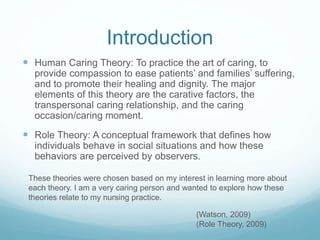
Introduction
 Human Caring Theory: To practice the art of caring, to
provide compassion to ease patients’ and families’ suffering,
and to promote their healing and dignity. The major
elements of this theory are the carative factors, the
transpersonal caring relationship, and the caring
occasion/caring moment.
 Role Theory: A conceptual framework that defines how
individuals behave in social situations and how these
behaviors are perceived by observers.
These theories were chosen based on my interest in learning more about
each theory. I am a very caring person and wanted to explore how these
theories relate to my nursing practice.
(Watson, 2009)
(Role Theory, 2009)
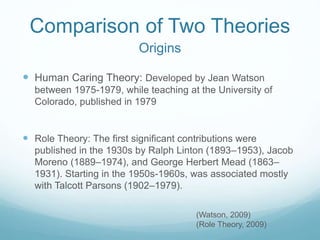
Origins
 Human Caring Theory: Developed by Jean Watson
between 1975-1979, while teaching at the University of
Colorado, published in 1979
 Role Theory: The first significant contributions were
published in the 1930s by Ralph Linton (1893–1953), Jacob
Moreno (1889–1974), and George Herbert Mead (1863–
1931). Starting in the 1950s-1960s, was associated mostly
with Talcott Parsons (1902–1979).
(Watson, 2009)
(Role Theory, 2009)
Comparison of Two Theories
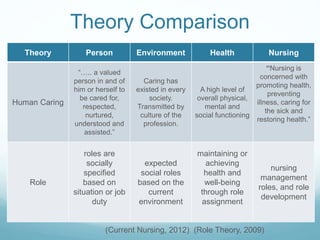
Theory Comparison
Theory Person Environment Health Nursing
Human Caring
“….. a valued
person in and of
him or herself to
be cared for,
respected,
nurtured,
understood and
assisted.”
Caring has
existed in every
society.
Transmitted by
culture of the
profession.
A high level of
overall physical,
mental and
social functioning
“Nursing is
concerned with
promoting health,
preventing
illness, caring for
the sick and
restoring health.”
Role
roles are
socially
specified
based on
situation or job
duty
expected
social roles
based on the
current
environment
maintaining or
achieving
health and
well-being
through role
assignment
nursing
management
roles, and role
development
(Current Nursing, 2012) (Role Theory, 2009)
Application to Practice
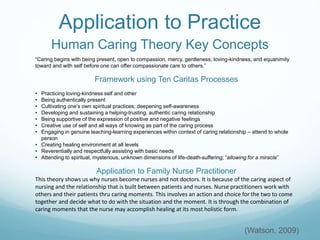
Human Caring Theory Key Concepts
“Caring begins with being present, open to compassion, mercy, gentleness, loving-kindness, and equanimity
toward and with self before one can offer compassionate care to others.”
Framework using Ten Caritas Processes
• Practicing loving-kindness self and other
• Being authentically present
• Cultivating one’s own spiritual practices; deepening self-awareness
• Developing and sustaining a helping-trusting, authentic caring relationship
• Being supportive of the expression of positive and negative feelings
• Creative use of self and all ways of knowing as part of the caring process
• Engaging in genuine teaching-learning experiences within context of caring relationship – attend to whole
person
• Creating healing environment at all levels
• Reverentially and respectfully assisting with basic needs
• Attending to spiritual, mysterious, unknown dimensions of life-death-suffering; “allowing for a miracle”
Application to Family Nurse Practitioner
This theory shows us why nurses become nurses and not doctors. It is because of the caring aspect of
nursing and the relationship that is built between patients and nurses. Nurse practitioners work with
others and their patients thru caring moments. This involves an action and choice for the two to come
together and decide what to do with the situation and the moment. It is through the combination of
caring moments that the nurse may accomplish healing at its most holistic form.
(Watson, 2009)
Application to Practice
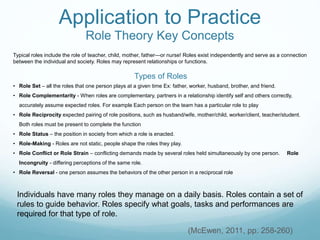
Role Theory Key Concepts
Typical roles include the role of teacher, child, mother, father—or nurse! Roles exist independently and serve as a connection
between the individual and society. Roles may represent relationships or functions.
Types of Roles
• Role Set – all the roles that one person plays at a given time Ex: father, worker, husband, brother, and friend.
• Role Complementarity - When roles are complementary, partners in a relationship identify self and others correctly,
accurately assume expected roles. For example Each person on the team has a particular role to play
• Role Reciprocity expected pairing of role positions, such as husband/wife, mother/child, worker/client, teacher/student.
Both roles must be present to complete the function
• Role Status – the position in society from which a role is enacted.
• Role-Making - Roles are not static, people shape the roles they play.
• Role Conflict or Role Strain – conflicting demands made by several roles held simultaneously by one person. Role
Incongruity - differing perceptions of the same role.
• Role Reversal - one person assumes the behaviors of the other person in a reciprocal role
Individuals have many roles they manage on a daily basis. Roles contain a set of
rules to guide behavior. Roles specify what goals, tasks and performances are
required for that type of role.
(McEwen, 2011, pp. 258-260)
Application to Practice
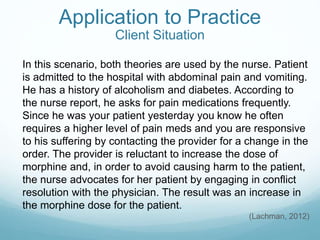
Client Situation
In this scenario, both theories are used by the nurse. Patient
is admitted to the hospital with abdominal pain and vomiting.
He has a history of alcoholism and diabetes. According to
the nurse report, he asks for pain medications frequently.
Since he was your patient yesterday you know he often
requires a higher level of pain meds and you are responsive
to his suffering by contacting the provider for a change in the
order. The provider is reluctant to increase the dose of
morphine and, in order to avoid causing harm to the patient,
the nurse advocates for her patient by engaging in conflict
resolution with the physician. The result was an increase in
the morphine dose for the patient.
(Lachman, 2012)
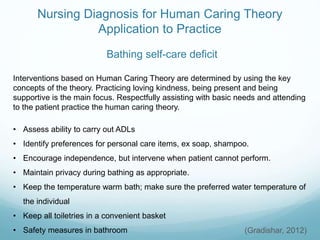
Nursing Diagnosis for Human Caring Theory
Application to Practice
Interventions based on Human Caring Theory are determined by using the key
concepts of the theory. Practicing loving kindness, being present and being
supportive is the main focus. Respectfully assisting with basic needs and attending
to the patient practice the human caring theory.
• Assess ability to carry out ADLs
• Identify preferences for personal care items, ex soap, shampoo.
• Encourage independence, but intervene when patient cannot perform.
• Maintain privacy during bathing as appropriate.
• Keep the temperature warm bath; make sure the preferred water temperature of
the individual
• Keep all toiletries in a convenient basket
• Safety measures in bathroom
Bathing self-care deficit
(Gradishar, 2012)
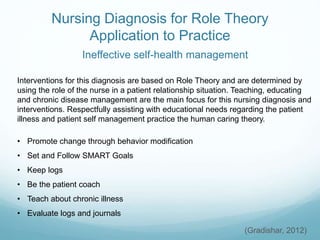
Nursing Diagnosis for Role Theory
Application to Practice
Ineffective self-health management
Interventions for this diagnosis are based on Role Theory and are determined by
using the role of the nurse in a patient relationship situation. Teaching, educating
and chronic disease management are the main focus for this nursing diagnosis and
interventions. Respectfully assisting with educational needs regarding the patient
illness and patient self management practice the human caring theory.
• Promote change through behavior modification
• Set and Follow SMART Goals
• Keep logs
• Be the patient coach
• Teach about chronic illness
• Evaluate logs and journals
(Gradishar, 2012)
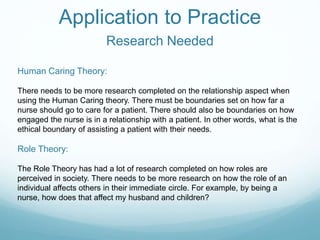
Application to Practice
Research Needed
Human Caring Theory:
There needs to be more research completed on the relationship aspect when
using the Human Caring theory. There must be boundaries set on how far a
nurse should go to care for a patient. There should also be boundaries on how
engaged the nurse is in a relationship with a patient. In other words, what is the
ethical boundary of assisting a patient with their needs.
Role Theory:
The Role Theory has had a lot of research completed on how roles are
perceived in society. There needs to be more research on how the role of an
individual affects others in their immediate circle. For example, by being a
nurse, how does that affect my husband and children?
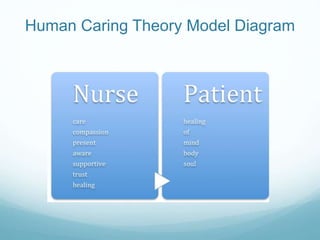
Human Caring Theory Model Diagram
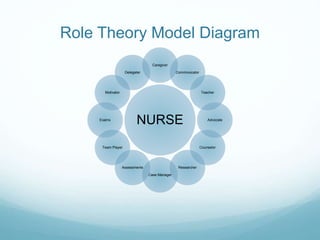
Role Theory Model Diagram
NURSE
Caregiver
Commnuicator
Teacher
Advocate
Counselor
Researcher
Case Manager
Assessments
Team Player
Exams
Motivator
Delegater
Synthesis of Human Caring Theory
and Application
By applying the Human Caring Theory to my practice I
have been able to see where I have already been doing
these things. Human caring to me is second nature and
comes naturally to me. Researching this project, I have
learned how, when, and where I have applied the
human caring theory to my practice. Everyday I use the
key concepts of this theory. Care, compassion, being
present, aware, supportive, trust, and healing are used
everyday in some way or another.
Synthesis of Role Theory
and Application
Researching the Role Theory has been fun and
interesting. I came across several different articles and
studies about roles in society. I found it interesting when
reading older material and the difference in today’s
perception of roles. I myself have many roles and have
found the role of nurse to be one of the most rewarding
roles I fill. Applying the theory to my practice has allowed
me to see how people may perceive the role of nurse in
different generations.
Summary
In summary, the application of theory to nursing practice is
very important and critical to a successful career in
nursing. By applying theories to nursing, you are better
able to understand the processes behind why things
happen a certain way and the relationship between
nurses and patients. The Human Caring Theory and Role
Theory were fun to research and write about. I learned a
lot about how these two theories apply to myself as a
nurse. My favorite theory is the Human Caring Theory.
The art of caring and providing compassion to others is
my calling in life.
References
Gradishar, D., & Gleason,M. (2014). EHS: Nursing Diagnosis Care Plans, 4/e - Self-Care Deficit.
EHS: Nursing Diagnosis Care Plans, 4/e - Self-Care Deficit. Retrieved July 22, 2014, from
http://www1.us.elsevierhealth.com/MERLIN/Gulanick/archive/Constructor/gulanick42.html
Lachman, V. (2012). Applying the Ethics of Care to Your Nursing Practice. MedSurg Nursing, 21(2).
Retrieved July 22, 2014, from
http://www.nursingworld.org/mainmenucategories/ethicsstandards/resources/applying-the-
ethics-of-care-to-your-nursing-practice.pdf
McEwen, M., & Wills, E. M. (2011). Theories From the Sociologic Sciences. Theoretical basis for
nursing (3rd ed., pp. 258-260). Philadelphia: Wolters Kluwer/Lippincott Williams & Wilkins
Health.
Role Theory. International Encyclopedia of the Social Sciences. 2009. Retrieved July 06, 2014 from
Encyclopedia.com: http://www.encyclopedia.com/doc/1G2-3045302300.html
Watson J. Nursing: The Philosophy and Science of Caring.(2009) Boulder, CO: University Press of
Colorado.
The Human Caring & Role
Theories
Application to Clinical Practice
Stephanie Thompson
Theory in Nursing
University of Arkansas for Medical Sciences

Human caring and role theories

  • 1.
    Human Caring &Role Theories Application to Clinical Practice Stephanie Thompson, RN Theory in Nursing University of Arkansas for Medical Sciences
  • 2.
    Introduction  Human CaringTheory: To practice the art of caring, to provide compassion to ease patients’ and families’ suffering, and to promote their healing and dignity. The major elements of this theory are the carative factors, the transpersonal caring relationship, and the caring occasion/caring moment.  Role Theory: A conceptual framework that defines how individuals behave in social situations and how these behaviors are perceived by observers. These theories were chosen based on my interest in learning more about each theory. I am a very caring person and wanted to explore how these theories relate to my nursing practice. (Watson, 2009) (Role Theory, 2009)
  • 3.
    Origins  Human CaringTheory: Developed by Jean Watson between 1975-1979, while teaching at the University of Colorado, published in 1979  Role Theory: The first significant contributions were published in the 1930s by Ralph Linton (1893–1953), Jacob Moreno (1889–1974), and George Herbert Mead (1863– 1931). Starting in the 1950s-1960s, was associated mostly with Talcott Parsons (1902–1979). (Watson, 2009) (Role Theory, 2009) Comparison of Two Theories
  • 4.
    Theory Comparison Theory PersonEnvironment Health Nursing Human Caring “….. a valued person in and of him or herself to be cared for, respected, nurtured, understood and assisted.” Caring has existed in every society. Transmitted by culture of the profession. A high level of overall physical, mental and social functioning “Nursing is concerned with promoting health, preventing illness, caring for the sick and restoring health.” Role roles are socially specified based on situation or job duty expected social roles based on the current environment maintaining or achieving health and well-being through role assignment nursing management roles, and role development (Current Nursing, 2012) (Role Theory, 2009)
  • 5.
    Application to Practice HumanCaring Theory Key Concepts “Caring begins with being present, open to compassion, mercy, gentleness, loving-kindness, and equanimity toward and with self before one can offer compassionate care to others.” Framework using Ten Caritas Processes • Practicing loving-kindness self and other • Being authentically present • Cultivating one’s own spiritual practices; deepening self-awareness • Developing and sustaining a helping-trusting, authentic caring relationship • Being supportive of the expression of positive and negative feelings • Creative use of self and all ways of knowing as part of the caring process • Engaging in genuine teaching-learning experiences within context of caring relationship – attend to whole person • Creating healing environment at all levels • Reverentially and respectfully assisting with basic needs • Attending to spiritual, mysterious, unknown dimensions of life-death-suffering; “allowing for a miracle” Application to Family Nurse Practitioner This theory shows us why nurses become nurses and not doctors. It is because of the caring aspect of nursing and the relationship that is built between patients and nurses. Nurse practitioners work with others and their patients thru caring moments. This involves an action and choice for the two to come together and decide what to do with the situation and the moment. It is through the combination of caring moments that the nurse may accomplish healing at its most holistic form. (Watson, 2009)
  • 6.
    Application to Practice RoleTheory Key Concepts Typical roles include the role of teacher, child, mother, father—or nurse! Roles exist independently and serve as a connection between the individual and society. Roles may represent relationships or functions. Types of Roles • Role Set – all the roles that one person plays at a given time Ex: father, worker, husband, brother, and friend. • Role Complementarity - When roles are complementary, partners in a relationship identify self and others correctly, accurately assume expected roles. For example Each person on the team has a particular role to play • Role Reciprocity expected pairing of role positions, such as husband/wife, mother/child, worker/client, teacher/student. Both roles must be present to complete the function • Role Status – the position in society from which a role is enacted. • Role-Making - Roles are not static, people shape the roles they play. • Role Conflict or Role Strain – conflicting demands made by several roles held simultaneously by one person. Role Incongruity - differing perceptions of the same role. • Role Reversal - one person assumes the behaviors of the other person in a reciprocal role Individuals have many roles they manage on a daily basis. Roles contain a set of rules to guide behavior. Roles specify what goals, tasks and performances are required for that type of role. (McEwen, 2011, pp. 258-260)
  • 7.
    Application to Practice ClientSituation In this scenario, both theories are used by the nurse. Patient is admitted to the hospital with abdominal pain and vomiting. He has a history of alcoholism and diabetes. According to the nurse report, he asks for pain medications frequently. Since he was your patient yesterday you know he often requires a higher level of pain meds and you are responsive to his suffering by contacting the provider for a change in the order. The provider is reluctant to increase the dose of morphine and, in order to avoid causing harm to the patient, the nurse advocates for her patient by engaging in conflict resolution with the physician. The result was an increase in the morphine dose for the patient. (Lachman, 2012)
  • 8.
    Nursing Diagnosis forHuman Caring Theory Application to Practice Interventions based on Human Caring Theory are determined by using the key concepts of the theory. Practicing loving kindness, being present and being supportive is the main focus. Respectfully assisting with basic needs and attending to the patient practice the human caring theory. • Assess ability to carry out ADLs • Identify preferences for personal care items, ex soap, shampoo. • Encourage independence, but intervene when patient cannot perform. • Maintain privacy during bathing as appropriate. • Keep the temperature warm bath; make sure the preferred water temperature of the individual • Keep all toiletries in a convenient basket • Safety measures in bathroom Bathing self-care deficit (Gradishar, 2012)
  • 9.
    Nursing Diagnosis forRole Theory Application to Practice Ineffective self-health management Interventions for this diagnosis are based on Role Theory and are determined by using the role of the nurse in a patient relationship situation. Teaching, educating and chronic disease management are the main focus for this nursing diagnosis and interventions. Respectfully assisting with educational needs regarding the patient illness and patient self management practice the human caring theory. • Promote change through behavior modification • Set and Follow SMART Goals • Keep logs • Be the patient coach • Teach about chronic illness • Evaluate logs and journals (Gradishar, 2012)
  • 10.
    Application to Practice ResearchNeeded Human Caring Theory: There needs to be more research completed on the relationship aspect when using the Human Caring theory. There must be boundaries set on how far a nurse should go to care for a patient. There should also be boundaries on how engaged the nurse is in a relationship with a patient. In other words, what is the ethical boundary of assisting a patient with their needs. Role Theory: The Role Theory has had a lot of research completed on how roles are perceived in society. There needs to be more research on how the role of an individual affects others in their immediate circle. For example, by being a nurse, how does that affect my husband and children?
  • 11.
    Human Caring TheoryModel Diagram
  • 12.
    Role Theory ModelDiagram NURSE Caregiver Commnuicator Teacher Advocate Counselor Researcher Case Manager Assessments Team Player Exams Motivator Delegater
  • 13.
    Synthesis of HumanCaring Theory and Application By applying the Human Caring Theory to my practice I have been able to see where I have already been doing these things. Human caring to me is second nature and comes naturally to me. Researching this project, I have learned how, when, and where I have applied the human caring theory to my practice. Everyday I use the key concepts of this theory. Care, compassion, being present, aware, supportive, trust, and healing are used everyday in some way or another.
  • 14.
    Synthesis of RoleTheory and Application Researching the Role Theory has been fun and interesting. I came across several different articles and studies about roles in society. I found it interesting when reading older material and the difference in today’s perception of roles. I myself have many roles and have found the role of nurse to be one of the most rewarding roles I fill. Applying the theory to my practice has allowed me to see how people may perceive the role of nurse in different generations.
  • 15.
    Summary In summary, theapplication of theory to nursing practice is very important and critical to a successful career in nursing. By applying theories to nursing, you are better able to understand the processes behind why things happen a certain way and the relationship between nurses and patients. The Human Caring Theory and Role Theory were fun to research and write about. I learned a lot about how these two theories apply to myself as a nurse. My favorite theory is the Human Caring Theory. The art of caring and providing compassion to others is my calling in life.
  • 16.
    References Gradishar, D., &Gleason,M. (2014). EHS: Nursing Diagnosis Care Plans, 4/e - Self-Care Deficit. EHS: Nursing Diagnosis Care Plans, 4/e - Self-Care Deficit. Retrieved July 22, 2014, from http://www1.us.elsevierhealth.com/MERLIN/Gulanick/archive/Constructor/gulanick42.html Lachman, V. (2012). Applying the Ethics of Care to Your Nursing Practice. MedSurg Nursing, 21(2). Retrieved July 22, 2014, from http://www.nursingworld.org/mainmenucategories/ethicsstandards/resources/applying-the- ethics-of-care-to-your-nursing-practice.pdf McEwen, M., & Wills, E. M. (2011). Theories From the Sociologic Sciences. Theoretical basis for nursing (3rd ed., pp. 258-260). Philadelphia: Wolters Kluwer/Lippincott Williams & Wilkins Health. Role Theory. International Encyclopedia of the Social Sciences. 2009. Retrieved July 06, 2014 from Encyclopedia.com: http://www.encyclopedia.com/doc/1G2-3045302300.html Watson J. Nursing: The Philosophy and Science of Caring.(2009) Boulder, CO: University Press of Colorado.
  • 17.
    The Human Caring& Role Theories Application to Clinical Practice Stephanie Thompson Theory in Nursing University of Arkansas for Medical Sciences