RESEARCH
METHODOLOGY
An overview
Dr P Manimalathi
Assistant Professor of Economics
Sri Ramakrishna College of Arts & Science
Coimbatore 641006
MEANING OF RESEARCH
 Research in simple terms refers to search for
knowledge. It is a scientific and systematic
 search for information on a particular topic
or issue. It is also known as the art of
scientific
 investigation. Several social scientists have
defined research in different ways.
OBJECTIVES OF RESEARCH
 The main aim of research is to find out the truth
which is hidden and has not yet been discovered.
Although every research study has its own specific
objectives, the research objectives may be broadly
grouped as follows:
 1. To gain familiarity with new insights into a
phenomenon (i.e., formulative research studies)
 2. To accurately portray the characteristics of a
particular individual, group, or a situation (i.e.,
descriptive research studies)
OBJECTIVES OF RESEARCH
 3. To analyse the frequency with which something
occurs (i.e., diagnostic research studies)
 4. To examine the hypothesis of a causal
relationship between two variables (i.e.,
hypothesis-testing research studies)
RESEARCH METHODS VERSUS METHODOLOGY:
 Research methods include all those
techniques/methods that are adopted for
conducting research. Thus, research
techniques or methods are the methods that
the researchers adopt for conducting the
research studies.
 On the other hand, research methodology is
the way in which research problems are
solved systematically. It is a science of
studying how research is conducted
scientifically.
RESEARCH APPROACHES
There are two main approaches to research:
 1. Quantitative approach :The quantitative
approach involves the collection of
quantitative data. This approach further
includes experimental, inferential, and
simulation approaches to research.
 2. Qualitative approach: The qualitative
approach uses the method of subjective
assessment of opinions, behaviour and
attitudes.
TYPES OF RESEARCH
1. Descriptive Versus Analytical
 Descriptive research consists of surveys and fact-
finding enquiries of different types.
 The main objective of descriptive research is
describing the state of affairs as it prevails at the
time of study.
 In the Analytical research, the researcher has to use
the already available facts or information, and
analyse them to make a critical evaluation of the
subject.
2. Applied Versus Fundamental
 Research can also be applied or fundamental
in nature. An attempt to find a solution to an
immediate problem encountered by a firm,
an industry, a business organisation, or the
society is known as applied research.
 The objective of applied research is to find a
solution to some pressing practical problem.
 Fundamental research mainly concerns
generalizations and formulation of a theory.
3. Quantitative Versus Qualitative
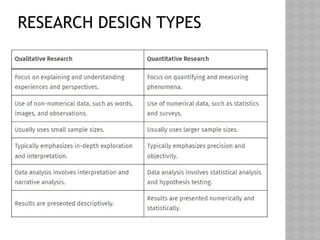
 Quantitative research relates to aspects that
can be quantified or can be expressed in
terms of quantity. It involves the
measurement of quantity or amount. Various
available statistical and econometric methods
are adopted for analysis in such research.
 Qualitative research is concerned with
qualitative phenomena, or more specifically,
the aspects related to or involving quality or
kind.
4. Conceptual Versus Empirical:
 The research related to some abstract idea or
theory is known as Conceptual Research.
 Generally, philosophers and thinkers use it for
developing new concepts or for reinterpreting the
existing ones.
 Empirical Research, on the other hand, exclusively
relies on the observation or experience with hardly
any regard for theory and system. Such research is
data based, which often comes up with conclusions
that can be verified through experiments or
observation.
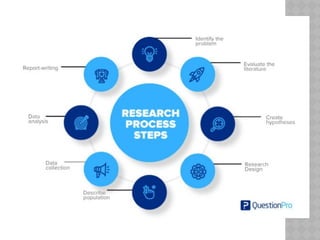
RESEARCH PROCESS
 The research process consists of a series of
systematic procedures that a researcher
must go through in order to generate
knowledge that will be considered valuable
by the project and focus on the relevant
topic.
STEPS IN RESEARCH PROCESS
Step 1: Identify the Problem
Finding an issue or formulating a research question is
the first step. A well-defined research problem will
guide the researcher through all stages of the
research process, from setting objectives to choosing
a technique. There are a number of approaches to
get insight into a topic and gain a better
understanding of it. Such as:
 A preliminary survey
 Case studies
 Interviews with a small group of people
 Observational survey
Step 2: Evaluate the Literature
 A thorough examination of the relevant studies is
essential to the research process. It enables the
researcher to identify the precise aspects of the
problem. Once a problem has been found, the
investigator or researcher needs to find out more
about it.
 This stage gives problem-zone background. It teaches
the investigator about previous research, how they
were conducted, and its conclusions. The researcher
can build consistency between his work and others
through a literature review. Such a review exposes the
researcher to a more significant body of knowledge
and helps him follow the research process efficiently.
Step 3: Create Hypotheses
 Formulating an original hypothesis is the next
logical step after narrowing down the research
topic and defining it. A belief solves logical
relationships between variables. In order to
establish a hypothesis, a researcher must have
a certain amount of expertise in the field.
 It is important for researchers to keep in mind
while formulating a hypothesis that it must be
based on the research topic. Researchers are
able to concentrate their efforts and stay
committed to their objectives when they
develop theories to guide their work.
Step 4: The Research Design
 Research design is the plan for achieving
objectives and answering research questions. It
outlines how to get the relevant information. Its
goal is to design research to test hypotheses,
address the research questions, and provide
decision-making insights.
 The research design aims to minimize the time,
money, and effort required to acquire
meaningful evidence. This plan fits into four
categories:
 Exploration and Surveys
 Experiment
 Data Analysis
 Observation
Step 5: Describe Population
 Research projects usually look at a specific group
of people, facilities, or how technology is used in
the business. In research, the term population
refers to this study group. The research topic
and purpose help determine the study group.
 Suppose a researcher wishes to investigate a
certain group of people in the community. In that
case, the research could target a specific age
group, males or females, a geographic location,
or an ethnic group. A final step in a study’s
design is to specify its sample or population so
that the results may be generalized.
Step 6: Data Collection
 Data collection is important in obtaining the knowledge
or information required to answer the research issue.
Every research collected data, either from the
literature or the people being studied. Data must be
collected from the two categories of researchers.
 These sources may provide primary data.
 Experiment
 Questionnaire
 Observation
 Interview
 Secondary data categories are:
 Literature survey
 Official, unofficial reports
 An approach based on library resources
Step 7: Data Analysis
 During research design, the researcher plans
data analysis. After collecting data, the
researcher analyzes it. The data is examined
based on the approach in this step. The
research findings are reviewed and reported.
 Data analysis involves a number of closely
related stages, such as setting up categories,
applying these categories to raw data through
coding and tabulation, and then drawing
statistical conclusions. The researcher can
examine the acquired data using a variety of
statistical methods.
Step 8: The Report-writing
 After completing these steps, the researcher must prepare a report
detailing his findings. The report must be carefully composed with the
following in mind:
 The Layout: On the first page, the title, date, acknowledgments, and preface
should be on the report. A table of contents should be followed by a list of
tables, graphs, and charts if any.
 Introduction: It should state the research’s purpose and methods. This
section should include the study’s scope and limits.
 Summary of Findings: A non-technical summary of findings and
recommendations will follow the introduction. The findings should be
summarized if they’re lengthy.
 Principal Report: The main body of the report should make sense and be
broken up into sections that are easy to understand.
 Conclusion: The researcher should restate his findings at the end of the
main text. It’s the final result.
RESEARCH DESIGN
 Research design is the framework of research
methods and techniques chosen by a
researcher to conduct a study.
 The design allows researchers to sharpen the
research methods suitable for the subject
matter and set up their studies for success.
 Creating a research topic explains the type of
research (experimental, survey research,
correlational, semi-experimental, review) and
its sub-type (experimental design,
research problem, descriptive case-study).
 There are three main types of designs for
research:
 Data collection
 Measurement
 Data Analysis
 The research problem an organization faces
will determine the design, not vice-versa. The
design phase of a study determines which
tools to use and how they are used.
THE PROCESS OF RESEARCH DESIGN
 Consider your aims and approaches: Determine the research questions and
objectives, and identify the theoretical framework and methodology for the
study.
 Choose a type of Research Design: Select the appropriate research design, such
as experimental, correlational, survey, case study, or ethnographic, based on the
research questions and objectives.
 Identify your population and sampling method: Determine the target
population and sample size, and choose the sampling method, such as random,
stratified random sampling, or convenience sampling.
 Choose your data collection methods: Decide on the data collection methods,
such as surveys, interviews, observations, or experiments, and select the
appropriate instruments or tools for collecting data.
 Plan your data collection procedures: Develop a plan for data collection,
including the timeframe, location, and personnel involved, and ensure ethical
considerations.
 Decide on your data analysis strategies: Select the appropriate data analysis
techniques, such as statistical analysis, content analysis, or discourse analysis,
and plan how to interpret the results.
RESEARCH DESIGN ELEMENTS
 Impactful research usually creates a minimum bias in data
and increases trust in the accuracy of collected data. A
design that produces the slightest margin of error in
experimental research is generally considered the desired
outcome. The essential elements are:
 Accurate purpose statement
 Techniques to be implemented for collecting and
analyzing research
 The method applied for analyzing collected details
 Type of research methodology
 Probable objections to research
 Settings for the research study
 Timeline
 Measurement of analysis
CHARACTERISTICS OF RESEARCH DESIGN
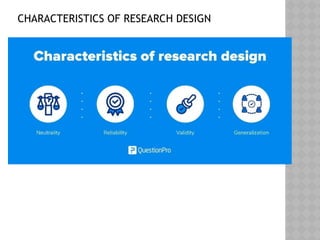
 Neutrality: When you set up your study, you may have to make
assumptions about the data you expect to collect. The results
projected in the research should be free from research bias and
neutral. Understand opinions about the final evaluated scores and
conclusions from multiple individuals and consider those who agree
with the results.
 Reliability: With regularly conducted research, the researcher
expects similar results every time. You’ll only be able to reach the
desired results if your design is reliable. Your plan should indicate
how to form research questions to ensure the standard of results.
 Validity: There are multiple measuring tools available. However, the
only correct measuring tools are those which help a researcher in
gauging results according to the objective of the research. The
questionnaire developed from this design will then be valid.
 Generalization: The outcome of your design should apply to a
population and not just a restricted sample. A generalized method
implies that your survey can be conducted on any part of a
population with similar accuracy.
RESEARCH DESIGN TYPES
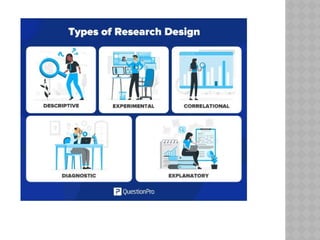
 Descriptive:
In a descriptive composition, a researcher is
solely interested in describing the situation
or case under their research study. It is a
theory-based design method created by
gathering, analyzing, and presenting
collected data. This allows a researcher to
provide insights into the why and how of
research. Descriptive design helps others
better understand the need for the research.
If the problem statement is not clear, you
can conduct exploratory research.
 Experimental:
Experimental research establishes a relationship between
the cause and effect of a situation. It is a causal research
design where one observes the impact caused by the
independent variable on the dependent variable. For
example, one monitors the influence of an independent
variable such as a price on a dependent variable such as
customer satisfaction or brand loyalty. It is an efficient
research method as it contributes to solving a problem.
The independent variables are manipulated to monitor
the change it has on the dependent variable. Social
sciences often use it to observe human behavior by
analyzing two groups. Researchers can have participants
change their actions and study how the people around
them react to understand social psychology better.
Correlational research:
 Correlational research is a non-experimental research
technique. It helps researchers establish a
relationship between two closely connected variables.
There is no assumption while evaluating a relationship
between two other variables, and statistical analysis
techniques calculate the relationship between them.
This type of research requires two different groups.
 A correlation coefficient determines the correlation
between two variables whose values range between -1
and +1. If the correlation coefficient is towards +1, it
indicates a positive relationship between the
variables, and -1 means a negative relationship
between the two variables.
Diagnostic research:
 In diagnostic design, the researcher is
looking to evaluate the underlying cause of a
specific topic or phenomenon. This method
helps one learn more about the factors that
create troublesome situations.
 This design has three parts of the research:
 Inception of the issue
 Diagnosis of the issue
 Solution for the issue
Explanatory research:
 Explanatory design uses a researcher’s ideas
and thoughts on a subject to further explore
their theories. The study explains unexplored
aspects of a subject and details the research
questions’ what, how, and why.
BENEFITS OF RESEARCH DESIGN
 Clarity of research objectives: Research design provides a clear
understanding of the research objectives and the desired outcomes.
 Increased validity and reliability: To ensure the validity and reliability of
results, research design help to minimize the risk of bias and helps to
control extraneous variables.
 Improved data collection: Research design helps to ensure that the proper
data is collected and data is collected systematically and consistently.
 Better data analysis: Research design helps ensure that the collected data
can be analyzed effectively, providing meaningful insights and conclusions.
 Improved communication: A well-designed research helps ensure the
results are clean and influential within the research team and external
stakeholders.
 Efficient use of resources: reducing the risk of waste and maximizing the
impact of the research, research design helps to ensure that resources are
used efficiently.
Introduction to Research Methodology.pptx

Introduction to Research Methodology.pptx

  • 1.
    RESEARCH METHODOLOGY An overview Dr PManimalathi Assistant Professor of Economics Sri Ramakrishna College of Arts & Science Coimbatore 641006
  • 2.
    MEANING OF RESEARCH Research in simple terms refers to search for knowledge. It is a scientific and systematic  search for information on a particular topic or issue. It is also known as the art of scientific  investigation. Several social scientists have defined research in different ways.
  • 3.
    OBJECTIVES OF RESEARCH The main aim of research is to find out the truth which is hidden and has not yet been discovered. Although every research study has its own specific objectives, the research objectives may be broadly grouped as follows:  1. To gain familiarity with new insights into a phenomenon (i.e., formulative research studies)  2. To accurately portray the characteristics of a particular individual, group, or a situation (i.e., descriptive research studies)
  • 4.
    OBJECTIVES OF RESEARCH 3. To analyse the frequency with which something occurs (i.e., diagnostic research studies)  4. To examine the hypothesis of a causal relationship between two variables (i.e., hypothesis-testing research studies)
  • 5.
    RESEARCH METHODS VERSUSMETHODOLOGY:  Research methods include all those techniques/methods that are adopted for conducting research. Thus, research techniques or methods are the methods that the researchers adopt for conducting the research studies.  On the other hand, research methodology is the way in which research problems are solved systematically. It is a science of studying how research is conducted scientifically.
  • 6.
    RESEARCH APPROACHES There aretwo main approaches to research:  1. Quantitative approach :The quantitative approach involves the collection of quantitative data. This approach further includes experimental, inferential, and simulation approaches to research.  2. Qualitative approach: The qualitative approach uses the method of subjective assessment of opinions, behaviour and attitudes.
  • 7.
    TYPES OF RESEARCH 1.Descriptive Versus Analytical  Descriptive research consists of surveys and fact- finding enquiries of different types.  The main objective of descriptive research is describing the state of affairs as it prevails at the time of study.  In the Analytical research, the researcher has to use the already available facts or information, and analyse them to make a critical evaluation of the subject.
  • 8.
    2. Applied VersusFundamental  Research can also be applied or fundamental in nature. An attempt to find a solution to an immediate problem encountered by a firm, an industry, a business organisation, or the society is known as applied research.  The objective of applied research is to find a solution to some pressing practical problem.  Fundamental research mainly concerns generalizations and formulation of a theory.
  • 9.
    3. Quantitative VersusQualitative  Quantitative research relates to aspects that can be quantified or can be expressed in terms of quantity. It involves the measurement of quantity or amount. Various available statistical and econometric methods are adopted for analysis in such research.  Qualitative research is concerned with qualitative phenomena, or more specifically, the aspects related to or involving quality or kind.
  • 10.
    4. Conceptual VersusEmpirical:  The research related to some abstract idea or theory is known as Conceptual Research.  Generally, philosophers and thinkers use it for developing new concepts or for reinterpreting the existing ones.  Empirical Research, on the other hand, exclusively relies on the observation or experience with hardly any regard for theory and system. Such research is data based, which often comes up with conclusions that can be verified through experiments or observation.
  • 11.
    RESEARCH PROCESS  Theresearch process consists of a series of systematic procedures that a researcher must go through in order to generate knowledge that will be considered valuable by the project and focus on the relevant topic.
  • 13.
    STEPS IN RESEARCHPROCESS Step 1: Identify the Problem Finding an issue or formulating a research question is the first step. A well-defined research problem will guide the researcher through all stages of the research process, from setting objectives to choosing a technique. There are a number of approaches to get insight into a topic and gain a better understanding of it. Such as:  A preliminary survey  Case studies  Interviews with a small group of people  Observational survey
  • 14.
    Step 2: Evaluatethe Literature  A thorough examination of the relevant studies is essential to the research process. It enables the researcher to identify the precise aspects of the problem. Once a problem has been found, the investigator or researcher needs to find out more about it.  This stage gives problem-zone background. It teaches the investigator about previous research, how they were conducted, and its conclusions. The researcher can build consistency between his work and others through a literature review. Such a review exposes the researcher to a more significant body of knowledge and helps him follow the research process efficiently.
  • 15.
    Step 3: CreateHypotheses  Formulating an original hypothesis is the next logical step after narrowing down the research topic and defining it. A belief solves logical relationships between variables. In order to establish a hypothesis, a researcher must have a certain amount of expertise in the field.  It is important for researchers to keep in mind while formulating a hypothesis that it must be based on the research topic. Researchers are able to concentrate their efforts and stay committed to their objectives when they develop theories to guide their work.
  • 16.
    Step 4: TheResearch Design  Research design is the plan for achieving objectives and answering research questions. It outlines how to get the relevant information. Its goal is to design research to test hypotheses, address the research questions, and provide decision-making insights.  The research design aims to minimize the time, money, and effort required to acquire meaningful evidence. This plan fits into four categories:  Exploration and Surveys  Experiment  Data Analysis  Observation
  • 17.
    Step 5: DescribePopulation  Research projects usually look at a specific group of people, facilities, or how technology is used in the business. In research, the term population refers to this study group. The research topic and purpose help determine the study group.  Suppose a researcher wishes to investigate a certain group of people in the community. In that case, the research could target a specific age group, males or females, a geographic location, or an ethnic group. A final step in a study’s design is to specify its sample or population so that the results may be generalized.
  • 18.
    Step 6: DataCollection  Data collection is important in obtaining the knowledge or information required to answer the research issue. Every research collected data, either from the literature or the people being studied. Data must be collected from the two categories of researchers.  These sources may provide primary data.  Experiment  Questionnaire  Observation  Interview  Secondary data categories are:  Literature survey  Official, unofficial reports  An approach based on library resources
  • 19.
    Step 7: DataAnalysis  During research design, the researcher plans data analysis. After collecting data, the researcher analyzes it. The data is examined based on the approach in this step. The research findings are reviewed and reported.  Data analysis involves a number of closely related stages, such as setting up categories, applying these categories to raw data through coding and tabulation, and then drawing statistical conclusions. The researcher can examine the acquired data using a variety of statistical methods.
  • 20.
    Step 8: TheReport-writing  After completing these steps, the researcher must prepare a report detailing his findings. The report must be carefully composed with the following in mind:  The Layout: On the first page, the title, date, acknowledgments, and preface should be on the report. A table of contents should be followed by a list of tables, graphs, and charts if any.  Introduction: It should state the research’s purpose and methods. This section should include the study’s scope and limits.  Summary of Findings: A non-technical summary of findings and recommendations will follow the introduction. The findings should be summarized if they’re lengthy.  Principal Report: The main body of the report should make sense and be broken up into sections that are easy to understand.  Conclusion: The researcher should restate his findings at the end of the main text. It’s the final result.
  • 21.
    RESEARCH DESIGN  Researchdesign is the framework of research methods and techniques chosen by a researcher to conduct a study.  The design allows researchers to sharpen the research methods suitable for the subject matter and set up their studies for success.
  • 22.
     Creating aresearch topic explains the type of research (experimental, survey research, correlational, semi-experimental, review) and its sub-type (experimental design, research problem, descriptive case-study).  There are three main types of designs for research:  Data collection  Measurement  Data Analysis  The research problem an organization faces will determine the design, not vice-versa. The design phase of a study determines which tools to use and how they are used.
  • 23.
    THE PROCESS OFRESEARCH DESIGN  Consider your aims and approaches: Determine the research questions and objectives, and identify the theoretical framework and methodology for the study.  Choose a type of Research Design: Select the appropriate research design, such as experimental, correlational, survey, case study, or ethnographic, based on the research questions and objectives.  Identify your population and sampling method: Determine the target population and sample size, and choose the sampling method, such as random, stratified random sampling, or convenience sampling.  Choose your data collection methods: Decide on the data collection methods, such as surveys, interviews, observations, or experiments, and select the appropriate instruments or tools for collecting data.  Plan your data collection procedures: Develop a plan for data collection, including the timeframe, location, and personnel involved, and ensure ethical considerations.  Decide on your data analysis strategies: Select the appropriate data analysis techniques, such as statistical analysis, content analysis, or discourse analysis, and plan how to interpret the results.
  • 24.
    RESEARCH DESIGN ELEMENTS Impactful research usually creates a minimum bias in data and increases trust in the accuracy of collected data. A design that produces the slightest margin of error in experimental research is generally considered the desired outcome. The essential elements are:  Accurate purpose statement  Techniques to be implemented for collecting and analyzing research  The method applied for analyzing collected details  Type of research methodology  Probable objections to research  Settings for the research study  Timeline  Measurement of analysis
  • 25.
  • 26.
     Neutrality: Whenyou set up your study, you may have to make assumptions about the data you expect to collect. The results projected in the research should be free from research bias and neutral. Understand opinions about the final evaluated scores and conclusions from multiple individuals and consider those who agree with the results.  Reliability: With regularly conducted research, the researcher expects similar results every time. You’ll only be able to reach the desired results if your design is reliable. Your plan should indicate how to form research questions to ensure the standard of results.  Validity: There are multiple measuring tools available. However, the only correct measuring tools are those which help a researcher in gauging results according to the objective of the research. The questionnaire developed from this design will then be valid.  Generalization: The outcome of your design should apply to a population and not just a restricted sample. A generalized method implies that your survey can be conducted on any part of a population with similar accuracy.
  • 27.
  • 29.
     Descriptive: In adescriptive composition, a researcher is solely interested in describing the situation or case under their research study. It is a theory-based design method created by gathering, analyzing, and presenting collected data. This allows a researcher to provide insights into the why and how of research. Descriptive design helps others better understand the need for the research. If the problem statement is not clear, you can conduct exploratory research.
  • 30.
     Experimental: Experimental researchestablishes a relationship between the cause and effect of a situation. It is a causal research design where one observes the impact caused by the independent variable on the dependent variable. For example, one monitors the influence of an independent variable such as a price on a dependent variable such as customer satisfaction or brand loyalty. It is an efficient research method as it contributes to solving a problem. The independent variables are manipulated to monitor the change it has on the dependent variable. Social sciences often use it to observe human behavior by analyzing two groups. Researchers can have participants change their actions and study how the people around them react to understand social psychology better.
  • 31.
    Correlational research:  Correlationalresearch is a non-experimental research technique. It helps researchers establish a relationship between two closely connected variables. There is no assumption while evaluating a relationship between two other variables, and statistical analysis techniques calculate the relationship between them. This type of research requires two different groups.  A correlation coefficient determines the correlation between two variables whose values range between -1 and +1. If the correlation coefficient is towards +1, it indicates a positive relationship between the variables, and -1 means a negative relationship between the two variables.
  • 32.
    Diagnostic research:  Indiagnostic design, the researcher is looking to evaluate the underlying cause of a specific topic or phenomenon. This method helps one learn more about the factors that create troublesome situations.  This design has three parts of the research:  Inception of the issue  Diagnosis of the issue  Solution for the issue
  • 33.
    Explanatory research:  Explanatorydesign uses a researcher’s ideas and thoughts on a subject to further explore their theories. The study explains unexplored aspects of a subject and details the research questions’ what, how, and why.
  • 34.
    BENEFITS OF RESEARCHDESIGN  Clarity of research objectives: Research design provides a clear understanding of the research objectives and the desired outcomes.  Increased validity and reliability: To ensure the validity and reliability of results, research design help to minimize the risk of bias and helps to control extraneous variables.  Improved data collection: Research design helps to ensure that the proper data is collected and data is collected systematically and consistently.  Better data analysis: Research design helps ensure that the collected data can be analyzed effectively, providing meaningful insights and conclusions.  Improved communication: A well-designed research helps ensure the results are clean and influential within the research team and external stakeholders.  Efficient use of resources: reducing the risk of waste and maximizing the impact of the research, research design helps to ensure that resources are used efficiently.