Slide 5.1
Saunders, Lewis and Thornhill, Research Methods for Business Students, 5th
Edition, © Mark Saunders, Philip Lewis and Adrian Thornhill 2009
Chapter 5
Formulating the research design
Slide 5.2
Saunders, Lewis and Thornhill, Research Methods for Business Students, 5th
Edition, © Mark Saunders, Philip Lewis and Adrian Thornhill 2009
The Process of Research Design
• Research choices
• Research strategies
• Time horizons
Slide 5.3
Saunders, Lewis and Thornhill, Research Methods for Business Students, 5th
Edition, © Mark Saunders, Philip Lewis and Adrian Thornhill 2009
Research Design and Tactics
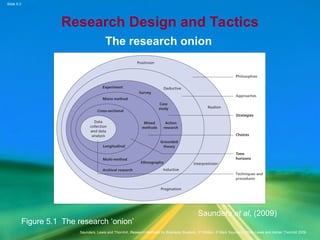
The research onion
Saunders et al, (2009)
Figure 5.1 The research ‘onion’
Slide 5.4
Saunders, Lewis and Thornhill, Research Methods for Business Students, 5th
Edition, © Mark Saunders, Philip Lewis and Adrian Thornhill 2009
Research Design
The research design needs
• Clear objectives derived from the research question
• To specify sources of data collection
• To consider constraints and ethical issues
• Valid reasons for your choice of design
Slide 5.5
Saunders, Lewis and Thornhill, Research Methods for Business Students, 5th
Edition, © Mark Saunders, Philip Lewis and Adrian Thornhill 2009
Multiple research methods
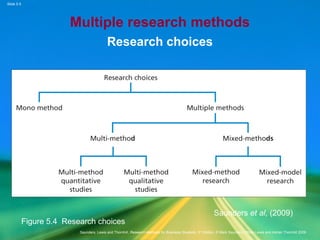
Research choices
Saunders et al, (2009)
Figure 5.4 Research choices
Slide 5.6
Saunders, Lewis and Thornhill, Research Methods for Business Students, 5th
Edition, © Mark Saunders, Philip Lewis and Adrian Thornhill 2009
Multiple research methods
Reasons for using mixed method designs: (Table
5.1 )
• Initiation
• Facilitation
• Complementarity
• Interpretation
• Generalisability
• Diversity
• Problem solving
• Focus
• Triangulation
• Confidence
Source: developed from Bryman (2006)
Slide 5.7
Saunders, Lewis and Thornhill, Research Methods for Business Students, 5th
Edition, © Mark Saunders, Philip Lewis and Adrian Thornhill 2009
Classification of the research purpose
• Exploratory research
• Descriptive studies
• Explanatory studies
Slide 5.8
Saunders, Lewis and Thornhill, Research Methods for Business Students, 5th
Edition, © Mark Saunders, Philip Lewis and Adrian Thornhill 2009
Research Strategies
Experiment Action research
Grounded theory Survey
Ethnography Case study
Archival research
Slide 5.9
Saunders, Lewis and Thornhill, Research Methods for Business Students, 5th
Edition, © Mark Saunders, Philip Lewis and Adrian Thornhill 2009
Research Strategies: Experiment
An experiment will involve
• Definition of a theoretical hypothesis
• Selection of samples from know populations
• Random allocation of samples
• Introduction of planned intervention
• Measurement on a small number of dependent
variables
• Control of all other variables
Slide 5.10
Saunders, Lewis and Thornhill, Research Methods for Business Students, 5th
Edition, © Mark Saunders, Philip Lewis and Adrian Thornhill 2009
Research Strategies: Experiment
Variables
• Independent variable
• Dependent variable
• Mediating variable
• Moderator variable
• Control variable
• Confounding variable
Slide 5.11
Saunders, Lewis and Thornhill, Research Methods for Business Students, 5th
Edition, © Mark Saunders, Philip Lewis and Adrian Thornhill 2009
Research Strategies: Experiment
• Classical experiment
• Quasi experiment
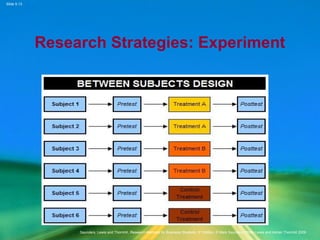
• Between Subject design
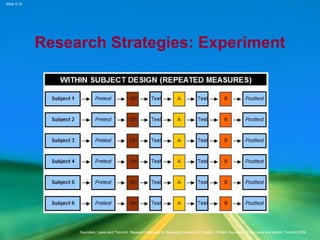
• Within Subject Design
Slide 5.12
Saunders, Lewis and Thornhill, Research Methods for Business Students, 5th
Edition, © Mark Saunders, Philip Lewis and Adrian Thornhill 2009
Research Strategies: Experiment
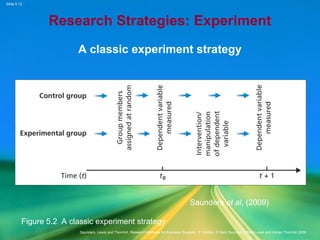
A classic experiment strategy
Saunders et al, (2009)
Figure 5.2 A classic experiment strategy
Slide 5.13
Saunders, Lewis and Thornhill, Research Methods for Business Students, 5th
Edition, © Mark Saunders, Philip Lewis and Adrian Thornhill 2009
Research Strategies: Experiment
Slide 5.14
Saunders, Lewis and Thornhill, Research Methods for Business Students, 5th
Edition, © Mark Saunders, Philip Lewis and Adrian Thornhill 2009
Research Strategies: Experiment
Slide 5.15
Saunders, Lewis and Thornhill, Research Methods for Business Students, 5th
Edition, © Mark Saunders, Philip Lewis and Adrian Thornhill 2009
Research Strategies: Survey
Survey: key features
• Popular in business research
• Perceived as authoritative
• Allows collection of quantitative data
• Data can be analysed quantitatively
• Samples need to be representative
• Gives the researcher independence
• Structured observation and interviews can be used
Slide 5.16
Saunders, Lewis and Thornhill, Research Methods for Business Students, 5th
Edition, © Mark Saunders, Philip Lewis and Adrian Thornhill 2009
Research Strategies: Archival
research
• An archival research makes use of
administrative records and documents as the
principal source of data.
• Focus on RQ that deals with past the
changes over time.
• Primary or secondary data?
Slide 5.17
Saunders, Lewis and Thornhill, Research Methods for Business Students, 5th
Edition, © Mark Saunders, Philip Lewis and Adrian Thornhill 2009
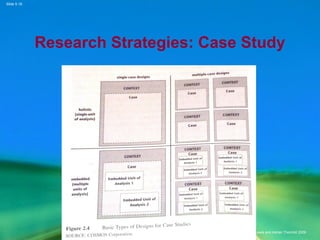
Research Strategies: Case Study
Case Study: key features
• Provides a rich understanding of a real life context
• Uses and triangulates multiple sources of data
A case study can be categorised in four ways
and based on two dimensions:
single case v. multiple case
holistic case v. embedded case
Yin (2003)
Slide 5.18
Saunders, Lewis and Thornhill, Research Methods for Business Students, 5th
Edition, © Mark Saunders, Philip Lewis and Adrian Thornhill 2009
Research Strategies: Case Study
Slide 5.19
Saunders, Lewis and Thornhill, Research Methods for Business Students, 5th
Edition, © Mark Saunders, Philip Lewis and Adrian Thornhill 2009
Research Strategies: Ethnography
• Ethnography is used to study groups.
• Aims to describe and explain the social world
inhabited by the researcher
• It may involve researchers living amongst
those whom they study to observe and talk
to them ion order to produce detail cultural
accounts of their shared beliefs, behaviors,
interactions, language, rituals and the events
that shape their lives.
• Takes place over an extended time period
Slide 5.20
Saunders, Lewis and Thornhill, Research Methods for Business Students, 5th
Edition, © Mark Saunders, Philip Lewis and Adrian Thornhill 2009
Research Strategies
Action research: key features
• Research IN action - not ON action
• Involves practitioners in the research
• The researcher becomes part of the organisation
• Promotes change within the organisation
• Can have two distinct focii (Schein, 1999) –
the aim of the research and the needs of the sponsor
Slide 5.21
Saunders, Lewis and Thornhill, Research Methods for Business Students, 5th
Edition, © Mark Saunders, Philip Lewis and Adrian Thornhill 2009
Research Strategies
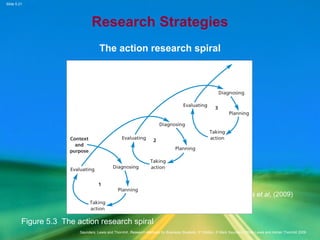
The action research spiral
Saunders et al, (2009)
Figure 5.3 The action research spiral
Slide 5.22
Saunders, Lewis and Thornhill, Research Methods for Business Students, 5th
Edition, © Mark Saunders, Philip Lewis and Adrian Thornhill 2009
Research Strategies
Grounded theory: key features
• Theory is built through induction and deduction
• Helps to predict and explain behaviour
• Develops theory from data generated by
observations
• Is an interpretative process, not a logico-
deductive one
Based on Suddaby (2006)
Slide 5.23
Saunders, Lewis and Thornhill, Research Methods for Business Students, 5th
Edition, © Mark Saunders, Philip Lewis and Adrian Thornhill 2009
Research Strategies
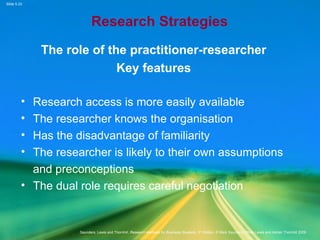
The role of the practitioner-researcher
Key features
• Research access is more easily available
• The researcher knows the organisation
• Has the disadvantage of familiarity
• The researcher is likely to their own assumptions
and preconceptions
• The dual role requires careful negotiation
Slide 5.24
Saunders, Lewis and Thornhill, Research Methods for Business Students, 5th
Edition, © Mark Saunders, Philip Lewis and Adrian Thornhill 2009
Time Horizons
Select the appropriate time horizon
• Cross-sectional studies
• Longitudinal studies
Slide 5.25
Saunders, Lewis and Thornhill, Research Methods for Business Students, 5th
Edition, © Mark Saunders, Philip Lewis and Adrian Thornhill 2009
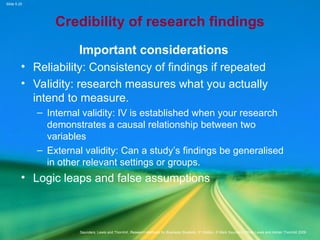
Credibility of research findings
Important considerations
• Reliability: Consistency of findings if repeated
• Validity: research measures what you actually
intend to measure.
– Internal validity: IV is established when your research
demonstrates a causal relationship between two
variables
– External validity: Can a study’s findings be generalised
in other relevant settings or groups.
• Logic leaps and false assumptions
Slide 5.26
Saunders, Lewis and Thornhill, Research Methods for Business Students, 5th
Edition, © Mark Saunders, Philip Lewis and Adrian Thornhill 2009
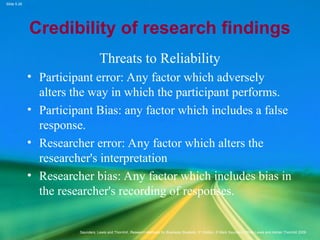
Credibility of research findings
Threats to Reliability
• Participant error: Any factor which adversely
alters the way in which the participant performs.
• Participant Bias: any factor which includes a false
response.
• Researcher error: Any factor which alters the
researcher's interpretation
• Researcher bias: Any factor which includes bias in
the researcher's recording of responses.
Slide 5.27
Saunders, Lewis and Thornhill, Research Methods for Business Students, 5th
Edition, © Mark Saunders, Philip Lewis and Adrian Thornhill 2009
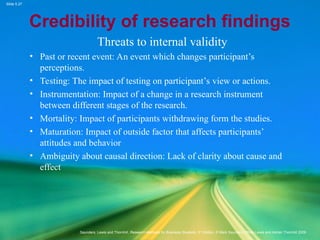
Credibility of research findings
Threats to internal validity
• Past or recent event: An event which changes participant’s
perceptions.
• Testing: The impact of testing on participant’s view or actions.
• Instrumentation: Impact of a change in a research instrument
between different stages of the research.
• Mortality: Impact of participants withdrawing form the studies.
• Maturation: Impact of outside factor that affects participants’
attitudes and behavior
• Ambiguity about causal direction: Lack of clarity about cause and
effect
Slide 5.28
Saunders, Lewis and Thornhill, Research Methods for Business Students, 5th
Edition, © Mark Saunders, Philip Lewis and Adrian Thornhill 2009
Research design ethics
Remember
‘The research design should not subject the
research population to embarrassment, harm or
other material disadvantage’
Adapted from Saunders et al, (2009)
Slide 5.29
Saunders, Lewis and Thornhill, Research Methods for Business Students, 5th
Edition, © Mark Saunders, Philip Lewis and Adrian Thornhill 2009
Summary: Chapter 5
Research design turns a research question and
objectives into a project that considers
Strategies Choices Time horizons
Research projects can be categorised as
Exploratory Descriptive Explanatory
Research projects may be
Cross-sectional Longitudinal
Slide 5.30
Saunders, Lewis and Thornhill, Research Methods for Business Students, 5th
Edition, © Mark Saunders, Philip Lewis and Adrian Thornhill 2009
Summary: Chapter 5
Important considerations
• The main research strategies may combined in
the same project
• The opportunities provided by using multiple
methods
• The validity and reliability of results
• Access and ethical considerations

Formulating the Research Design ChAPTER 05

  • 1.
    Slide 5.1 Saunders, Lewisand Thornhill, Research Methods for Business Students, 5th Edition, © Mark Saunders, Philip Lewis and Adrian Thornhill 2009 Chapter 5 Formulating the research design
  • 2.
    Slide 5.2 Saunders, Lewisand Thornhill, Research Methods for Business Students, 5th Edition, © Mark Saunders, Philip Lewis and Adrian Thornhill 2009 The Process of Research Design • Research choices • Research strategies • Time horizons
  • 3.
    Slide 5.3 Saunders, Lewisand Thornhill, Research Methods for Business Students, 5th Edition, © Mark Saunders, Philip Lewis and Adrian Thornhill 2009 Research Design and Tactics The research onion Saunders et al, (2009) Figure 5.1 The research ‘onion’
  • 4.
    Slide 5.4 Saunders, Lewisand Thornhill, Research Methods for Business Students, 5th Edition, © Mark Saunders, Philip Lewis and Adrian Thornhill 2009 Research Design The research design needs • Clear objectives derived from the research question • To specify sources of data collection • To consider constraints and ethical issues • Valid reasons for your choice of design
  • 5.
    Slide 5.5 Saunders, Lewisand Thornhill, Research Methods for Business Students, 5th Edition, © Mark Saunders, Philip Lewis and Adrian Thornhill 2009 Multiple research methods Research choices Saunders et al, (2009) Figure 5.4 Research choices
  • 6.
    Slide 5.6 Saunders, Lewisand Thornhill, Research Methods for Business Students, 5th Edition, © Mark Saunders, Philip Lewis and Adrian Thornhill 2009 Multiple research methods Reasons for using mixed method designs: (Table 5.1 ) • Initiation • Facilitation • Complementarity • Interpretation • Generalisability • Diversity • Problem solving • Focus • Triangulation • Confidence Source: developed from Bryman (2006)
  • 7.
    Slide 5.7 Saunders, Lewisand Thornhill, Research Methods for Business Students, 5th Edition, © Mark Saunders, Philip Lewis and Adrian Thornhill 2009 Classification of the research purpose • Exploratory research • Descriptive studies • Explanatory studies
  • 8.
    Slide 5.8 Saunders, Lewisand Thornhill, Research Methods for Business Students, 5th Edition, © Mark Saunders, Philip Lewis and Adrian Thornhill 2009 Research Strategies Experiment Action research Grounded theory Survey Ethnography Case study Archival research
  • 9.
    Slide 5.9 Saunders, Lewisand Thornhill, Research Methods for Business Students, 5th Edition, © Mark Saunders, Philip Lewis and Adrian Thornhill 2009 Research Strategies: Experiment An experiment will involve • Definition of a theoretical hypothesis • Selection of samples from know populations • Random allocation of samples • Introduction of planned intervention • Measurement on a small number of dependent variables • Control of all other variables
  • 10.
    Slide 5.10 Saunders, Lewisand Thornhill, Research Methods for Business Students, 5th Edition, © Mark Saunders, Philip Lewis and Adrian Thornhill 2009 Research Strategies: Experiment Variables • Independent variable • Dependent variable • Mediating variable • Moderator variable • Control variable • Confounding variable
  • 11.
    Slide 5.11 Saunders, Lewisand Thornhill, Research Methods for Business Students, 5th Edition, © Mark Saunders, Philip Lewis and Adrian Thornhill 2009 Research Strategies: Experiment • Classical experiment • Quasi experiment • Between Subject design • Within Subject Design
  • 12.
    Slide 5.12 Saunders, Lewisand Thornhill, Research Methods for Business Students, 5th Edition, © Mark Saunders, Philip Lewis and Adrian Thornhill 2009 Research Strategies: Experiment A classic experiment strategy Saunders et al, (2009) Figure 5.2 A classic experiment strategy
  • 13.
    Slide 5.13 Saunders, Lewisand Thornhill, Research Methods for Business Students, 5th Edition, © Mark Saunders, Philip Lewis and Adrian Thornhill 2009 Research Strategies: Experiment
  • 14.
    Slide 5.14 Saunders, Lewisand Thornhill, Research Methods for Business Students, 5th Edition, © Mark Saunders, Philip Lewis and Adrian Thornhill 2009 Research Strategies: Experiment
  • 15.
    Slide 5.15 Saunders, Lewisand Thornhill, Research Methods for Business Students, 5th Edition, © Mark Saunders, Philip Lewis and Adrian Thornhill 2009 Research Strategies: Survey Survey: key features • Popular in business research • Perceived as authoritative • Allows collection of quantitative data • Data can be analysed quantitatively • Samples need to be representative • Gives the researcher independence • Structured observation and interviews can be used
  • 16.
    Slide 5.16 Saunders, Lewisand Thornhill, Research Methods for Business Students, 5th Edition, © Mark Saunders, Philip Lewis and Adrian Thornhill 2009 Research Strategies: Archival research • An archival research makes use of administrative records and documents as the principal source of data. • Focus on RQ that deals with past the changes over time. • Primary or secondary data?
  • 17.
    Slide 5.17 Saunders, Lewisand Thornhill, Research Methods for Business Students, 5th Edition, © Mark Saunders, Philip Lewis and Adrian Thornhill 2009 Research Strategies: Case Study Case Study: key features • Provides a rich understanding of a real life context • Uses and triangulates multiple sources of data A case study can be categorised in four ways and based on two dimensions: single case v. multiple case holistic case v. embedded case Yin (2003)
  • 18.
    Slide 5.18 Saunders, Lewisand Thornhill, Research Methods for Business Students, 5th Edition, © Mark Saunders, Philip Lewis and Adrian Thornhill 2009 Research Strategies: Case Study
  • 19.
    Slide 5.19 Saunders, Lewisand Thornhill, Research Methods for Business Students, 5th Edition, © Mark Saunders, Philip Lewis and Adrian Thornhill 2009 Research Strategies: Ethnography • Ethnography is used to study groups. • Aims to describe and explain the social world inhabited by the researcher • It may involve researchers living amongst those whom they study to observe and talk to them ion order to produce detail cultural accounts of their shared beliefs, behaviors, interactions, language, rituals and the events that shape their lives. • Takes place over an extended time period
  • 20.
    Slide 5.20 Saunders, Lewisand Thornhill, Research Methods for Business Students, 5th Edition, © Mark Saunders, Philip Lewis and Adrian Thornhill 2009 Research Strategies Action research: key features • Research IN action - not ON action • Involves practitioners in the research • The researcher becomes part of the organisation • Promotes change within the organisation • Can have two distinct focii (Schein, 1999) – the aim of the research and the needs of the sponsor
  • 21.
    Slide 5.21 Saunders, Lewisand Thornhill, Research Methods for Business Students, 5th Edition, © Mark Saunders, Philip Lewis and Adrian Thornhill 2009 Research Strategies The action research spiral Saunders et al, (2009) Figure 5.3 The action research spiral
  • 22.
    Slide 5.22 Saunders, Lewisand Thornhill, Research Methods for Business Students, 5th Edition, © Mark Saunders, Philip Lewis and Adrian Thornhill 2009 Research Strategies Grounded theory: key features • Theory is built through induction and deduction • Helps to predict and explain behaviour • Develops theory from data generated by observations • Is an interpretative process, not a logico- deductive one Based on Suddaby (2006)
  • 23.
    Slide 5.23 Saunders, Lewisand Thornhill, Research Methods for Business Students, 5th Edition, © Mark Saunders, Philip Lewis and Adrian Thornhill 2009 Research Strategies The role of the practitioner-researcher Key features • Research access is more easily available • The researcher knows the organisation • Has the disadvantage of familiarity • The researcher is likely to their own assumptions and preconceptions • The dual role requires careful negotiation
  • 24.
    Slide 5.24 Saunders, Lewisand Thornhill, Research Methods for Business Students, 5th Edition, © Mark Saunders, Philip Lewis and Adrian Thornhill 2009 Time Horizons Select the appropriate time horizon • Cross-sectional studies • Longitudinal studies
  • 25.
    Slide 5.25 Saunders, Lewisand Thornhill, Research Methods for Business Students, 5th Edition, © Mark Saunders, Philip Lewis and Adrian Thornhill 2009 Credibility of research findings Important considerations • Reliability: Consistency of findings if repeated • Validity: research measures what you actually intend to measure. – Internal validity: IV is established when your research demonstrates a causal relationship between two variables – External validity: Can a study’s findings be generalised in other relevant settings or groups. • Logic leaps and false assumptions
  • 26.
    Slide 5.26 Saunders, Lewisand Thornhill, Research Methods for Business Students, 5th Edition, © Mark Saunders, Philip Lewis and Adrian Thornhill 2009 Credibility of research findings Threats to Reliability • Participant error: Any factor which adversely alters the way in which the participant performs. • Participant Bias: any factor which includes a false response. • Researcher error: Any factor which alters the researcher's interpretation • Researcher bias: Any factor which includes bias in the researcher's recording of responses.
  • 27.
    Slide 5.27 Saunders, Lewisand Thornhill, Research Methods for Business Students, 5th Edition, © Mark Saunders, Philip Lewis and Adrian Thornhill 2009 Credibility of research findings Threats to internal validity • Past or recent event: An event which changes participant’s perceptions. • Testing: The impact of testing on participant’s view or actions. • Instrumentation: Impact of a change in a research instrument between different stages of the research. • Mortality: Impact of participants withdrawing form the studies. • Maturation: Impact of outside factor that affects participants’ attitudes and behavior • Ambiguity about causal direction: Lack of clarity about cause and effect
  • 28.
    Slide 5.28 Saunders, Lewisand Thornhill, Research Methods for Business Students, 5th Edition, © Mark Saunders, Philip Lewis and Adrian Thornhill 2009 Research design ethics Remember ‘The research design should not subject the research population to embarrassment, harm or other material disadvantage’ Adapted from Saunders et al, (2009)
  • 29.
    Slide 5.29 Saunders, Lewisand Thornhill, Research Methods for Business Students, 5th Edition, © Mark Saunders, Philip Lewis and Adrian Thornhill 2009 Summary: Chapter 5 Research design turns a research question and objectives into a project that considers Strategies Choices Time horizons Research projects can be categorised as Exploratory Descriptive Explanatory Research projects may be Cross-sectional Longitudinal
  • 30.
    Slide 5.30 Saunders, Lewisand Thornhill, Research Methods for Business Students, 5th Edition, © Mark Saunders, Philip Lewis and Adrian Thornhill 2009 Summary: Chapter 5 Important considerations • The main research strategies may combined in the same project • The opportunities provided by using multiple methods • The validity and reliability of results • Access and ethical considerations