Chapter -1
History of communication:
 Communication can range from very subtle processes
of exchange, to full conversations and mass
communication. Human communication was
revolutionized with speech approximately 200,000
years ago. Symbols were developed about 30,000 years
ago, and writing in the past few centuries.
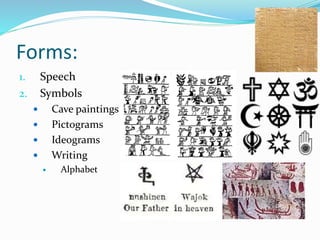
Forms:
1. Speech
2. Symbols
 Cave paintings
 Pictograms
 Ideograms
 Writing
 Alphabet
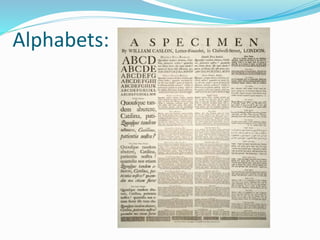
Alphabets:
Business communication:
 Encompasses such topics as marketing, brand
management, customer relations, consumer
behaviour, advertising,public relations, corporate
communication, community engagement, reputation
management, interpersonalcommunication,
employee engagement, and event management.
 It is closely related to the fields of professional
communication and technical communication.
 Media channels for business communication include
the Internet, print media, radio, television, ambient
media, and word of mouth.
Methods of business communication:
 Web-based communication
 video conferencing
 e-mails
 Reports
 Presentations
 telephoned
 speech
 forum boards
 face-to-face meetings,
 suggestion
Types of business communication:
 Verbal communication: use of words for communicating.
 Non-verbal communication: uses body language and
various other physical gestures as a means for
communicating.
 Written communication: includes written forms for
communicating.
 Employment communication: used for accepting the
applicants for a job.
 Electronic communication: includes electronics and latest
technology for communicating such as teleconferencing e-
mail, etc.
 Team B Communication: exists in the cyber classroom
where solid teamwork and collaboration results in excellent
grades in academia.
Reasons for Business Communication
Barriers:
 Complex Messages
 Withholding Information
 Different Status
 Ineffective Communication Processes
 Lack of Trust.
 Language barrier
Types of Information Exchanged in
Business organization:
 Statutory information
 Regular work situation
 Major policy or operation change information
 Communication by expectancy
Role of communication in Business
Organizations:
 Information sharing
 Feedback
 Influence
 Problem solving
 Assist in decision-making
 Facilitating change
 Group building
 Gate keeping
 Conveying right message
 Helps in co ordination effort
 Good industrial relations
 Development of managerial skills
 Ensuring effectiveness of policies
 Motivating people
 Performance feedback
 Job instruction
 Controlling people
 Useful as grapevine
 Emotive function
Important functions of Managing:
 Forecasting- objectives and policies
 Planning- programmes , procedures and budgets
 Organizing- organizational structure
 Instructing-performance oriented
 Coordinating-efforts directed towards
organizational goals
 Controlling-checks results, receives feedback.
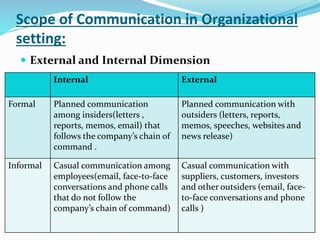
Scope of Communication in Organizational
setting:
 External and Internal Dimension
Internal External
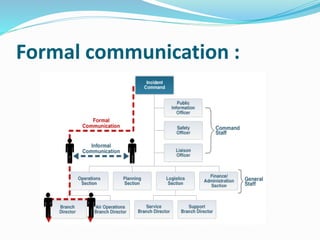
Formal Planned communication
among insiders(letters ,
reports, memos, email) that
follows the company’s chain of
command .
Planned communication with
outsiders (letters, reports,
memos, speeches, websites and
news release)
Informal Casual communication among
employees(email, face-to-face
conversations and phone calls
that do not follow the
company’s chain of command)
Casual communication with
suppliers, customers, investors
and other outsiders (email, face-
to-face conversations and phone
calls )
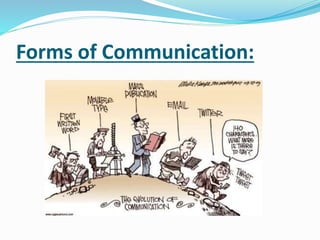
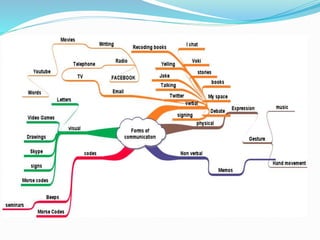
Forms of Communication:
 Provide practical information
 Give facts rather than impressions
 Clarify and condense information
 State precise responsibilities
 Persuade others and offer recommendations
New trends in Business Communication:
 New communication environment
 New communication Technologies
 Globalization of markets
 Increasing diverse workforce
 New work environments
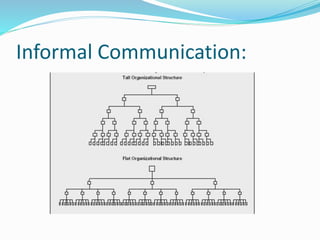
 Flattened management Hierarchies
 Team based management
 New knowledge Economy
Ethical challenges and Traps in Business:
 Cutting corners on quality
 Covering up incidents
 Abusing or lying about sick days
 Deceiving customers
 Lying to a supervisor or underlying
 Taking credit for a colleague’s idea
Other unethical Traps:
 Plagiarism, Selecting misquoting, Mis-
representing numbers
 Distorting visuals
Five common ethical traps:
 The false necessity Trap
 The Doctrine-of-relative – filth Trap
 The Rationalization Trap
 The Self-Deception Trap
 The ends-Justify-the-Means Trap
Communication in Management:
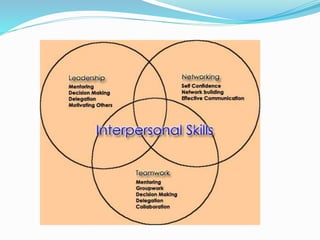
 Interpersonal
 Informational
 Decisional
Chapter -2
Definition:
 “Communication is the sum of all things, one person
does when he wants to create understanding in the
minds of another. It involves a systematic and
continuous process of telling, listening and
understanding”.
- Allen Louis
 “Communication is interchange of thoughts,
opinions, or information, by speech, writing, or
signs”.
-Robert Anderson
Nature of Communication:
 It is process
 It is inevitable
 Meaning based
 Communication is intentional/unintentional
 Communication is systematic
 A two way traffic
 Communication is a social process
 A dynamic process
 Continuous process
 Communication is both interaction and transaction
 It is spiraling process
 It is contextual
 Needs proper understanding
 Leads to organizational objective
 Dispels mis - understanding
 It is all-pervasive
 It is the lifeblood of the business
Objectives and Purpose of Communication:
 To inform
 To persuade
 To educate
 To train
 To Motivate
 To Integrate
 To Relate
 To Entertain
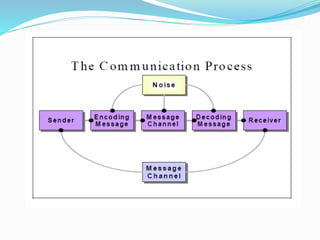
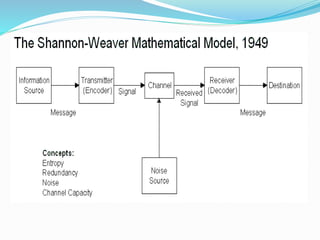
Elements of Communication:
 Sender/Encoder/Speaker
 Receiver/Decoder/Listener
 Message
 Medium
 Feedback
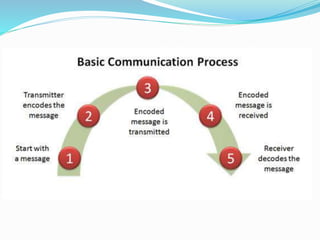
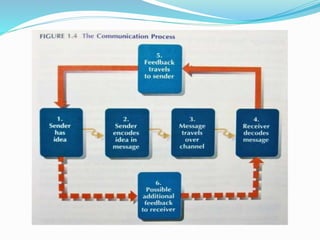
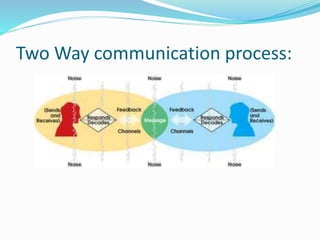
Two Way communication process:
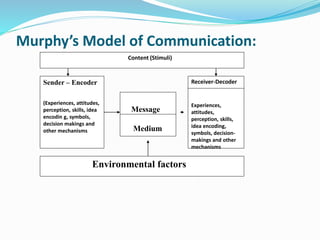
Murphy’s Model of Communication:
Sender – Encoder
(Experiences, attitudes,
perception, skills, idea
encodin g, symbols,
decision makings and
other mechanisms
Message
Medium
Receiver-Decoder
Experiences,
attitudes,
perception, skills,
idea encoding,
symbols, decision-
makings and other
mechanisms
Content (Stimuli)
Environmental factors
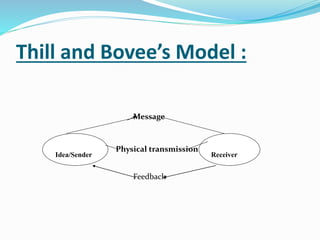
Thill and Bovee’s Model :
Idea/Sender Receiver
Message
Physical transmission
Feedback
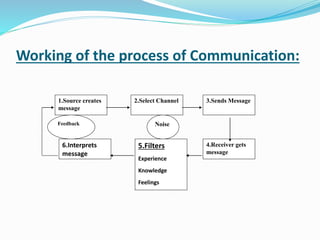
Working of the process of Communication:
1.Source creates
message
6.Interprets
message
5.Filters
Experience
Knowledge
Feelings
4.Receiver gets
message
3.Sends Message2.Select Channel
NoiseFeedback
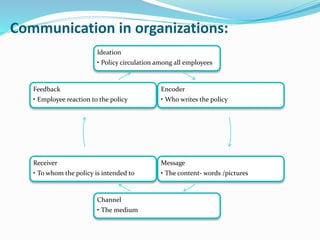
Communication in organizations:
Ideation
• Policy circulation among all employees
Encoder
• Who writes the policy
Message
• The content- words /pictures
Channel
• The medium
Receiver
• To whom the policy is intended to
Feedback
• Employee reaction to the policy
Activity:
 Watching TV
 Talking To A Friend Over Phone
 Interview
 Attending A Lecture
 Watching A Cricket match
 Conference
 Listening Music
 Writing personal Dairy
 Attending A Speech
Activity 2:
 This first Activity involves you in transposing a piece of
information. A supplier has sent you a document and you
want to communicate its main points to a section of your
staff. The staff concerned are those working directly with
the new machinery that is being discussed in the
document. This new equipment is an integral part of a
drive to improve efficiency so its successful
implementation is seen as being important.
 Your task is to summarise the main points in the following
document in as few a words as possible. It is a document
sent by Supplier X to Company B regarding the delivery of
the new equipment ordered by Company B.
 This machine is a highly specialized precision built piece and as such
needs to be handled with care. The Company (hereafter referred to as
the 'Supplier') will not be liable for any damage caused by incorrect
usage or failure to follow the guidelines contained in the manual and
online help facility provided by the purchaser (hereafter referred to as
the 'Buyer').
 The machine must be installed by fully qualified IS0 9000 accredited
engineers according to the specifications laid down in the contract of
purchase. Notwithstanding the liability of the Supplier for any defects in
the manufacture of the equipment prior to delivery, the Buyer must
ensure familiarity with the conditions of installation and operation at all
times.
 Installation should be carried out under ambient temperatures -
extremes of temperature should be avoided. The equipment must be
stored in the eventual location for a period not less than 36 hours prior
to unpack aging to allow for the dispersal of any condensation that
could affect internal components. Once this has been completed the
packaging must be removed in strict order as detailed in the
aforementioned manual. The power supply is designed for use in UK
and European countries utilizing 240v AC supplies. Any variations to
such power supplies must be corrected by the use of suitable
transformers at the expense of the Buyer. No warranty can be offered for
incorrect power supplies and the subsequent damage this could cause.
 The unit must be fully earthed and wired in accordance with the
regulations laid down by the regulatory bodies dealing with health and
safety in the workplace in the relevant country of use as well as any
regulations appertaining to member states of the European Union.
 The unit needs to be powered up on completing the installation and run
for a period no less than 48 hours but no more than 72 hours, before
loading appropriate raw materials onto the machine. Introduction of the
raw materials must only be carried out following certification of the
working order of the machine by the appropriate supervisor who should
register the successful trial run with the Supplier.
 Periodically, the machine must be shut down and fully cleaned. The
period of continued use must not exceed 27 days in any one calendar
month but can be less as dictated by the usage of the machine.
Maintenance must not be carried out by any site employee from the Buyer;
such maintenance will invalidate any warranty on the machine.
 Changes to the operational features can be made through amending the
software settings. Any person so doing must be fully conversant with M
(Mumps) language and the characteristics of distributed cache protocol
and the relational capabilities of the language with SQL.
 We hope that you enjoy using this machine and that it adds to the
efficiency and productivity of the business.
Activity 3:
 Below is a list of different business situations that
might involve different methods of communication.
Choose an appropriate medium and method of
communication as well as who might need to be part
of the communication and explain the possible
problems that might arise in ensuring the
communication is delivered successfully.
 Notification of the intention to increase bonus payments for all full time
staff
 Plans to consider relocation of a section of the business to India
 Amendments to holiday entitlement for all full time and part time staff
 Notification about a visit to the business by a minister from the
Department of Trade and Industry (DTI) on a fact-finding mission about
small and medium sized enterprises (SMEs)
 Plans are being discussed to introduce a new appraisal system for all staff
within the next 18 months
 The Technical Support Unit have recommended that all computers move
to a Unix platform from the current Windows platform
 A minute's silence at the firm is to be held in memory of the victims of a
natural disaster
 A meeting is being held to celebrate the retirement of a member of the
firm who has been with the company for 30 years.
 5 members of a team of 15 people in the distribution section of a business
have to be made redundant
 The firm has received a takeover approach from a rival and it looks like the
shareholders will accept the bid
 Several customers are threatening to report the firm to Trading Standards
officers after they reported health problems after eating food produced by
the firm
ACTIVITY 4 :
 Look at the conversation below - what do you think are
the elements of the communication that is going on in
the conversation? What can you conclude about the
aims and objectives of the two parties in the
conversation? Try to look for the subtle as well as the
obvious communication that may be going on in this
extract.
 Helen Rofe is the team leader for a sales section
dealing with the north west of England. 18
months ago, she returned from maternity leave
and has since had some gaps in her attendance
following a long-term illness of her daughter.Her
section leader, Norman Trubshaw, has asked to
see her about the disappointing sales figures the
team have achieved in the last quarter - the first
time the team has missed its targets in 5 years.
 NT: Ah, Helen, come on in, sit down my dear.
HR: What do you want to see me about Mr Trubshaw?
NT: Just a quick chat about the last quarter sales targets.
HR: Really, what's the problem with them? I haven't had chance to study them yet as they were only released to the Section Heads yesterday.
NT: Well, I am afraid they don't make good reading: targets were missed by 20% without any apparent external reasons. I wanted to know
what your thoughts on the reasoning might be?
HR: It has been a difficult period - there seems to be a reaction to the interest rate rises and spending seems to have dropped in general.
NT: None of the other regions seem to have suffered like that; are you suggesting that the north west is somehow different to everywhere else?
HR: No, not at all I am just trying to offer a possible answer to your question, as I haven't had any time to investigate this in any detail.
NT: Ah - there, my dear, might lie the problem: time. Things have not been easy since you returned, have they?
HR: No.
NT: Could that explain why these figures are so poor?
HR: I don't think so - the team have worked as hard as they ever do.
NT: Hmm, tell me Helen, how does your husband view you coming back to work?
HR: I am not sure that question has any relevance to the targets, Mr Trubshaw. What are you getting at?
NT: Nothing at all my dear, just trying to understand the situation you find yourself in. My wife has always been a housewife, you see, and I
don't know how you manage to do everything.
HR: I manage fine, thank you. What I will do, Mr Trubshaw, is to get hold of the figures if you will give me the appropriate links to the data
and I will get back to you by the end of this week - no, sorry, can we make that the start of next week, as I have an appointment at the hospital
for a couple of hours with Charlotte on Friday?
NT: Well, OK but make sure it is ready for then, Helen. I don't want this situation to get any further out of hand.
Word Activity:
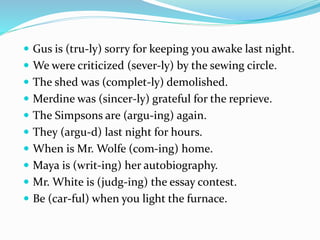
 Group A: To E or Not to E?
 Some of the words in parentheses require the addition
of the letter e; others are correct as they stand.
 Gus is (tru-ly) sorry for keeping you awake last night.
 We were criticized (sever-ly) by the sewing circle.
 The shed was (complet-ly) demolished.
 Merdine was (sincer-ly) grateful for the reprieve.
 The Simpsons are (argu-ing) again.
 They (argu-d) last night for hours.
 When is Mr. Wolfe (com-ing) home.
 Maya is (writ-ing) her autobiography.
 Mr. White is (judg-ing) the essay contest.
 Be (car-ful) when you light the furnace.
 ANSWERS--GROUP A
1. truly;
 2. severely;
 3. completely;
 4. sincerely;
 5. arguing;
 6. argued;
 7. coming;
 8. writing;
 9. judging;
 10. careful.
Group B: IE or EI?
 Group B: IE or EI?
 Some of the words require the addition of ie; others
require ei.
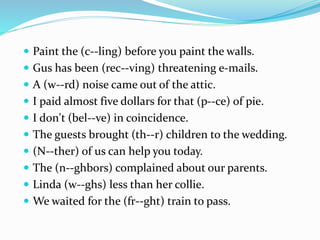
 Paint the (c--ling) before you paint the walls.
 Gus has been (rec--ving) threatening e-mails.
 A (w--rd) noise came out of the attic.
 I paid almost five dollars for that (p--ce) of pie.
 I don't (bel--ve) in coincidence.
 The guests brought (th--r) children to the wedding.
 (N--ther) of us can help you today.
 The (n--ghbors) complained about our parents.
 Linda (w--ghs) less than her collie.
 We waited for the (fr--ght) train to pass.
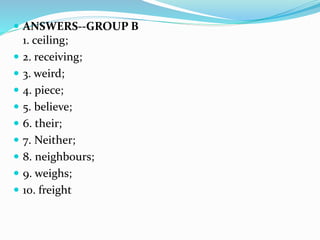
 ANSWERS--GROUP B
1. ceiling;
 2. receiving;
 3. weird;
 4. piece;
 5. believe;
 6. their;
 7. Neither;
 8. neighbours;
 9. weighs;
 10. freight
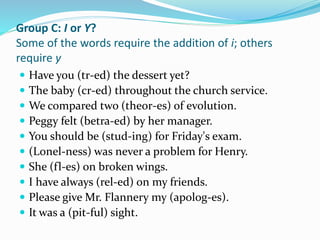
Group C: I or Y?
Some of the words require the addition of i; others
require y
 Have you (tr-ed) the dessert yet?
 The baby (cr-ed) throughout the church service.
 We compared two (theor-es) of evolution.
 Peggy felt (betra-ed) by her manager.
 You should be (stud-ing) for Friday's exam.
 (Lonel-ness) was never a problem for Henry.
 She (fl-es) on broken wings.
 I have always (rel-ed) on my friends.
 Please give Mr. Flannery my (apolog-es).
 It was a (pit-ful) sight.
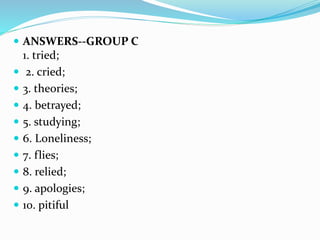
 ANSWERS--GROUP C
1. tried;
 2. cried;
 3. theories;
 4. betrayed;
 5. studying;
 6. Loneliness;
 7. flies;
 8. relied;
 9. apologies;
 10. pitiful
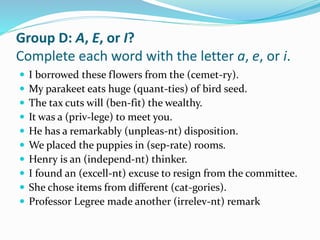
Group D: A, E, or I?
Complete each word with the letter a, e, or i.
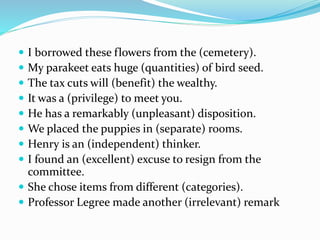
 I borrowed these flowers from the (cemet-ry).
 My parakeet eats huge (quant-ties) of bird seed.
 The tax cuts will (ben-fit) the wealthy.
 It was a (priv-lege) to meet you.
 He has a remarkably (unpleas-nt) disposition.
 We placed the puppies in (sep-rate) rooms.
 Henry is an (independ-nt) thinker.
 I found an (excell-nt) excuse to resign from the committee.
 She chose items from different (cat-gories).
 Professor Legree made another (irrelev-nt) remark
 I borrowed these flowers from the (cemetery).
 My parakeet eats huge (quantities) of bird seed.
 The tax cuts will (benefit) the wealthy.
 It was a (privilege) to meet you.
 He has a remarkably (unpleasant) disposition.
 We placed the puppies in (separate) rooms.
 Henry is an (independent) thinker.
 I found an (excellent) excuse to resign from the
committee.
 She chose items from different (categories).
 Professor Legree made another (irrelevant) remark
 ANSWERS--GROUP D
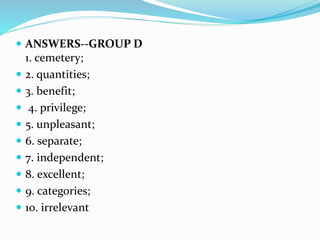
1. cemetery;
 2. quantities;
 3. benefit;
 4. privilege;
 5. unpleasant;
 6. separate;
 7. independent;
 8. excellent;
 9. categories;
 10. irrelevant
Group E: Single or Double?
Some of these words require the doubling of a consonant;
others are correct as they stand
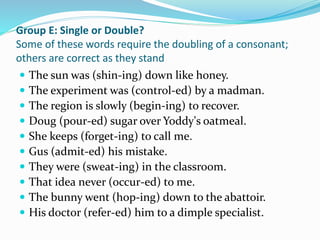
 The sun was (shin-ing) down like honey.
 The experiment was (control-ed) by a madman.
 The region is slowly (begin-ing) to recover.
 Doug (pour-ed) sugar over Yoddy's oatmeal.
 She keeps (forget-ing) to call me.
 Gus (admit-ed) his mistake.
 They were (sweat-ing) in the classroom.
 That idea never (occur-ed) to me.
 The bunny went (hop-ing) down to the abattoir.
 His doctor (refer-ed) him to a dimple specialist.
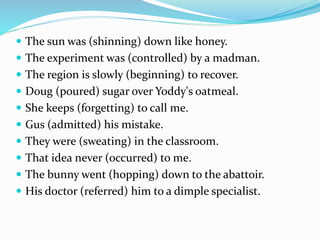
 The sun was (shinning) down like honey.
 The experiment was (controlled) by a madman.
 The region is slowly (beginning) to recover.
 Doug (poured) sugar over Yoddy's oatmeal.
 She keeps (forgetting) to call me.
 Gus (admitted) his mistake.
 They were (sweating) in the classroom.
 That idea never (occurred) to me.
 The bunny went (hopping) down to the abattoir.
 His doctor (referred) him to a dimple specialist.
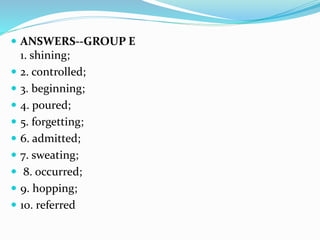
 ANSWERS--GROUP E
1. shining;
 2. controlled;
 3. beginning;
 4. poured;
 5. forgetting;
 6. admitted;
 7. sweating;
 8. occurred;
 9. hopping;
 10. referred
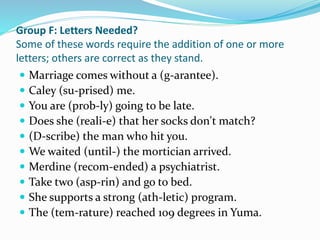
Group F: Letters Needed?
Some of these words require the addition of one or more
letters; others are correct as they stand.
 Marriage comes without a (g-arantee).
 Caley (su-prised) me.
 You are (prob-ly) going to be late.
 Does she (reali-e) that her socks don't match?
 (D-scribe) the man who hit you.
 We waited (until-) the mortician arrived.
 Merdine (recom-ended) a psychiatrist.
 Take two (asp-rin) and go to bed.
 She supports a strong (ath-letic) program.
 The (tem-rature) reached 109 degrees in Yuma.
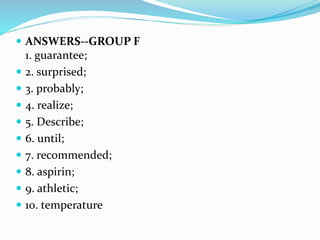
 ANSWERS--GROUP F
1. guarantee;
 2. surprised;
 3. probably;
 4. realize;
 5. Describe;
 6. until;
 7. recommended;
 8. aspirin;
 9. athletic;
 10. temperature
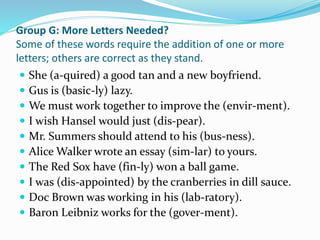
Group G: More Letters Needed?
Some of these words require the addition of one or more
letters; others are correct as they stand.
 She (a-quired) a good tan and a new boyfriend.
 Gus is (basic-ly) lazy.
 We must work together to improve the (envir-ment).
 I wish Hansel would just (dis-pear).
 Mr. Summers should attend to his (bus-ness).
 Alice Walker wrote an essay (sim-lar) to yours.
 The Red Sox have (fin-ly) won a ball game.
 I was (dis-appointed) by the cranberries in dill sauce.
 Doc Brown was working in his (lab-ratory).
 Baron Leibniz works for the (gover-ment).
 ANSWERS--GROUP G
1. acquired;
 2. basically;
 3. environment;
 4. disappear;
 5. business;
 6. similar;
 7. finally;
 8. disappointed;
 9. laboratory;
 10. government
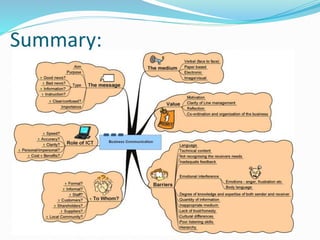
Summary
 The medium
 Verbal (face to face)
 Paper based
 Electronic
 Image/visual
 Value
 Motivation
 Clarity of Line management
 Reflection
 Co-ordination and organization of the business
 Barriers
 Language
 Technical content
 Not recognizing the receivers needs
 Inadequate feedback
 Emotional interference
 Emotions - anger, frustration, etc.
 Body language
 Degree of knowledge and expertise of both sender and receiver
 Quantity of information
 Inappropriate medium
 Lack of trust/honesty
 Cultural differences
 Poor listening skills
 Hierarchy
 To Whom?
 Formal?
 Informal?
 Staff?
 Customers?
 Shareholders?
 Suppliers?
 Local Community?
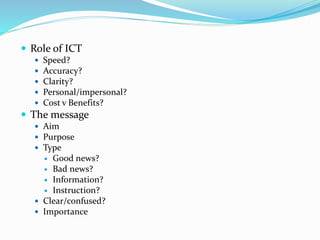
 Role of ICT
 Speed?
 Accuracy?
 Clarity?
 Personal/impersonal?
 Cost v Benefits?
 The message
 Aim
 Purpose
 Type
 Good news?
 Bad news?
 Information?
 Instruction?
 Clear/confused?
 Importance
Summary:
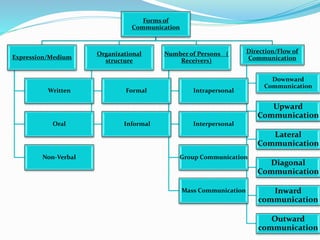
Forms of Communication:
Forms of
Communication
Expression/Medium
Written
Oral
Non-Verbal
Organizational
structure
Formal
Informal
Number of Persons (
Receivers)
Intrapersonal
Interpersonal
Group Communication
Mass Communication
Direction/Flow of
Communication
Downward
Communication
Upward
Communication
Lateral
Communication
Diagonal
Communication
Inward
communication
Outward
communication
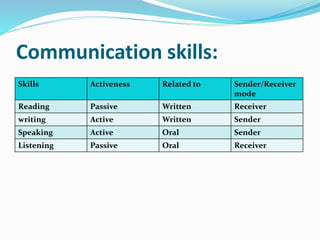
Communication skills:
Skills Activeness Related to Sender/Receiver
mode
Reading Passive Written Receiver
writing Active Written Sender
Speaking Active Oral Sender
Listening Passive Oral Receiver
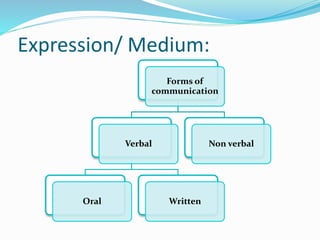
Expression/ Medium:
Forms of
communication
Verbal
Oral Written
Non verbal
Written communication :
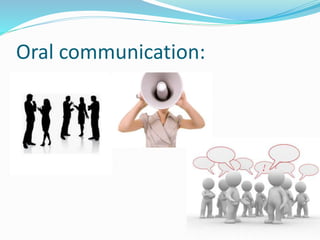
Oral communication:
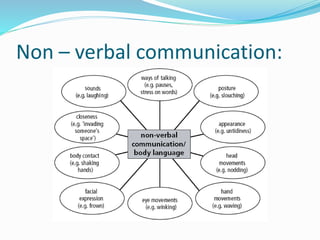
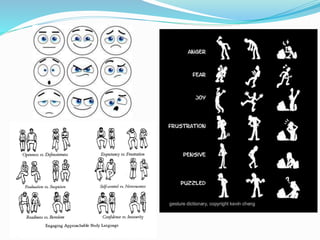
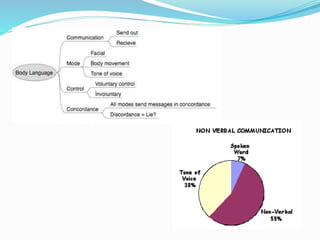
Non – verbal communication:
Formal communication :
Informal Communication:
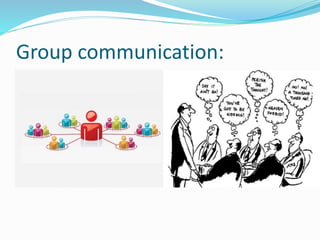
Group communication:
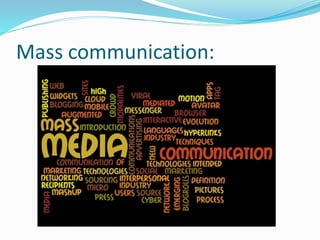
Mass communication:
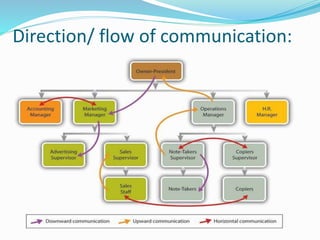
Direction/ flow of communication:
Business communication part 1- Introduction

Business communication part 1- Introduction

  • 1.
  • 2.
    History of communication: Communication can range from very subtle processes of exchange, to full conversations and mass communication. Human communication was revolutionized with speech approximately 200,000 years ago. Symbols were developed about 30,000 years ago, and writing in the past few centuries.
  • 3.
    Forms: 1. Speech 2. Symbols Cave paintings  Pictograms  Ideograms  Writing  Alphabet
  • 4.
  • 5.
    Business communication:  Encompassessuch topics as marketing, brand management, customer relations, consumer behaviour, advertising,public relations, corporate communication, community engagement, reputation management, interpersonalcommunication, employee engagement, and event management.  It is closely related to the fields of professional communication and technical communication.  Media channels for business communication include the Internet, print media, radio, television, ambient media, and word of mouth.
  • 6.
    Methods of businesscommunication:  Web-based communication  video conferencing  e-mails  Reports  Presentations  telephoned  speech  forum boards  face-to-face meetings,  suggestion
  • 7.
    Types of businesscommunication:  Verbal communication: use of words for communicating.  Non-verbal communication: uses body language and various other physical gestures as a means for communicating.  Written communication: includes written forms for communicating.  Employment communication: used for accepting the applicants for a job.  Electronic communication: includes electronics and latest technology for communicating such as teleconferencing e- mail, etc.  Team B Communication: exists in the cyber classroom where solid teamwork and collaboration results in excellent grades in academia.
  • 8.
    Reasons for BusinessCommunication Barriers:  Complex Messages  Withholding Information  Different Status  Ineffective Communication Processes  Lack of Trust.  Language barrier
  • 9.
    Types of InformationExchanged in Business organization:  Statutory information  Regular work situation  Major policy or operation change information  Communication by expectancy
  • 10.
    Role of communicationin Business Organizations:  Information sharing  Feedback  Influence  Problem solving  Assist in decision-making  Facilitating change  Group building  Gate keeping  Conveying right message  Helps in co ordination effort  Good industrial relations  Development of managerial skills  Ensuring effectiveness of policies  Motivating people  Performance feedback  Job instruction  Controlling people  Useful as grapevine  Emotive function
  • 11.
    Important functions ofManaging:  Forecasting- objectives and policies  Planning- programmes , procedures and budgets  Organizing- organizational structure  Instructing-performance oriented  Coordinating-efforts directed towards organizational goals  Controlling-checks results, receives feedback.
  • 12.
    Scope of Communicationin Organizational setting:  External and Internal Dimension Internal External Formal Planned communication among insiders(letters , reports, memos, email) that follows the company’s chain of command . Planned communication with outsiders (letters, reports, memos, speeches, websites and news release) Informal Casual communication among employees(email, face-to-face conversations and phone calls that do not follow the company’s chain of command) Casual communication with suppliers, customers, investors and other outsiders (email, face- to-face conversations and phone calls )
  • 13.
    Forms of Communication: Provide practical information  Give facts rather than impressions  Clarify and condense information  State precise responsibilities  Persuade others and offer recommendations
  • 14.
    New trends inBusiness Communication:  New communication environment  New communication Technologies  Globalization of markets  Increasing diverse workforce  New work environments  Flattened management Hierarchies  Team based management  New knowledge Economy
  • 15.
    Ethical challenges andTraps in Business:  Cutting corners on quality  Covering up incidents  Abusing or lying about sick days  Deceiving customers  Lying to a supervisor or underlying  Taking credit for a colleague’s idea
  • 16.
    Other unethical Traps: Plagiarism, Selecting misquoting, Mis- representing numbers  Distorting visuals
  • 17.
    Five common ethicaltraps:  The false necessity Trap  The Doctrine-of-relative – filth Trap  The Rationalization Trap  The Self-Deception Trap  The ends-Justify-the-Means Trap
  • 18.
    Communication in Management: Interpersonal  Informational  Decisional
  • 19.
  • 20.
    Definition:  “Communication isthe sum of all things, one person does when he wants to create understanding in the minds of another. It involves a systematic and continuous process of telling, listening and understanding”. - Allen Louis  “Communication is interchange of thoughts, opinions, or information, by speech, writing, or signs”. -Robert Anderson
  • 21.
    Nature of Communication: It is process  It is inevitable  Meaning based  Communication is intentional/unintentional  Communication is systematic  A two way traffic  Communication is a social process  A dynamic process  Continuous process  Communication is both interaction and transaction  It is spiraling process  It is contextual  Needs proper understanding  Leads to organizational objective  Dispels mis - understanding  It is all-pervasive  It is the lifeblood of the business
  • 22.
    Objectives and Purposeof Communication:  To inform  To persuade  To educate  To train  To Motivate  To Integrate  To Relate  To Entertain
  • 23.
    Elements of Communication: Sender/Encoder/Speaker  Receiver/Decoder/Listener  Message  Medium  Feedback
  • 27.
  • 29.
    Murphy’s Model ofCommunication: Sender – Encoder (Experiences, attitudes, perception, skills, idea encodin g, symbols, decision makings and other mechanisms Message Medium Receiver-Decoder Experiences, attitudes, perception, skills, idea encoding, symbols, decision- makings and other mechanisms Content (Stimuli) Environmental factors
  • 31.
    Thill and Bovee’sModel : Idea/Sender Receiver Message Physical transmission Feedback
  • 32.
    Working of theprocess of Communication: 1.Source creates message 6.Interprets message 5.Filters Experience Knowledge Feelings 4.Receiver gets message 3.Sends Message2.Select Channel NoiseFeedback
  • 33.
    Communication in organizations: Ideation •Policy circulation among all employees Encoder • Who writes the policy Message • The content- words /pictures Channel • The medium Receiver • To whom the policy is intended to Feedback • Employee reaction to the policy
  • 34.
    Activity:  Watching TV Talking To A Friend Over Phone  Interview  Attending A Lecture  Watching A Cricket match  Conference  Listening Music  Writing personal Dairy  Attending A Speech
  • 35.
    Activity 2:  Thisfirst Activity involves you in transposing a piece of information. A supplier has sent you a document and you want to communicate its main points to a section of your staff. The staff concerned are those working directly with the new machinery that is being discussed in the document. This new equipment is an integral part of a drive to improve efficiency so its successful implementation is seen as being important.  Your task is to summarise the main points in the following document in as few a words as possible. It is a document sent by Supplier X to Company B regarding the delivery of the new equipment ordered by Company B.
  • 36.
     This machineis a highly specialized precision built piece and as such needs to be handled with care. The Company (hereafter referred to as the 'Supplier') will not be liable for any damage caused by incorrect usage or failure to follow the guidelines contained in the manual and online help facility provided by the purchaser (hereafter referred to as the 'Buyer').  The machine must be installed by fully qualified IS0 9000 accredited engineers according to the specifications laid down in the contract of purchase. Notwithstanding the liability of the Supplier for any defects in the manufacture of the equipment prior to delivery, the Buyer must ensure familiarity with the conditions of installation and operation at all times.  Installation should be carried out under ambient temperatures - extremes of temperature should be avoided. The equipment must be stored in the eventual location for a period not less than 36 hours prior to unpack aging to allow for the dispersal of any condensation that could affect internal components. Once this has been completed the packaging must be removed in strict order as detailed in the aforementioned manual. The power supply is designed for use in UK and European countries utilizing 240v AC supplies. Any variations to such power supplies must be corrected by the use of suitable transformers at the expense of the Buyer. No warranty can be offered for incorrect power supplies and the subsequent damage this could cause.
  • 37.
     The unitmust be fully earthed and wired in accordance with the regulations laid down by the regulatory bodies dealing with health and safety in the workplace in the relevant country of use as well as any regulations appertaining to member states of the European Union.  The unit needs to be powered up on completing the installation and run for a period no less than 48 hours but no more than 72 hours, before loading appropriate raw materials onto the machine. Introduction of the raw materials must only be carried out following certification of the working order of the machine by the appropriate supervisor who should register the successful trial run with the Supplier.  Periodically, the machine must be shut down and fully cleaned. The period of continued use must not exceed 27 days in any one calendar month but can be less as dictated by the usage of the machine. Maintenance must not be carried out by any site employee from the Buyer; such maintenance will invalidate any warranty on the machine.  Changes to the operational features can be made through amending the software settings. Any person so doing must be fully conversant with M (Mumps) language and the characteristics of distributed cache protocol and the relational capabilities of the language with SQL.  We hope that you enjoy using this machine and that it adds to the efficiency and productivity of the business.
  • 38.
    Activity 3:  Belowis a list of different business situations that might involve different methods of communication. Choose an appropriate medium and method of communication as well as who might need to be part of the communication and explain the possible problems that might arise in ensuring the communication is delivered successfully.
  • 39.
     Notification ofthe intention to increase bonus payments for all full time staff  Plans to consider relocation of a section of the business to India  Amendments to holiday entitlement for all full time and part time staff  Notification about a visit to the business by a minister from the Department of Trade and Industry (DTI) on a fact-finding mission about small and medium sized enterprises (SMEs)  Plans are being discussed to introduce a new appraisal system for all staff within the next 18 months  The Technical Support Unit have recommended that all computers move to a Unix platform from the current Windows platform  A minute's silence at the firm is to be held in memory of the victims of a natural disaster  A meeting is being held to celebrate the retirement of a member of the firm who has been with the company for 30 years.  5 members of a team of 15 people in the distribution section of a business have to be made redundant  The firm has received a takeover approach from a rival and it looks like the shareholders will accept the bid  Several customers are threatening to report the firm to Trading Standards officers after they reported health problems after eating food produced by the firm
  • 40.
    ACTIVITY 4 : Look at the conversation below - what do you think are the elements of the communication that is going on in the conversation? What can you conclude about the aims and objectives of the two parties in the conversation? Try to look for the subtle as well as the obvious communication that may be going on in this extract.
  • 41.
     Helen Rofeis the team leader for a sales section dealing with the north west of England. 18 months ago, she returned from maternity leave and has since had some gaps in her attendance following a long-term illness of her daughter.Her section leader, Norman Trubshaw, has asked to see her about the disappointing sales figures the team have achieved in the last quarter - the first time the team has missed its targets in 5 years.
  • 42.
     NT: Ah,Helen, come on in, sit down my dear. HR: What do you want to see me about Mr Trubshaw? NT: Just a quick chat about the last quarter sales targets. HR: Really, what's the problem with them? I haven't had chance to study them yet as they were only released to the Section Heads yesterday. NT: Well, I am afraid they don't make good reading: targets were missed by 20% without any apparent external reasons. I wanted to know what your thoughts on the reasoning might be? HR: It has been a difficult period - there seems to be a reaction to the interest rate rises and spending seems to have dropped in general. NT: None of the other regions seem to have suffered like that; are you suggesting that the north west is somehow different to everywhere else? HR: No, not at all I am just trying to offer a possible answer to your question, as I haven't had any time to investigate this in any detail. NT: Ah - there, my dear, might lie the problem: time. Things have not been easy since you returned, have they? HR: No. NT: Could that explain why these figures are so poor? HR: I don't think so - the team have worked as hard as they ever do. NT: Hmm, tell me Helen, how does your husband view you coming back to work? HR: I am not sure that question has any relevance to the targets, Mr Trubshaw. What are you getting at? NT: Nothing at all my dear, just trying to understand the situation you find yourself in. My wife has always been a housewife, you see, and I don't know how you manage to do everything. HR: I manage fine, thank you. What I will do, Mr Trubshaw, is to get hold of the figures if you will give me the appropriate links to the data and I will get back to you by the end of this week - no, sorry, can we make that the start of next week, as I have an appointment at the hospital for a couple of hours with Charlotte on Friday? NT: Well, OK but make sure it is ready for then, Helen. I don't want this situation to get any further out of hand.
  • 43.
    Word Activity:  GroupA: To E or Not to E?  Some of the words in parentheses require the addition of the letter e; others are correct as they stand.
  • 44.
     Gus is(tru-ly) sorry for keeping you awake last night.  We were criticized (sever-ly) by the sewing circle.  The shed was (complet-ly) demolished.  Merdine was (sincer-ly) grateful for the reprieve.  The Simpsons are (argu-ing) again.  They (argu-d) last night for hours.  When is Mr. Wolfe (com-ing) home.  Maya is (writ-ing) her autobiography.  Mr. White is (judg-ing) the essay contest.  Be (car-ful) when you light the furnace.
  • 45.
     ANSWERS--GROUP A 1.truly;  2. severely;  3. completely;  4. sincerely;  5. arguing;  6. argued;  7. coming;  8. writing;  9. judging;  10. careful.
  • 46.
    Group B: IEor EI?  Group B: IE or EI?  Some of the words require the addition of ie; others require ei.
  • 47.
     Paint the(c--ling) before you paint the walls.  Gus has been (rec--ving) threatening e-mails.  A (w--rd) noise came out of the attic.  I paid almost five dollars for that (p--ce) of pie.  I don't (bel--ve) in coincidence.  The guests brought (th--r) children to the wedding.  (N--ther) of us can help you today.  The (n--ghbors) complained about our parents.  Linda (w--ghs) less than her collie.  We waited for the (fr--ght) train to pass.
  • 48.
     ANSWERS--GROUP B 1.ceiling;  2. receiving;  3. weird;  4. piece;  5. believe;  6. their;  7. Neither;  8. neighbours;  9. weighs;  10. freight
  • 49.
    Group C: Ior Y? Some of the words require the addition of i; others require y  Have you (tr-ed) the dessert yet?  The baby (cr-ed) throughout the church service.  We compared two (theor-es) of evolution.  Peggy felt (betra-ed) by her manager.  You should be (stud-ing) for Friday's exam.  (Lonel-ness) was never a problem for Henry.  She (fl-es) on broken wings.  I have always (rel-ed) on my friends.  Please give Mr. Flannery my (apolog-es).  It was a (pit-ful) sight.
  • 50.
     ANSWERS--GROUP C 1.tried;  2. cried;  3. theories;  4. betrayed;  5. studying;  6. Loneliness;  7. flies;  8. relied;  9. apologies;  10. pitiful
  • 51.
    Group D: A,E, or I? Complete each word with the letter a, e, or i.  I borrowed these flowers from the (cemet-ry).  My parakeet eats huge (quant-ties) of bird seed.  The tax cuts will (ben-fit) the wealthy.  It was a (priv-lege) to meet you.  He has a remarkably (unpleas-nt) disposition.  We placed the puppies in (sep-rate) rooms.  Henry is an (independ-nt) thinker.  I found an (excell-nt) excuse to resign from the committee.  She chose items from different (cat-gories).  Professor Legree made another (irrelev-nt) remark
  • 52.
     I borrowedthese flowers from the (cemetery).  My parakeet eats huge (quantities) of bird seed.  The tax cuts will (benefit) the wealthy.  It was a (privilege) to meet you.  He has a remarkably (unpleasant) disposition.  We placed the puppies in (separate) rooms.  Henry is an (independent) thinker.  I found an (excellent) excuse to resign from the committee.  She chose items from different (categories).  Professor Legree made another (irrelevant) remark
  • 53.
     ANSWERS--GROUP D 1.cemetery;  2. quantities;  3. benefit;  4. privilege;  5. unpleasant;  6. separate;  7. independent;  8. excellent;  9. categories;  10. irrelevant
  • 54.
    Group E: Singleor Double? Some of these words require the doubling of a consonant; others are correct as they stand  The sun was (shin-ing) down like honey.  The experiment was (control-ed) by a madman.  The region is slowly (begin-ing) to recover.  Doug (pour-ed) sugar over Yoddy's oatmeal.  She keeps (forget-ing) to call me.  Gus (admit-ed) his mistake.  They were (sweat-ing) in the classroom.  That idea never (occur-ed) to me.  The bunny went (hop-ing) down to the abattoir.  His doctor (refer-ed) him to a dimple specialist.
  • 55.
     The sunwas (shinning) down like honey.  The experiment was (controlled) by a madman.  The region is slowly (beginning) to recover.  Doug (poured) sugar over Yoddy's oatmeal.  She keeps (forgetting) to call me.  Gus (admitted) his mistake.  They were (sweating) in the classroom.  That idea never (occurred) to me.  The bunny went (hopping) down to the abattoir.  His doctor (referred) him to a dimple specialist.
  • 56.
     ANSWERS--GROUP E 1.shining;  2. controlled;  3. beginning;  4. poured;  5. forgetting;  6. admitted;  7. sweating;  8. occurred;  9. hopping;  10. referred
  • 57.
    Group F: LettersNeeded? Some of these words require the addition of one or more letters; others are correct as they stand.  Marriage comes without a (g-arantee).  Caley (su-prised) me.  You are (prob-ly) going to be late.  Does she (reali-e) that her socks don't match?  (D-scribe) the man who hit you.  We waited (until-) the mortician arrived.  Merdine (recom-ended) a psychiatrist.  Take two (asp-rin) and go to bed.  She supports a strong (ath-letic) program.  The (tem-rature) reached 109 degrees in Yuma.
  • 58.
     ANSWERS--GROUP F 1.guarantee;  2. surprised;  3. probably;  4. realize;  5. Describe;  6. until;  7. recommended;  8. aspirin;  9. athletic;  10. temperature
  • 59.
    Group G: MoreLetters Needed? Some of these words require the addition of one or more letters; others are correct as they stand.  She (a-quired) a good tan and a new boyfriend.  Gus is (basic-ly) lazy.  We must work together to improve the (envir-ment).  I wish Hansel would just (dis-pear).  Mr. Summers should attend to his (bus-ness).  Alice Walker wrote an essay (sim-lar) to yours.  The Red Sox have (fin-ly) won a ball game.  I was (dis-appointed) by the cranberries in dill sauce.  Doc Brown was working in his (lab-ratory).  Baron Leibniz works for the (gover-ment).
  • 60.
     ANSWERS--GROUP G 1.acquired;  2. basically;  3. environment;  4. disappear;  5. business;  6. similar;  7. finally;  8. disappointed;  9. laboratory;  10. government
  • 61.
    Summary  The medium Verbal (face to face)  Paper based  Electronic  Image/visual  Value  Motivation  Clarity of Line management  Reflection  Co-ordination and organization of the business
  • 62.
     Barriers  Language Technical content  Not recognizing the receivers needs  Inadequate feedback  Emotional interference  Emotions - anger, frustration, etc.  Body language  Degree of knowledge and expertise of both sender and receiver  Quantity of information  Inappropriate medium  Lack of trust/honesty  Cultural differences  Poor listening skills  Hierarchy
  • 63.
     To Whom? Formal?  Informal?  Staff?  Customers?  Shareholders?  Suppliers?  Local Community?
  • 64.
     Role ofICT  Speed?  Accuracy?  Clarity?  Personal/impersonal?  Cost v Benefits?  The message  Aim  Purpose  Type  Good news?  Bad news?  Information?  Instruction?  Clear/confused?  Importance
  • 65.
  • 66.
  • 69.
    Forms of Communication Expression/Medium Written Oral Non-Verbal Organizational structure Formal Informal Number ofPersons ( Receivers) Intrapersonal Interpersonal Group Communication Mass Communication Direction/Flow of Communication Downward Communication Upward Communication Lateral Communication Diagonal Communication Inward communication Outward communication
  • 70.
    Communication skills: Skills ActivenessRelated to Sender/Receiver mode Reading Passive Written Receiver writing Active Written Sender Speaking Active Oral Sender Listening Passive Oral Receiver
  • 71.
  • 72.
  • 73.
  • 74.
    Non – verbalcommunication:
  • 78.
  • 79.
  • 80.
  • 81.
  • 82.
    Direction/ flow ofcommunication: