Business communication I
Course – MCA
Subject – English Communication and Life Skills
Unit - 4
Concept of Business Communication
• Communication is an integral part of business.
• Business communication is the specialized branch of
general communication that is especially concerned with
business activities.
• Business Communication can be both Internal and External
Communication in an organization.
• When communication takes places among business parties
concerning business affairs or business related issues it is
known as business communication.
• Business communication is nothing but, the communication
between the people in the organization for the purpose of
carrying out the business activities.
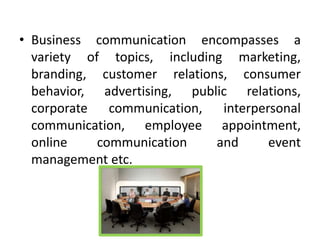
• Business communication encompasses a
variety of topics, including marketing,
branding, customer relations, consumer
behavior, advertising, public relations,
corporate communication, interpersonal
communication, employee appointment,
online communication and event
management etc.
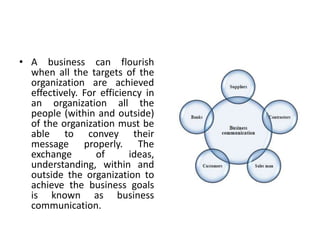
• A business can flourish
when all the targets of the
organization are achieved
effectively. For efficiency in
an organization all the
people (within and outside)
of the organization must be
able to convey their
message properly. The
exchange of ideas,
understanding, within and
outside the organization to
achieve the business goals
is known as business
communication.
Define: Business Communication
• According to Ricks and Gow, “Business communication
is a system that affects change within the total
organization.”
• According to Brennar, “Business communication is the
expression channeling, receiving and interchanging of
ides in commerce and industry.”
• According to W. H. Meaning, “The exchange of ideas,
news and views in connection with the business among
the related parties is called business communication.”
• Business communication is a term that can be defined
as the contact between the people in an organization
for the intention of carrying out the business activities.
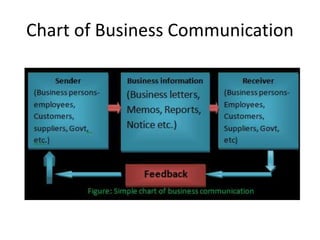
Chart of Business Communication
Importance of Business Communication
• When the business grows and expands, there is
more pressure for the need of effective business
communication.
• In business, reputation and credibility need to be
built up in order to get the client’s trust and
confidence. Having a sense of professionalism is
very important in business, especially in long
term relationships with employees and clients.
• Business communication doesn’t just involve
those who are inside the company but also those
who are outside the company. Through this, the
business can become well-organized.
1) Managerial Efficiency - Business Communication
helps in smooth operation of management.
Managerial task can only be performed when business
communication system is effective.
2) Effective Leadership - Effective leadership depends
upon effective business communication. Managerial
leader must handle the subordinates. For ordering
qualitative leadership is essential. And that can be
obtained from proper system of business
communication.
3) Enhance morale and relations - Effective business
communication emphasizes the employee’s
participation in management. It helps to build the
employees morale and cordial industrial relations
between management and employees.
4) Staffing – Business Communication helps in the
function of selection, placement, socialization, promotion
and transfer.
5) Better managerial concern - All managerial functions
such as planning, organizing, directing, controlling etc.
can’t be conducted without business communication.
Effective business communication is important for the
survival and the growth of the company. If there is good
communication, then all those who are part of the
company will have pleasant relationships. One will have
better control as well as coordination in the company if
the business communication in the company is effective.
Methods of Business Communication
• Web-based communication - for better and improved
communication, anytime anywhere.
• Video conferencing which allow people in different
locations to hold interactive meetings.
• E-mails, which provide an instantaneous (instant/on the
spot) medium of written communication worldwide.
• Reports - important in documenting the activities of any
department.
• Presentations - very popular method of communication in
all types of organizations, usually involving audiovisual
material.
• Forum boards, which allow people to instantly post
information at a centralized location.
• Face-to-face meetings, which are personal
and should be succeeded by a written follow
up.
• Suggestion box, it is mainly for upward
communication as because some people may
hesitate to communicate to the to
management directly so they can give
suggestion by drafting suggestion in
suggestion box.
Concept of Business Correspondence
• Business correspondence is a form of communication
related to business done in a written form. It is a
means for views, ideas and information to be
expressed between two parties. For example, sending
letters or e-mails to your clients and business
colleagues so that they will be well informed about any
activities related to business. Business correspondence
includes feedback from members for their
confirmation and reply which is kept in records by the
company.
• Business correspondence is the communication or
exchange of information in a written format for the
process of business activities. – Definition.
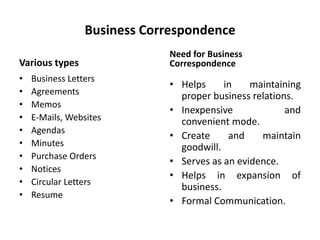
Business Correspondence
Various types
• Business Letters
• Agreements
• Memos
• E-Mails, Websites
• Agendas
• Minutes
• Purchase Orders
• Notices
• Circular Letters
• Resume
Need for Business
Correspondence
• Helps in maintaining
proper business relations.
• Inexpensive and
convenient mode.
• Create and maintain
goodwill.
• Serves as an evidence.
• Helps in expansion of
business.
• Formal Communication.
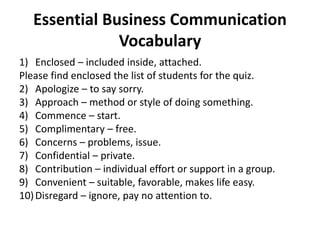
Essential Business Communication
Vocabulary
1) Enclosed – included inside, attached.
Please find enclosed the list of students for the quiz.
2) Apologize – to say sorry.
3) Approach – method or style of doing something.
4) Commence – start.
5) Complimentary – free.
6) Concerns – problems, issue.
7) Confidential – private.
8) Contribution – individual effort or support in a group.
9) Convenient – suitable, favorable, makes life easy.
10)Disregard – ignore, pay no attention to.
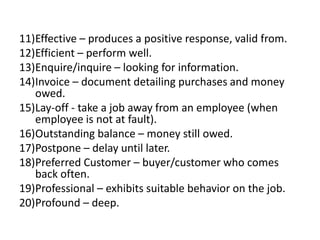
11)Effective – produces a positive response, valid from.
12)Efficient – perform well.
13)Enquire/inquire – looking for information.
14)Invoice – document detailing purchases and money
owed.
15)Lay-off - take a job away from an employee (when
employee is not at fault).
16)Outstanding balance – money still owed.
17)Postpone – delay until later.
18)Preferred Customer – buyer/customer who comes
back often.
19)Professional – exhibits suitable behavior on the job.
20)Profound – deep.
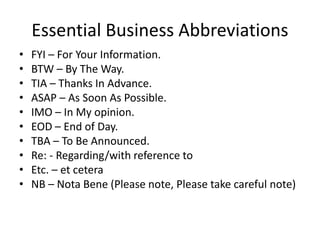
Essential Business Abbreviations
• FYI – For Your Information.
• BTW – By The Way.
• TIA – Thanks In Advance.
• ASAP – As Soon As Possible.
• IMO – In My opinion.
• EOD – End of Day.
• TBA – To Be Announced.
• Re: - Regarding/with reference to
• Etc. – et cetera
• NB – Nota Bene (Please note, Please take careful note)
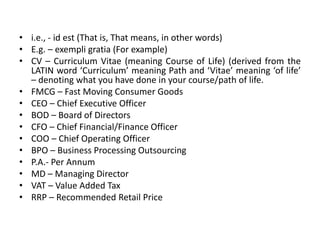
• i.e., - id est (That is, That means, in other words)
• E.g. – exempli gratia (For example)
• CV – Curriculum Vitae (meaning Course of Life) (derived from the
LATIN word ‘Curriculum’ meaning Path and ‘Vitae’ meaning ‘of life’
– denoting what you have done in your course/path of life.
• FMCG – Fast Moving Consumer Goods
• CEO – Chief Executive Officer
• BOD – Board of Directors
• CFO – Chief Financial/Finance Officer
• COO – Chief Operating Officer
• BPO – Business Processing Outsourcing
• P.A.- Per Annum
• MD – Managing Director
• VAT – Value Added Tax
• RRP – Recommended Retail Price
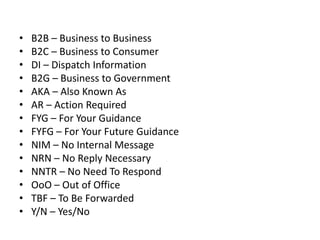
• B2B – Business to Business
• B2C – Business to Consumer
• DI – Dispatch Information
• B2G – Business to Government
• AKA – Also Known As
• AR – Action Required
• FYG – For Your Guidance
• FYFG – For Your Future Guidance
• NIM – No Internal Message
• NRN – No Reply Necessary
• NNTR – No Need To Respond
• OoO – Out of Office
• TBF – To Be Forwarded
• Y/N – Yes/No
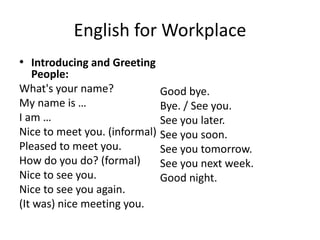
English for Workplace
• Introducing and Greeting
People:
What's your name?
My name is …
I am …
Nice to meet you. (informal)
Pleased to meet you.
How do you do? (formal)
Nice to see you.
Nice to see you again.
(It was) nice meeting you.
Good bye.
Bye. / See you.
See you later.
See you soon.
See you tomorrow.
See you next week.
Good night.
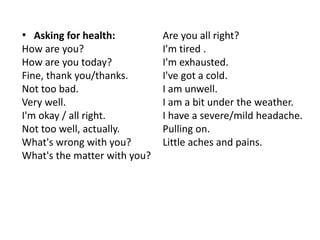
• Asking for health:
How are you?
How are you today?
Fine, thank you/thanks.
Not too bad.
Very well.
I'm okay / all right.
Not too well, actually.
What's wrong with you?
What's the matter with you?
Are you all right?
I'm tired .
I'm exhausted.
I've got a cold.
I am unwell.
I am a bit under the weather.
I have a severe/mild headache.
Pulling on.
Little aches and pains.
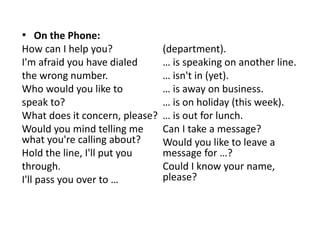
• On the Phone:
How can I help you?
I'm afraid you have dialed
the wrong number.
Who would you like to
speak to?
What does it concern, please?
Would you mind telling me
what you're calling about?
Hold the line, I'll put you
through.
I'll pass you over to …
(department).
… is speaking on another line.
… isn't in (yet).
… is away on business.
… is on holiday (this week).
… is out for lunch.
Can I take a message?
Would you like to leave a
message for …?
Could I know your name,
please?
References / Sources
1) www.usinnovation.org/.../ASTRA-EdTech-
Revolution-2d-Edition-100413
2) www.fao.org/docrep/W5830E/w5830e0f.html
3) www.academia.edu/2767976/Fundamentals_o
f_Management
4) lib.vcomsats.edu.pk/library/.../HUM%20400%2
0LECTURE%2001.ppt

Mca i ecls_u-4_business communication

  • 1.
    Business communication I Course– MCA Subject – English Communication and Life Skills Unit - 4
  • 2.
    Concept of BusinessCommunication • Communication is an integral part of business. • Business communication is the specialized branch of general communication that is especially concerned with business activities. • Business Communication can be both Internal and External Communication in an organization. • When communication takes places among business parties concerning business affairs or business related issues it is known as business communication. • Business communication is nothing but, the communication between the people in the organization for the purpose of carrying out the business activities.
  • 3.
    • Business communicationencompasses a variety of topics, including marketing, branding, customer relations, consumer behavior, advertising, public relations, corporate communication, interpersonal communication, employee appointment, online communication and event management etc.
  • 4.
    • A businesscan flourish when all the targets of the organization are achieved effectively. For efficiency in an organization all the people (within and outside) of the organization must be able to convey their message properly. The exchange of ideas, understanding, within and outside the organization to achieve the business goals is known as business communication.
  • 5.
    Define: Business Communication •According to Ricks and Gow, “Business communication is a system that affects change within the total organization.” • According to Brennar, “Business communication is the expression channeling, receiving and interchanging of ides in commerce and industry.” • According to W. H. Meaning, “The exchange of ideas, news and views in connection with the business among the related parties is called business communication.” • Business communication is a term that can be defined as the contact between the people in an organization for the intention of carrying out the business activities.
  • 6.
    Chart of BusinessCommunication
  • 7.
    Importance of BusinessCommunication • When the business grows and expands, there is more pressure for the need of effective business communication. • In business, reputation and credibility need to be built up in order to get the client’s trust and confidence. Having a sense of professionalism is very important in business, especially in long term relationships with employees and clients. • Business communication doesn’t just involve those who are inside the company but also those who are outside the company. Through this, the business can become well-organized.
  • 8.
    1) Managerial Efficiency- Business Communication helps in smooth operation of management. Managerial task can only be performed when business communication system is effective. 2) Effective Leadership - Effective leadership depends upon effective business communication. Managerial leader must handle the subordinates. For ordering qualitative leadership is essential. And that can be obtained from proper system of business communication. 3) Enhance morale and relations - Effective business communication emphasizes the employee’s participation in management. It helps to build the employees morale and cordial industrial relations between management and employees.
  • 9.
    4) Staffing –Business Communication helps in the function of selection, placement, socialization, promotion and transfer. 5) Better managerial concern - All managerial functions such as planning, organizing, directing, controlling etc. can’t be conducted without business communication. Effective business communication is important for the survival and the growth of the company. If there is good communication, then all those who are part of the company will have pleasant relationships. One will have better control as well as coordination in the company if the business communication in the company is effective.
  • 10.
    Methods of BusinessCommunication • Web-based communication - for better and improved communication, anytime anywhere. • Video conferencing which allow people in different locations to hold interactive meetings. • E-mails, which provide an instantaneous (instant/on the spot) medium of written communication worldwide. • Reports - important in documenting the activities of any department. • Presentations - very popular method of communication in all types of organizations, usually involving audiovisual material. • Forum boards, which allow people to instantly post information at a centralized location.
  • 11.
    • Face-to-face meetings,which are personal and should be succeeded by a written follow up. • Suggestion box, it is mainly for upward communication as because some people may hesitate to communicate to the to management directly so they can give suggestion by drafting suggestion in suggestion box.
  • 12.
    Concept of BusinessCorrespondence • Business correspondence is a form of communication related to business done in a written form. It is a means for views, ideas and information to be expressed between two parties. For example, sending letters or e-mails to your clients and business colleagues so that they will be well informed about any activities related to business. Business correspondence includes feedback from members for their confirmation and reply which is kept in records by the company. • Business correspondence is the communication or exchange of information in a written format for the process of business activities. – Definition.
  • 13.
    Business Correspondence Various types •Business Letters • Agreements • Memos • E-Mails, Websites • Agendas • Minutes • Purchase Orders • Notices • Circular Letters • Resume Need for Business Correspondence • Helps in maintaining proper business relations. • Inexpensive and convenient mode. • Create and maintain goodwill. • Serves as an evidence. • Helps in expansion of business. • Formal Communication.
  • 14.
    Essential Business Communication Vocabulary 1)Enclosed – included inside, attached. Please find enclosed the list of students for the quiz. 2) Apologize – to say sorry. 3) Approach – method or style of doing something. 4) Commence – start. 5) Complimentary – free. 6) Concerns – problems, issue. 7) Confidential – private. 8) Contribution – individual effort or support in a group. 9) Convenient – suitable, favorable, makes life easy. 10)Disregard – ignore, pay no attention to.
  • 15.
    11)Effective – producesa positive response, valid from. 12)Efficient – perform well. 13)Enquire/inquire – looking for information. 14)Invoice – document detailing purchases and money owed. 15)Lay-off - take a job away from an employee (when employee is not at fault). 16)Outstanding balance – money still owed. 17)Postpone – delay until later. 18)Preferred Customer – buyer/customer who comes back often. 19)Professional – exhibits suitable behavior on the job. 20)Profound – deep.
  • 16.
    Essential Business Abbreviations •FYI – For Your Information. • BTW – By The Way. • TIA – Thanks In Advance. • ASAP – As Soon As Possible. • IMO – In My opinion. • EOD – End of Day. • TBA – To Be Announced. • Re: - Regarding/with reference to • Etc. – et cetera • NB – Nota Bene (Please note, Please take careful note)
  • 17.
    • i.e., -id est (That is, That means, in other words) • E.g. – exempli gratia (For example) • CV – Curriculum Vitae (meaning Course of Life) (derived from the LATIN word ‘Curriculum’ meaning Path and ‘Vitae’ meaning ‘of life’ – denoting what you have done in your course/path of life. • FMCG – Fast Moving Consumer Goods • CEO – Chief Executive Officer • BOD – Board of Directors • CFO – Chief Financial/Finance Officer • COO – Chief Operating Officer • BPO – Business Processing Outsourcing • P.A.- Per Annum • MD – Managing Director • VAT – Value Added Tax • RRP – Recommended Retail Price
  • 18.
    • B2B –Business to Business • B2C – Business to Consumer • DI – Dispatch Information • B2G – Business to Government • AKA – Also Known As • AR – Action Required • FYG – For Your Guidance • FYFG – For Your Future Guidance • NIM – No Internal Message • NRN – No Reply Necessary • NNTR – No Need To Respond • OoO – Out of Office • TBF – To Be Forwarded • Y/N – Yes/No
  • 19.
    English for Workplace •Introducing and Greeting People: What's your name? My name is … I am … Nice to meet you. (informal) Pleased to meet you. How do you do? (formal) Nice to see you. Nice to see you again. (It was) nice meeting you. Good bye. Bye. / See you. See you later. See you soon. See you tomorrow. See you next week. Good night.
  • 20.
    • Asking forhealth: How are you? How are you today? Fine, thank you/thanks. Not too bad. Very well. I'm okay / all right. Not too well, actually. What's wrong with you? What's the matter with you? Are you all right? I'm tired . I'm exhausted. I've got a cold. I am unwell. I am a bit under the weather. I have a severe/mild headache. Pulling on. Little aches and pains.
  • 21.
    • On thePhone: How can I help you? I'm afraid you have dialed the wrong number. Who would you like to speak to? What does it concern, please? Would you mind telling me what you're calling about? Hold the line, I'll put you through. I'll pass you over to … (department). … is speaking on another line. … isn't in (yet). … is away on business. … is on holiday (this week). … is out for lunch. Can I take a message? Would you like to leave a message for …? Could I know your name, please?
  • 22.
    References / Sources 1)www.usinnovation.org/.../ASTRA-EdTech- Revolution-2d-Edition-100413 2) www.fao.org/docrep/W5830E/w5830e0f.html 3) www.academia.edu/2767976/Fundamentals_o f_Management 4) lib.vcomsats.edu.pk/library/.../HUM%20400%2 0LECTURE%2001.ppt