GROUP NO:1
GROUP MEMBERS:
M.IILYAS
M.YASEEN
SHEHZAD IQBAL
TAIMUR HASSAN
M.MASHOODKHAN
ASIF ALI
ONAIS ANWAR
BASHEER MUHAMMAD
SALMAN NISAR
 INTRODUCTION
 LOCATION
 CONSTUCTION
 INTERIOR AND EXTERIOR DESIGNING
 SPECIAL FEATURES
3
OWNER OF THE PROJECT
MOHAMMAD BIN RASHID AL MAKHTOOM
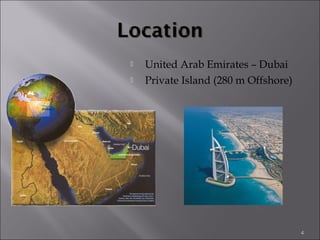
 United Arab Emirates – Dubai
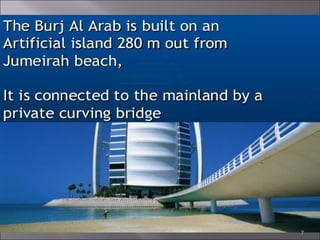
 Private Island (280 m Offshore)
4
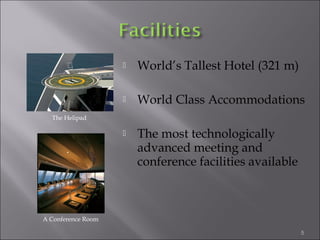
 World’s Tallest Hotel (321 m)
 World Class Accommodations
 The most technologically
advanced meeting and
conference facilities available
The Helipad
A Conference Room
5
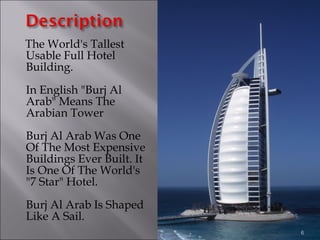
The World's Tallest
Usable Full Hotel
Building.
In English "Burj Al
Arab" Means The
Arabian Tower
Burj Al Arab Was One
Of The Most Expensive
Buildings Ever Built. It
Is One Of The World's
"7 Star" Hotel.
Burj Al Arab Is Shaped
Like A Sail.
6
7
8
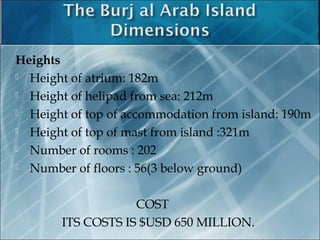
Heights
 Height of atrium: 182m
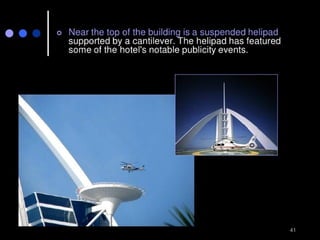
 Height of helipad from sea: 212m
 Height of top of accommodation from island: 190m
 Height of top of mast from island :321m
 Number of rooms : 202
 Number of floors : 56(3 below ground)
COST
ITS COSTS IS $USD 650 MILLION.
9
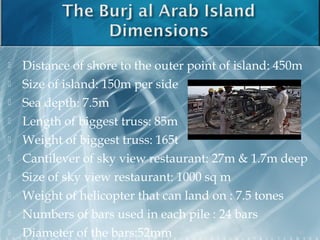
 Distance of shore to the outer point of island: 450m
 Size of island: 150m per side
 Sea depth: 7.5m
 Length of biggest truss: 85m
 Weight of biggest truss: 165t
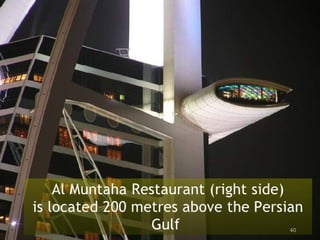
 Cantilever of sky view restaurant: 27m & 1.7m deep
 Size of sky view restaurant: 1000 sq m
 Weight of helicopter that can land on : 7.5 tones
 Numbers of bars used in each pile : 24 bars
 Diameter of the bars:52mm 10
 Total volume of concrete on the island: 33,000 cubic
m
 Total volume of concrete in the superstructure:
36,000 cubic m
 Total steel used: 9200 tones
 1 tone=1016 kg
 Gross area of building: 120,000 sq m
 28 double height floors (7m floor to floor height)
 Height of atrium: 182 m with volume of: 285,000 cubic m
 Length of mast: 60m
11
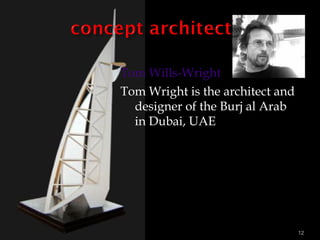
Tom Wills-Wright
Tom Wright is the architect and
designer of the Burj al Arab
in Dubai, UAE
12
 The building is built on sand, which is unusual
as most tall building are founded on rock.
 The building is supported on 250 piles.
 Each pile has 1.5m diameter and 45 meters
under the sea.
 So there is only sand to hold the building up.
13
 The trusses on the side of the building are 85m
and weighs 165t.
 They were built 15 KM from the site and
brought by road to Dubai on huge 80 wheel
lorries which had to be specially imported
from South Africa.
 The highest truss took a day to lift into place.
If one man was to build the building himself it
would take about 8,000 years to finish.
14
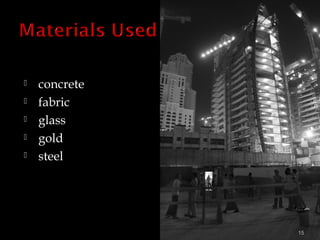
 concrete
 fabric  
 glass
 gold  
 steel
15
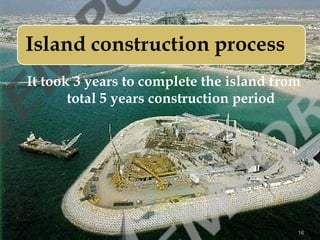
It took 3 years to complete the island from
total 5 years construction period
16
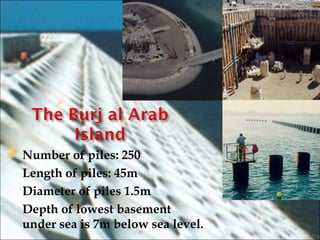
 Number of piles: 250
 Length of piles: 45m
 Diameter of piles 1.5m
 Depth of lowest basement
under sea is 7m below sea level.
17
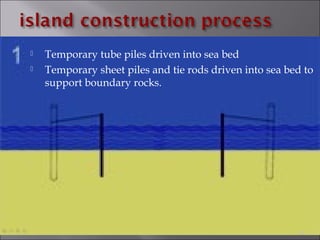
 Temporary tube piles driven into sea bed
 Temporary sheet piles and tie rods driven into sea bed to
support boundary rocks.
18
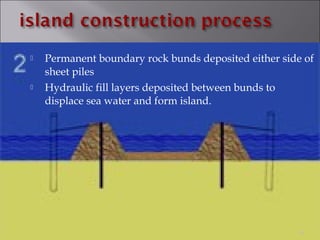
 Permanent boundary rock bunds deposited either side of
sheet piles
 Hydraulic fill layers deposited between bunds to
displace sea water and form island.
19
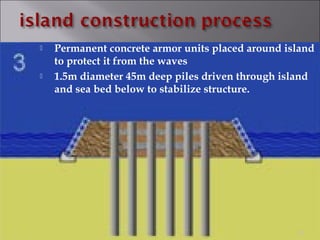
 Permanent concrete armor units placed around island
to protect it from the waves
 1.5m diameter 45m deep piles driven through island
and sea bed below to stabilize structure.
20
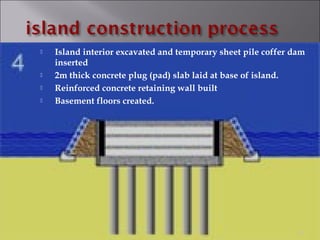
 Island interior excavated and temporary sheet pile coffer dam
inserted
 2m thick concrete plug (pad) slab laid at base of island.
 Reinforced concrete retaining wall built
 Basement floors created.
21
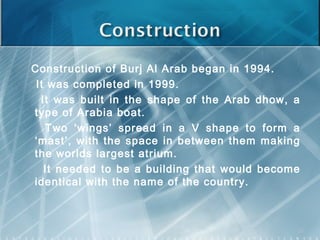
Construction of Burj Al Arab began in 1994.
It was completed in 1999.
It was built in the shape of the Arab dhow, a
type of Arabia boat.
Two ‘wings’ spread in a V shape to form a
‘mast’, with the space in between them making
the worlds largest atrium.
It needed to be a building that would become
identical with the name of the country.
22
 Principal Structural
Engineer of Building
 Martin Halford
 Eversendai Engineering
23
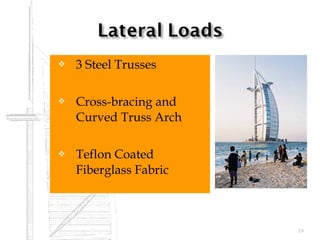
 3 Steel Trusses
 Cross-bracing and
Curved Truss Arch
 Teflon Coated
Fiberglass Fabric
24
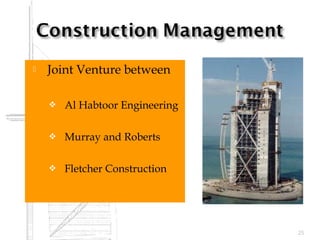
 Joint Venture between
 Al Habtoor Engineering
 Murray and Roberts
 Fletcher Construction
25
 The companies all joined togather because by
utilizing the separate talents of each partner:
 labor supply
1. concrete work
2. structural steel supply
3. Erection
4. high rise management experience
5. Purchasing
6. cost control
7. management staffing
26
 1- Al Habtoor Engineering had the responsibility
to provide the project with the labor required the
quality of the concrete and block work.
 2- Murray and Roberts brought the expertise for
detailing, fabrication, shipment and erection of
the complex structural steel. This was
subcontracted to Genrec Steel Fabricators of
Johannesburg, South Africa, a company owned by
Murray and Roberts. This subcontract would
reduce financial risk.
 3- Fletcher had the high-rise management and
planning expertise. The project director and
project manager came from Fletcher and were
based in Dubai.
27
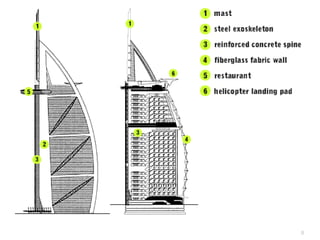
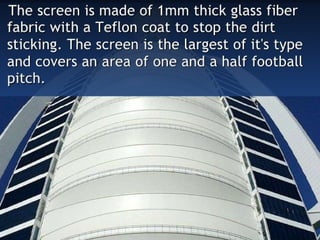
The structure is made of a steel exoskeleton.
Wrapped around an reinforced concrete tower.
The space between the wings is enclosed by a
Teflon-coated fiberglass sail, curving across the
front of the building and creating an atrium
inside.
The sail is made of a material called Dyneon,
spanning over 161,000 square feet, consists of two
layers, and is divided into twelve panels and
installed vertically.
The fabric is coated with DuPont Teflon to protect it
from harsh desert heat, wind, and dirt. The
fabricators estimate that it will hold up for up to 50
years.
28
29
30
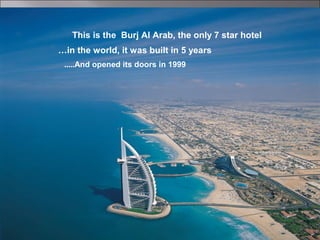
This is the Burj Al Arab, the only 7 star hotel
in the world, it was built in 5 years…
And opened its doors in 1999.....
 At 14,000 channels it is the largest architectural
lighting control system ever made (Futronix).
Each suite has one or more PFX-32 dimming
control systems.
It operate the lighting in every room.
The largest suites have five systems giving a
total of 160 channels of lighting.
31
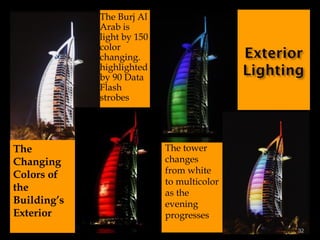
 The Burj Al
Arab is
light by 150
color
changing.
highlighted
by 90 Data
Flash
strobes
• The tower
changes
from white
to multicolor
as the
evening
progresses
The
Changing
Colors of
the
Building’s
Exterior
32
33
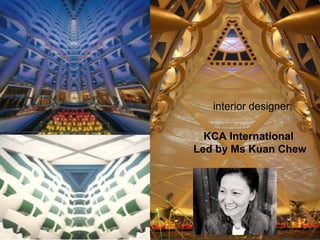
interior designer:
KCA International
Led by Ms Kuan Chew
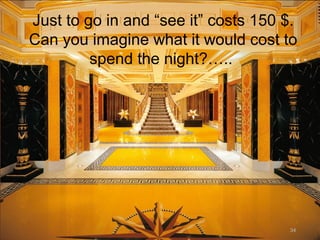
Just to go in and “see it” costs 150 $.
Can you imagine what it would cost to
spend the night?…..
34
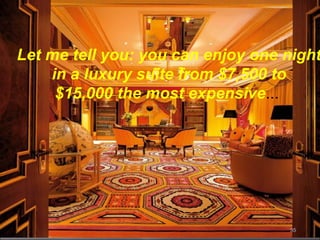
Let me tell you: you can enjoy one night
in a luxury suite from $7,500 to
$15,000 the most expensive...
35
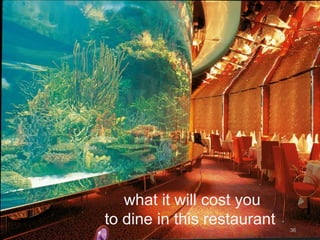
what it will cost you
to dine in this restaurant 36
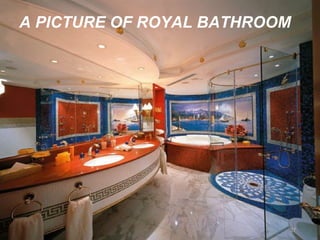
A PICTURE OF ROYAL BATHROOM
37
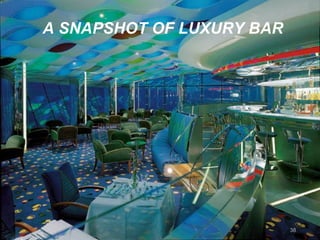
A SNAPSHOT OF LUXURY BAR
38
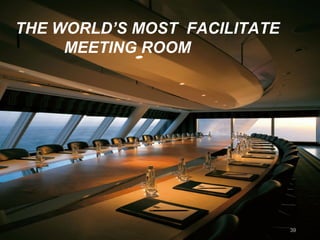
THE WORLD’S MOST FACILITATE
MEETING ROOM
39
40
41
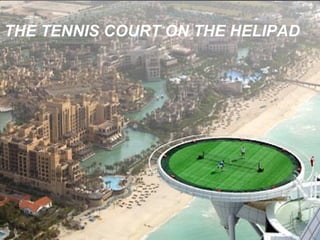
THE TENNIS COURT ON THE HELIPAD
42
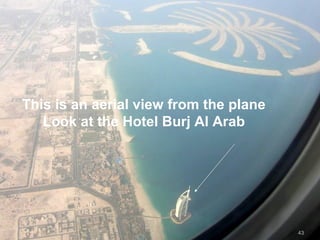
This is an aerial view from the plane
Look at the Hotel Burj Al Arab
43
44THE END

Burj al-arab

  • 2.
    GROUP NO:1 GROUP MEMBERS: M.IILYAS M.YASEEN SHEHZADIQBAL TAIMUR HASSAN M.MASHOODKHAN ASIF ALI ONAIS ANWAR BASHEER MUHAMMAD SALMAN NISAR
  • 3.
     INTRODUCTION  LOCATION CONSTUCTION  INTERIOR AND EXTERIOR DESIGNING  SPECIAL FEATURES 3 OWNER OF THE PROJECT MOHAMMAD BIN RASHID AL MAKHTOOM
  • 4.
     United ArabEmirates – Dubai  Private Island (280 m Offshore) 4
  • 5.
     World’s TallestHotel (321 m)  World Class Accommodations  The most technologically advanced meeting and conference facilities available The Helipad A Conference Room 5
  • 6.
    The World's Tallest UsableFull Hotel Building. In English "Burj Al Arab" Means The Arabian Tower Burj Al Arab Was One Of The Most Expensive Buildings Ever Built. It Is One Of The World's "7 Star" Hotel. Burj Al Arab Is Shaped Like A Sail. 6
  • 7.
  • 8.
  • 9.
    Heights  Height ofatrium: 182m  Height of helipad from sea: 212m  Height of top of accommodation from island: 190m  Height of top of mast from island :321m  Number of rooms : 202  Number of floors : 56(3 below ground) COST ITS COSTS IS $USD 650 MILLION. 9
  • 10.
     Distance ofshore to the outer point of island: 450m  Size of island: 150m per side  Sea depth: 7.5m  Length of biggest truss: 85m  Weight of biggest truss: 165t  Cantilever of sky view restaurant: 27m & 1.7m deep  Size of sky view restaurant: 1000 sq m  Weight of helicopter that can land on : 7.5 tones  Numbers of bars used in each pile : 24 bars  Diameter of the bars:52mm 10
  • 11.
     Total volumeof concrete on the island: 33,000 cubic m  Total volume of concrete in the superstructure: 36,000 cubic m  Total steel used: 9200 tones  1 tone=1016 kg  Gross area of building: 120,000 sq m  28 double height floors (7m floor to floor height)  Height of atrium: 182 m with volume of: 285,000 cubic m  Length of mast: 60m 11
  • 12.
    Tom Wills-Wright Tom Wrightis the architect and designer of the Burj al Arab in Dubai, UAE 12
  • 13.
     The buildingis built on sand, which is unusual as most tall building are founded on rock.  The building is supported on 250 piles.  Each pile has 1.5m diameter and 45 meters under the sea.  So there is only sand to hold the building up. 13
  • 14.
     The trusseson the side of the building are 85m and weighs 165t.  They were built 15 KM from the site and brought by road to Dubai on huge 80 wheel lorries which had to be specially imported from South Africa.  The highest truss took a day to lift into place. If one man was to build the building himself it would take about 8,000 years to finish. 14
  • 15.
     concrete  fabric   glass  gold    steel 15
  • 16.
    It took 3years to complete the island from total 5 years construction period 16
  • 17.
     Number ofpiles: 250  Length of piles: 45m  Diameter of piles 1.5m  Depth of lowest basement under sea is 7m below sea level. 17
  • 18.
     Temporary tubepiles driven into sea bed  Temporary sheet piles and tie rods driven into sea bed to support boundary rocks. 18
  • 19.
     Permanent boundaryrock bunds deposited either side of sheet piles  Hydraulic fill layers deposited between bunds to displace sea water and form island. 19
  • 20.
     Permanent concretearmor units placed around island to protect it from the waves  1.5m diameter 45m deep piles driven through island and sea bed below to stabilize structure. 20
  • 21.
     Island interiorexcavated and temporary sheet pile coffer dam inserted  2m thick concrete plug (pad) slab laid at base of island.  Reinforced concrete retaining wall built  Basement floors created. 21
  • 22.
    Construction of BurjAl Arab began in 1994. It was completed in 1999. It was built in the shape of the Arab dhow, a type of Arabia boat. Two ‘wings’ spread in a V shape to form a ‘mast’, with the space in between them making the worlds largest atrium. It needed to be a building that would become identical with the name of the country. 22
  • 23.
     Principal Structural Engineerof Building  Martin Halford  Eversendai Engineering 23
  • 24.
     3 SteelTrusses  Cross-bracing and Curved Truss Arch  Teflon Coated Fiberglass Fabric 24
  • 25.
     Joint Venturebetween  Al Habtoor Engineering  Murray and Roberts  Fletcher Construction 25
  • 26.
     The companiesall joined togather because by utilizing the separate talents of each partner:  labor supply 1. concrete work 2. structural steel supply 3. Erection 4. high rise management experience 5. Purchasing 6. cost control 7. management staffing 26
  • 27.
     1- AlHabtoor Engineering had the responsibility to provide the project with the labor required the quality of the concrete and block work.  2- Murray and Roberts brought the expertise for detailing, fabrication, shipment and erection of the complex structural steel. This was subcontracted to Genrec Steel Fabricators of Johannesburg, South Africa, a company owned by Murray and Roberts. This subcontract would reduce financial risk.  3- Fletcher had the high-rise management and planning expertise. The project director and project manager came from Fletcher and were based in Dubai. 27
  • 28.
    The structure ismade of a steel exoskeleton. Wrapped around an reinforced concrete tower. The space between the wings is enclosed by a Teflon-coated fiberglass sail, curving across the front of the building and creating an atrium inside. The sail is made of a material called Dyneon, spanning over 161,000 square feet, consists of two layers, and is divided into twelve panels and installed vertically. The fabric is coated with DuPont Teflon to protect it from harsh desert heat, wind, and dirt. The fabricators estimate that it will hold up for up to 50 years. 28
  • 29.
  • 30.
    30 This is theBurj Al Arab, the only 7 star hotel in the world, it was built in 5 years… And opened its doors in 1999.....
  • 31.
     At 14,000channels it is the largest architectural lighting control system ever made (Futronix). Each suite has one or more PFX-32 dimming control systems. It operate the lighting in every room. The largest suites have five systems giving a total of 160 channels of lighting. 31
  • 32.
     The BurjAl Arab is light by 150 color changing. highlighted by 90 Data Flash strobes • The tower changes from white to multicolor as the evening progresses The Changing Colors of the Building’s Exterior 32
  • 33.
  • 34.
    Just to goin and “see it” costs 150 $. Can you imagine what it would cost to spend the night?….. 34
  • 35.
    Let me tellyou: you can enjoy one night in a luxury suite from $7,500 to $15,000 the most expensive... 35
  • 36.
    what it willcost you to dine in this restaurant 36
  • 37.
    A PICTURE OFROYAL BATHROOM 37
  • 38.
    A SNAPSHOT OFLUXURY BAR 38
  • 39.
    THE WORLD’S MOSTFACILITATE MEETING ROOM 39
  • 40.
  • 41.
  • 42.
    THE TENNIS COURTON THE HELIPAD 42
  • 43.
    This is anaerial view from the plane Look at the Hotel Burj Al Arab 43
  • 44.