TIMBER
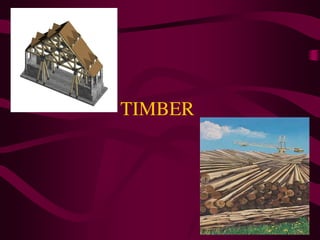
• Timber is one of the most popular material
in light construction because of :
a) simplicity in fabrication
b) lightness
c) reusability
d) insulation from heat. sound & electricity
e) aesthetically pleasing appearance
f) resistance to oxidation, acid attack & salt
attack and salt water
g) environmental compatibility
STRUCTURE OF WOOD
Cambium Layer
Bark
Pith
Annual Rings
STRUCTURE OF WOOD
“Bark” is a thin, rough and dense covering
that surrounds the trunk.
“Cambium” is a thin (microscopic) layer of
wood cells exists inside the bark.
The growth of wood takes place continuously
under the bark in the cambium layer resulting
ring knowns as “Annual ring”.
Width of ring depends on the rate of growth of
the tree.
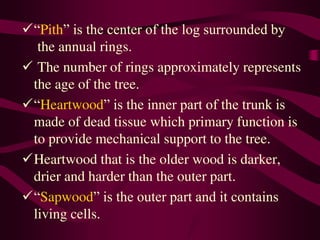
“Pith” is the center of the log surrounded by
the annual rings.
 The number of rings approximately represents
the age of the tree.
“Heartwood” is the inner part of the trunk is
made of dead tissue which primary function is
to provide mechanical support to the tree.
Heartwood that is the older wood is darker,
drier and harder than the outer part.
“Sapwood” is the outer part and it contains
living cells.
 The trunk place the role to convey a solution
called sap to the leaves & also to support the
crow at such a height as to ensure a
sufficiency of air & light.
As one layer of woods succeeds another, the
cell in the layers die, cease to function for
food storage and only useful to give the tree
stiffness.
• Heartwood & Softwood
 Physical & mechanical properties of wood
differ from species to species & also within
species.
Among the factor influencing it’s properties
are climate, density of the surrounding
forest, character of the soil, moisture
content, defects and the area in the log from
which the lumber is derived.
FACTORS AFFECTING
STRENGTH OF TIMBER
• Density
• Moisture Content
• Temperature
• Grain structure
• Position in tree
• Condition of growth
• Defects
• Creep
• DENSITY
 Density of wood is defined as the mass or
weight per unit volume.
 Moisture in wood has a very large effect on
the specific gravity as well as the density.
Timbers of young tree has a very low density,
therefore reduced stresses used for such
material.
 Weight of timber reduced by drying while
most strength properties are increased.
The higher the density, so the higher it’s
mechanical properties.
• MOISTURE CONTENT
 Moisture content in a living tree varies with
the species.
Even in the same species, variation in moisture
content depends on the age & size of the tree
and its location.
 Mechanical properties of wood influenced by
moisture content but modulus elasticity is less
affected by changes in moisture
 Strength of wood increase as the moisture
content decreases
Moisture content determined by oven-dry
method or by electric moisture-meter
method
Drying of timber from the green condition
as cut to constructional usable content of
say, 18% moisture content will cause
shrinkage.
• TEMPERATURE
 Strength of timber decreases, together with
increasing temperature
 Permanent loss of strength may happen if
wood is held at high temperature for a long
period.
• POSITION IN TREE
 In the early tree’s life, wood often tends to
become stronger with increasing distance
from the pith
• CONDITION OF GROWTH
 Environmental factor such as height above
the sea level, temperature, type of soil,
rainfall, spacing between the trees have
effect on the strength of the properties of
the timber
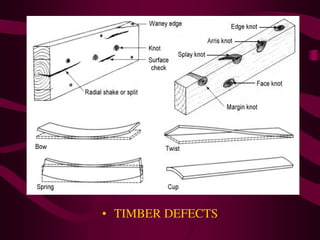
• DEFECTS
Common defect are cracks, knots and slope
of grain and occur principally during the
growing period and the drying process.
It can be classified:
a) knots
b) shake
c) split
d) check
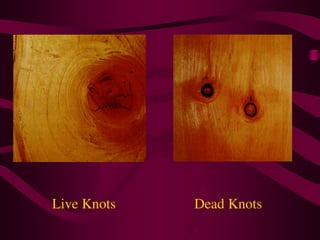
Knots
 It is a cross-section or longitudinal section
of a branch that was cut with the lumber
 It could affect the mechanical properties of
wood
 Also allow stress concentration to occur
 Effect of knots depends on their position in
the section.
 Knots are harder, denser and possess
different shrinkage characteristics than those
of wood tissue.
Live Knots Dead Knots
• Shake
 Shakes are lengthwise separations in the
wood occurring between and parallel to
annual rings
Split
 It’s a complete separation of wood fibers
usually at the ends, throughout the thickness
of lumber and parallel to the fiber direction.
 could affect the durability of timber.
Check
 It’s a lengthwise separation of wood
occurring across or through the annual ring
usually as a result of seasoning.
 It can occur anywhere on a piece of
lumber.
• TIMBER DEFECTS
• DECAY or DESTRUCTION
Decay is a decomposition of the wood
substances caused by fungi
Wood suffered fungal attack can becomes
brittle or weak.
Destruction is done by insects or marine borers
Termites normally found in warmer climates &
wood beetles in conditions of high humidity
Design of Timber Structures
Timber as a structural material
• The oldest construction material and still
one of the most versatile
• A natural material with inherent flaws and
variability
• We need to recognize its strengths and
weaknesses
• Timber design therefore as much an art as a
science
One of nature’s most efficient structures:
an Arbutus tree facing the onslaught of West Coast storms
Decay of wood
Requirements:
• nutrition (wood)
• modest temperature (~ 20 C)
• moisture (the only one that can be readily controlled)
Wet column bases
Comparative
material
properties
Strain, %
Stress (MPa)
-20
-100
-200
-400
300
302010-10
400
-300
200
100
mild steel
wood (parallel to grain)
concrete
• One of the biggest challenges in light timber construction
• Also an important benefit of heavy timber construction
Fire resistance
Reliability and Safety
Load
distributions
Strength distributions
Load, Resistance
Probabilityofoccurrence
Probability of failure
(overlap area)
Material
properties of
wood
lignin
cellulose fibres
… imagine a bundle of
straws held together with
elastic bands
• tension parallel to grain
• compression parallel to grain
• tension perpendicular to grain
• compression perpendicular to grain
• shear
Consequences of different design
values
• Avoid tension perpendicular and shear stresses at
all cost
• Make use of compression strength of wood as
much as possible
• Simplify connections and use compression load
transfer when possible
• Avoid stress concentrations and complex stress
patterns
Grading of timber
Defects that affect the
strength of timber
Visual Grading of Lumber
• Lumber is sorted for a specific application, e.g.
– For tension members all knots and defects have a
significant effect
– For beams and stringers, the grader focuses on
edge knots
– For posts and timbers sloped grain is more
important
• The larger the members, the higher the
probability of missing some important defects
The sorting process
• Sorting by species
– Species of similar strength characteristics are
lumped together
• Visual grading
– A certified grader sorts wood by hand according to
visual appearance
– Lumber gets sorted according to end use
– Grading criteria:
• Knots (type, location, size, frequency), wane, checks,
slope of grain, pitch pockets
• Mechanical grading
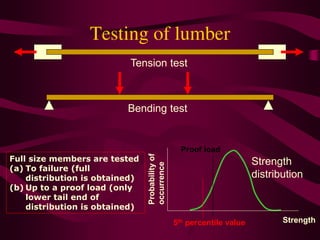
Testing of lumber
Tension test
Bending test
Full size members are tested
(a) To failure (full
distribution is obtained)
(b) Up to a proof load (only
lower tail end of
distribution is obtained)
Strength
distribution
Probabilityof
occurrence
Strength5th percentile value
Proof load
Use of dimension lumber in
residential construction
Platform construction
Platform
construction
Large glulam
beams in
buildings
and bridges
Defects are
distributed
among many
laminations
Engineered wood products -
pick the best member for each application
plywood
finger-jointed studs
oriented
strandboard
I-joists
laminated veneer lumber
laminated strand lumber
Efficient use of timber for a long span roof
(minimal connections)
Bearing
connections

Timber, its use and conections

  • 1.
  • 2.
    • Timber isone of the most popular material in light construction because of : a) simplicity in fabrication b) lightness c) reusability d) insulation from heat. sound & electricity e) aesthetically pleasing appearance f) resistance to oxidation, acid attack & salt attack and salt water g) environmental compatibility
  • 3.
    STRUCTURE OF WOOD CambiumLayer Bark Pith Annual Rings
  • 4.
    STRUCTURE OF WOOD “Bark”is a thin, rough and dense covering that surrounds the trunk. “Cambium” is a thin (microscopic) layer of wood cells exists inside the bark. The growth of wood takes place continuously under the bark in the cambium layer resulting ring knowns as “Annual ring”. Width of ring depends on the rate of growth of the tree.
  • 5.
    “Pith” is thecenter of the log surrounded by the annual rings.  The number of rings approximately represents the age of the tree. “Heartwood” is the inner part of the trunk is made of dead tissue which primary function is to provide mechanical support to the tree. Heartwood that is the older wood is darker, drier and harder than the outer part. “Sapwood” is the outer part and it contains living cells.
  • 6.
     The trunkplace the role to convey a solution called sap to the leaves & also to support the crow at such a height as to ensure a sufficiency of air & light. As one layer of woods succeeds another, the cell in the layers die, cease to function for food storage and only useful to give the tree stiffness.
  • 7.
  • 8.
     Physical &mechanical properties of wood differ from species to species & also within species. Among the factor influencing it’s properties are climate, density of the surrounding forest, character of the soil, moisture content, defects and the area in the log from which the lumber is derived.
  • 9.
    FACTORS AFFECTING STRENGTH OFTIMBER • Density • Moisture Content • Temperature • Grain structure • Position in tree • Condition of growth • Defects • Creep
  • 10.
    • DENSITY  Densityof wood is defined as the mass or weight per unit volume.  Moisture in wood has a very large effect on the specific gravity as well as the density. Timbers of young tree has a very low density, therefore reduced stresses used for such material.  Weight of timber reduced by drying while most strength properties are increased. The higher the density, so the higher it’s mechanical properties.
  • 11.
    • MOISTURE CONTENT Moisture content in a living tree varies with the species. Even in the same species, variation in moisture content depends on the age & size of the tree and its location.  Mechanical properties of wood influenced by moisture content but modulus elasticity is less affected by changes in moisture  Strength of wood increase as the moisture content decreases
  • 12.
    Moisture content determinedby oven-dry method or by electric moisture-meter method Drying of timber from the green condition as cut to constructional usable content of say, 18% moisture content will cause shrinkage.
  • 13.
    • TEMPERATURE  Strengthof timber decreases, together with increasing temperature  Permanent loss of strength may happen if wood is held at high temperature for a long period.
  • 14.
    • POSITION INTREE  In the early tree’s life, wood often tends to become stronger with increasing distance from the pith
  • 15.
    • CONDITION OFGROWTH  Environmental factor such as height above the sea level, temperature, type of soil, rainfall, spacing between the trees have effect on the strength of the properties of the timber
  • 16.
    • DEFECTS Common defectare cracks, knots and slope of grain and occur principally during the growing period and the drying process. It can be classified: a) knots b) shake c) split d) check
  • 17.
    Knots  It isa cross-section or longitudinal section of a branch that was cut with the lumber  It could affect the mechanical properties of wood  Also allow stress concentration to occur  Effect of knots depends on their position in the section.  Knots are harder, denser and possess different shrinkage characteristics than those of wood tissue.
  • 18.
  • 19.
    • Shake  Shakesare lengthwise separations in the wood occurring between and parallel to annual rings
  • 20.
    Split  It’s acomplete separation of wood fibers usually at the ends, throughout the thickness of lumber and parallel to the fiber direction.  could affect the durability of timber.
  • 21.
    Check  It’s alengthwise separation of wood occurring across or through the annual ring usually as a result of seasoning.  It can occur anywhere on a piece of lumber.
  • 22.
  • 23.
    • DECAY orDESTRUCTION Decay is a decomposition of the wood substances caused by fungi Wood suffered fungal attack can becomes brittle or weak. Destruction is done by insects or marine borers Termites normally found in warmer climates & wood beetles in conditions of high humidity
  • 24.
    Design of TimberStructures
  • 25.
    Timber as astructural material • The oldest construction material and still one of the most versatile • A natural material with inherent flaws and variability • We need to recognize its strengths and weaknesses • Timber design therefore as much an art as a science
  • 26.
    One of nature’smost efficient structures: an Arbutus tree facing the onslaught of West Coast storms
  • 27.
    Decay of wood Requirements: •nutrition (wood) • modest temperature (~ 20 C) • moisture (the only one that can be readily controlled)
  • 28.
  • 29.
  • 30.
    • One ofthe biggest challenges in light timber construction • Also an important benefit of heavy timber construction Fire resistance
  • 31.
    Reliability and Safety Load distributions Strengthdistributions Load, Resistance Probabilityofoccurrence Probability of failure (overlap area)
  • 32.
    Material properties of wood lignin cellulose fibres …imagine a bundle of straws held together with elastic bands • tension parallel to grain • compression parallel to grain • tension perpendicular to grain • compression perpendicular to grain • shear
  • 33.
    Consequences of differentdesign values • Avoid tension perpendicular and shear stresses at all cost • Make use of compression strength of wood as much as possible • Simplify connections and use compression load transfer when possible • Avoid stress concentrations and complex stress patterns
  • 34.
    Grading of timber Defectsthat affect the strength of timber
  • 35.
    Visual Grading ofLumber • Lumber is sorted for a specific application, e.g. – For tension members all knots and defects have a significant effect – For beams and stringers, the grader focuses on edge knots – For posts and timbers sloped grain is more important • The larger the members, the higher the probability of missing some important defects
  • 36.
    The sorting process •Sorting by species – Species of similar strength characteristics are lumped together • Visual grading – A certified grader sorts wood by hand according to visual appearance – Lumber gets sorted according to end use – Grading criteria: • Knots (type, location, size, frequency), wane, checks, slope of grain, pitch pockets • Mechanical grading
  • 37.
    Testing of lumber Tensiontest Bending test Full size members are tested (a) To failure (full distribution is obtained) (b) Up to a proof load (only lower tail end of distribution is obtained) Strength distribution Probabilityof occurrence Strength5th percentile value Proof load
  • 38.
    Use of dimensionlumber in residential construction
  • 39.
  • 40.
  • 41.
    Large glulam beams in buildings andbridges Defects are distributed among many laminations
  • 42.
    Engineered wood products- pick the best member for each application plywood finger-jointed studs oriented strandboard I-joists laminated veneer lumber laminated strand lumber
  • 43.
    Efficient use oftimber for a long span roof (minimal connections)
  • 44.