1st Draft of a new project
• Does intelligence alone determine success? Or do self-
  awareness, impulse control, persistence, zeal, self-
  motivation, empathy, and social deftness factor heavily
  into the equation? While not as readily quantified as
  IQ, these qualities, collectively termed "emotional
  intelligence," often determine whether or not people excel
  in life, relationships, and the workplace. In this
  simulation, you'll test your emotional IQ to see how it
  affects various aspects of professional life.
•   practicing social skills.
•   gauging emotional self-awareness.
•   coping with anger. keeping your emotions in check.
•   acting with integrity.
•   managing conflict.
•   practicing empathy.
•   employing persuasion.
•   fostering key connections.
•   applying constructive thinking.
• In today's workplace, you need to have both the
  intellectual skills to do the job and the emotional
  intelligence to interact effectively with co-workers. The
  successful leaders and managers around you outshine
  others because of their stellar people skills. Most people
  believe that emotions are automatic responses that they
  have no control over. Few realize that their emotions are
  determined by what they think, and that concrete
  techniques exist for gaining control of their feelings
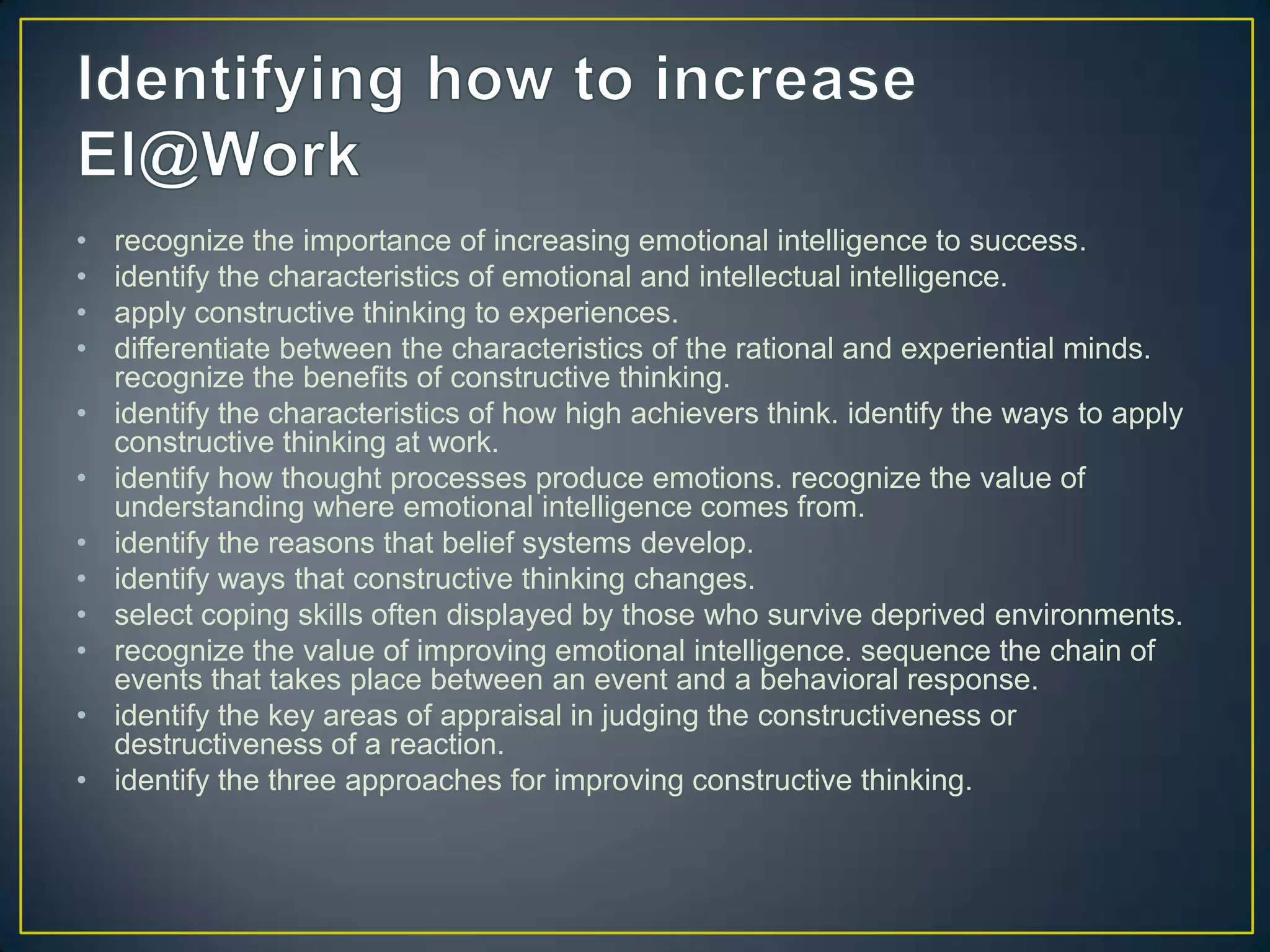
•   recognize the importance of increasing emotional intelligence to success.
•   identify the characteristics of emotional and intellectual intelligence.
•   apply constructive thinking to experiences.
•   differentiate between the characteristics of the rational and experiential minds.
    recognize the benefits of constructive thinking.
•   identify the characteristics of how high achievers think. identify the ways to apply
    constructive thinking at work.
•   identify how thought processes produce emotions. recognize the value of
    understanding where emotional intelligence comes from.
•   identify the reasons that belief systems develop.
•   identify ways that constructive thinking changes.
•   select coping skills often displayed by those who survive deprived environments.
•   recognize the value of improving emotional intelligence. sequence the chain of
    events that takes place between an event and a behavioral response.
•   identify the key areas of appraisal in judging the constructiveness or
    destructiveness of a reaction.
•   identify the three approaches for improving constructive thinking.
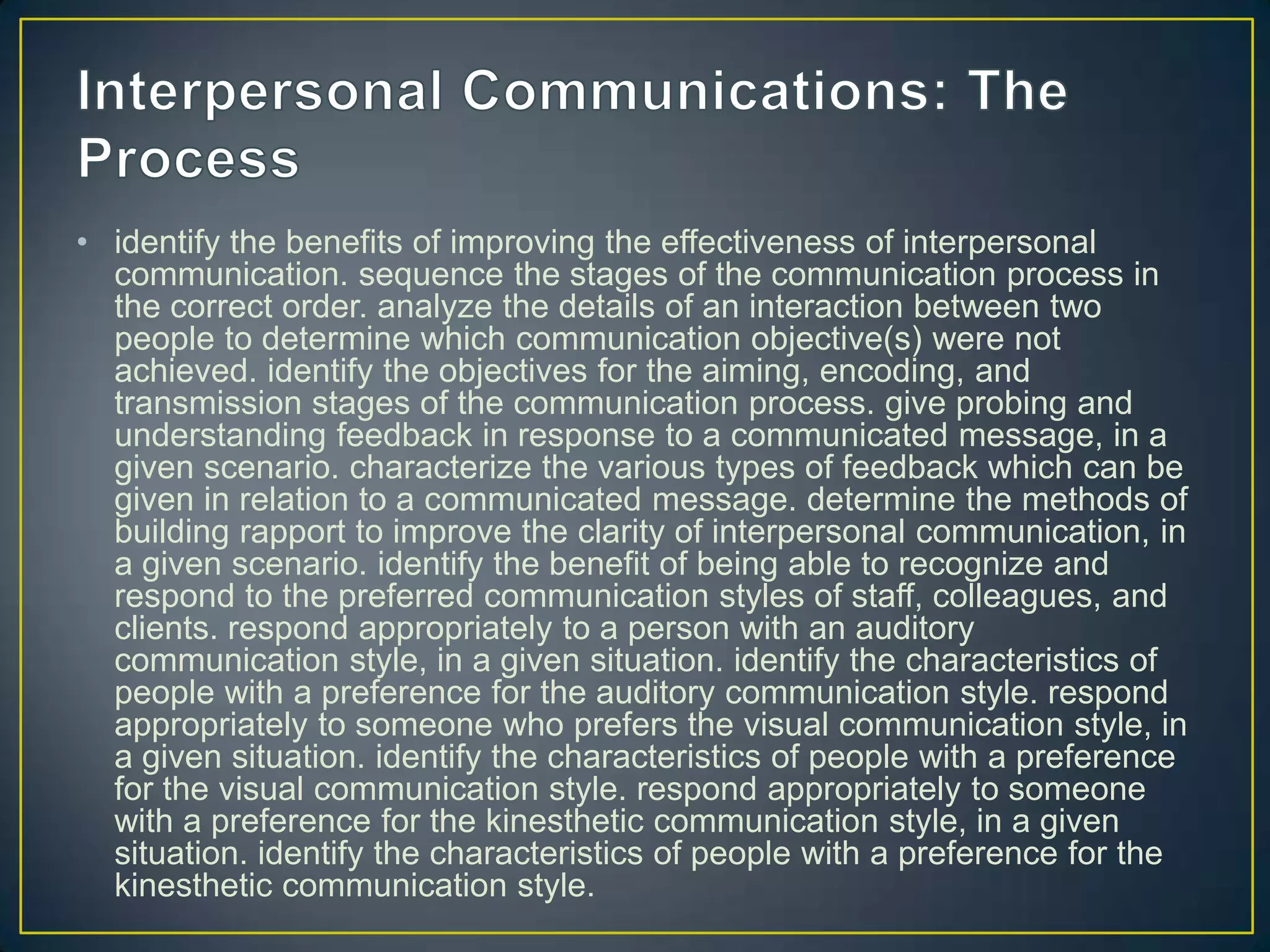
• identify the benefits of improving the effectiveness of interpersonal
  communication. sequence the stages of the communication process in
  the correct order. analyze the details of an interaction between two
  people to determine which communication objective(s) were not
  achieved. identify the objectives for the aiming, encoding, and
  transmission stages of the communication process. give probing and
  understanding feedback in response to a communicated message, in a
  given scenario. characterize the various types of feedback which can be
  given in relation to a communicated message. determine the methods of
  building rapport to improve the clarity of interpersonal communication, in
  a given scenario. identify the benefit of being able to recognize and
  respond to the preferred communication styles of staff, colleagues, and
  clients. respond appropriately to a person with an auditory
  communication style, in a given situation. identify the characteristics of
  people with a preference for the auditory communication style. respond
  appropriately to someone who prefers the visual communication style, in
  a given situation. identify the characteristics of people with a preference
  for the visual communication style. respond appropriately to someone
  with a preference for the kinesthetic communication style, in a given
  situation. identify the characteristics of people with a preference for the
  kinesthetic communication style.
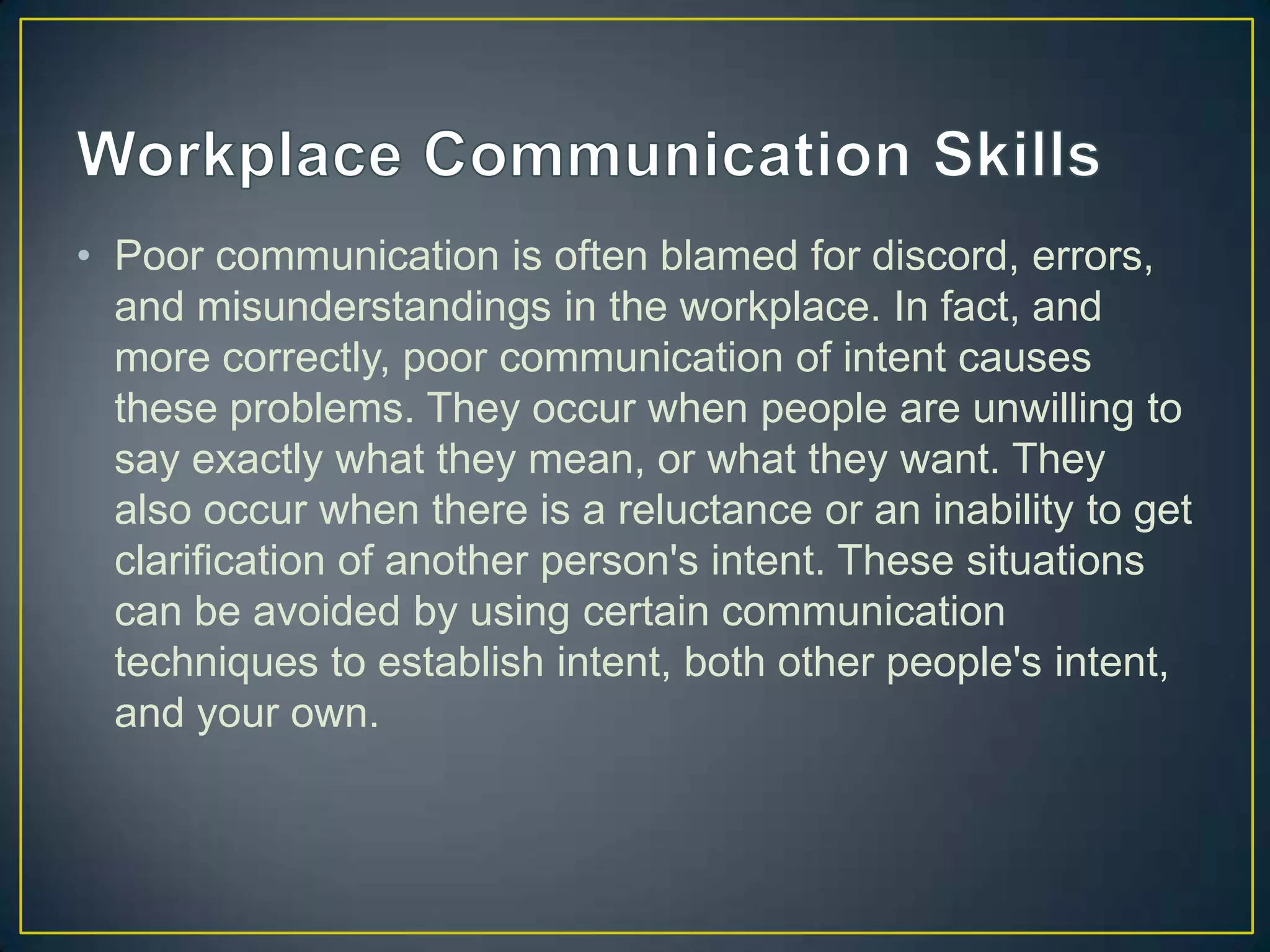
• Poor communication is often blamed for discord, errors,
  and misunderstandings in the workplace. In fact, and
  more correctly, poor communication of intent causes
  these problems. They occur when people are unwilling to
  say exactly what they mean, or what they want. They
  also occur when there is a reluctance or an inability to get
  clarification of another person's intent. These situations
  can be avoided by using certain communication
  techniques to establish intent, both other people's intent,
  and your own.
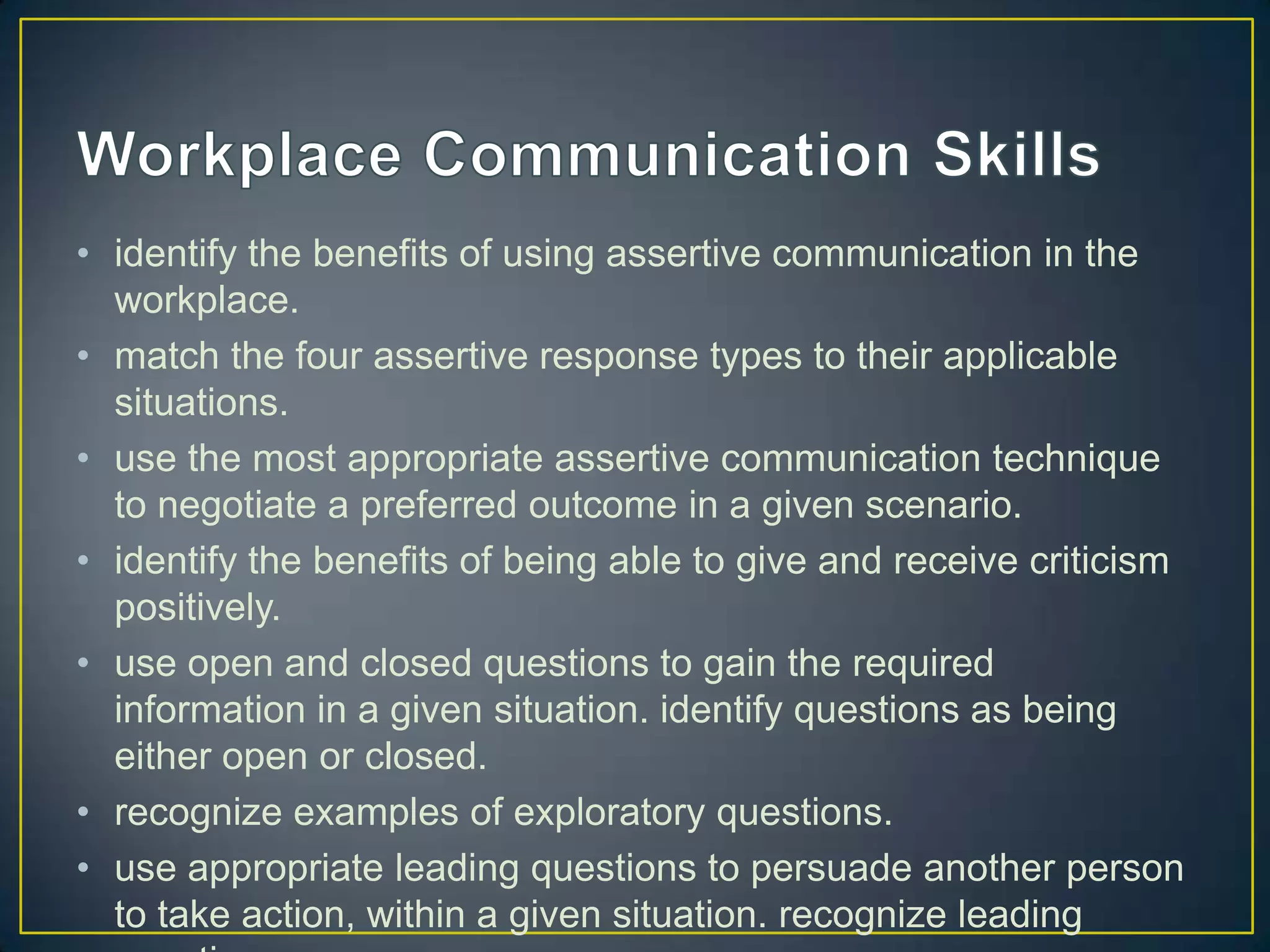
• identify the benefits of using assertive communication in the
  workplace.
• match the four assertive response types to their applicable
  situations.
• use the most appropriate assertive communication technique
  to negotiate a preferred outcome in a given scenario.
• identify the benefits of being able to give and receive criticism
  positively.
• use open and closed questions to gain the required
  information in a given situation. identify questions as being
  either open or closed.
• recognize examples of exploratory questions.
• use appropriate leading questions to persuade another person
  to take action, within a given situation. recognize leading
• Do you sometimes have difficulty using your listening
  skills to effectively evaluate arguments or appreciate
  complex ideas and emotions?
• identify the benefits of knowing how to listen critically.

• apply critical listening to recognize errors in reasoning, in a
  given listening scenario.
• identify the benefits of being able to listen critically to
  emotional appeals.
• identify common emotional appeals. identify the steps for
  dealing with emotive words.
• identify the benefits of using empathetic listening. apply the
  strategies for creating a supportive climate in an empathetic
  listening situation. apply the ground rules for empathetic
  listening to an empathetic listening situation.
• identify examples of key strategies for focusing attention in an
  empathetic listening situation.
Proactive Team Communication
• recognize the benefits of choosing to proactively communicate with team
  members. match the communication barriers with the appropriate examples.
  assess a given business scenario in which team member attempts to apply the
  principles for speaking nonjudgmentally, and determine what the team member
  did wrong.

Cooperative Communication
• select reasons why being an active participant in the communication process is
  important. recognize the techniques to use when listening supportively to
  teammates. analyze a given scenario to recommend improvements for listening
  supportively to a teammate. analyze a given scenario to recommend
  improvements for sharing a viewpoint assertively with a teammate.

Constructive Feedback
• choose the benefits of developing skills for constructively giving and receiving
  feedback. sequence examples of the steps for giving constructive feedback.
  apply the steps for giving feedback constructively to a teammate in a given
  situation. analyze a given business scenario to recommend improvements for
  receiving feedback gracefully from a teammate.
• recognize verbal barriers to communication apply ground
  rules for open communication, given a team meeting
  scenario identify strategies for maintaining open
  communication during team meetings identify which
  barriers to effective communication will be eliminated by
  specific strategies for team meetings recognize
  techniques for actively listening to a teammate's
  viewpoint
• A truly effective team is equal to more than the sum of its
  parts. And it takes the dedication of every member of the
  team. Effective team members go beyond themselves
  and their personal desires and goals. If you want to be an
  effective team member, your challenge is to put the team
  first, which means maximizing your contributions to help
  the team accomplish its purpose
• identify the strategies for adopting a positive mind-set
  about working on a team
• recognize how to be a proactive team member
• recognize strategies for demonstrating tolerance of
  teammates use strategies for being an effective team
  member
• recognize examples of the strategies for working
  collaboratively with others
• Your task is to deal with this organizational change by
  managing your own reactions and applying appropriate
  behaviors. How you respond to, as well as influence, the
  change process will be key to determining whether the
  change is beneficial or detrimental to your position in the
  new organizational structure.
•   managing your reactions to change.
•   assessing the pace of change.
•   utilizing an active learning strategy.
•   applying behaviors to deal effectively with change.
•   positively influencing communication during change.

Building A Professional Image

  • 1.
    1st Draft ofa new project
  • 2.
    • Does intelligencealone determine success? Or do self- awareness, impulse control, persistence, zeal, self- motivation, empathy, and social deftness factor heavily into the equation? While not as readily quantified as IQ, these qualities, collectively termed "emotional intelligence," often determine whether or not people excel in life, relationships, and the workplace. In this simulation, you'll test your emotional IQ to see how it affects various aspects of professional life.
  • 3.
    practicing social skills. • gauging emotional self-awareness. • coping with anger. keeping your emotions in check. • acting with integrity. • managing conflict. • practicing empathy. • employing persuasion. • fostering key connections. • applying constructive thinking.
  • 4.
    • In today'sworkplace, you need to have both the intellectual skills to do the job and the emotional intelligence to interact effectively with co-workers. The successful leaders and managers around you outshine others because of their stellar people skills. Most people believe that emotions are automatic responses that they have no control over. Few realize that their emotions are determined by what they think, and that concrete techniques exist for gaining control of their feelings
  • 5.
    recognize the importance of increasing emotional intelligence to success. • identify the characteristics of emotional and intellectual intelligence. • apply constructive thinking to experiences. • differentiate between the characteristics of the rational and experiential minds. recognize the benefits of constructive thinking. • identify the characteristics of how high achievers think. identify the ways to apply constructive thinking at work. • identify how thought processes produce emotions. recognize the value of understanding where emotional intelligence comes from. • identify the reasons that belief systems develop. • identify ways that constructive thinking changes. • select coping skills often displayed by those who survive deprived environments. • recognize the value of improving emotional intelligence. sequence the chain of events that takes place between an event and a behavioral response. • identify the key areas of appraisal in judging the constructiveness or destructiveness of a reaction. • identify the three approaches for improving constructive thinking.
  • 6.
    • identify thebenefits of improving the effectiveness of interpersonal communication. sequence the stages of the communication process in the correct order. analyze the details of an interaction between two people to determine which communication objective(s) were not achieved. identify the objectives for the aiming, encoding, and transmission stages of the communication process. give probing and understanding feedback in response to a communicated message, in a given scenario. characterize the various types of feedback which can be given in relation to a communicated message. determine the methods of building rapport to improve the clarity of interpersonal communication, in a given scenario. identify the benefit of being able to recognize and respond to the preferred communication styles of staff, colleagues, and clients. respond appropriately to a person with an auditory communication style, in a given situation. identify the characteristics of people with a preference for the auditory communication style. respond appropriately to someone who prefers the visual communication style, in a given situation. identify the characteristics of people with a preference for the visual communication style. respond appropriately to someone with a preference for the kinesthetic communication style, in a given situation. identify the characteristics of people with a preference for the kinesthetic communication style.
  • 7.
    • Poor communicationis often blamed for discord, errors, and misunderstandings in the workplace. In fact, and more correctly, poor communication of intent causes these problems. They occur when people are unwilling to say exactly what they mean, or what they want. They also occur when there is a reluctance or an inability to get clarification of another person's intent. These situations can be avoided by using certain communication techniques to establish intent, both other people's intent, and your own.
  • 8.
    • identify thebenefits of using assertive communication in the workplace. • match the four assertive response types to their applicable situations. • use the most appropriate assertive communication technique to negotiate a preferred outcome in a given scenario. • identify the benefits of being able to give and receive criticism positively. • use open and closed questions to gain the required information in a given situation. identify questions as being either open or closed. • recognize examples of exploratory questions. • use appropriate leading questions to persuade another person to take action, within a given situation. recognize leading
  • 9.
    • Do yousometimes have difficulty using your listening skills to effectively evaluate arguments or appreciate complex ideas and emotions?
  • 10.
    • identify thebenefits of knowing how to listen critically. • apply critical listening to recognize errors in reasoning, in a given listening scenario. • identify the benefits of being able to listen critically to emotional appeals. • identify common emotional appeals. identify the steps for dealing with emotive words. • identify the benefits of using empathetic listening. apply the strategies for creating a supportive climate in an empathetic listening situation. apply the ground rules for empathetic listening to an empathetic listening situation. • identify examples of key strategies for focusing attention in an empathetic listening situation.
  • 11.
    Proactive Team Communication •recognize the benefits of choosing to proactively communicate with team members. match the communication barriers with the appropriate examples. assess a given business scenario in which team member attempts to apply the principles for speaking nonjudgmentally, and determine what the team member did wrong. Cooperative Communication • select reasons why being an active participant in the communication process is important. recognize the techniques to use when listening supportively to teammates. analyze a given scenario to recommend improvements for listening supportively to a teammate. analyze a given scenario to recommend improvements for sharing a viewpoint assertively with a teammate. Constructive Feedback • choose the benefits of developing skills for constructively giving and receiving feedback. sequence examples of the steps for giving constructive feedback. apply the steps for giving feedback constructively to a teammate in a given situation. analyze a given business scenario to recommend improvements for receiving feedback gracefully from a teammate.
  • 12.
    • recognize verbalbarriers to communication apply ground rules for open communication, given a team meeting scenario identify strategies for maintaining open communication during team meetings identify which barriers to effective communication will be eliminated by specific strategies for team meetings recognize techniques for actively listening to a teammate's viewpoint
  • 13.
    • A trulyeffective team is equal to more than the sum of its parts. And it takes the dedication of every member of the team. Effective team members go beyond themselves and their personal desires and goals. If you want to be an effective team member, your challenge is to put the team first, which means maximizing your contributions to help the team accomplish its purpose
  • 14.
    • identify thestrategies for adopting a positive mind-set about working on a team • recognize how to be a proactive team member • recognize strategies for demonstrating tolerance of teammates use strategies for being an effective team member • recognize examples of the strategies for working collaboratively with others
  • 15.
    • Your taskis to deal with this organizational change by managing your own reactions and applying appropriate behaviors. How you respond to, as well as influence, the change process will be key to determining whether the change is beneficial or detrimental to your position in the new organizational structure.
  • 16.
    managing your reactions to change. • assessing the pace of change. • utilizing an active learning strategy. • applying behaviors to deal effectively with change. • positively influencing communication during change.