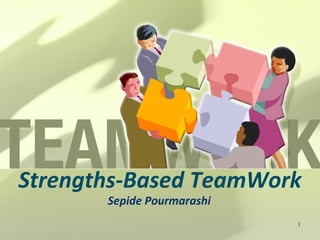
Strengths-Based TeamWork
Sepide Pourmarashi
1
What Is TEAMWORK?
2
What Is TEAMWORK?
A kind of work that blends individual STRENGTHS so
that they complement each other,
and in doing so brings people together with a sense
of friendship and shared vision
So That
strengths applied in a common direction
towards meaningful goals.
3
Strengths Discovery
“Bringing Talent To Life”
4
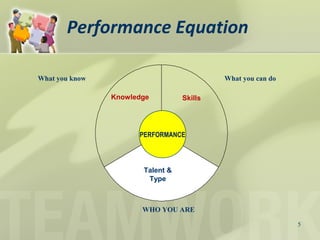
Performance Equation
5
PERFORMANCE
Skills
Talent &
Type
Knowledge
What you know What you can do
WHO YOU ARE
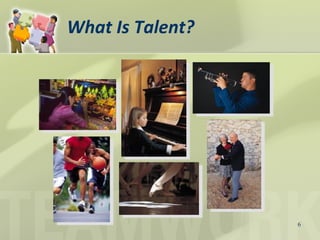
What Is Talent?
6
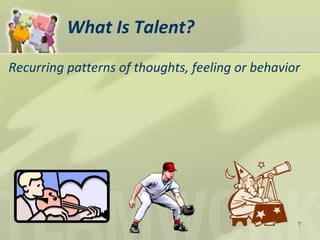
What Is Talent?
Recurring patterns of thoughts, feeling or behavior
7
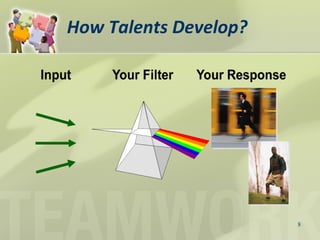
How Talents Develop?
8
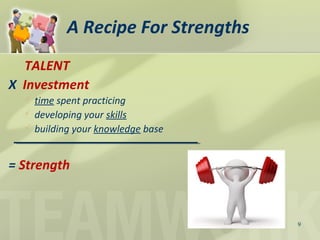
A Recipe For Strengths
TALENT
X Investment
 time spent practicing
 developing your skills
 building your knowledge base
= Strength
9
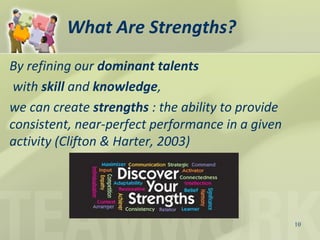
What Are Strengths?
By refining our dominant talents
with skill and knowledge,
we can create strengths : the ability to provide
consistent, near-perfect performance in a given
activity (Clifton & Harter, 2003)
10
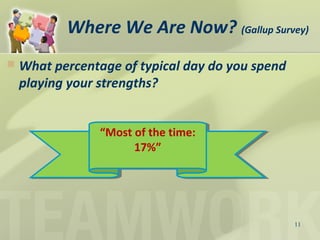
Where We Are Now? (Gallup Survey)
 What percentage of typical day do you spend
playing your strengths?
11
“Most of the time:
17%”
“Most of the time:
17%”
Where We Are Now? (Gallup Survey)
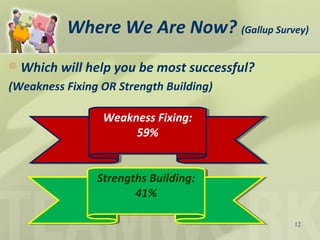
 Which will help you be most successful?
(Weakness Fixing OR Strength Building)
12
Weakness Fixing:
59%
Weakness Fixing:
59%
Strengths Building:
41%
Strengths Building:
41%
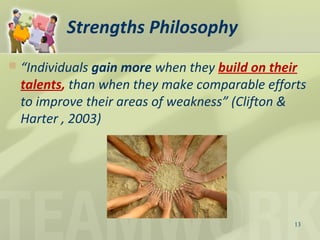
Strengths Philosophy
 “Individuals gain more when they build on their
talents, than when they make comparable efforts
to improve their areas of weakness” (Clifton &
Harter , 2003)
13
14
Weakness Fixing Model
-All behaviors can be learned:
• If you try hard enough, you can do it.
• If you want it badly enough, you can do it.
• If you dream it, you can achieve it.
-Weakness-fixing leads to success.
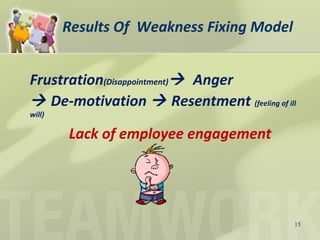
Frustration(Disappointment) Anger
 De-motivation  Resentment (feeling of ill
will)
Lack of employee engagement
15
Results Of Weakness Fixing Model
Chance of being engaged at work when the
organization does not focus on Strengths?
(According To Gallup Survey)
16
Results Of Weakness Fixing Model
9%9%
17
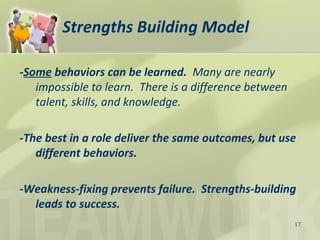
Strengths Building Model
-Some behaviors can be learned. Many are nearly
impossible to learn. There is a difference between
talent, skills, and knowledge.
-The best in a role deliver the same outcomes, but use
different behaviors.
-Weakness-fixing prevents failure. Strengths-building
leads to success.
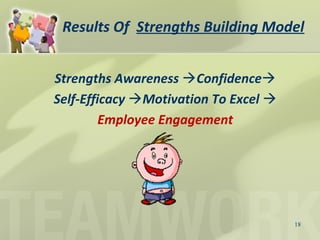
Strengths Awareness Confidence
Self-Efficacy Motivation To Excel 
Employee Engagement
18
Results Of Strengths Building Model
19
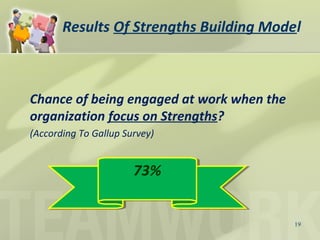
Results Of Strengths Building Model
Chance of being engaged at work when the
organization focus on Strengths?
(According To Gallup Survey)
73%73%
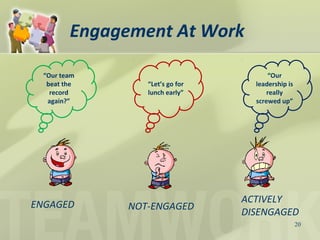
Engagement At Work
20
“Our team
beat the
record
again?”
ENGAGED
“Let’s go for
lunch early”
NOT-ENGAGED
“Our
leadership is
really
screwed up”
ACTIVELY
DISENGAGED
Knowing Our Strengths
 Most people think they
know what they are good at.
They are usually wrong….
(Business guru, Peter Drucker
1909-2005)
21
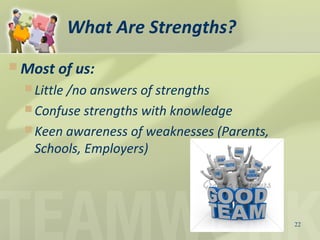
What Are Strengths?
 Most of us:
 Little /no answers of strengths
 Confuse strengths with knowledge
 Keen awareness of weaknesses (Parents,
Schools, Employers)
22
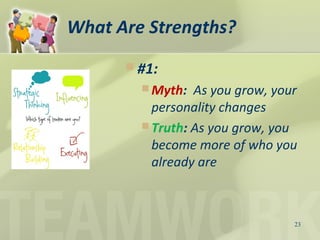
What Are Strengths?
 #1:
 Myth: As you grow, your
personality changes
 Truth: As you grow, you
become more of who you
already are
23
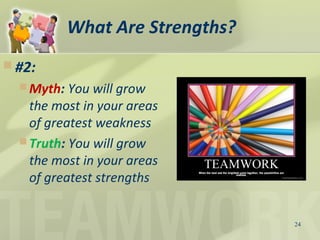
What Are Strengths?
 #2:
 Myth: You will grow
the most in your areas
of greatest weakness
 Truth: You will grow
the most in your areas
of greatest strengths
24
What Are Strengths?
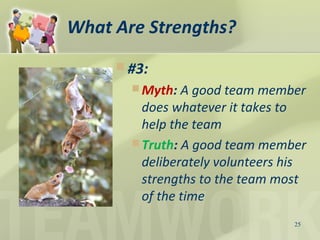
 #3:
 Myth: A good team member
does whatever it takes to
help the team
 Truth: A good team member
deliberately volunteers his
strengths to the team most
of the time
25
What Are Strengths?
 Strengths:
 Before doing an activity: You look forward to do it
 While doing it: You feel effective
 After doing it: You feel fulfilled & authentic
26
What Are Strengths?
 4 S.I.G.N Of Strengths:
 1-Success: Self-Efficacy, Activities that
 Fulfill and sustain
 Energize
 Generate positive feelings
 2-Instinct: Activities that
 You are drawn to
 You volunteer for
 You look forward to
 May be a bit scary 27
What Are Strengths?
 4 S.I.G.N Of Strengths:
 3-Growth: Activities that
 Feel easy and effortless
 Don’t seem to require you to concentrate
 Make time speed by
 Bring you happiness
 4-Needs: Activities that
 Seems to fill innate need
 Feel authentic and correct
 Feel satisfying
 Charge your “batteries”
28
Why Focus On Strengths?
29
 Speed: People operating from strength learn the
role faster and adapt to more variance in the role
quicker.
 Productivity and Precision: People operating
from strength produce significantly more at
higher quality.
 Longevity and Attendance: People operating
from strength stay longer, miss less work, and
build stronger customer relationships.
Recognizing & Putting Talent
To Work
30
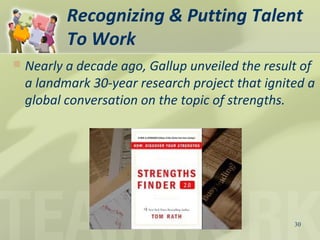
 Nearly a decade ago, Gallup unveiled the result of
a landmark 30-year research project that ignited a
global conversation on the topic of strengths.
Recognizing & Putting Talent
To Work
31
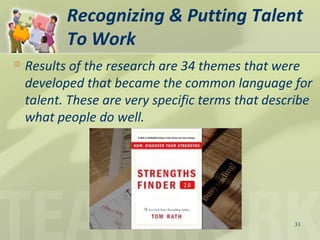
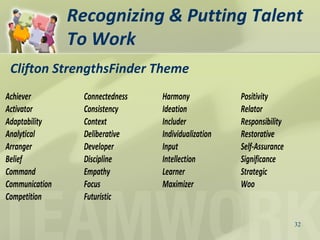
 Results of the research are 34 themes that were
developed that became the common language for
talent. These are very specific terms that describe
what people do well.
Recognizing & Putting Talent
To Work
32
Achiever Connectedness Harmony Positivity
Activator Consistency Ideation Relator
Adaptability Context Includer Responsibility
Analytical Deliberative Individualization Restorative
Arranger Developer Input Self-Assurance
Belief Discipline Intellection Significance
Command Empathy Learner Strategic
Communication Focus Maximizer Woo
Competition Futuristic
Clifton StrengthsFinder Theme
References:
 StrengthsFinder 2.0 ; Tom Rath ; Gallup Press; 2007
 Strengths Based Leadership; Tom Rath , Barry Conchie; Gallup Press; 2008
 Comprehensive Strengths Based Approach To The First-Year Experience; Laurie
A. Schreiner, Ph.D.; Eileen Hulme, Ph.D.; Azusa Pacific University: 2006 Annual
Conference on the First-Year Experience
 Building A Strengths-Based Organization (International Facilities Management
Association Austin, Texas, May 13, 2010, Melinda Figeley Dean, SPHR
 National Association of State Auditors, Comptrollers and Treasurers ;August 21,
2006;Omaha, Nebraska
 Strengths-Based Performing Teams, Facilitator; Presenter: Chiquita T. Tuttle,
MBA, Marketing Management & Health Care Consulting, LLC, Oakland,
California 94605, Bananactt@comcast.net
 Strengths and Leadership; Presented by: Jeremy David Jones
33
Thanks For Your Attention
34

Strenghts based teamwork

  • 1.
  • 2.
  • 3.
    What Is TEAMWORK? Akind of work that blends individual STRENGTHS so that they complement each other, and in doing so brings people together with a sense of friendship and shared vision So That strengths applied in a common direction towards meaningful goals. 3
  • 4.
  • 5.
  • 6.
  • 7.
    What Is Talent? Recurringpatterns of thoughts, feeling or behavior 7
  • 8.
  • 9.
    A Recipe ForStrengths TALENT X Investment  time spent practicing  developing your skills  building your knowledge base = Strength 9
  • 10.
    What Are Strengths? Byrefining our dominant talents with skill and knowledge, we can create strengths : the ability to provide consistent, near-perfect performance in a given activity (Clifton & Harter, 2003) 10
  • 11.
    Where We AreNow? (Gallup Survey)  What percentage of typical day do you spend playing your strengths? 11 “Most of the time: 17%” “Most of the time: 17%”
  • 12.
    Where We AreNow? (Gallup Survey)  Which will help you be most successful? (Weakness Fixing OR Strength Building) 12 Weakness Fixing: 59% Weakness Fixing: 59% Strengths Building: 41% Strengths Building: 41%
  • 13.
    Strengths Philosophy  “Individualsgain more when they build on their talents, than when they make comparable efforts to improve their areas of weakness” (Clifton & Harter , 2003) 13
  • 14.
    14 Weakness Fixing Model -Allbehaviors can be learned: • If you try hard enough, you can do it. • If you want it badly enough, you can do it. • If you dream it, you can achieve it. -Weakness-fixing leads to success.
  • 15.
    Frustration(Disappointment) Anger  De-motivation Resentment (feeling of ill will) Lack of employee engagement 15 Results Of Weakness Fixing Model
  • 16.
    Chance of beingengaged at work when the organization does not focus on Strengths? (According To Gallup Survey) 16 Results Of Weakness Fixing Model 9%9%
  • 17.
    17 Strengths Building Model -Somebehaviors can be learned. Many are nearly impossible to learn. There is a difference between talent, skills, and knowledge. -The best in a role deliver the same outcomes, but use different behaviors. -Weakness-fixing prevents failure. Strengths-building leads to success.
  • 18.
    Strengths Awareness Confidence Self-EfficacyMotivation To Excel  Employee Engagement 18 Results Of Strengths Building Model
  • 19.
    19 Results Of StrengthsBuilding Model Chance of being engaged at work when the organization focus on Strengths? (According To Gallup Survey) 73%73%
  • 20.
    Engagement At Work 20 “Ourteam beat the record again?” ENGAGED “Let’s go for lunch early” NOT-ENGAGED “Our leadership is really screwed up” ACTIVELY DISENGAGED
  • 21.
    Knowing Our Strengths Most people think they know what they are good at. They are usually wrong…. (Business guru, Peter Drucker 1909-2005) 21
  • 22.
    What Are Strengths? Most of us:  Little /no answers of strengths  Confuse strengths with knowledge  Keen awareness of weaknesses (Parents, Schools, Employers) 22
  • 23.
    What Are Strengths? #1:  Myth: As you grow, your personality changes  Truth: As you grow, you become more of who you already are 23
  • 24.
    What Are Strengths? #2:  Myth: You will grow the most in your areas of greatest weakness  Truth: You will grow the most in your areas of greatest strengths 24
  • 25.
    What Are Strengths? #3:  Myth: A good team member does whatever it takes to help the team  Truth: A good team member deliberately volunteers his strengths to the team most of the time 25
  • 26.
    What Are Strengths? Strengths:  Before doing an activity: You look forward to do it  While doing it: You feel effective  After doing it: You feel fulfilled & authentic 26
  • 27.
    What Are Strengths? 4 S.I.G.N Of Strengths:  1-Success: Self-Efficacy, Activities that  Fulfill and sustain  Energize  Generate positive feelings  2-Instinct: Activities that  You are drawn to  You volunteer for  You look forward to  May be a bit scary 27
  • 28.
    What Are Strengths? 4 S.I.G.N Of Strengths:  3-Growth: Activities that  Feel easy and effortless  Don’t seem to require you to concentrate  Make time speed by  Bring you happiness  4-Needs: Activities that  Seems to fill innate need  Feel authentic and correct  Feel satisfying  Charge your “batteries” 28
  • 29.
    Why Focus OnStrengths? 29  Speed: People operating from strength learn the role faster and adapt to more variance in the role quicker.  Productivity and Precision: People operating from strength produce significantly more at higher quality.  Longevity and Attendance: People operating from strength stay longer, miss less work, and build stronger customer relationships.
  • 30.
    Recognizing & PuttingTalent To Work 30  Nearly a decade ago, Gallup unveiled the result of a landmark 30-year research project that ignited a global conversation on the topic of strengths.
  • 31.
    Recognizing & PuttingTalent To Work 31  Results of the research are 34 themes that were developed that became the common language for talent. These are very specific terms that describe what people do well.
  • 32.
    Recognizing & PuttingTalent To Work 32 Achiever Connectedness Harmony Positivity Activator Consistency Ideation Relator Adaptability Context Includer Responsibility Analytical Deliberative Individualization Restorative Arranger Developer Input Self-Assurance Belief Discipline Intellection Significance Command Empathy Learner Strategic Communication Focus Maximizer Woo Competition Futuristic Clifton StrengthsFinder Theme
  • 33.
    References:  StrengthsFinder 2.0; Tom Rath ; Gallup Press; 2007  Strengths Based Leadership; Tom Rath , Barry Conchie; Gallup Press; 2008  Comprehensive Strengths Based Approach To The First-Year Experience; Laurie A. Schreiner, Ph.D.; Eileen Hulme, Ph.D.; Azusa Pacific University: 2006 Annual Conference on the First-Year Experience  Building A Strengths-Based Organization (International Facilities Management Association Austin, Texas, May 13, 2010, Melinda Figeley Dean, SPHR  National Association of State Auditors, Comptrollers and Treasurers ;August 21, 2006;Omaha, Nebraska  Strengths-Based Performing Teams, Facilitator; Presenter: Chiquita T. Tuttle, MBA, Marketing Management & Health Care Consulting, LLC, Oakland, California 94605, Bananactt@comcast.net  Strengths and Leadership; Presented by: Jeremy David Jones 33
  • 34.
    Thanks For YourAttention 34