Leadership Development: “What Got You Here, Won’t Get You There” Pathfinder
Workshop Topics Context The Role of Talent Talent:  Intelligence, Functional Skills, Interpersonal Behavior Skills The Leadership Ladder Effective Leadership & Interpersonal Behavior Skills Leadership Talent Assessment Leadership Talent Development Next Steps
Why This Topic? During the  Industrial Age  (1780-1980) , it was the  Means of Production  (Land, Equipment, Raw Materials, Capital) ,  that led to Competitive Advantage. Now that we have entered the  “Knowledge Age” , it will be high-performing  Talent  that will lead to Competitive Advantage. Question:  “How do we develop  Top Talent  in order to succeed – thrive – in this new economy?”
Leaders Understand:   Brand = Talent. -Tom Peters, Re-Imagine!
Talent:  Their Make-Up It is obvious that most talented people arrive in their organizations with above average… Intelligence & Functional Skills BUT, talented individuals have varying degrees of mature and effective… Interpersonal Behaviors
Talent:  Interpersonal Behaviors It will only be the talented individuals with mature and effective  Interpersonal Behaviors  who will make … Great Leaders And, at each level of the  Leadership Ladder , the degree and effectiveness of their  Interpersonal Behaviors  will be tested and must grow.
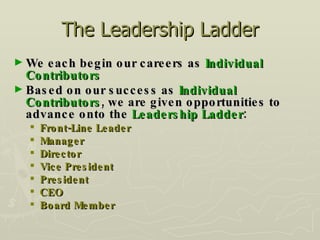
The Leadership Ladder We each begin our careers as  Individual Contributors Based on our success as  Individual Contributors , we are given opportunities to advance onto the  Leadership Ladder : Front-Line Leader Manager Director Vice President President CEO Board Member
Functional Skills:  The Beginning We each begin our careers by acquiring… Functional Skills Examples: Accounting Skills Marketing and/or Sales Skills Merchandising Skills Supply Chain Management Skills Copywriting Skills
Functional Skills:  The Beginning   (cont) As new professionals we each use our  Functional Skills  to various degrees of success. At this point in our careers, we are considered… Individual Contributors
Stepping Onto The Leadership Ladder For those of us who use our  Functional Skills  at a very high level, and consistently contribute to the success of the organization, it becomes likely that we will be selected for… Advance To Leadership
Stepping Onto The Leadership Ladder   (cont) Successful leaders at any level of the  Leadership Ladder  will rely less and less on their  Functional Skills , and more and more on their  Intelligence  and  Interpersonal Behavior Skills . At each level of the  Leadership Ladder , higher degrees of effectiveness will be required of our  Interpersonal Behavior Skills .
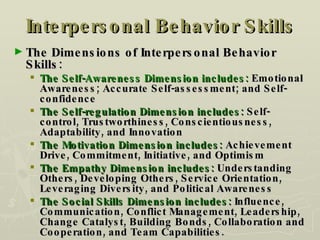
Interpersonal Behavior Skills The Dimensions of Interpersonal Behavior Skills: The Self-Awareness Dimension includes:  Emotional Awareness; Accurate Self-assessment; and Self-confidence The Self-regulation Dimension includes:  Self-control, Trustworthiness, Conscientiousness, Adaptability, and Innovation The Motivation Dimension includes:  Achievement Drive, Commitment, Initiative, and Optimism The Empathy Dimension includes:  Understanding Others, Developing Others, Service Orientation, Leveraging Diversity, and Political Awareness The Social Skills Dimension includes:  Influence, Communication, Conflict Management, Leadership, Change Catalyst, Building Bonds, Collaboration and Cooperation, and Team Capabilities.
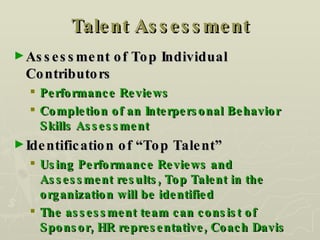
Talent Assessment Assessment of Top Individual Contributors Performance Reviews Completion of an Interpersonal Behavior Skills Assessment Identification of “Top Talent” Using Performance Reviews and Assessment results, Top Talent in the organization will be identified The assessment team can consist of Sponsor, HR representative, Coach Davis
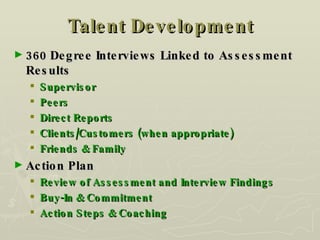
Talent Development 360 Degree Interviews Linked to Assessment Results Supervisor Peers Direct Reports Clients/Customers (when appropriate) Friends & Family Action Plan Review of Assessment and Interview Findings Buy-In & Commitment Action Steps & Coaching
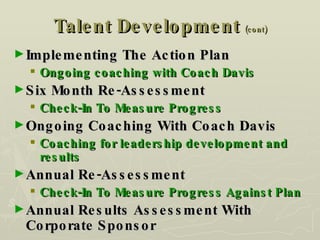
Talent Development  (cont) Implementing The Action Plan Ongoing coaching with Coach Davis Six Month Re-Assessment Check-In To Measure Progress Ongoing Coaching With Coach Davis Coaching for leadership development and results Annual Re-Assessment Check-In To Measure Progress Against Plan Annual Results Assessment With Corporate Sponsor
Organizational Leadership Training Each organization will also need to train managers in the following areas:  Staffing Plans, Hiring, Annual Performance Reviews, Ongoing Performance Management, Team & Meeting Management, Budgeting, Workflow Design, Measuring Results, and Reporting. Leadership Development Coaching can run parallel to training on these tasks.  Working with the Sponsor and HR, the two can be integrated.
Leadership Development Assignments During the first year of Talent Development, participants (aspiring leaders) can be offered leadership development assignments: Temporary assignments Intentional leadership assignments to test skills During these leadership development assignments, Coach Davis will continue his coaching, incorporating Action Plan coaching with the challenges of the new leadership assignment
“ We believe companies can increase their market cap 50 percent in 3 years. Steve Macadam at Georgia-Pacific …   changed  20  of his  40  box plant managers to put more talented, higher paid managers in charge.   He increased profitability from   $ 25   million to   $ 80   million in   2   years.”   —Ed Michaels,  War for Talent
Workshop Topics Context The Role of Talent Talent:  Intelligence, Functional Skills, Interpersonal Behavior Skills The Leadership Ladder Effective Leadership & Interpersonal Behavior Skills Leadership Talent Assessment Leadership Talent Development Next Steps…
Next Steps Establishing Leadership Development Strategy With Coach Davis Corporate Sponsor of Strategy Train The Sponsor & Team Implementing The Leadership Development Strategy Talent Assessment/Talent Inventory Initiate Work With Individual “Talent”
“ The leaders of Great Groups   love  talent   and know where to find it. They   revel  in the talent of others . ”   —Warren Bennis & Patricia Ward Biederman,  Organizing Genius
“ Connoisseur  of Talent” -Bob Taylor, Palo Alto Research Center Become a…
Pathfinder Career & Executive Coaching You can contact Coach Davis at: Email:  [email_address] Website:  www.pathfindermaine.com Phone:  207-272-5858
References Friedman, T.  (2006).  The World Is Flat.   New York:  Farrar, Straus and Giroux.  (ISBN:  0-374-29279-9) Goldsmith, M.  (2007).   What Got You Here, Won’t Get You There.   New York:  Hyperion.   (ISBN:  978-1-4013-0130-9) Goleman, D., Boyatzis, R., & McKee, A.  (2002).  Primal Leadership:  Realizing The Power of Emotional Intelligence.   Boston: Harvard Business School Press. (ISBN:  1-57851-486-X) Kouzes, J. & Posner, B.  (2003).  The Leadership Challenge (3rd Ed.) .  San Francisco:  Jossey-Bass. (ISBN-10: 0787968331; ISBN-13: 978-0787968335)  Peters, T.  (2003).  Re-imagine!:  Business Excellence in a Disruptive Age.   London:  Dorling Kindersley. (ISBN:  0-756-61746-4) Pink, D.  (2001).  Free Agent Nation:  How America’s New Independent Workers are Transforming the Way We Live.   New York:  Warner Books.  (ISBN:  0-446-52523-5) Pink, D.  (2006).  A Whole new Mind:  Moving from the Information Age to the Conceptual Age.   New York:  Penguin Group.  (ISBN:  1-573-22308-5)  Watkins, M.  (2003).  The First 90 Days:   Critical Success Strategies for New Leaders at All Levels .   Boston:  Harvard Business School Press (ISBN: 1-59139-110-5)

Leadership Development What Got You Here Wont Get You There

  • 1.
    Leadership Development: “WhatGot You Here, Won’t Get You There” Pathfinder
  • 2.
    Workshop Topics ContextThe Role of Talent Talent: Intelligence, Functional Skills, Interpersonal Behavior Skills The Leadership Ladder Effective Leadership & Interpersonal Behavior Skills Leadership Talent Assessment Leadership Talent Development Next Steps
  • 3.
    Why This Topic?During the Industrial Age (1780-1980) , it was the Means of Production (Land, Equipment, Raw Materials, Capital) , that led to Competitive Advantage. Now that we have entered the “Knowledge Age” , it will be high-performing Talent that will lead to Competitive Advantage. Question: “How do we develop Top Talent in order to succeed – thrive – in this new economy?”
  • 4.
    Leaders Understand: Brand = Talent. -Tom Peters, Re-Imagine!
  • 5.
    Talent: TheirMake-Up It is obvious that most talented people arrive in their organizations with above average… Intelligence & Functional Skills BUT, talented individuals have varying degrees of mature and effective… Interpersonal Behaviors
  • 6.
    Talent: InterpersonalBehaviors It will only be the talented individuals with mature and effective Interpersonal Behaviors who will make … Great Leaders And, at each level of the Leadership Ladder , the degree and effectiveness of their Interpersonal Behaviors will be tested and must grow.
  • 7.
    The Leadership LadderWe each begin our careers as Individual Contributors Based on our success as Individual Contributors , we are given opportunities to advance onto the Leadership Ladder : Front-Line Leader Manager Director Vice President President CEO Board Member
  • 8.
    Functional Skills: The Beginning We each begin our careers by acquiring… Functional Skills Examples: Accounting Skills Marketing and/or Sales Skills Merchandising Skills Supply Chain Management Skills Copywriting Skills
  • 9.
    Functional Skills: The Beginning (cont) As new professionals we each use our Functional Skills to various degrees of success. At this point in our careers, we are considered… Individual Contributors
  • 10.
    Stepping Onto TheLeadership Ladder For those of us who use our Functional Skills at a very high level, and consistently contribute to the success of the organization, it becomes likely that we will be selected for… Advance To Leadership
  • 11.
    Stepping Onto TheLeadership Ladder (cont) Successful leaders at any level of the Leadership Ladder will rely less and less on their Functional Skills , and more and more on their Intelligence and Interpersonal Behavior Skills . At each level of the Leadership Ladder , higher degrees of effectiveness will be required of our Interpersonal Behavior Skills .
  • 12.
    Interpersonal Behavior SkillsThe Dimensions of Interpersonal Behavior Skills: The Self-Awareness Dimension includes: Emotional Awareness; Accurate Self-assessment; and Self-confidence The Self-regulation Dimension includes: Self-control, Trustworthiness, Conscientiousness, Adaptability, and Innovation The Motivation Dimension includes: Achievement Drive, Commitment, Initiative, and Optimism The Empathy Dimension includes: Understanding Others, Developing Others, Service Orientation, Leveraging Diversity, and Political Awareness The Social Skills Dimension includes: Influence, Communication, Conflict Management, Leadership, Change Catalyst, Building Bonds, Collaboration and Cooperation, and Team Capabilities.
  • 13.
    Talent Assessment Assessmentof Top Individual Contributors Performance Reviews Completion of an Interpersonal Behavior Skills Assessment Identification of “Top Talent” Using Performance Reviews and Assessment results, Top Talent in the organization will be identified The assessment team can consist of Sponsor, HR representative, Coach Davis
  • 14.
    Talent Development 360Degree Interviews Linked to Assessment Results Supervisor Peers Direct Reports Clients/Customers (when appropriate) Friends & Family Action Plan Review of Assessment and Interview Findings Buy-In & Commitment Action Steps & Coaching
  • 15.
    Talent Development (cont) Implementing The Action Plan Ongoing coaching with Coach Davis Six Month Re-Assessment Check-In To Measure Progress Ongoing Coaching With Coach Davis Coaching for leadership development and results Annual Re-Assessment Check-In To Measure Progress Against Plan Annual Results Assessment With Corporate Sponsor
  • 16.
    Organizational Leadership TrainingEach organization will also need to train managers in the following areas: Staffing Plans, Hiring, Annual Performance Reviews, Ongoing Performance Management, Team & Meeting Management, Budgeting, Workflow Design, Measuring Results, and Reporting. Leadership Development Coaching can run parallel to training on these tasks. Working with the Sponsor and HR, the two can be integrated.
  • 17.
    Leadership Development AssignmentsDuring the first year of Talent Development, participants (aspiring leaders) can be offered leadership development assignments: Temporary assignments Intentional leadership assignments to test skills During these leadership development assignments, Coach Davis will continue his coaching, incorporating Action Plan coaching with the challenges of the new leadership assignment
  • 18.
    “ We believecompanies can increase their market cap 50 percent in 3 years. Steve Macadam at Georgia-Pacific … changed 20 of his 40 box plant managers to put more talented, higher paid managers in charge. He increased profitability from $ 25 million to $ 80 million in 2 years.” —Ed Michaels, War for Talent
  • 19.
    Workshop Topics ContextThe Role of Talent Talent: Intelligence, Functional Skills, Interpersonal Behavior Skills The Leadership Ladder Effective Leadership & Interpersonal Behavior Skills Leadership Talent Assessment Leadership Talent Development Next Steps…
  • 20.
    Next Steps EstablishingLeadership Development Strategy With Coach Davis Corporate Sponsor of Strategy Train The Sponsor & Team Implementing The Leadership Development Strategy Talent Assessment/Talent Inventory Initiate Work With Individual “Talent”
  • 21.
    “ The leadersof Great Groups love talent and know where to find it. They revel in the talent of others . ” —Warren Bennis & Patricia Ward Biederman, Organizing Genius
  • 22.
    “ Connoisseur of Talent” -Bob Taylor, Palo Alto Research Center Become a…
  • 23.
    Pathfinder Career &Executive Coaching You can contact Coach Davis at: Email: [email_address] Website: www.pathfindermaine.com Phone: 207-272-5858
  • 24.
    References Friedman, T. (2006). The World Is Flat. New York: Farrar, Straus and Giroux. (ISBN: 0-374-29279-9) Goldsmith, M. (2007). What Got You Here, Won’t Get You There. New York: Hyperion. (ISBN: 978-1-4013-0130-9) Goleman, D., Boyatzis, R., & McKee, A. (2002). Primal Leadership: Realizing The Power of Emotional Intelligence. Boston: Harvard Business School Press. (ISBN: 1-57851-486-X) Kouzes, J. & Posner, B. (2003). The Leadership Challenge (3rd Ed.) . San Francisco: Jossey-Bass. (ISBN-10: 0787968331; ISBN-13: 978-0787968335) Peters, T. (2003). Re-imagine!: Business Excellence in a Disruptive Age. London: Dorling Kindersley. (ISBN: 0-756-61746-4) Pink, D. (2001). Free Agent Nation: How America’s New Independent Workers are Transforming the Way We Live. New York: Warner Books. (ISBN: 0-446-52523-5) Pink, D. (2006). A Whole new Mind: Moving from the Information Age to the Conceptual Age. New York: Penguin Group. (ISBN: 1-573-22308-5) Watkins, M. (2003). The First 90 Days: Critical Success Strategies for New Leaders at All Levels . Boston: Harvard Business School Press (ISBN: 1-59139-110-5)