MAKING YOURSELF
INDISPENSABLE
John Zenger, Joseph Folkman, and
Scott Edinger
BY Manish Manghnani
Will be addressing following issues
1. Tom who was a sales executive after many years of thriving-- was well
liked, made numbers, got positive reviews.
His track record was solid, made no stupid mistakes, had no run-ins with
upper management, a seemingly perfect fit for skills and ambitions.
He was good at problem solving, strategic thinking and inspiring to top
performance.
What was the matter than that a colleague with less experience got
promoted instead him?
Tom was at loss….
Should he think more strategically?
Does he need to focus on his weakness or look for strength?
Does he need to build one strength or develop many in number?
Should he just take one strength at an outstanding level?
How a leader can be exceptionally better?
What skills will magnify his strength?
2
2. Organizations complain that they don’t have good leaders…is it a challenge to
replace good/bad once or turn people into outstanding leaders with distinctive strength?
3. What Peter Drucker, a management guru had to say on a business case --“The
Effective Executive”?
3
Key areas…
• Complementary skills/Non linear
Development/Cross training skills
• 360-degree evaluation
• Differentiating competencies falling into 5
categories
• Conducting cross-training for leadership skills
• Tom’s case
• Effects of 360 degree evaluation
• Developing linear way and whether to overdo it
• Closing with Peter Ducker's view
4
Cross training skills
• To appreciate better than a good leader one needs to
enhance complementary skills that enables to make full use
of strength.
• It is wise to improve a persons strength to a peak than
working hard to eradicate weakness.
• In Cross training, combination of two activities produces an
improvement.
Example:
Diet+ Exercise= losing weight.
Both combination is more effective than either diet or
exercise alone.
Later, will look for combinations of two positive strengths in
management perspective.
5
360 degree evaluation
• Asking team members, colleagues and boss questions
either in writing or in person
• Making clear it as seeking self improvement
• Inform that am explicitly open to negative feedback
• Absorb it professionally and appropriately without
retribution.
• Work on simple questions like:
 What outstanding impact I have on productivity,
efficiency, communication skills and relationships
 Fatal flaws to be considered if any
• Lastly to evaluate in quantitative term to measure the
progress.
6
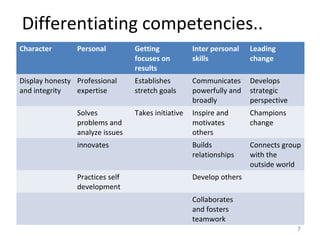
Differentiating competencies..
Character Personal Getting
focuses on
results
Inter personal
skills
Leading
change
Display honesty
and integrity
Professional
expertise
Establishes
stretch goals
Communicates
powerfully and
broadly
Develops
strategic
perspective
Solves
problems and
analyze issues
Takes initiative Inspire and
motivates
others
Champions
change
innovates Builds
relationships
Connects group
with the
outside world
Practices self
development
Develop others
Collaborates
and fosters
teamwork
7
Fetching examples from differentiating
competences..
• Assertiveness + honesty
 If a highly principled leader learned to become
assertive, he might more likely to speak up and act
with courage of his convictions, thus becoming more
effective.(applying strength more widely)
• Technical expert + communication skill
 A technical leader learns the ability to communicate
more positively might improve profitability to the
main competency.
• Innovativeness + champion change
 An innovative leader learn to champion change, thus
encouraging his team can lead to achieve results in
new and more creative ways.
8
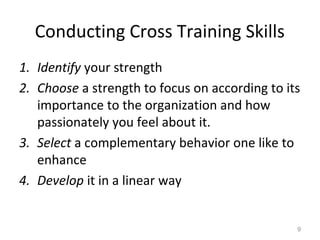
Conducting Cross Training Skills
1. Identify your strength
2. Choose a strength to focus on according to its
importance to the organization and how
passionately you feel about it.
3. Select a complementary behavior one like to
enhance
4. Develop it in a linear way
9
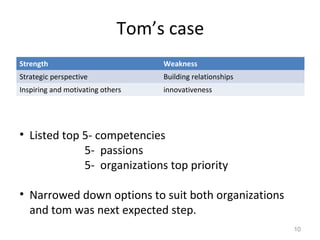
Tom’s case
Strength Weakness
Strategic perspective Building relationships
Inspiring and motivating others innovativeness
• Listed top 5- competencies
5- passions
5- organizations top priority
• Narrowed down options to suit both organizations
and tom was next expected step.
10
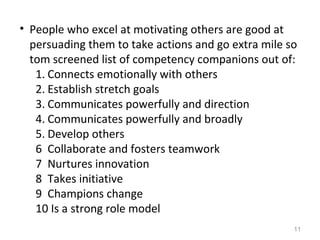
• People who excel at motivating others are good at
persuading them to take actions and go extra mile so
tom screened list of competency companions out of:
1. Connects emotionally with others
2. Establish stretch goals
3. Communicates powerfully and direction
4. Communicates powerfully and broadly
5. Develop others
6 Collaborate and fosters teamwork
7 Nurtures innovation
8 Takes initiative
9 Champions change
10 Is a strong role model
11
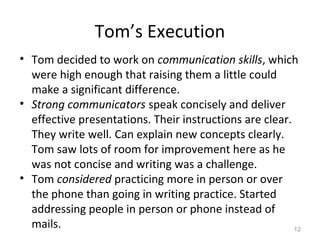
Tom’s Execution
• Tom decided to work on communication skills, which
were high enough that raising them a little could
make a significant difference.
• Strong communicators speak concisely and deliver
effective presentations. Their instructions are clear.
They write well. Can explain new concepts clearly.
Tom saw lots of room for improvement here as he
was not concise and writing was a challenge.
• Tom considered practicing more in person or over
the phone than going in writing practice. Started
addressing people in person or phone instead of
mails. 12
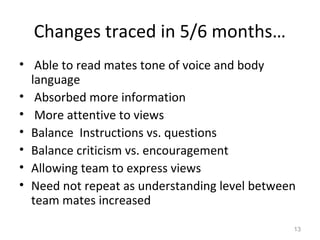
Changes traced in 5/6 months…
• Able to read mates tone of voice and body
language
• Absorbed more information
• More attentive to views
• Balance Instructions vs. questions
• Balance criticism vs. encouragement
• Allowing team to express views
• Need not repeat as understanding level between
team mates increased
13
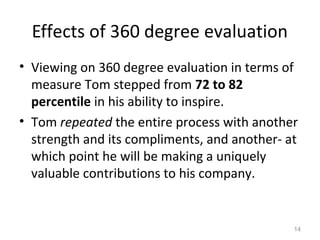
Effects of 360 degree evaluation
• Viewing on 360 degree evaluation in terms of
measure Tom stepped from 72 to 82
percentile in his ability to inspire.
• Tom repeated the entire process with another
strength and its compliments, and another- at
which point he will be making a uniquely
valuable contributions to his company.
14
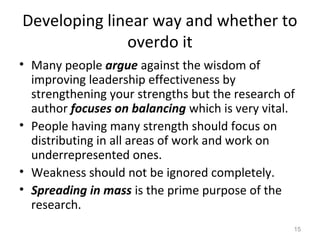
Developing linear way and whether to
overdo it
• Many people argue against the wisdom of
improving leadership effectiveness by
strengthening your strengths but the research of
author focuses on balancing which is very vital.
• People having many strength should focus on
distributing in all areas of work and work on
underrepresented ones.
• Weakness should not be ignored completely.
• Spreading in mass is the prime purpose of the
research.
15
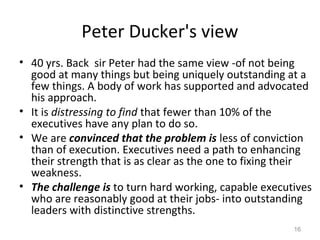
Peter Ducker's view
• 40 yrs. Back sir Peter had the same view -of not being
good at many things but being uniquely outstanding at a
few things. A body of work has supported and advocated
his approach.
• It is distressing to find that fewer than 10% of the
executives have any plan to do so.
• We are convinced that the problem is less of conviction
than of execution. Executives need a path to enhancing
their strength that is as clear as the one to fixing their
weakness.
• The challenge is to turn hard working, capable executives
who are reasonably good at their jobs- into outstanding
leaders with distinctive strengths.
16
17

Making yourself indispensable

  • 1.
    MAKING YOURSELF INDISPENSABLE John Zenger,Joseph Folkman, and Scott Edinger BY Manish Manghnani
  • 2.
    Will be addressingfollowing issues 1. Tom who was a sales executive after many years of thriving-- was well liked, made numbers, got positive reviews. His track record was solid, made no stupid mistakes, had no run-ins with upper management, a seemingly perfect fit for skills and ambitions. He was good at problem solving, strategic thinking and inspiring to top performance. What was the matter than that a colleague with less experience got promoted instead him? Tom was at loss…. Should he think more strategically? Does he need to focus on his weakness or look for strength? Does he need to build one strength or develop many in number? Should he just take one strength at an outstanding level? How a leader can be exceptionally better? What skills will magnify his strength? 2
  • 3.
    2. Organizations complainthat they don’t have good leaders…is it a challenge to replace good/bad once or turn people into outstanding leaders with distinctive strength? 3. What Peter Drucker, a management guru had to say on a business case --“The Effective Executive”? 3
  • 4.
    Key areas… • Complementaryskills/Non linear Development/Cross training skills • 360-degree evaluation • Differentiating competencies falling into 5 categories • Conducting cross-training for leadership skills • Tom’s case • Effects of 360 degree evaluation • Developing linear way and whether to overdo it • Closing with Peter Ducker's view 4
  • 5.
    Cross training skills •To appreciate better than a good leader one needs to enhance complementary skills that enables to make full use of strength. • It is wise to improve a persons strength to a peak than working hard to eradicate weakness. • In Cross training, combination of two activities produces an improvement. Example: Diet+ Exercise= losing weight. Both combination is more effective than either diet or exercise alone. Later, will look for combinations of two positive strengths in management perspective. 5
  • 6.
    360 degree evaluation •Asking team members, colleagues and boss questions either in writing or in person • Making clear it as seeking self improvement • Inform that am explicitly open to negative feedback • Absorb it professionally and appropriately without retribution. • Work on simple questions like:  What outstanding impact I have on productivity, efficiency, communication skills and relationships  Fatal flaws to be considered if any • Lastly to evaluate in quantitative term to measure the progress. 6
  • 7.
    Differentiating competencies.. Character PersonalGetting focuses on results Inter personal skills Leading change Display honesty and integrity Professional expertise Establishes stretch goals Communicates powerfully and broadly Develops strategic perspective Solves problems and analyze issues Takes initiative Inspire and motivates others Champions change innovates Builds relationships Connects group with the outside world Practices self development Develop others Collaborates and fosters teamwork 7
  • 8.
    Fetching examples fromdifferentiating competences.. • Assertiveness + honesty  If a highly principled leader learned to become assertive, he might more likely to speak up and act with courage of his convictions, thus becoming more effective.(applying strength more widely) • Technical expert + communication skill  A technical leader learns the ability to communicate more positively might improve profitability to the main competency. • Innovativeness + champion change  An innovative leader learn to champion change, thus encouraging his team can lead to achieve results in new and more creative ways. 8
  • 9.
    Conducting Cross TrainingSkills 1. Identify your strength 2. Choose a strength to focus on according to its importance to the organization and how passionately you feel about it. 3. Select a complementary behavior one like to enhance 4. Develop it in a linear way 9
  • 10.
    Tom’s case Strength Weakness Strategicperspective Building relationships Inspiring and motivating others innovativeness • Listed top 5- competencies 5- passions 5- organizations top priority • Narrowed down options to suit both organizations and tom was next expected step. 10
  • 11.
    • People whoexcel at motivating others are good at persuading them to take actions and go extra mile so tom screened list of competency companions out of: 1. Connects emotionally with others 2. Establish stretch goals 3. Communicates powerfully and direction 4. Communicates powerfully and broadly 5. Develop others 6 Collaborate and fosters teamwork 7 Nurtures innovation 8 Takes initiative 9 Champions change 10 Is a strong role model 11
  • 12.
    Tom’s Execution • Tomdecided to work on communication skills, which were high enough that raising them a little could make a significant difference. • Strong communicators speak concisely and deliver effective presentations. Their instructions are clear. They write well. Can explain new concepts clearly. Tom saw lots of room for improvement here as he was not concise and writing was a challenge. • Tom considered practicing more in person or over the phone than going in writing practice. Started addressing people in person or phone instead of mails. 12
  • 13.
    Changes traced in5/6 months… • Able to read mates tone of voice and body language • Absorbed more information • More attentive to views • Balance Instructions vs. questions • Balance criticism vs. encouragement • Allowing team to express views • Need not repeat as understanding level between team mates increased 13
  • 14.
    Effects of 360degree evaluation • Viewing on 360 degree evaluation in terms of measure Tom stepped from 72 to 82 percentile in his ability to inspire. • Tom repeated the entire process with another strength and its compliments, and another- at which point he will be making a uniquely valuable contributions to his company. 14
  • 15.
    Developing linear wayand whether to overdo it • Many people argue against the wisdom of improving leadership effectiveness by strengthening your strengths but the research of author focuses on balancing which is very vital. • People having many strength should focus on distributing in all areas of work and work on underrepresented ones. • Weakness should not be ignored completely. • Spreading in mass is the prime purpose of the research. 15
  • 16.
    Peter Ducker's view •40 yrs. Back sir Peter had the same view -of not being good at many things but being uniquely outstanding at a few things. A body of work has supported and advocated his approach. • It is distressing to find that fewer than 10% of the executives have any plan to do so. • We are convinced that the problem is less of conviction than of execution. Executives need a path to enhancing their strength that is as clear as the one to fixing their weakness. • The challenge is to turn hard working, capable executives who are reasonably good at their jobs- into outstanding leaders with distinctive strengths. 16
  • 17.

Editor's Notes

  • #12 Nurtures :- to encourage the growth and development