COURSE OBJECTIVES
1. Learn the value politeness, civility, courtesy and
respect at workplace.
2. Understand barriers and bridges to effective
communication.
3. Improve your abilities to listen in a focus and
attentive manner.
4. Be able to provide credit, give and receive
feedback among their superiors and peers.
5. Learn the skills to effectively manage conflict at
workplace.
LEARN THE VALUE POLITENESS, CIVILITY,
COURTESY AND RESPECT AT WORKPLACE
MODULE 1
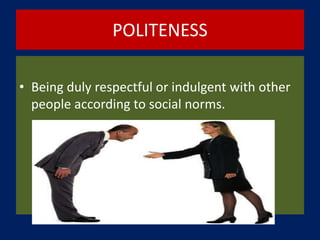
POLITENESS
• Being duly respectful or indulgent with other
people according to social norms.
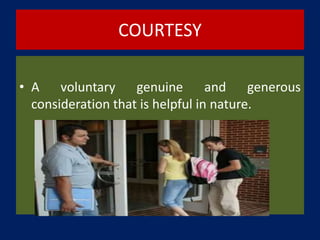
COURTESY
• A voluntary genuine and generous
consideration that is helpful in nature.
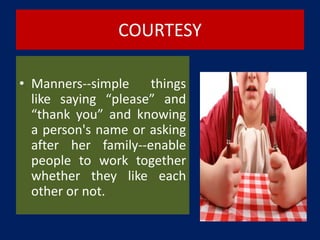
COURTESY
• Manners--simple things
like saying “please” and
“thank you” and knowing
a person's name or asking
after her family--enable
people to work together
whether they like each
other or not.
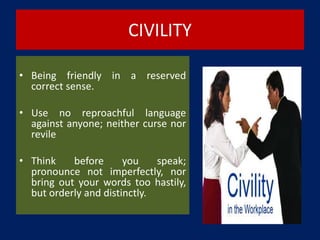
CIVILITY
• Being friendly in a reserved
correct sense.
• Use no reproachful language
against anyone; neither curse nor
revile
• Think before you speak;
pronounce not imperfectly, nor
bring out your words too hastily,
but orderly and distinctly.
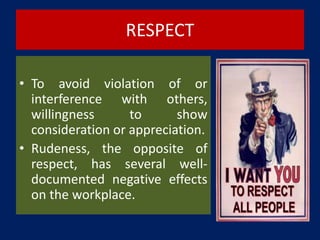
RESPECT
• To avoid violation of or
interference with others,
willingness to show
consideration or appreciation.
• Rudeness, the opposite of
respect, has several well-
documented negative effects
on the workplace.
EFFECTS OF RUDENESS
• 28% lost work time avoiding the instigator
• 53% lost work time worrying about the
incident
• 37% believe commitment to employer
declined
• 22% decreased work effort
• 10% decreased amount of time spent at
work
• 46%contemplated changing jobs
• 12 % changed jobs
EXERCISE 1
• A new staff has joined your department. How
would make him/her feel welcome?
• You and your friends are off for lunch but your
other colleague can’t because his/her task is
still uncompleted. What could you do?
• While a co worker was pushing the trolley, it
slipped and knocked into you. You are in pain.
How would you react?
UNDERSTAND BARRIERS AND BRIDGES
TO EFFECTIVE COMMUNICATION
MODULE 2
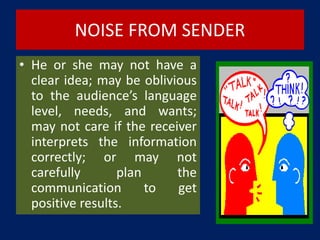
NOISE FROM SENDER
• He or she may not have a
clear idea; may be oblivious
to the audience’s language
level, needs, and wants;
may not care if the receiver
interprets the information
correctly; or may not
carefully plan the
communication to get
positive results.
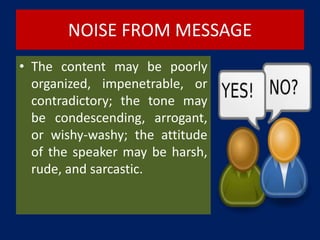
NOISE FROM MESSAGE
• The content may be poorly
organized, impenetrable, or
contradictory; the tone may
be condescending, arrogant,
or wishy-washy; the attitude
of the speaker may be harsh,
rude, and sarcastic.
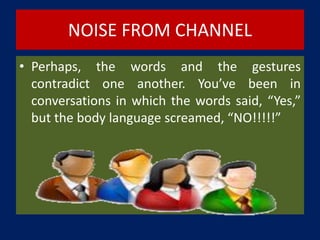
NOISE FROM CHANNEL
• Perhaps, the words and the gestures
contradict one another. You’ve been in
conversations in which the words said, “Yes,”
but the body language screamed, “NO!!!!!”
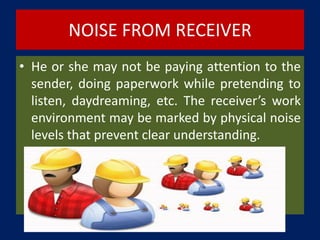
NOISE FROM RECEIVER
• He or she may not be paying attention to the
sender, doing paperwork while pretending to
listen, daydreaming, etc. The receiver’s work
environment may be marked by physical noise
levels that prevent clear understanding.
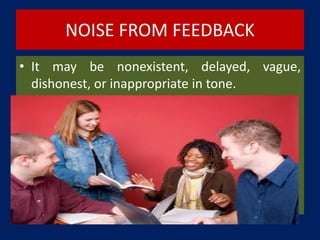
NOISE FROM FEEDBACK
• It may be nonexistent, delayed, vague,
dishonest, or inappropriate in tone.
SOLUTION - SENDER
• Understand the
audience(s) language
and needs.
• Use the “you” attitude,
putting the audiences
first.
• Clarify for themselves
the idea, purpose, and
desired end result.
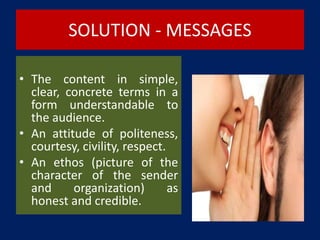
SOLUTION - MESSAGES
• The content in simple,
clear, concrete terms in a
form understandable to
the audience.
• An attitude of politeness,
courtesy, civility, respect.
• An ethos (picture of the
character of the sender
and organization) as
honest and credible.
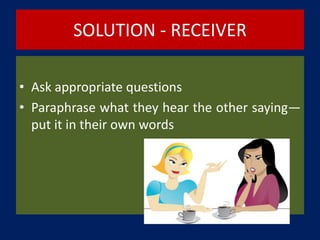
SOLUTION - RECEIVER
• Ask appropriate questions
• Paraphrase what they hear the other saying—
put it in their own words
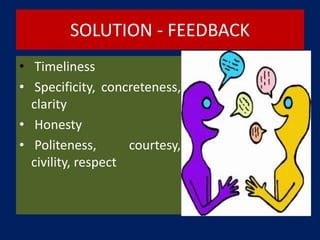
SOLUTION - FEEDBACK
• Timeliness
• Specificity, concreteness,
clarity
• Honesty
• Politeness, courtesy,
civility, respect
IMPROVE THEIR ABILITIES TO LISTEN IN
A FOCUS AND ATTENTIVE MANNER
MODULE 3
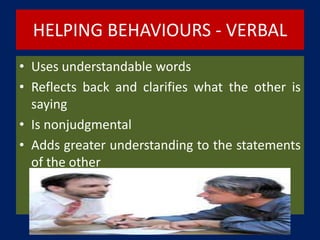
HELPING BEHAVIOURS - VERBAL
• Uses understandable words
• Reflects back and clarifies what the other is
saying
• Is nonjudgmental
• Adds greater understanding to the statements
of the other
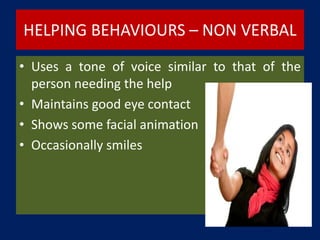
HELPING BEHAVIOURS – NON VERBAL
• Uses a tone of voice similar to that of the
person needing the help
• Maintains good eye contact
• Shows some facial animation
• Occasionally smiles
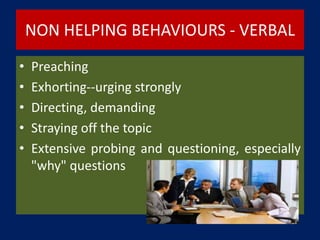
NON HELPING BEHAVIOURS - VERBAL
• Preaching
• Exhorting--urging strongly
• Directing, demanding
• Straying off the topic
• Extensive probing and questioning, especially
"why" questions
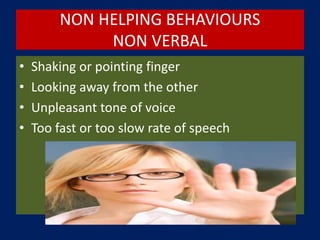
NON HELPING BEHAVIOURS
NON VERBAL
• Shaking or pointing finger
• Looking away from the other
• Unpleasant tone of voice
• Too fast or too slow rate of speech
FOUR ACTIVE LISTENING SKILLS
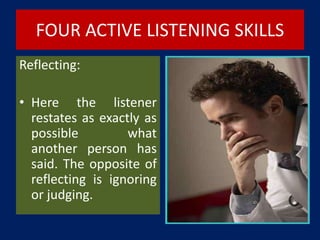
Reflecting:
• Here the listener
restates as exactly as
possible what
another person has
said. The opposite of
reflecting is ignoring
or judging.
FOUR ACTIVE LISTENING SKILLS
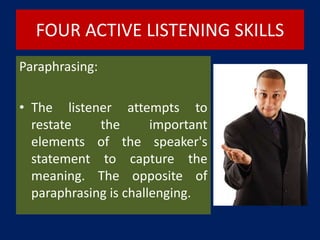
Paraphrasing:
• The listener attempts to
restate the important
elements of the speaker's
statement to capture the
meaning. The opposite of
paraphrasing is challenging.
FOUR ACTIVE LISTENING SKILLS
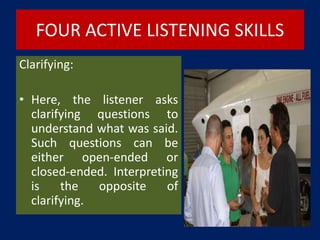
Clarifying:
• Here, the listener asks
clarifying questions to
understand what was said.
Such questions can be
either open-ended or
closed-ended. Interpreting
is the opposite of
clarifying.
FOUR ACTIVE LISTENING SKILLS
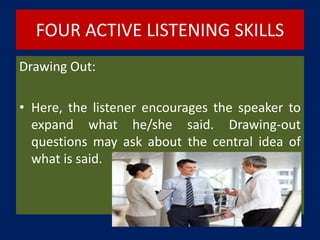
Drawing Out:
• Here, the listener encourages the speaker to
expand what he/she said. Drawing-out
questions may ask about the central idea of
what is said.
EXERCISE 3
“THIS IS YOUR LIFE” INTERVIEW
• If your physician told you that you had only six
more months to live, how would you spend
your time?
• Best/worst cases: job, boss, direct report.
• If you could time back, what one thing would
you change? What would you not change?
EXERCISE 3
“THIS IS YOUR LIFE” INTERVIEW
• As the interviewer, take no notes. Just listen
well, probe for clarification.
• Share your reading with your partner to
clarify, validate, and deepen your perception.
How well did you read your partner?
BE ABLE TO PROVIDE CREDIT, GIVE AND
RECEIVE FEEDBACK AMONG SUPERIORS
AND PEERS
MODULE 4
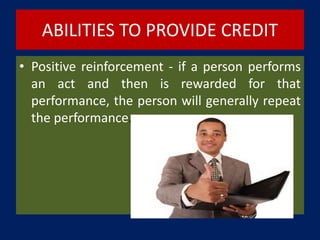
ABILITIES TO PROVIDE CREDIT
• Positive reinforcement - if a person performs
an act and then is rewarded for that
performance, the person will generally repeat
the performance.
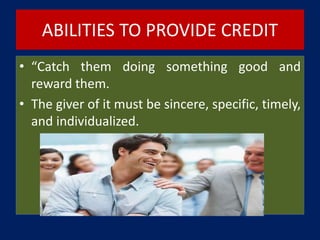
ABILITIES TO PROVIDE CREDIT
• “Catch them doing something good and
reward them.
• The giver of it must be sincere, specific, timely,
and individualized.
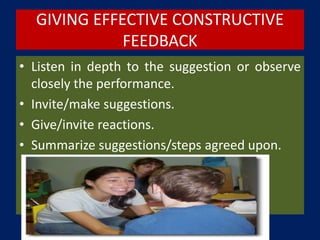
GIVING EFFECTIVE CONSTRUCTIVE
FEEDBACK
• Listen in depth to the suggestion or observe
closely the performance.
• Invite/make suggestions.
• Give/invite reactions.
• Summarize suggestions/steps agreed upon.
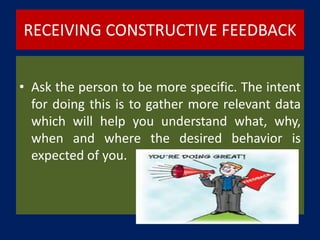
RECEIVING CONSTRUCTIVE FEEDBACK
• Ask the person to be more specific. The intent
for doing this is to gather more relevant data
which will help you understand what, why,
when and where the desired behavior is
expected of you.
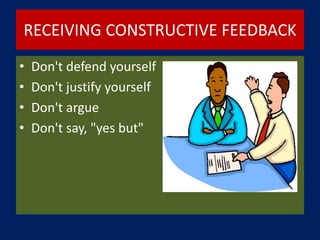
RECEIVING CONSTRUCTIVE FEEDBACK
• Don't defend yourself
• Don't justify yourself
• Don't argue
• Don't say, "yes but"
EXERCISE 4
• Simon has been a loyal employee whom has
performed well for the last 5 years. Lately
another new joined employee has been
promoted with better salary and Simon is
disappointed.
• The reason Simon was by passed for the
promotion was because his performance was bad
lately and actually Simon did it on purpose
because he was not rewarded for his past good
performance.
LEARN THE SKILLS TO MANAGE
CONFLICT AT WORKPLACE
MODULE 5
WORK PLACE CONFLICT
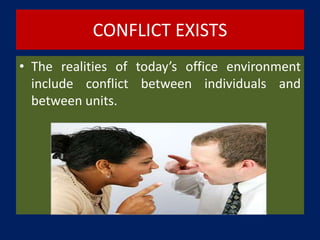
CONFLICT EXISTS
• The realities of today’s office environment
include conflict between individuals and
between units.
CONFLICT EXISTS
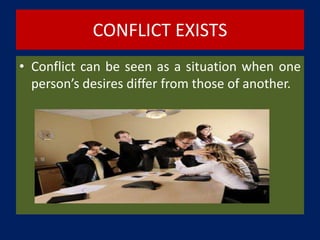
• Conflict can be seen as a situation when one
person’s desires differ from those of another.
CONFLICT EXISTS
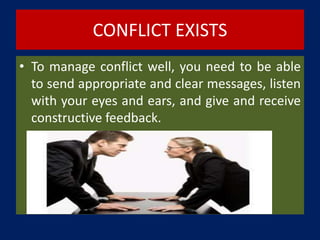
• To manage conflict well, you need to be able
to send appropriate and clear messages, listen
with your eyes and ears, and give and receive
constructive feedback.
CAUSES OF CONFLICTS
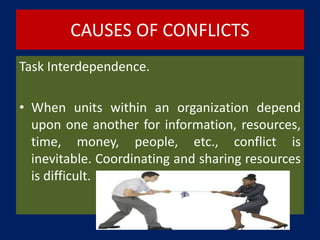
Task Interdependence.
• When units within an organization depend
upon one another for information, resources,
time, money, people, etc., conflict is
inevitable. Coordinating and sharing resources
is difficult.
CAUSES OF CONFLICTS
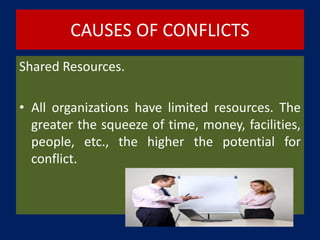
Shared Resources.
• All organizations have limited resources. The
greater the squeeze of time, money, facilities,
people, etc., the higher the potential for
conflict.
CAUSES OF CONFLICTS
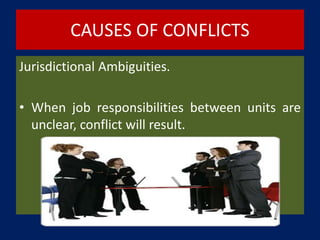
Jurisdictional Ambiguities.
• When job responsibilities between units are
unclear, conflict will result.
CAUSES OF CONFLICTS
Communications Breakdowns.
• Poor communications,
intentional or unintentional,
usually result in
misunderstandings and
misperceptions between units.
Mistrust and conflict increase
as communications break
down.
INTERPERSONAL CONFLICTS
Perceived Inequity of Rewards and Status.
• People are particularly sensitive to matters of
equity, believing the rewards they receive
should equal their contributions.
INTERPERSONAL CONFLICTS
Ego-Centrism/Obliviousness of Others.
• Some people falsely assume that they are the
only ones right in their judgments about the
world and that others are wrong except in
those cases when the others agree with them.
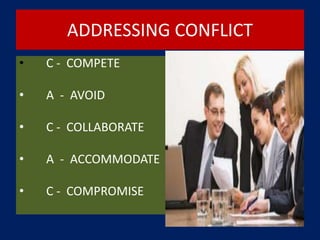
ADDRESSING CONFLICT
• C - COMPETE
• A - AVOID
• C - COLLABORATE
• A - ACCOMMODATE
• C - COMPROMISE
LISTEN, THEN SPEAK OUT
• Believe it or not, just listening to an
employee’s issue is the first and most
important step in resolving conflict. You
should simply listen to all parties involved to
completely understand the nature of conflict,
and then start troubleshooting solutions.
GATHER THE GROUP
• As a leader, you’ll need to arrange a meeting
with all involved parties to discuss the issue.
Give everyone a chance to speak; this is a
good opportunity to hear all sides and gain a
full understanding of the conflict. Having a
group meeting may also expedite a resolution
that will satisfy everyone.
BE IMPARTIAL
• Don’t take sides! In a leadership position, you
shouldn’t display any sort of opinion that
favors one person over another. If you are
partial towards one person, try to access the
situation from all sides to come up with a fair
and reasonable solution.
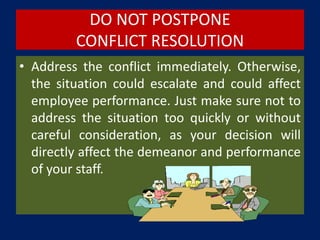
DO NOT POSTPONE
CONFLICT RESOLUTION
• Address the conflict immediately. Otherwise,
the situation could escalate and could affect
employee performance. Just make sure not to
address the situation too quickly or without
careful consideration, as your decision will
directly affect the demeanor and performance
of your staff.
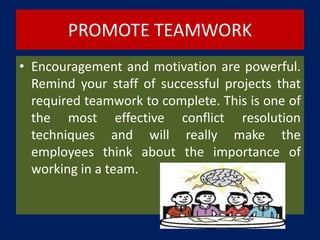
PROMOTE TEAMWORK
• Encouragement and motivation are powerful.
Remind your staff of successful projects that
required teamwork to complete. This is one of
the most effective conflict resolution
techniques and will really make the
employees think about the importance of
working in a team.
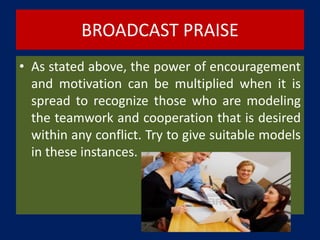
BROADCAST PRAISE
• As stated above, the power of encouragement
and motivation can be multiplied when it is
spread to recognize those who are modeling
the teamwork and cooperation that is desired
within any conflict. Try to give suitable models
in these instances.
Building Productive Relations @ Work

Building Productive Relations @ Work

  • 1.
    COURSE OBJECTIVES 1. Learnthe value politeness, civility, courtesy and respect at workplace. 2. Understand barriers and bridges to effective communication. 3. Improve your abilities to listen in a focus and attentive manner. 4. Be able to provide credit, give and receive feedback among their superiors and peers. 5. Learn the skills to effectively manage conflict at workplace.
  • 2.
    LEARN THE VALUEPOLITENESS, CIVILITY, COURTESY AND RESPECT AT WORKPLACE MODULE 1
  • 3.
    POLITENESS • Being dulyrespectful or indulgent with other people according to social norms.
  • 4.
    COURTESY • A voluntarygenuine and generous consideration that is helpful in nature.
  • 5.
    COURTESY • Manners--simple things likesaying “please” and “thank you” and knowing a person's name or asking after her family--enable people to work together whether they like each other or not.
  • 6.
    CIVILITY • Being friendlyin a reserved correct sense. • Use no reproachful language against anyone; neither curse nor revile • Think before you speak; pronounce not imperfectly, nor bring out your words too hastily, but orderly and distinctly.
  • 7.
    RESPECT • To avoidviolation of or interference with others, willingness to show consideration or appreciation. • Rudeness, the opposite of respect, has several well- documented negative effects on the workplace.
  • 8.
    EFFECTS OF RUDENESS •28% lost work time avoiding the instigator • 53% lost work time worrying about the incident • 37% believe commitment to employer declined • 22% decreased work effort • 10% decreased amount of time spent at work • 46%contemplated changing jobs • 12 % changed jobs
  • 9.
    EXERCISE 1 • Anew staff has joined your department. How would make him/her feel welcome? • You and your friends are off for lunch but your other colleague can’t because his/her task is still uncompleted. What could you do? • While a co worker was pushing the trolley, it slipped and knocked into you. You are in pain. How would you react?
  • 10.
    UNDERSTAND BARRIERS ANDBRIDGES TO EFFECTIVE COMMUNICATION MODULE 2
  • 11.
    NOISE FROM SENDER •He or she may not have a clear idea; may be oblivious to the audience’s language level, needs, and wants; may not care if the receiver interprets the information correctly; or may not carefully plan the communication to get positive results.
  • 12.
    NOISE FROM MESSAGE •The content may be poorly organized, impenetrable, or contradictory; the tone may be condescending, arrogant, or wishy-washy; the attitude of the speaker may be harsh, rude, and sarcastic.
  • 13.
    NOISE FROM CHANNEL •Perhaps, the words and the gestures contradict one another. You’ve been in conversations in which the words said, “Yes,” but the body language screamed, “NO!!!!!”
  • 14.
    NOISE FROM RECEIVER •He or she may not be paying attention to the sender, doing paperwork while pretending to listen, daydreaming, etc. The receiver’s work environment may be marked by physical noise levels that prevent clear understanding.
  • 15.
    NOISE FROM FEEDBACK •It may be nonexistent, delayed, vague, dishonest, or inappropriate in tone.
  • 16.
    SOLUTION - SENDER •Understand the audience(s) language and needs. • Use the “you” attitude, putting the audiences first. • Clarify for themselves the idea, purpose, and desired end result.
  • 17.
    SOLUTION - MESSAGES •The content in simple, clear, concrete terms in a form understandable to the audience. • An attitude of politeness, courtesy, civility, respect. • An ethos (picture of the character of the sender and organization) as honest and credible.
  • 18.
    SOLUTION - RECEIVER •Ask appropriate questions • Paraphrase what they hear the other saying— put it in their own words
  • 19.
    SOLUTION - FEEDBACK •Timeliness • Specificity, concreteness, clarity • Honesty • Politeness, courtesy, civility, respect
  • 20.
    IMPROVE THEIR ABILITIESTO LISTEN IN A FOCUS AND ATTENTIVE MANNER MODULE 3
  • 21.
    HELPING BEHAVIOURS -VERBAL • Uses understandable words • Reflects back and clarifies what the other is saying • Is nonjudgmental • Adds greater understanding to the statements of the other
  • 22.
    HELPING BEHAVIOURS –NON VERBAL • Uses a tone of voice similar to that of the person needing the help • Maintains good eye contact • Shows some facial animation • Occasionally smiles
  • 23.
    NON HELPING BEHAVIOURS- VERBAL • Preaching • Exhorting--urging strongly • Directing, demanding • Straying off the topic • Extensive probing and questioning, especially "why" questions
  • 24.
    NON HELPING BEHAVIOURS NONVERBAL • Shaking or pointing finger • Looking away from the other • Unpleasant tone of voice • Too fast or too slow rate of speech
  • 25.
    FOUR ACTIVE LISTENINGSKILLS Reflecting: • Here the listener restates as exactly as possible what another person has said. The opposite of reflecting is ignoring or judging.
  • 26.
    FOUR ACTIVE LISTENINGSKILLS Paraphrasing: • The listener attempts to restate the important elements of the speaker's statement to capture the meaning. The opposite of paraphrasing is challenging.
  • 27.
    FOUR ACTIVE LISTENINGSKILLS Clarifying: • Here, the listener asks clarifying questions to understand what was said. Such questions can be either open-ended or closed-ended. Interpreting is the opposite of clarifying.
  • 28.
    FOUR ACTIVE LISTENINGSKILLS Drawing Out: • Here, the listener encourages the speaker to expand what he/she said. Drawing-out questions may ask about the central idea of what is said.
  • 29.
    EXERCISE 3 “THIS ISYOUR LIFE” INTERVIEW • If your physician told you that you had only six more months to live, how would you spend your time? • Best/worst cases: job, boss, direct report. • If you could time back, what one thing would you change? What would you not change?
  • 30.
    EXERCISE 3 “THIS ISYOUR LIFE” INTERVIEW • As the interviewer, take no notes. Just listen well, probe for clarification. • Share your reading with your partner to clarify, validate, and deepen your perception. How well did you read your partner?
  • 31.
    BE ABLE TOPROVIDE CREDIT, GIVE AND RECEIVE FEEDBACK AMONG SUPERIORS AND PEERS MODULE 4
  • 32.
    ABILITIES TO PROVIDECREDIT • Positive reinforcement - if a person performs an act and then is rewarded for that performance, the person will generally repeat the performance.
  • 33.
    ABILITIES TO PROVIDECREDIT • “Catch them doing something good and reward them. • The giver of it must be sincere, specific, timely, and individualized.
  • 34.
    GIVING EFFECTIVE CONSTRUCTIVE FEEDBACK •Listen in depth to the suggestion or observe closely the performance. • Invite/make suggestions. • Give/invite reactions. • Summarize suggestions/steps agreed upon.
  • 35.
    RECEIVING CONSTRUCTIVE FEEDBACK •Ask the person to be more specific. The intent for doing this is to gather more relevant data which will help you understand what, why, when and where the desired behavior is expected of you.
  • 36.
    RECEIVING CONSTRUCTIVE FEEDBACK •Don't defend yourself • Don't justify yourself • Don't argue • Don't say, "yes but"
  • 37.
    EXERCISE 4 • Simonhas been a loyal employee whom has performed well for the last 5 years. Lately another new joined employee has been promoted with better salary and Simon is disappointed. • The reason Simon was by passed for the promotion was because his performance was bad lately and actually Simon did it on purpose because he was not rewarded for his past good performance.
  • 38.
    LEARN THE SKILLSTO MANAGE CONFLICT AT WORKPLACE MODULE 5
  • 39.
  • 40.
    CONFLICT EXISTS • Therealities of today’s office environment include conflict between individuals and between units.
  • 41.
    CONFLICT EXISTS • Conflictcan be seen as a situation when one person’s desires differ from those of another.
  • 42.
    CONFLICT EXISTS • Tomanage conflict well, you need to be able to send appropriate and clear messages, listen with your eyes and ears, and give and receive constructive feedback.
  • 43.
    CAUSES OF CONFLICTS TaskInterdependence. • When units within an organization depend upon one another for information, resources, time, money, people, etc., conflict is inevitable. Coordinating and sharing resources is difficult.
  • 44.
    CAUSES OF CONFLICTS SharedResources. • All organizations have limited resources. The greater the squeeze of time, money, facilities, people, etc., the higher the potential for conflict.
  • 45.
    CAUSES OF CONFLICTS JurisdictionalAmbiguities. • When job responsibilities between units are unclear, conflict will result.
  • 46.
    CAUSES OF CONFLICTS CommunicationsBreakdowns. • Poor communications, intentional or unintentional, usually result in misunderstandings and misperceptions between units. Mistrust and conflict increase as communications break down.
  • 47.
    INTERPERSONAL CONFLICTS Perceived Inequityof Rewards and Status. • People are particularly sensitive to matters of equity, believing the rewards they receive should equal their contributions.
  • 48.
    INTERPERSONAL CONFLICTS Ego-Centrism/Obliviousness ofOthers. • Some people falsely assume that they are the only ones right in their judgments about the world and that others are wrong except in those cases when the others agree with them.
  • 49.
    ADDRESSING CONFLICT • C- COMPETE • A - AVOID • C - COLLABORATE • A - ACCOMMODATE • C - COMPROMISE
  • 50.
    LISTEN, THEN SPEAKOUT • Believe it or not, just listening to an employee’s issue is the first and most important step in resolving conflict. You should simply listen to all parties involved to completely understand the nature of conflict, and then start troubleshooting solutions.
  • 51.
    GATHER THE GROUP •As a leader, you’ll need to arrange a meeting with all involved parties to discuss the issue. Give everyone a chance to speak; this is a good opportunity to hear all sides and gain a full understanding of the conflict. Having a group meeting may also expedite a resolution that will satisfy everyone.
  • 52.
    BE IMPARTIAL • Don’ttake sides! In a leadership position, you shouldn’t display any sort of opinion that favors one person over another. If you are partial towards one person, try to access the situation from all sides to come up with a fair and reasonable solution.
  • 53.
    DO NOT POSTPONE CONFLICTRESOLUTION • Address the conflict immediately. Otherwise, the situation could escalate and could affect employee performance. Just make sure not to address the situation too quickly or without careful consideration, as your decision will directly affect the demeanor and performance of your staff.
  • 54.
    PROMOTE TEAMWORK • Encouragementand motivation are powerful. Remind your staff of successful projects that required teamwork to complete. This is one of the most effective conflict resolution techniques and will really make the employees think about the importance of working in a team.
  • 55.
    BROADCAST PRAISE • Asstated above, the power of encouragement and motivation can be multiplied when it is spread to recognize those who are modeling the teamwork and cooperation that is desired within any conflict. Try to give suitable models in these instances.