Budget Planning and
   Management

  - Noel Lawas MD -
Definitions
• Budget
  – A statement containing the list of commitments
    by a body to provide the required resources with
    a given monetary value, to perform the activities
    that are expected to attain a given objective.
  – In an organization, the budget is the final act of
    commitment to the strategies it has set forth to
    do in the future in order to achieve its desired
    strategic objectives.
Pre-requisites Before Arriving at an
         Optimal Budget
• A sound organizational strategic plan that
  considers the available funds that can be
  provided at the time these are needed.
• Relevance of the budgeted activities to the
  attainment of the strategic objectives.
• Outputs of the budgeted activities can be
  objectively measured and assessed.
• Revenues from activities to be undertaken can
  be predicted with acceptable degree of accuracy
Strategic Planning Cycle vis-a vis Budget Cycle
Conceptual Framework to Budget
  Planning in an Organization

     Strategic Plan     Budget Policies
  of the Organization   Capital Budget


     Program /           Medium-term
    Departmental          Budget Plan
       Plan              (3 to 5 years)


     Operational        Annual Budget
       Plan                 Plan
Principles Underlying Budget Planning
           and Management
• Budget as a control instrument of
  management
  – Resource allocation: priority setting and
    spending plan
  – Financial control and planning: containment of
    expenditure, financial forecasts
  – Improving efficiency and effectiveness of
    organizational resources/activities
  – Communication: between different levels/units
    of organization and its stakeholders
Principles Underlying Budget Planning
           and Management
• Types of Budget
   – Income and Expenditure Budget
      • sets out the anticipated (recurrent) costs of the institutions and
        shows the source of funds to cover them.
      • annual income and expenditure budget is often broken down into
        shorter periods for better monitoring
   – Capital Budget
      • Budget for capital projects and acquisition of equipment or fixed
        assets
      • need separate budget and monitoring because it usually involves
        major expenditure items and non-recurrent costs
      • need to consider the effect of capital investment on recurrent cost
      • e.g., Vehicles, building hospital, medical equipment
   – Cash Budget (Cashflow Forecast)
      • aims to monitor the availability of cash: whether sufficient cash is
        available in the bank to meet the payments needs as they arise
      • based on the income and expenditure budget and capital budget
Principles Underlying Budget Planning
           and Management
• Approaches to Budgeting (Process of budget
  formulation)
  – Incremental Budgeting
     • Increase the amount of budget based on the budget of the previous
       year
     • Idea of historical budgeting: historical funding allocation plus
       adjustment for inflation, usually based on inputs (personnel, bed)
       not taking into account actual utilization
     • simple and little requirement for management and clinical
       information: incremental budgeting can be used when annual policy
       and plan is stable
     • perverse incentive and reward for spending more (to get greater
       budget next year)
     • lack of incentive for efficiency and effectiveness: little incentive to
       improve outputs and outcomes, little incentive for innovation and
       change in management and service delivery
     • cannot reflect changing needs
Principles Underlying Budget Planning
           and Management
• Approaches to Budgeting (Process of
  budget formulation)
  – Zero-based Budgeting
    • considers the previous year’s budget as zero
    • re-evaluates all the projects, and allocate budget
      according to priority
    • takes much time and cost
    • idea of needs-based budgeting: budgeting based
      on the resources required to meet health care
      needs of population (epidemiological and health
      profiles, needs for health care and prevention)
Principles Underlying Budget Planning and
                Management
• Budgeting Systems (Budget allocation structure)
   – Line-item budgeting
      • Distribution of expenditure item by item, to make it possible to control
        budget expenditure
      • budget allocation by input classes: salary, drug, equipment, fuel, etc.
      • usually short-term, no link to outputs or outcomes
      • Indicators: total cost, % of labor cost…
      • Pros
          – expenditure list and amount is clear and accurate
          – clear budget and accounting responsibility
      • Cons
          – Inflexible: hard to deal with unexpected incidents or changing needs
          – Focusing on budget items and monetary inputs (expense items), not
             the result of a project → can fail to achieve initial goals of
             government programs
          – Limited attention to the value for money: difficult to monitor and
             evaluate the efficiency and effectiveness of funding
Principles Underlying Budget Planning and
                Management
• Budgeting Systems (Budget allocation structure)
   – Performance-based budget
      • budget allocation based on outputs (not outcomes)
      • budget allocation by programs: maternal health, primary care,
        immunization, hospital inpatient care, HIV/AIDS, etc.
      • Pros
          – helps stakeholders understand what organization is doing and why
          – can better establish long-term plans, and use organizational
            resources more flexibly
          – can include performance objectives in the budget
          – budget as a management tool: compare actual and planned
            performance
          – e.g., No. of hospital admissions, No. of fully immunized children
      • Cons
          – Setting performance is tough: quality of performance indicator,
            consensus on performance measure, track/measure performance,
            etc.
          – may be hard to control public expenditure
Program/Operational Budget
         Planning Methods
1. Create a chart of accounts for revenue and
   expense with corresponding account codes
  – Examples
     •   Revenue accounts – revenues from drug sales, ancillary
         services, service fees, rentals, donations, subsidies,
         retainer fees, etc.
     •   Expense accounts
         – Personal Services – salaries, hazard pay, Christmas bonus,
           13th month pay, honoraria, etc.
         – MOOE – transportation, supplies, utilities, services,
           communications, repairs, etc
Program/Operational Budget
           Planning Methods
1. Review budget guidelines and policies
   that may set the environment for budget
   planning
  –   Note the budget amount limits imposed under the
      budget guidelines
2. Identify sources of revenues and develop
   forecasts for the period covered.
  –   Note if the use of revenues for each source has
      restrictions
Program/Operational Budget
           Planning Methods
1. For each activity identified in the operational
   plan, compute budgetary requirements
   specifically needed to implement the activity.
   These requirements should consider personal,
   mooe and finance expenses for each activity.
  –   Note: Some types of expenses cut across different units and
      programs (eg. Salaries, utilities). In this situation, each of
      these expenses are assigned to one program or unit.
      Example: salary and electricity expenses are assigned to
      general administrative services program.
Operational Budget Planning Worksheet
    Program/ Operational Unit: _________________________
Managing Implementation of
         Budget
Budget Management System
                 Framework
         Allotted budget
                                                   Allocated Budget
                                                   from Income


                                         Amount
Amount


         Expenditure
         s                     Working
                               Capital


                                                  Expenditure
                                                  s


                Fiscal Year                         Fiscal Year

            Government Model                      Private Model
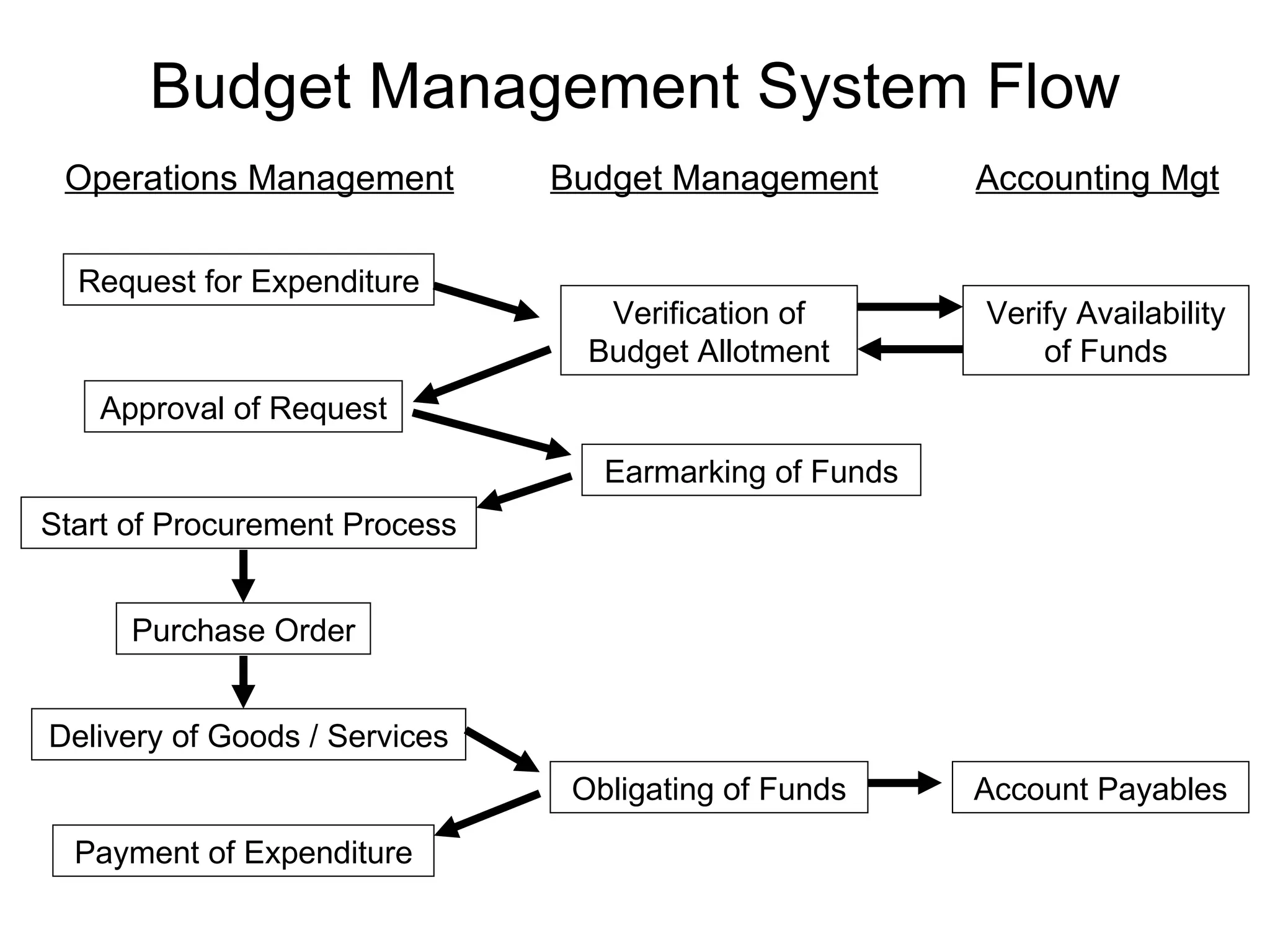
Budget Management System Flow
 Operations Management         Budget Management        Accounting Mgt

  Request for Expenditure
                                  Verification of       Verify Availability
                                 Budget Allotment           of Funds
   Approval of Request

                                  Earmarking of Funds
Start of Procurement Process


      Purchase Order


Delivery of Goods / Services
                                Obligating of Funds     Account Payables

  Payment of Expenditure
Budget Management Activities
      During Implementation
• Verification of budget allotment
  – Expenditure requested is within the approved budget
  – Availability of funds is confirmed based on the
    revenues collected and/or the presence of “Notice of
    Cash Allocation” for public offices
• Earmarking of budget allotment and available
  funds
  – The act of setting aside specific amounts from the
    available funds for possible future payments
• Obligating of funds
  – The act of recognizing specific amounts from the
    available funds as spent.
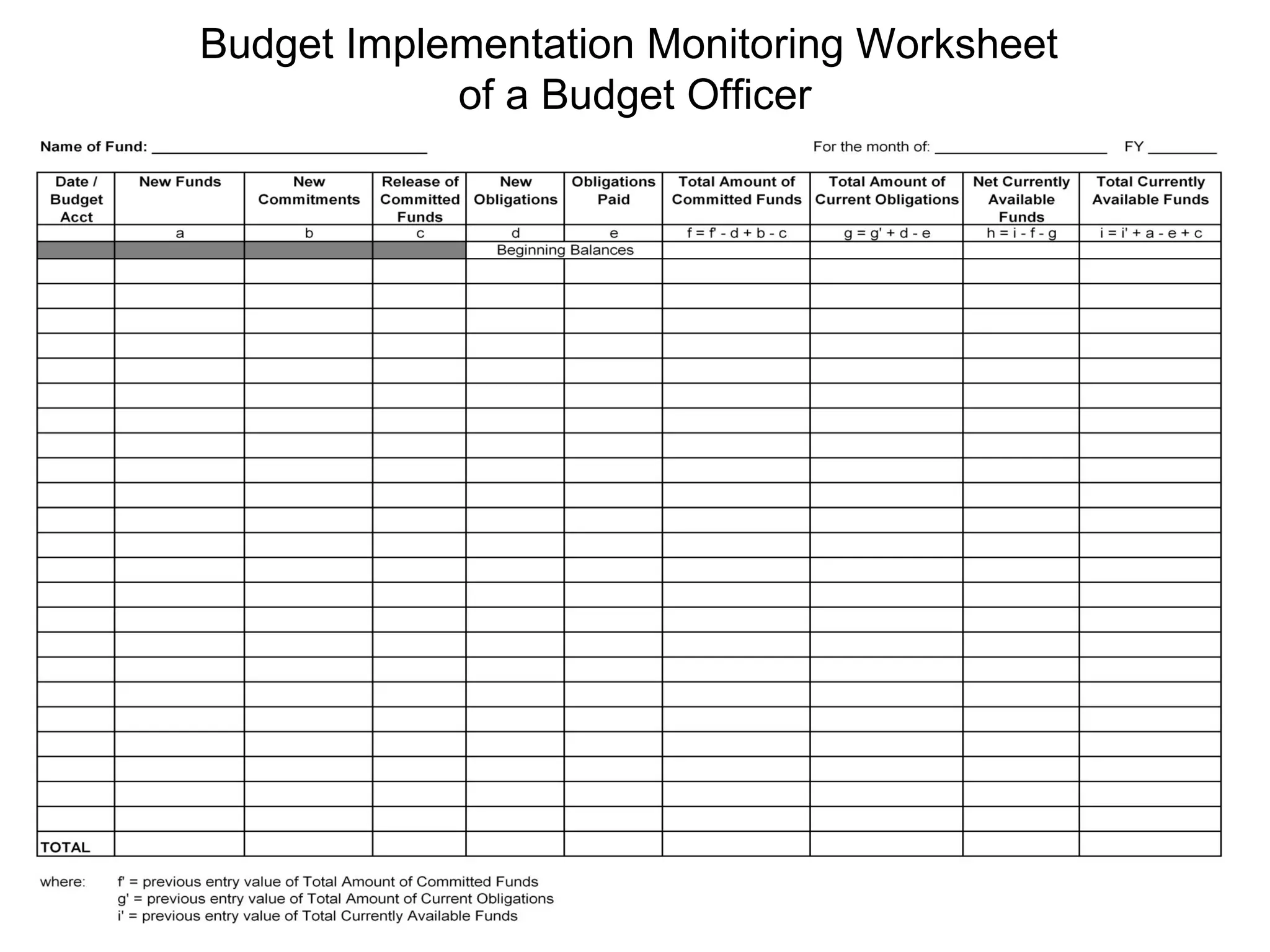
Budget Implementation Monitoring Worksheet
            of a Budget Officer
Dept / Unit: _________________________
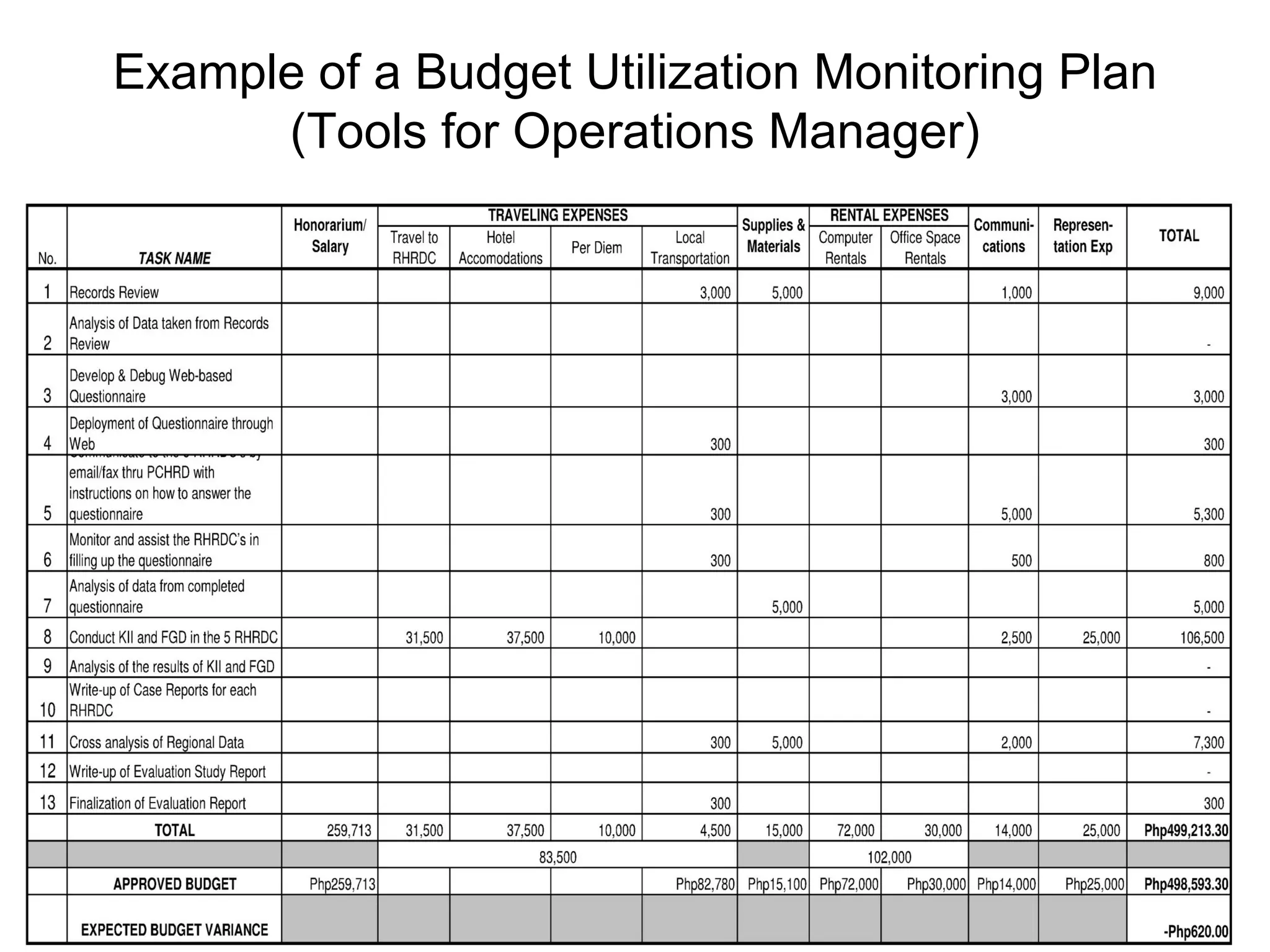
Example of a Budget Utilization Monitoring Plan
      (Tools for Operations Manager)
Example of   (Tools for Operations Mgr)

Budget planning and management

  • 1.
    Budget Planning and Management - Noel Lawas MD -
  • 2.
    Definitions • Budget – A statement containing the list of commitments by a body to provide the required resources with a given monetary value, to perform the activities that are expected to attain a given objective. – In an organization, the budget is the final act of commitment to the strategies it has set forth to do in the future in order to achieve its desired strategic objectives.
  • 3.
    Pre-requisites Before Arrivingat an Optimal Budget • A sound organizational strategic plan that considers the available funds that can be provided at the time these are needed. • Relevance of the budgeted activities to the attainment of the strategic objectives. • Outputs of the budgeted activities can be objectively measured and assessed. • Revenues from activities to be undertaken can be predicted with acceptable degree of accuracy
  • 4.
    Strategic Planning Cyclevis-a vis Budget Cycle
  • 5.
    Conceptual Framework toBudget Planning in an Organization Strategic Plan Budget Policies of the Organization Capital Budget Program / Medium-term Departmental Budget Plan Plan (3 to 5 years) Operational Annual Budget Plan Plan
  • 6.
    Principles Underlying BudgetPlanning and Management • Budget as a control instrument of management – Resource allocation: priority setting and spending plan – Financial control and planning: containment of expenditure, financial forecasts – Improving efficiency and effectiveness of organizational resources/activities – Communication: between different levels/units of organization and its stakeholders
  • 7.
    Principles Underlying BudgetPlanning and Management • Types of Budget – Income and Expenditure Budget • sets out the anticipated (recurrent) costs of the institutions and shows the source of funds to cover them. • annual income and expenditure budget is often broken down into shorter periods for better monitoring – Capital Budget • Budget for capital projects and acquisition of equipment or fixed assets • need separate budget and monitoring because it usually involves major expenditure items and non-recurrent costs • need to consider the effect of capital investment on recurrent cost • e.g., Vehicles, building hospital, medical equipment – Cash Budget (Cashflow Forecast) • aims to monitor the availability of cash: whether sufficient cash is available in the bank to meet the payments needs as they arise • based on the income and expenditure budget and capital budget
  • 8.
    Principles Underlying BudgetPlanning and Management • Approaches to Budgeting (Process of budget formulation) – Incremental Budgeting • Increase the amount of budget based on the budget of the previous year • Idea of historical budgeting: historical funding allocation plus adjustment for inflation, usually based on inputs (personnel, bed) not taking into account actual utilization • simple and little requirement for management and clinical information: incremental budgeting can be used when annual policy and plan is stable • perverse incentive and reward for spending more (to get greater budget next year) • lack of incentive for efficiency and effectiveness: little incentive to improve outputs and outcomes, little incentive for innovation and change in management and service delivery • cannot reflect changing needs
  • 9.
    Principles Underlying BudgetPlanning and Management • Approaches to Budgeting (Process of budget formulation) – Zero-based Budgeting • considers the previous year’s budget as zero • re-evaluates all the projects, and allocate budget according to priority • takes much time and cost • idea of needs-based budgeting: budgeting based on the resources required to meet health care needs of population (epidemiological and health profiles, needs for health care and prevention)
  • 10.
    Principles Underlying BudgetPlanning and Management • Budgeting Systems (Budget allocation structure) – Line-item budgeting • Distribution of expenditure item by item, to make it possible to control budget expenditure • budget allocation by input classes: salary, drug, equipment, fuel, etc. • usually short-term, no link to outputs or outcomes • Indicators: total cost, % of labor cost… • Pros – expenditure list and amount is clear and accurate – clear budget and accounting responsibility • Cons – Inflexible: hard to deal with unexpected incidents or changing needs – Focusing on budget items and monetary inputs (expense items), not the result of a project → can fail to achieve initial goals of government programs – Limited attention to the value for money: difficult to monitor and evaluate the efficiency and effectiveness of funding
  • 11.
    Principles Underlying BudgetPlanning and Management • Budgeting Systems (Budget allocation structure) – Performance-based budget • budget allocation based on outputs (not outcomes) • budget allocation by programs: maternal health, primary care, immunization, hospital inpatient care, HIV/AIDS, etc. • Pros – helps stakeholders understand what organization is doing and why – can better establish long-term plans, and use organizational resources more flexibly – can include performance objectives in the budget – budget as a management tool: compare actual and planned performance – e.g., No. of hospital admissions, No. of fully immunized children • Cons – Setting performance is tough: quality of performance indicator, consensus on performance measure, track/measure performance, etc. – may be hard to control public expenditure
  • 12.
    Program/Operational Budget Planning Methods 1. Create a chart of accounts for revenue and expense with corresponding account codes – Examples • Revenue accounts – revenues from drug sales, ancillary services, service fees, rentals, donations, subsidies, retainer fees, etc. • Expense accounts – Personal Services – salaries, hazard pay, Christmas bonus, 13th month pay, honoraria, etc. – MOOE – transportation, supplies, utilities, services, communications, repairs, etc
  • 13.
    Program/Operational Budget Planning Methods 1. Review budget guidelines and policies that may set the environment for budget planning – Note the budget amount limits imposed under the budget guidelines 2. Identify sources of revenues and develop forecasts for the period covered. – Note if the use of revenues for each source has restrictions
  • 14.
    Program/Operational Budget Planning Methods 1. For each activity identified in the operational plan, compute budgetary requirements specifically needed to implement the activity. These requirements should consider personal, mooe and finance expenses for each activity. – Note: Some types of expenses cut across different units and programs (eg. Salaries, utilities). In this situation, each of these expenses are assigned to one program or unit. Example: salary and electricity expenses are assigned to general administrative services program.
  • 15.
    Operational Budget PlanningWorksheet Program/ Operational Unit: _________________________
  • 16.
  • 17.
    Budget Management System Framework Allotted budget Allocated Budget from Income Amount Amount Expenditure s Working Capital Expenditure s Fiscal Year Fiscal Year Government Model Private Model
  • 18.
    Budget Management SystemFlow Operations Management Budget Management Accounting Mgt Request for Expenditure Verification of Verify Availability Budget Allotment of Funds Approval of Request Earmarking of Funds Start of Procurement Process Purchase Order Delivery of Goods / Services Obligating of Funds Account Payables Payment of Expenditure
  • 19.
    Budget Management Activities During Implementation • Verification of budget allotment – Expenditure requested is within the approved budget – Availability of funds is confirmed based on the revenues collected and/or the presence of “Notice of Cash Allocation” for public offices • Earmarking of budget allotment and available funds – The act of setting aside specific amounts from the available funds for possible future payments • Obligating of funds – The act of recognizing specific amounts from the available funds as spent.
  • 20.
    Budget Implementation MonitoringWorksheet of a Budget Officer
  • 21.
    Dept / Unit:_________________________
  • 22.
    Example of aBudget Utilization Monitoring Plan (Tools for Operations Manager)
  • 23.
    Example of (Tools for Operations Mgr)