BUDGETING CONTROL
BUDGET
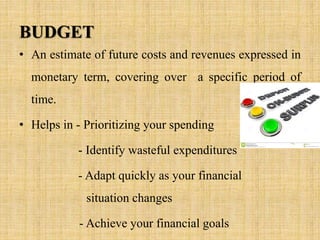
• An estimate of future costs and revenues expressed in
monetary term, covering over a specific period of
time.
• Helps in - Prioritizing your spending
- Identify wasteful expenditures
- Adapt quickly as your financial
situation changes
- Achieve your financial goals
‘‘ Gives you control
over your money’’
BUDGET CONTROL
• The exercise of control in the organization
with the help of budgets (control documents).
• To ensure that planned performance as laid
down in the budgets are being achieved.
• A comparison of plans and actual performance
is done and the difference is reported , thus
the management will take corrective actions.
• Regulating the activity of the business to
follow the pattern which was planned in the
budget.
• According to Appiah - Mensah (1993)
‘ If actual performance is not controlled, then
it will differ from planned performance and the
business will not achieve its objectives’
OBJECTIVE OF BUDGET CONTROL
Planning
Force management of all levels to plan for
future activities.
Co-ordination
Coordinates C - operation so that objective
is successfully achieved.
Control
Ensuring the performance by continuous
comparisons for corrective action.
PRINCIPLES OF GOOD BUDGETARY
CONTROL
• Managerial responsibilities is clearly defined.
• Budgets must include plan of action.
• Performance must be monitored against the budget.
• Corrective action to be taken if performance differs.
• Budgetary control must enhance ‘Management by
Exception’.
ESSENTIALS OF BUDGETARY
CONTROL
• Establish budgets for each function and section of
the organization.
• Continuous comparison of the actual performance
with that of the budget.
• Taking suitable remedial action to achieve the desires
objective.
• Revision of budgets in the light of changed
circumstances.
EFFECTIVE BUDGETARY CONTROL
REPORT
• Important in the feedback process
• To ensure maximum effectiveness
• Its design, timing ,impact is not misunderstood
• Key items - The budgeted level of costs and
revenue for the period
- Actual level of cost and revenue for
the period
- The variance
- Making variances under control
WHY MANAGERS USE BUDGETARY
CONTROLS
• Determining the cost of a project
• To adequately plan and allocate resources
• Tools to control finances and budget
- Financial forecasting calculations
- Budgeting techniques
- Variance analysis
• To control every stage of the project expenses
• If resources are mismanaged, the project will be characterized
by sunk costs (i.e., investments that procure no returns).
Drummond (1998)
‘ When any of such variance occurs,
it will involve budgeters in taking
three steps towards controlling the
budgets ’
I Reviewing
II Reaching
III Revising
PROCESS OF BUDGET CONTROL
• Preparation of various budgets
• Continuous comparison of actual
performance with budgetary
performance
• Revision of budgets according to
circumstances
BUDGET CONTROL TOOL
• The Budget Control System (BCS) is
designed to allow flexible customer-
specific adjustments to all important
functions
A Product of SAP
INSTALLING A BUDGETARY
CONTROL SYSTEM
• What is likely to happen?
• What can the objectives to be achieved?
• What are the constraints and to what
extent their effects can be minimized?
BUDGET CONTROLLER
• Supervisory responsibility is delegated to
Budget Controller or Budget Director
• Should have knowledge of the technical
details of the business
• Should report directly to the president or
the Chief Executive of the organization
BUDGETARY CONTROL
RESPONSIBILITY CENTRES
Enable managers to monitor organisational
functions
Four types
a) Revenue centres
Outputs are measured in monetary terms but
are not directly compared to input costs.
b) Expense centres
Inputs are measured in monetary terms but
outputs are not.
c) Profit centres
Performance is measured by the
difference between revenues and
expenditure.
d) Investment centres
Outputs are compared with the assets
employed in producing them, i.e. ROI.
ADVANTAGES
• Economy in working : Efficiency in business
economy
• Buck passing avoided : Divisional and
departmental responsibility
• Establishes coordination : Coordinates the
various divisions
• Acts as a safety signal : Shows when to be
caution and when to expand
• Adoption of uniform policy : Military type of
organization
• Decrease in production costs : By developing
new fill in products
• Optimum mix : Obtaining the most profitable
combination of different factors of production
• Favour with credit agencies : Well ordered
budget plan organizations receive greater favour
from credit agencies
DISADVANTAGES
• Reduces initiative and innovation for
employees
• Impossible to obtain money for new ideas.
• De-motivate employees because of lack of
participation
• Cause perceptions of unfairness
• Create competition for resources and politics
• Based on estimates: Estimate must be based on
only available facts and good
• Need for continuous adaptation: Continuously
adapted and cannot be installed and perfected in
a short time
• Only a tool of the management: The budget
control should be regarded not as a master but as
a servant
THANK YOU

Budget control

  • 1.
  • 2.
    BUDGET • An estimateof future costs and revenues expressed in monetary term, covering over a specific period of time. • Helps in - Prioritizing your spending - Identify wasteful expenditures - Adapt quickly as your financial situation changes - Achieve your financial goals
  • 3.
    ‘‘ Gives youcontrol over your money’’
  • 4.
    BUDGET CONTROL • Theexercise of control in the organization with the help of budgets (control documents). • To ensure that planned performance as laid down in the budgets are being achieved. • A comparison of plans and actual performance is done and the difference is reported , thus the management will take corrective actions.
  • 5.
    • Regulating theactivity of the business to follow the pattern which was planned in the budget. • According to Appiah - Mensah (1993) ‘ If actual performance is not controlled, then it will differ from planned performance and the business will not achieve its objectives’
  • 6.
    OBJECTIVE OF BUDGETCONTROL Planning Force management of all levels to plan for future activities. Co-ordination Coordinates C - operation so that objective is successfully achieved. Control Ensuring the performance by continuous comparisons for corrective action.
  • 7.
    PRINCIPLES OF GOODBUDGETARY CONTROL • Managerial responsibilities is clearly defined. • Budgets must include plan of action. • Performance must be monitored against the budget. • Corrective action to be taken if performance differs. • Budgetary control must enhance ‘Management by Exception’.
  • 8.
    ESSENTIALS OF BUDGETARY CONTROL •Establish budgets for each function and section of the organization. • Continuous comparison of the actual performance with that of the budget. • Taking suitable remedial action to achieve the desires objective. • Revision of budgets in the light of changed circumstances.
  • 9.
    EFFECTIVE BUDGETARY CONTROL REPORT •Important in the feedback process • To ensure maximum effectiveness • Its design, timing ,impact is not misunderstood • Key items - The budgeted level of costs and revenue for the period - Actual level of cost and revenue for the period - The variance - Making variances under control
  • 10.
    WHY MANAGERS USEBUDGETARY CONTROLS • Determining the cost of a project • To adequately plan and allocate resources • Tools to control finances and budget - Financial forecasting calculations - Budgeting techniques - Variance analysis • To control every stage of the project expenses • If resources are mismanaged, the project will be characterized by sunk costs (i.e., investments that procure no returns).
  • 11.
    Drummond (1998) ‘ Whenany of such variance occurs, it will involve budgeters in taking three steps towards controlling the budgets ’ I Reviewing II Reaching III Revising
  • 12.
    PROCESS OF BUDGETCONTROL • Preparation of various budgets • Continuous comparison of actual performance with budgetary performance • Revision of budgets according to circumstances
  • 13.
    BUDGET CONTROL TOOL •The Budget Control System (BCS) is designed to allow flexible customer- specific adjustments to all important functions A Product of SAP
  • 15.
    INSTALLING A BUDGETARY CONTROLSYSTEM • What is likely to happen? • What can the objectives to be achieved? • What are the constraints and to what extent their effects can be minimized?
  • 16.
    BUDGET CONTROLLER • Supervisoryresponsibility is delegated to Budget Controller or Budget Director • Should have knowledge of the technical details of the business • Should report directly to the president or the Chief Executive of the organization
  • 17.
    BUDGETARY CONTROL RESPONSIBILITY CENTRES Enablemanagers to monitor organisational functions Four types a) Revenue centres Outputs are measured in monetary terms but are not directly compared to input costs. b) Expense centres Inputs are measured in monetary terms but outputs are not.
  • 18.
    c) Profit centres Performanceis measured by the difference between revenues and expenditure. d) Investment centres Outputs are compared with the assets employed in producing them, i.e. ROI.
  • 19.
    ADVANTAGES • Economy inworking : Efficiency in business economy • Buck passing avoided : Divisional and departmental responsibility • Establishes coordination : Coordinates the various divisions • Acts as a safety signal : Shows when to be caution and when to expand
  • 20.
    • Adoption ofuniform policy : Military type of organization • Decrease in production costs : By developing new fill in products • Optimum mix : Obtaining the most profitable combination of different factors of production • Favour with credit agencies : Well ordered budget plan organizations receive greater favour from credit agencies
  • 21.
    DISADVANTAGES • Reduces initiativeand innovation for employees • Impossible to obtain money for new ideas. • De-motivate employees because of lack of participation • Cause perceptions of unfairness • Create competition for resources and politics
  • 22.
    • Based onestimates: Estimate must be based on only available facts and good • Need for continuous adaptation: Continuously adapted and cannot be installed and perfected in a short time • Only a tool of the management: The budget control should be regarded not as a master but as a servant
  • 23.