Planning and
Budgeting Process
Presented by:
BJORN KAYE T. NICOLAS, EMT, RN, MSN
Presented to: JOSEFINA B. BITONIO, DPA
What is Planning and Budgeting?
PLANNING – is a framework which helps management to
develop a plan of action to estimate future revenues and
cost to anticipate future events, to reduce uncertainty
about the future and to increase the chances of achieving
the goals and objectives of the organization through
coordination of plans.
BUDGETING – are quantitative expressions of these plans,
expressed in either physical or financial terms or both
budget is a plan showing how resources are to be acquired
and used over a specific time period
yourarticlelibrabry.com
Planning and budgeting – is an analytical application
that helps you set up down targets and generate a
bottom up budget, which is at the foundation of
organizations operations.
“ Planning identifies a desired output while budgeting
identifies inputs needed to achieve that output. Thus
management uses the planning process to establish
program, make basic policies and set goals, and
objectives for the overall organization, budgeting as a
part of the planning process, coordinates the details of
the many activities needed to implement the program
that meet the company's goal and objectives.”
(Anderson and Sollenberger)
Uses of planning and budgeting
• Develop planning target
• Access and analyze historical and current data
• Connect strategic objectives with daily
processes
• Link top-down targets with bottom-up budget
• Integrate and update financial statement as
business conditions change
• Conduct continuous forecasting
• Perform real-time, multi dimensional
modeling of your planning and budgeting data
Symptoms of incomplete or
inadequate planning and budgeting
• Management activity is largely reactive, stressful and
disorganized
• Authority and accountability for results are unclear or highly
centralized
• Funding and other resource priorities are unclear or non-
existent
• Cash flow problems are common
• Persons responsible for activities have difficulty obtaining
the necessary resources
• Objectives, schedules and budget are not established or are
nor communicated to persons responsible for action
• Performance expectation are not specified or achieved
• Unexpected workforce reductions or excessive overtime are
common
Cont.
• Untrained or inadequately trained
employees are assigned in important task
• The organization has recurring difficulty
meeting customer delivery and service
requirements.
Effective Planning and Budgeting
• Proactive management activity and time for strategic
thinking and planning
• A focused, discipline organization with good coordination
among functions and activities
• Higher productivity and greater operational efficiency
because of better work planning and coordination.
• Crisis and unanticipated events are contained and managed
effectively
• A stable, well trained workforce performing key task
• Planned goals and objectives are regularly achieved
• Customized organizational model significantly reduce the
time required for planning, budgeting and performance
measurement.
Local Revenue Generation and
Budgeting System
Local Government Code Sec. 129 – Power to
create source of revenue
“Each local government unit shall exercise its
power to create its own sources of revenue
and to levy taxes, fees, charges subject to
the provisions herein consistent taxes, fees
and charges shall accrue exclusively to the
local government units.”
Five Distinct Classes of Potential LGU
Revenue Sources
• Land-Based Tools
• Community Activity-Based Tools
• Infrastructure-Based Tools
• Debt-Based Tools
• Revenue Sharing Tools
Land-Based Tools
• Basic Real Property Tax (Sec. 232)
• Special Education Fund – SEF Real Property Tax
(Sec. 235)
• Land Transfer Tax (Sec. 135)
• Idle Hand Tax (Sec. 236)
• Public Land Use Tax (Sec. 235a)
• Land Scale of Foreclosed Real Properties (Sec. 257,
258 and 260)
• Land Reclassification (Sec. 20)
• Land Development Permit Fee (Sec. 557 and 558)
• Tax on Sand, Gravel and other Quarry Resources
(Sec. 138)
Community-Based Tools
• Business Tax (Sec. 143)
• Community Tax (Sec. 156)
• Franchise Tax (Sec.137)
• Tax on Business of Printing and Publication
(Sec. 136)
• Professional Tax (Sec. 139)
• Amusement Tax (Sec. 140)
• Annual Fixed Tax in Delivery Trucks or Vans
(Sec. 141)
• Fishery Rentals, fees and Charges (Sec. 149)
Infrastructure-Based Tools
• Special Levy (Sec. 250)
• Toll Fees or Charges (Sec. 155)
• Public Utility Charges (Sec. 155)
Debt-Based Tools
• Debt Financing (Sec. 297-302)
• Financial Investment (Sec. 18)
Revenue Sharing-Based Tools
• Share in Mining, Fishery and
Forestry Taxes (Sec. 290)
• Share in the Gross Sales on taxes of
Government-Owned and Controlled
corporations (Sec. 291)
Types of Governmental Funds
• General Fund
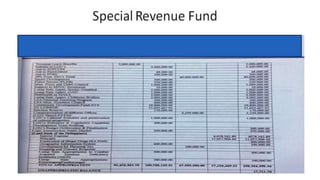
• Special Revenue Fund
• Capital Fund
• Supplementary Fund
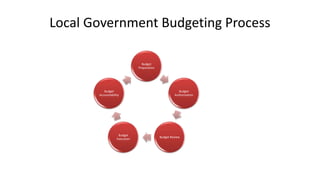
Local Government Budgeting Process
Budget
Preparation
Budget
Authorization
Budget Review
Budget
Execution
Budget
Accountability
Budget Preparation
Executive Budget
- Local Chief Executive
Done Between July 15 to October 15 of the current
year transmitted to the local Sanggunian not later than
October 16.
2 parts of Executive Budget
- Estimates of income
- Total appropriations covering current operating
expenditures and capital
Budget Preparation
Personal Services
- Salaries and Wages
- Per Diems
- Compensation and Non Commutable
Allowances
- Life and Retirement Insurances
- Premiums
- Overtime Pay
Cont.
• Maintenance and Other Operating
Expenses
- Payments for Travelling Expenses
- Communication Services
- Supplies and Materials
 Capital Outlays
- Expenses for Land
- Land Improvements
- Structure and Equipment
Budget Authorization
Legislative discussion of the
proposed budget is done by the
Sanggunian between October 16 and
November 17
Enact annual budget by issuing an
appropriation ordinances on or
before the current fiscal year
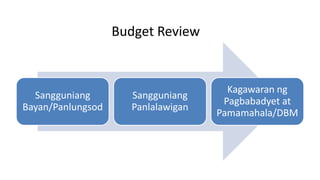
Budget Review
Sangguniang
Bayan/Panlungsod
Sangguniang
Panlalawigan
Kagawaran ng
Pagbabadyet at
Pamamahala/DBM
Budget Review
• The review action by the reviewing
authority may lead to either the
declaration of the budget
Budget Execution
• This phase involves the release and actual disbursement of
funds for the identified functions, work and financial plan
and request for allotment
Limitations on disbursement
1. No advance payment shall be made unless goods
have been delivered or services rendered.
2. No cash advance shall be made to any local officials
or employee unless made in accordance with Commission on
Audit and Regulations.
3. No Appropriations hall be transferred from one
item to another.
4. Use of savings is allowed from other items to
augment any items in the budget provided that it is within
the same expense class.
Budget Accountability
• Final Phase of the budget process
• Recording and reporting actual income
and expenditures
• Evaluation of the performance of the local
government unit
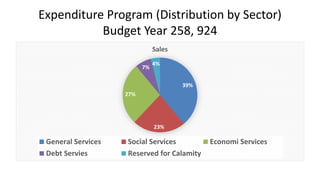
Expenditure Program (Distribution by Sector)
Budget Year 258, 924
39%
23%
27%
7%
4%
Sales
General Services Social Services Economi Services
Debt Servies Reserved for Calamity
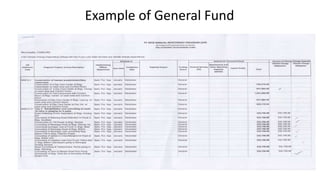
Example of General Fund
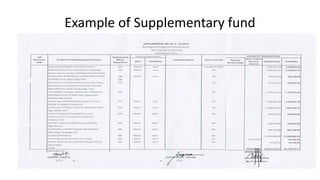
Example of Supplementary fund
Issues and Challenges in the Budget
• Conflicts between the executive and legislation branches of
the local government cause the delay of the of the passage
of the budget.
• Some Sanggunian would authorize anything appropriate by
lower level of local units for political purposes.
• Failure to submit supporting documents on time.
• Non submission of work and financial plan and request for
allotments by the heads of departments or offices.
• Non submission of supporting documents for the request
for allotment by the local accountant.
• Delayed submission of financial statement to local finance
committee by the local accountant.
Cont.
• LGU failed to prepare development programs
for the 20% Development Plan.
• LGU appropriated funds for development
project less than the level of appropriation
required.
• LGUs failed to implement or complete
projects program under the fund.
• Failure to liquidate cash advances thus
making those advances accumulate through
the years.
References:
• www.Hostanalytics.com
• https://docs.oracle.com
• www.threesigma.com
• www.yourarticlelibrary.com
• www.patimes.org
• www.study.com

Planning and Budgeting

  • 1.
    Planning and Budgeting Process Presentedby: BJORN KAYE T. NICOLAS, EMT, RN, MSN Presented to: JOSEFINA B. BITONIO, DPA
  • 2.
    What is Planningand Budgeting? PLANNING – is a framework which helps management to develop a plan of action to estimate future revenues and cost to anticipate future events, to reduce uncertainty about the future and to increase the chances of achieving the goals and objectives of the organization through coordination of plans. BUDGETING – are quantitative expressions of these plans, expressed in either physical or financial terms or both budget is a plan showing how resources are to be acquired and used over a specific time period yourarticlelibrabry.com
  • 3.
    Planning and budgeting– is an analytical application that helps you set up down targets and generate a bottom up budget, which is at the foundation of organizations operations. “ Planning identifies a desired output while budgeting identifies inputs needed to achieve that output. Thus management uses the planning process to establish program, make basic policies and set goals, and objectives for the overall organization, budgeting as a part of the planning process, coordinates the details of the many activities needed to implement the program that meet the company's goal and objectives.” (Anderson and Sollenberger)
  • 4.
    Uses of planningand budgeting • Develop planning target • Access and analyze historical and current data • Connect strategic objectives with daily processes • Link top-down targets with bottom-up budget • Integrate and update financial statement as business conditions change • Conduct continuous forecasting • Perform real-time, multi dimensional modeling of your planning and budgeting data
  • 5.
    Symptoms of incompleteor inadequate planning and budgeting • Management activity is largely reactive, stressful and disorganized • Authority and accountability for results are unclear or highly centralized • Funding and other resource priorities are unclear or non- existent • Cash flow problems are common • Persons responsible for activities have difficulty obtaining the necessary resources • Objectives, schedules and budget are not established or are nor communicated to persons responsible for action • Performance expectation are not specified or achieved • Unexpected workforce reductions or excessive overtime are common
  • 6.
    Cont. • Untrained orinadequately trained employees are assigned in important task • The organization has recurring difficulty meeting customer delivery and service requirements.
  • 7.
    Effective Planning andBudgeting • Proactive management activity and time for strategic thinking and planning • A focused, discipline organization with good coordination among functions and activities • Higher productivity and greater operational efficiency because of better work planning and coordination. • Crisis and unanticipated events are contained and managed effectively • A stable, well trained workforce performing key task • Planned goals and objectives are regularly achieved • Customized organizational model significantly reduce the time required for planning, budgeting and performance measurement.
  • 8.
    Local Revenue Generationand Budgeting System Local Government Code Sec. 129 – Power to create source of revenue “Each local government unit shall exercise its power to create its own sources of revenue and to levy taxes, fees, charges subject to the provisions herein consistent taxes, fees and charges shall accrue exclusively to the local government units.”
  • 9.
    Five Distinct Classesof Potential LGU Revenue Sources • Land-Based Tools • Community Activity-Based Tools • Infrastructure-Based Tools • Debt-Based Tools • Revenue Sharing Tools
  • 10.
    Land-Based Tools • BasicReal Property Tax (Sec. 232) • Special Education Fund – SEF Real Property Tax (Sec. 235) • Land Transfer Tax (Sec. 135) • Idle Hand Tax (Sec. 236) • Public Land Use Tax (Sec. 235a) • Land Scale of Foreclosed Real Properties (Sec. 257, 258 and 260) • Land Reclassification (Sec. 20) • Land Development Permit Fee (Sec. 557 and 558) • Tax on Sand, Gravel and other Quarry Resources (Sec. 138)
  • 11.
    Community-Based Tools • BusinessTax (Sec. 143) • Community Tax (Sec. 156) • Franchise Tax (Sec.137) • Tax on Business of Printing and Publication (Sec. 136) • Professional Tax (Sec. 139) • Amusement Tax (Sec. 140) • Annual Fixed Tax in Delivery Trucks or Vans (Sec. 141) • Fishery Rentals, fees and Charges (Sec. 149)
  • 12.
    Infrastructure-Based Tools • SpecialLevy (Sec. 250) • Toll Fees or Charges (Sec. 155) • Public Utility Charges (Sec. 155)
  • 13.
    Debt-Based Tools • DebtFinancing (Sec. 297-302) • Financial Investment (Sec. 18)
  • 14.
    Revenue Sharing-Based Tools •Share in Mining, Fishery and Forestry Taxes (Sec. 290) • Share in the Gross Sales on taxes of Government-Owned and Controlled corporations (Sec. 291)
  • 15.
    Types of GovernmentalFunds • General Fund • Special Revenue Fund • Capital Fund • Supplementary Fund
  • 16.
    Local Government BudgetingProcess Budget Preparation Budget Authorization Budget Review Budget Execution Budget Accountability
  • 17.
    Budget Preparation Executive Budget -Local Chief Executive Done Between July 15 to October 15 of the current year transmitted to the local Sanggunian not later than October 16. 2 parts of Executive Budget - Estimates of income - Total appropriations covering current operating expenditures and capital
  • 18.
    Budget Preparation Personal Services -Salaries and Wages - Per Diems - Compensation and Non Commutable Allowances - Life and Retirement Insurances - Premiums - Overtime Pay
  • 19.
    Cont. • Maintenance andOther Operating Expenses - Payments for Travelling Expenses - Communication Services - Supplies and Materials  Capital Outlays - Expenses for Land - Land Improvements - Structure and Equipment
  • 20.
    Budget Authorization Legislative discussionof the proposed budget is done by the Sanggunian between October 16 and November 17 Enact annual budget by issuing an appropriation ordinances on or before the current fiscal year
  • 21.
  • 22.
    Budget Review • Thereview action by the reviewing authority may lead to either the declaration of the budget
  • 23.
    Budget Execution • Thisphase involves the release and actual disbursement of funds for the identified functions, work and financial plan and request for allotment Limitations on disbursement 1. No advance payment shall be made unless goods have been delivered or services rendered. 2. No cash advance shall be made to any local officials or employee unless made in accordance with Commission on Audit and Regulations. 3. No Appropriations hall be transferred from one item to another. 4. Use of savings is allowed from other items to augment any items in the budget provided that it is within the same expense class.
  • 24.
    Budget Accountability • FinalPhase of the budget process • Recording and reporting actual income and expenditures • Evaluation of the performance of the local government unit
  • 25.
    Expenditure Program (Distributionby Sector) Budget Year 258, 924 39% 23% 27% 7% 4% Sales General Services Social Services Economi Services Debt Servies Reserved for Calamity
  • 26.
  • 30.
  • 32.
    Issues and Challengesin the Budget • Conflicts between the executive and legislation branches of the local government cause the delay of the of the passage of the budget. • Some Sanggunian would authorize anything appropriate by lower level of local units for political purposes. • Failure to submit supporting documents on time. • Non submission of work and financial plan and request for allotments by the heads of departments or offices. • Non submission of supporting documents for the request for allotment by the local accountant. • Delayed submission of financial statement to local finance committee by the local accountant.
  • 33.
    Cont. • LGU failedto prepare development programs for the 20% Development Plan. • LGU appropriated funds for development project less than the level of appropriation required. • LGUs failed to implement or complete projects program under the fund. • Failure to liquidate cash advances thus making those advances accumulate through the years.
  • 34.
    References: • www.Hostanalytics.com • https://docs.oracle.com •www.threesigma.com • www.yourarticlelibrary.com • www.patimes.org • www.study.com