ES S EN TI A L S I N
          F I N A N CI A L
     M A N A GEM EN T
Executive Course H OS PI TA L
        F OR in Hospital Administration
          EXECU TI VES
      Organized by the College of Public Health
            University of the Philippines

    Presented by:   Manuel Eduardo B. Lunas
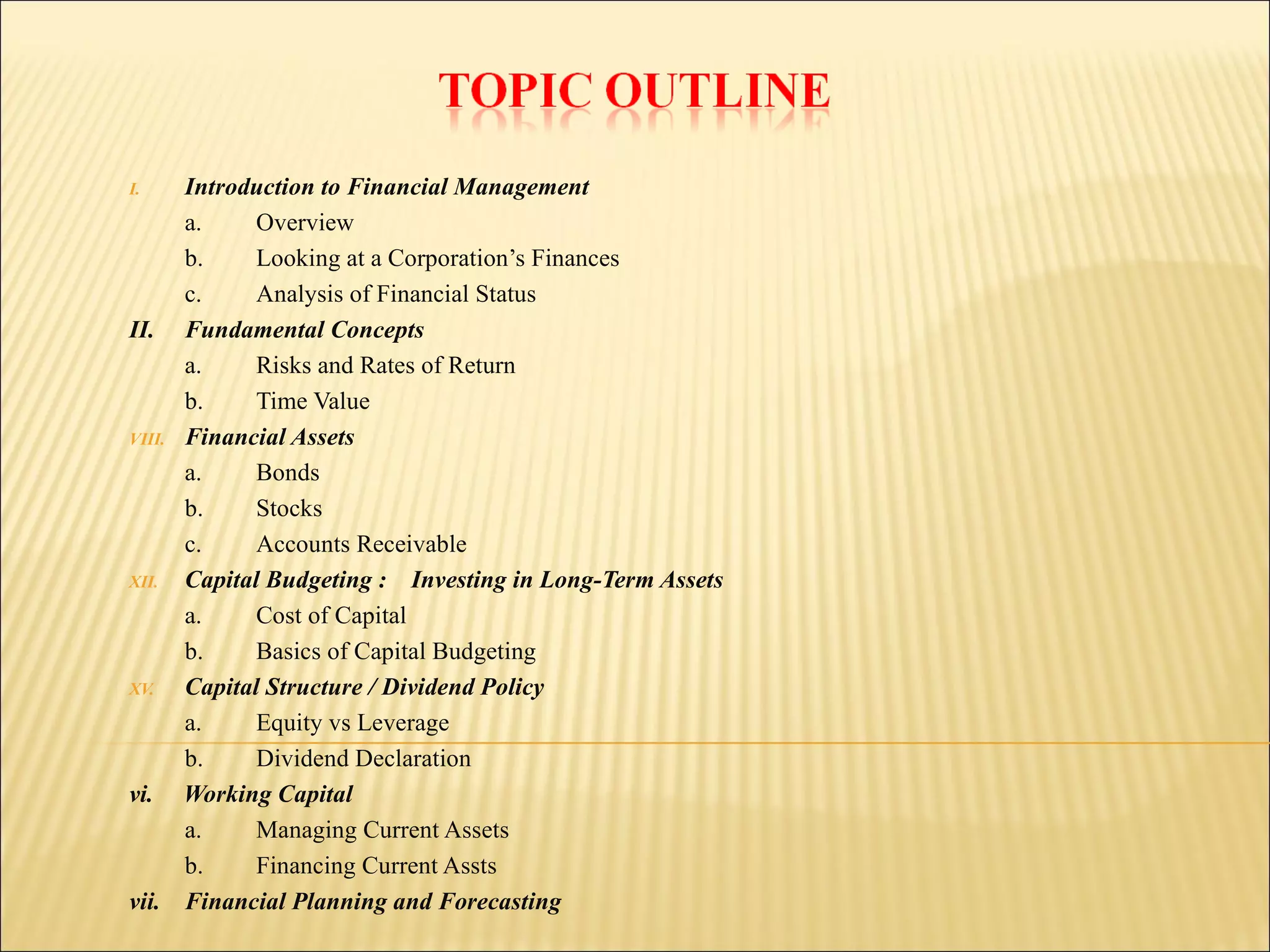
I.    Introduction to Financial Management
      a.     Overview
      b.     Looking at a Corporation’s Finances
      c.     Analysis of Financial Status
II. Fundamental Concepts
      a.     Risks and Rates of Return
      b.     Time Value
VIII. Financial Assets

      a.     Bonds
      b.     Stocks
      c.     Accounts Receivable
XII.  Capital Budgeting : Investing in Long-Term Assets
      a.     Cost of Capital
      b.     Basics of Capital Budgeting
XV.   Capital Structure / Dividend Policy
      a.     Equity vs Leverage
      b.     Dividend Declaration
vi. Working Capital
      a.     Managing Current Assets
      b.     Financing Current Assts
vii. Financial Planning and Forecasting
simply is the science of the
      handling of money

Financial Management
      -involves the planning, directing,
      monitoring,     organizing    and
      controlling of the monetary
      resources of an organization
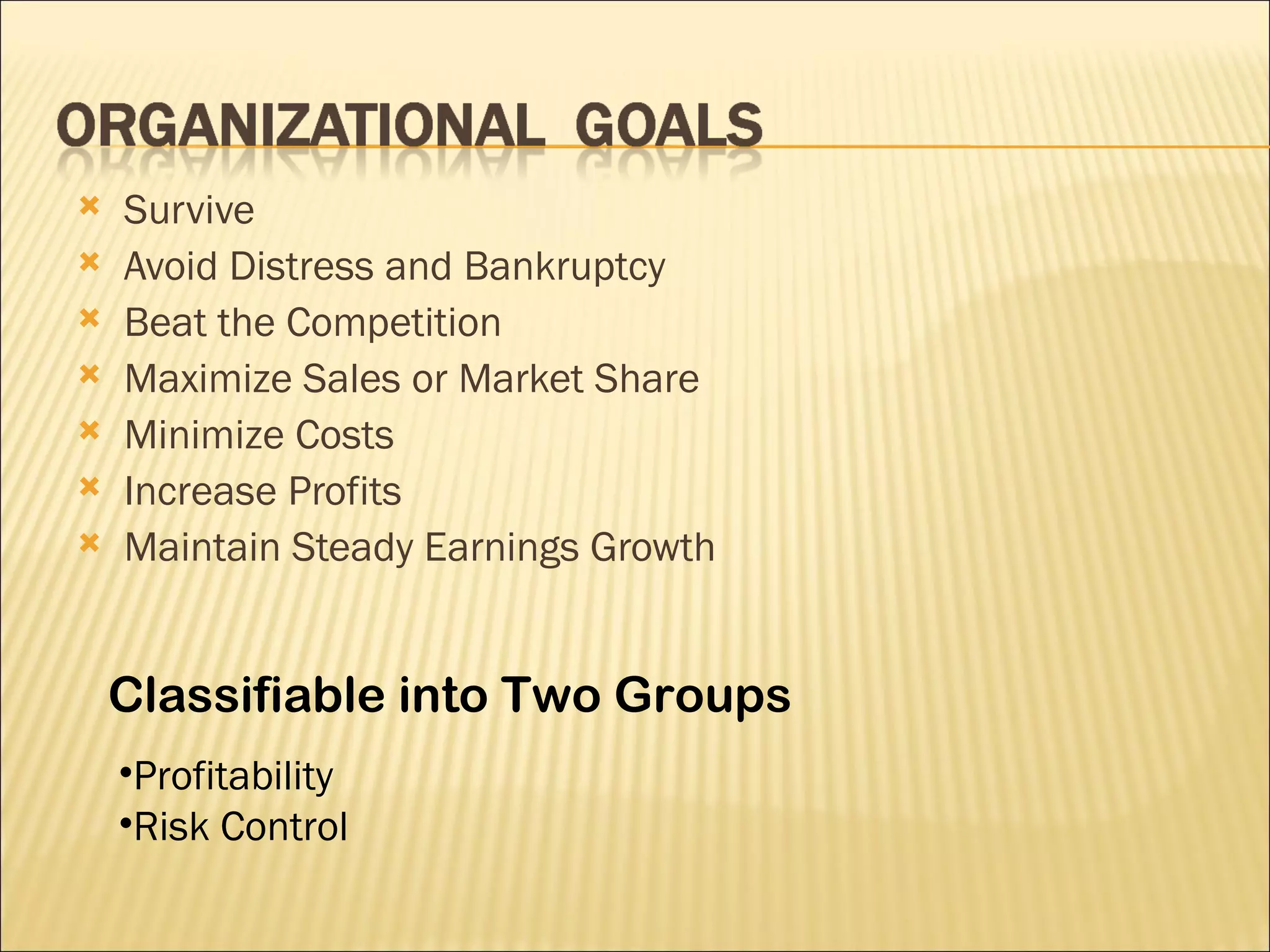
   Survive
   Avoid Distress and Bankruptcy
   Beat the Competition
   Maximize Sales or Market Share
   Minimize Costs
   Increase Profits
   Maintain Steady Earnings Growth


    Classifiable into Two Groups
    •Profitability
    •Risk Control
Type of Organization      Private Company                 Private / Government
                           Profit Oriented                 Non Profit

 Objective                 Profit                          Service Provision
                           Financial Viability             Financial Viability (?)
                           Shareholders Satisfaction

 Stakeholders              Investors / Shareholders        General Public
                                                           Defined Sector

                           Borrowings                      Subsidies
Other Sources              •Loans                          •Loans
                           •Bond float                     •Grants
                           •Leasing                        •Industrial partnership
                           •Public offering
                            Joint venture agreements common for both

Organizational Structure   Traditional Bureaucratic       By service lines or major grouping
                           Responsibility centers
                                                           •(Cardio Vascular- Section
                           (Profit or cost center)         •Radiology Department-
                                                           •Diagnostics Center
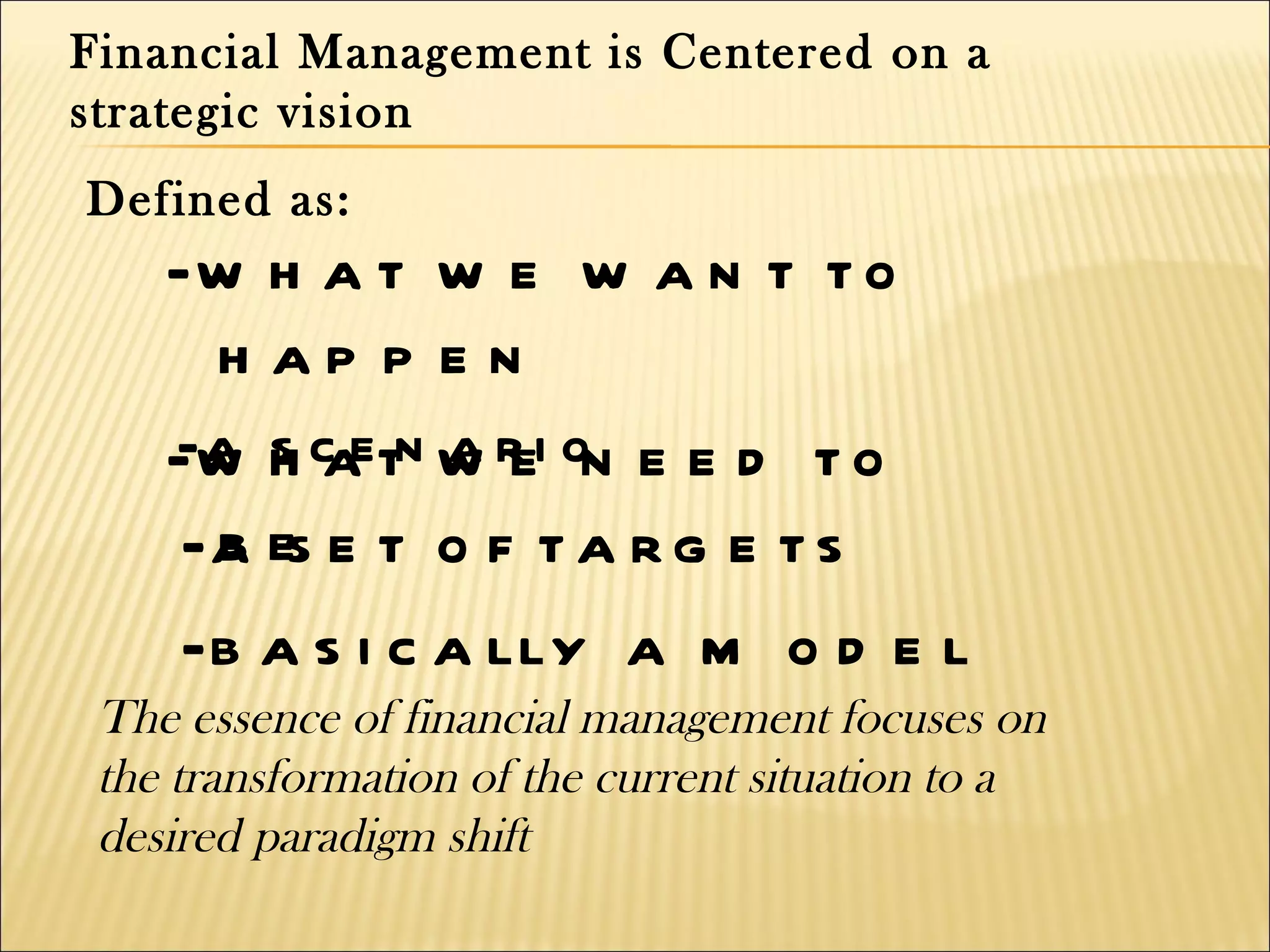
Financial Management is Centered on a
strategic vision
Defined as:
    -w h a t w e w a n t t o
     h ap p e n
    -w h c etn w r i on e e d t o
    -a s a a e
    -a es e t o f t a r g e t s
     b
    -b a s i c a lly a m o d e l
 The essence of financial management focuses on
 the transformation of the current situation to a
 desired paradigm shift
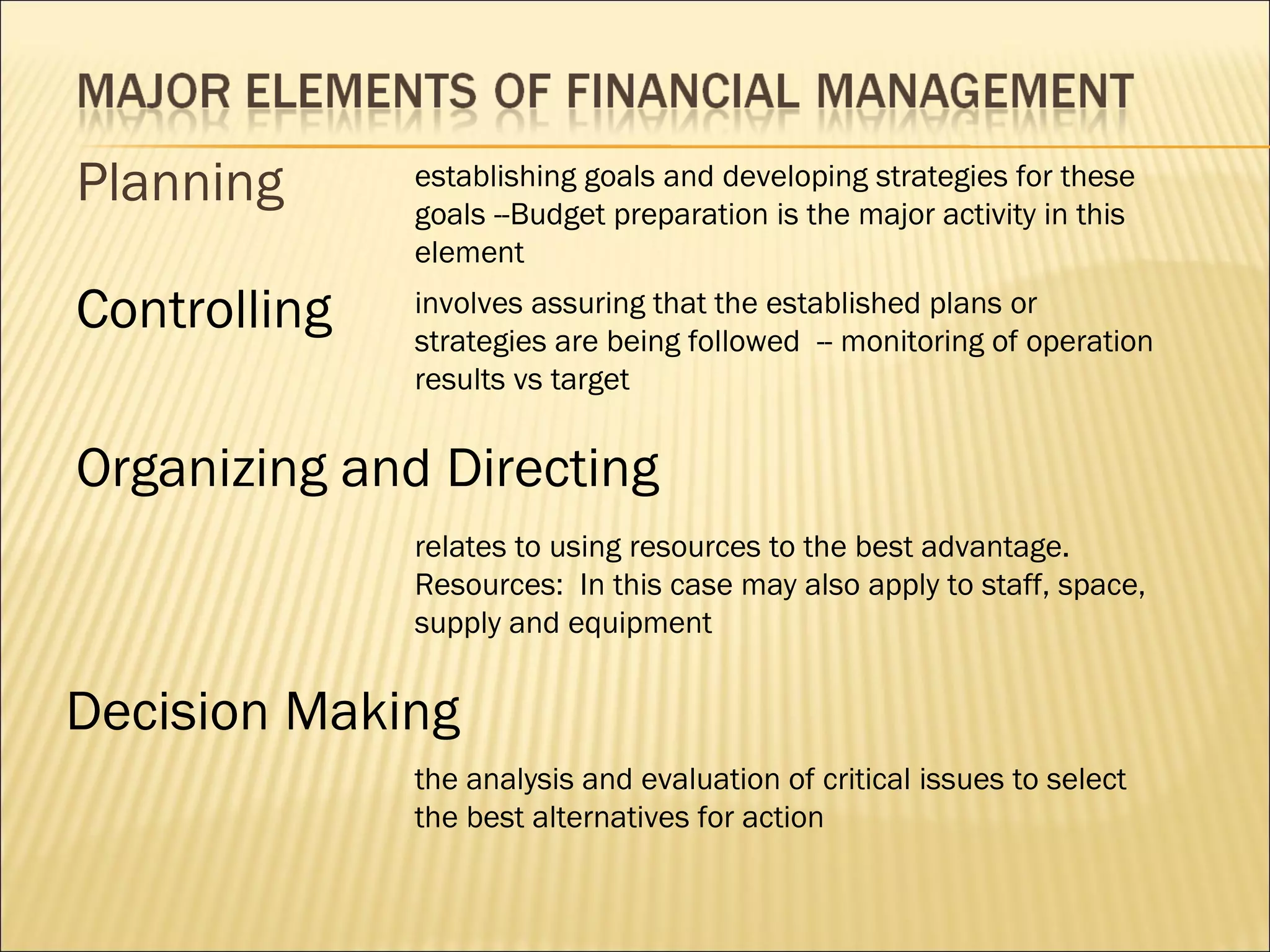
Planning      establishing goals and developing strategies for these
              goals --Budget preparation is the major activity in this
              element

Controlling   involves assuring that the established plans or
              strategies are being followed -- monitoring of operation
              results vs target


Organizing and Directing
              relates to using resources to the best advantage.
              Resources: In this case may also apply to staff, space,
              supply and equipment


Decision Making
              the analysis and evaluation of critical issues to select
              the best alternatives for action
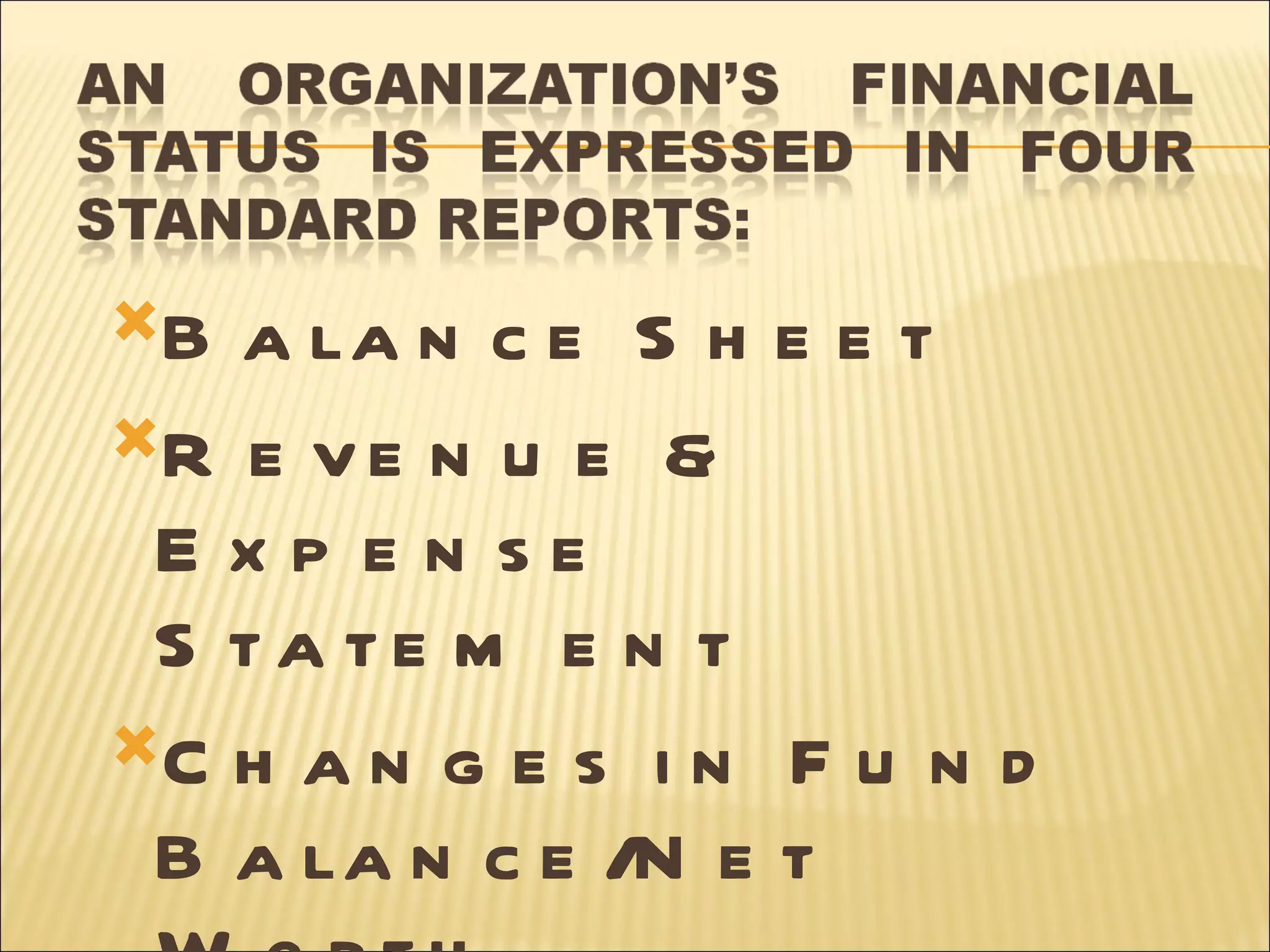
B a la n c e S h e e t
R e v e n u e &
 E xp e n se
 S ta te m e n t
C h a n g e s i n F u n d
 B a la n c e /N e t
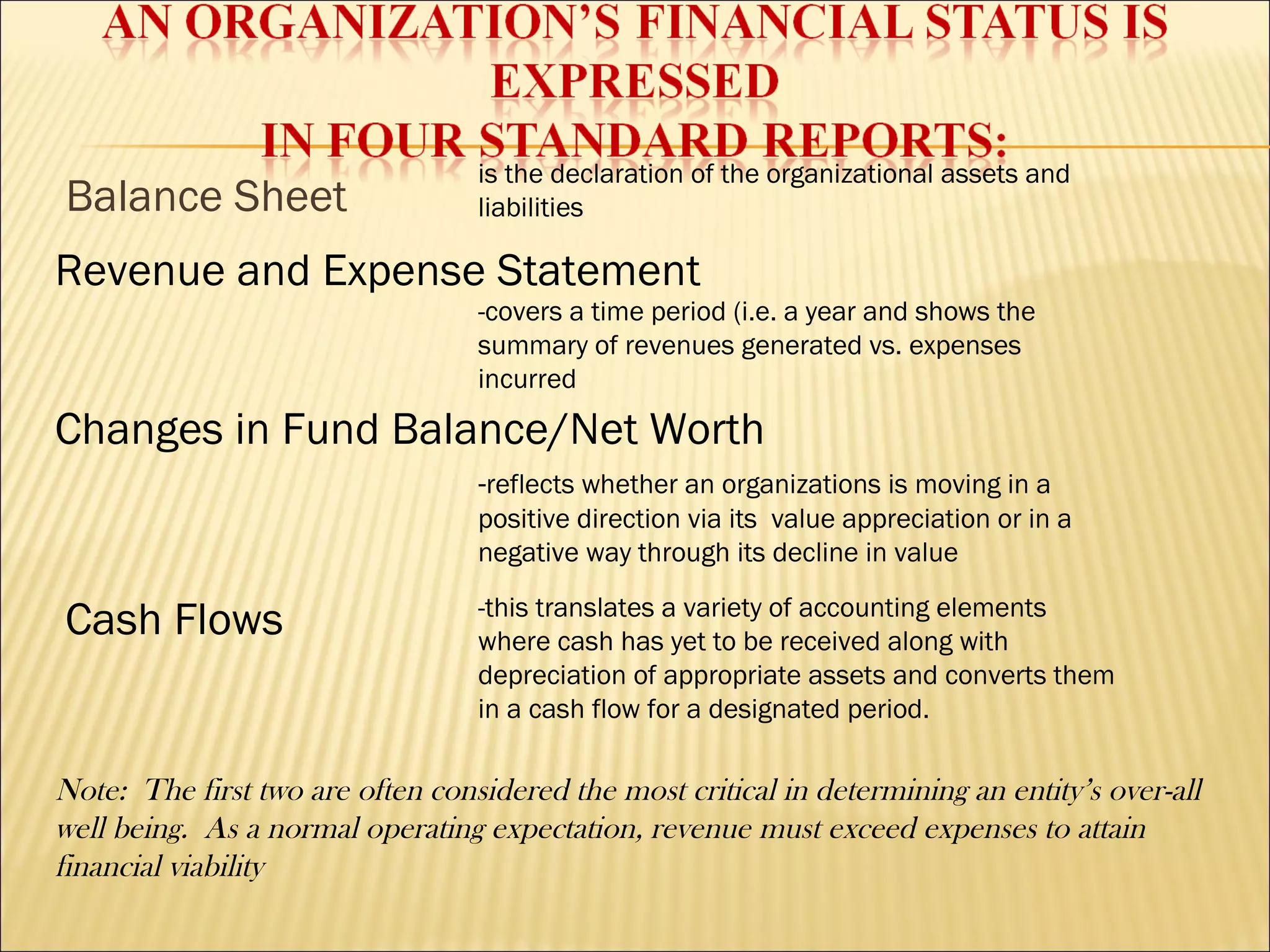
is the declaration of the organizational assets and
Balance Sheet                     liabilities

Revenue and Expense Statement
                                  -covers a time period (i.e. a year and shows the
                                  summary of revenues generated vs. expenses
                                  incurred
Changes in Fund Balance/Net Worth
                                  -reflects whether an organizations is moving in a
                                  positive direction via its value appreciation or in a
                                  negative way through its decline in value
                                  -this translates a variety of accounting elements
Cash Flows                        where cash has yet to be received along with
                                  depreciation of appropriate assets and converts them
                                  in a cash flow for a designated period.

Note: The first two are often considered the most critical in determining an entity’s over-all
well being. As a normal operating expectation, revenue must exceed expenses to attain
financial viability
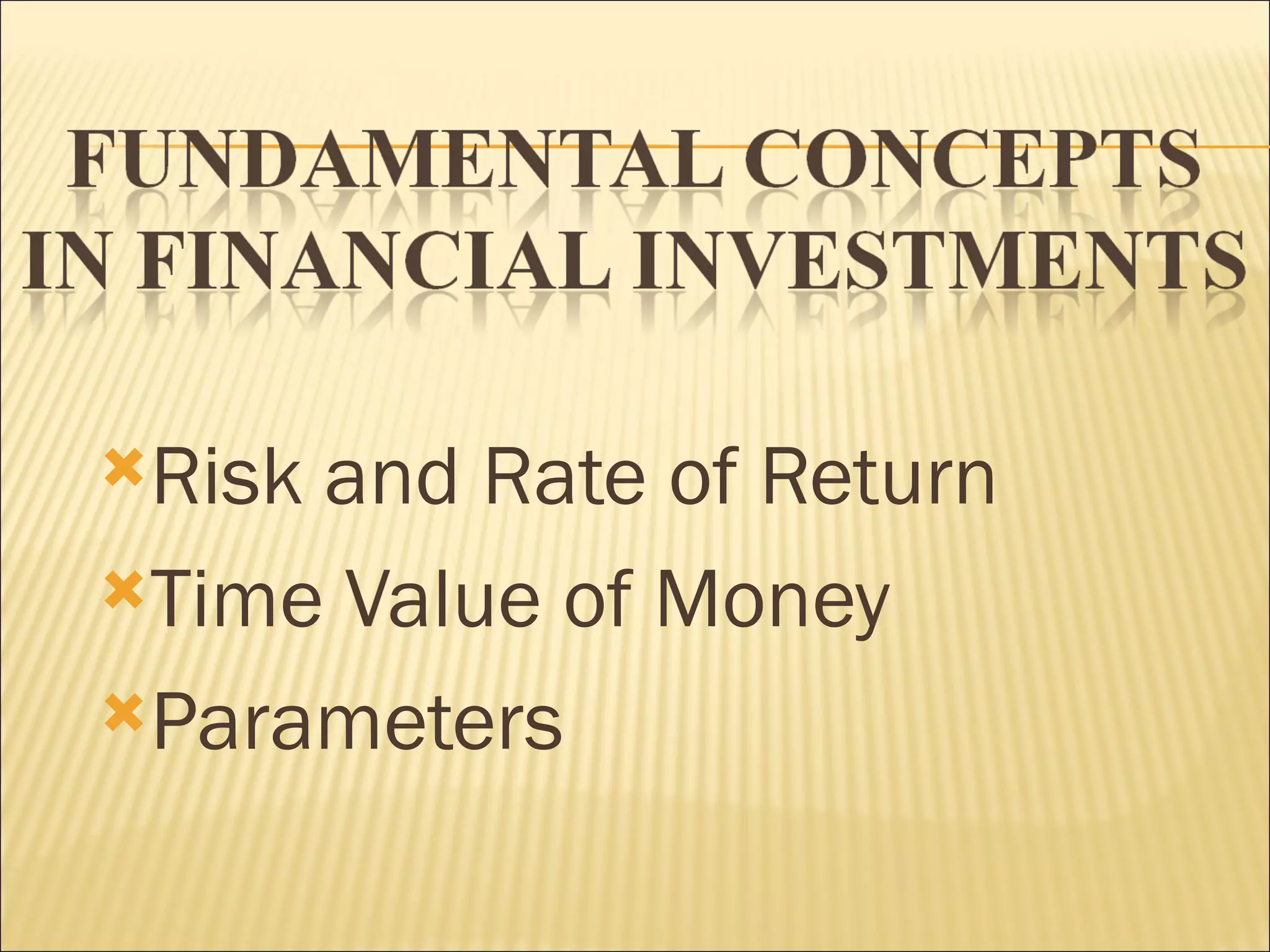
Riskand Rate of Return
Time Value of Money

Parameters
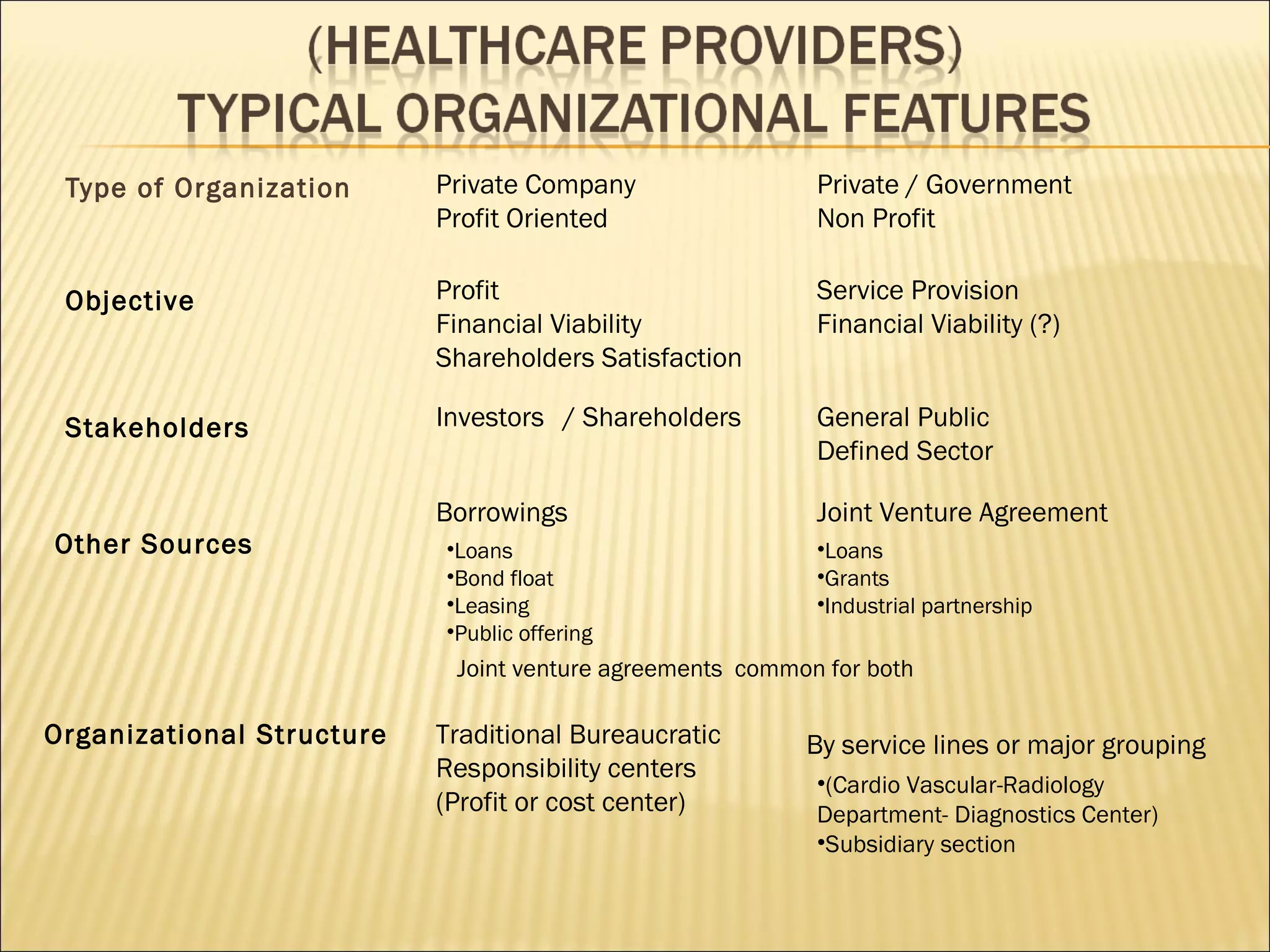
Type of Organization      Private Company                 Private / Government
                           Profit Oriented                 Non Profit

 Objective                 Profit                          Service Provision
                           Financial Viability             Financial Viability (?)
                           Shareholders Satisfaction

 Stakeholders              Investors / Shareholders        General Public
                                                           Defined Sector

                           Borrowings                      Joint Venture Agreement
Other Sources              •Loans                          •Loans
                           •Bond float                     •Grants
                           •Leasing                        •Industrial partnership
                           •Public offering
                            Joint venture agreements common for both

Organizational Structure   Traditional Bureaucratic       By service lines or major grouping
                           Responsibility centers
                                                           •(Cardio Vascular-Radiology
                           (Profit or cost center)         Department- Diagnostics Center)
                                                           •Subsidiary section
-t h e p r o c e s s b y w h i c h
             c a p i ta l e x p e n d i tu re s a re
             d e c i d e d u s i n g va ri o u s
             c r i t e r i a fo r p r o je c t
             s e le c t i o n
Tools for Capital Budgeting
      •   N e t P r e s e n t V a lu e
      •   I n te rn a l R a te o f R e tu rn
      •   P r o fi t a b i li t y I n d e x
      •   P a y b a c k P e ri o d
      •   R e t u r n o n B o o k V a lu e
A capital expenditure normally requires a huge
  cash outlay for a project that is supposed to
  produce a cash inflow over a period of time
  exceeding one year. E.g. acquisition of a new
  CT-Scan machine, setting up a Medical Arts
  bldg, Land acquisition
G o a l o f e v e r y fi r m          i s to m        ax im ize
p re s e n t     s h a r e h o ld e r    v a lu e .         Th i s
i m p li e s t h a t p r o je c t s t o b e u n d     e rta k e n
s h o u ld r e s u lt i n a p o s i t i v e n e t     p re s e n t
v a lu e , t h a t i s t h e p r e s e n t v a lu     e o f th e
e x p e c t e d c a s h i n flo w s le s s t h e      p re s e n t
v a lu e       of        th e       need ed            c a p i ta l
e x p e n d i tu re s .

T h e r e i s a w i d e a r r a y o f c r i t e r i a fo r
s e le c t i n g p r o je c t s . S o m e s t a k e h o ld e r s
w a n t p r o je c t s w i t h i m m e d i a t e s u r g e s
i n c a s h flo w w h i le o t h e r s e m p h a s i z e o n
lo n g t e r m g r o w t h w i t h li t t le s h o r t t e r m
p e r fo r m a n c e . T h i s d i ffi c u lt y a r i s e s i n
s a t i s fy i n g      d i ffe r e n t  i n te re s ts      of
s t a k e h o ld e r s .
-takes the form of a loan or other borrowings (debt) proceeds of which are invested
or used with the intent of earning a higher return than the cost of interest on the
borrowing.


If the firm’s ROA is higher than the rate of interest on the loan then ROE will be
higher that if it did not borrow. But if the ROA is lower than the cost of borrowing
then the ROE will be lower. Borrowing is not recommended


 A corporation without borrowings is an all equity firm whereas a leverage firm is one
 with a mix of ownership equity and debt. The higher the debt means the firm is more
 leveraged. The extent of leveraging can show the potential positive returns a
 company may attain and the optimum levels that must be maintained to assure
 positive financial viability. Over leveraging in turn can cause the reverse.
Components of Working Capital

•Cash
•Marketable Securities
•Inventory
•A/R’s
Inventory and receivables are financed by trade suppliers
     (Just In Time Concept)
     It decreases working capital requirements and increases
     profits as working capital has costs

(-) Negative Working Capital
     Cash is already received even prior to actual sales
     delivery and more so prior to payment to supplier
     •Credit card transactions
        e.g. Amazon (books), Dell (cellphone)
        Globe (prepaid cards)
     •HMO’s
Working Capital Policy

Type o sho rm de
    s f rt-te   bt
•Short-term bank loans
•trade credits
•Commercial paper (iou’s)
•Accrued liabilities

A dvantages
•Speed
•flexibility


D isadvantages
 •High costs
 •Short-term dependability
Short-Term Loans
•Bank Loans
•Commercial Paper
•Trade Credit
•Revolving Credit Line
•A/R Financing
  --Sale / Factoring / Discounting of A/R’s


 Long-Term Loans / Borrowing
 •Mortgage Loans - on Real Assets
 •Chattel Mortgage
 •Leasing
  --operating lease
  --financial lease
 •Bond floatation
   High A/R levels
   Mounting Promissory Notes
   Cash Flows (Erratic behavior)
   Pressures on A/P’s
   Need for CAPEX
   Huge debt Burden
   Decreasing Profit Margins

Opportunity Areas
•   Savings
•   Efficiencies
•   Corporate Social Responsibility
•   Ecological Support
Thank you for your time and
       participation!

Financial management for hospital executives2

  • 1.
    ES S ENTI A L S I N F I N A N CI A L M A N A GEM EN T Executive Course H OS PI TA L F OR in Hospital Administration EXECU TI VES Organized by the College of Public Health University of the Philippines Presented by: Manuel Eduardo B. Lunas
  • 2.
    I. Introduction to Financial Management a. Overview b. Looking at a Corporation’s Finances c. Analysis of Financial Status II. Fundamental Concepts a. Risks and Rates of Return b. Time Value VIII. Financial Assets a. Bonds b. Stocks c. Accounts Receivable XII. Capital Budgeting : Investing in Long-Term Assets a. Cost of Capital b. Basics of Capital Budgeting XV. Capital Structure / Dividend Policy a. Equity vs Leverage b. Dividend Declaration vi. Working Capital a. Managing Current Assets b. Financing Current Assts vii. Financial Planning and Forecasting
  • 3.
    simply is thescience of the handling of money Financial Management -involves the planning, directing, monitoring, organizing and controlling of the monetary resources of an organization
  • 4.
    Survive  Avoid Distress and Bankruptcy  Beat the Competition  Maximize Sales or Market Share  Minimize Costs  Increase Profits  Maintain Steady Earnings Growth Classifiable into Two Groups •Profitability •Risk Control
  • 5.
    Type of Organization Private Company Private / Government Profit Oriented Non Profit Objective Profit Service Provision Financial Viability Financial Viability (?) Shareholders Satisfaction Stakeholders Investors / Shareholders General Public Defined Sector Borrowings Subsidies Other Sources •Loans •Loans •Bond float •Grants •Leasing •Industrial partnership •Public offering Joint venture agreements common for both Organizational Structure Traditional Bureaucratic By service lines or major grouping Responsibility centers •(Cardio Vascular- Section (Profit or cost center) •Radiology Department- •Diagnostics Center
  • 6.
    Financial Management isCentered on a strategic vision Defined as: -w h a t w e w a n t t o h ap p e n -w h c etn w r i on e e d t o -a s a a e -a es e t o f t a r g e t s b -b a s i c a lly a m o d e l The essence of financial management focuses on the transformation of the current situation to a desired paradigm shift
  • 7.
    Planning establishing goals and developing strategies for these goals --Budget preparation is the major activity in this element Controlling involves assuring that the established plans or strategies are being followed -- monitoring of operation results vs target Organizing and Directing relates to using resources to the best advantage. Resources: In this case may also apply to staff, space, supply and equipment Decision Making the analysis and evaluation of critical issues to select the best alternatives for action
  • 8.
    B a lan c e S h e e t R e v e n u e & E xp e n se S ta te m e n t C h a n g e s i n F u n d B a la n c e /N e t
  • 9.
    is the declarationof the organizational assets and Balance Sheet liabilities Revenue and Expense Statement -covers a time period (i.e. a year and shows the summary of revenues generated vs. expenses incurred Changes in Fund Balance/Net Worth -reflects whether an organizations is moving in a positive direction via its value appreciation or in a negative way through its decline in value -this translates a variety of accounting elements Cash Flows where cash has yet to be received along with depreciation of appropriate assets and converts them in a cash flow for a designated period. Note: The first two are often considered the most critical in determining an entity’s over-all well being. As a normal operating expectation, revenue must exceed expenses to attain financial viability
  • 10.
    Riskand Rate ofReturn Time Value of Money Parameters
  • 11.
    Type of Organization Private Company Private / Government Profit Oriented Non Profit Objective Profit Service Provision Financial Viability Financial Viability (?) Shareholders Satisfaction Stakeholders Investors / Shareholders General Public Defined Sector Borrowings Joint Venture Agreement Other Sources •Loans •Loans •Bond float •Grants •Leasing •Industrial partnership •Public offering Joint venture agreements common for both Organizational Structure Traditional Bureaucratic By service lines or major grouping Responsibility centers •(Cardio Vascular-Radiology (Profit or cost center) Department- Diagnostics Center) •Subsidiary section
  • 12.
    -t h ep r o c e s s b y w h i c h c a p i ta l e x p e n d i tu re s a re d e c i d e d u s i n g va ri o u s c r i t e r i a fo r p r o je c t s e le c t i o n Tools for Capital Budgeting • N e t P r e s e n t V a lu e • I n te rn a l R a te o f R e tu rn • P r o fi t a b i li t y I n d e x • P a y b a c k P e ri o d • R e t u r n o n B o o k V a lu e
  • 13.
    A capital expenditurenormally requires a huge cash outlay for a project that is supposed to produce a cash inflow over a period of time exceeding one year. E.g. acquisition of a new CT-Scan machine, setting up a Medical Arts bldg, Land acquisition
  • 14.
    G o al o f e v e r y fi r m i s to m ax im ize p re s e n t s h a r e h o ld e r v a lu e . Th i s i m p li e s t h a t p r o je c t s t o b e u n d e rta k e n s h o u ld r e s u lt i n a p o s i t i v e n e t p re s e n t v a lu e , t h a t i s t h e p r e s e n t v a lu e o f th e e x p e c t e d c a s h i n flo w s le s s t h e p re s e n t v a lu e of th e need ed c a p i ta l e x p e n d i tu re s . T h e r e i s a w i d e a r r a y o f c r i t e r i a fo r s e le c t i n g p r o je c t s . S o m e s t a k e h o ld e r s w a n t p r o je c t s w i t h i m m e d i a t e s u r g e s i n c a s h flo w w h i le o t h e r s e m p h a s i z e o n lo n g t e r m g r o w t h w i t h li t t le s h o r t t e r m p e r fo r m a n c e . T h i s d i ffi c u lt y a r i s e s i n s a t i s fy i n g d i ffe r e n t i n te re s ts of s t a k e h o ld e r s .
  • 15.
    -takes the formof a loan or other borrowings (debt) proceeds of which are invested or used with the intent of earning a higher return than the cost of interest on the borrowing. If the firm’s ROA is higher than the rate of interest on the loan then ROE will be higher that if it did not borrow. But if the ROA is lower than the cost of borrowing then the ROE will be lower. Borrowing is not recommended A corporation without borrowings is an all equity firm whereas a leverage firm is one with a mix of ownership equity and debt. The higher the debt means the firm is more leveraged. The extent of leveraging can show the potential positive returns a company may attain and the optimum levels that must be maintained to assure positive financial viability. Over leveraging in turn can cause the reverse.
  • 16.
    Components of WorkingCapital •Cash •Marketable Securities •Inventory •A/R’s
  • 17.
    Inventory and receivablesare financed by trade suppliers (Just In Time Concept) It decreases working capital requirements and increases profits as working capital has costs (-) Negative Working Capital Cash is already received even prior to actual sales delivery and more so prior to payment to supplier •Credit card transactions e.g. Amazon (books), Dell (cellphone) Globe (prepaid cards) •HMO’s
  • 18.
    Working Capital Policy Typeo sho rm de s f rt-te bt •Short-term bank loans •trade credits •Commercial paper (iou’s) •Accrued liabilities A dvantages •Speed •flexibility D isadvantages •High costs •Short-term dependability
  • 19.
    Short-Term Loans •Bank Loans •CommercialPaper •Trade Credit •Revolving Credit Line •A/R Financing --Sale / Factoring / Discounting of A/R’s Long-Term Loans / Borrowing •Mortgage Loans - on Real Assets •Chattel Mortgage •Leasing --operating lease --financial lease •Bond floatation
  • 20.
    High A/R levels  Mounting Promissory Notes  Cash Flows (Erratic behavior)  Pressures on A/P’s  Need for CAPEX  Huge debt Burden  Decreasing Profit Margins Opportunity Areas • Savings • Efficiencies • Corporate Social Responsibility • Ecological Support
  • 21.
    Thank you foryour time and participation!