Budgeting
Remya.G
CONTENTS
Introduction
• Increasing demand of health care but limited
resources
- importance of planning and management
• Budgeting is the financial part of planning
• Budget is an important tool in the hands of a
trained health professional
BOUGETTE
Definitions
• Budget -anticipated receipts and available
resources of an organisation during the given year,
Or
Statement of future plans described in
quantitative and monetary terms, for a specific
period of time.
• Budgeting – the process of preparing the budget.
• Budgetary control –preparing, implementing and
monitoring of budgets.
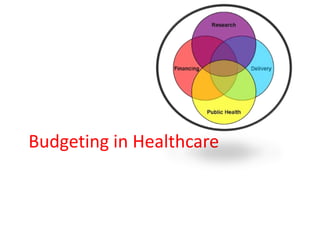
Budgeting in Healthcare
NEED OF BUDGET IN HEALTH
a) Budgets are effective means of communicating the future
organizational plans in monetary and financial terms.
(b) A pre-decided and approved budget monitor the ongoing
operations.
(c) Budgeting reduces wastage and losses
(d) Budgets, when drawn up through participation, encourage, and
develop team spirit
(e) Budgets form the basis for assessing the performance of
managers
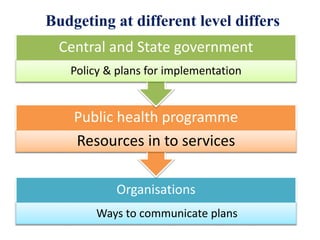
Budgeting at different level differs
Organisations
Ways to communicate plans
Public health programme
Resources in to services
Central and State government
Policy & plans for implementation
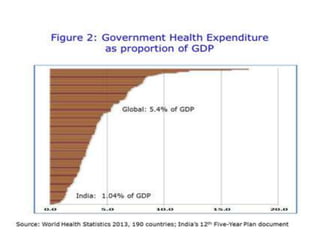
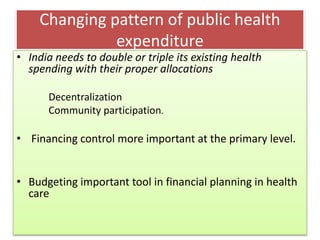
Changing pattern of public health
expenditure
• India needs to double or triple its existing health
spending with their proper allocations
Decentralization
Community participation.
• Financing control more important at the primary level.
• Budgeting important tool in financial planning in health
care
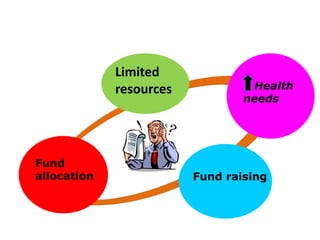
Health
needs
Fund raising
Fund
allocation
Limited
resources
Why budgeting in health is
complicated?
• Intangibility and often non-measurability of the
product (health outcome).
• Actual expenditures for health care will never
exactly match the budget.
• The ever increasing healthcare cost.
• Needs to meet unfunded healthcare.
• The complexity of fundflow.
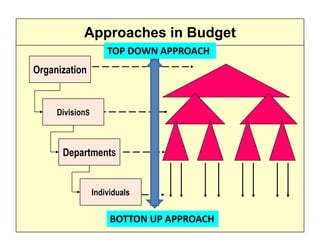
Organization
DivisionS
DepartmentS
Individuals
Approaches in Budget
TOP DOWN APPROACH
BOTTON UP APPROACH
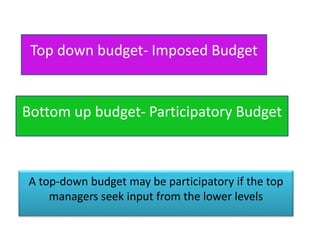
Top down budget- Imposed Budget
Bottom up budget- Participatory Budget
A top-down budget may be participatory if the top
managers seek input from the lower levels
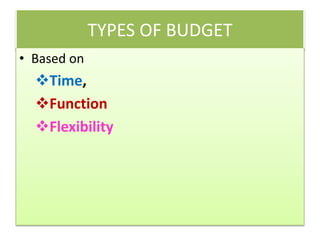
TYPES OF BUDGET
• Based on
Time,
Function
Flexibility
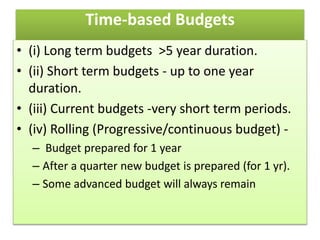
Time-based Budgets
• (i) Long term budgets >5 year duration.
• (ii) Short term budgets - up to one year
duration.
• (iii) Current budgets -very short term periods.
• (iv) Rolling (Progressive/continuous budget) -
– Budget prepared for 1 year
– After a quarter new budget is prepared (for 1 yr).
– Some advanced budget will always remain
Function based budgets
• Revenue budget
• Expenditure budget
• Capital budget
• Operation budget
• Cash budget
• Research budget
• Master budget
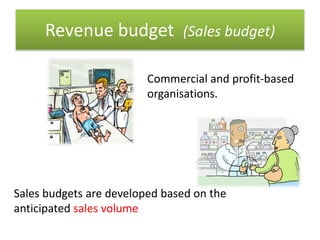
Revenue budget (Sales budget)
Commercial and profit-based
organisations.
Sales budgets are developed based on the
anticipated sales volume
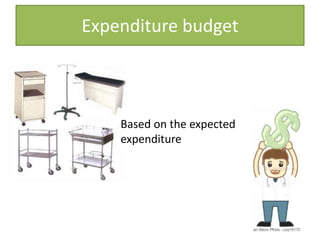
Expenditure budget
Based on the expected
expenditure
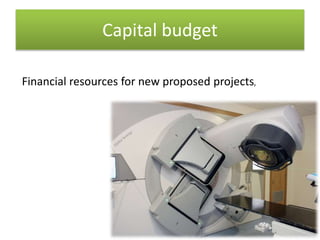
Capital budget
Financial resources for new proposed projects,
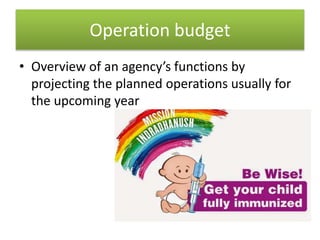
Operation budget
• Overview of an agency’s functions by
projecting the planned operations usually for
the upcoming year
Cash budget
Ensure that the agency has enough, but not too much, cash
on hand during the budgetary period
Cash budget are planned to make adequate funds
available.
Research budget
Allocating financial resources for innovation
Master budget
• Amalgamation of all organizational budgets
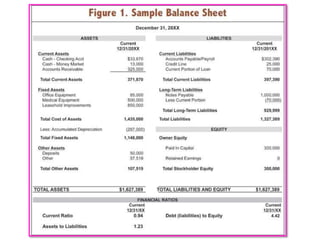
•Balance sheet
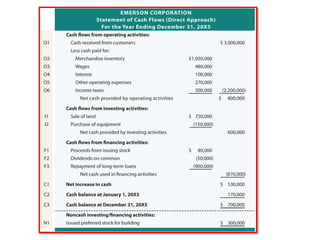
•Fund flow statement
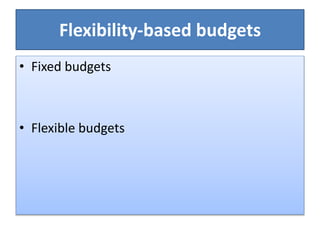
Flexibility-based budgets
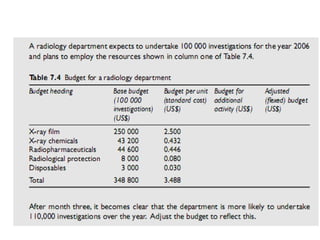
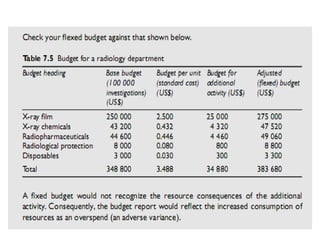
• Fixed budgets
• Flexible budgets
.
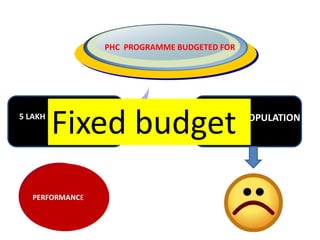
PHC PROGRAMME BUDGETED FOR
5 LAKH POPULATION 7 LAKH POPULATION
PERFORMANCE
Fixed budget
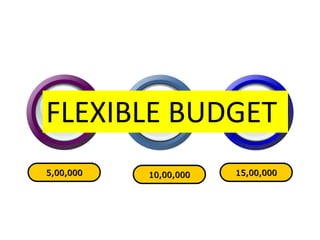
5,00,000 10,00,000 15,00,000
BASIC
COST
5 BEDS 10 BEDSFLEXIBLE BUDGET
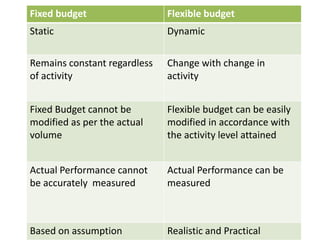
Fixed budget Flexible budget
Static Dynamic
Remains constant regardless
of activity
Change with change in
activity
Fixed Budget cannot be
modified as per the actual
volume
Flexible budget can be easily
modified in accordance with
the activity level attained
Actual Performance cannot
be accurately measured
Actual Performance can be
measured
Based on assumption Realistic and Practical
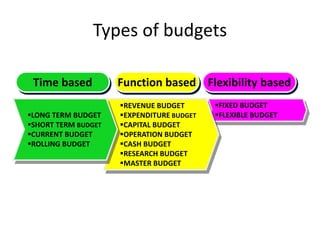
Types of budgets
FIXED BUDGET
FLEXIBLE BUDGET
REVENUE BUDGET
EXPENDITURE BUDGET
CAPITAL BUDGET
OPERATION BUDGET
CASH BUDGET
RESEARCH BUDGET
MASTER BUDGET
LONG TERM BUDGET
SHORT TERM BUDGET
CURRENT BUDGET
ROLLING BUDGET
Time based Function based Flexibility based
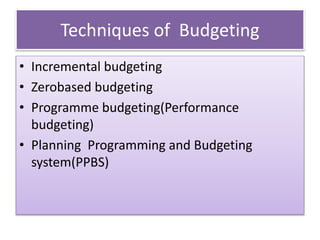
TECHNIQUE OF BUDGETING
Techniques of Budgeting
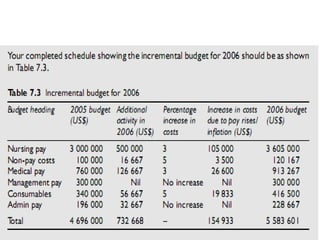
• Incremental budgeting
• Zerobased budgeting
• Programme budgeting(Performance
budgeting)
• Planning Programming and Budgeting
system(PPBS)
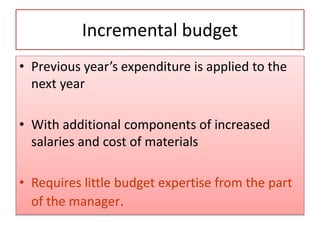
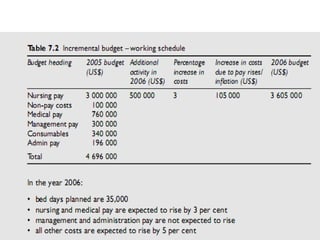
Incremental budget
• Previous year’s expenditure is applied to the
next year
• With additional components of increased
salaries and cost of materials
• Requires little budget expertise from the part
of the manager.
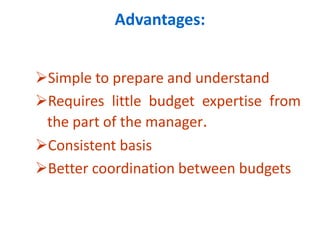
Advantages:
Simple to prepare and understand
Requires little budget expertise from
the part of the manager.
Consistent basis
Better coordination between budgets
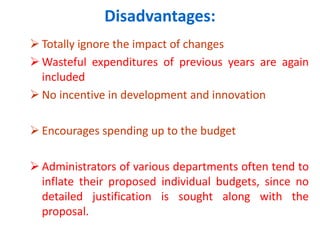
Disadvantages:
 Totally ignore the impact of changes
 Wasteful expenditures of previous years are again
included
 No incentive in development and innovation
 Encourages spending up to the budget
 Administrators of various departments often tend to
inflate their proposed individual budgets, since no
detailed justification is sought along with the
proposal.
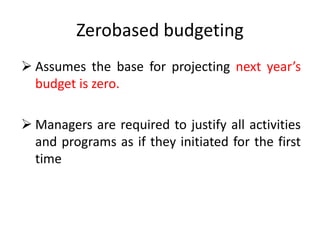
Zerobased budgeting
 Assumes the base for projecting next year’s
budget is zero.
 Managers are required to justify all activities
and programs as if they initiated for the first
time
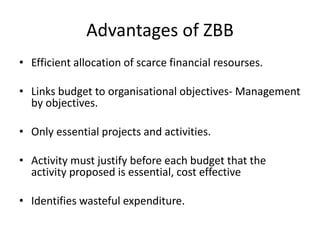
Advantages of ZBB
• Efficient allocation of scarce financial resourses.
• Links budget to organisational objectives- Management
by objectives.
• Only essential projects and activities.
• Activity must justify before each budget that the
activity proposed is essential, cost effective
• Identifies wasteful expenditure.
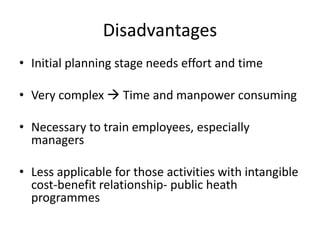
Disadvantages
• Initial planning stage needs effort and time
• Very complex  Time and manpower consuming
• Necessary to train employees, especially
managers
• Less applicable for those activities with intangible
cost-benefit relationship- public heath
programmes
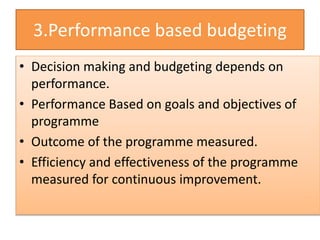
3.Performance based budgeting
• Decision making and budgeting depends on
performance.
• Performance Based on goals and objectives of
programme
• Outcome of the programme measured.
• Efficiency and effectiveness of the programme
measured for continuous improvement.
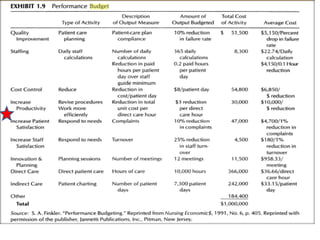
PERFORMANCE BUDGETING
-The departmental head usually prepare
periodic performance reports
- Which compare the budgeted actual
performance
-In terms of output, production or services
rendered
(to detect any deviations at the earliest
possible.)
PB
• Introduced in USA in 1951
• GOI & some State Govts have accepted it.
• Most useful in public health
Problems in Performance Budgeting
• Time gap b/w the input ( intervention) and
output ( improvement in health)
• Establishment of standards, norms for
measurement is difficult
• It is almost impossible to separate out the
individual effects of different units.
4.Planning programming and
budgeting system.PPBS
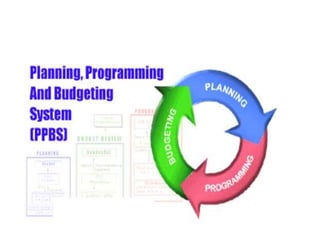
• Planning, Programming, and Budgeting
System (PPBS) is in effect an integration of a
number of techniques in a planning
and budgeting process.
• The aim of PPBS was to Identify the Goals,
Objectives, Tasks
• Prioritise in planning process,
• Identify, estimate costs and assign the various
resources needed for the achievement of the
established goals in the form of major
programs, in the programming phase
• Difference between conventional budgeting
PPBS – More importance is given for planning
Conventional budgeting- Planning phase is not
very important
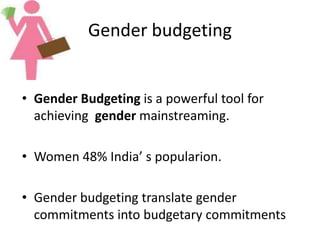
Gender budgeting
• Gender Budgeting is a powerful tool for
achieving gender mainstreaming.
• Women 48% India’ s popularion.
• Gender budgeting translate gender
commitments into budgetary commitments
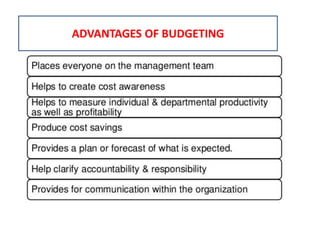
Advantages of budgetingADVANTAGES OF BUDGETINGADVANTAGES OF BUDGETING
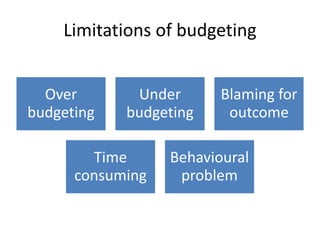
Limitations of budgeting
Over
budgeting
Under
budgeting
Blaming for
outcome
Time
consuming
Behavioural
problem
conclusion
• Financing in health care sector is presently in
its nascent stage in India and it is imperative
that all health care professionals and those
associated with health have a sound
knowledge of budgeting and health care
financing.
Budgeting

Budgeting

  • 1.
  • 2.
  • 3.
    Introduction • Increasing demandof health care but limited resources - importance of planning and management • Budgeting is the financial part of planning • Budget is an important tool in the hands of a trained health professional
  • 4.
  • 5.
    Definitions • Budget -anticipatedreceipts and available resources of an organisation during the given year, Or Statement of future plans described in quantitative and monetary terms, for a specific period of time. • Budgeting – the process of preparing the budget. • Budgetary control –preparing, implementing and monitoring of budgets.
  • 6.
  • 7.
    NEED OF BUDGETIN HEALTH a) Budgets are effective means of communicating the future organizational plans in monetary and financial terms. (b) A pre-decided and approved budget monitor the ongoing operations. (c) Budgeting reduces wastage and losses (d) Budgets, when drawn up through participation, encourage, and develop team spirit (e) Budgets form the basis for assessing the performance of managers
  • 8.
    Budgeting at differentlevel differs Organisations Ways to communicate plans Public health programme Resources in to services Central and State government Policy & plans for implementation
  • 10.
    Changing pattern ofpublic health expenditure • India needs to double or triple its existing health spending with their proper allocations Decentralization Community participation. • Financing control more important at the primary level. • Budgeting important tool in financial planning in health care
  • 11.
  • 12.
    Why budgeting inhealth is complicated? • Intangibility and often non-measurability of the product (health outcome). • Actual expenditures for health care will never exactly match the budget. • The ever increasing healthcare cost. • Needs to meet unfunded healthcare. • The complexity of fundflow.
  • 13.
  • 14.
    Top down budget-Imposed Budget Bottom up budget- Participatory Budget A top-down budget may be participatory if the top managers seek input from the lower levels
  • 15.
    TYPES OF BUDGET •Based on Time, Function Flexibility
  • 16.
    Time-based Budgets • (i)Long term budgets >5 year duration. • (ii) Short term budgets - up to one year duration. • (iii) Current budgets -very short term periods. • (iv) Rolling (Progressive/continuous budget) - – Budget prepared for 1 year – After a quarter new budget is prepared (for 1 yr). – Some advanced budget will always remain
  • 17.
    Function based budgets •Revenue budget • Expenditure budget • Capital budget • Operation budget • Cash budget • Research budget • Master budget
  • 18.
    Revenue budget (Salesbudget) Commercial and profit-based organisations. Sales budgets are developed based on the anticipated sales volume
  • 19.
    Expenditure budget Based onthe expected expenditure
  • 20.
    Capital budget Financial resourcesfor new proposed projects,
  • 21.
    Operation budget • Overviewof an agency’s functions by projecting the planned operations usually for the upcoming year
  • 22.
    Cash budget Ensure thatthe agency has enough, but not too much, cash on hand during the budgetary period Cash budget are planned to make adequate funds available.
  • 23.
    Research budget Allocating financialresources for innovation
  • 24.
    Master budget • Amalgamationof all organizational budgets •Balance sheet •Fund flow statement
  • 27.
    Flexibility-based budgets • Fixedbudgets • Flexible budgets
  • 28.
    . PHC PROGRAMME BUDGETEDFOR 5 LAKH POPULATION 7 LAKH POPULATION PERFORMANCE Fixed budget
  • 29.
    5,00,000 10,00,000 15,00,000 BASIC COST 5BEDS 10 BEDSFLEXIBLE BUDGET
  • 30.
    Fixed budget Flexiblebudget Static Dynamic Remains constant regardless of activity Change with change in activity Fixed Budget cannot be modified as per the actual volume Flexible budget can be easily modified in accordance with the activity level attained Actual Performance cannot be accurately measured Actual Performance can be measured Based on assumption Realistic and Practical
  • 31.
    Types of budgets FIXEDBUDGET FLEXIBLE BUDGET REVENUE BUDGET EXPENDITURE BUDGET CAPITAL BUDGET OPERATION BUDGET CASH BUDGET RESEARCH BUDGET MASTER BUDGET LONG TERM BUDGET SHORT TERM BUDGET CURRENT BUDGET ROLLING BUDGET Time based Function based Flexibility based
  • 32.
  • 33.
    Techniques of Budgeting •Incremental budgeting • Zerobased budgeting • Programme budgeting(Performance budgeting) • Planning Programming and Budgeting system(PPBS)
  • 34.
    Incremental budget • Previousyear’s expenditure is applied to the next year • With additional components of increased salaries and cost of materials • Requires little budget expertise from the part of the manager.
  • 37.
    Advantages: Simple to prepareand understand Requires little budget expertise from the part of the manager. Consistent basis Better coordination between budgets
  • 38.
    Disadvantages:  Totally ignorethe impact of changes  Wasteful expenditures of previous years are again included  No incentive in development and innovation  Encourages spending up to the budget  Administrators of various departments often tend to inflate their proposed individual budgets, since no detailed justification is sought along with the proposal.
  • 39.
    Zerobased budgeting  Assumesthe base for projecting next year’s budget is zero.  Managers are required to justify all activities and programs as if they initiated for the first time
  • 42.
    Advantages of ZBB •Efficient allocation of scarce financial resourses. • Links budget to organisational objectives- Management by objectives. • Only essential projects and activities. • Activity must justify before each budget that the activity proposed is essential, cost effective • Identifies wasteful expenditure.
  • 43.
    Disadvantages • Initial planningstage needs effort and time • Very complex  Time and manpower consuming • Necessary to train employees, especially managers • Less applicable for those activities with intangible cost-benefit relationship- public heath programmes
  • 44.
    3.Performance based budgeting •Decision making and budgeting depends on performance. • Performance Based on goals and objectives of programme • Outcome of the programme measured. • Efficiency and effectiveness of the programme measured for continuous improvement.
  • 45.
    PERFORMANCE BUDGETING -The departmentalhead usually prepare periodic performance reports - Which compare the budgeted actual performance -In terms of output, production or services rendered (to detect any deviations at the earliest possible.)
  • 46.
    PB • Introduced inUSA in 1951 • GOI & some State Govts have accepted it. • Most useful in public health
  • 48.
    Problems in PerformanceBudgeting • Time gap b/w the input ( intervention) and output ( improvement in health) • Establishment of standards, norms for measurement is difficult • It is almost impossible to separate out the individual effects of different units.
  • 49.
    4.Planning programming and budgetingsystem.PPBS • Planning, Programming, and Budgeting System (PPBS) is in effect an integration of a number of techniques in a planning and budgeting process.
  • 50.
    • The aimof PPBS was to Identify the Goals, Objectives, Tasks • Prioritise in planning process, • Identify, estimate costs and assign the various resources needed for the achievement of the established goals in the form of major programs, in the programming phase
  • 52.
    • Difference betweenconventional budgeting PPBS – More importance is given for planning Conventional budgeting- Planning phase is not very important
  • 53.
    Gender budgeting • GenderBudgeting is a powerful tool for achieving gender mainstreaming. • Women 48% India’ s popularion. • Gender budgeting translate gender commitments into budgetary commitments
  • 55.
    Advantages of budgetingADVANTAGESOF BUDGETINGADVANTAGES OF BUDGETING
  • 56.
    Limitations of budgeting Over budgeting Under budgeting Blamingfor outcome Time consuming Behavioural problem
  • 57.
    conclusion • Financing inhealth care sector is presently in its nascent stage in India and it is imperative that all health care professionals and those associated with health have a sound knowledge of budgeting and health care financing.