Budgets provide a comprehensive financial overview of planned operations and help managers communicate objectives across an organization. The master budget is a detailed analysis that summarizes activities for the first year of a long-range plan. It includes an operating budget focusing on the income statement and a financial budget focusing on cash flows. The key steps in preparing the master budget are to create basic data like sales and expense budgets, then use that data to prepare the operating and financial budgets.
In this document
Powered by AI
Introduction to budgets, overview of operations, reevaluation of activities, manager communication, and forward-thinking.
Participation issues, budget dishonesty, inaccurate sales forecasts, and incentives resulting in poor decisions.
Sales forecasts predicting sales under conditions, influences including competitors and market studies.
Strategic plan linking long-term goals to master budget detailing subunits' planned activities.
Introduction to rolling budgets, operating and financial budgets, focusing on income statements and cash effects.
Essential steps in preparing master budgets including data collection, operating and financial budgets.
Preparation of budgeted cash collections alongside sales budgets and variables affecting operating expenses.
Disbursements for operating expenses based on budgets, fixed and variable costs, affecting profitability.
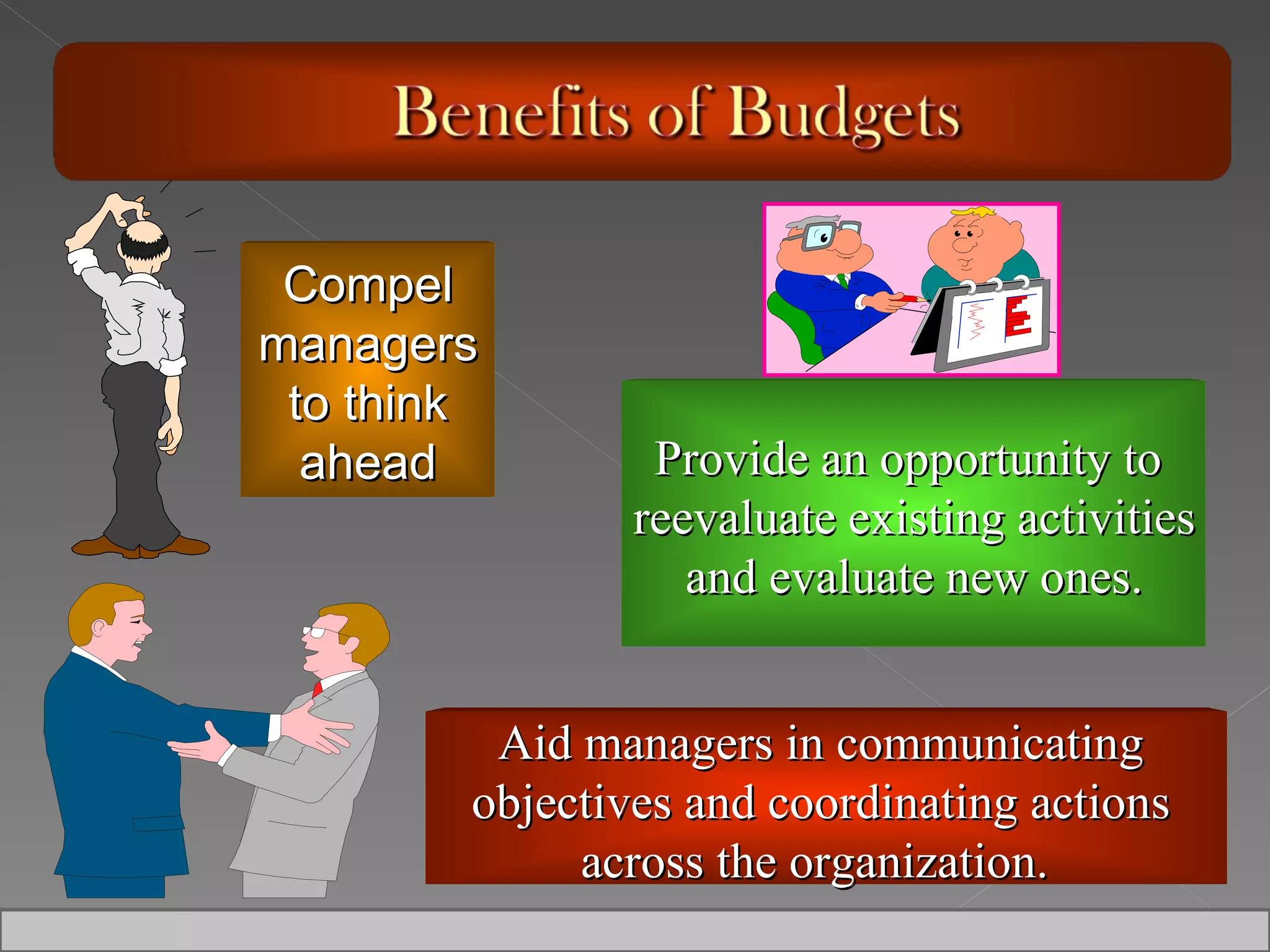
Budgets A budgetprovides a comprehensive financial overview of planned company operations. Learning Objective 1 Goals and objectives
3.
Provide an opportunityto reevaluate existing activities and evaluate new ones. Aid managers in communicating objectives and coordinating actions across the organization. Compel managers to think ahead
4.
1. Lowlevels of participation in the budget process and Lack of acceptance of responsibility for the final budget. 2. Incentives to lie and cheat in the budget process. 3. Difficulties in obtaining accurate sales forecasts. Learning Objective 2 Management should seek to create an environment where there is a true two-way flow of information.
5.
Participative budgets areformulated with the active participation of all affected employees. Message conveyed by the budget system may be misaligned with incentives provided by the compensation system.
6.
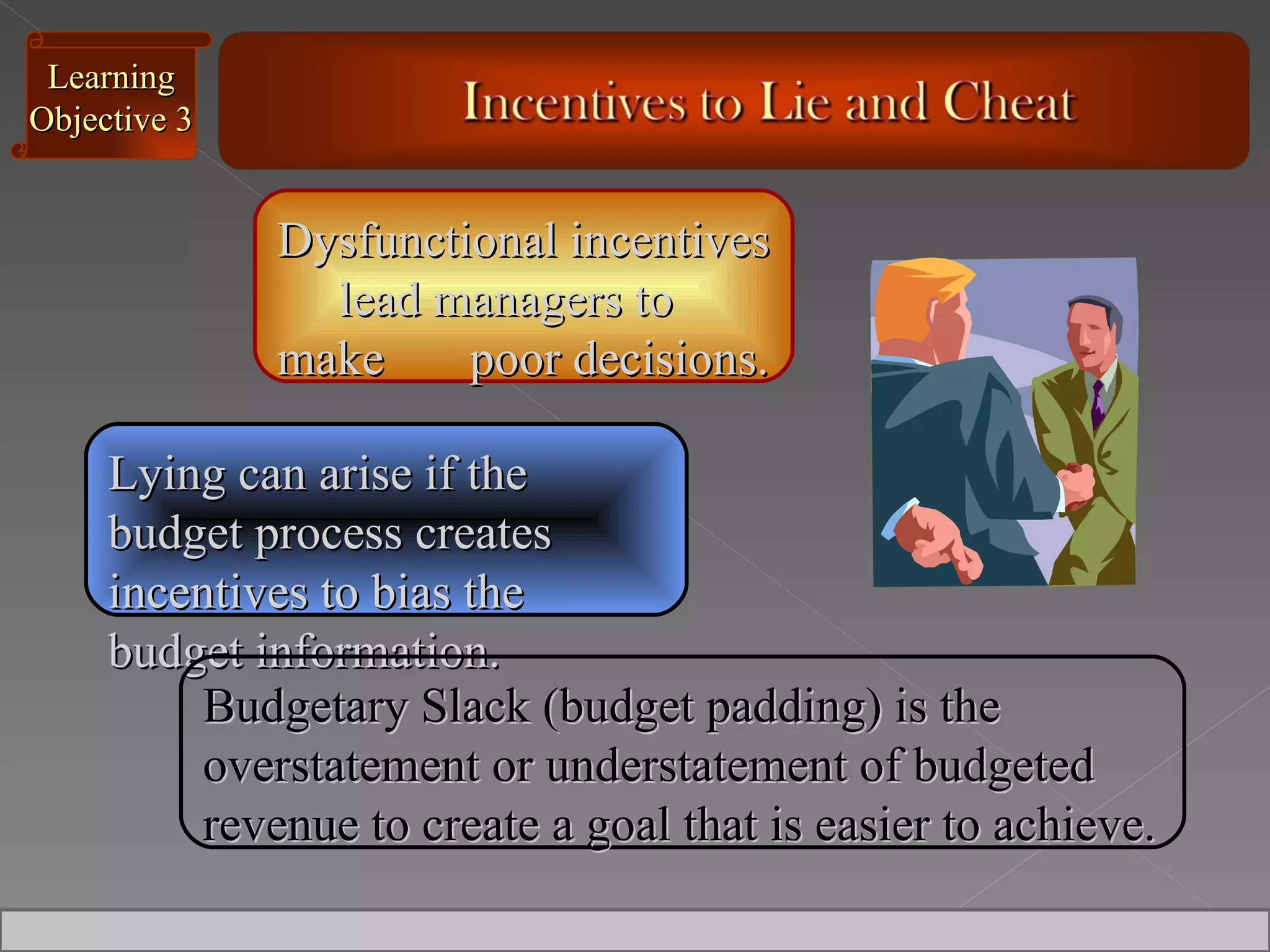
Dysfunctional incentives lead managers to make poor decisions. Lying can arise if the budget process creates incentives to bias the budget information. Budgetary Slack (budget padding) is the overstatement or understatement of budgeted revenue to create a goal that is easier to achieve. Learning Objective 3
7.
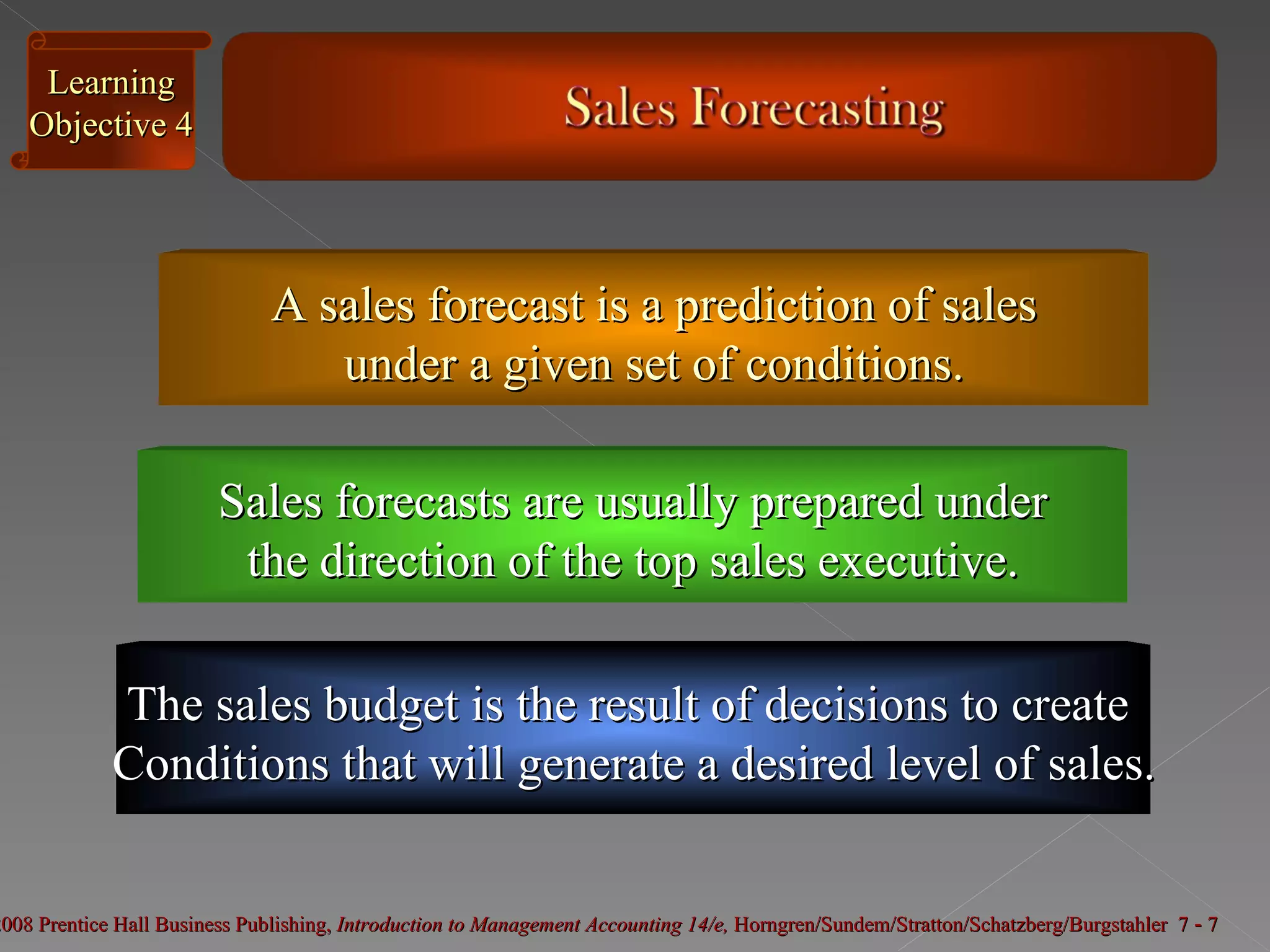
A sales forecastis a prediction of sales under a given set of conditions. Sales forecasts are usually prepared under the direction of the top sales executive. Learning Objective 4 The sales budget is the result of decisions to create Conditions that will generate a desired level of sales.
8.
Competitors’ actionsPast patterns of sales Estimates made By sales force General economic conditions Changes in the firm’s prices Changes in product mix Market research studies Advertising and sales promotion plans
9.
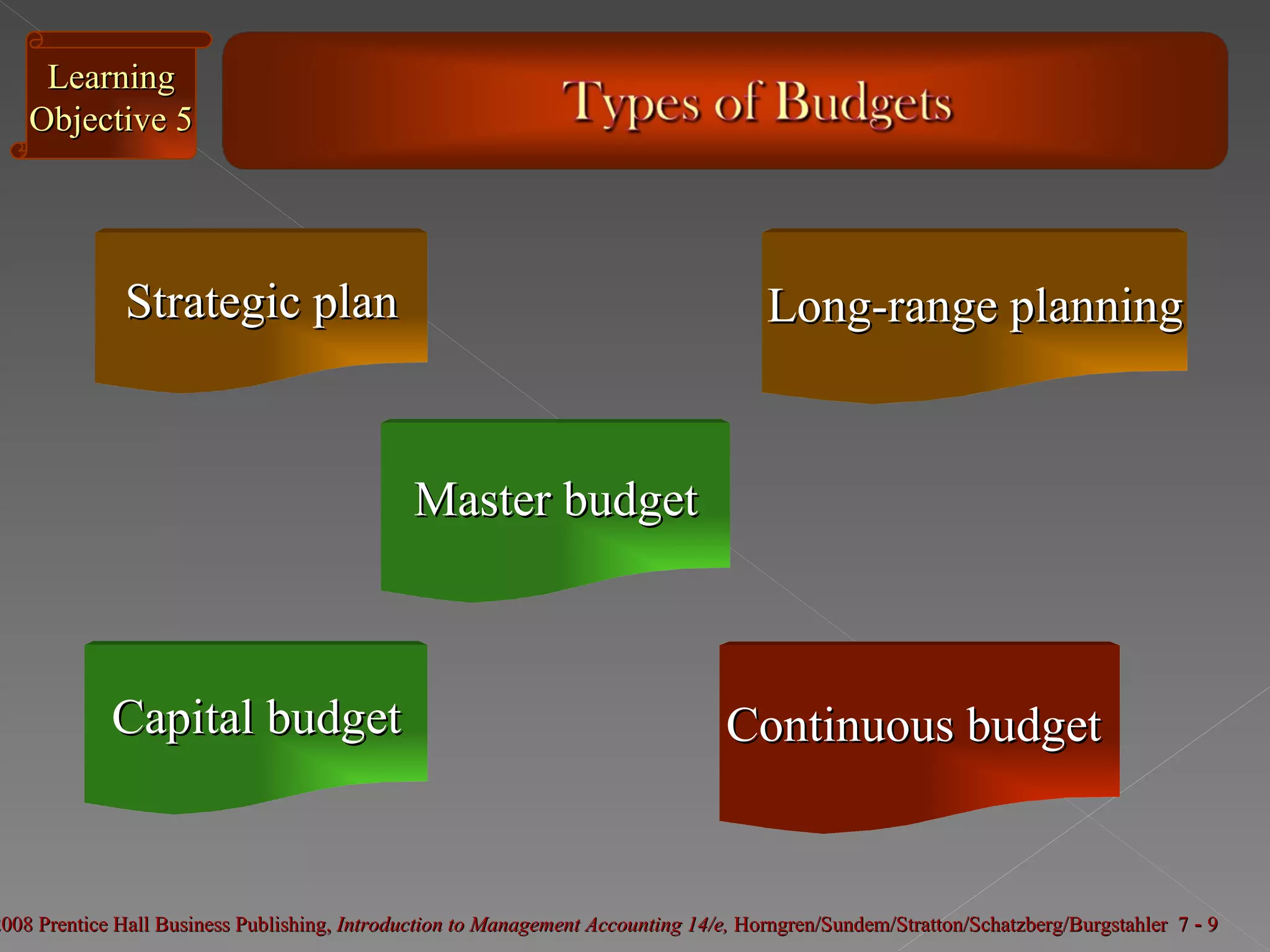
Strategic plan Long-rangeplanning Capital budget Master budget Continuous budget Learning Objective 5
10.
The most forward-lookingbudget is the strategic plan, which sets the overall goals and objectives of the organization. The strategic plan leads to long-range planning, which produces forecasted financial statements for five- to ten-year periods.
11.
Long-range plans… arecoordinated with capital budgets, which detail the planned expenditures for facilities, equipment, new products, and other long-term investments. Master budgets link to both long-range plans and short-term budgets.
12.
The master budgetis a detailed and comprehensive analysis of the first year of the long-range plan. It summarizes the planned activities of all subunits of an organization. Sales Production Distribution Finance
13.
Rolling budgets... area common form of master budgets that add a month in the future as the month just ended is dropped.
14.
Operating budget (Profitplan). . . Financial budget. . . Focuses on the Income Statement and supporting schedules or budgeted expenses. Focuses on the effects that the operating budget and other plans will have on cash balances.
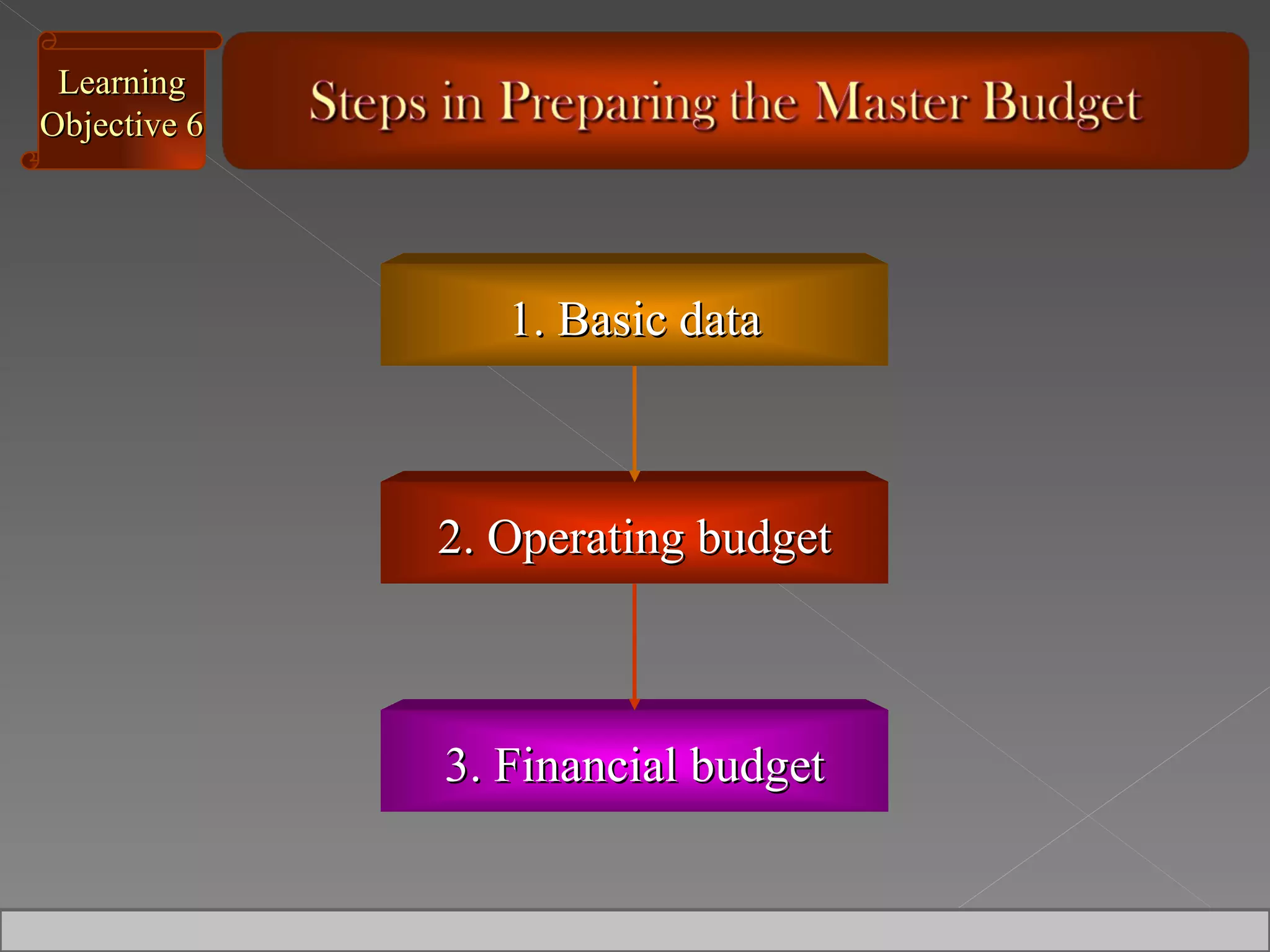
1. Basic dataa. Sales budget b. Cash collections from customers c. Purchases and cost-of-goods sold budget d. Cash disbursements for purchases e. Operating expense budget f. Cash disbursements for operating expenses The principal steps in preparing the master budget:
17.
Financial Budget Prepareforecasted financial statements: b. Capital budget c. Cash budget d. Budgeted Balance sheet Operating Budget 2. Prepare budgeted income statement using basic data in step 1.
18.
Sales budget LearningObjective 7 Cash collections from customers Disbursements for purchases Disbursements for operating expenses Purchases budget Operating expenses budget
19.
It is easiestto prepare budgeted cash collections at the same time as the sales budget. Cash collections include the current month’s cash sales plus the previous month’s credit sales.
20.
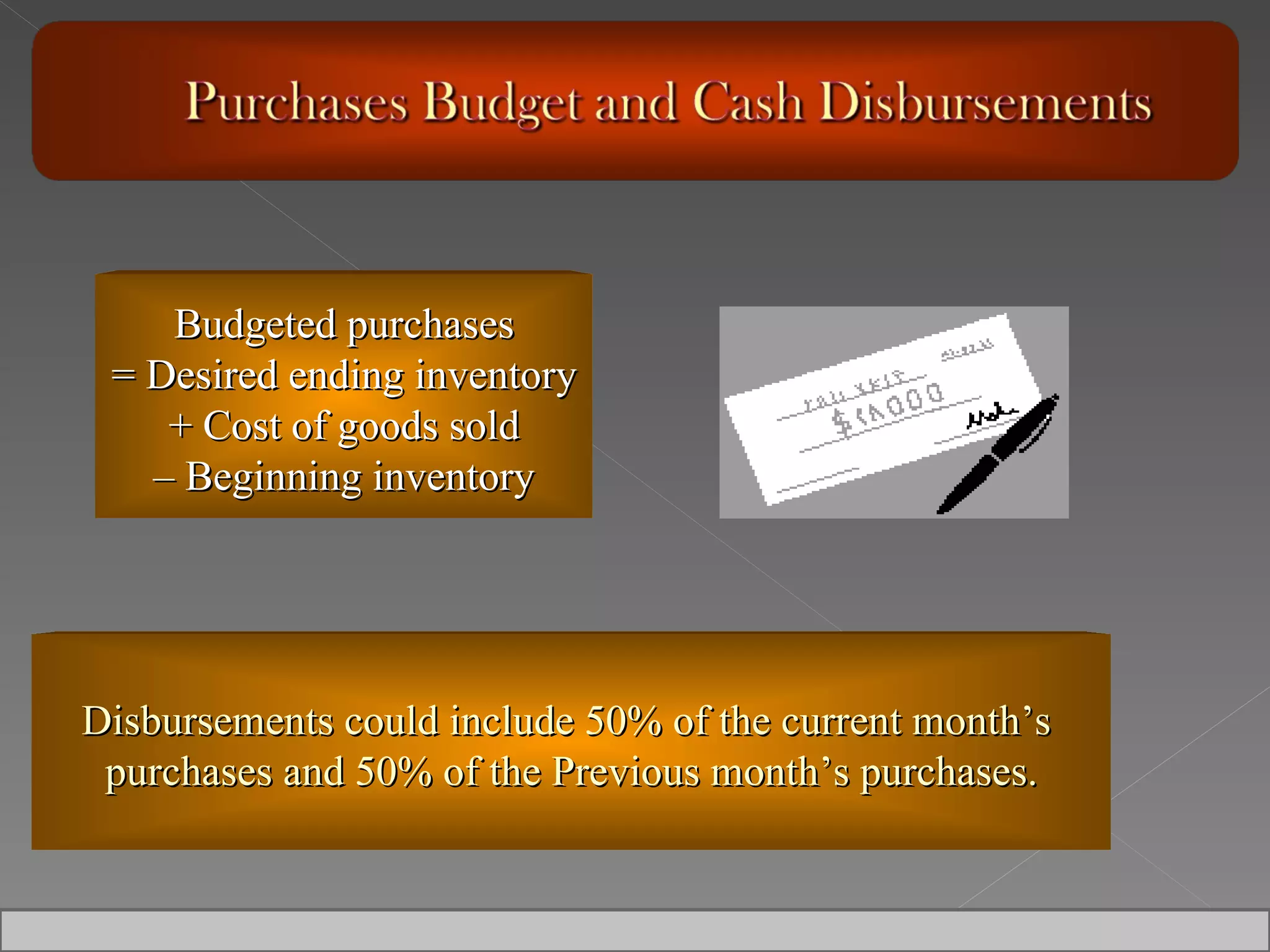
Budgeted purchases =Desired ending inventory + Cost of goods sold – Beginning inventory Disbursements could include 50% of the current month’s purchases and 50% of the Previous month’s purchases.
21.
The budgeting ofoperating expenses depends on several factors. Month-to-month changes in sales volume and other cost-driver activities directly influence many operating expenses. Expenses driven by sales volume include sales commissions and many delivery expenses.
22.
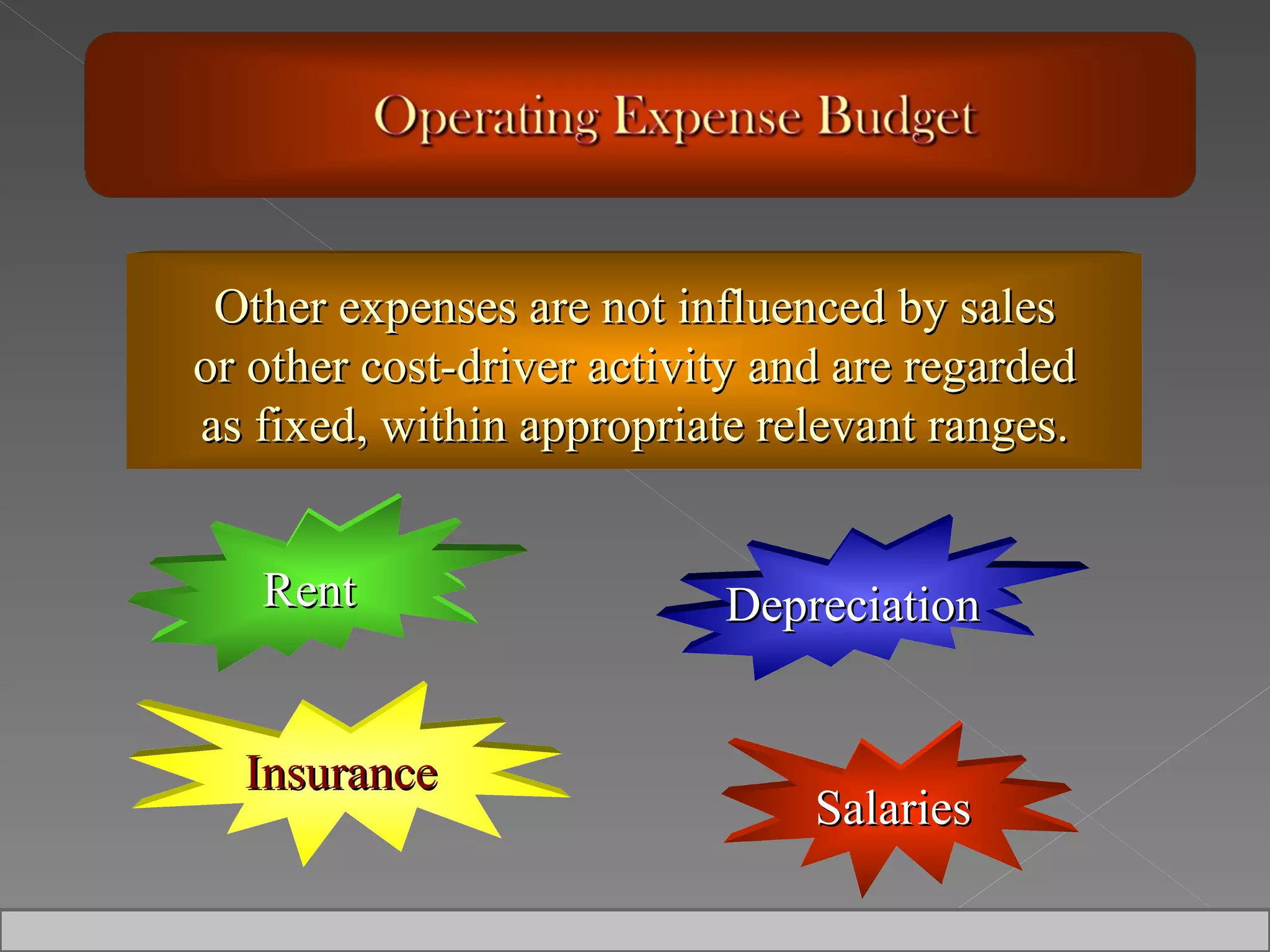
Other expenses arenot influenced by sales or other cost-driver activity and are regarded as fixed, within appropriate relevant ranges. Rent Insurance Depreciation Salaries
23.
Disbursements for operatingexpenses are based on the operating expense budget. Disbursements may include 50% of last month’s and this month’s wages and commissions plus miscellaneous and rent expenses. The total of these disbursements is then used in preparing the cash budget.
24.
The income statementwill be complete after addition of the interest expense, which is computed after the cash budget has been prepared. Budgeted income from operations is often a benchmark for judging management performance.
25.
The Cash budgetcontains these major sections: available cash balance net cash receipts and disbursements financing Learning Objective 8 The cash budget is a statement of planned cash receipts and disbursements.
26.
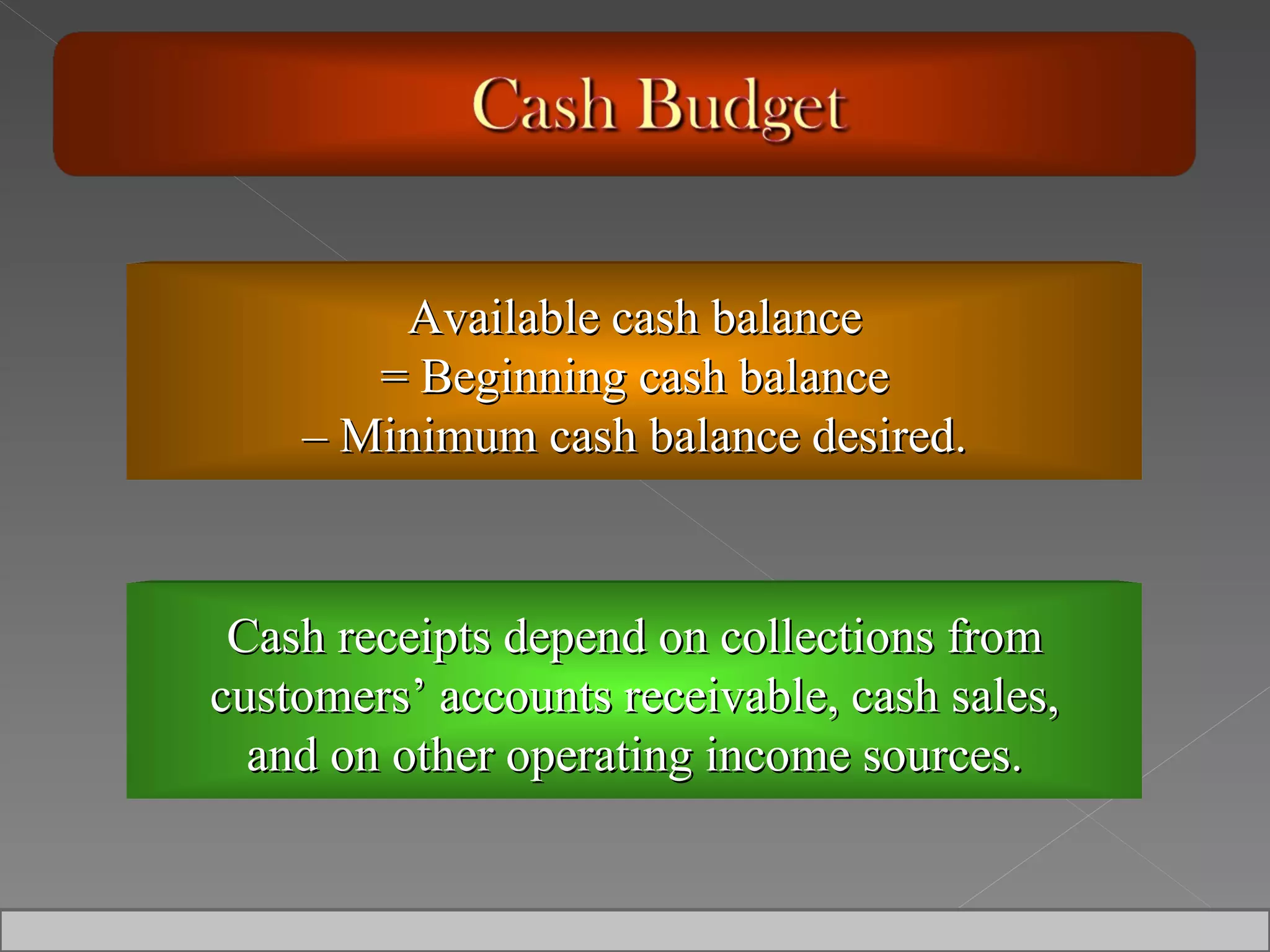
Available cash balance= Beginning cash balance – Minimum cash balance desired. Cash receipts depend on collections from customers’ accounts receivable, cash sales, and on other operating income sources.
27.
Cash disbursements forpurchases depend on the credit terms extended by suppliers and the bill-paying habits of the buyer. Payroll depends on wage, salary, and commission terms and on payroll dates.
28.
Other disbursements includeoutlays for fixed assets, long-term investments, dividends, and the like. Disbursements for some costs and expenses depend on contractual terms for installment payments, mortgage payments, rents, leases, and miscellaneous items.
29.
Management determines theminimum cash balance desired depending on the nature of the business and credit arrangements.
30.
Financing requirements dependon how the total cash available compares with the total cash needed. Needs include the disbursements plus the desired ending cash balance.
31.
Ending cash balance= Beginning cash balance + Receipts – Disbursements + Cash from financing The cash from financing can be either positive (borrowing) or negative (repayment).
32.
The final stepin preparing the master budget is to construct the budgeted balance sheet that projects each balance sheet item in accordance with the business plan. Management then considers all the major financial statements as a basis for changing the course of events.
33.
An activity-based budgetarysystem emphasizes the planning and control purpose of cost management. Functional budgeting focuses on preparing budgets for various functions such as production, selling, and administrative support.
34.
Financial models areonly as good as the assumptions and the inputs used to build and manipulate them. Financial planning models are mathematical models that can incorporate the effects of alternative assumptions about sales, costs, or product mix.
35.
Arithmetic errors arevirtually nonexistent. Spreadsheet software for personal computers is a powerful and flexible tool for budgeting that can be used to prepare mathematical models. Financial planning models are mathematical models that can incorporate the effects of alternative assumptions about sales, costs, or product mix. Learning Objective 9