INTRODUCTION
• One ofthe primary objectives of
management accounting is to provide
information to management for planning
and control. A widely used device for
managerial control is the budget.
Because the amount and quality of
Nursing Services depended on budgetary
plans, nurses should become proficiency
will provide the resources necessary for
the safe and effective nursing care.
3.
DEFINITION
• A budgetis an estimate of future needs
arranged to an orderly basis covering
some or all the activities of an enterprise
for a definite period of time. T.N.Chhabra
• Budgeting is the formulation of plans for
a given period in numerical terms.
Harold Koortz
4.
DEFINITION
• A budgetis a plan that uses
numerical data to predict that
activities of an organization over a
period of time.
-Bessie.
5.
PURPOSE OF BUDGET
•Budget supplies the mechanism for translating fiscal
objectives into project monthly spending pattern.
• Budget enhances fiscal planning and decision
making.
• Budget clearly recognizes controllable and
uncontrollable cost areas.
• Budget offers a useful format for communication
fiscal objectives.
• Budget allows feed back of utilization of budget.
• Budget helps to identify problem areas and
facilitates effective solution.
• Budget provides means for measuring and
recording financial success within the objectives of
the organization.
6.
FEATURES OF BUDGET
Itshould be flexible.
It should be synthesis of past, present, future.
It should be product of joint venture for co-
operation of executives department heads or
different level of management.
It should be in the form of statistical laid down
in specific numerical terms.
It should have support of top management
throughout the period of its planning and
implementation.
7.
IMPORTANCE OF BUDGET
•Budget is needs for planning for future course of
action and to have a control over all activities in
the organization.
• Budget facilitates co-ordinating operation of
various departments and section for realizing
organizational objectives.
• Budget serves as a guide for action in the
organization.
• Budget helps one to weight the value and to
make decision when necessary or whether one is
of a greater value in the programme that the
order.
8.
PRINCIPLE OF BUDGET
•Budget should provide sound financial
management by focusing on requirement of the
organization.
• Budget should focus on objectives and policies of
the organization. It must flow from objectives and
give realistic expression to the way of realistic such
objective.
• Budget should ensure the most effective use of
scarce financial and non financial resources.
• Budget requires that programme activities planned
in advance.
9.
• Budgetary processrequires consistent delegation for
which fixed duties and responsibilities are required to
be allocated to managers at different level for framing
and executing budget.
• Budget should include co-ordinating efforts of various
departments establishing a frame of reference for
managerial decision and providing certain criteria for
evaluating managerial performance.
• Selling budget target requires an adequate checks
and balance against the adoption of too high or too
low estimate, almost care is a must for fixing targets.
• Budget period must be appropriate to the nature of
business or service and to type of budget.
• Budget is prepared under the direction on the
supervision of the administration or financial officer.
• Budget are to be prepared and interpreted
consistently throughout the organization in the
communication in the planning process.
10.
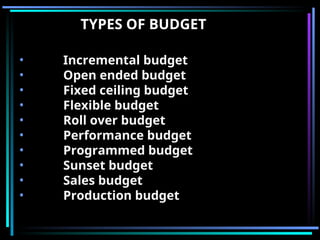
TYPES OF BUDGET
•Incremental budget
• Open ended budget
• Fixed ceiling budget
• Flexible budget
• Roll over budget
• Performance budget
• Programmed budget
• Sunset budget
• Sales budget
• Production budget
11.
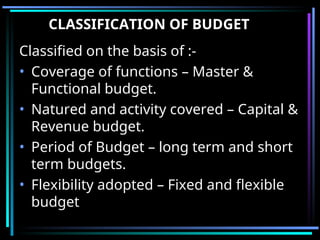
CLASSIFICATION OF BUDGET
Classifiedon the basis of :-
• Coverage of functions – Master &
Functional budget.
• Natured and activity covered – Capital &
Revenue budget.
• Period of Budget – long term and short
term budgets.
• Flexibility adopted – Fixed and flexible
budget
12.
MASTER & FUNCTIONALBUDGET
• A mastered budget is prepared for the entire
organization incorporating the budget of
different functions. For eg. When we refer to the
annual budget of Govt. of India. It incorporates
the budget out lays of different ministries.
• A functional budget is prepared incorporating a
major function and its sub functions since an
organization may have a number of functions,
numerous functional budgets are prepared. Eg.,
production budget, cash budget in an
organization.
13.
CAPITAL & REVENUEBUDGET
• An organization activities involve two process.
Creating facilities for carrying out activities and
actual performance activities. Creating facilities for
carrying out activities include capital expenditure
whole returns accrue over a number of years. For
such activities, capital budget is prepared which is
essentially a list of what management believes to be
worth while projects for acquisition of new assets
together with the estimated cost of each project.
• Revenue budget involves the formation of target for
a year or so in respect of various organizational
activities such as production, marketing, finance,
etc., Thus a revenue budget includes expenditure
and earning for a specific period like one year.
14.
LONG TERM ANDSHORT TERM BUDGET
• Many organization integrate their yearly budgets
with long term projection of business activities
and along with yearly budget; they prepare
budgets for a longer period of 2-3 years. When
one budget period is over budgets are prepared
for the next year and subsequent 2-3 years.
• The short term budget is for a year and is divided
into a number of periods for effective
implementation. For eg. Cash budgets are
prepared on yearly basis as well as on monthly
or quarterly basis to facilitate better cash
management.
15.
FIXED AND FLEXIBLEBUDGETS
• Generally, organizations prepare budgets which
pertain to only certain projected fixed volume of
operations for a year or so such budget are known
as fixed or static budgets. When an organizations
volume of business can be predicted with fair
amount of precision, the fixed budget is satisfactory.
• A budget which is designed to change in accordance
with the activities of the organization is known as
flexible budget. It considers several level of activity
and assures that labour, material or facilities used in
production and hence cost vary with a known
relationship to the actual volume of activity.
16.
TYPES OF BUDGETING
Thereare mainly two types of
budgeting.
• Performance Budgeting
• Zero base budgeting.
17.
PERFORMANCE BUDGETING
• Aperformance budgeting is an input/output
budget or costs and results budget. It shows
costs matching with operations. Performance
budget emphasis on non financial measures of
performance which can be related to financial
measures in explaining changes and deviation
from planned performance. Performance
measurement are useful for evaluating past
performance and for planning future activities.
Performance budgeting, results into the
following.
18.
• It correlatesthe financial and physical
aspects of every programme or activity.
• It improves budget formulation, review
and decision making at all levels of the
organization.
• It facilitates better appreciation and
review of organizational activities by the
top management.
• It makes possible move effective
performance audit.
• It measures progress towards long term
objectives.
19.
ZERO BASE BUDGETING
•This was applied for the first time in
preparing the divisional budgets of Texas
instruments of the USA in 1971.
• Zero base budget is based on a system
where each function, irrespective of the
fact whether it is old or new, must be
justified in its entirely each time a new
budget is formulated. It requires each
managed to justify his entire budget in
detail from scratch that zero base.
20.
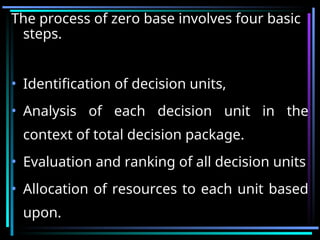
The process ofzero base involves four basic
steps.
• Identification of decision units,
• Analysis of each decision unit in the
context of total decision package.
• Evaluation and ranking of all decision units
• Allocation of resources to each unit based
upon.
21.
BENEFITS OF ZEROBASE BUDGETING
• Effective allocation of resources.
• Improvement in productivity and cost
effectiveness.
• Effective means to control costs.
• Eliminator of unnecessary activities.
• Better focus or organizational objectives.
• Saving time of top management.
22.
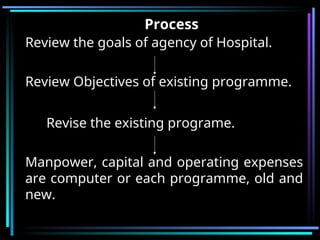
Process
Review the goalsof agency of Hospital.
Review Objectives of existing programme.
Revise the existing programe.
Manpower, capital and operating expenses
are computer or each programme, old and
new.
23.
LIMITATION OF BUDGETING
•Planning, budgeting or forecasting is not an
exact science; it uses appropriately and
judgment which may not be 100% accurate.
At best a budget is an estimate no one
knows precisely what will happen in the
future.
• The success and utility of budgeting depends
on the co-operation and participating of all
members of management. All person
should direct their effort according to the
plan. Many time budgeting has paid only lip
services to its executing.
24.
• A budgetis only a tool and neither
eliminates nor takes over the place of
management. A budget cannot be
substituted for management but should
only be used by management for
accomplishing managerial functions.
• The establishment of a budgeting process
takes time. Also sometime too much is
expected from a budget and in case
expectation are not fulfilled the blame is
put on the budget. An efficient budgeting
programme requires that responsible
person should understand the philosophy,
objective and essential of budgeting.
25.
BUDGETS FOR GOVERNMENTOF INDIA
• India’s budget : India’s public finance
system follows the British pattern. The
Indian constitution establishes the
supremacy of the Parliament – specifically
the Lok Sabha in financial matters.
• Proposal for taxation or expenditures,
however, may be initiated only within the
council of ministers – specifically by the
Ministers of Finance.
26.
• Ministers offinance is required submit to
parliament, usually on the last day of
February, a financial statement detailing the
estimated receipts and expenditure of the
Central Govt. for the forthcoming fiscal year
and financial review of the current fiscal year.
• The Lok Sabha has one month to review and
modify the Government’s budget proposals.
If by April 1 the beginning of the fiscal years,
the parliamentary discussion of the budget
has not been completed, the budget a
proposed by the minister of finance goes
into effect, subject to retroactive
modifications after the parliamentary review.
27.
• On completionof its budget discussion, the
Lok Sabha passess the annual appropriation
act, authorizing the executive to spend
money, and the finance act, authority the
executive to impose and collect taxes.
• Supplementary requests for funds are
presented during the course of the fiscal
year to cover emergencies, such as war or
other catastrophes.
28.
• The billsforwarded to the Rajya Sabha
(Council of State the upper house of
parliamentary) for comment Lok Sabha,
however, is not bound by the
comments, and the Rajya Sabha cannot
delay passage of money bills. When
signed by the president, the bills
become Law.