PRODUCED BY THE WORLD
HEALTH ORGANIZATION


The ICD has been evolving for more
       than 100 years as a
SYSTEMATIC CODING SYSTEM.
-it is the 10th revision of the
  International Statistical
  Classification of Diseases and
  Related Health Problems
  commonly known as ICD - 10
-it is used in clinical coding
-it is the translation of diseases,
health related problems and
procedural concepts from text to
alphabetic/numeric codes for
storage, retrieval and analysis
-it is a system of categories or
 groupings to which diseases, injuries,
 conditions and procedures are
 assigned according to established
 criteria
           ICD-10 is a statistical
           classification, which means that it
           contains limited number of
           mutually exclusive code categories
           describing all disease concepts.
To allow easy storage, retrieval
 and analysis of data


To allow comparison of data
 between hospitals, provinces,
 regions and countries
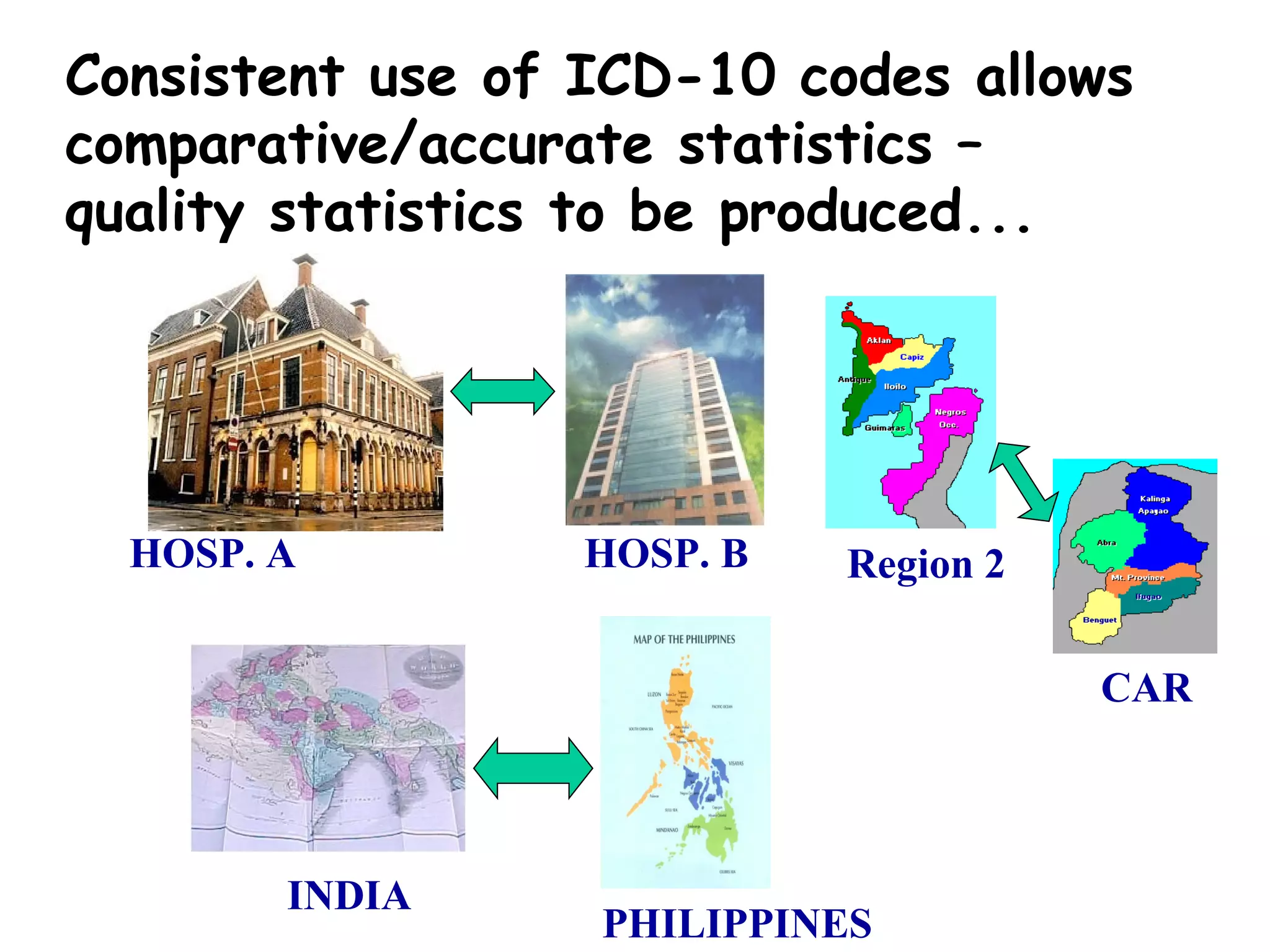
Consistent use of ICD-10 codes allows
comparative/accurate statistics –
quality statistics to be produced...


  HOSP. A        HOSP. B   Region 2

                                      CAR


        INDIA
                  PHILIPPINES
ICD-10 codes are used to
         generate
        statistics
for Morbidity and Mortality.
Epidemiology

       Medical Care Management

HOW?
• provides clues for causes of disease
• evaluation of previous treatments
• review of previous public health
  initiatives or programs
• aid health services planning decisions
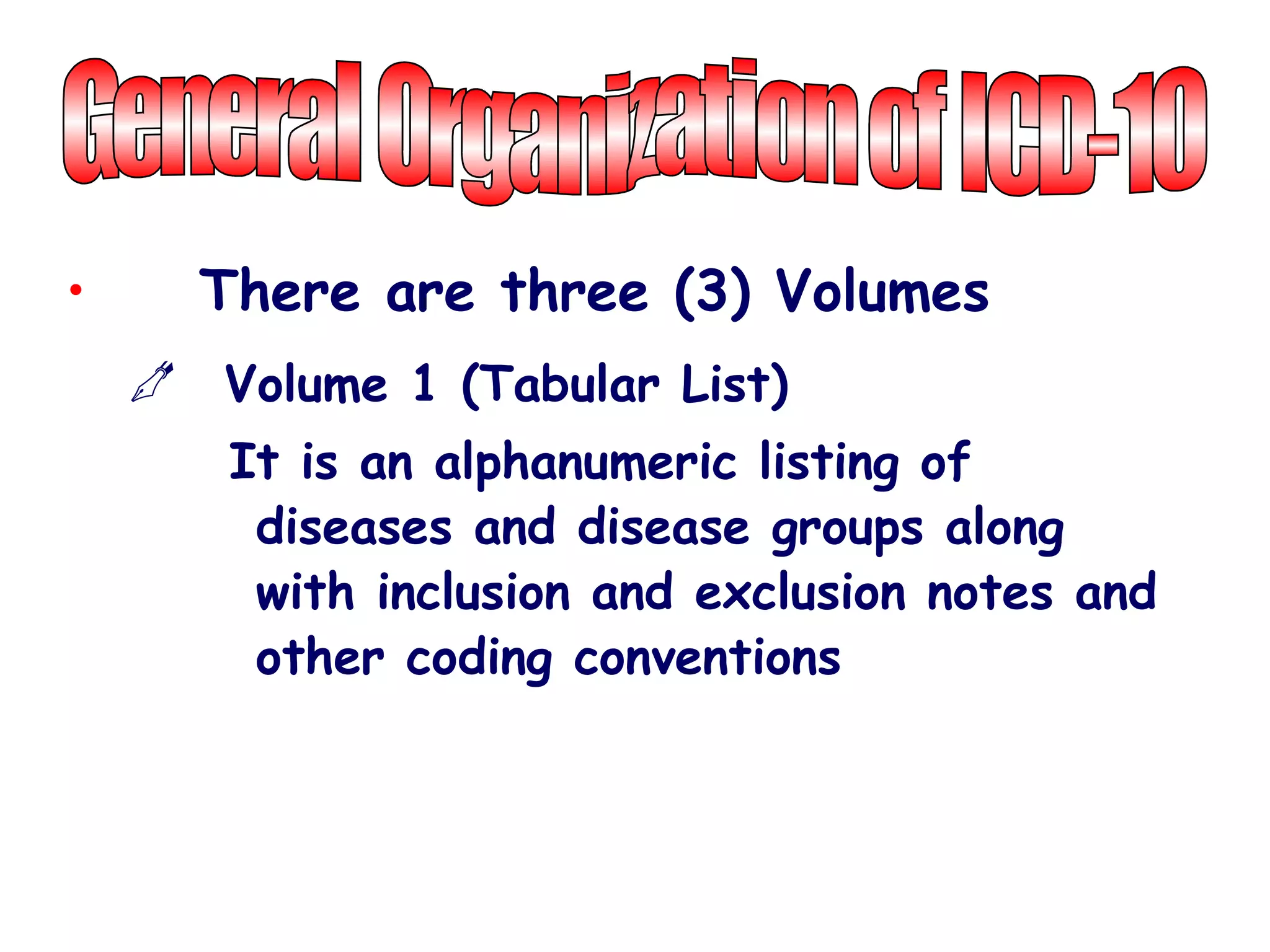
•     There are three (3) Volumes
     Volume 1 (Tabular List)
       It is an alphanumeric listing of
        diseases and disease groups along
        with inclusion and exclusion notes and
        other coding conventions
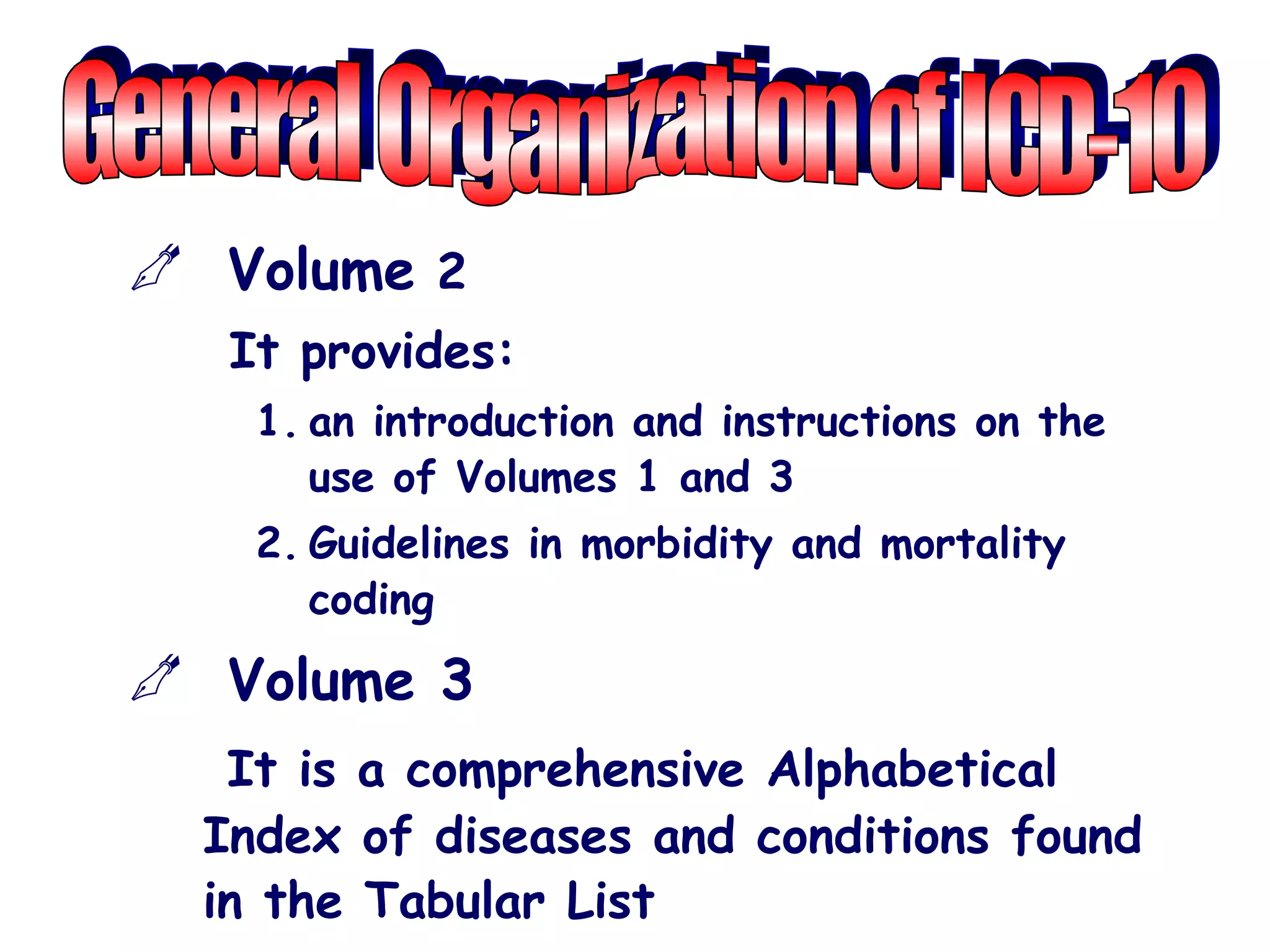
Volume 2
   It provides:
    1. an introduction and instructions on the
       use of Volumes 1 and 3
    2. Guidelines in morbidity and mortality
       coding
 Volume 3
   It is a comprehensive Alphabetical
  Index of diseases and conditions found
  in the Tabular List
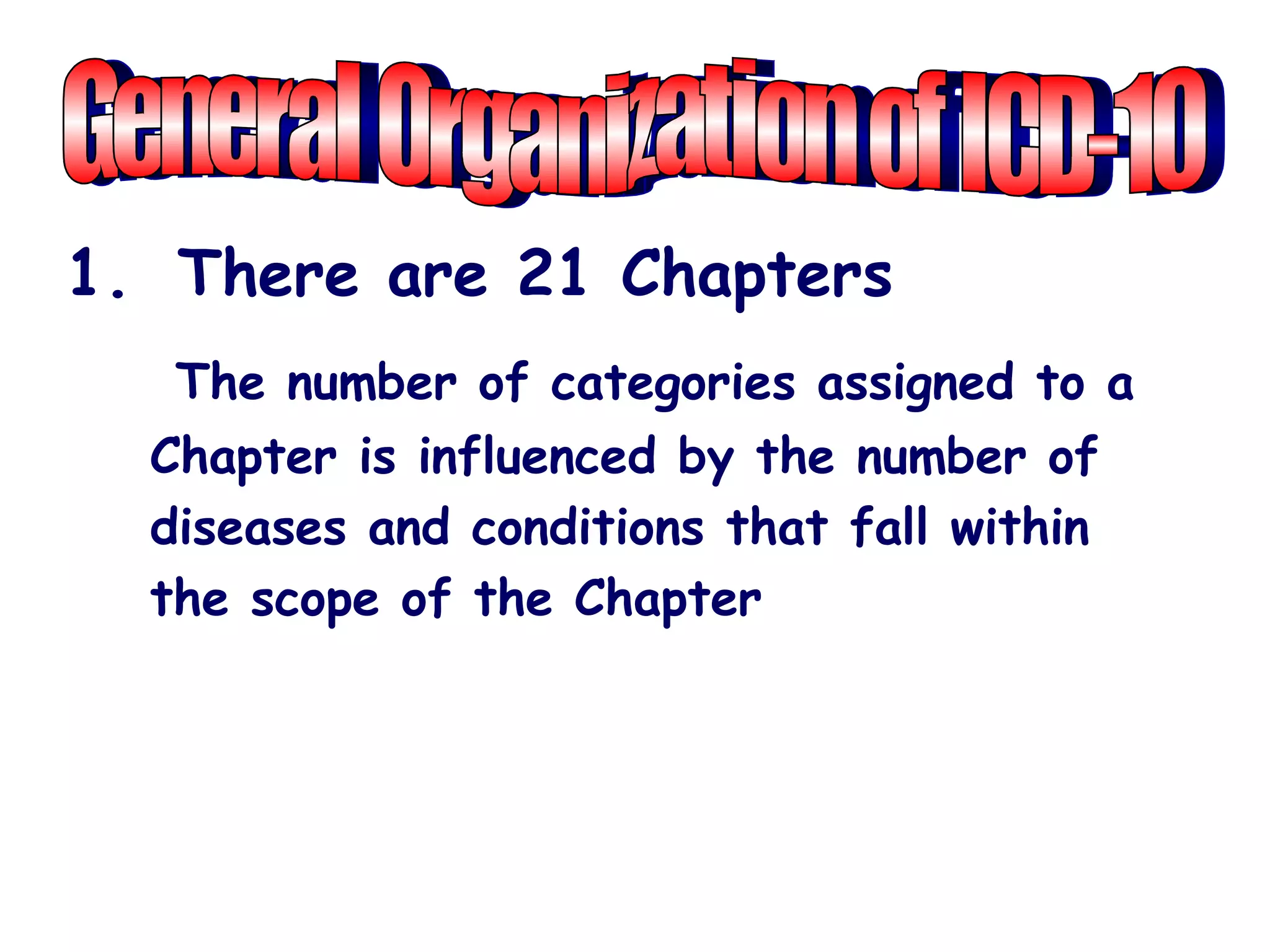
1. There are 21 Chapters
   The number of categories assigned to a
  Chapter is influenced by the number of
  diseases and conditions that fall within
  the scope of the Chapter
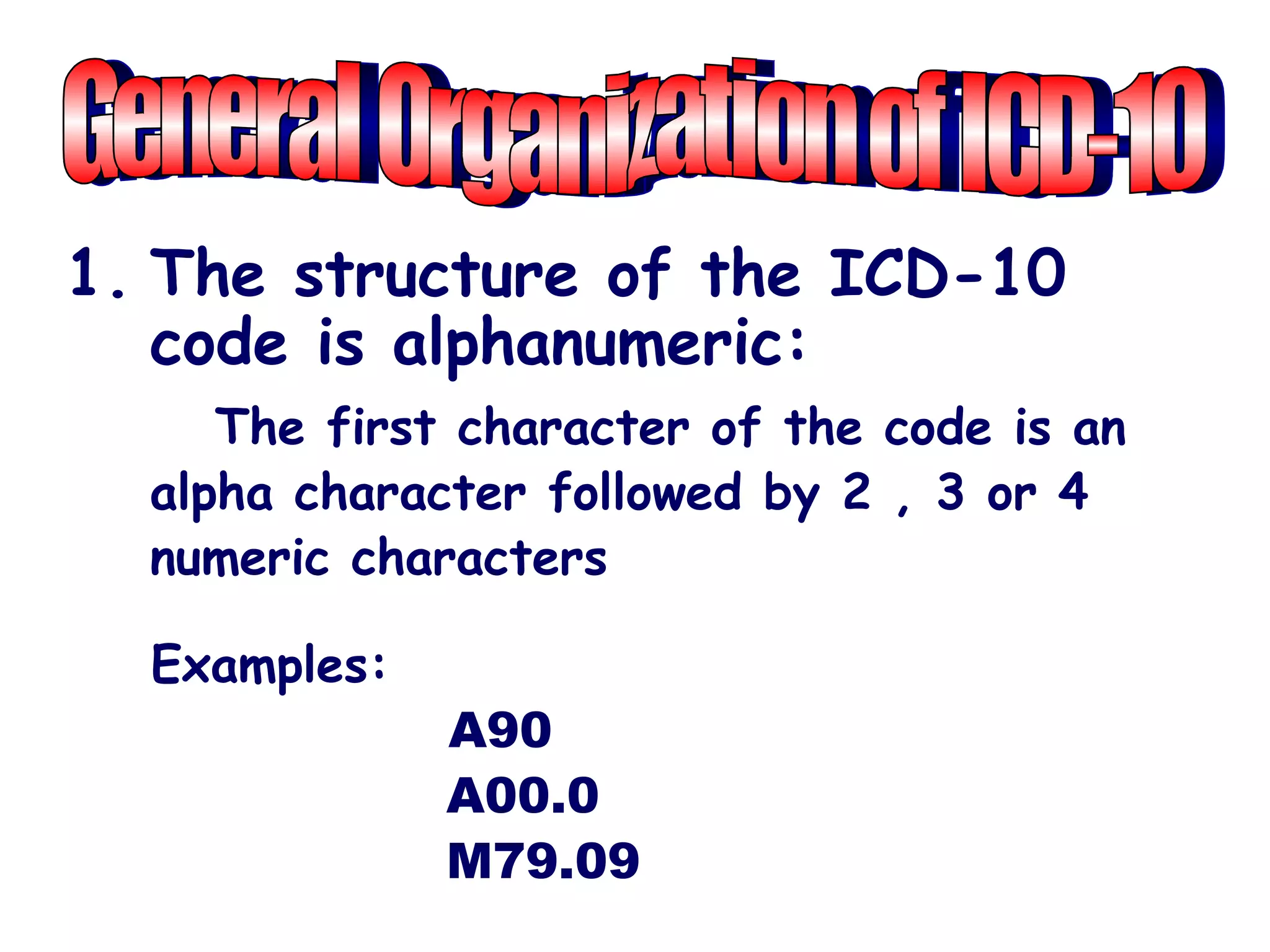
1. The structure of the ICD-10
   code is alphanumeric:
     The first character of the code is an
  alpha character followed by 2 , 3 or 4
  numeric characters

  Examples:
              A90
              A00.0
              M79.09
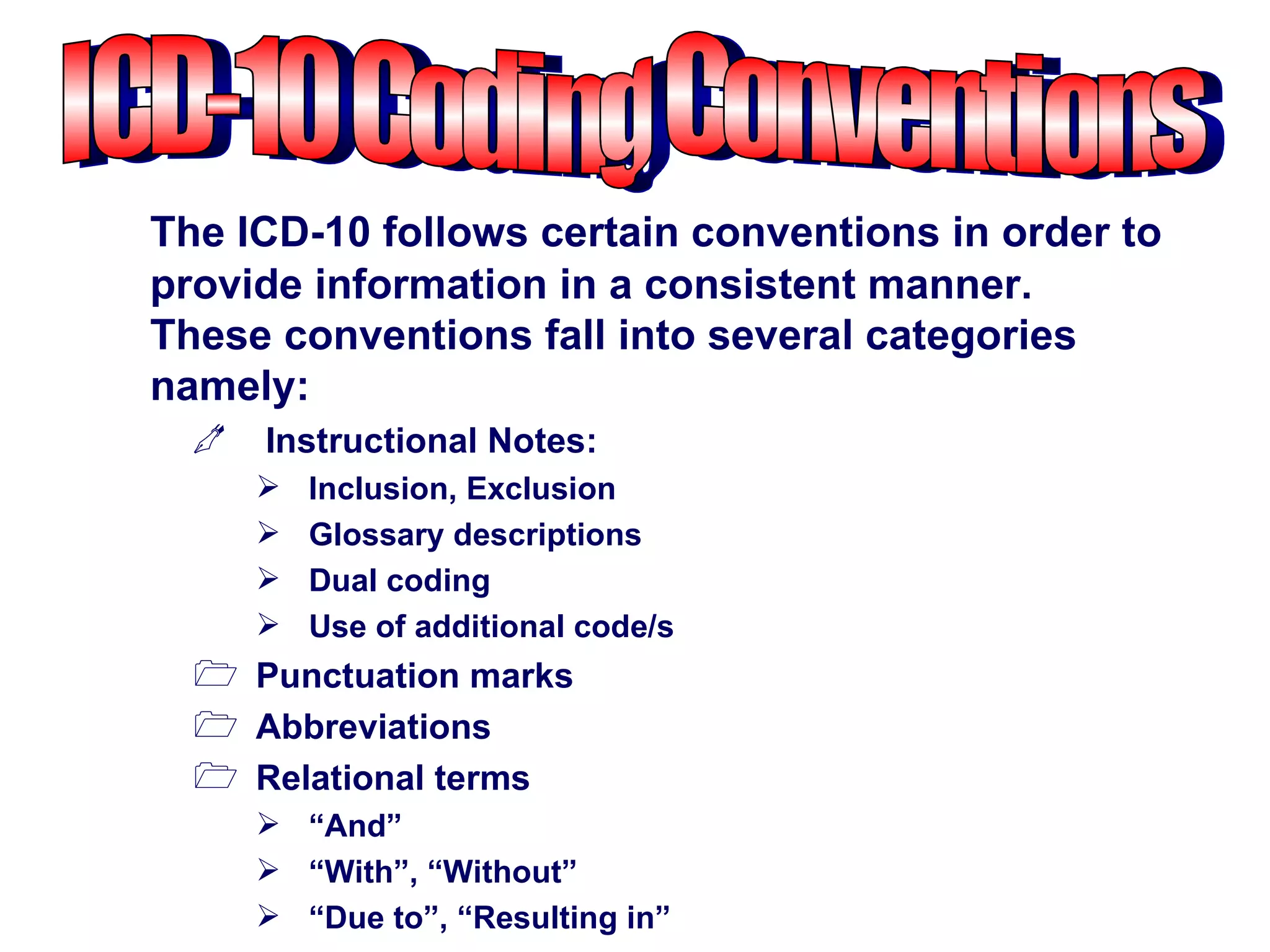
The ICD-10 follows certain conventions in order to
provide information in a consistent manner.
These conventions fall into several categories
namely:
     Instructional Notes:
         Inclusion, Exclusion
         Glossary descriptions
         Dual coding
         Use of additional code/s
   Punctuation marks
   Abbreviations
   Relational terms
       “And”
       “With”, “Without”
       “Due to”, “Resulting in”
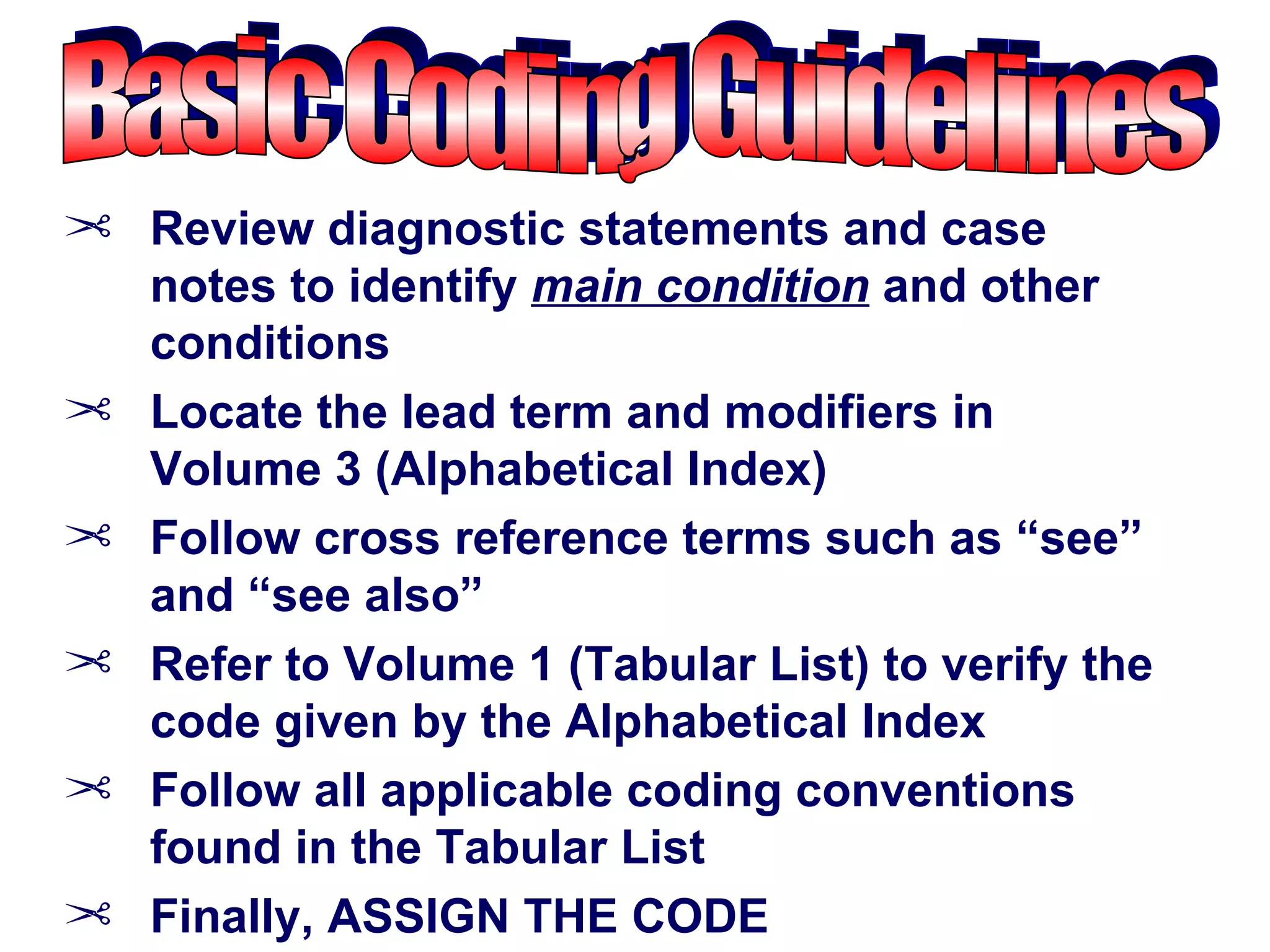
¢ Review diagnostic statements and case
  notes to identify main condition and other
  conditions
¢ Locate the lead term and modifiers in
  Volume 3 (Alphabetical Index)
¢ Follow cross reference terms such as “see”
  and “see also”
¢ Refer to Volume 1 (Tabular List) to verify the
  code given by the Alphabetical Index
¢ Follow all applicable coding conventions
  found in the Tabular List
¢ Finally, ASSIGN THE CODE
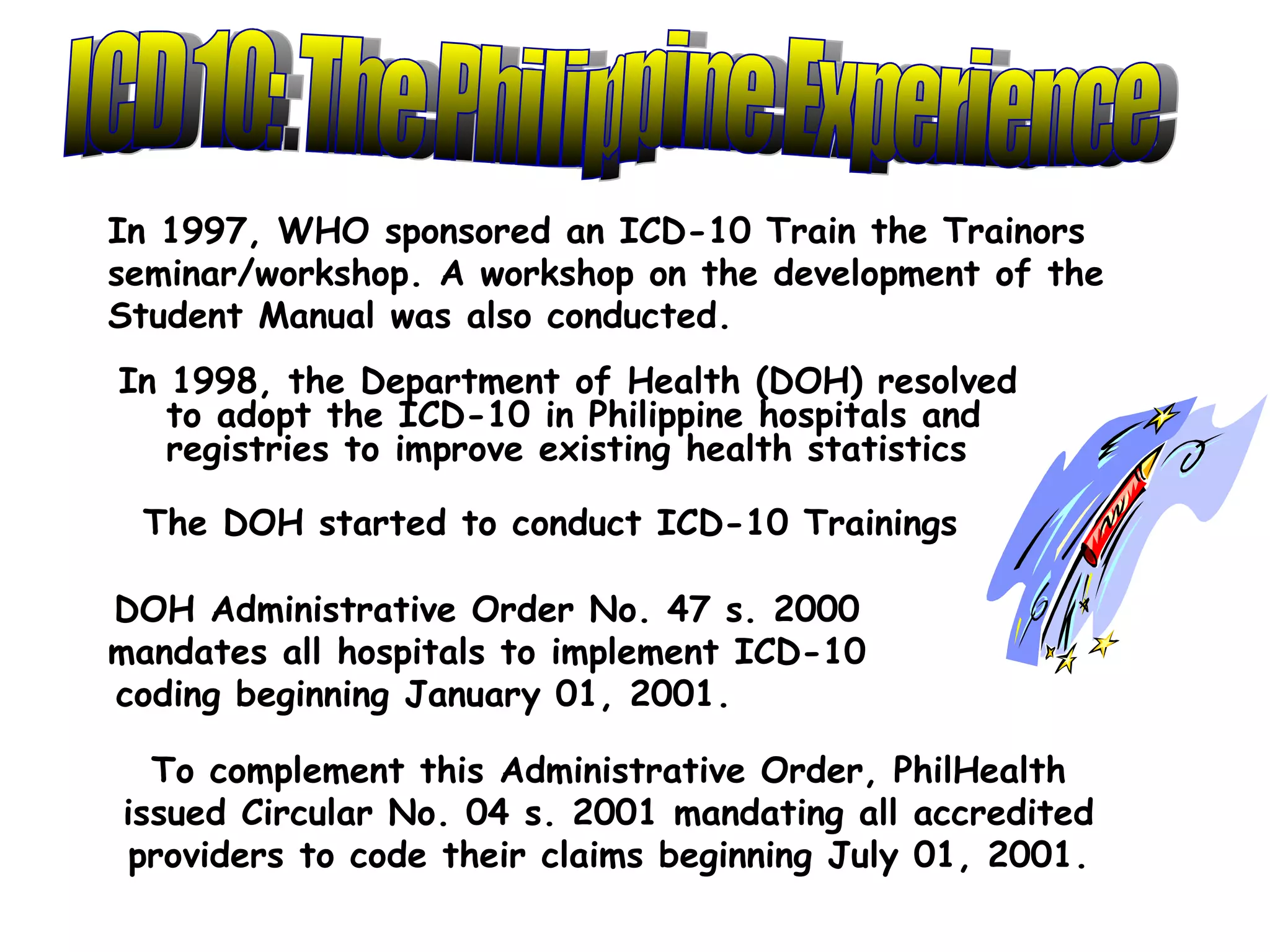
In 1997, WHO sponsored an ICD-10 Train the Trainors
seminar/workshop. A workshop on the development of the
Student Manual was also conducted.
In 1998, the Department of Health (DOH) resolved
   to adopt the ICD-10 in Philippine hospitals and
   registries to improve existing health statistics

 The DOH started to conduct ICD-10 Trainings

DOH Administrative Order No. 47 s. 2000
mandates all hospitals to implement ICD-10
coding beginning January 01, 2001.

  To complement this Administrative Order, PhilHealth
issued Circular No. 04 s. 2001 mandating all accredited
 providers to code their claims beginning July 01, 2001.
The National Epidemiology Center together with the
  Bureau of Health Facilities and Services, National
 Center for Health Facility Development of the DOH
     and PhilHealth, have been tasked to provide
  intensive training courses on ICD-10 Coding to all
                       concerned.

Two Training Modules were developed by the National
                  ICD-10 Program:
          • Non-Coders Training (3 days)
             • Coders Training (5 days)
ICD-10 Coding Guidelines were developed by the
    ICD-10 National Technical Working Group in
  consultation with the concerned Medical Specialty
                       Societies

Department Circular No. 33, s. 2004 was signed by
  then Health Secretary Manuel M. Dayrit for the
        dissemination of the said guidelines
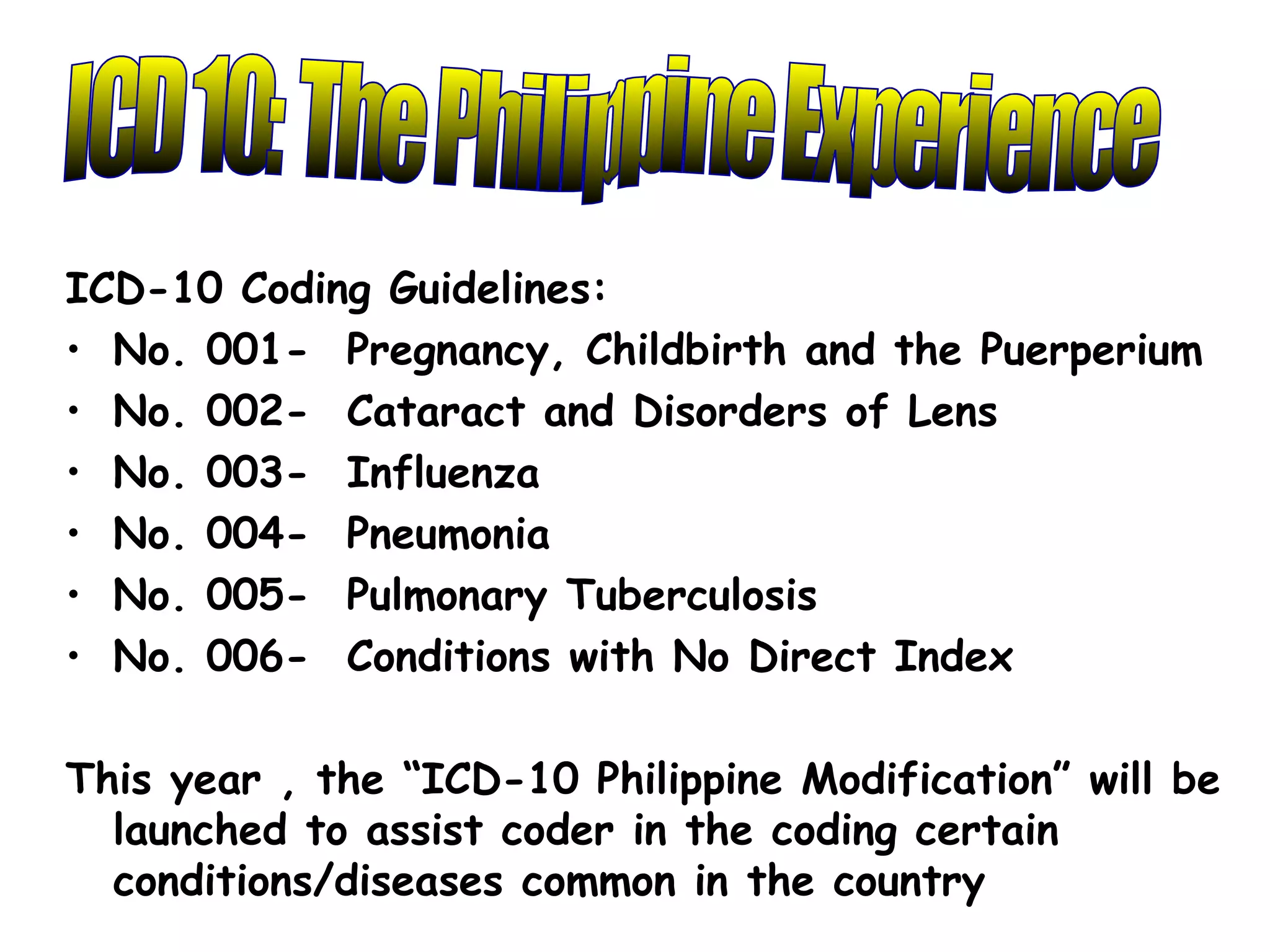
ICD-10 Coding Guidelines:
• No. 001- Pregnancy, Childbirth and the Puerperium
• No. 002- Cataract and Disorders of Lens
• No. 003- Influenza
• No. 004- Pneumonia
• No. 005- Pulmonary Tuberculosis
• No. 006- Conditions with No Direct Index

This year , the “ICD-10 Philippine Modification” will be
  launched to assist coder in the coding certain
  conditions/diseases common in the country
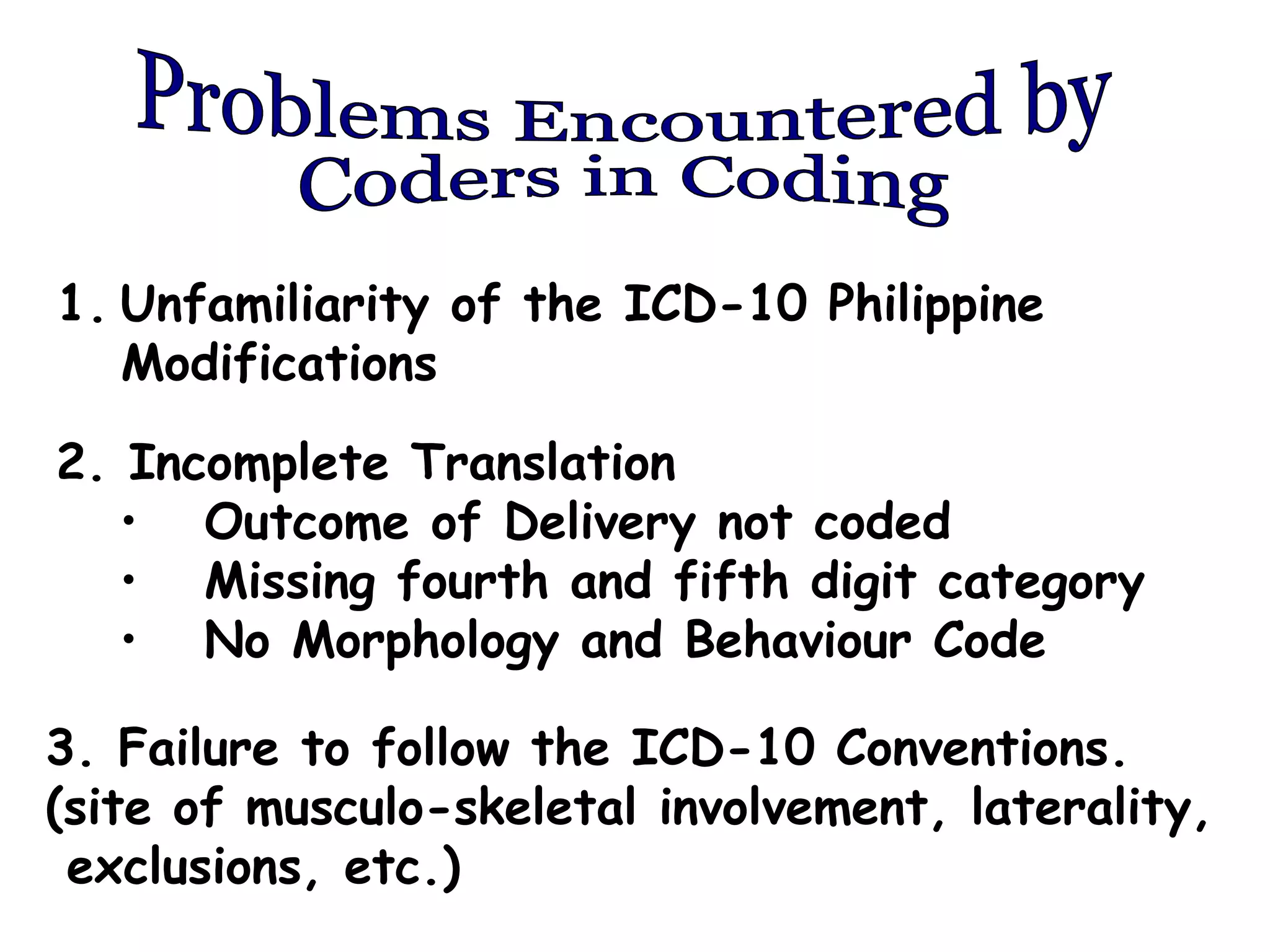
1. Unfamiliarity of the ICD-10 Philippine
   Modifications

2. Incomplete Translation
   • Outcome of Delivery not coded
   • Missing fourth and fifth digit category
   • No Morphology and Behaviour Code

3. Failure to follow the ICD-10 Conventions.
(site of musculo-skeletal involvement, laterality,
 exclusions, etc.)
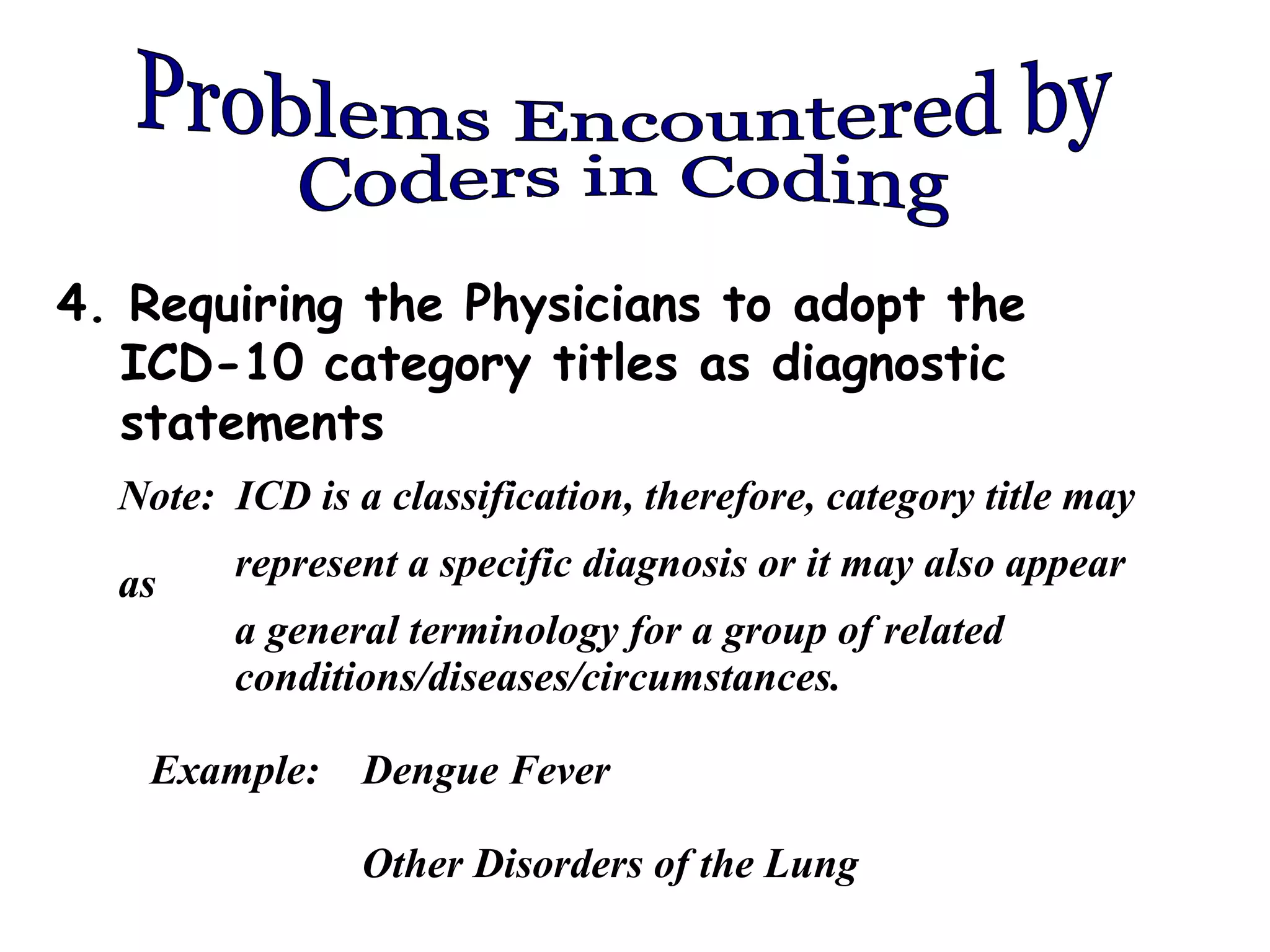
4. Requiring the Physicians to adopt the
   ICD-10 category titles as diagnostic
   statements
  Note: ICD is a classification, therefore, category title may

  as    represent a specific diagnosis or it may also appear
        a general terminology for a group of related
        conditions/diseases/circumstances.

   Example:     Dengue Fever

                Other Disorders of the Lung
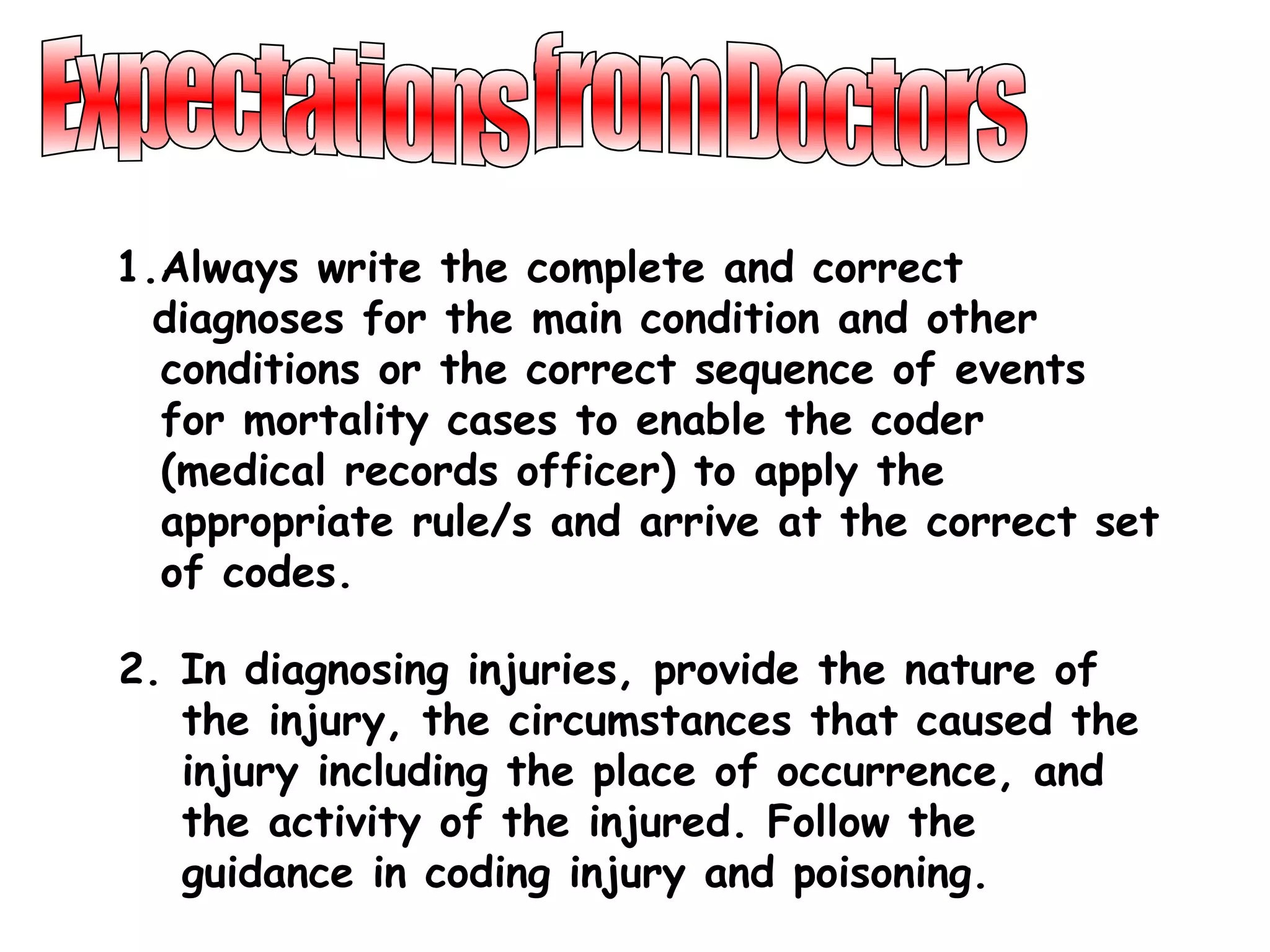
1.Always write the complete and correct
  diagnoses for the main condition and other
  conditions or the correct sequence of events
  for mortality cases to enable the coder
  (medical records officer) to apply the
  appropriate rule/s and arrive at the correct set
  of codes.

2. In diagnosing injuries, provide the nature of
   the injury, the circumstances that caused the
   injury including the place of occurrence, and
   the activity of the injured. Follow the
   guidance in coding injury and poisoning.
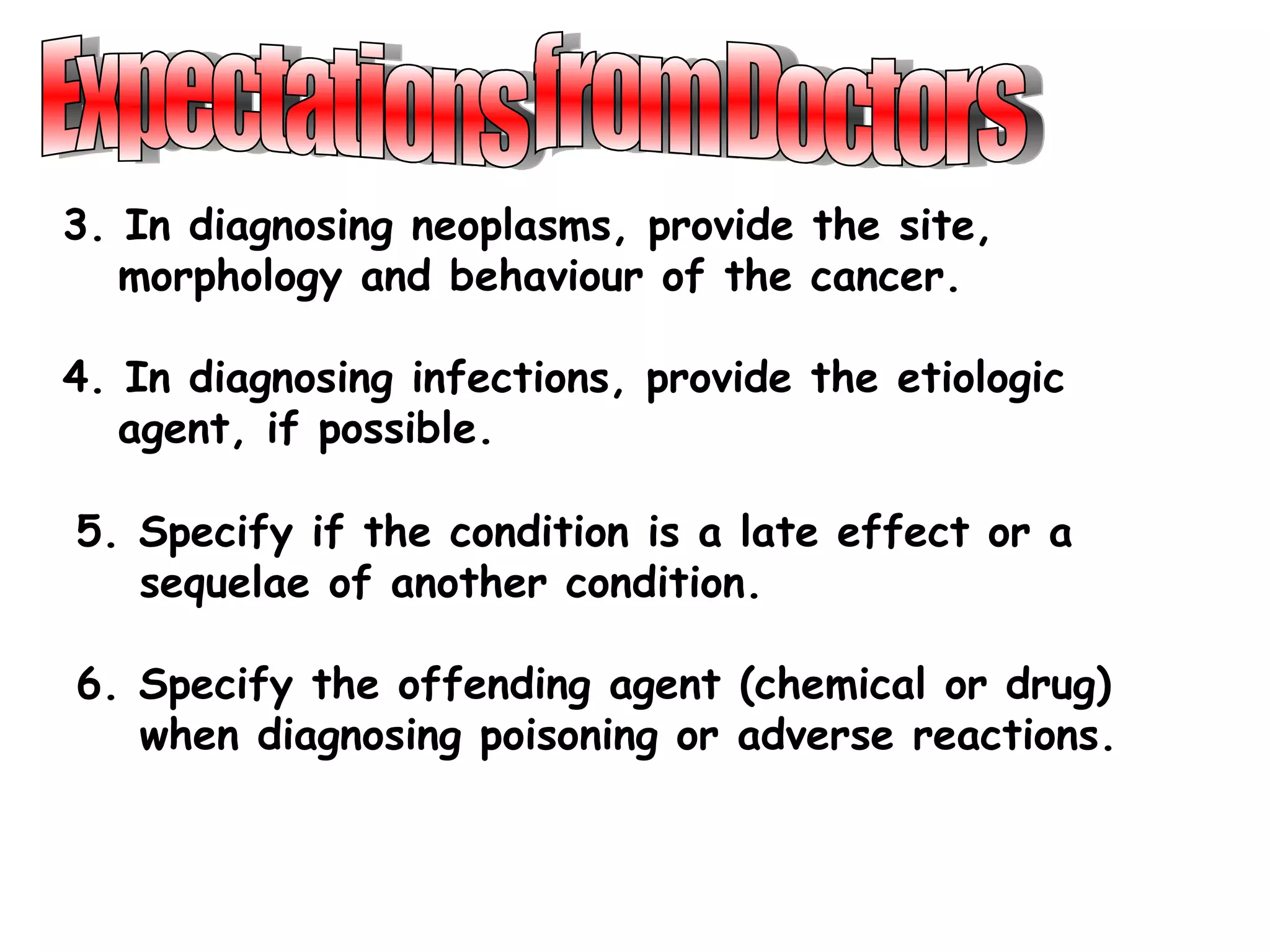
3. In diagnosing neoplasms, provide the site,
   morphology and behaviour of the cancer.

4. In diagnosing infections, provide the etiologic
   agent, if possible.

5. Specify if the condition is a late effect or a
   sequelae of another condition.

6. Specify the offending agent (chemical or drug)
   when diagnosing poisoning or adverse reactions.
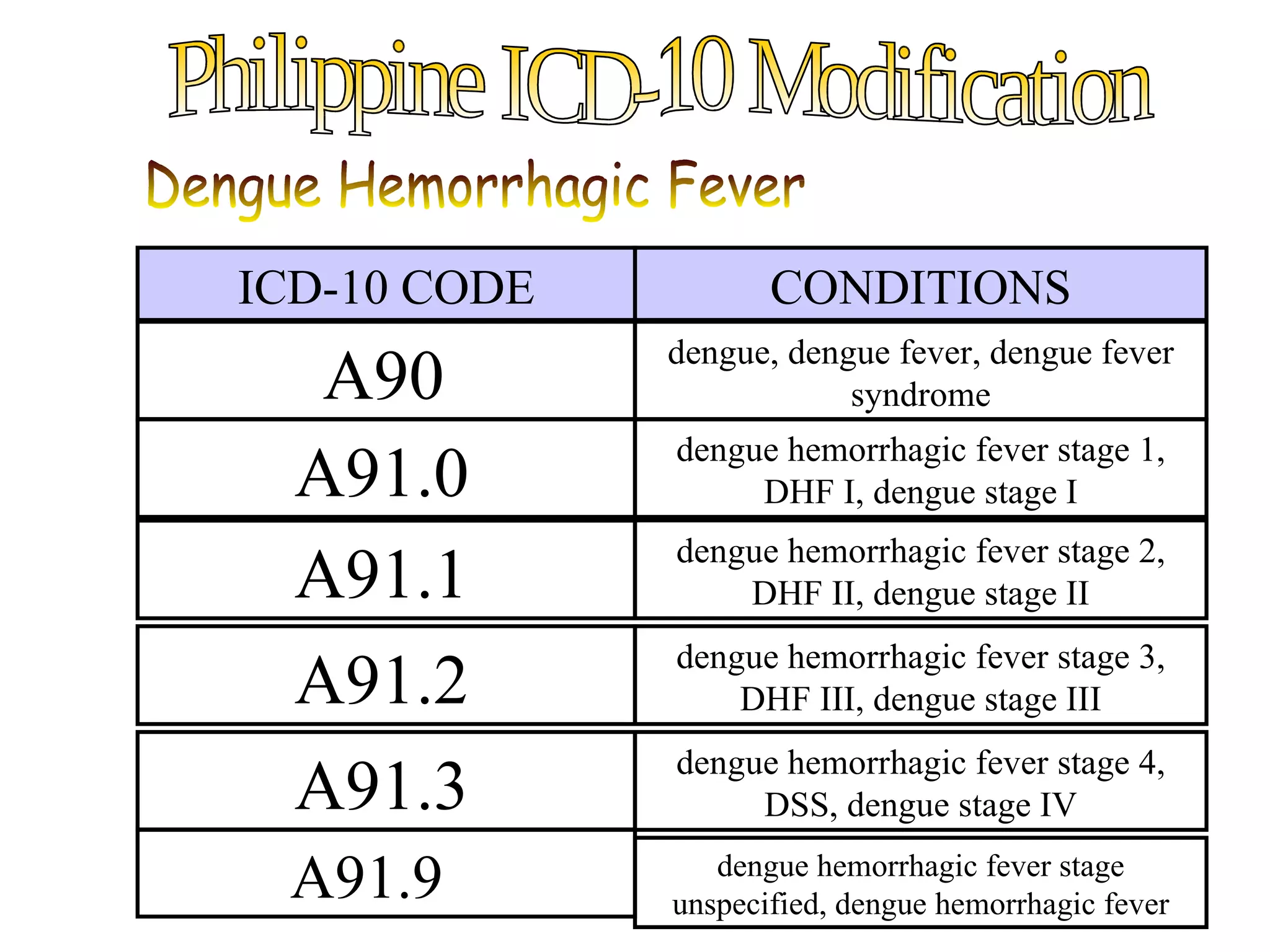
ICD-10 CODE          CONDITIONS
              dengue, dengue fever, dengue fever
   A90                    syndrome
              dengue hemorrhagic fever stage 1,
  A91.0            DHF I, dengue stage I
              dengue hemorrhagic fever stage 2,
  A91.1           DHF II, dengue stage II
              dengue hemorrhagic fever stage 3,
  A91.2           DHF III, dengue stage III
              dengue hemorrhagic fever stage 4,
  A91.3            DSS, dengue stage IV

 A91.9           dengue hemorrhagic fever stage
              unspecified, dengue hemorrhagic fever
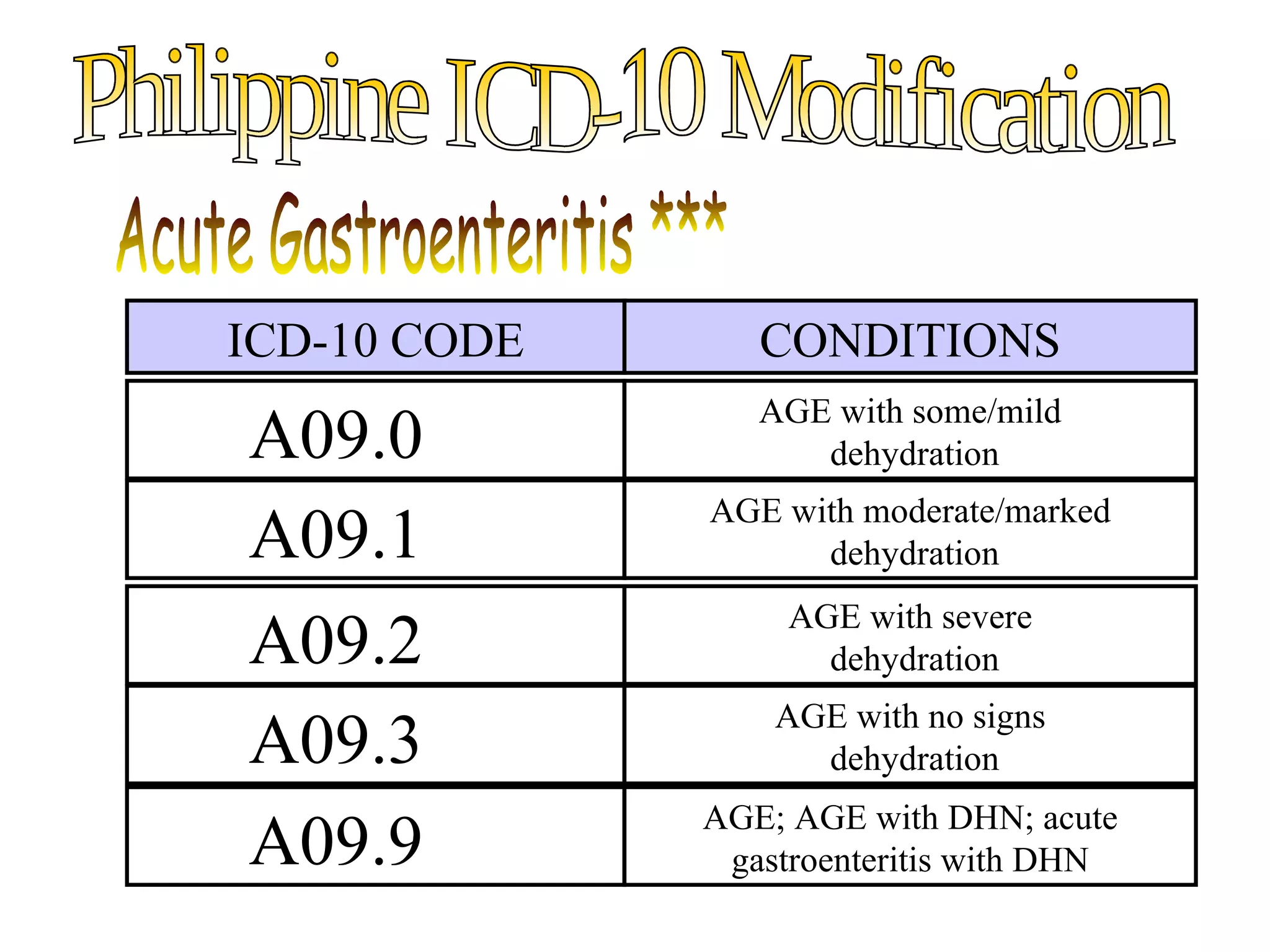
ICD-10 CODE      CONDITIONS
                 AGE with some/mild
A09.0               dehydration
              AGE with moderate/marked
A09.1               dehydration
                   AGE with severe
A09.2                dehydration
                  AGE with no signs
A09.3               dehydration
              AGE; AGE with DHN; acute
A09.9          gastroenteritis with DHN
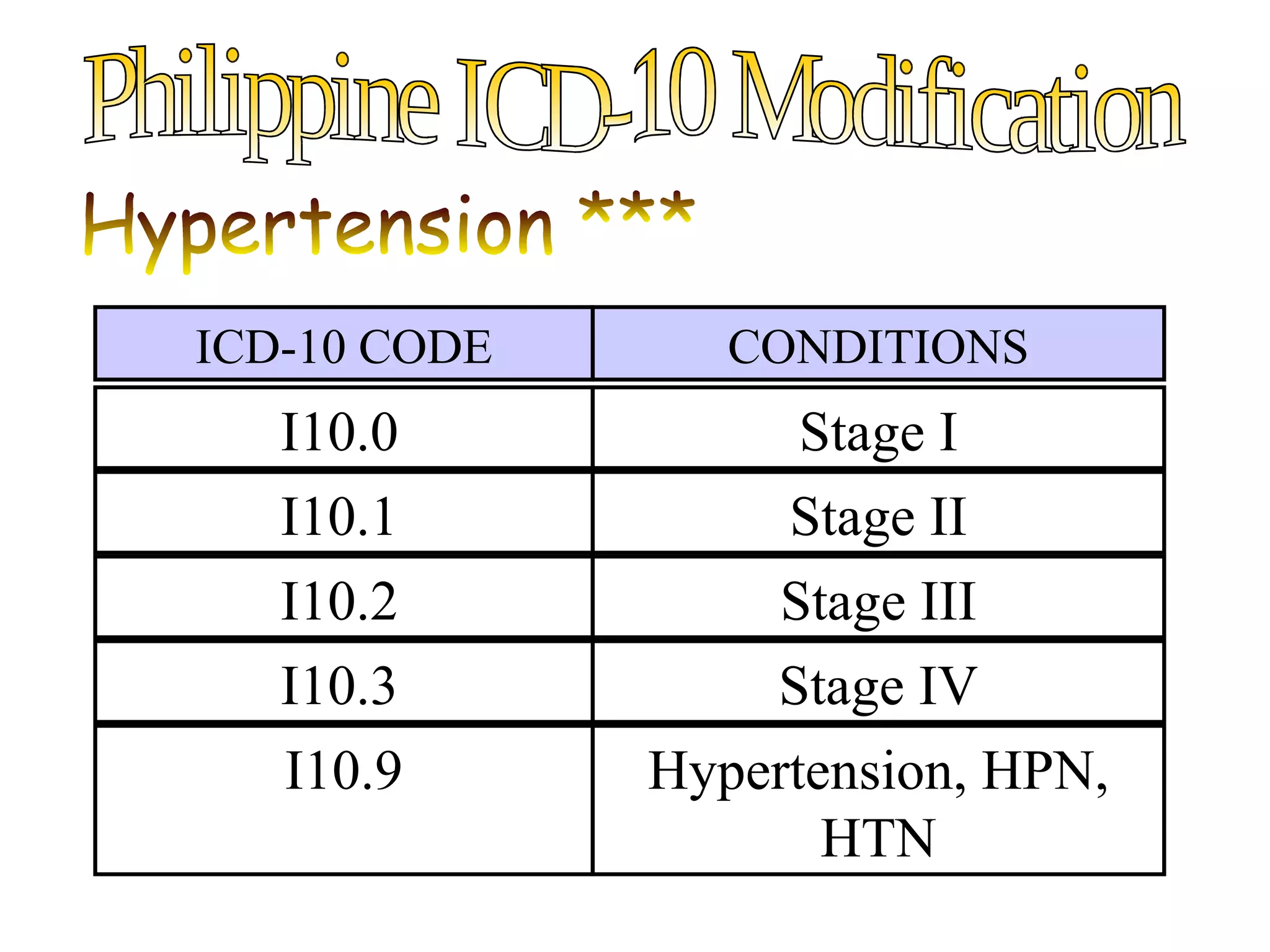
ICD-10 CODE      CONDITIONS
   I10.0            Stage I
   I10.1           Stage II
   I10.2           Stage III
   I10.3          Stage IV
   I10.9      Hypertension, HPN,
                     HTN
ICD-10 CODE           CONDITIONS
   Z20.1      Pulmonary Tuberculosis [PTB]
              Class 1,2
   A15.0      Pulmonary Tuberculosis [PTB]
              Class 3 by sputum confirmation

   A16.2      Pulmonary Tuberculosis [PTB]
              Pulmonary Tuberculosis [PTB]
              Class 2,3,5 by x-ray confirmation

   Z03.0      Pulmonary Tuberculosis [PTB]
              Class 5
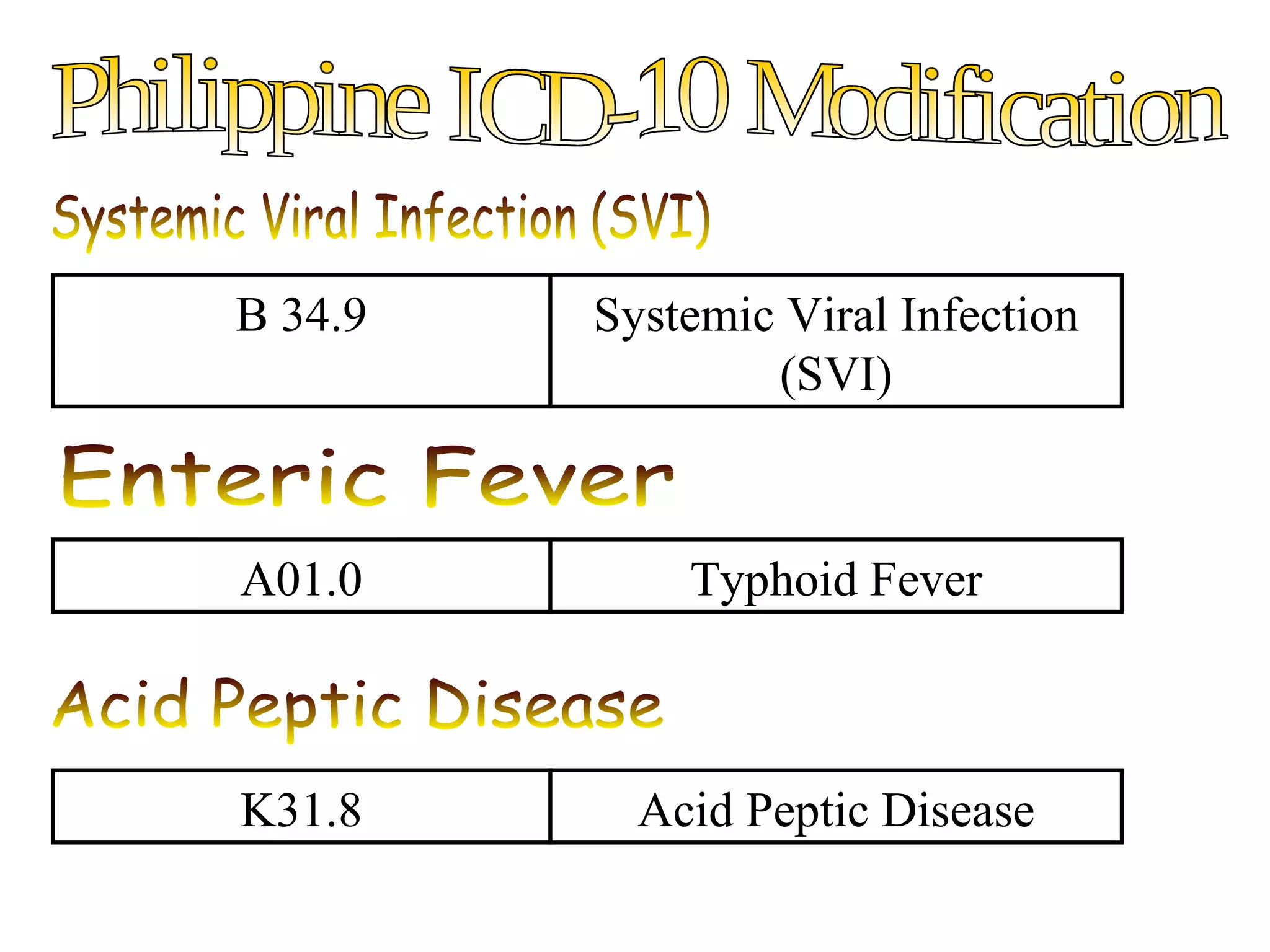
B 34.9   Systemic Viral Infection
                 (SVI)


A01.0        Typhoid Fever


K31.8      Acid Peptic Disease
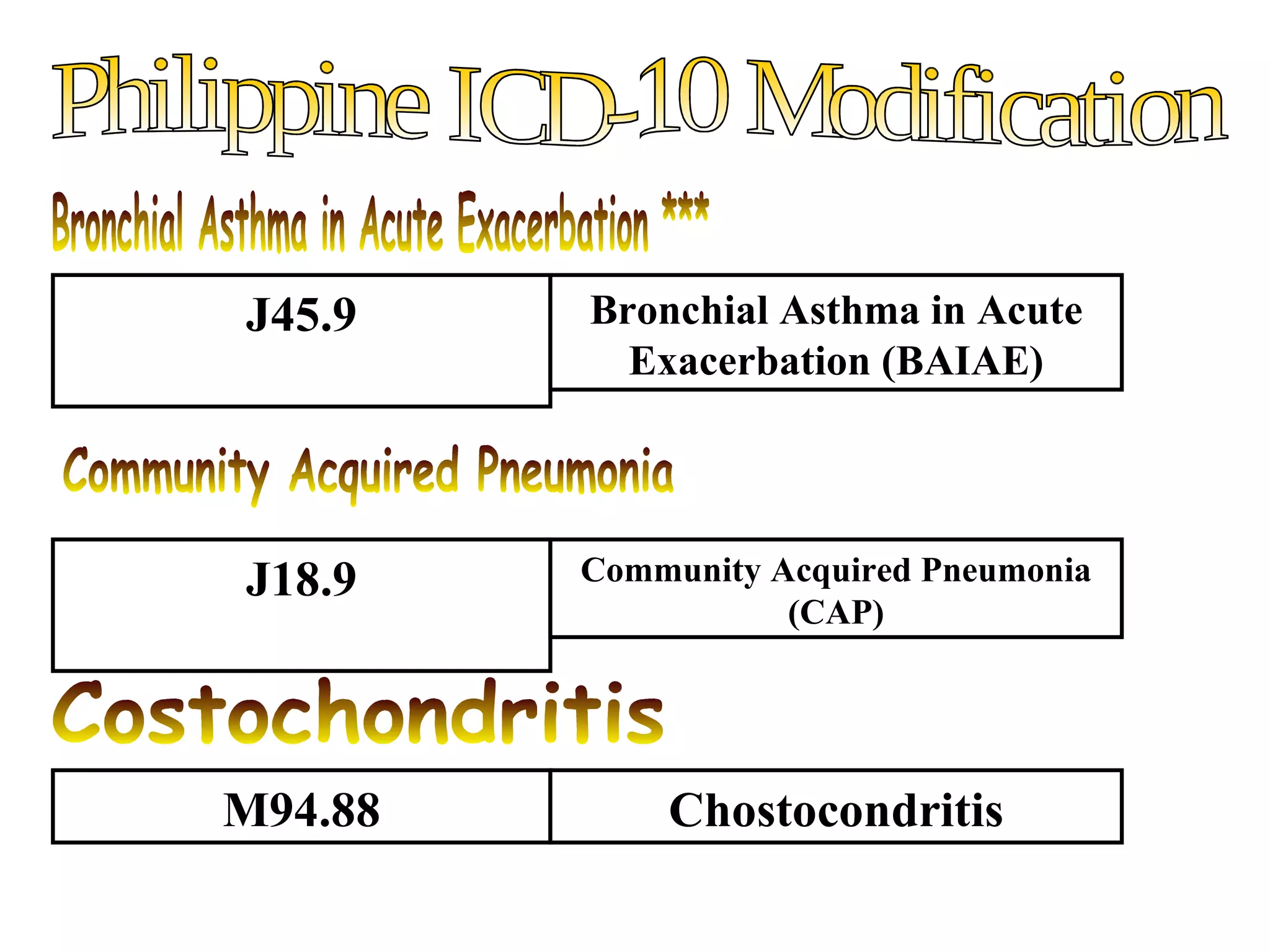
J45.9    Bronchial Asthma in Acute
           Exacerbation (BAIAE)


J18.9    Community Acquired Pneumonia
                    (CAP)


M94.88       Chostocondritis
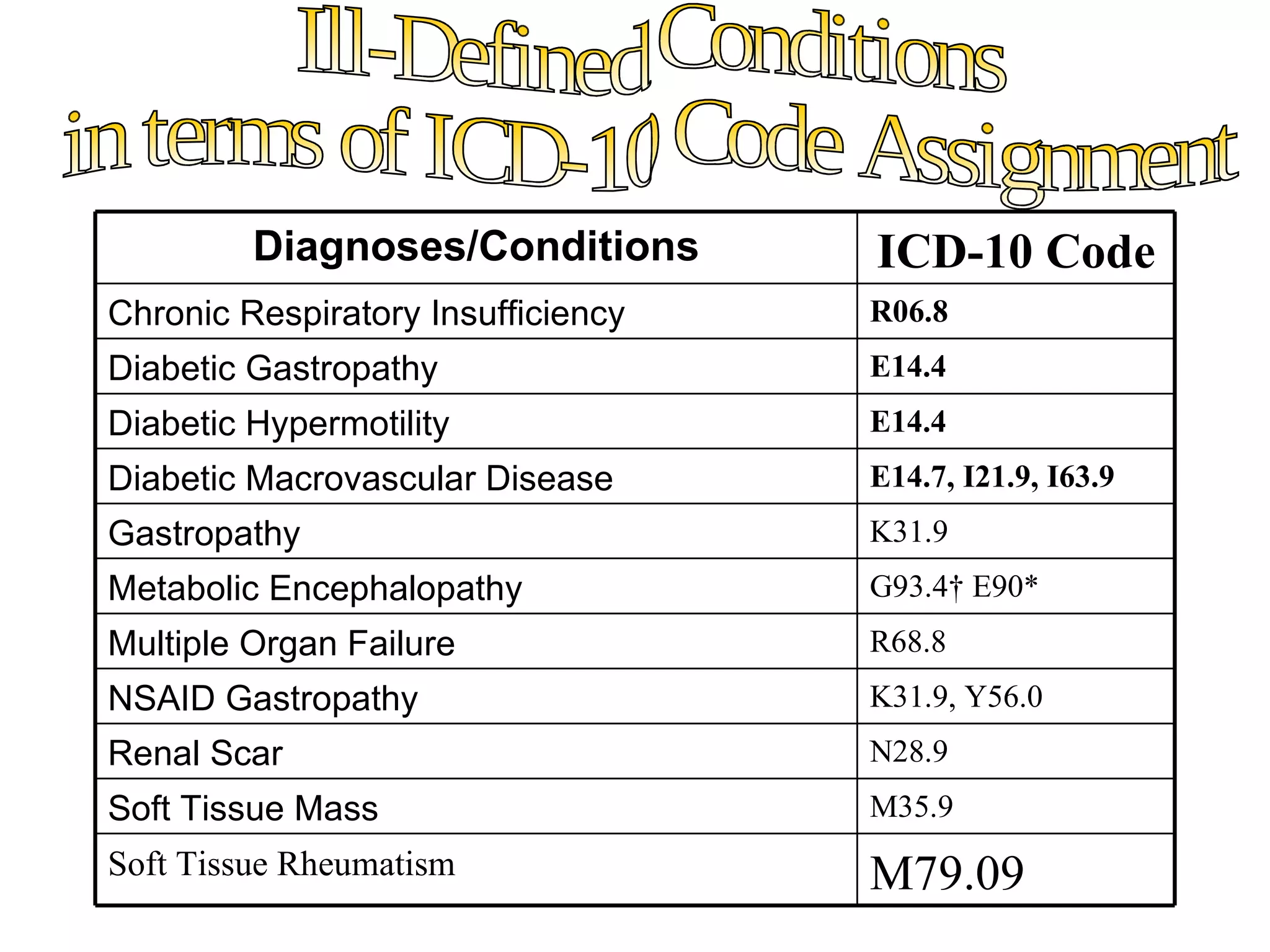
Diagnoses/Conditions       ICD-10 Code
Chronic Respiratory Insufficiency   R06.8
Diabetic Gastropathy                E14.4
Diabetic Hypermotility              E14.4
Diabetic Macrovascular Disease      E14.7, I21.9, I63.9
Gastropathy                         K31.9
Metabolic Encephalopathy            G93.4† E90*
Multiple Organ Failure              R68.8
NSAID Gastropathy                   K31.9, Y56.0
Renal Scar                          N28.9
Soft Tissue Mass                    M35.9
Soft Tissue Rheumatism              M79.09
Icd updt

Icd updt

  • 2.
    PRODUCED BY THEWORLD HEALTH ORGANIZATION The ICD has been evolving for more than 100 years as a SYSTEMATIC CODING SYSTEM.
  • 3.
    -it is the10th revision of the International Statistical Classification of Diseases and Related Health Problems commonly known as ICD - 10 -it is used in clinical coding
  • 4.
    -it is thetranslation of diseases, health related problems and procedural concepts from text to alphabetic/numeric codes for storage, retrieval and analysis
  • 5.
    -it is asystem of categories or groupings to which diseases, injuries, conditions and procedures are assigned according to established criteria ICD-10 is a statistical classification, which means that it contains limited number of mutually exclusive code categories describing all disease concepts.
  • 6.
    To allow easystorage, retrieval and analysis of data To allow comparison of data between hospitals, provinces, regions and countries
  • 7.
    Consistent use ofICD-10 codes allows comparative/accurate statistics – quality statistics to be produced... HOSP. A HOSP. B Region 2 CAR INDIA PHILIPPINES
  • 8.
    ICD-10 codes areused to generate statistics for Morbidity and Mortality.
  • 9.
    Epidemiology Medical Care Management HOW? • provides clues for causes of disease • evaluation of previous treatments • review of previous public health initiatives or programs • aid health services planning decisions
  • 10.
    There are three (3) Volumes Volume 1 (Tabular List) It is an alphanumeric listing of diseases and disease groups along with inclusion and exclusion notes and other coding conventions
  • 11.
    Volume 2 It provides: 1. an introduction and instructions on the use of Volumes 1 and 3 2. Guidelines in morbidity and mortality coding Volume 3 It is a comprehensive Alphabetical Index of diseases and conditions found in the Tabular List
  • 12.
    1. There are21 Chapters The number of categories assigned to a Chapter is influenced by the number of diseases and conditions that fall within the scope of the Chapter
  • 13.
    1. The structureof the ICD-10 code is alphanumeric: The first character of the code is an alpha character followed by 2 , 3 or 4 numeric characters Examples: A90 A00.0 M79.09
  • 14.
    The ICD-10 followscertain conventions in order to provide information in a consistent manner. These conventions fall into several categories namely: Instructional Notes:  Inclusion, Exclusion  Glossary descriptions  Dual coding  Use of additional code/s  Punctuation marks  Abbreviations  Relational terms  “And”  “With”, “Without”  “Due to”, “Resulting in”
  • 15.
    ¢ Review diagnosticstatements and case notes to identify main condition and other conditions ¢ Locate the lead term and modifiers in Volume 3 (Alphabetical Index) ¢ Follow cross reference terms such as “see” and “see also” ¢ Refer to Volume 1 (Tabular List) to verify the code given by the Alphabetical Index ¢ Follow all applicable coding conventions found in the Tabular List ¢ Finally, ASSIGN THE CODE
  • 17.
    In 1997, WHOsponsored an ICD-10 Train the Trainors seminar/workshop. A workshop on the development of the Student Manual was also conducted. In 1998, the Department of Health (DOH) resolved to adopt the ICD-10 in Philippine hospitals and registries to improve existing health statistics The DOH started to conduct ICD-10 Trainings DOH Administrative Order No. 47 s. 2000 mandates all hospitals to implement ICD-10 coding beginning January 01, 2001. To complement this Administrative Order, PhilHealth issued Circular No. 04 s. 2001 mandating all accredited providers to code their claims beginning July 01, 2001.
  • 18.
    The National EpidemiologyCenter together with the Bureau of Health Facilities and Services, National Center for Health Facility Development of the DOH and PhilHealth, have been tasked to provide intensive training courses on ICD-10 Coding to all concerned. Two Training Modules were developed by the National ICD-10 Program: • Non-Coders Training (3 days) • Coders Training (5 days)
  • 19.
    ICD-10 Coding Guidelineswere developed by the ICD-10 National Technical Working Group in consultation with the concerned Medical Specialty Societies Department Circular No. 33, s. 2004 was signed by then Health Secretary Manuel M. Dayrit for the dissemination of the said guidelines
  • 20.
    ICD-10 Coding Guidelines: •No. 001- Pregnancy, Childbirth and the Puerperium • No. 002- Cataract and Disorders of Lens • No. 003- Influenza • No. 004- Pneumonia • No. 005- Pulmonary Tuberculosis • No. 006- Conditions with No Direct Index This year , the “ICD-10 Philippine Modification” will be launched to assist coder in the coding certain conditions/diseases common in the country
  • 21.
    1. Unfamiliarity ofthe ICD-10 Philippine Modifications 2. Incomplete Translation • Outcome of Delivery not coded • Missing fourth and fifth digit category • No Morphology and Behaviour Code 3. Failure to follow the ICD-10 Conventions. (site of musculo-skeletal involvement, laterality, exclusions, etc.)
  • 22.
    4. Requiring thePhysicians to adopt the ICD-10 category titles as diagnostic statements Note: ICD is a classification, therefore, category title may as represent a specific diagnosis or it may also appear a general terminology for a group of related conditions/diseases/circumstances. Example: Dengue Fever Other Disorders of the Lung
  • 23.
    1.Always write thecomplete and correct diagnoses for the main condition and other conditions or the correct sequence of events for mortality cases to enable the coder (medical records officer) to apply the appropriate rule/s and arrive at the correct set of codes. 2. In diagnosing injuries, provide the nature of the injury, the circumstances that caused the injury including the place of occurrence, and the activity of the injured. Follow the guidance in coding injury and poisoning.
  • 24.
    3. In diagnosingneoplasms, provide the site, morphology and behaviour of the cancer. 4. In diagnosing infections, provide the etiologic agent, if possible. 5. Specify if the condition is a late effect or a sequelae of another condition. 6. Specify the offending agent (chemical or drug) when diagnosing poisoning or adverse reactions.
  • 25.
    ICD-10 CODE CONDITIONS dengue, dengue fever, dengue fever A90 syndrome dengue hemorrhagic fever stage 1, A91.0 DHF I, dengue stage I dengue hemorrhagic fever stage 2, A91.1 DHF II, dengue stage II dengue hemorrhagic fever stage 3, A91.2 DHF III, dengue stage III dengue hemorrhagic fever stage 4, A91.3 DSS, dengue stage IV A91.9 dengue hemorrhagic fever stage unspecified, dengue hemorrhagic fever
  • 26.
    ICD-10 CODE CONDITIONS AGE with some/mild A09.0 dehydration AGE with moderate/marked A09.1 dehydration AGE with severe A09.2 dehydration AGE with no signs A09.3 dehydration AGE; AGE with DHN; acute A09.9 gastroenteritis with DHN
  • 27.
    ICD-10 CODE CONDITIONS I10.0 Stage I I10.1 Stage II I10.2 Stage III I10.3 Stage IV I10.9 Hypertension, HPN, HTN
  • 28.
    ICD-10 CODE CONDITIONS Z20.1 Pulmonary Tuberculosis [PTB] Class 1,2 A15.0 Pulmonary Tuberculosis [PTB] Class 3 by sputum confirmation A16.2 Pulmonary Tuberculosis [PTB] Pulmonary Tuberculosis [PTB] Class 2,3,5 by x-ray confirmation Z03.0 Pulmonary Tuberculosis [PTB] Class 5
  • 29.
    B 34.9 Systemic Viral Infection (SVI) A01.0 Typhoid Fever K31.8 Acid Peptic Disease
  • 30.
    J45.9 Bronchial Asthma in Acute Exacerbation (BAIAE) J18.9 Community Acquired Pneumonia (CAP) M94.88 Chostocondritis
  • 31.
    Diagnoses/Conditions ICD-10 Code Chronic Respiratory Insufficiency R06.8 Diabetic Gastropathy E14.4 Diabetic Hypermotility E14.4 Diabetic Macrovascular Disease E14.7, I21.9, I63.9 Gastropathy K31.9 Metabolic Encephalopathy G93.4† E90* Multiple Organ Failure R68.8 NSAID Gastropathy K31.9, Y56.0 Renal Scar N28.9 Soft Tissue Mass M35.9 Soft Tissue Rheumatism M79.09