Budget, Budgeting and Budgetary Control
Learning Objectives:
A budget outlines the financial and quantitative ramifications of management's decisions for the
upcoming term.
The budget serves as a framework for management to assess the organization's performance and
determine if targets were met. It is a highly effective control technique. After learning the lesson,
one should be able to—
1. Learn about the budgeting process, its benefits, the advantages of budgetary control, and its
limitations.
2. Create various budget kinds, including cash and flexible budgets.
3. A comparison of budgeted and actual expenses.
4. Learn about zero-based budgeting, including its benefits and limitations.
5. Learn about the Budget Manual, Budget Period, and Budget Period.
A budget establishes a target in terms of money or quantities against which actual performance is
evaluated.
Kohler's "A Dictionary for Accountants" describes a budget as
1 a financial plan that estimates and controls future activities.
2. As a result, any expense forecast for the future.
3. Any systematic plan for allocating people, material, or other resources.
The Chartered Institute of Management Accountants in London (terminology) defines a budget
as
"A financial plan. Prior to the budget period, it is developed and authorized and may include
income, expenses, and capital allocations. It is possible to create incremental budgets based on
previous or actual figures, or use zero-based budgeting.
A budget outlines the financial and quantitative implications of management's decision-making for
the next year.
Thus, the important features of a budget are as follows:
(i) A monetary or physical declaration created to implement management-formulated policies.
(ii) It is established prior to the budget period during which it is implemented.
(iii) It is intended for a specific future period.
BUDGET
(iv) Prior to preparing the budget, the policy to be followed in order to achieve the stated goal must
be established.
Budgeting encompasses the entire process of creating, adopting, and operating budgets.
This focuses on short-term budgeting, which involves allocating resources to support
current plans.
Budgets are inextricably linked to fiscal discipline. The Chartered Institute of Management
Accountants defines budgetary control as "the establishment of budgets, relating executive
responsibilities to the requirements of a policy, and the continuous comparison of actual and
budgeted results to secure the objectives of that policy or to provide a firm basis for its revision." A
budgetary control system ensures cost and performance management across an organization.
(i) Create budgets
(ii) Compare actual results to budgets
(iii) Implement corrective measures or revise budgets as needed.
A budget outlines a quantitative plan of action for a specific time period. Budgets provide a solid
framework for implementing plans and monitoring adherence, resulting in a complete system of
control. Budgeting is the planning process, whereas budgetary control is the execution of that plan.
Budgetary control involves comparing actual results to budgets and implementing timely corrective
action.
A control system involves setting targets, collecting information, comparing actuals to targets, and
reporting for action. In this way, a financial control system functions similarly to a control system.
This method effectively decentralizes authority while maintaining solid control over operations.
Budgets and budgetary control should not be viewed as inflexible or restrictive. This system instills
dynamism in an organization by setting targets for progress, allowing executives to act freely, and
ensuring a colLabourative effort to achieve the firm's objectives. There is always room for initiative
and desire, but not for recklessness or excessive caution.
De Paula used an analogy to explain fiscal control, comparing it to navigating a ship across the sea.
The captain can acquire significant lessons from studying the factors that led to previous
misfortunes by keeping a journal of the ship's movements and position hourly. To successfully
navigate a ship across the oceans, the captain relies on his navigating officer to plot the course
ahead and regularly compare the ship's position to the predetermined one. If the ship deviates
from its intended path, the navigating officer must notify the captain immediately so that
appropriate action can be taken to rectify the course.
BUDGETING
BUDGETARY CONTROL
The auditor is responsible for validating the accuracy of prior records to provide a true and fair
assessment of a company's financial status, similar to an industrial ship's log. Modern management
involves detailed estimates of corporate operations for the future year. Management expects quick
updates on any significant deviations from the scheduled course of operations, together with an
explanation of the reasons for the differences.
Budgetary control involves determining what has to be done and how, and ensuring that actual
results do not deviate from the plan beyond what is necessary. The word "necessary" should not be
interpreted loosely. Divergence owing to inefficiency is unnecessary.
Rowland and William in their book entitled Budgeting for Management Control has given the
difference between budget, budgeting and budgetary control as follows:
Budgets are particular departmental objectives, while budgeting is the process of creating budgets.
Budgetary control encompasses budget preparation and implementation as a management tool
for business operations.
Thus, a budget is a financial plan, and budgetary control stems from the implementation of the
financial plan.
A forecast is an evaluation of possible future events. A budget is the financial and operational
strategy for a business. During the planning stage, it's important to forecast potential future
business actions. A budget is a target set by management based on forecasted results. Forecasts
are created for sales, production costs, and financial necessities. A forecast allows for some
flexibility, whereas a budget sets a specific aim.
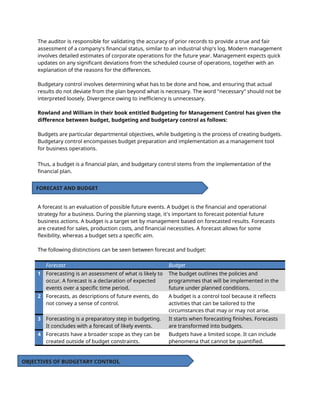
The following distinctions can be seen between forecast and budget:
Forecast Budget
1 Forecasting is an assessment of what is likely to
occur. A forecast is a declaration of expected
events over a specific time period.
The budget outlines the policies and
programmes that will be implemented in the
future under planned conditions.
2 Forecasts, as descriptions of future events, do
not convey a sense of control.
A budget is a control tool because it reflects
activities that can be tailored to the
circumstances that may or may not arise.
3 Forecasting is a preparatory step in budgeting.
It concludes with a forecast of likely events.
It starts when forecasting finishes. Forecasts
are transformed into budgets.
4 Forecasts have a broader scope as they can be
created outside of budget constraints.
Budgets have a limited scope. It can include
phenomena that cannot be quantified.
FORECAST AND BUDGET
OBJECTIVES OF BUDGETARY CONTROL
The objectives of financial control are as follows:
 Collaborate across management levels to meet the firm's objectives.
 To enable centralized control via delegated authority and responsibility.
 Maximize profitability by effectively managing income and expenses.
 Ensure appropriate working capital in other resources for the proper functioning of the
business.
 To keep losses and waste to a minimum.
 To clearly identify where work is required to improve the situation.
 Ensure the firm remains focused on its long-term goals and avoid being distracted by
unexpected events.
 Budgetary control facilitates coordination of activities such as manufacturing, sales, and
material purchases.
Budgetary control is crucial for navigating uncharted waters and achieving a specific goal. It
improves management by facilitating planning, coordination, and control.
The main advantages of a financial control system are listed below:
 Budgetary control seeks to maximise profits by effective revenue and spending planning
and control, moving capital and resources to the most profitable channel.
 The business has a planned approach to expenditure and financing, ensuring efficient use
of cash for maximum profit.
 It offers a clear statement of the concern's aim and policies, as well as a method for
protesting. These policies will be subjected to frequent evaluation.
 Budgetary control makes it easier to coordinate managerial activities.
 Because each level of management is aware of the work and completely aware of the best
approach to complete it, the most efficient use of men, materials, and resources can be
achieved.
 Reports are prepared using the ideas of management or control by exception. Only
departures from budgets that highlight inefficiencies are investigated thoroughly.
 It encourages management to anticipate difficulties and make informed decisions.
 A budgetary control system facilitates delegation of authority and is an effective instrument
for responsibility accounting.
 Budgets are the forerunners of standard costs in that they create the required conditions
for the establishment of standard costs.
 Evaluating performance versus budgets can help develop a results-based reward structure
and identify individuals with superior leadership and management skills.
 Because it entails anticipating many forms of challenges, it will result in their eradication in
a timely manner.
ADVANTAGES OF BUDGETARY CONTROL
LIMITATIONS OF BUDGETARY CONTROL
 Budgetary control begins with the creation of budgets, which are only estimates. The
effectiveness of a budgetary control system is heavily influenced by the accuracy of its
estimates.
 Budgets are designed to address ever-changing company conditions. The rigidity of budget
estimates limits their utility in changing conditions. It is vital to keep the financial control
system sufficiently flexible.
 Budgetary control relies on quantitative data and is ineffective without sufficient personal
administration support.
 Budgetary control systems can be costly for small businesses due to their top-heavy
structure.
 Budgets and budgetary management can lead to a negative perception of being the
exclusive solution to corporate challenges. The lack of human effort in addressing these
issues has led to a failure of the budgetary control system.
 It is a natural reaction of humans to dislike all forms of control. Employees detest budgetary
controls that limit administrative discretion.
The restrictions mentioned above highlight the importance of maintaining a realistic and dynamic
budgetary control system, rather than relying on routines.
Certain prerequisites must be met before a budgetary control system can be successfully
implemented. They are summarized as follows:
 An organization chart should clearly define the roles and responsibilities of each executive
level, including delegation of authority.
 Define corporate objectives, plans, and policies clearly and unambiguously.
 Identify the essential budget factor(s) that will serve as the foundation for budget planning.
 A Budget Committee should be established to facilitate the plan's creation and execution.
 An effective accounting system is necessary to record and present data that aligns with the
budget control system.
 Effective communication and reporting across management levels is essential.
 A Budget Manual should include detailed information about the plan, operation
procedures, and budget timeframe.
 Budgets should be prepared largely by people in charge of performance.
 Budgets should be full, complete, consistent, and attainable.
 Top management executives should provide assurances of cooperation and acceptance of
the budgetary control system.
 A successful financial control system requires well-organized budget preparation,
maintenance, and administration processes. The budgetary control organization is led by a
top executive, known as the Budget Controller, Budget Director, or Budget Officer. The
Budget Committee includes representatives from departments such as purchases, sales,
production, development, administration, and accounts.
PRELIMINARIES FOR THE ADOPTION OF A SYSTEM OF BUDGETARY CONTROL
If everyone in charge does not agree on the concept of budgeting and control, the system may not
function effectively. Effective budgeting requires full colLabouration from all parties involved. Only
then will they feel dedicated to achieving the goals set for them.
To create effective budgets and execute a budgetary management system, follow these steps
carefully.
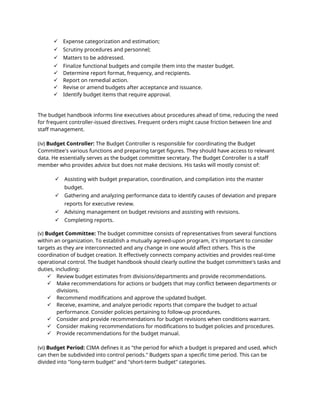
(i) Organizational Chart: An organizational chart outlines the functional representatives of
executives accountable for achieving organizational objectives. This chart displays:
 Functional responsibilities of a certain executive.
 Delegation of authority at different levels.
 A functional head's relative position in comparison to the heads of other functions. An
organization chart for financial control could look like this:
(ii) Budget Center: A budget center is a component of an organization dedicated to controlling
budgets. Establish a budget center for cost control, and align all budgets with it. Budget centers will
identify areas of the organization where anticipated performance is not met. Each budget center
requires a separate budget, which must be established with the department head's assistance. To
prepare a budget, confer with the production manager and the finance manager.
(iii) Budget Manual: A budget manual is a booklet that outlines procedures, forms, and records for
preparing and using budgets. It includes standing instructions and time schedules. The following
are some major issues addressed in the budget manual:
 Submission deadlines for preliminary forecasts and plans;
 Submission form and recipients;
 Key factors to consider for each forecast or plan;
INSTALLATION OF BUDGETARY CONTROL SYSTEM
 Expense categorization and estimation;
 Scrutiny procedures and personnel;
 Matters to be addressed.
 Finalize functional budgets and compile them into the master budget.
 Determine report format, frequency, and recipients.
 Report on remedial action.
 Revise or amend budgets after acceptance and issuance.
 Identify budget items that require approval.
The budget handbook informs line executives about procedures ahead of time, reducing the need
for frequent controller-issued directives. Frequent orders might cause friction between line and
staff management.

(iv) Budget Controller: The Budget Controller is responsible for coordinating the Budget
Committee's various functions and preparing target figures. They should have access to relevant
data. He essentially serves as the budget committee secretary. The Budget Controller is a staff
member who provides advice but does not make decisions. His tasks will mostly consist of:
 Assisting with budget preparation, coordination, and compilation into the master
budget.
 Gathering and analyzing performance data to identify causes of deviation and prepare
reports for executive review.
 Advising management on budget revisions and assisting with revisions.
 Completing reports.
(v) Budget Committee: The budget committee consists of representatives from several functions
within an organization. To establish a mutually agreed-upon program, it's important to consider
targets as they are interconnected and any change in one would affect others. This is the
coordination of budget creation. It effectively connects company activities and provides real-time
operational control. The budget handbook should clearly outline the budget committee's tasks and
duties, including:
 Review budget estimates from divisions/departments and provide recommendations.
 Make recommendations for actions or budgets that may conflict between departments or
divisions.
 Recommend modifications and approve the updated budget.
 Receive, examine, and analyze periodic reports that compare the budget to actual
performance. Consider policies pertaining to follow-up procedures.
 Consider and provide recommendations for budget revisions when conditions warrant.
 Consider making recommendations for modifications to budget policies and procedures.
 Provide recommendations for the budget manual.
(vi) Budget Period: CIMA defines it as "the period for which a budget is prepared and used, which
can then be subdivided into control periods." Budgets span a specific time period. This can be
divided into "long-term budget" and "short-term budget" categories.
The short-term budget can be divided into annual and quarterly budgets. Long-term budgets
provide perspective by allowing one to see what is likely to be achieved and what the major issues
are likely to be, such as competition from new products. Short-term budgets, such as those for a
year, are very precise, as are those for a quarter. These are particularly useful for control purposes.
A short-term budget does not need to be for a single year. It often covers a single season or
business year.
To determine the length of the budget period, the following elements should be considered:
 The budget period should be lengthy enough to cover the entire manufacturing cycle
for each product.
 Seasonal businesses should have a budget that covers at least one whole season.
 The budget term should be long enough to cover manufacturing costs ahead of time.
 Plan major operational and production modifications ahead of time to estimate
financial requirements.
 Align the budget and financial accounting periods to compare actual results to
planned estimates.
A budget period must be separated from a "control period". The letter specifies how frequently
reports are provided to different levels of management. It does not have to be the same as the
budgetary period. Reports are typically issued at shorter intervals to allow for timely remedial
action within the budget. This minimizes the variance between budget and actual results. Report
frequency varies based on the urgency and significance of the subject matter.
(vii) Budget Key Factor: According to CIMA London, a budget key factor is one that limits an
undertaking's actions and is considered while generating budgets. The limiting constraint for an
initiative may be a lack of productive resources such as skilled Labour, raw materials, or machine
capacity, in addition to the degree of demand for its products or services. Assessing the impact of
this element on functional budgets is necessary to assure their reasonable capability for fulfillment.
As previously stated, all organizational functions are interconnected. One's target influences the
other's. Producing 100,000 items is ineffective if the sales department can only sell 50,000. If the
production department has a capacity of 50,000 units, a sales potential of 1,000,000 units is not
significant. The budget committee would decide on how to overcome a restricting factor.
Overcoming one limitation may lead to the emergence of another. Thus, limiting variables may vary
depending on conditions. To achieve optimal production, decisions must be made while
considering various constraints. The fundamental issue is an inquiry into the future. Calculate all
probability under all scenarios to determine the optimal goal level. This may involve long
mathematical calculations.
The following is a list of the main budget issues that may affect the targets: (a) Customer demand,
(b) Plant capacity, (c) Raw material, skilled Labour, and capital availability, (d) Accommodation for
plant, raw materials, and finished goods, and (e) Government prohibitions.
If a limiting element cannot be overcome, the entire budget must be constructed around it. If
manufacturing capacity is limited to 50,000 units and cannot be extended in the short term, all
budgeting, including sales and raw material purchases, must be based on that number. To
maximize profitability, it's important to overcome or minimize any negative factors.
(viii) Budget Reports: Evaluating performance and reporting deviations is crucial for effective
control systems. To be effective, budgets must be periodically compared to actual expenditure and
reported to management. Budget reports comparing actual and budgeted expenditures should be
issued on a regular and timely basis. Reports should clearly identify a department's or executive's
responsibilities and provide reasons for variations, allowing for appropriate remedial action.
Reporting should be based on exceptions, highlighting both positive and negative variations and
providing commentary. A budget report compares actuals against budgets for the current month
as well as the previous months. Budget variances are analyzed for each spending item to identify
culpability and take corrective action.
To serve its job effectively, a budget report must be:
 Keep it simple and easy to understand for the recipient. Use a good title and specify the
relevant period.
 Presented regularly and promptly.
 Designed to provide essential information without unnecessary details.
 Expressed in direct figures whenever possible.
 Correlated to a "money value" wherever possible.
 Free from personal bias.
 Dated and signed by those preparing and checking.
Every budget report should be followed up until the intended results are obtained. To prevent
future deviations, either discuss the issue with the person in charge or revise the budget based on
errors or policy changes.
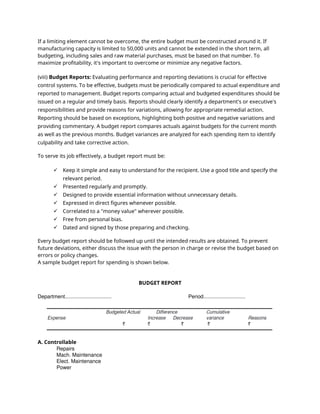
A sample budget report for spending is shown below.
BUDGET REPORT
Department................................ Period.............................
A. Controllable
Repairs
Mach. Maintenance
Elect. Maintenance
Power
Lighting
Lubrication etc.
B. Non-controllable Expense
Floorspace
General
Prorated
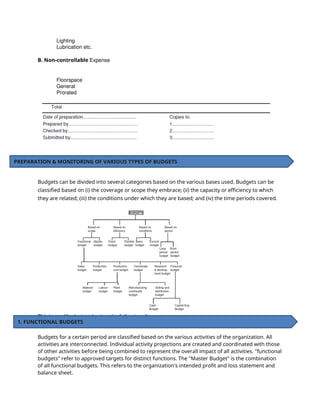
Budgets can be divided into several categories based on the various bases used. Budgets can be
classified based on (i) the coverage or scope they embrace; (ii) the capacity or efficiency to which
they are related; (iii) the conditions under which they are based; and (iv) the time periods covered.
This is readily depicted using the following diagram:
Budgets for a certain period are classified based on the various activities of the organization. All
activities are interconnected. Individual activity projections are created and coordinated with those
of other activities before being combined to represent the overall impact of all activities. "functional
budgets" refer to approved targets for distinct functions. The "Master Budget" is the combination
of all functional budgets. This refers to the organization's intended profit and loss statement and
balance sheet.
PREPARATION & MONITORING OF VARIOUS TYPES OF BUDGETS
1. FUNCTIONAL BUDGETS
The main functional budgets are:
(1.1) Sales Budget: A sales budget is a prediction of total sales stated in terms of money and
volume. To prepare a sales budget, start by precisely forecasting expected sales for the
budget period. Sales projections are influenced by both internal and external influences.
External variables include general business conditions, government policies, and so on.
Internal influences include sales prices, trends, new items, etc. The sales budget relies on
forecasting, which is the duty of the sales manager and market research team. The sales
budget is considered the cornerstone of budgeting.
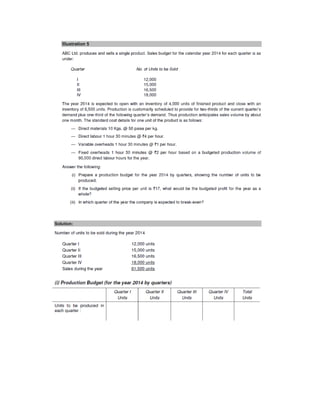
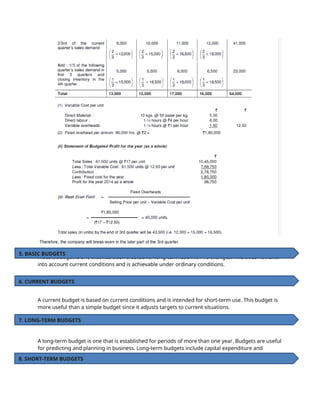
(1.2) Production Budget: The production budget forecasts production during the budget
period. The budget is divided into two parts: production value for product units and cost of
manufacturing. Preparing a production budget involves planning production, considering
capacity, integrating with sales estimates, inventory policies, and management policies.
Using a production budget has several benefits, including maximizing productive
resources, producing goods on time, adhering to delivery dates, and properly scheduling
production components.
(1.3) Production Cost Budget: It may be further classified as under:
(1.3.1) Materials Budget: The materials budget helps the purchasing department plan purchases
and determine maximum and minimum levels of materials and components. The materials budget
helps determine the necessary funds and schedule for purchases.
(1.3.2) Labour Budget: Each production item's Labour content is established by the required
worker grades and trades, as well as Labour time for each job, operation, and process. The Labour
cost for each budget center is computed by multiplying the wage rate with the Labour hours for the
number of items allocated, taking into account each category's pay rates, allowances, and bonuses.
(1.3.3) Plant Utilization Budget: This budget is created to estimate the plant's ability to meet the
production target within the allocated time frame. It is a projection of the plant capacities that can
be used to meet the production budget's requirements. This budget is stated in easy units, such as
working hours.
The characteristics of the Plant Utilization Budget are as follows:
1. It will serve as the foundation for the production department's and sale department's machine
requirements.
2. It will give the machine the foundation for a fair depreciation, allowing for future replacement.
3. In the context of plants and technology, it might serve as the foundation for new inventions.
4. The budgeted machine load on departments or machines will be displayed.
5. It shows that certain departments are overworked, thus offering after-sales support and running
an ad campaign with lower prices might boost sales volume.
(1.4) Overhead Budget: It may be further classified as under:
(1.4.1) Manufacturing Overhead Budget: To create the manufacturing overhead budget, the
following actions must be performed:
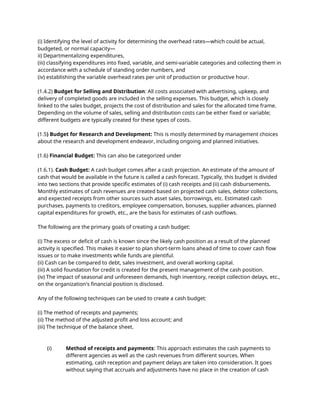
(i) Identifying the level of activity for determining the overhead rates—which could be actual,
budgeted, or normal capacity—
ii) Departmentalizing expenditures,
(iii) classifying expenditures into fixed, variable, and semi-variable categories and collecting them in
accordance with a schedule of standing order numbers, and
(iv) establishing the variable overhead rates per unit of production or productive hour.
(1.4.2) Budget for Selling and Distribution: All costs associated with advertising, upkeep, and
delivery of completed goods are included in the selling expenses. This budget, which is closely
linked to the sales budget, projects the cost of distribution and sales for the allocated time frame.
Depending on the volume of sales, selling and distribution costs can be either fixed or variable;
different budgets are typically created for these types of costs.
(1.5) Budget for Research and Development: This is mostly determined by management choices
about the research and development endeavor, including ongoing and planned initiatives.
(1.6) Financial Budget: This can also be categorized under
(1.6.1). Cash Budget: A cash budget comes after a cash projection. An estimate of the amount of
cash that would be available in the future is called a cash forecast. Typically, this budget is divided
into two sections that provide specific estimates of (i) cash receipts and (ii) cash disbursements.
Monthly estimates of cash revenues are created based on projected cash sales, debtor collections,
and expected receipts from other sources such asset sales, borrowings, etc. Estimated cash
purchases, payments to creditors, employee compensation, bonuses, supplier advances, planned
capital expenditures for growth, etc., are the basis for estimates of cash outflows.
The following are the primary goals of creating a cash budget:
(i) The excess or deficit of cash is known since the likely cash position as a result of the planned
activity is specified. This makes it easier to plan short-term loans ahead of time to cover cash flow
issues or to make investments while funds are plentiful.
(ii) Cash can be compared to debt, sales investment, and overall working capital.
(iii) A solid foundation for credit is created for the present management of the cash position.
(iv) The impact of seasonal and unforeseen demands, high inventory, receipt collection delays, etc.,
on the organization's financial position is disclosed.
Any of the following techniques can be used to create a cash budget:
(i) The method of receipts and payments;
(ii) The method of the adjusted profit and loss account; and
(iii) The technique of the balance sheet.
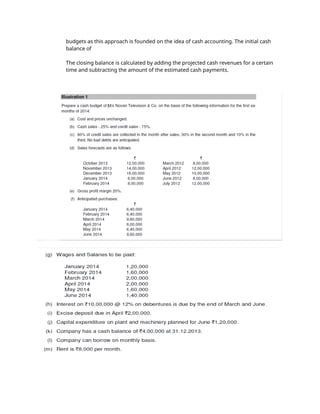
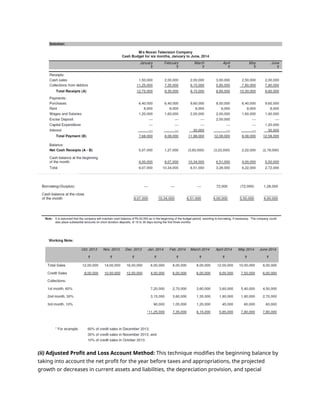
(i) Method of receipts and payments: This approach estimates the cash payments to
different agencies as well as the cash revenues from different sources. When
estimating, cash reception and payment delays are taken into consideration. It goes
without saying that accruals and adjustments have no place in the creation of cash
budgets as this approach is founded on the idea of cash accounting. The initial cash
balance of
The closing balance is calculated by adding the projected cash revenues for a certain
time and subtracting the amount of the estimated cash payments.
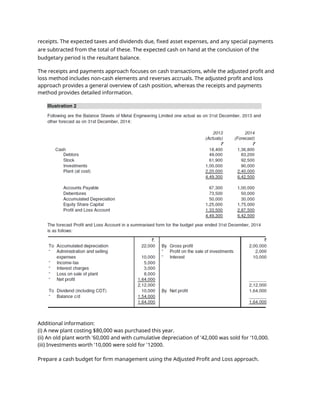
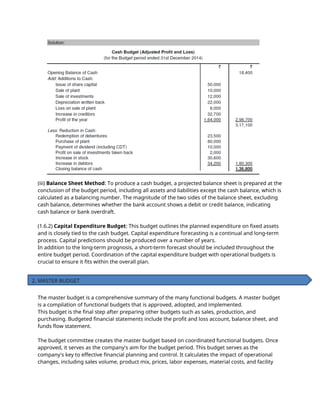
(ii) Adjusted Profit and Loss Account Method: This technique modifies the beginning balance by
taking into account the net profit for the year before taxes and appropriations, the projected
growth or decreases in current assets and liabilities, the depreciation provision, and special
receipts. The expected taxes and dividends due, fixed asset expenses, and any special payments
are subtracted from the total of these. The expected cash on hand at the conclusion of the
budgetary period is the resultant balance.
The receipts and payments approach focuses on cash transactions, while the adjusted profit and
loss method includes non-cash elements and reverses accruals. The adjusted profit and loss
approach provides a general overview of cash position, whereas the receipts and payments
method provides detailed information.
Additional information:
(i) A new plant costing $80,000 was purchased this year.
(ii) An old plant worth '60,000 and with cumulative depreciation of '42,000 was sold for '10,000.
(iii) Investments worth '10,000 were sold for '12000.
Prepare a cash budget for firm management using the Adjusted Profit and Loss approach.
(iii) Balance Sheet Method: To produce a cash budget, a projected balance sheet is prepared at the
conclusion of the budget period, including all assets and liabilities except the cash balance, which is
calculated as a balancing number. The magnitude of the two sides of the balance sheet, excluding
cash balance, determines whether the bank account shows a debit or credit balance, indicating
cash balance or bank overdraft.
(1.6.2) Capital Expenditure Budget: This budget outlines the planned expenditure on fixed assets
and is closely tied to the cash budget. Capital expenditure forecasting is a continual and long-term
process. Capital predictions should be produced over a number of years.
In addition to the long-term prognosis, a short-term forecast should be included throughout the
entire budget period. Coordination of the capital expenditure budget with operational budgets is
crucial to ensure it fits within the overall plan.
The master budget is a comprehensive summary of the many functional budgets. A master budget
is a compilation of functional budgets that is approved, adopted, and implemented.
This budget is the final step after preparing other budgets such as sales, production, and
purchasing. Budgeted financial statements include the profit and loss account, balance sheet, and
funds flow statement.
The budget committee creates the master budget based on coordinated functional budgets. Once
approved, it serves as the company's aim for the budget period. This budget serves as the
company's key to effective financial planning and control. It calculates the impact of operational
changes, including sales volume, product mix, prices, labor expenses, material costs, and facility
2. MASTER BUDGET
changes. It divides income, costs, and profits into areas of responsibility. The master budget
provides detailed information for high management decision-making.
The master budget categorizes and summarizes costs by spending type and department.
This information broadens the scope of master budget's usefulness. This is the most effective way
to understand the company's microeconomic status for the upcoming budget term. Master Budget
is more than just a collection of theoretical computations. The data in this report represent the
company's goals for the upcoming budget term.
A budget can be designed as either a fixed or flexible budget. A set budget remains constant
regardless of actual activity levels. A fixed budget is set for a specified output level and does not
fluctuate based on actual expenditures. Obviously, fixed budgets are only effective for short
periods of time when the actual output is expected to be close to the planned amount. Fixed
budgets can be revised if company conditions change or actual operations differ significantly from
projected ones. Budgets are useful for fixed spending, but are not helpful for cost control.
The Chartered Institute of Management Accountants in London describes a flexible budget as one
that adapts to changing expense patterns and production volume. A budget provides expense
estimates for all levels of activity. A budget that considers fixed, semi-fixed, and variable costs
adjusts based on activities. It is intended to provide budgeted costs for every level of activity
accomplished. Flexible budgeting is ideal in the following situations:
(i) Seasonal or demand-driven fluctuations in activity throughout the year.
(ii) Where the firm is new and it is difficult to predict demand.
(iii) When there is a lack of a manufacturing factor, such as materials, labor, or plant capacity.
A flexible budget allocates expenditure based on output levels. The flexible budget can be used to
adjust expenditure based on changes in volume and compare it to actual spending for control
purposes. It enables a clear comparison of budget allowances to actual costs. When creating a
flexible budget, actual costs are compared against budgeted costs for the same activity. To create a
flexible budget, individual cost components must be analyzed to understand how they respond to
volume changes. As a result, detailed cost analysis and expense identification are required for the
creation of a flexible budget.
The following are the defining characteristics of flexible budgets:
(i) They are prepared for a variety of activities rather than just one level.
(ii) They give a dynamic basis for comparison as they automatically adjust to volume changes.
(iii) They offer a customized budget for a specific volume.
(iv) These are based on a thorough understanding of cost behavior patterns.
3. FIXED BUDGETS
4. FLEXIBLE BUDGETS
Flexible budgets can be prepared in the following manner:
(i) Tabular or multi-activity technique.
(ii) Formula or ratio method;
(iii) Graphic method.
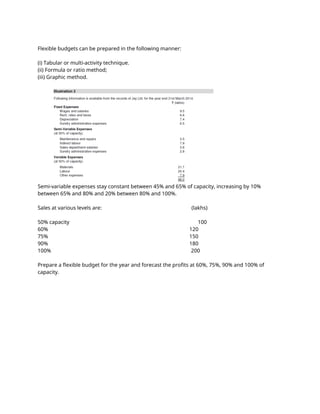
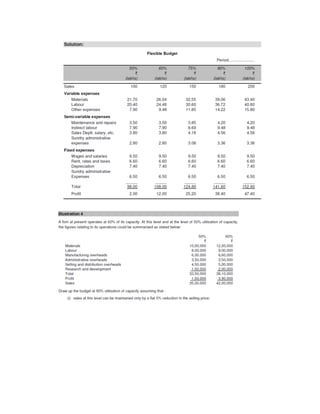
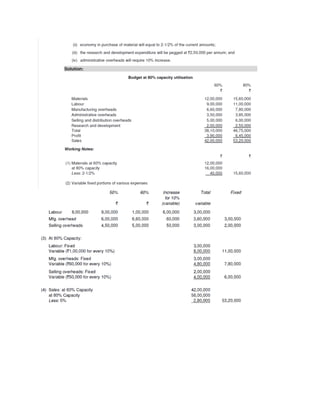
Semi-variable expenses stay constant between 45% and 65% of capacity, increasing by 10%
between 65% and 80% and 20% between 80% and 100%.
Sales at various levels are: (lakhs)
50% capacity 100
60% 120
75% 150
90% 180
100% 200
Prepare a flexible budget for the year and forecast the profits at 60%, 75%, 90% and 100% of
capacity.
A basic budget is one that has been created for long-term use with no changes. This does not take
into account current conditions and is achievable under ordinary conditions.
A current budget is based on current conditions and is intended for short-term use. This budget is
more useful than a simple budget since it adjusts targets to current situations.
A long-term budget is one that is established for periods of more than one year. Budgets are useful
for predicting and planning in business. Long-term budgets include capital expenditure and
research & development budgets.
5. BASIC BUDGETS
6. CURRENT BUDGETS
7. LONG-TERM BUDGETS
8. SHORT-TERM BUDGETS
This budget is for a period of less than a year and serves as a control tool for lower management
levels. Ideally, a short-term budget should align with a long-term budget.
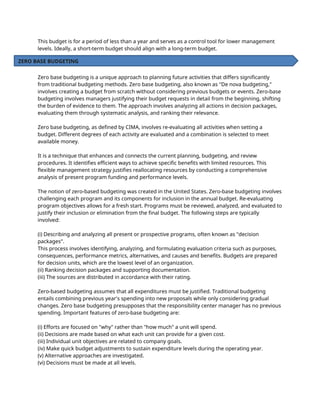
Zero base budgeting is a unique approach to planning future activities that differs significantly
from traditional budgeting methods. Zero base budgeting, also known as "De nova budgeting,"
involves creating a budget from scratch without considering previous budgets or events. Zero-base
budgeting involves managers justifying their budget requests in detail from the beginning, shifting
the burden of evidence to them. The approach involves analyzing all actions in decision packages,
evaluating them through systematic analysis, and ranking their relevance.
Zero base budgeting, as defined by CIMA, involves re-evaluating all activities when setting a
budget. Different degrees of each activity are evaluated and a combination is selected to meet
available money.
It is a technique that enhances and connects the current planning, budgeting, and review
procedures. It identifies efficient ways to achieve specific benefits with limited resources. This
flexible management strategy justifies reallocating resources by conducting a comprehensive
analysis of present program funding and performance levels.
The notion of zero-based budgeting was created in the United States. Zero-base budgeting involves
challenging each program and its components for inclusion in the annual budget. Re-evaluating
program objectives allows for a fresh start. Programs must be reviewed, analyzed, and evaluated to
justify their inclusion or elimination from the final budget. The following steps are typically
involved:
(i) Describing and analyzing all present or prospective programs, often known as "decision
packages".
This process involves identifying, analyzing, and formulating evaluation criteria such as purposes,
consequences, performance metrics, alternatives, and causes and benefits. Budgets are prepared
for decision units, which are the lowest level of an organization.
(ii) Ranking decision packages and supporting documentation.
(iii) The sources are distributed in accordance with their rating.
Zero-based budgeting assumes that all expenditures must be justified. Traditional budgeting
entails combining previous year's spending into new proposals while only considering gradual
changes. Zero base budgeting presupposes that the responsibility center manager has no previous
spending. Important features of zero-base budgeting are:
(i) Efforts are focused on "why" rather than "how much" a unit will spend.
(ii) Decisions are made based on what each unit can provide for a given cost.
(iii) Individual unit objectives are related to company goals.
(iv) Make quick budget adjustments to sustain expenditure levels during the operating year.
(v) Alternative approaches are investigated.
(vi) Decisions must be made at all levels.
ZERO BASE BUDGETING
Difference between Traditional Budgeting and Zero Base Budgeting:
(i) Traditional budgeting is accounting-focused. The main attention is on the previous level of
expenditure. Zero base budgeting takes a decision-oriented approach.
(ii) Traditional budgeting prioritizes historical spending levels before considering inflation and
future programs. Zero base budgeting divides decision units into ranked packages, allowing senior
management to prioritize the most important decisions above others.
(iii) In traditional budgeting, some managers intentionally overestimate their budget requests to
ensure they receive the desired outcome even after cuts. Zero-base budgeting involves a
reasonable study of budget proposals.
(iv) Traditional budgeting is less clear and responsive than zero-based budgeting.
(v) Traditional budgeting relies on top management to justify expenditures on certain decision
units. Zero base budgeting assigns accountability from top management to the manager of the
decision unit.
(vi) Traditional budgeting takes a routing approach, whereas zero base budgeting prioritizes
certain decision packages over others.
Advantages of Zero Base Budgeting:
(i) Zero base budgeting enhances operational efficiency by requiring managers to justify their
activities and fund requests, rather than taking an incremental approach.
(ii) This approach compels all managers to participate in budget creation and execution, ensuring
accountability at all levels of management.
(iii) This technique is somewhat elastic because budgets are created each year from scratch. This
system requires developing a financial planning and management information system.
(iv) This method eliminates inefficiencies and reduces production costs by evaluating budget
proposals based on cost-benefit analysis.
(v) It provides a systematic approach for evaluating management operations and programs. This
allows management to prioritize programs and distribute resources accordingly.
(vi) Zero base budgeting allows management to optimize resource allocation by evaluating current
and prospective expenditures and prioritizing them.
Opposition to zero base budgeting:
(1) It can be challenging to define the decision units and decision packages.
(2) Managers must get extensive training in zero base budgeting.
(3) In large organizations with many decision packages, the cost of producing the various packages
may be very significant.
(4) It can place greater focus on immediate advantages at the expense of the organization's long-
term goals.
(5) The decision packages will result in a massive increase of paperwork. Every package's cost and
benefit assumptions need to be updated on a regular basis, and new packages need to be created
as soon as new activities appear.
(6) Zero base budgeting provides no discernible control advantage in areas like research and
development where goals are extremely hard to measure.
PROGRAMME BUDGETING
A budget created specifically for a program or activity is known as a program budget. Only the
income and costs for a particular program are included in this budget. Many organizations,
including companies and educational institutions, use program budgets. Creating a budget by
classifying income and expenses into programs or functional activities. A program budget would
only include projected capital expenditures for a single program, as opposed to having a budget
item for capital equipment that might be distributed across numerous programs (as is done in line-
item budgeting).
With an emphasis on the anticipated outcomes of services and activities to be performed, the
program budget allots funds to the main program areas. Public safety, public works, human
services, recreational services, and general governance are among the program areas frequently
used by government organizations. Program projects provide a strong emphasis on achieving
long-term local community objectives.
Performance budgeting is a notion that pertains to increased management efficiency, particularly
in government employment. Financial categorization gave way to "cost" or "objective" classification
as a result of the development of the concept of performance budgeting, which aimed to introduce
a system's approach. Therefore, performance budgeting is viewed as a budget that is based on
projects, activities, and functions and is connected to the budgetary system that is based on the
objective categorization of expenditures.
The Bombay performance budgeting technique, as defined by the National Institute of Bank
Management, is the process of analyzing, identifying, streamlining, and crystallizing specific
performance objectives of a job that must be accomplished over time within the framework of the
organization's goals and the job's purpose. The method is distinguished by its particular focus on
the organization's business goals. As a result, performance budgeting places an emphasis on
achieving particular objectives throughout time. Periodic performance reports must be prepared.
These reports highlight any discrepancies between budgeted and actual data.
Performance budgeting aims to direct attention away from items that need to be purchased or
spent on and toward the work that needs to be done and the services that need to be provided.
Performance budgeting places more of an emphasis on the economical and effective management
of functions and goals than on input control. By attempting to link the inputs of expenditure with
the output of accomplishment in terms of services, benefits, etc., performance budgeting adopts a
system view of operations. Prior to budgetary allocations of inputs, performance budgeting
requires that the goals of the budget makers and the tasks and subtasks necessary to achieve the
goals be clearly determined. Every homogenous function has several subordinate functions.
Performance budgeting's primary goals are:
1. To evaluate at all organizational levels and stages in order to gauge progress toward both short-
and long-term goals.
2. To relate each program, project, or activity's financial and physical components.
PERFORMANCE BUDGETING
3. To make performance audits more efficient.
4. To evaluate how supervisory decision-making affects middle and upper management.
5. To align yearly plans and budgets with the goals of the short- and long-term plans.
6. To provide a thorough operational document that demonstrates the entire planned fabric of the
programs and prospectus, including how their goals are interwoven with the material and financial
elements.
A performance budget shows projected costs and revenues for projects, activities, programs, and
functions. The following financial requirements are set up for the introduction of performance
budgeting:
(a) Programs and expenditures that outline the scope of work expected of each agency in the
category.
(b) Object-wise classification displaying expenditure objects, such as office establishment, is
typically displayed in the traditional budgets.
(c) Financial sources:
Performance budgeting has constraints, including difficulties in categorizing programs and
activities, evaluating multiple schemes, and relegating significant programs to the background.
Furthermore, this technique only allows for quantitative examination, which may not always yield
the desired results.
 A budget outlines the financial and quantitative implications of management's decision-
making for the next year.
 Budgetary control involves creating budgets, aligning executive responsibilities with policy
requirements, and continuously comparing actual and budgeted results to ensure policy
objectives are met or to justify policy revisions.
 A budget manual outlines responsibilities, forms, and documents necessary for budgetary
control.
 The budget major component, commonly referred to as the controlling or principal budget,
regulates the size of production. Assessing the impact of this component is crucial for
ensuring functional budgets can be met. The following elements influence production: (a)
consumer demand, (b) plant capacity, (c) raw material, skilled labor, and capital availability,
(d) plant and raw material accommodation, and (e) government constraints.
 A fixed budget is one that remains constant regardless of the actual amount of activity.
 A flexible budget is one that is intended to adapt in response to the level of activity
achieved.
 Zero base budgeting is a style of budgeting in which all activities are re-evaluated every
time a budget is prepared. Various levels of each activity are evaluated, and a mix is chosen
LESSON ROUND UP
to meet the finances available. The system requires full justification for all budget items,
whether new or old, whenever they are added. Budget has been prepared.
 Performance budgeting evaluates an organization's performance against its specific and
general objectives. Performance budgeting focuses on meeting physical criteria.

Budget, Budgeting and Budgetary Control.docx

  • 1.
    Budget, Budgeting andBudgetary Control Learning Objectives: A budget outlines the financial and quantitative ramifications of management's decisions for the upcoming term. The budget serves as a framework for management to assess the organization's performance and determine if targets were met. It is a highly effective control technique. After learning the lesson, one should be able to— 1. Learn about the budgeting process, its benefits, the advantages of budgetary control, and its limitations. 2. Create various budget kinds, including cash and flexible budgets. 3. A comparison of budgeted and actual expenses. 4. Learn about zero-based budgeting, including its benefits and limitations. 5. Learn about the Budget Manual, Budget Period, and Budget Period. A budget establishes a target in terms of money or quantities against which actual performance is evaluated. Kohler's "A Dictionary for Accountants" describes a budget as 1 a financial plan that estimates and controls future activities. 2. As a result, any expense forecast for the future. 3. Any systematic plan for allocating people, material, or other resources. The Chartered Institute of Management Accountants in London (terminology) defines a budget as "A financial plan. Prior to the budget period, it is developed and authorized and may include income, expenses, and capital allocations. It is possible to create incremental budgets based on previous or actual figures, or use zero-based budgeting. A budget outlines the financial and quantitative implications of management's decision-making for the next year. Thus, the important features of a budget are as follows: (i) A monetary or physical declaration created to implement management-formulated policies. (ii) It is established prior to the budget period during which it is implemented. (iii) It is intended for a specific future period. BUDGET
  • 2.
    (iv) Prior topreparing the budget, the policy to be followed in order to achieve the stated goal must be established. Budgeting encompasses the entire process of creating, adopting, and operating budgets. This focuses on short-term budgeting, which involves allocating resources to support current plans. Budgets are inextricably linked to fiscal discipline. The Chartered Institute of Management Accountants defines budgetary control as "the establishment of budgets, relating executive responsibilities to the requirements of a policy, and the continuous comparison of actual and budgeted results to secure the objectives of that policy or to provide a firm basis for its revision." A budgetary control system ensures cost and performance management across an organization. (i) Create budgets (ii) Compare actual results to budgets (iii) Implement corrective measures or revise budgets as needed. A budget outlines a quantitative plan of action for a specific time period. Budgets provide a solid framework for implementing plans and monitoring adherence, resulting in a complete system of control. Budgeting is the planning process, whereas budgetary control is the execution of that plan. Budgetary control involves comparing actual results to budgets and implementing timely corrective action. A control system involves setting targets, collecting information, comparing actuals to targets, and reporting for action. In this way, a financial control system functions similarly to a control system. This method effectively decentralizes authority while maintaining solid control over operations. Budgets and budgetary control should not be viewed as inflexible or restrictive. This system instills dynamism in an organization by setting targets for progress, allowing executives to act freely, and ensuring a colLabourative effort to achieve the firm's objectives. There is always room for initiative and desire, but not for recklessness or excessive caution. De Paula used an analogy to explain fiscal control, comparing it to navigating a ship across the sea. The captain can acquire significant lessons from studying the factors that led to previous misfortunes by keeping a journal of the ship's movements and position hourly. To successfully navigate a ship across the oceans, the captain relies on his navigating officer to plot the course ahead and regularly compare the ship's position to the predetermined one. If the ship deviates from its intended path, the navigating officer must notify the captain immediately so that appropriate action can be taken to rectify the course. BUDGETING BUDGETARY CONTROL
  • 3.
    The auditor isresponsible for validating the accuracy of prior records to provide a true and fair assessment of a company's financial status, similar to an industrial ship's log. Modern management involves detailed estimates of corporate operations for the future year. Management expects quick updates on any significant deviations from the scheduled course of operations, together with an explanation of the reasons for the differences. Budgetary control involves determining what has to be done and how, and ensuring that actual results do not deviate from the plan beyond what is necessary. The word "necessary" should not be interpreted loosely. Divergence owing to inefficiency is unnecessary. Rowland and William in their book entitled Budgeting for Management Control has given the difference between budget, budgeting and budgetary control as follows: Budgets are particular departmental objectives, while budgeting is the process of creating budgets. Budgetary control encompasses budget preparation and implementation as a management tool for business operations. Thus, a budget is a financial plan, and budgetary control stems from the implementation of the financial plan. A forecast is an evaluation of possible future events. A budget is the financial and operational strategy for a business. During the planning stage, it's important to forecast potential future business actions. A budget is a target set by management based on forecasted results. Forecasts are created for sales, production costs, and financial necessities. A forecast allows for some flexibility, whereas a budget sets a specific aim. The following distinctions can be seen between forecast and budget: Forecast Budget 1 Forecasting is an assessment of what is likely to occur. A forecast is a declaration of expected events over a specific time period. The budget outlines the policies and programmes that will be implemented in the future under planned conditions. 2 Forecasts, as descriptions of future events, do not convey a sense of control. A budget is a control tool because it reflects activities that can be tailored to the circumstances that may or may not arise. 3 Forecasting is a preparatory step in budgeting. It concludes with a forecast of likely events. It starts when forecasting finishes. Forecasts are transformed into budgets. 4 Forecasts have a broader scope as they can be created outside of budget constraints. Budgets have a limited scope. It can include phenomena that cannot be quantified. FORECAST AND BUDGET OBJECTIVES OF BUDGETARY CONTROL
  • 4.
    The objectives offinancial control are as follows:  Collaborate across management levels to meet the firm's objectives.  To enable centralized control via delegated authority and responsibility.  Maximize profitability by effectively managing income and expenses.  Ensure appropriate working capital in other resources for the proper functioning of the business.  To keep losses and waste to a minimum.  To clearly identify where work is required to improve the situation.  Ensure the firm remains focused on its long-term goals and avoid being distracted by unexpected events.  Budgetary control facilitates coordination of activities such as manufacturing, sales, and material purchases. Budgetary control is crucial for navigating uncharted waters and achieving a specific goal. It improves management by facilitating planning, coordination, and control. The main advantages of a financial control system are listed below:  Budgetary control seeks to maximise profits by effective revenue and spending planning and control, moving capital and resources to the most profitable channel.  The business has a planned approach to expenditure and financing, ensuring efficient use of cash for maximum profit.  It offers a clear statement of the concern's aim and policies, as well as a method for protesting. These policies will be subjected to frequent evaluation.  Budgetary control makes it easier to coordinate managerial activities.  Because each level of management is aware of the work and completely aware of the best approach to complete it, the most efficient use of men, materials, and resources can be achieved.  Reports are prepared using the ideas of management or control by exception. Only departures from budgets that highlight inefficiencies are investigated thoroughly.  It encourages management to anticipate difficulties and make informed decisions.  A budgetary control system facilitates delegation of authority and is an effective instrument for responsibility accounting.  Budgets are the forerunners of standard costs in that they create the required conditions for the establishment of standard costs.  Evaluating performance versus budgets can help develop a results-based reward structure and identify individuals with superior leadership and management skills.  Because it entails anticipating many forms of challenges, it will result in their eradication in a timely manner. ADVANTAGES OF BUDGETARY CONTROL LIMITATIONS OF BUDGETARY CONTROL
  • 5.
     Budgetary controlbegins with the creation of budgets, which are only estimates. The effectiveness of a budgetary control system is heavily influenced by the accuracy of its estimates.  Budgets are designed to address ever-changing company conditions. The rigidity of budget estimates limits their utility in changing conditions. It is vital to keep the financial control system sufficiently flexible.  Budgetary control relies on quantitative data and is ineffective without sufficient personal administration support.  Budgetary control systems can be costly for small businesses due to their top-heavy structure.  Budgets and budgetary management can lead to a negative perception of being the exclusive solution to corporate challenges. The lack of human effort in addressing these issues has led to a failure of the budgetary control system.  It is a natural reaction of humans to dislike all forms of control. Employees detest budgetary controls that limit administrative discretion. The restrictions mentioned above highlight the importance of maintaining a realistic and dynamic budgetary control system, rather than relying on routines. Certain prerequisites must be met before a budgetary control system can be successfully implemented. They are summarized as follows:  An organization chart should clearly define the roles and responsibilities of each executive level, including delegation of authority.  Define corporate objectives, plans, and policies clearly and unambiguously.  Identify the essential budget factor(s) that will serve as the foundation for budget planning.  A Budget Committee should be established to facilitate the plan's creation and execution.  An effective accounting system is necessary to record and present data that aligns with the budget control system.  Effective communication and reporting across management levels is essential.  A Budget Manual should include detailed information about the plan, operation procedures, and budget timeframe.  Budgets should be prepared largely by people in charge of performance.  Budgets should be full, complete, consistent, and attainable.  Top management executives should provide assurances of cooperation and acceptance of the budgetary control system.  A successful financial control system requires well-organized budget preparation, maintenance, and administration processes. The budgetary control organization is led by a top executive, known as the Budget Controller, Budget Director, or Budget Officer. The Budget Committee includes representatives from departments such as purchases, sales, production, development, administration, and accounts. PRELIMINARIES FOR THE ADOPTION OF A SYSTEM OF BUDGETARY CONTROL
  • 6.
    If everyone incharge does not agree on the concept of budgeting and control, the system may not function effectively. Effective budgeting requires full colLabouration from all parties involved. Only then will they feel dedicated to achieving the goals set for them. To create effective budgets and execute a budgetary management system, follow these steps carefully. (i) Organizational Chart: An organizational chart outlines the functional representatives of executives accountable for achieving organizational objectives. This chart displays:  Functional responsibilities of a certain executive.  Delegation of authority at different levels.  A functional head's relative position in comparison to the heads of other functions. An organization chart for financial control could look like this: (ii) Budget Center: A budget center is a component of an organization dedicated to controlling budgets. Establish a budget center for cost control, and align all budgets with it. Budget centers will identify areas of the organization where anticipated performance is not met. Each budget center requires a separate budget, which must be established with the department head's assistance. To prepare a budget, confer with the production manager and the finance manager. (iii) Budget Manual: A budget manual is a booklet that outlines procedures, forms, and records for preparing and using budgets. It includes standing instructions and time schedules. The following are some major issues addressed in the budget manual:  Submission deadlines for preliminary forecasts and plans;  Submission form and recipients;  Key factors to consider for each forecast or plan; INSTALLATION OF BUDGETARY CONTROL SYSTEM
  • 7.
     Expense categorizationand estimation;  Scrutiny procedures and personnel;  Matters to be addressed.  Finalize functional budgets and compile them into the master budget.  Determine report format, frequency, and recipients.  Report on remedial action.  Revise or amend budgets after acceptance and issuance.  Identify budget items that require approval. The budget handbook informs line executives about procedures ahead of time, reducing the need for frequent controller-issued directives. Frequent orders might cause friction between line and staff management. (iv) Budget Controller: The Budget Controller is responsible for coordinating the Budget Committee's various functions and preparing target figures. They should have access to relevant data. He essentially serves as the budget committee secretary. The Budget Controller is a staff member who provides advice but does not make decisions. His tasks will mostly consist of:  Assisting with budget preparation, coordination, and compilation into the master budget.  Gathering and analyzing performance data to identify causes of deviation and prepare reports for executive review.  Advising management on budget revisions and assisting with revisions.  Completing reports. (v) Budget Committee: The budget committee consists of representatives from several functions within an organization. To establish a mutually agreed-upon program, it's important to consider targets as they are interconnected and any change in one would affect others. This is the coordination of budget creation. It effectively connects company activities and provides real-time operational control. The budget handbook should clearly outline the budget committee's tasks and duties, including:  Review budget estimates from divisions/departments and provide recommendations.  Make recommendations for actions or budgets that may conflict between departments or divisions.  Recommend modifications and approve the updated budget.  Receive, examine, and analyze periodic reports that compare the budget to actual performance. Consider policies pertaining to follow-up procedures.  Consider and provide recommendations for budget revisions when conditions warrant.  Consider making recommendations for modifications to budget policies and procedures.  Provide recommendations for the budget manual. (vi) Budget Period: CIMA defines it as "the period for which a budget is prepared and used, which can then be subdivided into control periods." Budgets span a specific time period. This can be divided into "long-term budget" and "short-term budget" categories.
  • 8.
    The short-term budgetcan be divided into annual and quarterly budgets. Long-term budgets provide perspective by allowing one to see what is likely to be achieved and what the major issues are likely to be, such as competition from new products. Short-term budgets, such as those for a year, are very precise, as are those for a quarter. These are particularly useful for control purposes. A short-term budget does not need to be for a single year. It often covers a single season or business year. To determine the length of the budget period, the following elements should be considered:  The budget period should be lengthy enough to cover the entire manufacturing cycle for each product.  Seasonal businesses should have a budget that covers at least one whole season.  The budget term should be long enough to cover manufacturing costs ahead of time.  Plan major operational and production modifications ahead of time to estimate financial requirements.  Align the budget and financial accounting periods to compare actual results to planned estimates. A budget period must be separated from a "control period". The letter specifies how frequently reports are provided to different levels of management. It does not have to be the same as the budgetary period. Reports are typically issued at shorter intervals to allow for timely remedial action within the budget. This minimizes the variance between budget and actual results. Report frequency varies based on the urgency and significance of the subject matter. (vii) Budget Key Factor: According to CIMA London, a budget key factor is one that limits an undertaking's actions and is considered while generating budgets. The limiting constraint for an initiative may be a lack of productive resources such as skilled Labour, raw materials, or machine capacity, in addition to the degree of demand for its products or services. Assessing the impact of this element on functional budgets is necessary to assure their reasonable capability for fulfillment. As previously stated, all organizational functions are interconnected. One's target influences the other's. Producing 100,000 items is ineffective if the sales department can only sell 50,000. If the production department has a capacity of 50,000 units, a sales potential of 1,000,000 units is not significant. The budget committee would decide on how to overcome a restricting factor. Overcoming one limitation may lead to the emergence of another. Thus, limiting variables may vary depending on conditions. To achieve optimal production, decisions must be made while considering various constraints. The fundamental issue is an inquiry into the future. Calculate all probability under all scenarios to determine the optimal goal level. This may involve long mathematical calculations. The following is a list of the main budget issues that may affect the targets: (a) Customer demand, (b) Plant capacity, (c) Raw material, skilled Labour, and capital availability, (d) Accommodation for plant, raw materials, and finished goods, and (e) Government prohibitions.
  • 9.
    If a limitingelement cannot be overcome, the entire budget must be constructed around it. If manufacturing capacity is limited to 50,000 units and cannot be extended in the short term, all budgeting, including sales and raw material purchases, must be based on that number. To maximize profitability, it's important to overcome or minimize any negative factors. (viii) Budget Reports: Evaluating performance and reporting deviations is crucial for effective control systems. To be effective, budgets must be periodically compared to actual expenditure and reported to management. Budget reports comparing actual and budgeted expenditures should be issued on a regular and timely basis. Reports should clearly identify a department's or executive's responsibilities and provide reasons for variations, allowing for appropriate remedial action. Reporting should be based on exceptions, highlighting both positive and negative variations and providing commentary. A budget report compares actuals against budgets for the current month as well as the previous months. Budget variances are analyzed for each spending item to identify culpability and take corrective action. To serve its job effectively, a budget report must be:  Keep it simple and easy to understand for the recipient. Use a good title and specify the relevant period.  Presented regularly and promptly.  Designed to provide essential information without unnecessary details.  Expressed in direct figures whenever possible.  Correlated to a "money value" wherever possible.  Free from personal bias.  Dated and signed by those preparing and checking. Every budget report should be followed up until the intended results are obtained. To prevent future deviations, either discuss the issue with the person in charge or revise the budget based on errors or policy changes. A sample budget report for spending is shown below. BUDGET REPORT Department................................ Period............................. A. Controllable Repairs Mach. Maintenance Elect. Maintenance Power
  • 10.
    Lighting Lubrication etc. B. Non-controllableExpense Floorspace General Prorated Budgets can be divided into several categories based on the various bases used. Budgets can be classified based on (i) the coverage or scope they embrace; (ii) the capacity or efficiency to which they are related; (iii) the conditions under which they are based; and (iv) the time periods covered. This is readily depicted using the following diagram: Budgets for a certain period are classified based on the various activities of the organization. All activities are interconnected. Individual activity projections are created and coordinated with those of other activities before being combined to represent the overall impact of all activities. "functional budgets" refer to approved targets for distinct functions. The "Master Budget" is the combination of all functional budgets. This refers to the organization's intended profit and loss statement and balance sheet. PREPARATION & MONITORING OF VARIOUS TYPES OF BUDGETS 1. FUNCTIONAL BUDGETS
  • 11.
    The main functionalbudgets are: (1.1) Sales Budget: A sales budget is a prediction of total sales stated in terms of money and volume. To prepare a sales budget, start by precisely forecasting expected sales for the budget period. Sales projections are influenced by both internal and external influences. External variables include general business conditions, government policies, and so on. Internal influences include sales prices, trends, new items, etc. The sales budget relies on forecasting, which is the duty of the sales manager and market research team. The sales budget is considered the cornerstone of budgeting. (1.2) Production Budget: The production budget forecasts production during the budget period. The budget is divided into two parts: production value for product units and cost of manufacturing. Preparing a production budget involves planning production, considering capacity, integrating with sales estimates, inventory policies, and management policies. Using a production budget has several benefits, including maximizing productive resources, producing goods on time, adhering to delivery dates, and properly scheduling production components. (1.3) Production Cost Budget: It may be further classified as under: (1.3.1) Materials Budget: The materials budget helps the purchasing department plan purchases and determine maximum and minimum levels of materials and components. The materials budget helps determine the necessary funds and schedule for purchases. (1.3.2) Labour Budget: Each production item's Labour content is established by the required worker grades and trades, as well as Labour time for each job, operation, and process. The Labour cost for each budget center is computed by multiplying the wage rate with the Labour hours for the number of items allocated, taking into account each category's pay rates, allowances, and bonuses. (1.3.3) Plant Utilization Budget: This budget is created to estimate the plant's ability to meet the production target within the allocated time frame. It is a projection of the plant capacities that can be used to meet the production budget's requirements. This budget is stated in easy units, such as working hours. The characteristics of the Plant Utilization Budget are as follows: 1. It will serve as the foundation for the production department's and sale department's machine requirements. 2. It will give the machine the foundation for a fair depreciation, allowing for future replacement. 3. In the context of plants and technology, it might serve as the foundation for new inventions. 4. The budgeted machine load on departments or machines will be displayed. 5. It shows that certain departments are overworked, thus offering after-sales support and running an ad campaign with lower prices might boost sales volume. (1.4) Overhead Budget: It may be further classified as under: (1.4.1) Manufacturing Overhead Budget: To create the manufacturing overhead budget, the following actions must be performed:
  • 12.
    (i) Identifying thelevel of activity for determining the overhead rates—which could be actual, budgeted, or normal capacity— ii) Departmentalizing expenditures, (iii) classifying expenditures into fixed, variable, and semi-variable categories and collecting them in accordance with a schedule of standing order numbers, and (iv) establishing the variable overhead rates per unit of production or productive hour. (1.4.2) Budget for Selling and Distribution: All costs associated with advertising, upkeep, and delivery of completed goods are included in the selling expenses. This budget, which is closely linked to the sales budget, projects the cost of distribution and sales for the allocated time frame. Depending on the volume of sales, selling and distribution costs can be either fixed or variable; different budgets are typically created for these types of costs. (1.5) Budget for Research and Development: This is mostly determined by management choices about the research and development endeavor, including ongoing and planned initiatives. (1.6) Financial Budget: This can also be categorized under (1.6.1). Cash Budget: A cash budget comes after a cash projection. An estimate of the amount of cash that would be available in the future is called a cash forecast. Typically, this budget is divided into two sections that provide specific estimates of (i) cash receipts and (ii) cash disbursements. Monthly estimates of cash revenues are created based on projected cash sales, debtor collections, and expected receipts from other sources such asset sales, borrowings, etc. Estimated cash purchases, payments to creditors, employee compensation, bonuses, supplier advances, planned capital expenditures for growth, etc., are the basis for estimates of cash outflows. The following are the primary goals of creating a cash budget: (i) The excess or deficit of cash is known since the likely cash position as a result of the planned activity is specified. This makes it easier to plan short-term loans ahead of time to cover cash flow issues or to make investments while funds are plentiful. (ii) Cash can be compared to debt, sales investment, and overall working capital. (iii) A solid foundation for credit is created for the present management of the cash position. (iv) The impact of seasonal and unforeseen demands, high inventory, receipt collection delays, etc., on the organization's financial position is disclosed. Any of the following techniques can be used to create a cash budget: (i) The method of receipts and payments; (ii) The method of the adjusted profit and loss account; and (iii) The technique of the balance sheet. (i) Method of receipts and payments: This approach estimates the cash payments to different agencies as well as the cash revenues from different sources. When estimating, cash reception and payment delays are taken into consideration. It goes without saying that accruals and adjustments have no place in the creation of cash
  • 13.
    budgets as thisapproach is founded on the idea of cash accounting. The initial cash balance of The closing balance is calculated by adding the projected cash revenues for a certain time and subtracting the amount of the estimated cash payments.
  • 14.
    (ii) Adjusted Profitand Loss Account Method: This technique modifies the beginning balance by taking into account the net profit for the year before taxes and appropriations, the projected growth or decreases in current assets and liabilities, the depreciation provision, and special
  • 15.
    receipts. The expectedtaxes and dividends due, fixed asset expenses, and any special payments are subtracted from the total of these. The expected cash on hand at the conclusion of the budgetary period is the resultant balance. The receipts and payments approach focuses on cash transactions, while the adjusted profit and loss method includes non-cash elements and reverses accruals. The adjusted profit and loss approach provides a general overview of cash position, whereas the receipts and payments method provides detailed information. Additional information: (i) A new plant costing $80,000 was purchased this year. (ii) An old plant worth '60,000 and with cumulative depreciation of '42,000 was sold for '10,000. (iii) Investments worth '10,000 were sold for '12000. Prepare a cash budget for firm management using the Adjusted Profit and Loss approach.
  • 16.
    (iii) Balance SheetMethod: To produce a cash budget, a projected balance sheet is prepared at the conclusion of the budget period, including all assets and liabilities except the cash balance, which is calculated as a balancing number. The magnitude of the two sides of the balance sheet, excluding cash balance, determines whether the bank account shows a debit or credit balance, indicating cash balance or bank overdraft. (1.6.2) Capital Expenditure Budget: This budget outlines the planned expenditure on fixed assets and is closely tied to the cash budget. Capital expenditure forecasting is a continual and long-term process. Capital predictions should be produced over a number of years. In addition to the long-term prognosis, a short-term forecast should be included throughout the entire budget period. Coordination of the capital expenditure budget with operational budgets is crucial to ensure it fits within the overall plan. The master budget is a comprehensive summary of the many functional budgets. A master budget is a compilation of functional budgets that is approved, adopted, and implemented. This budget is the final step after preparing other budgets such as sales, production, and purchasing. Budgeted financial statements include the profit and loss account, balance sheet, and funds flow statement. The budget committee creates the master budget based on coordinated functional budgets. Once approved, it serves as the company's aim for the budget period. This budget serves as the company's key to effective financial planning and control. It calculates the impact of operational changes, including sales volume, product mix, prices, labor expenses, material costs, and facility 2. MASTER BUDGET
  • 17.
    changes. It dividesincome, costs, and profits into areas of responsibility. The master budget provides detailed information for high management decision-making. The master budget categorizes and summarizes costs by spending type and department. This information broadens the scope of master budget's usefulness. This is the most effective way to understand the company's microeconomic status for the upcoming budget term. Master Budget is more than just a collection of theoretical computations. The data in this report represent the company's goals for the upcoming budget term. A budget can be designed as either a fixed or flexible budget. A set budget remains constant regardless of actual activity levels. A fixed budget is set for a specified output level and does not fluctuate based on actual expenditures. Obviously, fixed budgets are only effective for short periods of time when the actual output is expected to be close to the planned amount. Fixed budgets can be revised if company conditions change or actual operations differ significantly from projected ones. Budgets are useful for fixed spending, but are not helpful for cost control. The Chartered Institute of Management Accountants in London describes a flexible budget as one that adapts to changing expense patterns and production volume. A budget provides expense estimates for all levels of activity. A budget that considers fixed, semi-fixed, and variable costs adjusts based on activities. It is intended to provide budgeted costs for every level of activity accomplished. Flexible budgeting is ideal in the following situations: (i) Seasonal or demand-driven fluctuations in activity throughout the year. (ii) Where the firm is new and it is difficult to predict demand. (iii) When there is a lack of a manufacturing factor, such as materials, labor, or plant capacity. A flexible budget allocates expenditure based on output levels. The flexible budget can be used to adjust expenditure based on changes in volume and compare it to actual spending for control purposes. It enables a clear comparison of budget allowances to actual costs. When creating a flexible budget, actual costs are compared against budgeted costs for the same activity. To create a flexible budget, individual cost components must be analyzed to understand how they respond to volume changes. As a result, detailed cost analysis and expense identification are required for the creation of a flexible budget. The following are the defining characteristics of flexible budgets: (i) They are prepared for a variety of activities rather than just one level. (ii) They give a dynamic basis for comparison as they automatically adjust to volume changes. (iii) They offer a customized budget for a specific volume. (iv) These are based on a thorough understanding of cost behavior patterns. 3. FIXED BUDGETS 4. FLEXIBLE BUDGETS
  • 18.
    Flexible budgets canbe prepared in the following manner: (i) Tabular or multi-activity technique. (ii) Formula or ratio method; (iii) Graphic method. Semi-variable expenses stay constant between 45% and 65% of capacity, increasing by 10% between 65% and 80% and 20% between 80% and 100%. Sales at various levels are: (lakhs) 50% capacity 100 60% 120 75% 150 90% 180 100% 200 Prepare a flexible budget for the year and forecast the profits at 60%, 75%, 90% and 100% of capacity.
  • 22.
    A basic budgetis one that has been created for long-term use with no changes. This does not take into account current conditions and is achievable under ordinary conditions. A current budget is based on current conditions and is intended for short-term use. This budget is more useful than a simple budget since it adjusts targets to current situations. A long-term budget is one that is established for periods of more than one year. Budgets are useful for predicting and planning in business. Long-term budgets include capital expenditure and research & development budgets. 5. BASIC BUDGETS 6. CURRENT BUDGETS 7. LONG-TERM BUDGETS 8. SHORT-TERM BUDGETS
  • 23.
    This budget isfor a period of less than a year and serves as a control tool for lower management levels. Ideally, a short-term budget should align with a long-term budget. Zero base budgeting is a unique approach to planning future activities that differs significantly from traditional budgeting methods. Zero base budgeting, also known as "De nova budgeting," involves creating a budget from scratch without considering previous budgets or events. Zero-base budgeting involves managers justifying their budget requests in detail from the beginning, shifting the burden of evidence to them. The approach involves analyzing all actions in decision packages, evaluating them through systematic analysis, and ranking their relevance. Zero base budgeting, as defined by CIMA, involves re-evaluating all activities when setting a budget. Different degrees of each activity are evaluated and a combination is selected to meet available money. It is a technique that enhances and connects the current planning, budgeting, and review procedures. It identifies efficient ways to achieve specific benefits with limited resources. This flexible management strategy justifies reallocating resources by conducting a comprehensive analysis of present program funding and performance levels. The notion of zero-based budgeting was created in the United States. Zero-base budgeting involves challenging each program and its components for inclusion in the annual budget. Re-evaluating program objectives allows for a fresh start. Programs must be reviewed, analyzed, and evaluated to justify their inclusion or elimination from the final budget. The following steps are typically involved: (i) Describing and analyzing all present or prospective programs, often known as "decision packages". This process involves identifying, analyzing, and formulating evaluation criteria such as purposes, consequences, performance metrics, alternatives, and causes and benefits. Budgets are prepared for decision units, which are the lowest level of an organization. (ii) Ranking decision packages and supporting documentation. (iii) The sources are distributed in accordance with their rating. Zero-based budgeting assumes that all expenditures must be justified. Traditional budgeting entails combining previous year's spending into new proposals while only considering gradual changes. Zero base budgeting presupposes that the responsibility center manager has no previous spending. Important features of zero-base budgeting are: (i) Efforts are focused on "why" rather than "how much" a unit will spend. (ii) Decisions are made based on what each unit can provide for a given cost. (iii) Individual unit objectives are related to company goals. (iv) Make quick budget adjustments to sustain expenditure levels during the operating year. (v) Alternative approaches are investigated. (vi) Decisions must be made at all levels. ZERO BASE BUDGETING
  • 24.
    Difference between TraditionalBudgeting and Zero Base Budgeting: (i) Traditional budgeting is accounting-focused. The main attention is on the previous level of expenditure. Zero base budgeting takes a decision-oriented approach. (ii) Traditional budgeting prioritizes historical spending levels before considering inflation and future programs. Zero base budgeting divides decision units into ranked packages, allowing senior management to prioritize the most important decisions above others. (iii) In traditional budgeting, some managers intentionally overestimate their budget requests to ensure they receive the desired outcome even after cuts. Zero-base budgeting involves a reasonable study of budget proposals. (iv) Traditional budgeting is less clear and responsive than zero-based budgeting. (v) Traditional budgeting relies on top management to justify expenditures on certain decision units. Zero base budgeting assigns accountability from top management to the manager of the decision unit. (vi) Traditional budgeting takes a routing approach, whereas zero base budgeting prioritizes certain decision packages over others. Advantages of Zero Base Budgeting: (i) Zero base budgeting enhances operational efficiency by requiring managers to justify their activities and fund requests, rather than taking an incremental approach. (ii) This approach compels all managers to participate in budget creation and execution, ensuring accountability at all levels of management. (iii) This technique is somewhat elastic because budgets are created each year from scratch. This system requires developing a financial planning and management information system. (iv) This method eliminates inefficiencies and reduces production costs by evaluating budget proposals based on cost-benefit analysis. (v) It provides a systematic approach for evaluating management operations and programs. This allows management to prioritize programs and distribute resources accordingly. (vi) Zero base budgeting allows management to optimize resource allocation by evaluating current and prospective expenditures and prioritizing them. Opposition to zero base budgeting: (1) It can be challenging to define the decision units and decision packages. (2) Managers must get extensive training in zero base budgeting. (3) In large organizations with many decision packages, the cost of producing the various packages may be very significant. (4) It can place greater focus on immediate advantages at the expense of the organization's long- term goals. (5) The decision packages will result in a massive increase of paperwork. Every package's cost and benefit assumptions need to be updated on a regular basis, and new packages need to be created as soon as new activities appear. (6) Zero base budgeting provides no discernible control advantage in areas like research and development where goals are extremely hard to measure. PROGRAMME BUDGETING
  • 25.
    A budget createdspecifically for a program or activity is known as a program budget. Only the income and costs for a particular program are included in this budget. Many organizations, including companies and educational institutions, use program budgets. Creating a budget by classifying income and expenses into programs or functional activities. A program budget would only include projected capital expenditures for a single program, as opposed to having a budget item for capital equipment that might be distributed across numerous programs (as is done in line- item budgeting). With an emphasis on the anticipated outcomes of services and activities to be performed, the program budget allots funds to the main program areas. Public safety, public works, human services, recreational services, and general governance are among the program areas frequently used by government organizations. Program projects provide a strong emphasis on achieving long-term local community objectives. Performance budgeting is a notion that pertains to increased management efficiency, particularly in government employment. Financial categorization gave way to "cost" or "objective" classification as a result of the development of the concept of performance budgeting, which aimed to introduce a system's approach. Therefore, performance budgeting is viewed as a budget that is based on projects, activities, and functions and is connected to the budgetary system that is based on the objective categorization of expenditures. The Bombay performance budgeting technique, as defined by the National Institute of Bank Management, is the process of analyzing, identifying, streamlining, and crystallizing specific performance objectives of a job that must be accomplished over time within the framework of the organization's goals and the job's purpose. The method is distinguished by its particular focus on the organization's business goals. As a result, performance budgeting places an emphasis on achieving particular objectives throughout time. Periodic performance reports must be prepared. These reports highlight any discrepancies between budgeted and actual data. Performance budgeting aims to direct attention away from items that need to be purchased or spent on and toward the work that needs to be done and the services that need to be provided. Performance budgeting places more of an emphasis on the economical and effective management of functions and goals than on input control. By attempting to link the inputs of expenditure with the output of accomplishment in terms of services, benefits, etc., performance budgeting adopts a system view of operations. Prior to budgetary allocations of inputs, performance budgeting requires that the goals of the budget makers and the tasks and subtasks necessary to achieve the goals be clearly determined. Every homogenous function has several subordinate functions. Performance budgeting's primary goals are: 1. To evaluate at all organizational levels and stages in order to gauge progress toward both short- and long-term goals. 2. To relate each program, project, or activity's financial and physical components. PERFORMANCE BUDGETING
  • 26.
    3. To makeperformance audits more efficient. 4. To evaluate how supervisory decision-making affects middle and upper management. 5. To align yearly plans and budgets with the goals of the short- and long-term plans. 6. To provide a thorough operational document that demonstrates the entire planned fabric of the programs and prospectus, including how their goals are interwoven with the material and financial elements. A performance budget shows projected costs and revenues for projects, activities, programs, and functions. The following financial requirements are set up for the introduction of performance budgeting: (a) Programs and expenditures that outline the scope of work expected of each agency in the category. (b) Object-wise classification displaying expenditure objects, such as office establishment, is typically displayed in the traditional budgets. (c) Financial sources: Performance budgeting has constraints, including difficulties in categorizing programs and activities, evaluating multiple schemes, and relegating significant programs to the background. Furthermore, this technique only allows for quantitative examination, which may not always yield the desired results.  A budget outlines the financial and quantitative implications of management's decision- making for the next year.  Budgetary control involves creating budgets, aligning executive responsibilities with policy requirements, and continuously comparing actual and budgeted results to ensure policy objectives are met or to justify policy revisions.  A budget manual outlines responsibilities, forms, and documents necessary for budgetary control.  The budget major component, commonly referred to as the controlling or principal budget, regulates the size of production. Assessing the impact of this component is crucial for ensuring functional budgets can be met. The following elements influence production: (a) consumer demand, (b) plant capacity, (c) raw material, skilled labor, and capital availability, (d) plant and raw material accommodation, and (e) government constraints.  A fixed budget is one that remains constant regardless of the actual amount of activity.  A flexible budget is one that is intended to adapt in response to the level of activity achieved.  Zero base budgeting is a style of budgeting in which all activities are re-evaluated every time a budget is prepared. Various levels of each activity are evaluated, and a mix is chosen LESSON ROUND UP
  • 27.
    to meet thefinances available. The system requires full justification for all budget items, whether new or old, whenever they are added. Budget has been prepared.  Performance budgeting evaluates an organization's performance against its specific and general objectives. Performance budgeting focuses on meeting physical criteria.