THE GRI FRAMEWORK OF
REPORTING
GRI
 Global Reporting Initiative (NGO) - International independent
standards organization founded in 1997, USA.
 Helps organizations to report on the economic, environmental, and
social dimensions of their activities, products, and services.
 Affiliations - OECD, UNEP, United Nations Global Compact, ISO and
so on.
 Governance of the GRI
 Sustainability reporting is a more recent concept that encourages
businesses and institutions to report on their environmental
performance.
 As of 2015, 7,500 organizations used GRI Guidelines for the
sustainability reports.
GRI IN INDIA
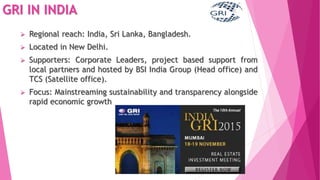
 Regional reach: India, Sri Lanka, Bangladesh.
 Located in New Delhi.
 Supporters: Corporate Leaders, project based support from
local partners and hosted by BSI India Group (Head office) and
TCS (Satellite office).
 Focus: Mainstreaming sustainability and transparency alongside
rapid economic growth
GRI FRAMEWORK
 Provide a holistic framework that addresses broad
performance in social, environmental and economic.
 Guides an organization's approach to ‘proving’ its impact
 Internationally accepted flexible reporting framework.
 To help measure and benchmark performance, both
against their own targets and externally.
 GRI indicators to encourage employees to understand
and contribute to progressively better performance.
 The Guidelines support and integrate other tools such as
Social Accounting and the AA1000 Series.
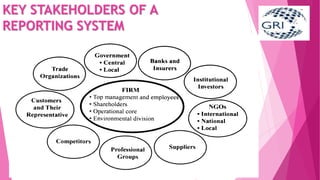
KEY STAKEHOLDERS OF A
REPORTING SYSTEM
FOUR KEY ELEMENTS IN THE
FRAMEWORK
SUSTAINABILITY REPORTING GUIDELINES
 Consists of Principles for defining report content
 Ensuring the quality of reported information
 Standard Disclosures made up of performance indicators
INDICATOR PROTOCOLS
 Protocols provide definitions, compilation guidance etc…
 Assist report preparers
 Ensure consistency in the interpretation of the performance
indicators
 Users of the Guidelines should also use the Indicator Protocols.
SECTOR SUPPLEMENTS
 Guidance on how to apply them in a given sector
 Sector-specific performance indicators
 Applicable sector supplements should be used in
addition
TECHNICAL PROTOCOLS
 Provide guidance on issues in reporting
 Sector supplements and cover issues that most
organizations face during the reporting process
GRI INITIVATIVES
 Climate risk and opportunity
 A catalyst to move beyond reports
 SUSTAINABLE DEVELOPMENT GOALS - To use creativity and innovation to address
development challenges and recognize the need for governments to encourage
sustainability reporting
 INTEGRATED REPORTING - To bridge the gap between the value of integrated
thinking for executives and the reality of sustainability and financial reporting
practice for organizations
 FRIENDS OF PARAGRAPH 47 - Leading governments join together to commit to
corporate sustainability reporting
 RIO+20 - The United Nations Conference on Sustainable Development
 REPORTING 2025 - The main issues which would be affecting companies agendas,
and consequently their public reports, by 2025. Leaders in various fields would be
interviewed on subjects ranging from data technology to society and business
development scenarios, and videos and analytical papers would be produced
throughout the year to promote an international discussion.
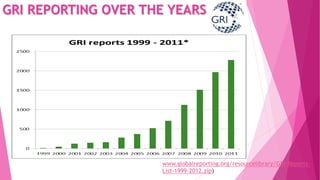
GRI REPORTING OVER THE YEARS
www.globalreporting.org/resourcelibrary/GRI-Reports-
List-1999-2012.zip)
GRI REPORTERS
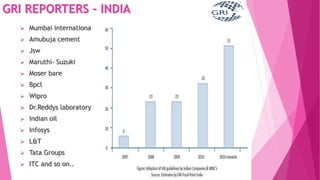
GRI REPORTERS – INDIA
 Mumbai international airport
 Amubuja cement
 Jsw
 Maruthi- Suzuki
 Moser bare
 Bpcl
 Wipro
 Dr.Reddys laboratory
 Indian oil
 Infosys
 L&T
 Tata Groups
 ITC and so on..
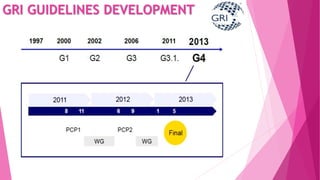
GRI GUIDELINES DEVELOPMENT
G4: NEXT GENERATION OF
REPORTING
 G4 : Fourth generation of the Guidelines
 Launched in May 2013
 Culmination of two years of extensive stakeholder consultation and dialogue with
hundreds of experts from across the world from a wide variety of sectors
 Structure - Two separate documents – 1) Reporting Principles and Standard Disclosures
2) Implementation Manual
 Objectives
 To help reporters prepare sustainability reports and to make robust and purposeful
sustainability reporting standard practice
 Be user friendly for beginners and experienced reporters
 Improve technical quality with clearer definitions
 Align with other international reporting references
 Offer guidance on how to link sustainability and integrated reporting
 Improve data access
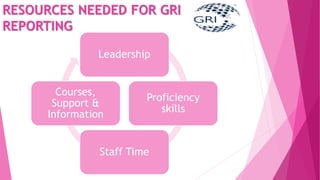
RESOURCES NEEDED FOR GRI
REPORTING
Leadership
Proficiency
skills
Staff Time
Courses,
Support &
Information
INTERNAL BENEFITS OF GRI
REPORTING
 Increased understanding of risks and opportunities
 Emphasizing the link between financial and non-financial performance
 Influencing long term management strategy and policy, and business plans
 Streamlining processes, reducing costs and improving efficiency
 Benchmarking and assessing sustainability performance with respect to laws,
norms, codes, performance standards, and voluntary initiatives
 Avoiding being implicated in publicized environmental, social and governance
failures
 Comparing performance internally, and between organizations and sectors
EXTERNAL BENEFITS OF GRI
REPORTING
 Mitigating – or reversing – negative environmental,
social and governance impacts
 Improving reputation and brand loyalty
 Enabling external stakeholders to understand the
organization’s true value, and tangible and intangible
assets
 Demonstrating how the organization influences, and is
influenced by, expectations about sustainable
development
DISTINCTIVE ELEMENTS OF THE
GRI STANDARDS
 Multi-stakeholder input : Universally applicable reporting
guidance that meets the needs of all report makers and
users
 A record of use and endorsement : Of the world’s
largest 250 corporations, 93% report on their sustainability
performance and 82% of these use GRI’s Standards to do
so
 Governmental references and activities : 27 countries
use GRI in their sustainability policies and look to us for
guidance as the world’s most widely used sustainability
reporting standards
 Independence : Funding approach ,degree of self-
sufficiency
POTENTIAL LIMITATIONS
 Adhering to the Guidelines can be labour intensive and full
reporting may represent a challenge for smaller organizations.
 Use in the third sector is limited and some of the language and
approaches are more familiar and appropriate for multinational
corporations.
 They provide guidance, but not accreditation, a mark or
external evaluation unless combined with other tools, such as
an assurance standard.
 Their main focus is ‘sustainability’, e.g. reporting external
impact but not necessarily focusing on positive outcomes or
impacts.
GRI FRAMEWORK
EFFECTIVENESS
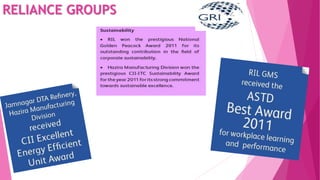
RELIANCE GROUPS
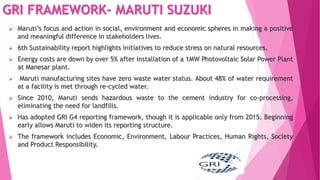
GRI FRAMEWORK- MARUTI SUZUKI
 Maruti’s focus and action in social, environment and economic spheres in making a positive
and meaningful difference in stakeholders lives.
 6th Sustainability report highlights initiatives to reduce stress on natural resources.
 Energy costs are down by over 5% after installation of a 1MW Photovoltaic Solar Power Plant
at Manesar plant.
 Maruti manufacturing sites have zero waste water status. About 48% of water requirement
at a facility is met through re-cycled water.
 Since 2010, Maruti sends hazardous waste to the cement industry for co-processing,
eliminating the need for landfills.
 Has adopted GRI G4 reporting framework, though it is applicable only from 2015. Beginning
early allows Maruti to widen its reporting structure.
 The framework includes Economic, Environment, Labour Practices, Human Rights, Society
and Product Responsibility.
GRI FRAMEWORK - WIPRO
 IT firm Wipro said that Dow Jones Sustainability Index (DJSI)
has chosen the Indian outsourcing major as its member.
 "At Wipro, sustainability is an integral part of its strategy and
organization ethic.
 Inclusion in the DJSI is a clear and strong testimony to its
commitment to sustainability and its key dimensions of
ecology, transparency, good governance and active corporate
citizenship.
THANK
YOU!

Csr gri framework

  • 1.
    THE GRI FRAMEWORKOF REPORTING
  • 2.
    GRI  Global ReportingInitiative (NGO) - International independent standards organization founded in 1997, USA.  Helps organizations to report on the economic, environmental, and social dimensions of their activities, products, and services.  Affiliations - OECD, UNEP, United Nations Global Compact, ISO and so on.  Governance of the GRI  Sustainability reporting is a more recent concept that encourages businesses and institutions to report on their environmental performance.  As of 2015, 7,500 organizations used GRI Guidelines for the sustainability reports.
  • 3.
    GRI IN INDIA Regional reach: India, Sri Lanka, Bangladesh.  Located in New Delhi.  Supporters: Corporate Leaders, project based support from local partners and hosted by BSI India Group (Head office) and TCS (Satellite office).  Focus: Mainstreaming sustainability and transparency alongside rapid economic growth
  • 4.
    GRI FRAMEWORK  Providea holistic framework that addresses broad performance in social, environmental and economic.  Guides an organization's approach to ‘proving’ its impact  Internationally accepted flexible reporting framework.  To help measure and benchmark performance, both against their own targets and externally.  GRI indicators to encourage employees to understand and contribute to progressively better performance.  The Guidelines support and integrate other tools such as Social Accounting and the AA1000 Series.
  • 5.
    KEY STAKEHOLDERS OFA REPORTING SYSTEM
  • 6.
    FOUR KEY ELEMENTSIN THE FRAMEWORK SUSTAINABILITY REPORTING GUIDELINES  Consists of Principles for defining report content  Ensuring the quality of reported information  Standard Disclosures made up of performance indicators INDICATOR PROTOCOLS  Protocols provide definitions, compilation guidance etc…  Assist report preparers  Ensure consistency in the interpretation of the performance indicators  Users of the Guidelines should also use the Indicator Protocols.
  • 7.
    SECTOR SUPPLEMENTS  Guidanceon how to apply them in a given sector  Sector-specific performance indicators  Applicable sector supplements should be used in addition TECHNICAL PROTOCOLS  Provide guidance on issues in reporting  Sector supplements and cover issues that most organizations face during the reporting process
  • 8.
    GRI INITIVATIVES  Climaterisk and opportunity  A catalyst to move beyond reports  SUSTAINABLE DEVELOPMENT GOALS - To use creativity and innovation to address development challenges and recognize the need for governments to encourage sustainability reporting  INTEGRATED REPORTING - To bridge the gap between the value of integrated thinking for executives and the reality of sustainability and financial reporting practice for organizations  FRIENDS OF PARAGRAPH 47 - Leading governments join together to commit to corporate sustainability reporting  RIO+20 - The United Nations Conference on Sustainable Development  REPORTING 2025 - The main issues which would be affecting companies agendas, and consequently their public reports, by 2025. Leaders in various fields would be interviewed on subjects ranging from data technology to society and business development scenarios, and videos and analytical papers would be produced throughout the year to promote an international discussion.
  • 9.
    GRI REPORTING OVERTHE YEARS www.globalreporting.org/resourcelibrary/GRI-Reports- List-1999-2012.zip)
  • 10.
  • 11.
    GRI REPORTERS –INDIA  Mumbai international airport  Amubuja cement  Jsw  Maruthi- Suzuki  Moser bare  Bpcl  Wipro  Dr.Reddys laboratory  Indian oil  Infosys  L&T  Tata Groups  ITC and so on..
  • 12.
  • 13.
    G4: NEXT GENERATIONOF REPORTING  G4 : Fourth generation of the Guidelines  Launched in May 2013  Culmination of two years of extensive stakeholder consultation and dialogue with hundreds of experts from across the world from a wide variety of sectors  Structure - Two separate documents – 1) Reporting Principles and Standard Disclosures 2) Implementation Manual  Objectives  To help reporters prepare sustainability reports and to make robust and purposeful sustainability reporting standard practice  Be user friendly for beginners and experienced reporters  Improve technical quality with clearer definitions  Align with other international reporting references  Offer guidance on how to link sustainability and integrated reporting  Improve data access
  • 14.
    RESOURCES NEEDED FORGRI REPORTING Leadership Proficiency skills Staff Time Courses, Support & Information
  • 15.
    INTERNAL BENEFITS OFGRI REPORTING  Increased understanding of risks and opportunities  Emphasizing the link between financial and non-financial performance  Influencing long term management strategy and policy, and business plans  Streamlining processes, reducing costs and improving efficiency  Benchmarking and assessing sustainability performance with respect to laws, norms, codes, performance standards, and voluntary initiatives  Avoiding being implicated in publicized environmental, social and governance failures  Comparing performance internally, and between organizations and sectors
  • 16.
    EXTERNAL BENEFITS OFGRI REPORTING  Mitigating – or reversing – negative environmental, social and governance impacts  Improving reputation and brand loyalty  Enabling external stakeholders to understand the organization’s true value, and tangible and intangible assets  Demonstrating how the organization influences, and is influenced by, expectations about sustainable development
  • 17.
    DISTINCTIVE ELEMENTS OFTHE GRI STANDARDS  Multi-stakeholder input : Universally applicable reporting guidance that meets the needs of all report makers and users  A record of use and endorsement : Of the world’s largest 250 corporations, 93% report on their sustainability performance and 82% of these use GRI’s Standards to do so  Governmental references and activities : 27 countries use GRI in their sustainability policies and look to us for guidance as the world’s most widely used sustainability reporting standards  Independence : Funding approach ,degree of self- sufficiency
  • 18.
    POTENTIAL LIMITATIONS  Adheringto the Guidelines can be labour intensive and full reporting may represent a challenge for smaller organizations.  Use in the third sector is limited and some of the language and approaches are more familiar and appropriate for multinational corporations.  They provide guidance, but not accreditation, a mark or external evaluation unless combined with other tools, such as an assurance standard.  Their main focus is ‘sustainability’, e.g. reporting external impact but not necessarily focusing on positive outcomes or impacts.
  • 19.
  • 20.
  • 21.
    GRI FRAMEWORK- MARUTISUZUKI  Maruti’s focus and action in social, environment and economic spheres in making a positive and meaningful difference in stakeholders lives.  6th Sustainability report highlights initiatives to reduce stress on natural resources.  Energy costs are down by over 5% after installation of a 1MW Photovoltaic Solar Power Plant at Manesar plant.  Maruti manufacturing sites have zero waste water status. About 48% of water requirement at a facility is met through re-cycled water.  Since 2010, Maruti sends hazardous waste to the cement industry for co-processing, eliminating the need for landfills.  Has adopted GRI G4 reporting framework, though it is applicable only from 2015. Beginning early allows Maruti to widen its reporting structure.  The framework includes Economic, Environment, Labour Practices, Human Rights, Society and Product Responsibility.
  • 22.
    GRI FRAMEWORK -WIPRO  IT firm Wipro said that Dow Jones Sustainability Index (DJSI) has chosen the Indian outsourcing major as its member.  "At Wipro, sustainability is an integral part of its strategy and organization ethic.  Inclusion in the DJSI is a clear and strong testimony to its commitment to sustainability and its key dimensions of ecology, transparency, good governance and active corporate citizenship.
  • 23.