CONTENT
Meaning of Budget
Essentials of Budget
Benefits of Budgeting
Meaning of Budgetory Control
Objectives of Budgetory Control
Types Of Budget
Format and Illustrations of different
Budget
WHAT IS A BUDGET ?
 Simply put, a budget is an summary of likely
income and expenses for a given period. It’s an
invaluable tool to help you prioritize your spending
and manage your money—no matter how much or
how little you have.
 Planning and monitoring your budget will help you
identify wasteful expenditures, adapt quickly as
your financial situation changes, and achieve your
financial goals.
THE CHARTERED INSTITUTE OF MANAGEMENT
ACCOUNTANTS, ENGLAND, DEFINES A BUDGET
AS:
“A plan quantified in monetary terms prepared and
approved prior to a defined period of time usually
showing planned income to be generated and/or
expenditure to be incurred during that period and the
capital to be employed to attain a give objective.”
ESSENTIALS OF A BUDGET
 PLAN EXPRESSED IN MONETARY TERMS
• PREPARED PRIOR TO A DEFINED PERIOD
OF TIME
• RELATED TO A DEFINITE FUTURE PERIOD
BENEFITS OF BUDGETING
 Gives you control over your money
A budget is a way of being intentional about the
way you spend and save your money. It is said that
with budgeting, you control your money and not
your money controls you. Budgeting saves you the
stress of suddenly having to adjust to lack of funds
because you did not initially plan how to spend
them. It also helps you decide if you want to
sacrifice short term spending like buying coffee
everyday in exchange for a long term benefit like a
cruise vacation or a new HDTV.
 Keeps you focused on your money goals
You avoid spending unnecessarily on items and
services that do not contribute to attaining your
financial goals. If you are working with limited
resources, budgeting makes it easier to make ends
meet.
 Helps you organize your spending and savings
By dividing your money into categories of
expenditures and savings, a budget makes you
aware which category of expenditure takes which
portion of your money. That way, it is easy for you
to make adjustments. Budget also serves as a
reference for organizing your bills, receipts, and
financial statements. When all of your financial
transactions are organized for tax time or creditor
questions, you save time and effort.
 Provides you with an early warning for
potential problems
When you budget and take a “big picture” view, you
will see potential money problems in advance, and
be able to make adjustments before the problem
appears.
 Helps you determine if you can take debt and
how much
Taking debt is not necessarily a bad thing if the debt
is necessary or you can afford it. Budgeting shows
you how much a debt load you can realistically take
without being stressed or if taking the debt load is
worth it.
WHAT IS BUDGETORY CONTROL?
 A system of management control in which actual
income and spending are compared with planned
income and spending, so that you can see if plans
are being followed and if those plans need to be
changed in order to make a profit
THE CHARTERED INSTITUTE OF MANAGEMENT
ACCOUNTANTS, ENGLAND, DEFINES IT AS:
The establishment of the budgets relating to the
responsibilities of executives to the requirements of a
policy and the continuous comparison of actual with
budgeted result either to secure by individual action the
objectives of that policy or to provide a firm basis for its
revision.
OBJECTIVES OF BUDGETARY CONTROL
•Planning:
A budget provides a detailed plan of action for a
business over a definite period of time. Detailed
plans relating to production, sales, raw material
requirements, labor needs, advertising and sales
promotion performance, research and development
activities, capital additions etc. are drawn up. By
planning many problems are anticipated long
before they arise and solutions can be sought
through careful study. Thus most business
emergencies can be avoided by planning. In brief,
budgeting forces the management to think ahead,
to anticipate and prepare for the anticipated
conditions.
COORDINATION
• Budgeting aids managers in co-coordinating their
efforts so that objectives of the organization as a
whole harmonize with the objectives of its divisions.
Effective planning and organization contributes a lot
in achieving coordination. There should be
coordination in the budgets of various departments.
For example, the budget of sales should be in
coordination with the budget of production.
Similarly, production budget should be prepared in
coordination with the purchase budget, and so on.
COMMUNICATION
• A budget is actually a communication device. The
accepted budget copies are distributed to every
management personnel which gives not only
adequate understanding and knowledge of the
policies and programmes to be followed however
also gives understanding about the restrictions to
be followed to. It is not the budget by itself that
facilitates communication; however the vital
information will be communicated in the work of
preparing budgets and participation of most
responsible men and women in this act.
CONTROL
• Control is necessary to ensure that plans and
objectives as laid down in the budgets are being
achieved. Control, as applied to budgeting, is a,
systematized effort to keep the management
informed of whether planned performance is being
achieved or not. For this purpose, a comparison is
made between plans and actual performance. The
difference between the two is reported to
management for taking corrective action.
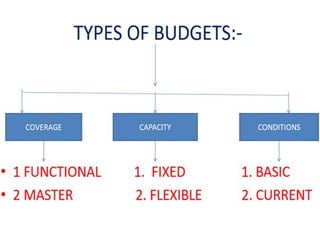
TYPES OF BUDGETS
• Depending upon the purpose that a budget is
expected to serve and the requirements of the
organization, Budgets are classified into several
types on the basis of coverage, capacity and
conditions. The following chart sums up the
different types of Budgets:
FUNCTIONAL BUDGET
• CIMA defined a Functional budget as, “ A Budget of
income or expenditure appropriate to or the
responsibility of a particular function.
• E.g. Sales Budget, Purchase Budget, Production
Budget, Cash Budget etc.
MASTER BUDGET
• CIMA has defined a Master Budget as- “The
summary Budget incorporating its component
functional Budgets.”
• It contains the summary of the Sales Budget,
Purchase Budget, Production Budget, Cash Budget
etc.
FIXED BUDGET
• CIMA has defined a Fixed Budget as, “A Budget
which is designed to remain unchanged irrespective
of the level of capacity or volume”
• Fixed Budget is used as an effective tool of cost
control,
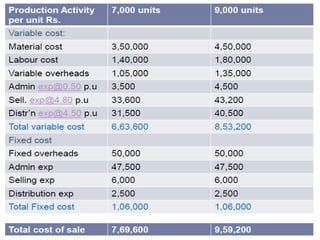
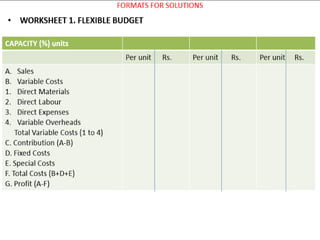
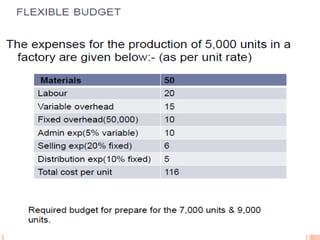
FLEXIBLE BUDGET
• CIMA has defined Flexible Budget as- “A Budget
which by recognizing the difference between fixed,
semi-fixed and variable costs, is designed to
change in relation to the level of activity attained”.
• Flexible Budget can adjusted for current conditions
arising out of seasonal changes or change in the
length of working period etc.
BASIC BUDGET AND CURRENT
BUDGET
• BASIC BUDGET:
CIMA had defined Basic Budget as, “A Budget
which is established for use unaltered over a long
period of time”.
• CURRENT BUDGET:
CIMA defined Current budget as, “ A Budget is
established for use over a short period of time and
is related to current conditions”.
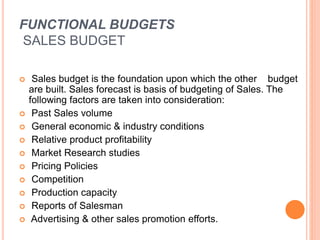
FUNCTIONAL BUDGETS
SALES BUDGET
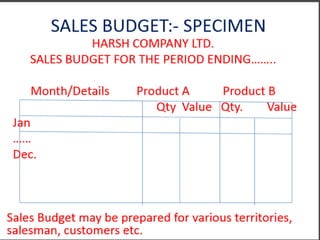
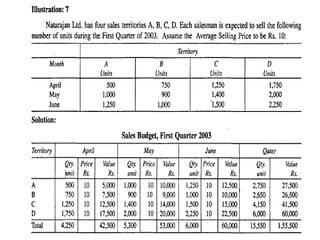
 Sales budget is the foundation upon which the other budget
are built. Sales forecast is basis of budgeting of Sales. The
following factors are taken into consideration:
 Past Sales volume
 General economic & industry conditions
 Relative product profitability
 Market Research studies
 Pricing Policies
 Competition
 Production capacity
 Reports of Salesman
 Advertising & other sales promotion efforts.
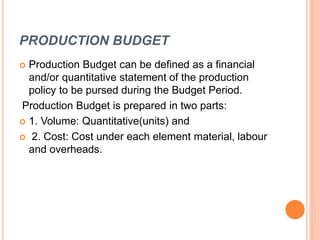
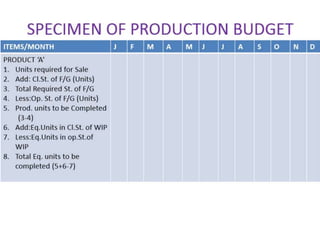
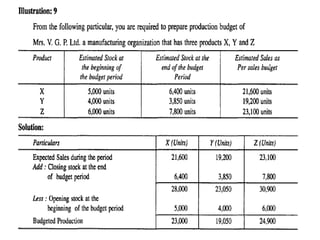
PRODUCTION BUDGET
 Production Budget can be defined as a financial
and/or quantitative statement of the production
policy to be pursed during the Budget Period.
Production Budget is prepared in two parts:
 1. Volume: Quantitative(units) and
 2. Cost: Cost under each element material, labour
and overheads.
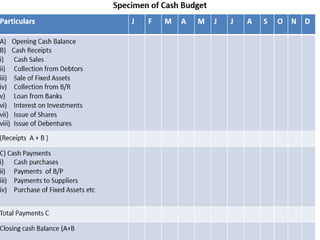
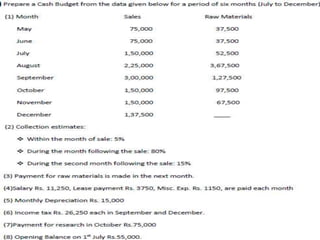
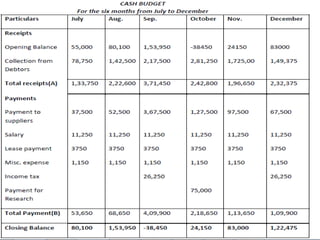
CASH BUDGET
• A Cash budget is an estimate of the receipts &
payments for each month or other period forming
part of the whole budget period. It is essential to
allow for the time lag between certain transactions
and the receipt or payment of the concerned cash.
• The objective of the cash budget is to ensure that
sufficient cash is available for the both the revenue
and capital expenditure to indicate additional
finance is required and how much.
RECEIPTS & PAYMENTS METHOD
• This method is to forecast only the final cash
balance at year end and not an item-by-item
forecast. Hence, business concerns normally use
the Receipts & Payments method which shows
item-wise details of cash flows and balance for any
given period.
Budget and budgetary control

Budget and budgetary control

  • 2.
    CONTENT Meaning of Budget Essentialsof Budget Benefits of Budgeting Meaning of Budgetory Control Objectives of Budgetory Control Types Of Budget Format and Illustrations of different Budget
  • 3.
    WHAT IS ABUDGET ?  Simply put, a budget is an summary of likely income and expenses for a given period. It’s an invaluable tool to help you prioritize your spending and manage your money—no matter how much or how little you have.  Planning and monitoring your budget will help you identify wasteful expenditures, adapt quickly as your financial situation changes, and achieve your financial goals.
  • 4.
    THE CHARTERED INSTITUTEOF MANAGEMENT ACCOUNTANTS, ENGLAND, DEFINES A BUDGET AS: “A plan quantified in monetary terms prepared and approved prior to a defined period of time usually showing planned income to be generated and/or expenditure to be incurred during that period and the capital to be employed to attain a give objective.”
  • 5.
    ESSENTIALS OF ABUDGET  PLAN EXPRESSED IN MONETARY TERMS
  • 6.
    • PREPARED PRIORTO A DEFINED PERIOD OF TIME
  • 7.
    • RELATED TOA DEFINITE FUTURE PERIOD
  • 8.
    BENEFITS OF BUDGETING Gives you control over your money A budget is a way of being intentional about the way you spend and save your money. It is said that with budgeting, you control your money and not your money controls you. Budgeting saves you the stress of suddenly having to adjust to lack of funds because you did not initially plan how to spend them. It also helps you decide if you want to sacrifice short term spending like buying coffee everyday in exchange for a long term benefit like a cruise vacation or a new HDTV.
  • 9.
     Keeps youfocused on your money goals You avoid spending unnecessarily on items and services that do not contribute to attaining your financial goals. If you are working with limited resources, budgeting makes it easier to make ends meet.
  • 10.
     Helps youorganize your spending and savings By dividing your money into categories of expenditures and savings, a budget makes you aware which category of expenditure takes which portion of your money. That way, it is easy for you to make adjustments. Budget also serves as a reference for organizing your bills, receipts, and financial statements. When all of your financial transactions are organized for tax time or creditor questions, you save time and effort.
  • 11.
     Provides youwith an early warning for potential problems When you budget and take a “big picture” view, you will see potential money problems in advance, and be able to make adjustments before the problem appears.
  • 12.
     Helps youdetermine if you can take debt and how much Taking debt is not necessarily a bad thing if the debt is necessary or you can afford it. Budgeting shows you how much a debt load you can realistically take without being stressed or if taking the debt load is worth it.
  • 13.
    WHAT IS BUDGETORYCONTROL?  A system of management control in which actual income and spending are compared with planned income and spending, so that you can see if plans are being followed and if those plans need to be changed in order to make a profit
  • 14.
    THE CHARTERED INSTITUTEOF MANAGEMENT ACCOUNTANTS, ENGLAND, DEFINES IT AS: The establishment of the budgets relating to the responsibilities of executives to the requirements of a policy and the continuous comparison of actual with budgeted result either to secure by individual action the objectives of that policy or to provide a firm basis for its revision.
  • 15.
    OBJECTIVES OF BUDGETARYCONTROL •Planning: A budget provides a detailed plan of action for a business over a definite period of time. Detailed plans relating to production, sales, raw material requirements, labor needs, advertising and sales promotion performance, research and development activities, capital additions etc. are drawn up. By planning many problems are anticipated long before they arise and solutions can be sought through careful study. Thus most business emergencies can be avoided by planning. In brief, budgeting forces the management to think ahead, to anticipate and prepare for the anticipated conditions.
  • 16.
    COORDINATION • Budgeting aidsmanagers in co-coordinating their efforts so that objectives of the organization as a whole harmonize with the objectives of its divisions. Effective planning and organization contributes a lot in achieving coordination. There should be coordination in the budgets of various departments. For example, the budget of sales should be in coordination with the budget of production. Similarly, production budget should be prepared in coordination with the purchase budget, and so on.
  • 17.
    COMMUNICATION • A budgetis actually a communication device. The accepted budget copies are distributed to every management personnel which gives not only adequate understanding and knowledge of the policies and programmes to be followed however also gives understanding about the restrictions to be followed to. It is not the budget by itself that facilitates communication; however the vital information will be communicated in the work of preparing budgets and participation of most responsible men and women in this act.
  • 18.
    CONTROL • Control isnecessary to ensure that plans and objectives as laid down in the budgets are being achieved. Control, as applied to budgeting, is a, systematized effort to keep the management informed of whether planned performance is being achieved or not. For this purpose, a comparison is made between plans and actual performance. The difference between the two is reported to management for taking corrective action.
  • 19.
    TYPES OF BUDGETS •Depending upon the purpose that a budget is expected to serve and the requirements of the organization, Budgets are classified into several types on the basis of coverage, capacity and conditions. The following chart sums up the different types of Budgets:
  • 21.
    FUNCTIONAL BUDGET • CIMAdefined a Functional budget as, “ A Budget of income or expenditure appropriate to or the responsibility of a particular function. • E.g. Sales Budget, Purchase Budget, Production Budget, Cash Budget etc.
  • 22.
    MASTER BUDGET • CIMAhas defined a Master Budget as- “The summary Budget incorporating its component functional Budgets.” • It contains the summary of the Sales Budget, Purchase Budget, Production Budget, Cash Budget etc.
  • 23.
    FIXED BUDGET • CIMAhas defined a Fixed Budget as, “A Budget which is designed to remain unchanged irrespective of the level of capacity or volume” • Fixed Budget is used as an effective tool of cost control,
  • 24.
    FLEXIBLE BUDGET • CIMAhas defined Flexible Budget as- “A Budget which by recognizing the difference between fixed, semi-fixed and variable costs, is designed to change in relation to the level of activity attained”. • Flexible Budget can adjusted for current conditions arising out of seasonal changes or change in the length of working period etc.
  • 25.
    BASIC BUDGET ANDCURRENT BUDGET • BASIC BUDGET: CIMA had defined Basic Budget as, “A Budget which is established for use unaltered over a long period of time”. • CURRENT BUDGET: CIMA defined Current budget as, “ A Budget is established for use over a short period of time and is related to current conditions”.
  • 26.
    FUNCTIONAL BUDGETS SALES BUDGET Sales budget is the foundation upon which the other budget are built. Sales forecast is basis of budgeting of Sales. The following factors are taken into consideration:  Past Sales volume  General economic & industry conditions  Relative product profitability  Market Research studies  Pricing Policies  Competition  Production capacity  Reports of Salesman  Advertising & other sales promotion efforts.
  • 29.
    PRODUCTION BUDGET  ProductionBudget can be defined as a financial and/or quantitative statement of the production policy to be pursed during the Budget Period. Production Budget is prepared in two parts:  1. Volume: Quantitative(units) and  2. Cost: Cost under each element material, labour and overheads.
  • 32.
    CASH BUDGET • ACash budget is an estimate of the receipts & payments for each month or other period forming part of the whole budget period. It is essential to allow for the time lag between certain transactions and the receipt or payment of the concerned cash. • The objective of the cash budget is to ensure that sufficient cash is available for the both the revenue and capital expenditure to indicate additional finance is required and how much.
  • 33.
    RECEIPTS & PAYMENTSMETHOD • This method is to forecast only the final cash balance at year end and not an item-by-item forecast. Hence, business concerns normally use the Receipts & Payments method which shows item-wise details of cash flows and balance for any given period.