Food Cost Management
Emilie Gorman · Courtney Marshall · Amanda Parks
Quick Session on Food Cost Management
• Improve the success of your dining establishment
• Tips for increasing profit
• Areas of high concern for y0ur business
Lesson Plan
I. Menu Execution
II. Food Prep
III. Storing Food
IV. Eliminating Waste
V. Record Keeping
VI. Forecasting
I. Menu Execution
How menu items effect your business
Target points
a) Pricing
b) Seasonality
c) High profit/low cost items
Pricing
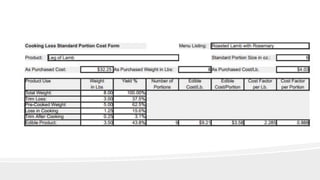
• Edible Yield
– For produce, determine what % is edible and then cost it out using
only that amount instead of the full weight of the item as is
– For meat you must consider how much is reduced when cooked as
well as unedible portions such as bones or excess fat
Pricing
• Calculate out each ingredient cost and then add up
• Long process but well worth it
• Also consider the cost of “free” items offered to customers
– Rolls, butter, plate garnishes
Pricing
• Lastly, look at the following to ensure you are in the ballpark
price range for your success
– Location
– Competition
– Clientele
– Atmosphere
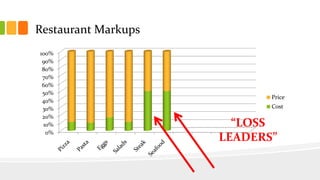
Restaurant Markups
0%
10%
20%
30%
40%
50%
60%
70%
80%
90%
100%
Price
Cost
“LOSS
LEADERS”
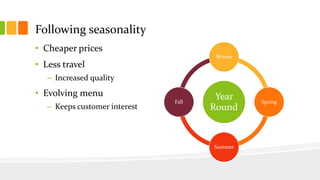
Following seasonality
• Cheaper prices
• Less travel
– Increased quality
• Evolving menu
– Keeps customer interest
Year
Round
Winter
Spring
Summer
Fall
II. Food Preparation
Full utilization of ingredients in time efficient manners
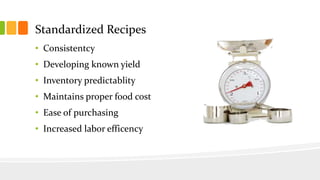
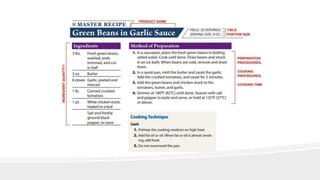
Standardized Recipes
• Consistentcy
• Developing known yield
• Inventory predictablity
• Maintains proper food cost
• Ease of purchasing
• Increased labor efficency
Interview: Dan Winans
• Program Director, EcoGastronomy, University
of New Hampshire
• Previous restuarant owner
• Lectured over forty courses at a culinary school
on “Managing Food Cost”
III. Food Storage
Efficient and proper usage of space
Target points
• Storage capacity (refrigerator/freezer, cupboard space)
• Vendor delivery schedule/operating schedule
• Items perishability and shelf life
• Purchase Point
First IN
First OUT
Older items are to be taken out of
storage prior to more recently delivered
products
IN STORAGE
NEW DELIVERY
IV. Eliminate Waste
Don’t be throwing $ down the drain!
Opportunities in many areas:
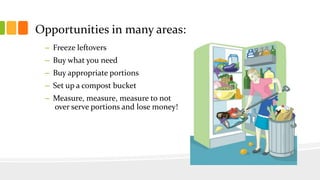
– Freeze leftovers
– Buy what you need
– Buy appropriate portions
– Set up a compost bucket
– Measure, measure, measure to not
over serve portions and lose money!
V. Record Keeping
Maintaining accurate books
Why is it important?
– Payment of suppliers, employees, debts, supplies, etc.
– Predicts type and amount of food item needed based on past sales
and number of customers in a given season
VI. Forecasting
Using past data to determine future needs and demands
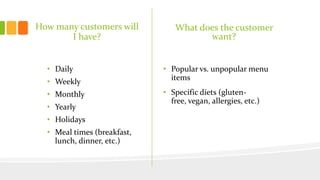
How many customers will
I have?
• Daily
• Weekly
• Monthly
• Yearly
• Holidays
• Meal times (breakfast,
lunch, dinner, etc.)
What does the customer
want?
• Popular vs. unpopular menu
items
• Specific diets (gluten-
free, vegan, allergies, etc.)
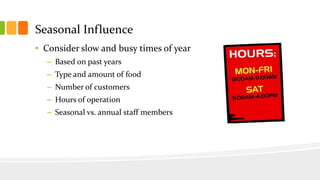
Seasonal Influence
• Consider slow and busy times of year
– Based on past years
– Type and amount of food
– Number of customers
– Hours of operation
– Seasonal vs. annual staff members
References
Dopson, Lea R., David K. Hayes, and Jack E. Miller. Study Guide to Accompany Food and Beverage Cost Control.
Hoboken, NJ: John Wiley, 2008. Print.
Dopson, Lea and David K.Hayes. Food and Beverage Cost Control. New York: John Wiley & Sons, 2010. Print.
Finz, Stacy. “Restaurant Markups Deconstructed.” San Fransisco Chronicle. May 22, 2011. Web. Available at:
http://www.sfgate.com/business/article/Restaurant-markups-deconstructed-2370995.php.
“Forecasting in Food Service.” Hotel Mule. Hospitality and Tourism. Available at:
http://hotelmule.com/wiki/Forecasting-in-foodservice
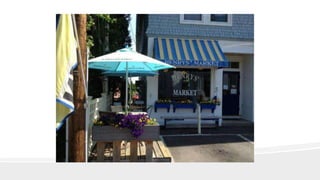
Hayhurst, Gabriela. Store owner, Henrys’ Market in New Castle, NH. Personal Interview. April 2013.
Mcevty P, S Marshall, and B Ware. The Menu and Cycle of Cost Control. Dubuque, Iowa: Kendall Hunt 2002. Print.
Ojugo, Clement, and Todd Rymer. Practical Food & Beverage Cost Control. Albany, NY: Delmar, 1999. Print.
“Why Use Standardized Recipes?” National Food Service Management Institute. Tools and tips for trainers.
Available at: http://www.nfsmi.org/documentlibraryfiles/PDF/20110314105501.pdf
Winans, Dan. Lecturer, Hospitality Management. Personal Interview. April 2013.
Images*
http://img4-2.cookinglight.timeinc.net/i/2008/10/0810p14-kitchen-scale-
m.jpg?300:300
http://teacherweb.com/NY/Arlington/Losee/CE_Ch13_328-345.pdf
http://www.onearth.org/files/onearth/article_images/spr10_livinggreen_01_F
oodWaste_slideshow.jpg
http://media-cdn.tripadvisor.com/media/photo-s/03/2f/7c/2c/henry-s-
market-cafe.jpg
http://teacherweb.com/NY/Arlington/Losee/CE_Ch13_328-345.pdf
*Aside from Microsoft Office Clip Art

Amb 508 food cost pp