LABOURCOSTCOTROL
Ajit Kumar
BBA 3rd
75148114
I
N
T
R
O
D
U
C
TI
O
N
Human efforts used for conversion of materials
into finished products or doing various jobs in
the business are known as labour.
Payment made towards the labour is
called labour cost. Labour cost is the significant
element of the total cost of production.
LABOUR
Labour is the most perishable commodity
and as such should be effectively utilized
immediately.
Therefore, efficient and
effective utilization of labour is an
important need of the modern business.
T
Y
P
ES
O
F
L
A
B
O
U
R
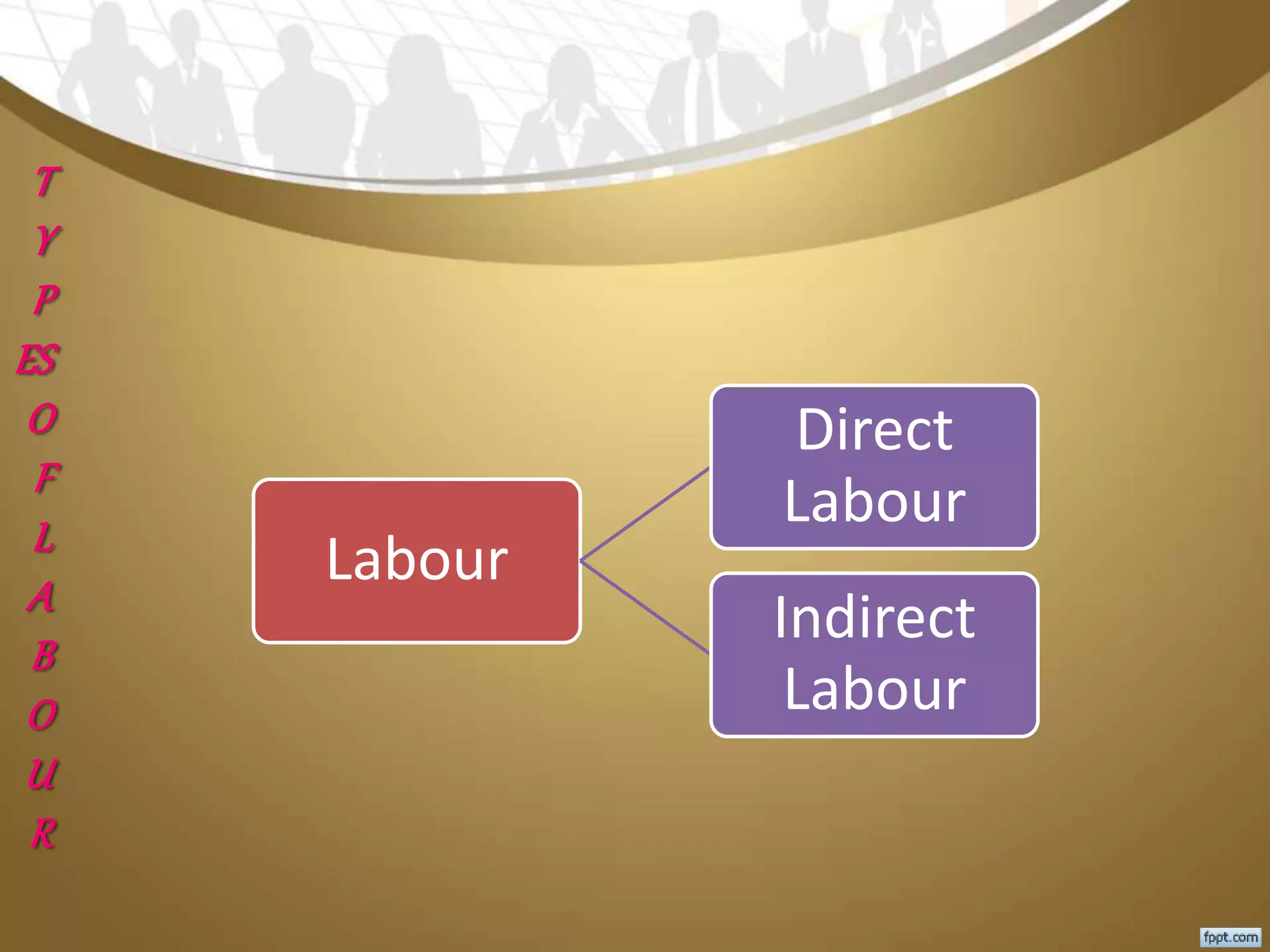
Labour
Direct
Labour
Indirect
Labour
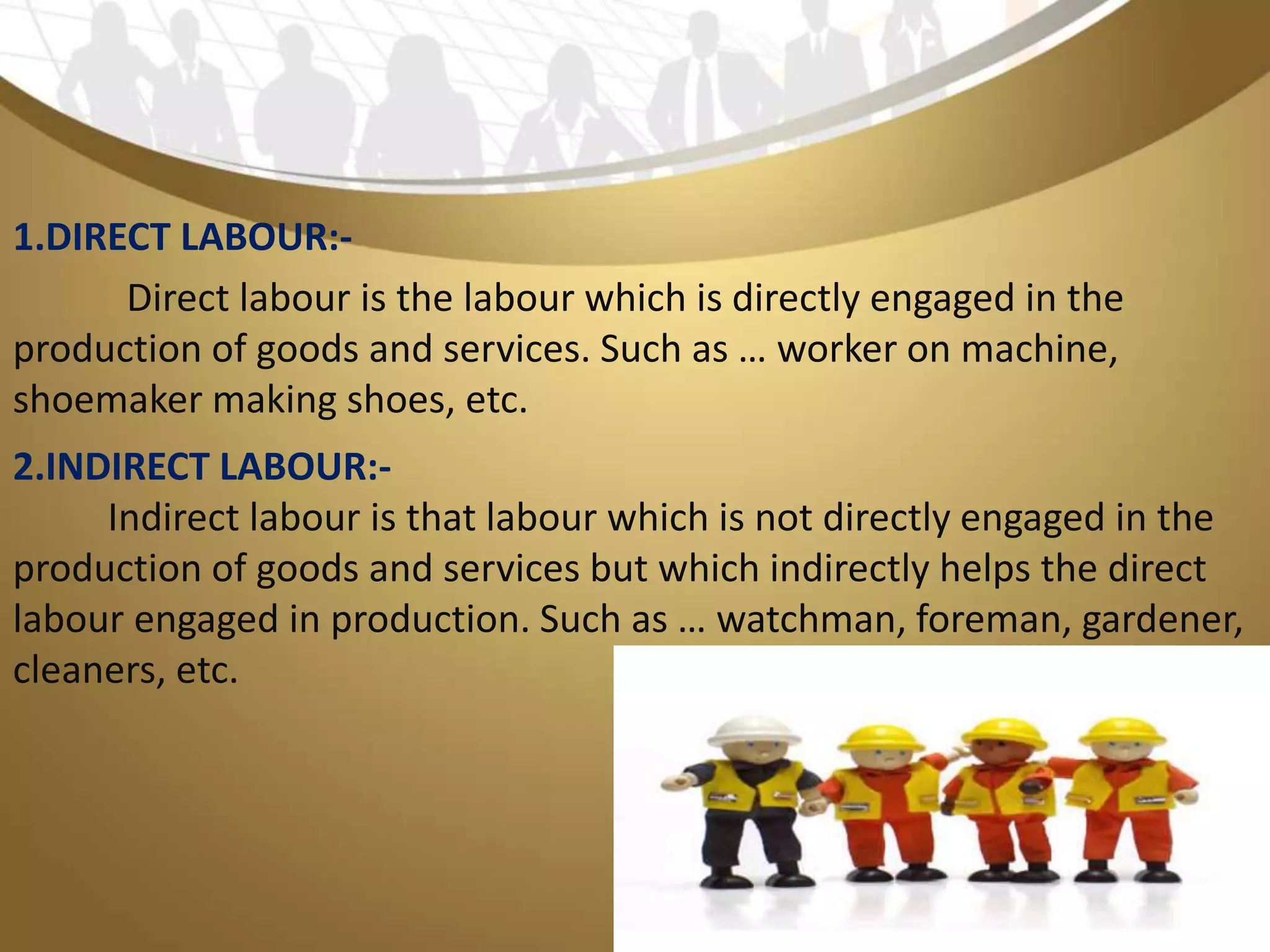
2.INDIRECT LABOUR:-
Indirect labour is that labour which is not directly engaged in the
production of goods and services but which indirectly helps the direct
labour engaged in production. Such as … watchman, foreman, gardener,
cleaners, etc.
1.DIRECT LABOUR:-
Direct labour is the labour which is directly engaged in the
production of goods and services. Such as … worker on machine,
shoemaker making shoes, etc.
LABOURCOST
“Labour Cost, representing the human contribution to
production, is an important cost factor which requires
constant control, measurement and analysis.”
MATZ, CURRY & FRANK
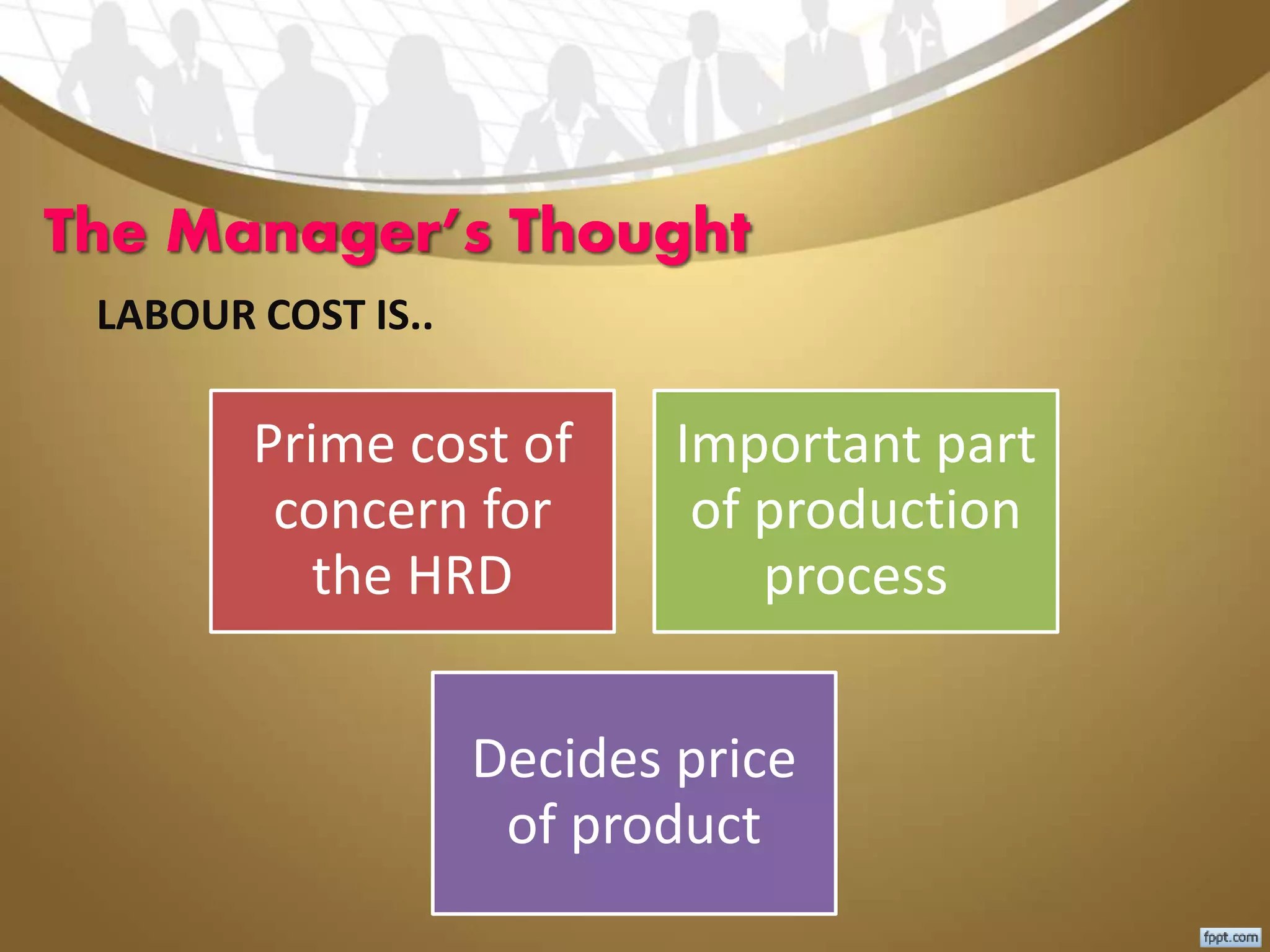
The Manager’s Thought
LABOUR COST IS..
Prime cost of
concern for
the HRD
Important part
of production
process
Decides price
of product
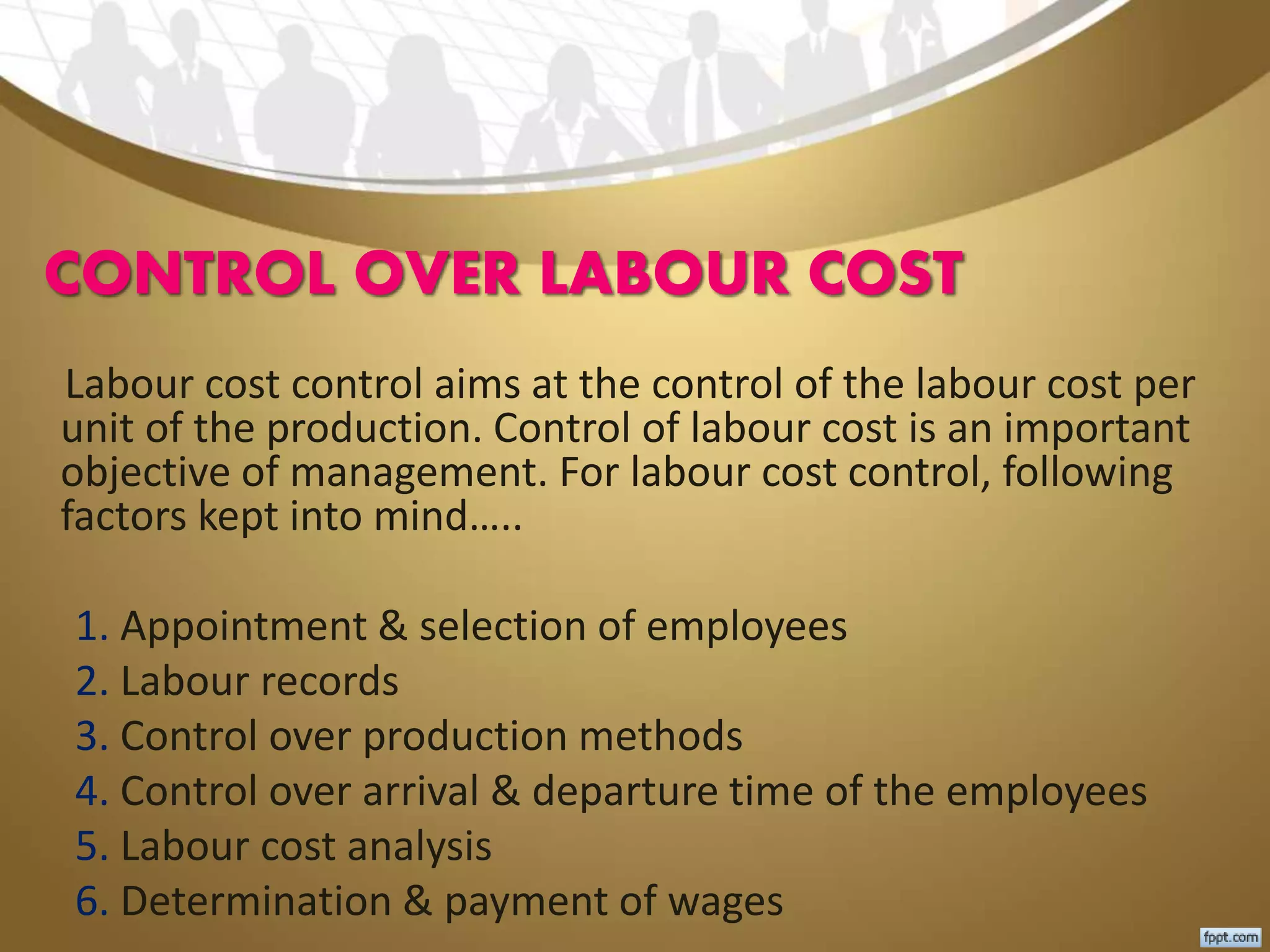
CONTROL OVER LABOUR COST
Labour cost control aims at the control of the labour cost per
unit of the production. Control of labour cost is an important
objective of management. For labour cost control, following
factors kept into mind…..
1. Appointment & selection of employees
2. Labour records
3. Control over production methods
4. Control over arrival & departure time of the employees
5. Labour cost analysis
6. Determination & payment of wages
LABOUR COST CONTROL DEPARTMENT
1. Personnel Department
The main function of the personnel department are
recruitment and selection of workers, providing them
training and placing them to the jobs they are best fitted.
2. Engineering Department
This department maintains control over the
production method and working condition
for each job, department or process.
3. Time-Keeping Department
Time keeping means recording the arrival
and departure time of each worker. Time
record is divided into two parts :-
1. Time Keeping
2. Time Booking
4. Pay roll department
The payroll department is responsible for making payment
of wages or salary to each employee. It maintains all the
functions related to the wages and salaries of the
employees.
5. Cost Accounting Department
The cost accounting department is responsible
for the collection and classification of all
labour cost with the time cards , job cards ,
labour cost of various jobs , work orders , etc.
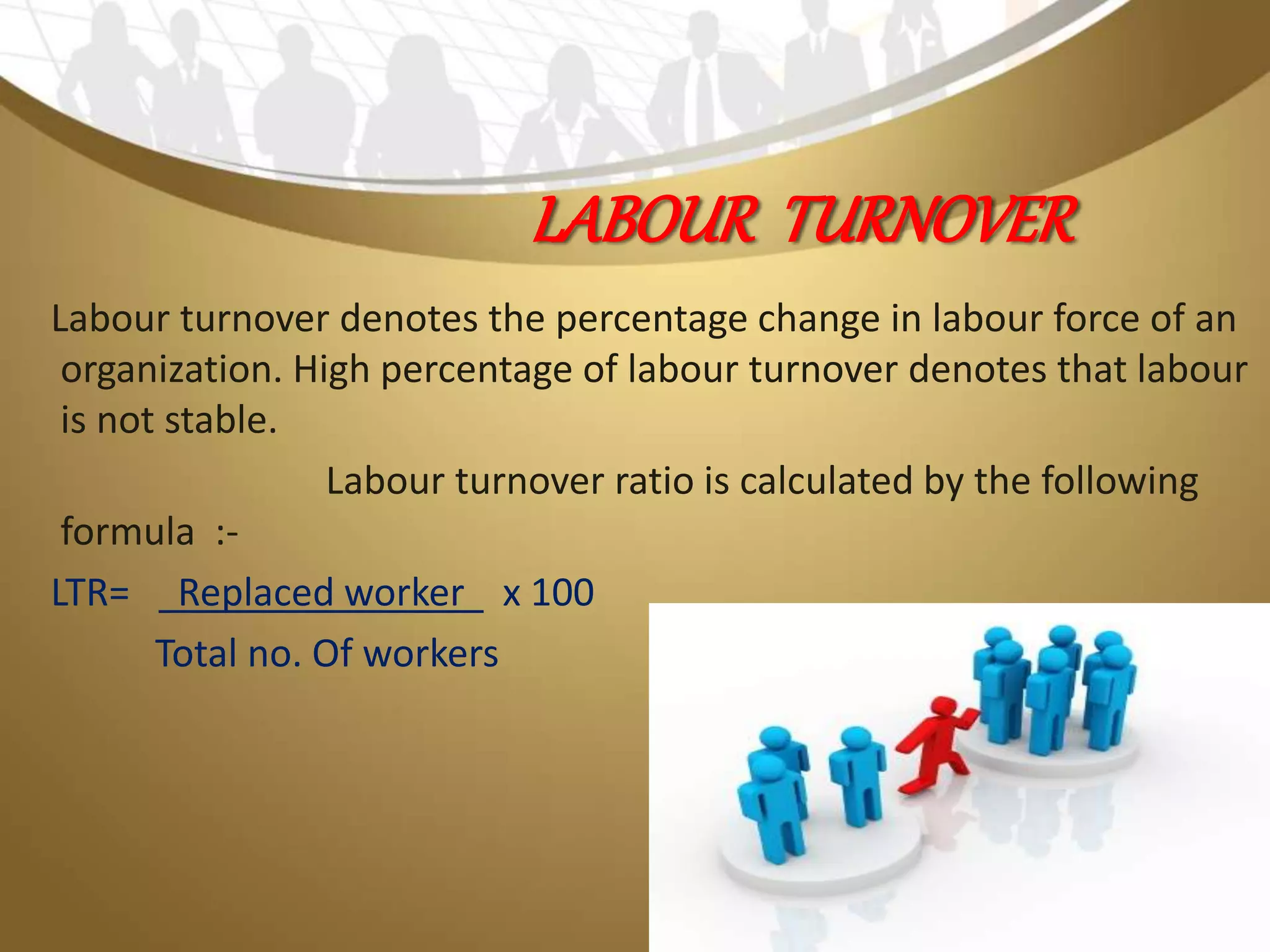
LABOUR TURNOVER
Labour turnover denotes the percentage change in labour force of an
organization. High percentage of labour turnover denotes that labour
is not stable.
Labour turnover ratio is calculated by the following
formula :-
LTR= Replaced worker x 100
Total no. Of workers
CAUSES OF LABOUR TURNOVER
1.Personal
Cause
• Death
• Ill health
• Dislike for the job
• Marriage of women
workers
• Retirement
• Family problem
2.Unavoidable
Cause
• Due to
insubordination
• Due to lack of
attention to duty
• Due to immoral
character
• Due to accidents
3.Avoidable
Causes
• Lack of job security
• Lack of proper
training facilities
• Lack of promotion
opportunities
• Lack of medical
facilities
Measurement Of Labour Turnover
1. Separation method :-
L.T. = No. of employees left during a period x 100
Avg. No. of employees during a period
2. Replacement method :-
L.T. = No. of workers replaced during a period x 100
Avg. No. of workers during a period
3. Flux method :-
L.T. = No. of separations + No. of additions x 100
Avg. No. of employees during a period
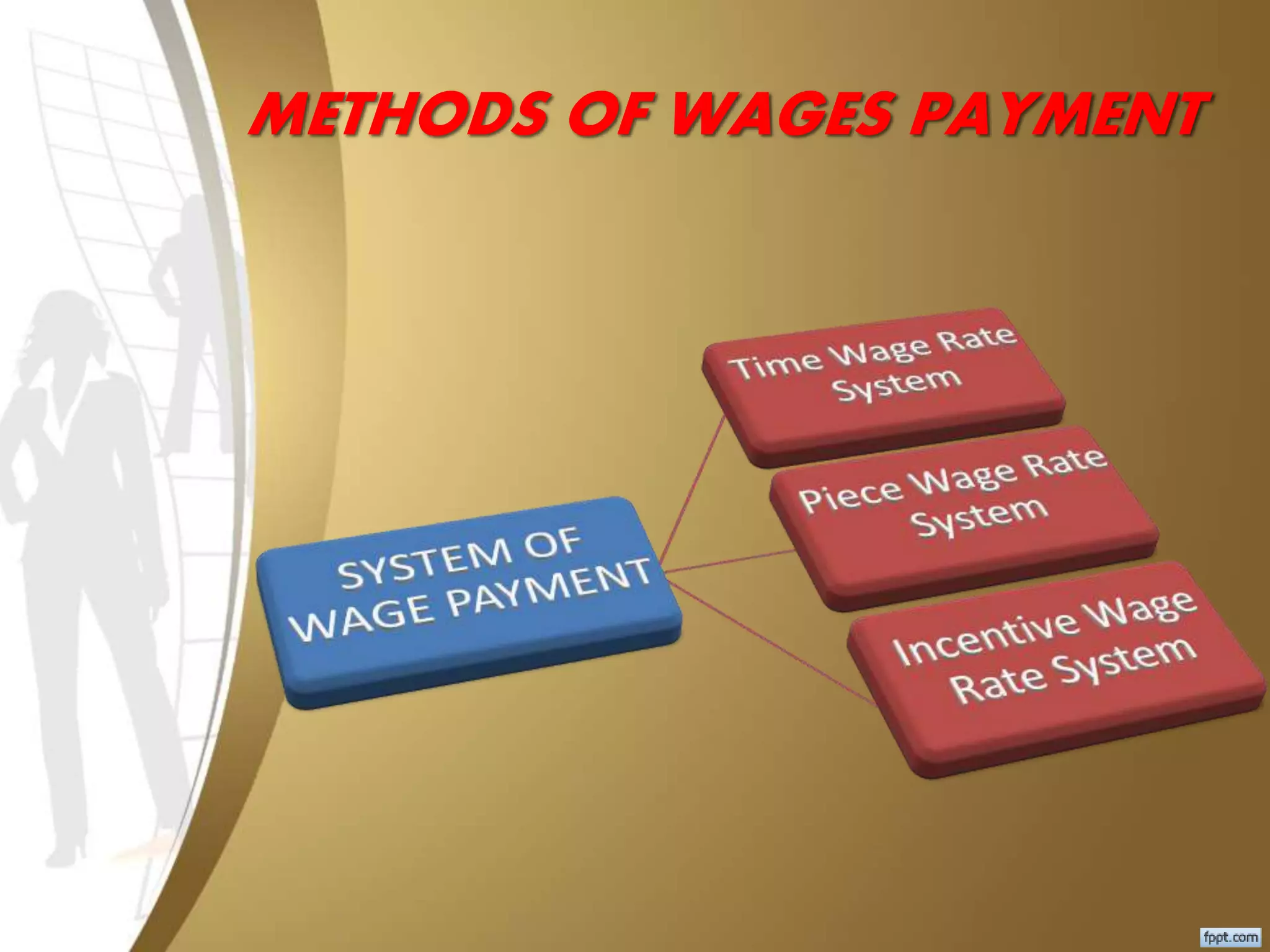
METHODS OF WAGES PAYMENT
Continued….
1. Time wage rate system :--
In this system the workers are paid on the basis of
time spent in the factory irrespective of the amount of
work done.
The total earnings are calculated as……….
( TOTAL EARNINGS = Hours Worked x Rate Per Hour )
Continued….
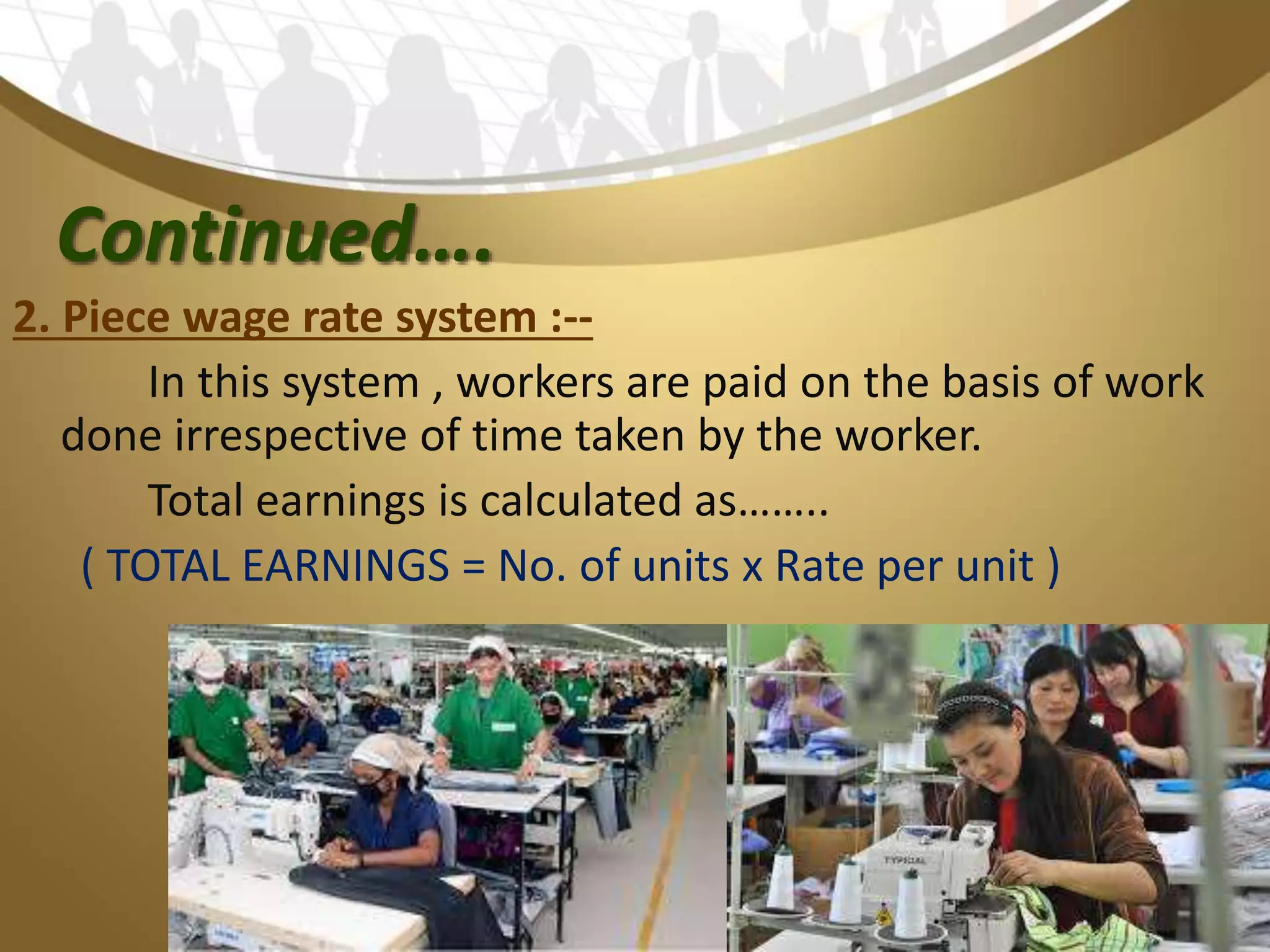
2. Piece wage rate system :--
In this system , workers are paid on the basis of work
done irrespective of time taken by the worker.
Total earnings is calculated as……..
( TOTAL EARNINGS = No. of units x Rate per unit )
Continued….
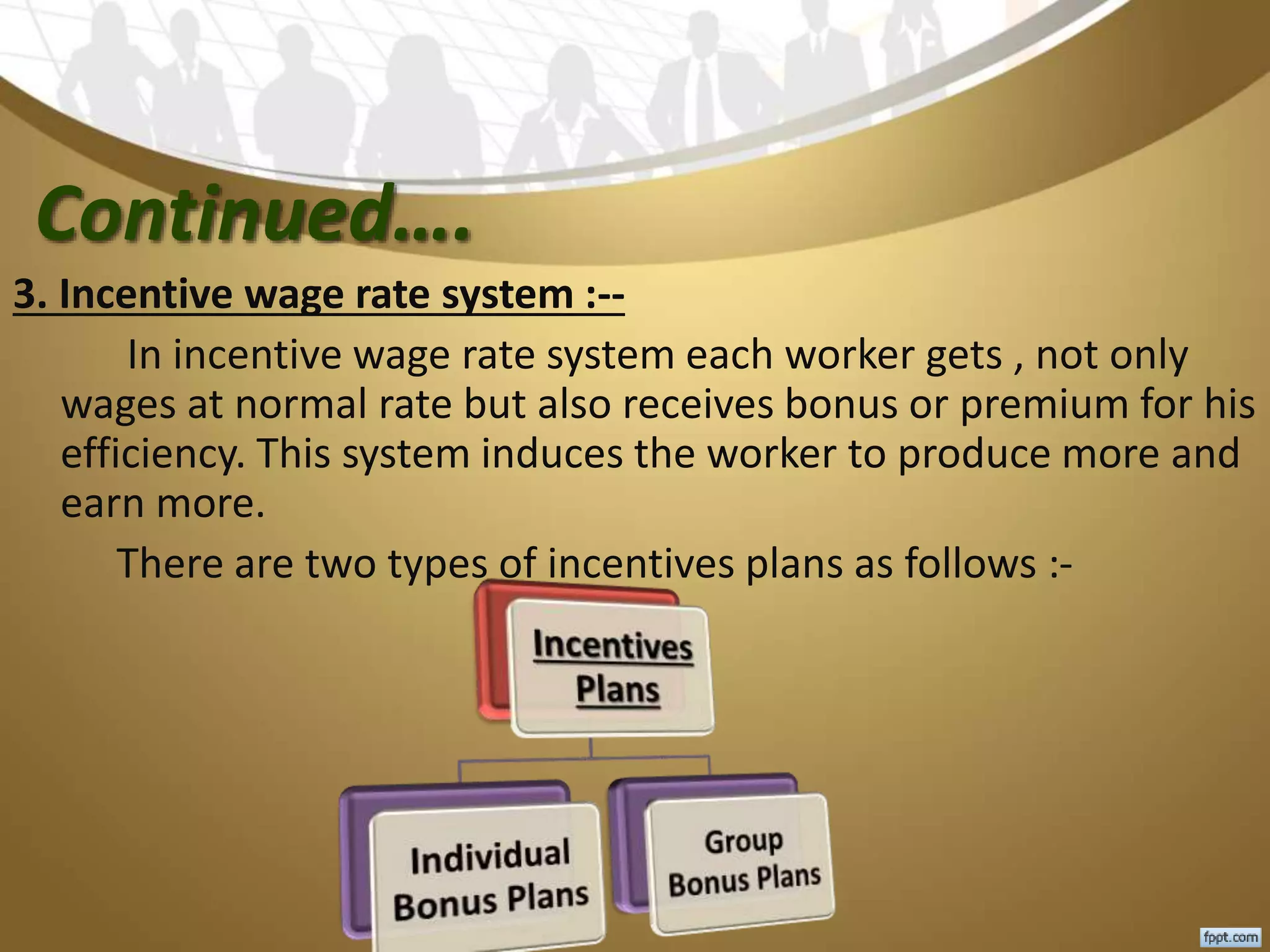
3. Incentive wage rate system :--
In incentive wage rate system each worker gets , not only
wages at normal rate but also receives bonus or premium for his
efficiency. This system induces the worker to produce more and
earn more.
There are two types of incentives plans as follows :-
Continued….
3.1. Individual Bonus Plans :--
1. Halsey Premium Plan
2. Halsey Weir Plan
3. Rowan Premium Plan
4. Taylor’s Differential Piece Rate Plan
5. Gantt Bonus Plan
6. Emerson’s Efficiency Plan
7. Merrick’s Multiple Piece Rate Plan
8. Bedeaux Point Premium Plan
9. Barth Variable Sharing Plan
CONTINUED….
3.1.1. Halsey premium plan:--
• The worker is paid a %(30% to 90% but usually 50%) of
the time saved over the standard rate per piece.
• Standard time is fixed for each job/operation
• If the labour completes at standard time or more he is
given the standard price.
• If time saved- wages given for actual hours saved as a
bonus.
Total Earnings = (Hours Worked x Rate Per Hour) +
% (Time Saved x Rate Per Hour)
Continued….
3.1.2. Halsey weir plan :--
It is calculated as Halsey Premium Plan , the only difference
is that the rate of premium or bonus is only 30% in place of
50%.
Total Earnings = (Hours Worked x Rate Per Hour) +
30% (Time Saved x Rate Per Hour)
Continued….
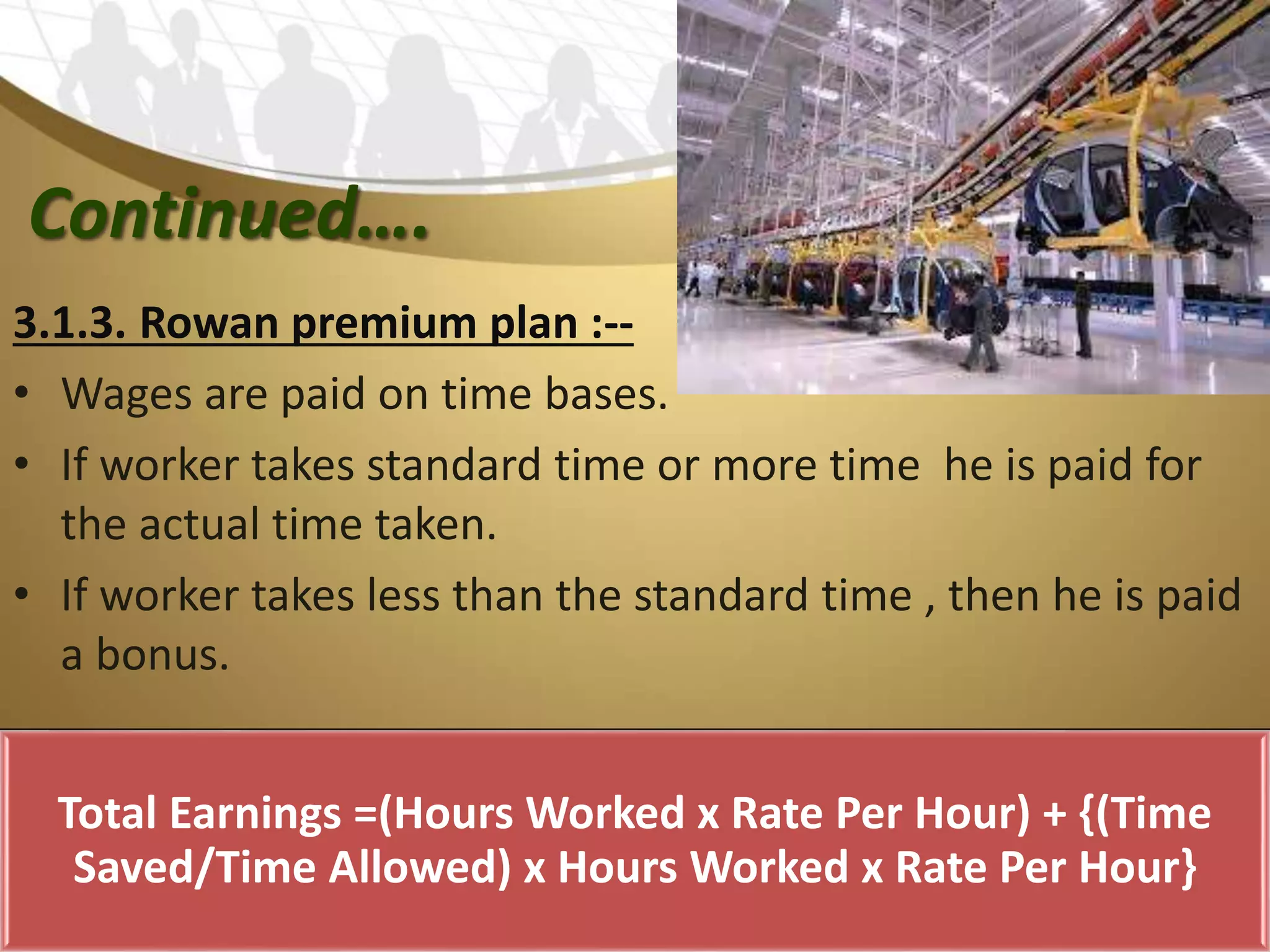
3.1.3. Rowan premium plan :--
• Wages are paid on time bases.
• If worker takes standard time or more time he is paid for
the actual time taken.
• If worker takes less than the standard time , then he is paid
a bonus.
Total Earnings =(Hours Worked x Rate Per Hour) + {(Time
Saved/Time Allowed) x Hours Worked x Rate Per Hour}
Continued….
3.1.4. Taylor’s differential piece rate system :--
This system was introduced by F. W. Taylor. The main features of
this incentive plan are as follows:
1)Day wages are not guaranteed, i.e. it does not assure any
minimum amount of wages to workers.
2)A standard time for each job is set very carefully after time
and motion studies.
3)Two piece rates are set for each job- the lower rate and the
higher rate.
–The lower piece rate is payable where a worker takes a
longer time than the standard time to complete the work.
–Higher rate is payable when a worker completes the work
within the standard time.
Continued….
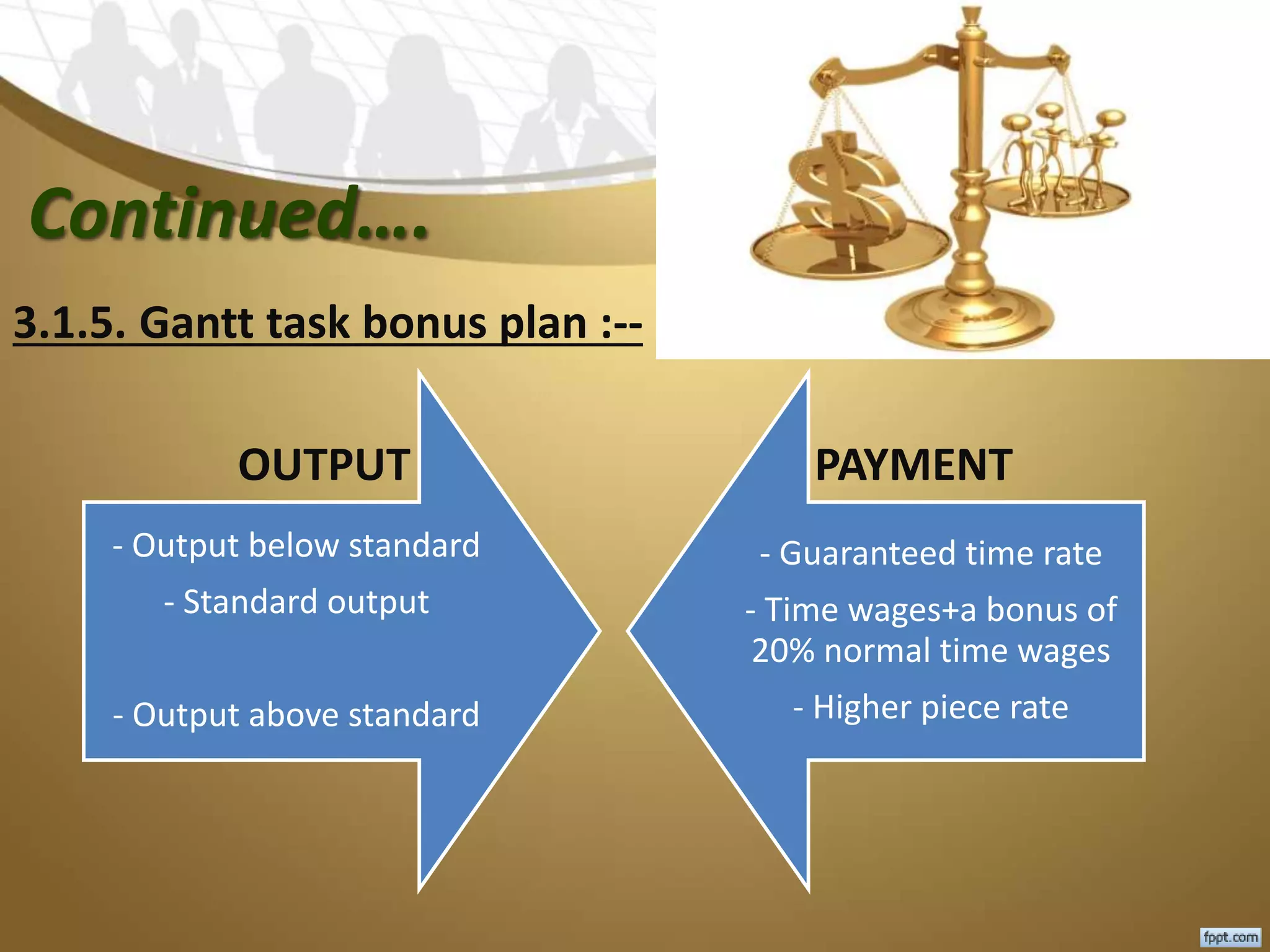
3.1.5. Gantt task bonus plan :--
OUTPUT PAYMENT
- Output below standard
- Standard output
- Output above standard
- Guaranteed time rate
- Time wages+a bonus of
20% normal time wages
- Higher piece rate
Continued….
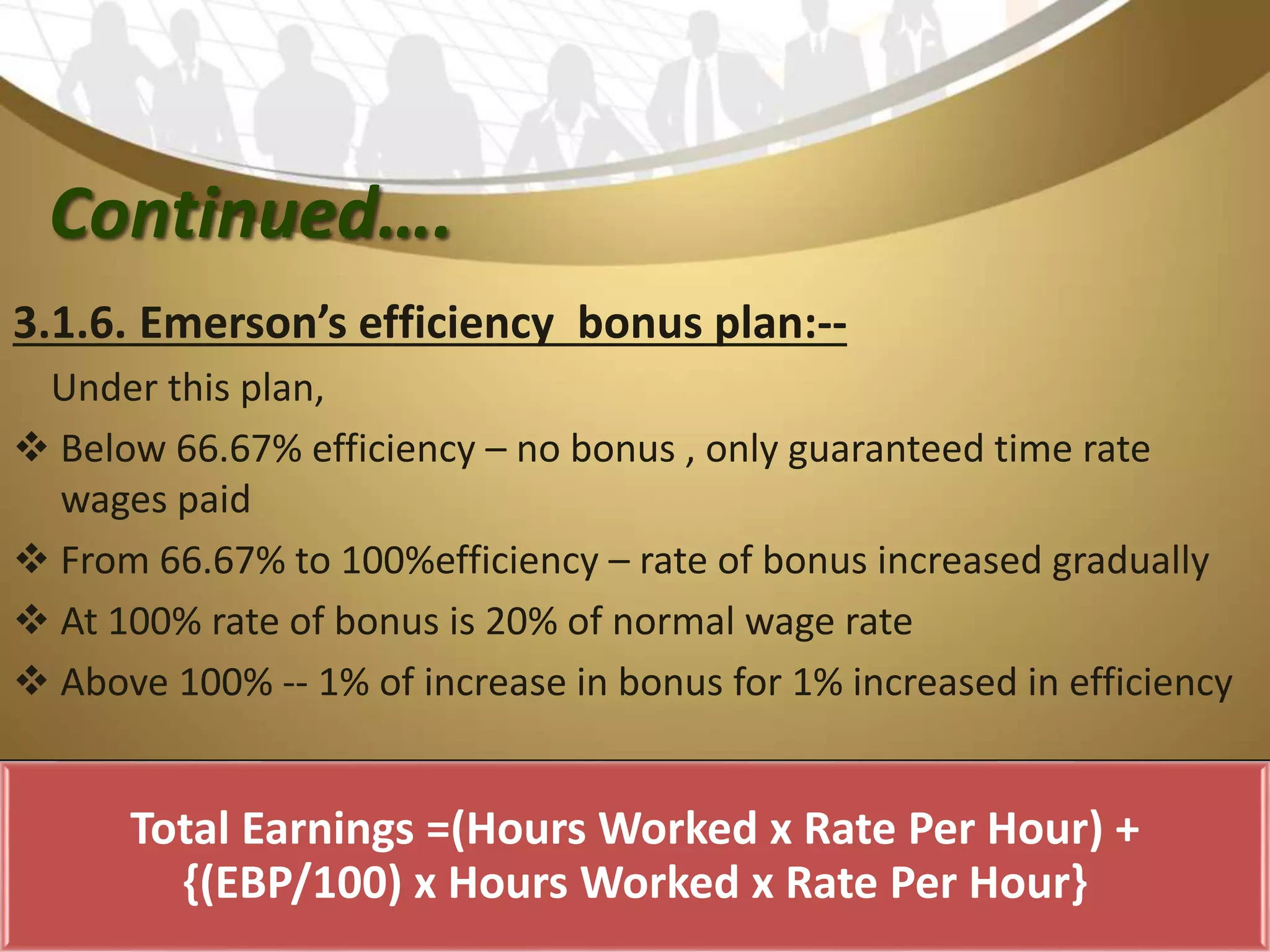
3.1.6. Emerson’s efficiency bonus plan:--
Under this plan,
 Below 66.67% efficiency – no bonus , only guaranteed time rate
wages paid
 From 66.67% to 100%efficiency – rate of bonus increased gradually
 At 100% rate of bonus is 20% of normal wage rate
 Above 100% -- 1% of increase in bonus for 1% increased in efficiency
Total Earnings =(Hours Worked x Rate Per Hour) +
{(EBP/100) x Hours Worked x Rate Per Hour}
Continued….
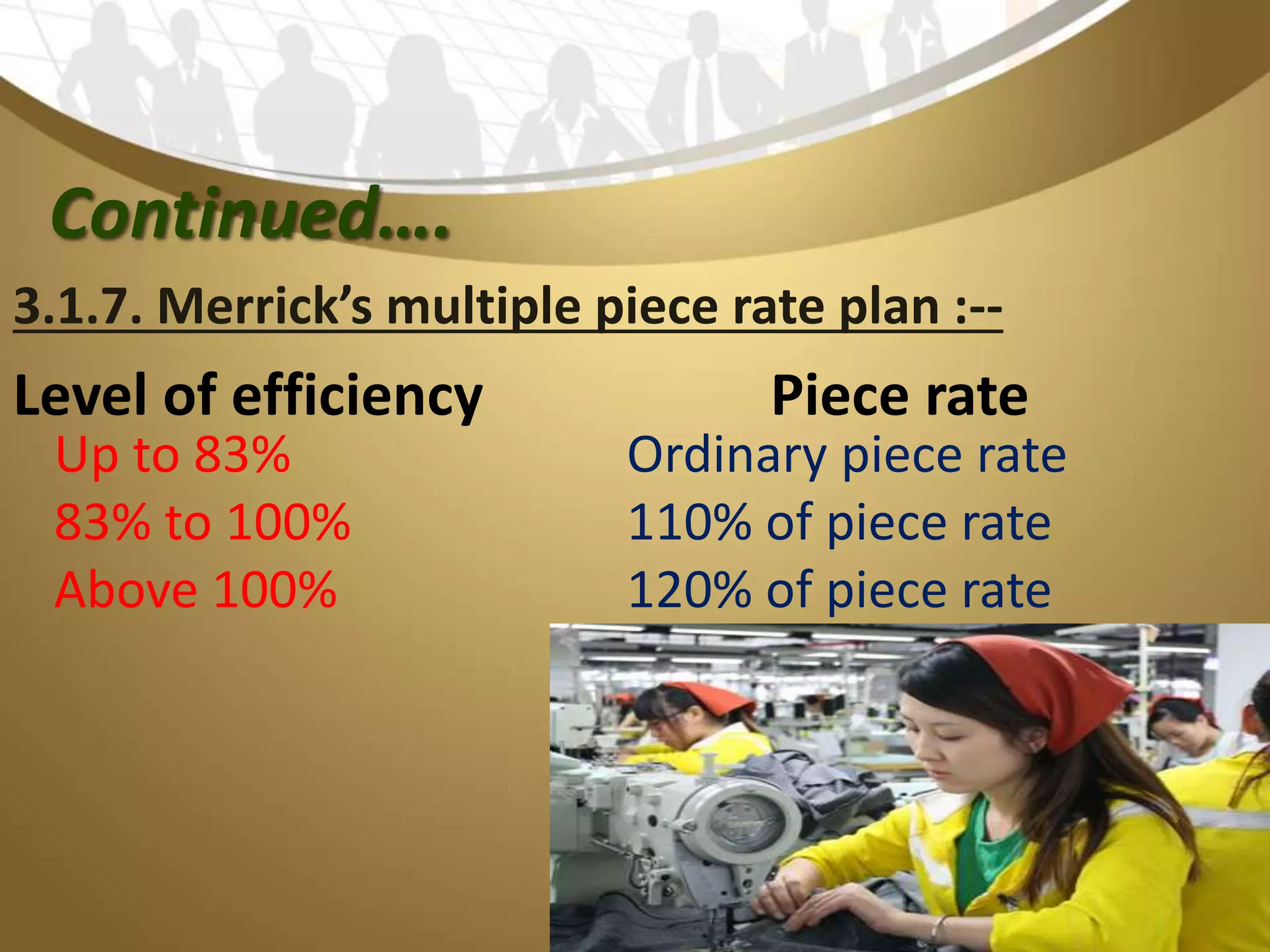
3.1.7. Merrick’s multiple piece rate plan :--
Level of efficiency Piece rate
Up to 83%
83% to 100%
Above 100%
Ordinary piece rate
110% of piece rate
120% of piece rate
Continued….
3.1.8. Bedeaux point premium plan :--
Under this plan, Standard time is divided into Standard
minutes. Each minute of standard time is called Bedeaux
point or B's. B's are indicated on each job ticket. Time
wages are paid until 100% efficiency is reached. Bonus is
paid on the basis of number of Bedeaux Points saved.
Bonus at 75% of wages of Bedeaux saved is paid to the
worker and 25% is paid to the foreman.
Total Earnings =(Hours Worked x Rate Per Hour) + 75%
{(Bedeaux point saved/60) x Rate Per Hour}
Continued….
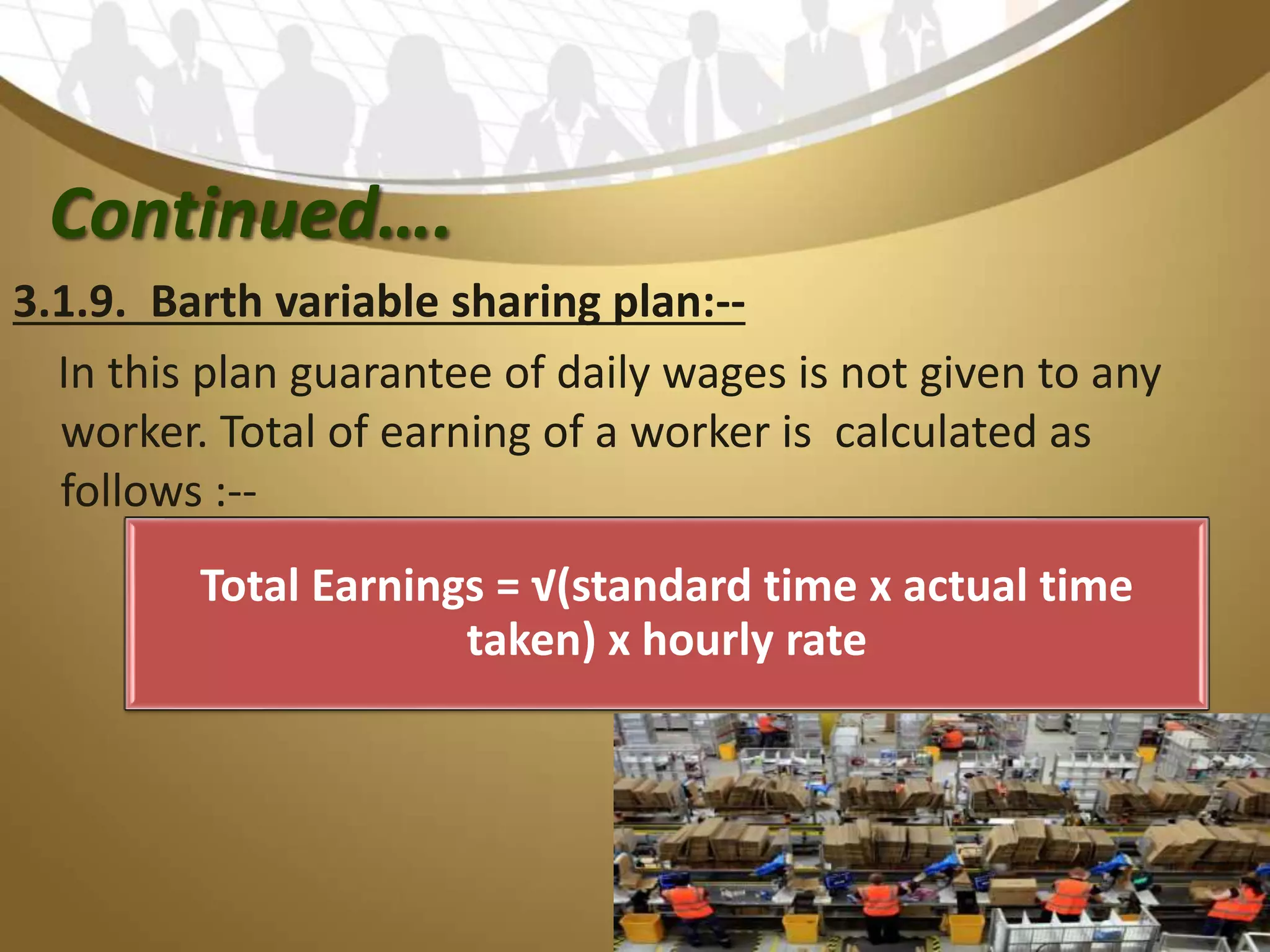
3.1.9. Barth variable sharing plan:--
In this plan guarantee of daily wages is not given to any
worker. Total of earning of a worker is calculated as
follows :--
Total Earnings = √(standard time x actual time
taken) x hourly rate
3.2. Group Bonus Plans
1. Priestiman’s Production Bonus Plan
2. Scanlon Plan
3. Towne Plan
4. Profit Sharing And Co-partnership Schemes
Continued….
3.2. 1. Priestiman’s Production Bonus Plan:--
A standard performance in terms of output or point is fixed
by this scheme. The workers as a whole, becomes entitled
to bonus, if by producing output above the standard output
, or by securing points more than the standard points, they
can be account for better performance. On the basis of the
ratio of excess performance to standard performance,
bonus is paid according to this scheme. Obviously, time
wage is guaranteed under this scheme.
Bonus = (Increase in production/ standard
production) x 100
Continued….
3.2.2. SCANLON PLAN:--
Under this plan , bonus is paid at a constant proportion of the
added value of output to the workers who are responsible for
the increase in value.
3.2.3. TOWNE PLAN:--
The main objective of this plan is to encourage the foreman and
workers to reduce the cost. A standard labour cost per unit is
fixed for a particular period and if actual labour cost is less than
the standard labour cost, 50% 0f the total saving in labour is
divided among the workers and foreman in ratios of their
wages.
Continued….
3.2.4. Profit Sharing And Co-partnership Schemes:--
The purpose of introducing these schemes is to strengthen
the loyalty of employees to the firm. Workers can be given
their share of profits in the form of cash or shares in the
company. If a part of profit is paid in cash , it is known as
profit sharing and if a part of profit is paid ion the form of
shares , it is known as co-partnership.
labour cost control

labour cost control

  • 1.
  • 2.
    I N T R O D U C TI O N Human efforts usedfor conversion of materials into finished products or doing various jobs in the business are known as labour. Payment made towards the labour is called labour cost. Labour cost is the significant element of the total cost of production.
  • 3.
    LABOUR Labour is themost perishable commodity and as such should be effectively utilized immediately. Therefore, efficient and effective utilization of labour is an important need of the modern business.
  • 4.
  • 5.
    2.INDIRECT LABOUR:- Indirect labouris that labour which is not directly engaged in the production of goods and services but which indirectly helps the direct labour engaged in production. Such as … watchman, foreman, gardener, cleaners, etc. 1.DIRECT LABOUR:- Direct labour is the labour which is directly engaged in the production of goods and services. Such as … worker on machine, shoemaker making shoes, etc.
  • 6.
    LABOURCOST “Labour Cost, representingthe human contribution to production, is an important cost factor which requires constant control, measurement and analysis.” MATZ, CURRY & FRANK
  • 7.
    The Manager’s Thought LABOURCOST IS.. Prime cost of concern for the HRD Important part of production process Decides price of product
  • 8.
    CONTROL OVER LABOURCOST Labour cost control aims at the control of the labour cost per unit of the production. Control of labour cost is an important objective of management. For labour cost control, following factors kept into mind….. 1. Appointment & selection of employees 2. Labour records 3. Control over production methods 4. Control over arrival & departure time of the employees 5. Labour cost analysis 6. Determination & payment of wages
  • 9.
  • 10.
    1. Personnel Department Themain function of the personnel department are recruitment and selection of workers, providing them training and placing them to the jobs they are best fitted.
  • 11.
    2. Engineering Department Thisdepartment maintains control over the production method and working condition for each job, department or process.
  • 12.
    3. Time-Keeping Department Timekeeping means recording the arrival and departure time of each worker. Time record is divided into two parts :- 1. Time Keeping 2. Time Booking
  • 13.
    4. Pay rolldepartment The payroll department is responsible for making payment of wages or salary to each employee. It maintains all the functions related to the wages and salaries of the employees.
  • 14.
    5. Cost AccountingDepartment The cost accounting department is responsible for the collection and classification of all labour cost with the time cards , job cards , labour cost of various jobs , work orders , etc.
  • 15.
    LABOUR TURNOVER Labour turnoverdenotes the percentage change in labour force of an organization. High percentage of labour turnover denotes that labour is not stable. Labour turnover ratio is calculated by the following formula :- LTR= Replaced worker x 100 Total no. Of workers
  • 16.
    CAUSES OF LABOURTURNOVER 1.Personal Cause • Death • Ill health • Dislike for the job • Marriage of women workers • Retirement • Family problem 2.Unavoidable Cause • Due to insubordination • Due to lack of attention to duty • Due to immoral character • Due to accidents 3.Avoidable Causes • Lack of job security • Lack of proper training facilities • Lack of promotion opportunities • Lack of medical facilities
  • 17.
    Measurement Of LabourTurnover 1. Separation method :- L.T. = No. of employees left during a period x 100 Avg. No. of employees during a period 2. Replacement method :- L.T. = No. of workers replaced during a period x 100 Avg. No. of workers during a period 3. Flux method :- L.T. = No. of separations + No. of additions x 100 Avg. No. of employees during a period
  • 18.
  • 19.
    Continued…. 1. Time wagerate system :-- In this system the workers are paid on the basis of time spent in the factory irrespective of the amount of work done. The total earnings are calculated as………. ( TOTAL EARNINGS = Hours Worked x Rate Per Hour )
  • 20.
    Continued…. 2. Piece wagerate system :-- In this system , workers are paid on the basis of work done irrespective of time taken by the worker. Total earnings is calculated as…….. ( TOTAL EARNINGS = No. of units x Rate per unit )
  • 21.
    Continued…. 3. Incentive wagerate system :-- In incentive wage rate system each worker gets , not only wages at normal rate but also receives bonus or premium for his efficiency. This system induces the worker to produce more and earn more. There are two types of incentives plans as follows :-
  • 22.
    Continued…. 3.1. Individual BonusPlans :-- 1. Halsey Premium Plan 2. Halsey Weir Plan 3. Rowan Premium Plan 4. Taylor’s Differential Piece Rate Plan 5. Gantt Bonus Plan 6. Emerson’s Efficiency Plan 7. Merrick’s Multiple Piece Rate Plan 8. Bedeaux Point Premium Plan 9. Barth Variable Sharing Plan
  • 23.
    CONTINUED…. 3.1.1. Halsey premiumplan:-- • The worker is paid a %(30% to 90% but usually 50%) of the time saved over the standard rate per piece. • Standard time is fixed for each job/operation • If the labour completes at standard time or more he is given the standard price. • If time saved- wages given for actual hours saved as a bonus. Total Earnings = (Hours Worked x Rate Per Hour) + % (Time Saved x Rate Per Hour)
  • 24.
    Continued…. 3.1.2. Halsey weirplan :-- It is calculated as Halsey Premium Plan , the only difference is that the rate of premium or bonus is only 30% in place of 50%. Total Earnings = (Hours Worked x Rate Per Hour) + 30% (Time Saved x Rate Per Hour)
  • 25.
    Continued…. 3.1.3. Rowan premiumplan :-- • Wages are paid on time bases. • If worker takes standard time or more time he is paid for the actual time taken. • If worker takes less than the standard time , then he is paid a bonus. Total Earnings =(Hours Worked x Rate Per Hour) + {(Time Saved/Time Allowed) x Hours Worked x Rate Per Hour}
  • 26.
    Continued…. 3.1.4. Taylor’s differentialpiece rate system :-- This system was introduced by F. W. Taylor. The main features of this incentive plan are as follows: 1)Day wages are not guaranteed, i.e. it does not assure any minimum amount of wages to workers. 2)A standard time for each job is set very carefully after time and motion studies. 3)Two piece rates are set for each job- the lower rate and the higher rate. –The lower piece rate is payable where a worker takes a longer time than the standard time to complete the work. –Higher rate is payable when a worker completes the work within the standard time.
  • 27.
    Continued…. 3.1.5. Gantt taskbonus plan :-- OUTPUT PAYMENT - Output below standard - Standard output - Output above standard - Guaranteed time rate - Time wages+a bonus of 20% normal time wages - Higher piece rate
  • 28.
    Continued…. 3.1.6. Emerson’s efficiencybonus plan:-- Under this plan,  Below 66.67% efficiency – no bonus , only guaranteed time rate wages paid  From 66.67% to 100%efficiency – rate of bonus increased gradually  At 100% rate of bonus is 20% of normal wage rate  Above 100% -- 1% of increase in bonus for 1% increased in efficiency Total Earnings =(Hours Worked x Rate Per Hour) + {(EBP/100) x Hours Worked x Rate Per Hour}
  • 29.
    Continued…. 3.1.7. Merrick’s multiplepiece rate plan :-- Level of efficiency Piece rate Up to 83% 83% to 100% Above 100% Ordinary piece rate 110% of piece rate 120% of piece rate
  • 30.
    Continued…. 3.1.8. Bedeaux pointpremium plan :-- Under this plan, Standard time is divided into Standard minutes. Each minute of standard time is called Bedeaux point or B's. B's are indicated on each job ticket. Time wages are paid until 100% efficiency is reached. Bonus is paid on the basis of number of Bedeaux Points saved. Bonus at 75% of wages of Bedeaux saved is paid to the worker and 25% is paid to the foreman. Total Earnings =(Hours Worked x Rate Per Hour) + 75% {(Bedeaux point saved/60) x Rate Per Hour}
  • 31.
    Continued…. 3.1.9. Barth variablesharing plan:-- In this plan guarantee of daily wages is not given to any worker. Total of earning of a worker is calculated as follows :-- Total Earnings = √(standard time x actual time taken) x hourly rate
  • 32.
    3.2. Group BonusPlans 1. Priestiman’s Production Bonus Plan 2. Scanlon Plan 3. Towne Plan 4. Profit Sharing And Co-partnership Schemes
  • 33.
    Continued…. 3.2. 1. Priestiman’sProduction Bonus Plan:-- A standard performance in terms of output or point is fixed by this scheme. The workers as a whole, becomes entitled to bonus, if by producing output above the standard output , or by securing points more than the standard points, they can be account for better performance. On the basis of the ratio of excess performance to standard performance, bonus is paid according to this scheme. Obviously, time wage is guaranteed under this scheme. Bonus = (Increase in production/ standard production) x 100
  • 34.
    Continued…. 3.2.2. SCANLON PLAN:-- Underthis plan , bonus is paid at a constant proportion of the added value of output to the workers who are responsible for the increase in value. 3.2.3. TOWNE PLAN:-- The main objective of this plan is to encourage the foreman and workers to reduce the cost. A standard labour cost per unit is fixed for a particular period and if actual labour cost is less than the standard labour cost, 50% 0f the total saving in labour is divided among the workers and foreman in ratios of their wages.
  • 35.
    Continued…. 3.2.4. Profit SharingAnd Co-partnership Schemes:-- The purpose of introducing these schemes is to strengthen the loyalty of employees to the firm. Workers can be given their share of profits in the form of cash or shares in the company. If a part of profit is paid in cash , it is known as profit sharing and if a part of profit is paid ion the form of shares , it is known as co-partnership.